#
Bob Dylan
Dionysus as Rolling Stone
An Attempt to Understand Nietzsche with Rock Music
Dionysos als rolling stone
An Attempt to Understand Nietzsche with Rock Music

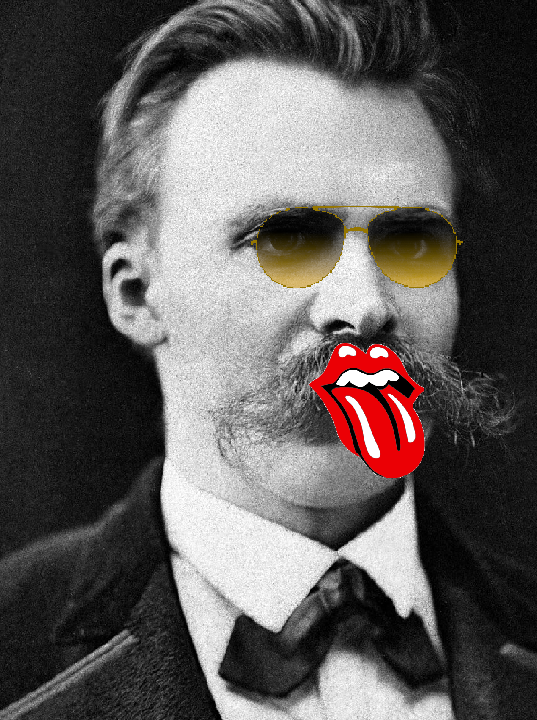
On the one hand, Nietzsche's distinction between the Apollonian and the Dionysian helps to understand the development of the rock music of the Rolling Stones both internally and externally. On the other hand, Nietzsche's philosophy is reflected in many places in their songs. But above all, it is also illuminated by the Stones, and their songs show what Nietzsche is thinking — an Apollonian act. If Nietzsche is aesthetically oriented towards intoxication, then you can also learn from the Stones how to receive Nietzsche's poetry in a Dionysian way. It is therefore not just about understanding the Stones with Nietzsche, but vice versa: with the Nietzsche Stones.
An audiovisual version of this article with clips of the quoted songs can be found on the YouTube channel of the Halcyonic Association for Radical Philosophy and on Soundcloud.
“Music, your advocate”
Nietzsche and the Liberating Power of Melody
“Music, your advocate”
Nietzsche and the Liberating Power of Melody


After Christian Saehrendt took a primarily biographical look at Nietzsche's relationship to music on this blog in June last year (link), Paul Stephan focuses in this article on Nietzsche's content statements about music and comes to a somewhat different conclusion: For Nietzsche, music has a liberating power through its subjectivating power. It affirms our sense of self and inspires us to resist repressive norms and morals. However, not all music can do that. With late Nietzsche, this is no longer Richard Wagner's opera, but Georges Bizet's opera carmen. Our author recognizes a similar attitude in Sartre's novel The disgust and in black popular music, which is not about comfort or grief, but affirmation and overcoming.
Age-Old Rage
The birth of Modernity out of the Spirit of Resentment
Age-Old Rage
The birth of Modernity out of the Spirit of Resentment


“Resentment” is one of the guiding concepts of Nietzsche's philosophy and perhaps even its most effective. In his new book The cold rage. Resentment theory and practice (Marburg 2024, Büchner-Verlag), Jürgen Grosse argues that since the 18th century, more or less all political or social movements have been those of resentment. Our main author Hans-Martin Schönherr-Mann has read it and presents major theses below.