Dionysus as Rolling Stone
An Attempt to Understand Nietzsche with Rock Music
Dionysos als rolling stone
An Attempt to Understand Nietzsche with Rock Music
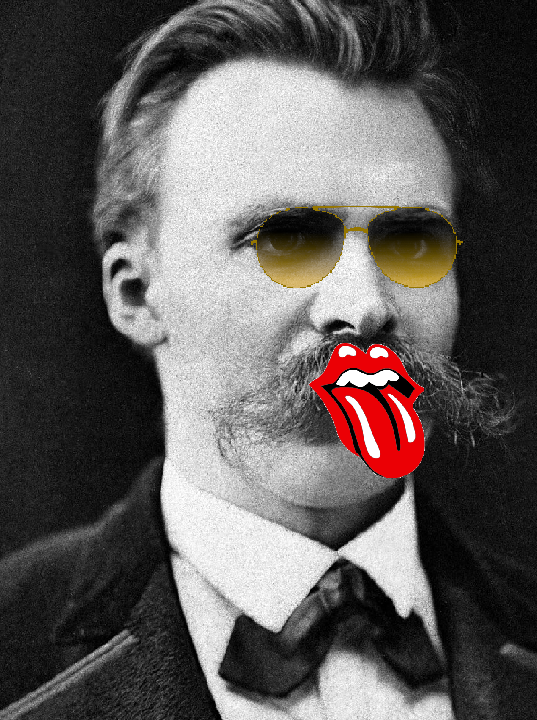
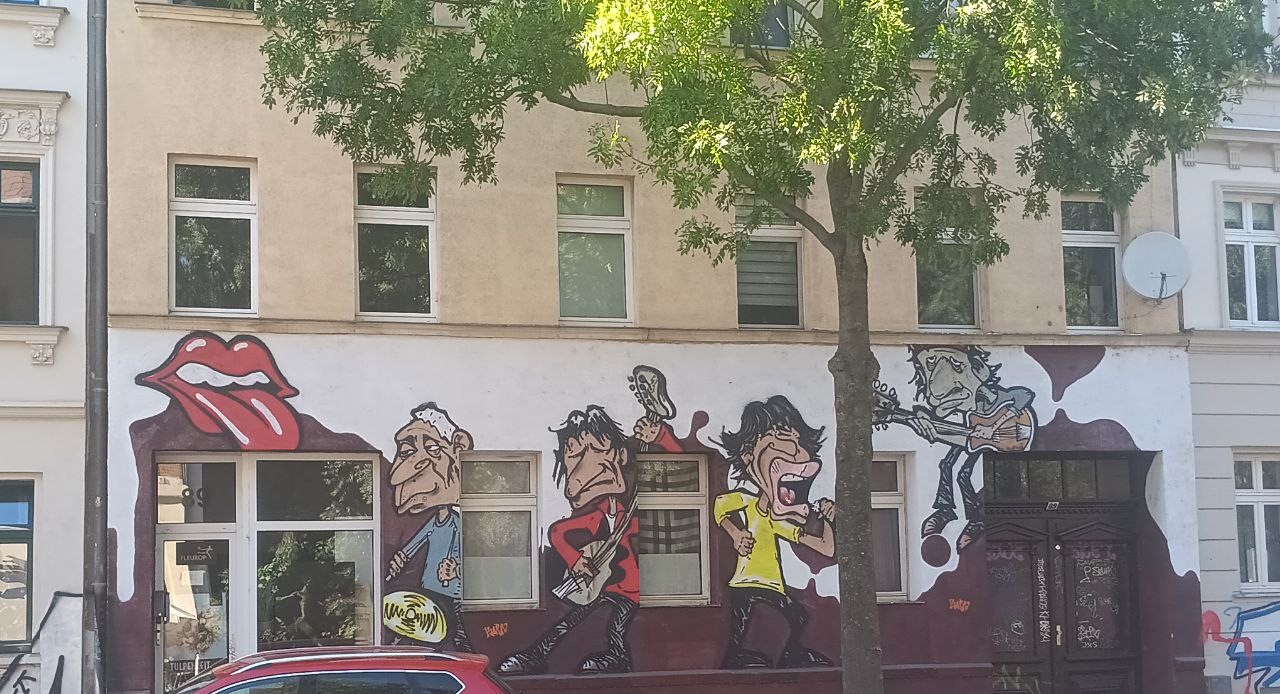
On the one hand, Nietzsche's distinction between the Apollonian and the Dionysian helps to understand the development of the rock music of the Rolling Stones both internally and externally. On the other hand, Nietzsche's philosophy is reflected in many places in their songs. But above all, it is also illuminated by the Stones, and their songs show what Nietzsche is thinking — an Apollonian act. If Nietzsche is aesthetically oriented towards intoxication, then you can also learn from the Stones how to receive Nietzsche's poetry in a Dionysian way. It is therefore not just about understanding the Stones with Nietzsche, but vice versa: with the Nietzsche Stones.
An audiovisual version of this article with clips of the quoted songs can be found on the YouTube channel of the Halcyonic Association for Radical Philosophy and on Soundcloud.
If you meet me, have some courtesy/Have some sympathy, and some taste. If you are unable to do so, the devil threatens to destroy your existence: Or I'll lay your soul to waste. — Sympathy for the Devil Compares Jochen Hörisch with the “best Schubert-Schumann-Mahler tradition of German art song”1.

1. The Devil and the Last Men
Who is this devil supposed to be? So Jagger sings: I Rode a Tank, Held a General's Rank/When the Blitzkrieg Raged. — According to Friedrich Kittler, the success of the Blitzkriege was based on VHF radio. Ergo: “All car radios that carried us to the sound of the Stones to their beloved Cote d'Azur have only adopted this Blitzkrieg trade secret. ”2 Did the devil pave the way for the Stones?
Who is this devil? Kurt Flasch explains his origins: It was not Judaism, not Islam, “it was the Christians who made him God's most powerful adversary. [...] [A] ber he also looked a hell of a lot like him. ”3
Nietzsche accuses Christians of this, while Buddhists do not need the devil: “[M] an had an overwhelming and terrible enemy — there was no need to be ashamed of suffering from such an enemy. ”4
Who is the devil? God's Helper for Flasch! An excuse for Nietzsche! In the middle of the song is the explanation: Who killed the Kennedys? When after all/It was you and me.
Who is the devil? The people who use the devil as an excuse in the sense of Nietzsche! According to Zarathustra, this would be “the last person to make everything small. ”5 Are we all devilsJust as every cop is a criminal?
The Stones implement Nietzsche's remark: “But the worst is the small thoughts. Truly better yet bad than thought! ”6
This is how the song on the LP reflects Beggars Banquet The restless spirit of 1968. The devil appears as a gentleman with manners: Please allow me to introduce myself/I'm a man of wealth and taste. Are the rich capitalists the devils?
Are the Stones on the side of the protesting youth? In the monarchy, such people were called “rabble.” Played, Nietzsche is appalled: “[I] ch once asked and almost choked on my question: How? Does life also need the rabble? ”7
Does the rabble also include dropouts or relegations? Bob Dylan narrates 1965 in the song Like a Rolling Stone from a socially smoked lady:
You used to laugh about
Everybody that was hanging out.
Now you don't talk so loud,
Now you don't seem so proud
About having to be scrounging your next meal.
This is how Dylan asks in the refrain:
How does it feel, how does it feel?
To be on your own, with no direction home
A complete unknown, like a Rolling Stone.
Men play a significant part in the descent of women:
You used to be so amused
At Napoleon in Rags and the Language That He Used
Go to him he calls you, you can't refuse
When You Ain't Got Nothing, You Got Nothing to Lose
You're invisible now, you've got no secrets to conceal.
The phrases of the lyrics require reflection like many of Dylan's songs, which inspire critical thought, less to sing along devotedly.
2. Bob Dylan's Apollonian Ballads or Dionysian “get louder” (Grace Slick)
Was this song too Apollinan for the Stones? In fact, Nietzsche distinguishes between two aesthetic forms, the Dionysian and the Apollonian. Apollo, as the god of the visual arts, uses art to comfort people in the face of their isolated existence. Nietzsche writes: “Apollo [.] shows us, with sublime gestures, how the whole world of torment is necessary so that it urges the individual to produce the redemptive vision.”8.
This is how Max Horkheimer and Theodor Adorno comment about Odysseus while driving past the Isle of Sirens: “The bound person attends a concert, listening motionlessly like the concert-goers later, and his enthusiastic call for liberation fades away as applause. ”9
The Stones played Like a Rolling Stone himself at various concerts and even together with Dylan, including at a concert in Buenos Aires in 1998, at which the audience sings along exuberantly, does not behave in an Apollinan way at all to reflect what is being sung to him, but in Dionysian.10 Dionysus, the god of intoxication, makes people forget their isolated existence. Nietzsche writes: “Under the magic of Dionysian, it is not only the bond between man and person that reunites. ”11
Herbert Marcuse, on the other hand: “The 'group' [...] is' totalitarian '[...]. It is true that the audience actively takes part in such a spectacle: the music moves their bodies make them 'natural'. But their (literally) electrical excitation often takes on hysterical features. ”12
Marcuse mocks at the comment made by Grace Slick from Jefferson Airplane: “Our constant goal in life, says Grace with a completely expressionless face, is to get louder. ”13
Of course, Marcuse could have learned from Arthur Danto that the Dionysian element of art is by no means irrational. So Danto 1965:
It would be too superficial to equate Nietzsche's pair of categories [Apollinian/Dionysian] with rationality and irrationality. In the end, dreaming is nothing more rational than dancing, and music [...] is also no less rational than poetry.14
The Stones included Dylan's song in 1972 Tumbling Dice towards a programmatic song: The rolling stone becomes a tumbling cube, also a social outsider:
Women think I'm tasty, but they're always tryin' to waste me
And make me burn the candle right down,
But baby, baby, I don't need no jewels in my crown.
Women want to retain the attractive man who was still able to talk his way out of financial and drug problems at that time:
Honey, got no money
I'm all sixes and sevens and nines.
Say now, baby, I'm the rank outsider
You can be my partner in crime.
Then she gets at least what Nietzsche writes:
She's got spirit now — how did she find him?
A man lost his mind as a result of her recently
His head was rich before this pastime:
His head went to hell — no! No to the woman!15
Jagger was a Homme des femmes, who embodied the male sexiness of that time like hardly anyone else and was accordingly idolized. Because he can only ever partially accept the far too many offers, he doesn't lose his mind: Baby, I can't stay, you got to roll me/And call me the tumblin' dice.
The infinitely repetitive Got to roll me, keep on rolling Reminds all the more of Like a Rolling Stone, thus to the name of the band, and various forms of outsider existence that the Stones themselves were in their beginnings and which they still continued in 2023 in Whole Wide World thematize:
When the whole wide world's against you
And you're standing in the rain,
When all your friends have let you down
And treat you with disdain.

3. Dionysian Farewell to Apollonian Reflection
In May 1965, the Stones released Satisfaction, which states:
When I'm watchin' my T.V.
And a man comes on to tell me
How white my shirts can be
But he can't be a man 'cause he doesn't smoke
The same cigarettes as me
I can't get no...
Even then, the Stones concealed their song lyrics in places in such a way that they appear confusing. The song critiques consumption in Apollonian terms.
When I'm Ridin' Round the World [..]
I'm tryin' to make some girl
Who tells me: “Baby better come back maybe next week,
“Cause you see, I'm on a losing streak.”
The sexual revolution of that time also included the refusal if the courted lady doesn't feel like it despite contraceptive pills, which, according to Hans Blumenberg, “are the only really significant change in human behavior in our century.”16 evokes.
On the other hand, rock concerts can be seen as a return to old traditions of Dionysian festivals. This is how Nietzsche writes:
From all ends of the ancient world [...] we can prove the existence of Dionysian festivals [...]. Almost everywhere, the center of these festivals was an exuberant sexual lack of discipline, the waves of which flooded every family home [.]17
In ancient times, people had a positive understanding of sexual pleasure, which is not devalued as a sin as in Christianity. According to Michel Foucault, negative is rather when “you remain passive in the face of your desires. ”18
The original song Satisfaction It sounds like Dylan's songs from 1965 as an Apollonian protest song. The Stones later transform the song to give it a Dionysian character that sweeps the audience away and lets them sing along, e.g. in concert Havana Moon 2016.19
Of course, there have been strong Dionysian tendencies since the early days of the Stones. This is how Jagger sings in 1967: Let's spend the night together now. And he says what it's about:
This doesn't happen to me every day, oh my,
No excuses offered anyway, oh my,
I'll satisfy your every need
And now I know you will satisfy me.
Oh come on now
Oh baby, my, my...
Yet prudery was widespread in the sixties. So you might think that Zarathustra's claim is still relevant as it was in 1967, when the US government thought it was winning the Vietnam War. So Zarathustra spoke:
That is how I want man and woman: warlike one, childbearing the other, but both ready to dance with head and legs. And let us lose the day when people never danced once!20
Rock music was also the music of the Vietnam War. Dancing and intoxication with hashish and LSD belong to war. Jagger had to admit in 1969: Now you can't (always get what you want), yeah,/And if you try sometimes, you just might find:/You get what you need.
You are not completely unsuccessful, as Camus notes: “Feel your rebellion [...] as strongly as possible — that means living as intensely as possible. ”21 The Stones everyday the famous nonetheless that Camus hurled at the Nazis. Resistance takes place on a small scale.
In a conflict of the sexes, you don't get what you want, but you get hurt. This is how Nietzsche makes Ariadne complain: “[M] an executioner god! ../No! /Come back! / With to all your torments! /[...] My pain! /My last luck! ”22 The Stones sing:
And I saw her today at the reception.
In her glass was a bleeding man.
She was practiced at the art of deception.
Well, I could tell by her blood-stained hands.
Nietzsche laments about George Sand: “The worst, of course, remains female coquetry with masculinities, with the manners of naughty boys. — How cold she must have been in all this, this obnoxious artist! ”23
Rock music, whether in front of the gramophone or in the arena, is comfort and distraction. This is how Nietzsche writes about Dionysian art: “[W] r are forced to look into the horrors of individual existence — and yet should not freeze. ”24 Or a bit simpler and yet highly Dionysian: You can't always get what you want.
Problems of having to express sexual innuendo discreetly disappeared largely in 1981 — but certainly only in the Western world. However, the Stones are popular almost all over the world and give concerts everywhere. This is how a double sense goes through Start Me Up. The beginning of the song sounds harmless: If you start me up,/I'll never stop. But suggestive words immediately follow: I've been running hot,/You got me ticking, now don't blow my top. The following line is unequivocal: You make a grown man cry.
The song culminates in the unequivocal sentence, which you could of course read innocently if the Stones didn't sometimes do half-naked gymnastics on stage: You, you make a dead man come.
Does this make Nietzsche's poem understandable:
”The world is deep
“And deeper than the day thought.
“Her pain is deep —
“Pleasure — even deeper than heartbreak:
“Woe says: Go away!
“But all pleasure wants eternity —
“— wants deep, deep eternity! ”25
However, pleasure comes from playing with displeasure. That is why, according to Vladimir Jankélévitch, ironic love follows the principle”A little of everything and not: Everything of one. ”26
Then receive comments in Start me up a non-technical sense: My eyes dilate, my lips go green,/My hands are greasy, she's a mean, mean machine.
Is that discriminatory? If you understand it innocently, not if you read it suggestively. This is how Nietzsche can be interpreted:
For there to be art, [...] a physiological precondition is unavoidable: intoxication. The intoxication must first have increased the excitability of the entire machine: sooner there will be no art. All [..] Types of intoxication have the power to do so: in particular the intoxication of sexual stimulation [.]27
4. Sweet Sound of Heaven “beyond good and evil”
Have the Stones turned away from Dionysian in recent years? This is how the gospel-like begins Sweet Sound of Heaven from 2023 with: Bless the Father, Bless the Son.
But it's hard to blame the Stones for what Nietzsche complains about:
[T] he artists of all time [.] are the glorifies of the religious and philosophical errors of humanity, and they could not have been so without believing in the absolute truth of them [.]28
In fact, you will hardly find any absolute truths in the Stones' songs. Dionysian is relativism. The Apollinan in art tends towards immutable truths. But Jagger sings:
No, I'm not, not goin' to Hell
In Some Dusty Motel [.]
I'm gonna laugh, [..], I'm gonna cry.
Eat the bread, drink the wine
'Cause I'm finally, finally Quenchin'
My thirst, yeah.
And what do the Stones want? I want to be drenched in the rain of your heavenly love.
It sounds hyper-erotic, almost pornographic. And not humble at all, but sinful:
And we all feel the heat
Of the sun,
Let us sing, let us shout
Let us all stand up proud
Let the old still believe
That they're young.
For pride or pride is the highest Christian mortal sin.
Even Nietzsche's poem Sils-Maria doubts self-evident things:
I sat here, waiting, waiting, but for nothing
Beyond good and evil, soon of light
Enjoying, soon the shadow, just playing,
All lake, all noon, all time without a destination.
There, suddenly, girlfriend! became one to two —
— And Zarathustra passed me by.29
Rock music had Dionysian features right from the start, but it also still had an Apollonian character, which was increasingly lost with the Stones over the decades. It is more and more about intoxication, not about reflection. Where this still persists in the texts, it is more due to the ambiguity, which is becoming increasingly superfluous to reflect on Dionysically, as in Nietzsche Sils-Mariawhen you refrain from reflecting it and enjoy it as a kind of rock 'n' roll.
Article image
The Stones on a Leipzig house wall on Wurzener Straße, painted by an unknown artist, photographed by Paul Stephan, who passes by here almost every day.
Literature
Adorno, Theodor W. & Max Horkheimer: Dialectic of Enlightenment (1944), Frankfurt am Main 1971.
Blumenberg, Hans: Description of the person. From the estate. Frankfurt am Main 2006.
Camus, Albert: The myth of Sisyphus (1942). Hamburg 1959.
Danto, Arthur C.: Nietzsche as a philosopher (1965). Munich 1998.
Flasch, Kurt: The devil and his angels. The new biography. Munich 2015.
Foucault, Michel: The use of delights. Sexuality and Truth 2 (1984), Frankfurt a.M. 1989.
That's right, Jochen: A Man Of Wealth And Taste. Jaggers Lucifer meets Goethe's Mephisto. In: Albert Kümmel-Schnur (ed.): Sympathy for the Devil. Munich 2009.
Jankélévitch, Vladimir: The irony (1964). Berlin 2012.
Kittler, Friedrich: When The Blitzkrieg Raged. In: Albert Kümmel-Schnur (ed.): Sympathy for the Devil. Munich 2009.
Marcuse, Herbert: Counterrevolution and revolt (1972). Frankfurt am Main 1973.
Footnotes
1: A Man of Wealth and Taste, P. 29.
2: When The Blitzkrieg Raged, P. 139.
3: The devil and his angels, P. 77.
5: So Zarathustra spoke, Preface, paragraph 4.
6: So Zarathustra spoke, From the compassionate.
7: So Zarathustra spoke, From the rabble.
8:The birth of tragedy, paragraph 4.
9: Dialectic of Enlightenment, P. 34.
10: Cf. this recording of the concert on YouTube. The Stones appeared five times in a row in Buenos Aires in short succession and reached a total of 272,000 spectators. They made a concert film from the recording of the last of these concerts.
11: The birth of tragedy, paragraph 1.
12: Counterrevolution and revolt, P. 135.
13: Ibid., p. 135, footnote.
14: Nietzsche as a philosopher, P. 66.
15: The happy science, prelude, No. 50.
16:Description of the person, P. 479.
17: The birth of tragedy, Paragraph 2.
18: The use of delights, P. 35.
19: Cf. this recording of the concert on YouTube. The concert in the capital of Cuba, which was celebrated on Good Friday despite the Vatican's intervention, was attended by 500,000 enthusiastic fans and was recorded as a movie.
20: So Zarathustra spoke, From old and new boards, paragraph 23.
21: The myth of Sisyphus, P. 56.
22:Dionysus Dithyrambi, Ariadne's Lament.
23: Götzen-Dämmerung, rambles, paragraph 6.
24: The birth of tragedy, paragraph 17.
25: So Zarathustra spoke, The Nightwalker Song, paragraph 12.
26: The irony, P. 35.
27: Götzen-Dämmerung, rambles, Aph 8.