Nietzsche’s Techniques of Philosophizing
With Glances Towards Wittgenstein and Heidegger
Nietzsche’s Techniques of Philosophizing
With Glances Towards Wittgenstein and Heidegger
A fixed feature at the annual conference of the Nietzsche Gesellschaft [Nietzsche Society] conference is the Lectio Nietzscheana Naumburgensis: a particularly distinguished scholar delivering an extended lecture on the conference theme on the final day, thereby providing a pointed conclusion. The most recent conference in October 2025 awarded this special honor to Werner Stegmaier to recognize his long tenure as editor of the influential Nietzsche-Studien [Nietzsche Studies] and his authorship of numerous seminal monographs on Nietzsche’s philosophy. Running from October 16-19, 2025, the conference focused the theme “Nietzsche’s Technologies,” as Emma Schunack reported.
Generously granting his permission to publish his lecture in full and in this translation, Stegmaier takes on the conference theme from an unexpected perspective. Rather than examining what is commonly understood as “technologies”—machines, cyborgs, or automata—he explores instead Nietzsche’s philosophical techniques, both intellectual and rhetorical. Weighing up the original and idiosyncratic methods Nietzsche deployed while writing, Stegmaier reflects on how best to interpret and assess them. How were they able to enthuse and win over successive generations of readers? What can we learn from these today?
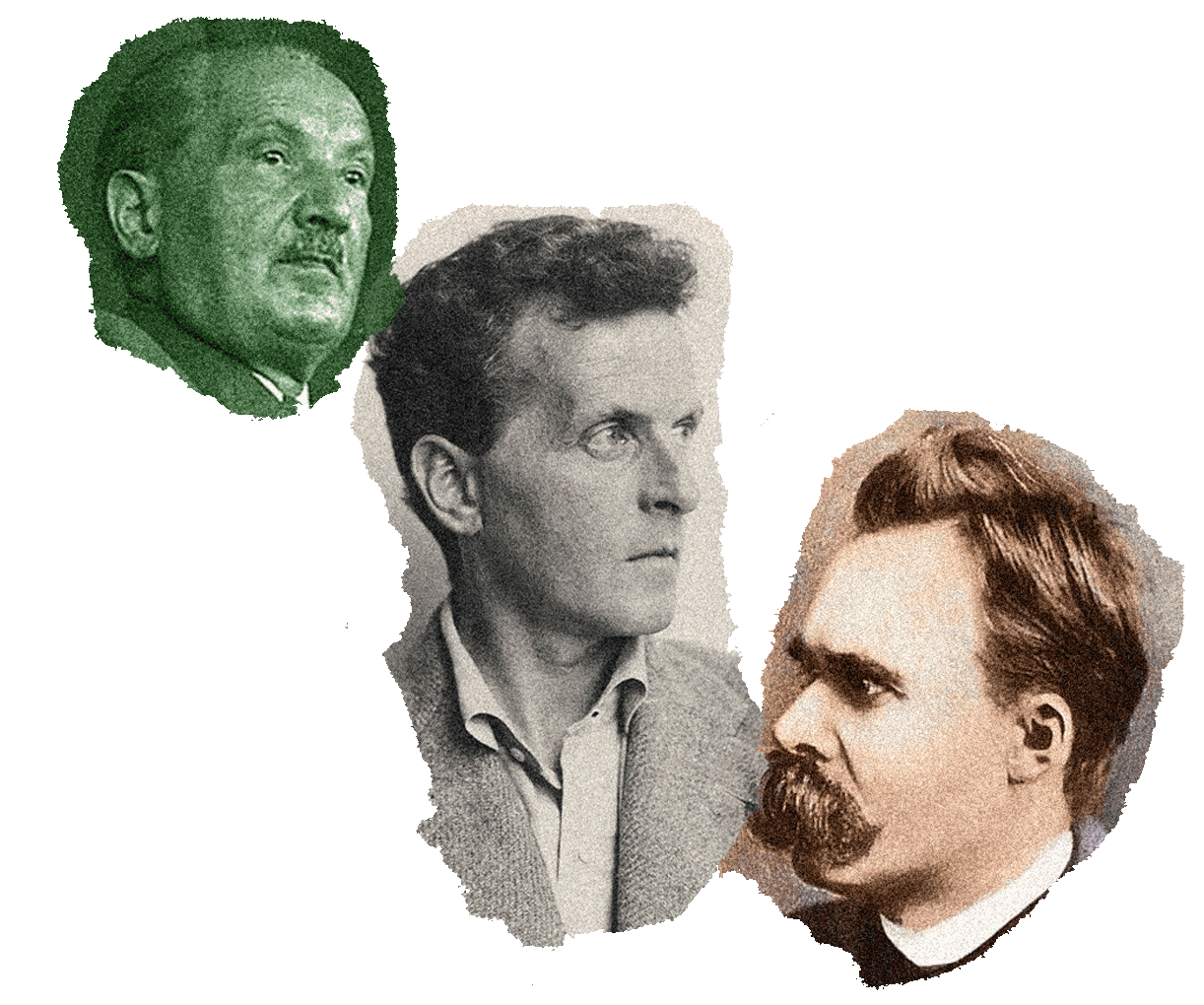
Comparing Nietzsche’s techniques with those of two other modern philosophical giants, Martin Heidegger (1889–1976) and Ludwig Wittgenstein (1889–1951), Stegmaier retraces all three philosophers’ break with the classical and conceptually oriented techniques of thinking inherited from antiquity, and their discoveries of radical and experimental means of developing philosophy in the age of “nihilism.” Replacing a one-dimensional, metaphysical understanding of rationality, these means cultivate a plural, perspectival mode of thought that necessarily relies on entirely different techniques. Situating Nietzsche’s methods within these broader developments in intellectual history, the Lectio establishes an utterly new framework for understanding his thought and its place within modern philosophy.
Translated by Henry Holland.
I. Nietzsche’s Philosophizing Techniques Continue to Fascinate
Nietzsche recounts how his great adversary, Socrates, had “fascinated”—in our twenty-first century argot we might say bewitched—the noble Athenians with his dialectical method. With it, he claims, Socrates had a “ruthless instrument to hand,” one by means of which he “depotentiated” his opponents’ intellect.1 For Nietzsche, dialectics, and with it the West’s whole rationalist tradition, was a technique [Technik] for producing a semblance of truth.1.5 A note of Nietzsche’s from 1880 recorded the general conviction had taken hold “that we do not possess the truth”:2 a condition he would later call nihilism. After a long struggle to understand the meaning and import of this state of affairs, he finally came to recognize in it the “normal condition” in which we live once again now that metaphysics has left us:3 A condition in which what metaphysics, together with the Christian dogmatics that followed it, had elevated to supreme values loses its credibility. After grasping that there were no longer any absolute certainties, Nietzsche consistently de-metaphysicized and emptied the morality out of the language of philosophy, so we might achieve a new “deepening into reality.”4 Only hesitantly do we begin to fathom these new depths, as we’re still strongly bound to metaphysical–moral idealizations.
As is only fully clear today, Nietzsche did not construct a new “system.” The very “will to [create] a system is a lack of moral fiber,” as he memorably put it.5 Instead, one of Nietzsche’s favorite techniques was to place doctrines in the mouth of his best known protagonist, Zarathustra, which—especially since Heidegger—were later taken to form the core of such a system: the doctrines of the overhuman [Übermensch],5.5 the will to power, and the eternal recurrence of the same. Yet we cannot forget that Nietzsche let his anti-hero fail with these same doctrines at every turn. No one understands them as he intends: not the ordinary people, not his disciples, not his animals, not even the group he calls “the higher humans.” Ultimately, Zarathustra is left moving alone toward a sign meant only for him. Under his own name, by contrast, Nietzsche introduces the concept of the will to power in Beyond Good and Evil (aph. 36) as a mere hypothesis and as a means of being thrifty with principles: as a means of giving the simplest and easy overview of the entire reality. Such a world, “seen from inside,” would be “‘will to power’ and nothing besides.” As the now completed edition of the late-career part of Nietzsche’s posthumously-published papers [Nachlass] demonstrates, Nietzsche’s initially worked at this textural juncture with the hypothesis of the eternal recurrence of the same, inserting the will to power in its place only later.6 These two hypotheses evidently appeared to him functionally equivalent for the radical reorientation of philosophy demanded by nihilism. They are not dogmas but rather stores in his technique-arsenal for philosophizing.
And they weren’t treated as dogmas either in later philosophies. There was no Nietzsche School comparable to the Hegelian, and later the Kantian schools of the nineteenth century. Meanwhile, Nietzsche scholars have learnt to stop fixing his thought to clear-cut doctrines and to follow, rather, his process of orientation in all its facets, and with all its hesitations and turns—to observe Nietzsche at work.7 Doing this, we may try to learn how one might orient oneself even amid a state of nihilism, under nihilistic conditions, and how, while traversing this path, one might gain readers for this topic across the world. Keeping faith with this congress’s theme, I thus pursue Nietzsche’s techniques of philosophizing to better understand how, from within the prevailing nihilistic condition, he achieved an orientational security that continues to fascinate.
To avoid fixing too exclusively on Nietzsche, I also glance sideways at Heidegger’s and Wittgenstein’s philosophizing, the two most innovative twentieth-century figures to pursue this artful craft. Both born in 1889, the year Nietzsche collapsed into madness, Wittgenstein noticed Nietzsche, but from quite some distance. Heidegger, by contrast, put him on the pedestal of being a major opponent, against whom he could define his own “other beginning.”8 Yet both accomplished something rare and remarkable—something Nietzsche would have called self-overcoming. They subverted the foundations of the philosophies that had made them world famous in the first place. Wittgenstein came to recognize in the Tractatus Logico-Philosophicus— by which he initially believed to have attained the “unassailable and definitive” truth that would resolve the philosophical problems—a doctrine that could not be sustained; Heidegger came to see in Being and Time a wrong turning in the path towards the “meaning of being.” Both thus refocused towards the issue of the techniques of philosophizing: to the ways in which philosophy has been led, hitherto, into doctrines, and to the means by which it can throw off these doctrinal chains. Like Nietzsche before them, they now spoke emphatically of their philosophizing rather than of their philosophy. They, too, set aside inherited standards and created radically new ones. And like Nietzsche, they embarked on this adventure without a preconceived plan, exposing themselves intentionally to surprises even in their own thinking. Neither of them arrived at a goal; both ended up only at a provisional end. And yet it was through these very technique-based operations that they enacted their most efficacious philosophy.9
II. Mastering the Most General of Concepts, or: The Technique of Philosophizing
Techniques are nothing that one holds to be true; we judge them, instead, solely by their functioning, by their success or failure. Neither technique should be generally suspected of being a kind of metaphysics, as the later Heidegger suggested. Moreover, it’s more than merely the mechanical technology that Nietzsche liked to use—typewriters, trains, etc.—and which the engineering student Wittgenstein devoted himself to so intensively that he arrived via mathematics at philosophy. Techniques also include, for both Nietzsche and Wittgenstein, ways to compose and make music, means of writing poetry—and thus also techniques for and of philosophizing. According to Nietzsche, Greek tragic poets knew how to learn the same from one another;10 techniques can be acquired in education;11 and Richard Wagner “profoundly overcame all scholarliness, transforming it into instinctive technique.”12 Nietzsche also speaks of techniques of commerce and hunting,13 and of linguistic expression.14 Summarizing matters in late 1887, he posits “the natural sciences’ great technique and inventiveness” as a tremendous bulwark against the “moralizing of all previous philosophy {and appreciation}”; against Christian idealization “(e.g., {in music}, in socialism)”; against Rousseau’s “hatred of aristocratic culture”; against a “false and derivative form of superior humanity” stemming from Romanticism; and finally against the “hatred” of “all forms of rank order and distance.”15 Indeed, and on this view, all that “{which is born {relatively} out of abundance}—in the 19th century with contentment is … technique.” Moreover, and alongside “{cheerful music, etc.},” and perhaps also “{history (?)},” such technique is a “{relative product of the 19th cent.[ury]’s strength and self-confidence}.” It lends our language a new security of orientation, making nihilism bearable. By contrast, as Nietzsche writes in The Anti-Christ (chapter 44), Christianity makes a “technique” of its “art of lying sacredly” developing it to the point of “ultimate mastery.”15.5
In this sense, techniques need not be conscious practices. On the contrary, when we become conscious of them, for example while someone’s playing the piano or carrying out a simple movement process such as walking, they can—through this “making conscious”—such techniques can even be disturbed, as Heinrich von Kleist described in his famous essay On the Marionette Theater. Comparably, Nietzsche reflected on how we generally write only poorly about our own techniques.16 They are learned through trial and practiced in action until we can eventually “do them,” without having to explain why. They can be learned by observing others but cannot be easily taught, as aptitudes for them differ hugely. In any case, they must be “skilled,” and philosophizing must be skilled in this sense. Whether it is in fact practiced skillfully is best judged, as with any craft, by practitioners themselves.
The later Wittgenstein noted privately: “We go through common or garden movements of thoughts, automatically transitioning from one thought to the other based on the techniques we’ve learned. And now we have to first review what we have said.”17 The later Heidegger also emphasizes that the “craft of thought” must be learned and practiced.18 This leads onto a “technical” concept of philosophy itself: no longer determined by preconditioned issues including world and truth, or being and time, but apprehended rather as a skilled handling of the most general concepts of this kind. And we’ll now look at what this skill genuinely involves, by taking the examples of Nietzsche, Wittgenstein, and Heidegger.
III. Nietzsche’s Techniques of Philosophizing
A. Nietzsche’s Techniques as Responses to Specific Problems
Regarding Nietzsche’s characterization of Socrates’ “magic of the extreme,” I have already demonstrated how Nietzsche, proceeding down the trails of his own work, responded to particular problems confronting him with specific techniques for their resolution.19 I found seven such techniques:
First, in The Birth of Tragedy, he responded to the problem of the “theoretical human,” which he alleged Socrates had created, with the technique of embedding this figure within a radically reinterpreted Greek culture;
Second, in Human, All Too Human, he responded to the problem of the earth’s overall governance with the technique of comparing cultures in an “age of comparison” (vol. I, aph. 23);
Third, in Daybreak, he responded to the problem of Europe’s self-misrecognition of its morality with the technique of a moral critique of morality, from which On the Genealogy of Morality later emerged;
Fourth, in The Joyful Science,19.5a he responded to the problem of nihilism with the technique of a fundamental reorientation of philosophizing through incorporating art into it;
Fifth, in Beyond Good and Evil, he responded to the problem of the will to truth—which persists even once one knows that truth cannot be possessed—with the technique of expanding the horizons of human orientation (all the “human’s basic drives” have “once practiced philosophy” [aphorism 6]);19.5b
Sixth, in Book V of The Joyful Science, he responded to the problem of rank order—which also encompasses the right to problems—in an era of unstoppable democratization with the technique of shifting from equalities to differences;20
Seventh, in Twilight of the Idols and the final works prepared for publication, he responded to the “problem of the value of life as such” (“Morality as Anti-Nature,” 5) with the technique of affirming everything that happens, or of liberation from ressentiment.21
All of these techniques—embedding, comparison, self-referential critique, incorporation of art, expansion of horizons, breaking with habitual equations, and affirmation of what is given—expand the scope of Nietzsche’s philosophizing while at the same time giving it their own foothold. In this sense, they are techniques of orientation.22 We always orient ourselves towards something without thereby committing ourselves to that thing irrecoverably, and Nietzsche’s philosophical orientations are themselves marked by their questionability and provisionality. He turns the truth that one “cannot have” into a part of the game, the “rendezvous […] of questions and question marks”23 that experience routinely reveals itself to be. Philosophizing, understood as the skillful handling of the most general of concepts, accordingly becomes a permanently evolving technique of orienting oneself in the world. It involves vigilant and constant self-critique, or, to put it in Nietzsche’s words, ceaseless “self-overcoming.”
These techniques are also valid to describe the ways in which Wittgenstein and Heidegger worked: to an extent. But to make our core argument more explicit still, we shall first look at
B. Nietzsche’s Techniques of Philosophizing as Such
Again, I name seven techniques. We must see how far we are willing—and able—to follow them up today.
1. Radically Destroying Dogmatic Truths – Toward Nihilism
Nietzsche, and similarly Wittgenstein and Heidegger in their late periods, consistently destroy what they see as the dogmatic truths of nearly all previous philosophy: except those of Heraclitus. A new departure in philosophy is hardly possible without clearing out old junk. Yet more than just a crude throwing out, one could, and following the literal sense of the Latin destruere, merely dismantle this inheritance “layer by layer”: aware that the inheritance could still guide thought. This means that all these three figures no longer approach destruction as systematically as Hegel did, but rather strike selectively where traditional doctrines seem to obscure philosophical reorientation, usually setting their sights at figures including Socrates, Plato, Aristotle, Augustine, Descartes, Spinoza, Kant, and Hegel. Yet it is not individuals but standards of philosophizing that have become seemingly self-evident that they attack, encompassing logic with its principle of non-contradiction, or the epistemological isolation of faculties like sensibility, understanding, feeling, and the will. All three of them accept logical paradoxes and rely actively on them. Nietzsche for instance embraces the certainty of uncertainty;24 untruth as a basic condition for life;25 the teaching of unteachable things (cf. the entire Zarathustra), the communicating of the incommunicable,26 and the acceptance of the inacceptable (amor fati).27 For his part, Wittgenstein works with paradoxes in the play with rules within rules-based language games, while Heidegger focusses on the incomprehensibility of the all-decisive Being [Sein] writing it down with a strange “y” as “Seyn” and crossing it out at the same time.27.5 By that, they all follow Heraclitus, who clung to time, which has no permanence, Socrates, who knew that he knew nothing, and Plato, who wrote that he would never write down doctrines. Surpassing this, Nietzsche attacks morally the apparently untouchable morality insofar as it forces philosophy into telling lies: heedless of its own intrinsic deceitfulness.
Gained from what Heidegger explicitly calls a technique of destruction is an emancipatory release, from which to stretch for new footholds and horizons, paths and modes, standards and dispositions for philosophizing beyond system boundaries.28 This, for Nietzsche, includes bodily functions, drives, instincts, moods, and rhythms, phenomena he sums up as the “music of life,”29 an orientation toward other cultures and languages, the deceptions and self-deceptions necessary to stay alive, and a solemn seriousness of playing with everything in philosophizing. The later Wittgenstein achieves, through the destruction of the one-dimensional Augustinian image of language, the breakthrough into the manifold functions of language leeways, as I call them, of diverse forms of life, and into the techniques of reassurance they disclose. The later Heidegger envisages, regarding the clearing of the meaning of Being—now released from ontological predeterminations—the “incoming pass” of “other beginnings” into a “precipitous” and groundless “space-of-time-and-play”, into which thought must find its way.30
2. Deepening Deconstruction – Toward the Immediately Plausible
Purely destructive philosophizing would render one completely unanchored; it must also lead constructively forward. Derrida happily combined destruction and construction in the term “deconstruction” while cautioning against seeing it as a generalizable method.31 Likewise, the technique of deconstruction, as employed by Nietzsche, Heidegger, and Wittgenstein, also never goes to work in a purely destructive manner. The same applies to the gradual deepening of concepts in Hegel’s dialectics. It transforms previously gained concepts which proved contradictory in a way that it leads constructively to “deeper” concepts which unites the former ones. Contradictions and paradoxes thus become productive tools for the task of philosophical orientation. Using this technique of deepening, or digging deeper, concepts gain a foothold in relation to one another, without needing to or even being able to anchor themselves to something existing per se. The foothold in each case is the immediate plausibility of the “deeper” concept that transforms the previous ones. In Nietzsche’s philosophy, this is the concept of life, in which philosophizing itself moves: “[a]ll philosophizing until now didn’t deal with “truth” in the slightest, but rather with something else, say health, future, growth, power, life …”32 Wielding this concept of life, Nietzsche incorporates into philosophical orientation all that the concept of pure thought had excluded for being uncertain and unanchored: first bodily functions and sensibility, then increasingly the impenetrably interwoven contexts and complexities of all world experience. Nietzsche deepens the concept of life further into that of will to power, explicitly following the technique of ontological parsimony developed by William of Ockham (ca. 1287-1347 CE), also known as “Ockham’s Razor.”33 Thus, “will to power” is not used metaphysically but rather technically, as a method of consistent conceptual work: while simultaneously electrifying a wide audience with its immediate plausibility.
In what has become known as the “Midnight Song,” which Nietzsche places at the end of Parts Three and Four of Thus Spoke Zarathustra like a solution to all philosophical and perhaps also everyday problems—the text engraved into a prominent rock on Chastè Peninsula on the banks of Lake Sils, spellbinds passersby to this day—he demonstrates the technique of deepening most impressively.34 Here “deep” [“tief”] itself becomes a kind of banner–pronounced eight times in eleven lines—for the unity of life to rally around all its opposites of day and dream, pain and pleasure, decay and eternity. The depth of philosophizing felt here immediately requires no justification; even the concepts of life and will to power no longer appear, and the “deep, deep eternity” that concludes the song is not that of the eternal recurrence of the same but what desire/pleasure [“Lust”] wants: “But all desire wants eternity —, / — wants deep, deep eternity!” Thus, the Midnight Song creates desire for living.
In the language of the later Heidegger, the deepening of concepts, providing hold in philosophizing, consists of “joinings” [“Fügungen”], which guide it even through the abysses.34.5 He develops his own poetic language, whose joinings are intended to make the forgotten Being [Seyn] audible in the silence, and thus immediately plausible, rather than logically comprehensible. Wittgenstein, for whom logic initially had “a special depth—general significance” as if it lay “on the ground of all sciences,”35 observes later—after becoming skeptical about anything profound in philosophy—that “the depth of the essence [“Wesens”]” alleged here corresponds merely to “the deep need of agreement.”36 So-called “deep meaning” acquires something through its “surroundings,” a specific context that confers “importance on it”: no less, but also no more.37 Above all, the philosophically esteemed technique of seemingly deepening the observation of people through the assumption of an inner human life, which seeks to explain observable actions through recourse to unobservable psychic or mental processes seemed to him a “con trick.”38 Nietzsche would hardly have disagreed.
3. Pushing Strategic Generalizations – Toward Extremes
Deepening concepts is simultaneously a technique of generalization. By concepts one detaches from the situation in which they are used, gaining a broader overview; a progressive deepening and generalization of concepts allows us to better situate ourselves and make more of the situation we find ourselves in. Philosophy, with its most general concepts, seeks an overview of the whole of world events, in order to intervene whenever possible.
Since Aristotelian metaphysics, philosophers and other interested parties have believed that a fixed foothold existed in a pyramidal structure of increasingly general concepts; and at the top stood the ultimately utterly empty concept of sheer being. Nietzsche, Wittgenstein, and Heidegger break with this, exposing abstraction according to genus proximum and differentia specifica to be nothing more than an orientation technique.39 From any particular standpoint, concepts can be generalized in various directions and to varying degrees, but each generalization must be responsibly handled. Daily life and philosophy cannot do without generalizations, yet those operating them do not invoke a pre-existing universal; generalizations are always strategic, serving specific needs.
Nietzsche criticized his teacher Schopenhauer’s typical “philosopher’s rage for generalization”: working with a “rough hunch” regarding intrusive and pervasive sexual drives, that teacher created the “poetic metaphor” of a blind will, asserted the absolute “primacy of the will over the intellect,” placed it “into a gap in language,” and “misused it for false reification”; “all fashionable philosophers” then went on to expand and disseminate this “mystical nonsense.”40 Nietzsche, by contrast, characterized his own philosophizing as “dizzyingly broad survey of what is experienced, guessed, inferred” and simultaneously as “{the will to consequence}, a fearlessness when facing harshness and dangerous consequence.”41 Leaving metaphysics and a pyramidal building of concepts for dust, he pushes to extremes the technique of generalization.
He addresses this explicitly in his Lenzer-Heide Note, written in Graubünden, Switzerland, after completing Beyond Good and Evil and the fifth book of The Joyful Science, sketching an overview of the ideas guiding his own philosophizing.42 He observes how the extreme of believing in a single omniscient, omnipotent, and just God, which had provided humans with an absolutely certain hold for orientation, now turns into the extreme of believing that being is characterized by a complete absence of order, meaning, and worth, which, among the masses who are now confused and disoriented, must now become a will to destroy all order and to self-destruction. His thoughts of eternal recurrence and will to power are to serve as a strategic means to escalate this process of making things extreme. They are targeted, on the one hand, to destructively intensify discouragement and paralysis and, on the other hand, constructively, to provoke a new “rank order of forces.” They are consistently aimed at effect and no longer at truth.
The “extreme’s magic”43 lies in its ability to fascinate without reasons, even when there are a lot of counter-arguments. This is exemplified in the Lenzer-Heide Note’s claim that the “God” we’ve had until now was “a far too extreme hypothesis.”44 Yet all universal statements are extreme, including this statement itself; philosophizing as such turns out to be something extreme. Like the concept of a god, who rules the entire word, concepts like “pure reason” and “transcendental subject”, which are used to turn away from the whole rest of the world, and also “‘will to power’—and nothing else” are extreme generalizations.45 Zarathustra, Nietzsche’s figure of the philosophical teacher, is created to be an extreme of mental and physical superiority.46
Yet “extremization,” as we might call it, is no sufficient basis for philosophizing in itself, because one extreme can always flip into another. It must also be handled skillfully. Nietzsche famously concludes the Lenzer-Heide Note by observing that it is those “most moderate individuals” who “need no extreme beliefs” that turn out to be “the strongest.”47 The strongest philosophical technique, therefore, would be to think extremes without succumbing to them, only using them to orient oneself. Not committing to extremes allows experimentation and thought experiments. In The Joyful Science (aph. 109), Nietzsche attempts to conceive of a complete chaos where no law yet applies and in which there is not the slightest order, i.e. an extreme nihilistic state. He wants to see what is possible under these circumstances. At last, he considers, as a counter-extreme, the “great ambition” to “master the chaos {that one is}; to force {one’s} chaos to become form; [to become] necessity in form: logical, {simple, unambiguous Mathematics} […] law.”48 Extremes in philosophizing are meant to open up the maximal, unrestrained leeway for it. Nietzsche programmatically connects the greatest and farthest topics with the smallest and nearest ones, tying the general to the concrete. This technique carries the added bonus of granting everyday plausibility to his far-reaching philosophizing.
Large leeways also entail uncertainty and instability of orientation, in both everyday life and philosophy. For the later Wittgenstein, “in every more serious philosophical problem […] uncertainty reaches to the very roots. / One must always be prepared to learn something completely new.”49 He turns this necessity into a virtue, and questions the need people have for certainty in their philosophical orientation: “Only when we think in a much crazier fashion still than the philosophers can we solve their problems”50. Heidegger, too, after departing from metaphysics, explicitly does not seek certainty. As he writes in his Black Notebooks: “Renunciation of all safety valves and of uncertainty—which stem only from a welling up of self-interest of the human being,” i.e., in Heidegger’s metaphysical interpretation, from the will to power.51
4. A Personalized Perspectivizing – Toward Compromising Oneself
With their grand thought experiments, productive philosophers most are alone—the larger the experiments, the fewer others dare to participate. Even summit meetings among contemporaries are rare and rarely fruitful: after Lou Salomé and Paul Rée, Nietzsche found no one left with whom he could philosophize on an equal footing; Heidegger and Jaspers became estranged rather too quickly; Heidegger and Wittgenstein ignored one another entirely. All lamented the plight of not being understood—at least in their own lifetimes.
Thus, under nihilism as the normal condition, one ultimately depends on one’s own orientation. Nietzsche boldly put his own person into play from the very beginning, especially strikingly in Unfashionable Observations;51.5 later, in the new prefaces and in Ecce homo, he places his person entirely in the foreground. When he lays out his “practice of war,” he explicitly counts among its strategies or techniques that of “compromising” himself.52 All those who philosophize inevitably reveal a particular standpoint. Even if one attempts to hide behind the apparent consensus of a “one” or a “we,” one finds oneself—also among “‘good friends’” who Nietzsche invokes here–, his scare quotes leading us to doubt how “good” they are—in a “leeway and playground of misunderstanding.”53 Positively speaking, a good part of Nietzsche’s impact may consist precisely in his open and honest avowal of the personal character of his philosophizing, including his account of how he arrives at his thoughts—not seated at a desk, but during long walks—how thoughts emerge unexpectedly and only gradually take shape, how they learn to fly, but can also get stuck on tracks from which they are hard to dislodge. For someone with a “will to system” this would indeed be compromising; in a philosopher like Nietzsche, it generates trust in his sincerity.
Philosophically, Nietzsche famously proceeds from the “phenomenalism and perspectivism” of all orientation.54 He turns the desperation of nihilism, understood as the loss of all general certainties, into a virtue: the technique of “disengaging and re-engaging” perspectives, thereby creating “precisely the diversity of perspectives and affect-interpretations from which cognition can reap the harvest.” All this takes place beyond “the dangerous old conceptual fables” that assumed “a ‘pure, will-less, painless, timeless subject of cognition’,” a “pure reason,” an “absolute spirituality [Geistigkeit],” a cognition “in itself.”55 Philosophical problems thus present themselves differently to each individual. What matters, according to Nietzsche, is again “whether a thinker stands by his problems personally, so that he has in them his destiny, his plight, and also his best happiness—or handles them ‘impersonally.’”56 Under conditions of nihilism, one can persuade people only by standing by one’s standpoints, horizons, and perspectives even in philosophizing.
Heidegger and Wittgenstein did not go this far. In line with the “scientification” of philosophy that had already become dominant in their own day, they keep their respective persons largely out of their writings, or confine personal remarks to prefaces. The later Heidegger seeks to let Seyn speak itself; the later Wittgenstein, in his much-admired short dialogues, regularly leaves readers in the dark about which side he’s actually gunning for.
5. An Elastic Linguistic Formation – Expressed Extremely Precisely
Through his literary and linguistic art, Nietzsche is able to render what he writes immediately plausible, mostly without further justification. He consciously exploits the mobility of concepts along metaphors—a possibility he had already clarified in On Truth and Lie in an Extra-Moral Sense and later condensed in On the Genealogy of Morality into the terse clause: “The form is fluid, but the ‘meaning’ is even more so …”.57 Concepts convince people, precisely when they are not terminologically fixed, by becoming alive themselves—by undergoing “processes of overpowering that delve more or less deep, that are more or less independent of one another”(ibid.). In short, concepts are convincing by moving with the times in which orientation itself is changing, whereas rigid definitions quickly prove inadequate and inhibiting. Nietzsche thus forms what Wittgenstein would later call elastic concepts.58 In order to engage different thematic complexes in different ways, Nietzsche employs a huge variety of writing forms: the treatise, the essay, the book of aphorisms, the dialogues, the didactic poem, the pamphlet, and the song,59 shaping them all through a technique of musical composition, because music itself is convincing.60 This includes the technique of linguistic abbreviation, of concision; Nietzsche boasts—perhaps rightly—that he may be the greatest master of achieving, with a “minimum regarding extent and number of signs […] a maximum in terms of the signs’ energy.”61 Added to this is his technique of making things “credible” through images and parables, by which one “convinces” without wanting to “prove,” precisely where—unlike in the sciences—there is nothing really to prove.62
Wittgenstein was, I guess, Nietzsche’s equal in linguistic precision and concision. Just as Nietzsche philosophized in aphoristic books, which make it possible to effortlessly switch between themes and contexts and allow to immediately let flash up new insights (“I tackle deep problems as I would a cold bath—quickly in, quickly out”),63 Wittgenstein, in his later period, philosophized only in scattered “remarks,” which he assembled like “landscape sketches” into “albums,”64 in which each reader is left to their own devices as to how they might orient themselves. The guiding concepts of his late career—“language game,” “life form,” and “family resemblance”—are kept deliberately close to everyday language, and deployed within flexible leeways, and never strictly defined. Since we can assume that everyday language, over time, settles into the most suitable possibilities available for mutual orientation, Wittgenstein remains as close to it as possible in his philosophizing. He even surpasses Nietzsche’s Heracliteanism by extending, in his last remarks On Certainty, the image of the river that cannot remain the same when stepped into twice by evoking the riverbed, which itself changes irrecoverably with the river’s flow: not only human orientation, but also that which conditions it, are in constant flux.65 And Wittgenstein, too, understood himself above all as an inventor of new similes.66
The later Heidegger elevated the technique of avoiding mechanized terminologies, and of letting everyday language speak philosophically instead, almost to the level of a mania in order to allow the ineffable and unmasterable Seyn to speak. He did this by returning to the roots of current words, lending them deeper and more allusive meanings, which he then recombined in surprising ways.67
6. Fittings of Mere Footholds – in the Greatest Possible Density
The Platonic Socrates distinguished himself from the Sophists by differentiating rhetorical persuasion from convincing argumentation that works with defined concepts and mutually acknowledged reasons, thereby founding philosophy as an independent discipline.68 From this, Aristotle elaborated in Topics and Analytics the standards of logic on which he concurrently built his metaphysics.68.5 For Nietzsche as much as for Heidegger and Wittgenstein, the standards of logic restrict philosophizing from the outset, precisely because concepts—even in philosophical usage—are always in flux, as today’s Historical Dictionary of Philosophy sufficiently demonstrates.69 Moreover, the terminological fixation of concepts through definitions ultimately leads back to undefined concepts, and arguments, as Plato already shows in dialogues such as the Protagoras or the Gorgias, never convince everyone—thus never in general. They are “good” when they “fit” in particular situations, that is, when they convince the respective interlocutors with their respective standpoints, horizons, and perspectives. Fitting is the deeper unity of the opposition between “persuading” and “convincing.”
Criteria for what fits or is fitting vary widely. Aphorisms in volumes of the same must fit together without following from one another. In Nietzsche’s “joyful science”, they fit together according to artistic criteria. “One is an artist at the cost,” he concludes ultimately, “of experiencing what all non-artists call form as content, as the matter or cause [die Sache] itself.” He adds: “one thus certainly belongs to a topsy-turvy world.”70 This, however, is neither as new or as topsy-turvy as it may seem. For Aristotle already, it’s form that carries the greater weight, correlating form and content as the decisive path of European philosophy. According to him, form shapes contents, giving them recognizable configuration. This configuration, which in living beings shows itself in their constant appearance (eîdos), and is preserved through the continuous reproduction of the individuals of a species, is a real and distinct foothold for the formation of enduring concepts, thus also grounding systematic philosophies in today’s sense. Aristotle merely hypostatizes forms metaphysically into eternal beings (ousíai), a move no longer tenable today.
Post-metaphysically, we are dealing with established and stabilized fittings in observing footholds such as: individual and general appearance; words and states of affairs; words, images, and concepts in sentences; sentences in texts; arguments in procedures of proof; forms and colors; landscapes and moods; feelings and facial expressions, and so on, all the way to the fitting together of individual human beings into groups and societies. Fittings continually develop further and can always assume new forms. According to Nietzsche, one arranges one’s world so that it fits one’s needs and expectations; in the sense of his concept of the will to power, these are fittings at almost any price:
The Epicurean selects the situation, the persons, and even the events that fit or suit his extremely sensitive intellectual constitution, and renounces the rest—almost everything, that is—because it would be too strong and heavy fare for him. The Stoic, by contrast, trains himself to gulp down stones and worms, shards of glass and scorpions, without feeling disgust; his stomach ought thus to become indifferent to everything that the chance of existence pours into it.71
As Nietzsche had noted earlier, “ethical needs must fit as if they were tailored to our bodies!”72
When orientating ourselves, we only have footholds or points of reference to which we hold fast provisionally, because infinitely many matters may hide behind them; we trust them all the more the better they fit with others in a particular situation under a particular perspective. If they fit sufficiently well together, they become plausible; one can “do something with them,” as Wittgenstein and Heidegger, no less than Nietzsche, like to say. This holds in philosophy just as much as in everyday life. If methods are introduced here, they too must fit the respective matter in order to convince. It is therefore a common—though mostly unnoticed—technique of philosophizing to find what fits and, if it cannot be found, to invent it. Ultimately, as Wittgenstein—who works very strongly with the concept of fitting—writes at a central point of his Philosophical Investigations, what is at stake is “surveyable presentation” (no. 122).73 Heidegger formulated this more poetically and pathetically with his wordplay using semantic variants of “Fügung” (whose meaning ranges from “acquiescence” to “providence”) and “Fugen”: literally: “joints,” but also used in everyday German and by Heidegger figuratively, e.g., when the latter questions whether “world history” is actually “out of joint?”73.5 Such interplay between meanings culminates in the aphorism: “Alles Fügen des Gefüges wird nur aus der Fügsamkeit zum Fug“ – this may mean: “All joining of the structure into justice [Fug] arises only from compliance.”74 Fitting [Passung] is for Heidegger the technique—though he would not call it that—with which to provide the clearing of [Lichtung] and for Seyn: and clearing should also be understood in the strongly metaphorical sense that a sunlit woodland clearing can convey. No one has found such rich, and above all such every day and immediately plausible, footholds for his philosophizing, which fit together so convincingly—without being reconstructible as a system—as Nietzsche. The density of his fittings persuades in its own right.
7. Generating Pathos – by Appealing to the God Dionysus
Philosophizing ultimately requires pathos, and no one understood the technique of pathos quite like Nietzsche. The very generality of the concepts employed in philosophy creates a sublime mood. This sublimity is enhanced when one ascends to the divine. Nietzsche, Heidegger, and Wittgenstein still do this, and perhaps they do it because of the current nihilism, albeit in utterly different ways. Wittgenstein professes belief in God, but only personally, and mainly in his Secret Diaries [Geheime Tagebüchern] and in letters—in the Christian God who monitors and punishes human sinfulness, yet also provides unshakable support. From his actual philosophizing, Wittgenstein consistently keeps God out. This makes him skeptical of any pathos in philosophy:
“Language (or thought) is something unique”—this proves itself to be a superstition (not an error!), that is even produced by grammatical deceptions. And it is to these deceptions, to these problems, that pathos now falls back.75
Heidegger, by contrast, who decisively rejected Christianity, waits in his late philosophizing—guided by Hölderlin, the “only” poet for him— for a wholly different god than the Christian one: the “last God” of a new and “different beginning” for philosophizing.76 The “decision about the flight and arrival of the gods” is “the opening of a wholly different time-space for a—yes, the first grounded truth of Being (des Seyns)—the event (das Ereignis).” This ought to be a god who passes by silently, remaining alien and unpredictable, offering only “hints” for a new orientation from the ground up. According to Heidegger, this god should embody “purest concealment and highest transfiguration, sweetest enchantment and most terrible exaltation” and yet still, himself, require Being, which must clear itself on its own. But this clearing must be “pre-liminarily” (vor-läufig) prepared by “great and hidden individuals” through their philosophizing.77
Such pathos can cause shivers and seize one, whether it has substantive justification or not. Nietzsche, in contrast, cheerfully proclaimed Dionysus the god of his philosophizing.79 Dionysus is his idea of a god who continuously destroys and reshapes everything and, as we might now say, aligns things in an unfathomable way, sovereignly orienting himself even within nihilism. Nietzsche makes of the pathos and paradox of metaphysics—the appeal to a god through whom one can understand everything without grasping him—an explicit technique of his philosophizing. In aphorism 56 of Beyond Good and Evil, he portrays the initially unnamed god as “the ideal of the most overconfident, most alive, and most world-affirming man, who has not only come to terms with what was and is but has learned to endure it,” who justifies it and “wants it again just as it was and is, for all eternity.” Only from a divine standpoint can the idea of the eternal recurrence of the same be comprehended. From this standpoint, the entirety of worldly events, which so fascinate and irritate humans, may repeatedly occur and ultimately lack meaning, yet appear as a spectacle like in a Greek amphitheater, from which one looks down from elevated seats onto the orchestra, participates in it, listens to it, and simultaneously maintains distance. Dionysus was the god of theater; the Athenians had built it in his honor, him who “precisely needs—and makes necessary— this spectacle – –” (ibid.). Philosophy remains committed to him: when one philosophically tries to survey the world, one inevitably adopts a divine standpoint. Dionysus, as Nietzsche then models him in aphorism 295 of Beyond Good and Evil, in which he declares him the god of his philosophizing, simultaneously “descends to the underworld of every soul,” understands every mask and semblance as a theater god, and, by letting them perform, engages with all of this in a “daring honesty, truthfulness, and love of wisdom.” He loves humanity, Nietzsche has him say in a staged dialogue, because he “still finds his way through all labyrinths.” But this is simply another term for orientation—here, for philosophical orientation. Dionysian philosophical orientation keeps everything open, dares new beginnings, and approaches the observation of world events using a variety of techniques. Nietzsche sees the god’s role as going “always many steps ahead” of humanity, so as not to let them become stuck in any determinations, convictions, or dogmas upon which they need desperately to rely, but which hinder their further orientation.
Finally, however, Nietzsche also exposes his appeal to a god—this enticing and sly god Dionysus—as merely a technique of his philosophizing. For the gods in their sublimity never had to learn to orient themselves and therefore never had to philosophize.79 Thus, Nietzsche concludes the aphorism: “in some ways the gods may altogether go to school with us humans.” The gods, to whom humans so pathetically cling in philosophizing, must themselves adhere to humans—circulus vitiosus deus.80
As a mode of orienting itself, every philosophizing knows that it is tied to an earthly standpoint. Today it can remain sober and without pathos keep its feet on the ground.
Werner Stegmaier, born on July 19, 1946, in Ludwigsburg, was Professor of Philosophy with a focus on Practical Philosophy at the University of Greifswald from 1994 to 2011. From 1999 to 2017, he served as chief co-editor of Nietzsche-Studien. International Yearbook for Nietzsche Research, the leading journal in international Nietzsche studies, as well as the important publication series Monographs and Texts on Nietzsche Research. He has published numerous monographs and edited volumes on Nietzsche’s philosophy and on philosophy more broadly. These include the Philosophie der Orientierung [2008], translated in an abridged and renewed version under the title What is Orientation? [2019], and the books, which have not yet been translated into English, especially: Orientierung im Nihilismus: Luhmann meets Nietzsche [Orientation in Nihilism], 2016, Nietzsche an der Arbeit. Das Gewicht seiner nachgelassenen Aufzeichnungen für sein Philosophieren [Nietzsche at Work: The Significance of His Posthumous Writings for His Philosophizing, 2022, and most recently Wittgensteins Orientierung: Techniken der Vergewisserung [Wittgenstein’s Orientation: Reassurance Techniques], 2025. Further developing the “Philosophy of Orientation” that he founded, he gave a survey on the most interesting innovations in the history of philosophy in his Orientation in Philosophy: Courageous Beginnings, 2024. Additional information about him and his work is available on his personal website and on the website of the Foundation for Philosophical Orientation.
Bibliography
Aristotle. (1928). Prior Analytics and Posterior Analytics (A. J. Jenkinson & G. R. G. Mure, Trans.). In W. D. Ross (Ed.), The works of Aristotle translated into English (Vol. 1). Oxford, UK: Clarendon Press. (Original work written c. 350 BCE)
Aristotle. (1928). Topics (W. A. Pickard‑Cambridge, Trans.). In W. D. Ross (Ed.), The works of Aristotle translated into English (Vol. 1). Oxford, UK: Clarendon Press. (Original work written c. 350 BCE)
Derrida, Jacques. (2002). Force of law: The “mystical foundation of authority” (M. Quaintance, Trans.; G. Anidjar, Ed.). Stanford University Press. (Original work published 1991)
Heidegger, Martin. (1989). Gesamtausgabe: Vol. 65. Beiträge (Vom Ereignis). Vittorio Klostermann.
Heidegger, Martin. (2015). Gesamtausgabe: Vol. 97. Anmerkungen I–IV (Schwarze Hefte 1942–1948). Vittorio Klostermann.
Heidegger, Martin. (1986). Sein und Zeit. Max Niemeyer Verlag. (Original work published 1927)
Heidegger, Martin. (1999) Contributions to Philosophy (From Enowning) (P. Emad & K. Maly, Trans.). Indiana University Press. (Original work published 1989)
Kaiser, K. U. (2013). Gespräch mit Hölderlin I. In D. Thomä, Florian Grosser, Katrin Meyer, Hans Bernhard Schmid (Eds.), Heidegger‑Handbuch. Leben – Werk – Wirkung (2nd rev. & enl. ed., pp. 184–188). Springer Nature.
Marafioti, Rosa Maria. (2024). Heideggers ‚Schwarze Hefte‘. Das Seynsdenken und unsere Geschichte. Karl Alber.
Müller, Enrico. (2015). Das Pathos Zarathustras. In G. Pelloni & I. Schiffermüller (Eds.), Pathos, Parodie, Kryptomnesie. Das Gedächtnis der Literatur in Nietzsches Also sprach Zarathustra (pp. 11–31). De Gruyter.
Nietzsche, Friedrich. (1967–2022). Werke. Kritische Gesamtausgabe (G. Colli & M. Montinari, Eds.; continued by V. Gerhardt, N. Miller, W. Müller‑Lauter & K. Pestalozzi). Walter de Gruyter.
Nietzsche, Friedrich. (1967–2022). Digitale kritische Gesamtausgabe Werke und Briefe (eKGWB) (G. Colli & M. Montinari, established critical text; P. D’Iorio, Digital Editor). Nietzsche Source. http://www.nietzschesource.org/#eKGWB/
Nietzsche, Friedrich. (2001). “Band 1 Bd. 1. Notizheft N VII 1. Bd. 2. Notizheft N VII 2. Bd. 3. Notizheft N VII 3. Notizheft N VII 4” in Abteilung [Section] 9: Der handschriftliche Nachlaß ab Frühjahr 1885 in differenzierter Transkription [9/1-3]. De Gruyter.
Nietzsche, Friedrich. (1999). The birth of tragedy (R. Speirs, Trans.; R. Geuss & R. Speirs, Eds.). Cambridge University Press. (Original work published 1872)
Nietzsche, Friedrich. (1995). Unfashionable observations (R. T. Gray, Trans. & Afterword). Stanford University Press. (Original works published 1873-1876)
Nietzsche, Friedrich. (1996). Human, all too human (G. Handwerk, Trans.; R.-P. Horstmann, Ed.). Stanford University Press. (Original work published 1878–1879)
Nietzsche, Friedrich. (2023). The joyful science / Idylls from Messina / Unpublished fragments from the period of the joyful science (A. Del Caro, Trans.; afterword by Adrian Del Caro). Stanford University Press. (Original work published 1882)
Nietzsche, Friedrich. (2002). Beyond good and evil (J. Norman, Trans.; R.-P. Horstmann & J. Norman, Eds.). Stanford University Press. (Original work published 1886)
Nietzsche, Friedrich. (2005). Thus spoke Zarathustra: A book for everyone and nobody (G. Parkes, Trans.). Oxford University Press. (Original work published 1883–1885)
Nietzsche, Friedrich. (2007). On the genealogy of morality (C. Diethe, Trans.; K. Ansell-Pearson, Ed.). Stanford University Press. (Original work published 1887)
Nietzsche, Friedrich. (2007). Ecce homo (D. Large, Trans.; A. Ridley & J. Norman, Eds.). Stanford University Press. (Original work published 1888)
Nietzsche, Friedrich. (2008). Twilight of the idols. In Twilight of the idols and The anti-Christ (D. Large, Trans.; M. Tanner, Ed.). Cambridge University Press. (Original work published 1888)
Rauschelbach, Uwe. (2022). Die singende Seele. Denken und Schreiben „durch“ Musik bei Nietzsche. Nietzscheforschung, 29, 85–118. De Gruyter.
Sommer, Andreas Urs. (2016). Kommentar zu Jenseits von Gut und Böse. Historischer und kritischer Kommentar zu Friedrich Nietzsches Werken (Vol. 5/1). De Gruyter.
Stegmaier, Werner. (1999 [2000].) Das Zeichen X in der Philosophie der Moderne. In W. Stegmaier (Ed.), Zeichen-Kunst. Zeichen und Interpretation V. Suhrkamp.
Stegmaier, Werner. (2008). Philosophie der Orientierung. Walter de Gruyter.
Stegmaier, Werner. (2017). Was spricht die tiefe Mitternacht? Erläuterungen zu Nietzsches Gedicht „Oh Mensch! Gieb Acht!“. Nietzsche lesen (No. 2). Wallstein.
Stegmaier, Werner. (2021). Die „Magie des Extrems“ in philosophischen Neuorientierungen. Nietzsche-Studien, 50, 1–25. De Gruyter.
Stegmaier, Werner. (2021). Formen philosophischer Schriften zur Einführung. Junius.
Stegmaier, Werner. (2022). Nietzsche an der Arbeit. Das Gewicht seiner nachgelassenen Aufzeichnungen für sein Philosophieren. Vittorio Klostermann.
Stegmaier, Werner. (2024). Friedrich Nietzsche zur Einführung (4th rev. ed.). Junius.
Stegmaier, Werner. (2025). Wittgensteins Orientierung. Techniken der Vergewisserung. Vittorio Klostermann.
Stegmaier, Werner. (in press). Aspekte der Rezeption und Wirkung [Nietzsches]: Philosophie. In R. Krause, A. U. Sommer et al. (Eds.), Nietzsche-Handbuch. Leben – Werk – Wirkung (2nd completely revised ed.). J.B. Metzler.
Stegmaier, Werner. (in press). Nihilismus und andere Anfänge. Wege zu einer neuen Orientierung. In H. Zaborowski (Ed.), Heidegger und die Frage nach dem Nihilismus. Karl Alber.
Stegmaier, Werner. (in press). Wie ein Gott philosophieren? Nietzsches Anmessung an Dionysos als Gott seiner philosophischen Orientierung. In J. Kerkmann (Ed.), Religionsphilosophie nach Nietzsche. Der Verlust der Wahrheit und die Suche nach Gott. Karl Alber.
Wittgenstein, L. (2006). Philosophical Investigations (G. E. M. Anscombe, Trans.; P. M. S. Hacker & J. Schulte, Eds.; Vol. 1). Wiley-Blackwell. (Original work published 1953)
Wittgenstein, Ludwig. (2006). Werkausgabe: Vol. 1. Philosophische Untersuchungen. Suhrkamp. (Original work published 1953)
Wittgenstein, Ludwig. (1984). Werkausgabe: Vol. 6. Bemerkungen über die Grundlagen der Mathematik. Suhrkamp.
Wittgenstein, Ludwig. (1984). Werkausgabe: Vol. 7. Bemerkungen über die Philosophie der Psychologie. Suhrkamp.
Wittgenstein, Ludwig. (1984). Werkausgabe: Vol. 8. Bemerkungen über die Farben. Suhrkamp.
Wittgenstein, Ludwig. (1984). Werkausgabe: Vol. 8. Über Gewißheit. Suhrkamp.
Wittgenstein, Ludwig. (1984). Werkausgabe: Vol. 8. Vermischte Bemerkungen. Suhrkamp.
Wittgenstein, Ludwig. (1991). Geheime Tagebücher: 1914-1916, ed. Wilhelm Baum. Turia & Kant.
Zittel, Claus. (2016). Der Dialog als philosophische Form bei Nietzsche. Nietzsche-Studien, 45, 81–112. De Gruyter.
Footnotes
1: Nietzsche, Twilight of the Idols, “The Problem of Socrates,” 7 (emphasis in the original; translation amended).
1.5: Translator’s footnote: Technik in German conflates the two English terms technique and technology, suggesting, at least on a semantic-philosophical level, that we cannot strictly divide these concepts. While Technologie is also an option in contemporary German, and is directly translatable using “technology,” Stegmaier doesn’t use the term at all in this article, and nor does Nietzsche use it at all in his Complete Works. I tackle this translation challenge pragmatically, switching between using “technique” and “technology” to translate the author’s Technik, depending on the respective point being made.
2: Nietzsche, Nachlass 1880, 3[19], H. Holland’s translation.
3: Nietzsche, Nachlass 1887, 9[35] / KGW IX 6, W II 1, 115, H. Holland’s translation. Quotations from Nietzsche’s Nachlass [literary estate, but used in this translation to particularly mean those notes and papers published posthumously] follow the IX. Section of the Kritische Gesamtausgabe [Critical Complete Works], initiated by Giorgio Colli and Mazzino Montinari, and continued by Marie-Luise Haase, Michael Kohlenbach and others. This reconstructs the manuscripts of 1885–1889 with maximal fidelity and minimal editorial intervention; what is provisionally the final volume of this division appeared in 2023. The curly brackets {} indicate additions that Nietzsche made to his manuscripts at a later date.
4: Nietzsche, On the Genealogy of Morality, III, 24 (translation amended).
5: Nietzsche, Twilight of the Idols, “Maxims and Arrows,” 26 (Henry Holland’s translation).
5.5: Translator’s footnote: This is the option preferred by Graham Parkes in his OUP translation of Zarathustra. If it sounds clunky at first, it is more faithful to the breadth of the concept of the Übermensch than other translations, e.g., “overman,” “superman” are. Mensch is certainly a human being in German, not a male, and the translation needs to reflect this.
6: Cf. Werner Stegmaier, Nietzsche an der Arbeit, 223–234.
7: Cf. Werner Stegmaier, “Aspekte der Rezeption und Wirkung [Nietzsches]: Philosophie.”
8: Cf. Werner Stegmaier, “Sein zum Tode – Leben mit dem Tod” and “Nihilismus und andere Anfänge.”
9: On Heidegger, I draw primarily on the Black Notebooks, which—much like Nietzsche’s Nachlass—make visible how his philosophizing advances step by step. Put differently, it drives itself forward. Wittgenstein’s later work consists largely of individual “remarks” [“Bemerkungen,” also in the titles of the posthumously published volumes in the German-language Wittgenstein edition, the Werkausgabe]” that he repeatedly revised, rearranged, and expanded: and chose not to publish in his lifetime. Only gradually does this process make clear to Wittgenstein what his philosophizing is aiming at and which techniques come into play in securing it. Cf. Werner Stegmaier, Wittgensteins Orientierung. Techniken der Vergewisserung [Wittgenstein’s Orientation. Techniques of Reassurance]. – (Editorial note: The Black Notebooks, Heidegger’s philosophical diaries from 1931 to 1975, which have been published in stages since 2014, drew broad public attention primarily for political statements embedded in them, including antisemitic passages. However, these constitute but a small fraction of all the notebook entries.)
10: Cf. Nietzsche, Socrates and Tragedy, 1st lecture (translation amended).
11: Cf. Nietzsche, On the Future of Our Educational Institutions, 2nd lecture (translation amended).
12: Nietzsche, Nachlass 1873, 19[274], H. Holland’s translation.
13: Cf. Nietzsche, The Joyful Science, aphorism 31 (translation amended).
14: Cf. Nietzsche, The Joyful Science, aphorism 101 (translation amended).
15: Nietzsche, Nachlass 1887, 10[2] / KGW IX 6, W II 2, 141, H. Holland’s translation.
15.5: Nietzsche, The Antichrist, chapter 44, H. Holland’s translation.
16: Cf. Nietzsche, Human, All Too Human, Vol. 1, aphorism 196 (translation amended).
17: Wittgenstein, Vermischte Bemerkungen, 541 (H. Holland’s translation).
18: Heidegger, Anmerkungen I–IV [Schwarze Hefte 1942–1948], 71, 76–81, 118 & elsewhere (H. Holland’s translation).
19: Cf. Stegmaier, Die „Magie des Extrems“ in philosophischen Neuorientierungen.
19.5a: Translator’s footnote: Although generally rendered as The Gay Science in translation history, this translation is outdated for several reasons: almost no one in contemporary English uses “gay” to express “fröhlich.” Doing so would be to choose antiquated, pretentious sounding diction. Adrian del Caro is but one of several translators no opting for: The Joyful Science.
19.5b: Cf. Nietzsche, Beyond Good and Evil, aphorism 6, H. Holland’s translation.
20: Cf. The Joyful Science, aphorism 373: “It follows from the laws of rank order that scholars, as far as they are part of the intellectual middle estate [or class: Mittelstande], must not even be allowed to catch sight of the truly great problems and question marks; in any case, neither their courage nor their gaze can stretch that far.” (Emphasis in the original, translation H. Holland)
21: Cf. Nietzsche, Ecce Homo, “Why I Am So Wise,” chapter 6, translation amended.
22: Cf. Stegmaier, Philosophie der Orientierung. Editor’s note: readers wishing to learn more about Stegmaier’s own philosophy of orientation, which he applies here in exemplary fashion, should read our interview from October 2025 directly with the University of Greifswald’s professor emeritus (link).
23: Nietzsche, Beyond Good and Evil, aphorism 1, H. Holland’s translation.
24: Cf. ibid, H. Holland’s translation.
25: Cf. Beyond Good and Evil, aphorism 4, H. Holland’s translation
26: Cf. Beyond Good and Evil, aphorism 27, translation amended.
27: Cf. The Joyful Science, aphorism 276, translation amended.
27.5: For more on late Heidegger’s particular use of crossings see Stegmaier, Das Zeichen X in der Philosophie der Moderne.
28: Cf. Heidegger, Being and Time, § 6, translation amended.
29: The Joyful Science, aphorism 372, translation amended.
30: Heidegger, Beiträge (Vom Ereignis), pp. 69, 169, 379 & 408, H. Holland’s translation.
31: Cf. Jacques Derrida, Force of Law: The “Mystical Foundation of Authority”.
32: The Joyful Science, Preface, Section 2, H. Holland’s translation
33: For Nietzsche’s reference to the same, see Beyond Good and Evil, aphorism 36.
34: Cf. Stegmaier, Was spricht die tiefe Mitternacht?
34.5: Cf. Emad & Maly (as Heidegger’s translators), 1999: pp. xiv-xv.
35: Wittgenstein, Philosophical Investigations, no. 89, translation amended.
36: Wittgenstein, Bemerkungen über die Grundlagen der Mathematik, I 74, p. 65. Emphases in original, H. Holland’s translation.
37: Wittgenstein, Philosophical Investigations, nos. 583; cf. also no. 594.
38: Ibid., no. 308; cf. Stegmaier, Wittgenstein’s Orientation, pp. 45–68.
39: Editor’s note: The Latin formula “genus proximum et differentia specifica” in medieval scholasticism designated the rule for defining any concept: always by referencing the “next higher general kind” and a “specific difference.” One could, for example, define Nietzsche as “the philosopher (genus) who wrote Thus Spoke Zarathustra (differentia)” or winter as “the season (genus) in which it is coldest in the Northern Hemisphere (differentia).”
40: Human, All Too Human, Vol. 2, Mixed Opinions and Maxims, aphorism 5, translation amended.
41: Nachlass 1888, 14[25] / KGW IX 8, W II 5, 178, H. Holland’s translation.
42: Nachlass 1886, 5[71] (dated “Lenzer Heide [Heath], 10 June, 1887”) / KGW IX 3, N VII 3, 13–24; cf. Stegmaier, Nietzsche, pp. 319–358, H. Holland’s translation.
43: Nachlass 1887, 10[94] / KGW IX 6, W II 2, 72, H. Holland’s translation.
44: Nachlass 1886, 5[71], 3 / KGW IX 3, N VII 3, 15, H. Holland’s translation.
45: Beyond Good and Evil, aphorism 36, translation amended.
46: Cf. Enrico Müller, Das Pathos Zarathustras.
47: Nachlass 1886, 5[71], 15 / KGW IX 3, N VII 3, 24, H. Holland’s translation.
48: Nachlass 1888, 14[61] / KGW IX 8, W II 5, 152, H. Holland’s translation.
49: Wittgenstein, Bemerkungen über die Farben, I 15, p. 16, emphasis in the original, H. Holland’s translation.
50: Wittgenstein, Vermischte Bemerkungen, p. 557 (1948), H. Holland’s translation.
51: Heidegger, Anmerkungen I–IV, p. 64, H. Holland’s translation.
51.5: Translator’s footnote: Previously translated almost uniformly as Untimely Meditations, R.T. Gray broke rank by publishing his 1998 translation of Unzeitgemässe Betrachtungen under the title of Unfashionable Observations. This new title is superior for several reasons, as Gray explains in an afterword to the publication.
52: Nietzsche, Ecce homo, “Why I Am So Wise,” 7 (translation amended).
53: Nietzsche, Beyond Good and Evil, aphorism 27, translation amended; cf. Stegmaier, Nietzsche an der Arbeit, pp. 67–83, H. Holland’s translation.
54: Nietzsche, The Joyful Science, aphorism 354 (translation amended).
55: Nietzsche, On the Genealogy of Morality, III, 12 (translation amended).
56: Nietzsche, The Joyful Science, aphorism 345 (translation amended).
57: Nietzsche, On the Genealogy of Morality, II, 12 (translation amended).
58: Cf. Wittgenstein, Bemerkungen über die Philosophie der Psychologie, I 243–246, p. 385.
59: Cf. Stegmaier, Friedrich Nietzsche zur Einführung, pp. 98–113; Claus Zittel, Der Dialog als philosophische Form bei Nietzsche.
60: On the concrete refinements of this technique, research remains insufficient; even Uwe Rauschelbach’s learned study Die singende Seele largely confines itself to theoretical considerations.
61: Nietzsche, Twilight of the Idols, “What I Owe to the Ancients,” 1 (translation amended).
62: Nietzsche, Human, All Too Human, Vol. 2, The Wanderer and His Shadow, aphorism 145 (translation amended).
63: Nietzsche, The Joyful Science, aphorism 381 (translation amended).
64: Wittgenstein, Philosophical Investigations, Preface, translation amended.
65: Wittgenstein, Über Gewißheit, 96–99 (1949–1951), p. 140; cf. Stegmaier, Wittgenstein’s Orientation, pp. 199–205.
66: Wittgenstein, Vermischte Bemerkungen, p. 476 (1931), H. Holland’s translation.
67: On Heidegger’s choice of form for his second major work, the posthumously published Beiträge, cf. Stegmaier, Formen philosophischer Schriften zur Einführung, pp. 225–234.
68: Editor’s note: Our knowledge of Socrates’ thought comes almost exclusively from its presentation in the dialogues of his student Plato, who does not necessarily present the “Socratic Socrates,” but rather his own interpretation of Socratic teaching.
68.5: Translator’s footnote: Ross’s 1928 edition of these two works lists the second title as “Prior Analytics and Posterior Analytics.”
69: Editor’s note: The Historisches Wörterbuch der Philosophie (Historical Dictionary of Philosophy) was edited from 1971 to 2007 by Joachim Ritter, Karlfried Gründer, and Gottfried Gabriel, and published by Schwabe (Basel). The thirteen volumes are regarded as a standard reference work and trace the historical development of 3,670 central concepts of Western philosophy.
70: Nietzsche, Nachlass 1888, 18[6] / KGW IX 12, Mp XVI, 56v, H. Holland’s translation.
71: Nietzsche, The Joyful Science, aphorism 306 (translation amended).
72: Nietzsche, Nachlass 1880, 7[155], H. Holland’s translation.
73: Cf. Stegmaier, Wittgenstein’s Orientation, pp. 170–179.
73.5: Cf. Heidegger, Anmerkungen I–IV, p. 146, H. Holland’s translation.
74: Heidegger, Anmerkungen I–IV, p. 32, H. Holland’s translation. Translator’s notice: It must be said that Heidegger’s original German is a good deal more obscurantist than this translation, and sounds like a tautological and cryptic tongue-twister: “Alles Fügen des Gefüges wird nur aus der Fügsamkeit zum Fug.” By the time Heidegger wrote this in the 1942-1948 period, the Fug with which the aphorism concludes was thoroughly antiquated, though as the Deutsches Rechtswörterbuch [German Legal Dictionary] and other sources demonstrate, it had been used, in legal and other written contexts, up to ca. 1835.
75: Wittgenstein, Philosophical Investigations, §110.
76: Heidegger, Beiträge (Vom Ereignis), pp. 403, 405 & 411. On the significance of Hölderlin for Heidegger’s thought, see Kaiser, Gespräch mit Hölderlin I, pp. 184–188; Marafioti, Heideggers „Schwarze Hefte“, pp. 150–151 and following pages (translation amended).
77: Heidegger, Beiträge (Vom Ereignis), pp. 405–415.
78: Nietzsche, Beyond Good and Evil, aphorism 295, translation amended. Cf. Stegmaier, Wie ein Gott philosophieren? – Using Dionysos as a provocative pseudonym, Nietzsche intended to dedicate a separate text to his “attempt to philosophize divinely”: Nachlass 1885, 34[182] / KSA IX 1, N VII 1, 68 (translation: Henry Holland).
79: Andreas Urs Sommer, Kommentar zu Jenseits von Gut und Böse, pp. 804–807, cites the passage from Plato’s Symposium (203e–204a) in the translation used by Nietzsche: “None of the gods philosophizes or desires to become wise, for they already are; nor, if anyone else is wise, does this person philosophize.”
80: Jenseits von Gut und Böse, aphorism 56. Editorial note: the Latin phrase “circulus vitiosus deus” literally means “the defective circle God” or “the vicious circle as God.” Pierre Klossowski, the French philosopher, used this formulation in the title of his main monograph on Nietzsche, Nietzsche et le Cercle Vicieux (1969; cf. also Henry Holland, “Peace with Islam?” on this blog).