#
breathing
"Thou goest to women? …"
A Conversation about Nietzsche and Erotic Female Dominance with the Dominatrix MissT
Part II: "Between the hookers and the saints"
"Thou goest to women? …" II
A Conversation about Nietzsche and Erotic Female Dominance with the Dominatrix MissT Part II: "Between the hookers and the saints"


Our editor Paul Stephan met with professional dominatrix MissT to discuss potential affinities between BDSM practices, female dominance, and Nietzsche’s philosophy of Dionysian transgression, the intertwining of pleasure and violence, and the affirmation of the body.
In the second part of this three-part interview, learn more about her work and how femdom and feminism align. Could erotic female dominance serve as a source of inspiration for contemporary feminist practice?
"Thou goest to women? …"
A Conversation about Nietzsche and Erotic Female Dominance with the Dominatrix MissT
Part I: In the Dungeon of the "Somatrix"
"Thou goest to women? …"
A Conversation about Nietzsche and Erotic Female Dominance with the Dominatrix MissTPart I: In the Dungeon of the "Somatrix"


"Thou goest to women? Do not forget thy whip!"1 – Hardly any sentence by Nietzsche is more famous – and more frequently misunderstood. Our editor Paul Stephan met with professional dominatrix MissT to discuss the "other" interpretation of the quote and her work. To what extent can Nietzsche's insights inspire a woman like MissT in her profession? Is there an affinity between BDSM practices, female dominance, and Nietzsche's philosophy of Dionysian transgression, the intertwining of pleasure and violence, and the affirmation of the body? Who are MissT's clients, and what does she learn in her line of work about masculinity, femininity, power, and eroticism that might be relevant to us all? Could erotic female dominance be understood as applied Nietzscheanism – and serve as a source of inspiration for contemporary feminist practice? And what about Nietzsche as a person?
In the first part of this three-part interview, read about how Paul Stephan came to meet MissT, who she is, and what motivates her.
Heightened Idyll
Nietzsche and the Forest
Part II: Overcoming discontent. Idyll on the edge
Heightened Idyll 2
Nietzsche and the Forest Part II: Overcoming Resentment. Idyll on the edge
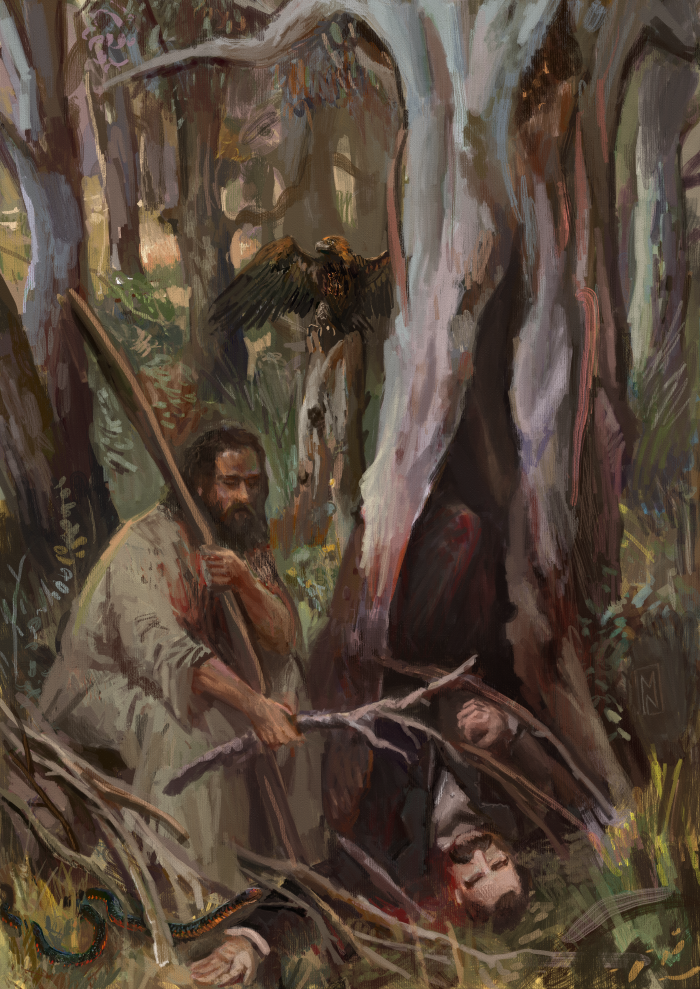

Nietzsche modifies the quintessentially German notion of the forest as an idyll, which our author described in the first part of this two-part series (link). This follow-up aims to precisely understand this modification and its significance for our time.
Nietzsche’s preferred landscape for thought is the high mountains. In this context, the forest becomes important as the tree line—a zone where life is just barely possible before it freezes. For Nietzsche, the timberline becomes the muse of a thinker who lives dangerously and always on the edge. Modernity can thus be described as a cultural high forest that is constantly on the verge of withering; the fading of the idyll of forest solitude is obvious to the Germans. Nietzsche’s stance is long past being an elitist attitude; in post-war modernity, for instance within various subcultures, it has become a mass mentality. In the current movement of social radicalization, however, we are observing a new kind of mass resentment—to escape it, we must relearn the art of shaping our own lives as a heroic idyll on the edge of the abyss.
Wille zum Wald
Nietzsche’s Discovery of Forest Bathing
Wille zum Wald
Nietzsche’s Discovery of Forest Bathing


In the fourth part of our “The Forest as a Living Foundation” series, the distinguished American Nietzsche scholar Gary Shapiro investigates new angles on Nietzsche’s bonds to the woods: the philosopher’s personal enthusiasm for what is increasingly called “forest bathing,” the science behind how this practice benefits body, mind, and spirit, and the sheer pleasure of breathing fresh air, in woodland and wherever else we can find it. Shapiro’s essay showcases why this particular Lebensraum matters, not just for our individual well-being, but for the health of the entire planet.