#
Charles Darwin
Nietzsche on a Bike
A Declaration of Love
Nietzsche on a Bike
A Declaration of Love
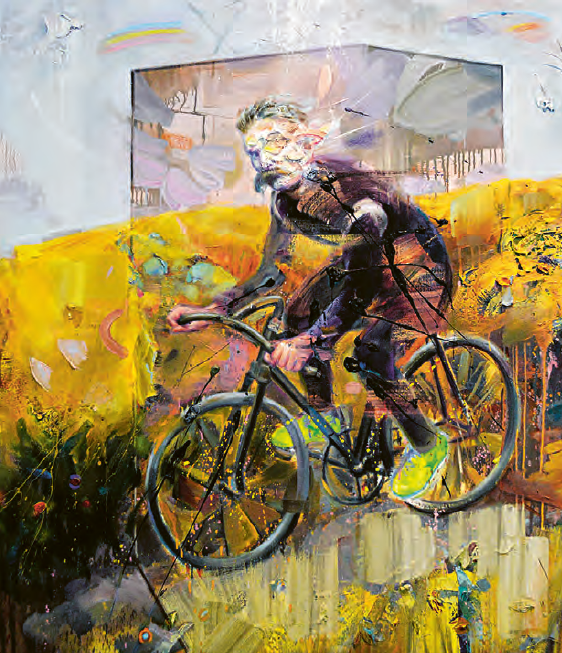

What does the most radical thinker of modernity have to do with cycling? Officially nothing: Nietzsche was a passionate hiker, and bicycles were conspicuously absent from his biography. Yet, his philosophy brilliantly anticipated the bicycle.
From the Buddhist Kala-Chakra up to Zarathustra's vision of the "self-rolling wheel," this essay embarks on a fascinating quest. It shows why the bicycle is far more than a mere means of transport: It is a philosophical instrument that teaches us the dynamic balance of life and makes the "Eternal Recurrence of the Same" palpable in the wind. An invitation to set thought in motion.
Monumentality Issues. Nietzsche in Art After 1945
Thoughts on the Book Nietzsche Forever? by Barbara Straka II
Monumentality Issues. Nietzsche in Art After 1945
Thoughts on the Book Nietzsche Forever? by Barbara Straka II
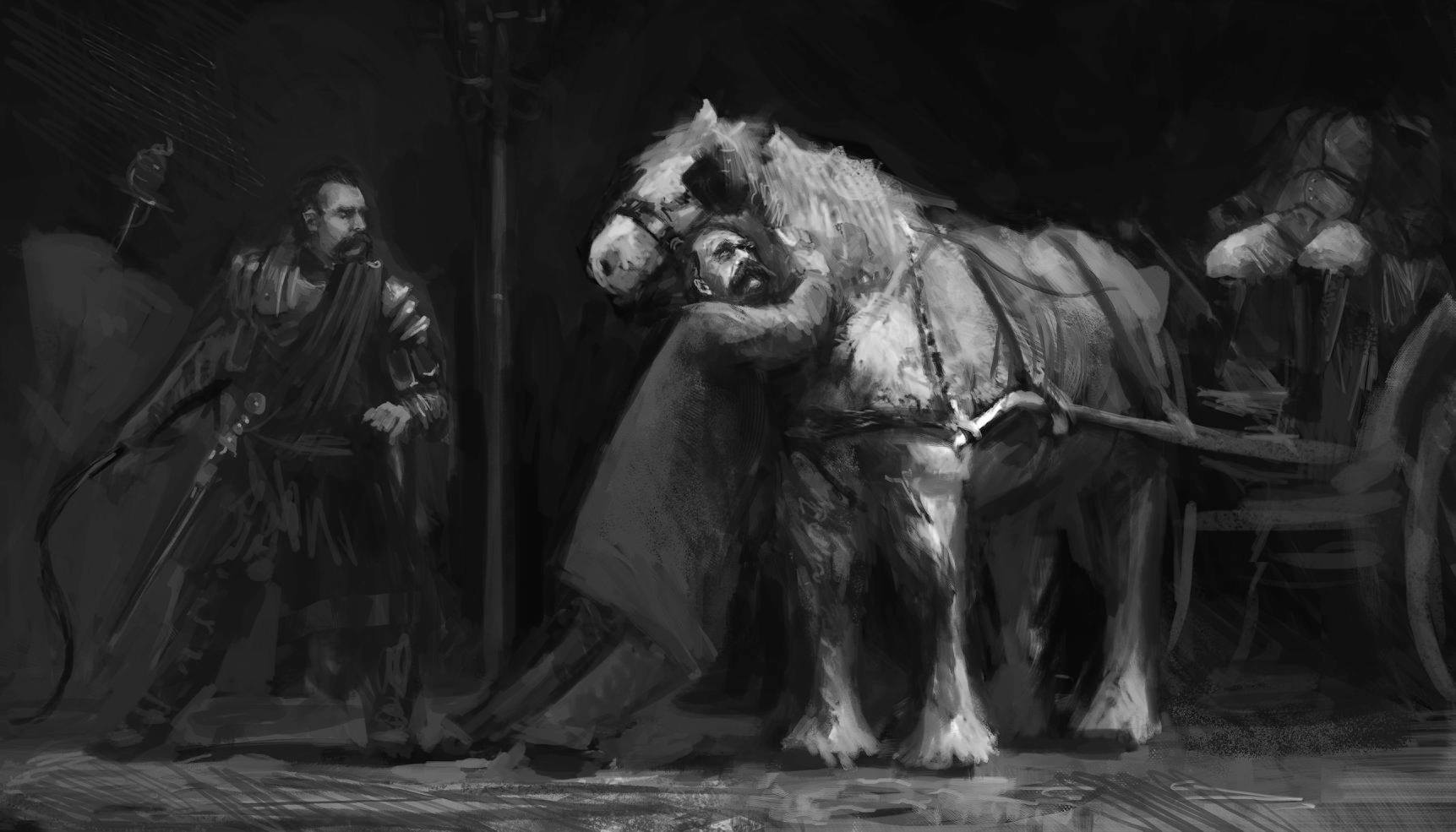

Barbara Straka's newly published book Nietzsche Forever? explores the question of how Nietzsche is received in 20th century art, in particular that after 1945. But the reception of Nietzsche's reception raises the question of whether the philosopher's monumentality is lost sight of. Does this reveal a fundamental problem of our age with monumentality? In any case, starting from Nietzsche, Michael Meyer-Albert argues against Straka for a “post-monumental monumentality” as an alternative to aesthetic postmodernism. In the first part of the two-part series, he dedicated himself to her book, and now he is accentuating his opposite position.
Amor fati — A Guide and Its Failure
Reflections between Adorno, Nietzsche, and Deleuze
Amor fati — A Guide and Its Failure
Reflections between Adorno, Nietzsche, and Deleuze


This article attempts to approach two of Nietzsche's most puzzling ideas: the Eternal Return and Amor fati, the “love of fate.” How exactly are these ideas to be understood — and above all: What do they have to tell us? How can we not only affirm fate, which is interpreted as an eternal return, but really love learn?
Among the philosophers, it was in particular the “main philosopher” of the Institute for Social Research, Theodor W. Adorno (1903-1969), who was skeptical or negative of these ideas of Nietzsche. Where remains, from the point of view of Amor fati, of critique and utopia whose banner Adorno and his intellectual companions held up?
As a result of the general failure of Marxisms to deal with fascism theoretically, the Frankfurt Institute tried to reorient itself from the 1930s onwards. The success of this movement seemed understandable to many unorthodox Marxists not only on the basis of economic laws; in their opinion, greater consideration was needed of the “subjective factor,” i.e. the psychological structure of the bourgeois individual. As part of this paradigm shift, Adorno turned to Sigmund Freud as well as Nietzsche. For the rest of his work, the German philosopher was a recurring point of reference for him.
Adorno, however, remained stubborn towards Nietzsche in an aspect that is typical of Marxist Nietzsche interpreters time and again: the insistence on the orientation towards a state of redemption for humanity in some way — the anticipation of which is manifested above all in the devaluation of the present. From this point of view, he also criticizes in his main aphoristic work Minima Moralia (1951) — according to him, a “sad science [...] of the right life”1 — Nietzsche's concept of Amor fati. Nietzsche's will to “just be a yes-sayer at some point”2, he thinks is a kind of Stockholm syndrome in the philosophy of life. However, such a task — not only of affirmation, but even of the will to affirm — would amount to abandoning the basis for every living appropriation of Nietzsche's philosophy. Taking up Adorno's critique, with reference to the interpretation of the important French Nietzsche interpreter Gilles Deleuze (1925-1995), it is intended to explore what Nietzsche provides for the universal and yet always very personal question of why existence — here and now — wants to be affirmed.
Traveling with Nietzsche through Southeast Asia II
Cambodia
Traveling with Nietzsche through Southeast Asia II
Cambodia


Our author Natalie Schulte spent nine months cycling in Southeast Asia and reports on her travel experiences with and without Nietzsche in a short series of essays. This time it's about the vast plain of Cambodia and the temples of Angkor in the middle of the jungle.
Better to Want Nothing, Than Not to Want at All
Self-Alienation through Modern Science
Better to Want Nothing, Than Not to Want at All
Self-Alienation through Modern Science


Nietzsche's criticism of science is perhaps one of the most provocative, but also the most relevant, sub-areas of Nietzsche's comprehensive critique of modern culture. Estella Walter reconstructs her perhaps most important formulation in the third treatise of The genealogy of morality and shows how Nietzsche's science is a form of estrangement Understands. She explains this concept, which is so central to modern philosophy, and bridges it from Nietzsche to (young) Marx: Both are critics of the alienations of the modern way of life, whose critiques we should read together in order to reach a comprehensive understanding of it.