#
bodybuilding
“It is no longer about monumentalization! Artists today want to make Nietzsche human so that one can deal with him in a new way.”
Interview with Barbara Straka about Her Book Nietzsche Forever?
Discussion with Barbara Straka
Interview with Barbara Straka about Her Book Nietzsche Forever?
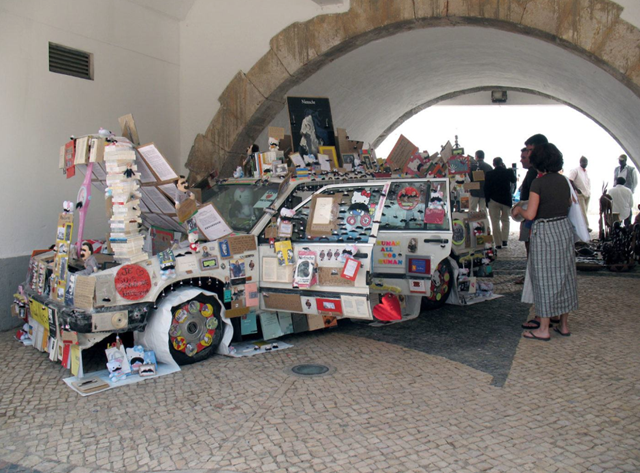

Last year, curator and art historian Barbara Straka published a two-volume monograph entitled Nietzsche forever? Friedrich Nietzsches Transfigurationen in der zeitgenössischen Kunst (Nietzsche Forever? Friedrich Nietzsche's Transfigurations in Contemporary Art), in which she explains Nietzsche's significance for the visual arts of the present day. After Michael Meyer-Albert dedicated a two-part review to her work in recent weeks (part 1, part 2), here follows an interview conducted by our author Jonas Pohler with the author in Potsdam. He discussed her book with her, but also about the not always easy relationship between philosophy and contemporary art.
Look, I'm Teaching You the Transhumanist
Friedrich Nietzsche as a Personal Trainer of Extropianism
Look, I'm Teaching You the Transhumanist
Friedrich Nietzsche as a Personal Trainer of Extropianism


After Natalie Schulte reported on the echo of Nietzsche's “superman” idea in the start-up scene last week (Link), Swiss art scholar Jörg Scheller is dedicating this week to her continued existence in extropianism, a subtype of transhumanism that aims to artificially accelerate human evolution on both individual and genre levels using modern technology. The physical law of “entropy,” according to which there is a tendency in closed systems to equalize all energy differences until a state of equilibrium has been established — a state of complete cooling in terms of the universe — is opposed by the proponents of this flow with the principle of “extropy,” the increasing vitality of a system.