#
Shoa
From the Will to Power to the Human Being as a New Beginning
Nietzsche from Hannah Arendt's Perspective
From the Will to Power to the Human Being as a New Beginning
Nietzsche from Hannah Arendt's Perspective
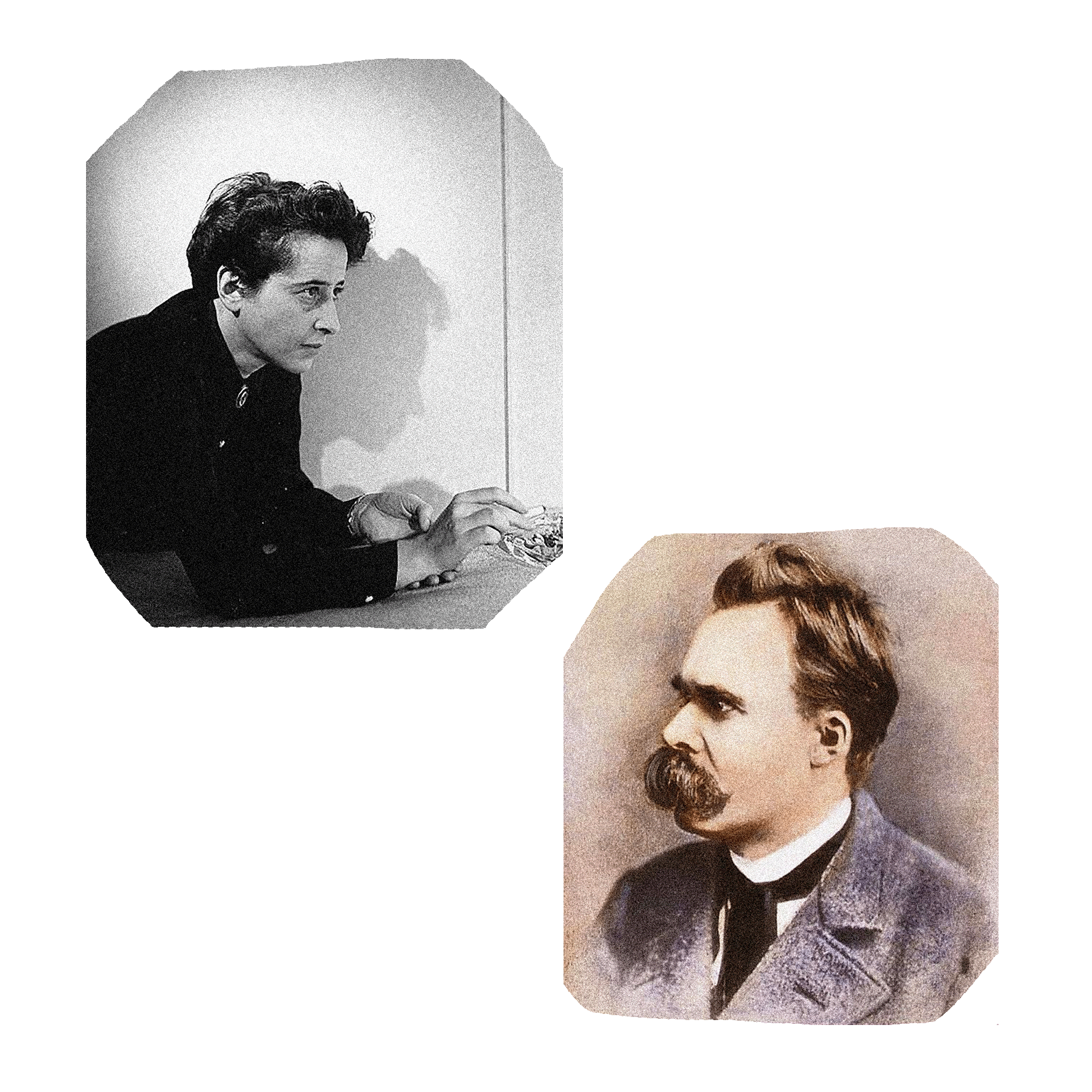

In her major work The Life of the Mind, Arendt builds upon Nietzsche’s understanding of the will to power as interpretation. Rather than following Kant’s conception of free will, she argues that through the will, something new enters the world with every newborn human being—a notion that resembles Zarathustra’s demand that the Übermensch should invent new values. Arendt also agrees with Nietzsche’s assertion that the "‘true world’" is a "fable," for Arendt because modern sciences possess no ultimate truths—a fact they themselves acknowledged around 1900, but which they now refuse to recognize. Thus, as heretics of science, Nietzsche and Arendt belong to the ranks of the "evil" philosophers.
Arendt lived from 1906 to 1975 and is considered one of the great thinkers of the 20th century. The daughter of secular Jews, she studied in the 1920s in Marburg, Freiburg, and Heidelberg under such influential philosophers as Edmund Husserl, Karl Jaspers, and Martin Heidegger. As a young student, she was briefly involved with the latter. In 1933, she was forced to emigrate, and from 1941 she lived in the USA, where she began teaching at various universities in 1953. This unorthodox intellectual is best known for her critique of totalitarianism and her communicative concept of the political.
Her 120th birthday provides sufficient reason to take a closer look at the intellectual relationship between Nietzsche and Arendt.
You can listen to and watch a version of this text, read by the author himself and supplemented with original audio clips of Arendt, on YouTube and Soundcloud .
From Denier to Conspiracy Theory to Ghosting
Nietzsche and the Social Upheavals Caused by Today's Widespread Resentment
From Denier to Conspiracy Theory to Ghosting
Nietzsche and the Social Upheavals Caused by Today's Widespread resentment
After Hans-Martin Schönherr-Mann has already dealt with Nietzsche's concept of resentment in two articles on this blog (here and there), he now addresses the question of how it can be applied to the current social situation.
His thesis: The current political landscape is characterized by many divisions based on resentment. They are due to the weaknesses of their own arguments. This is how critics are defamed as “corona” or “climate deniers.” The objections are often branded as conspiracy theories. You can't ask 'Cui bono?' anymore. Or you break off contact without comment to protect yourself. This is not only in line with Nietzsche's understanding of resentment in many places, precisely because he himself is not free from it, but is looking for ways out of it.
“What is the topicality of Nietzsche's analysis and critique of 'resentment'?“ is also the question of this year's Kingfisher Award for Radical Essay Writing, in which you can once again win up to 750 Swiss francs. The closing date for entries is August 25. The complete tender text can be found here.
If you'd rather listen to the article, you can find an audiovisual version on the Halcyonic Association YouTube channel, read by the author himself (link) and a listening-online version on Soundcloud (link).