From Denier to Conspiracy Theory to Ghosting
Nietzsche and the Social Upheavals Caused by Today's Widespread Resentment
From Denier to Conspiracy Theory to Ghosting
Nietzsche and the Social Upheavals Caused by Today's Widespread resentment

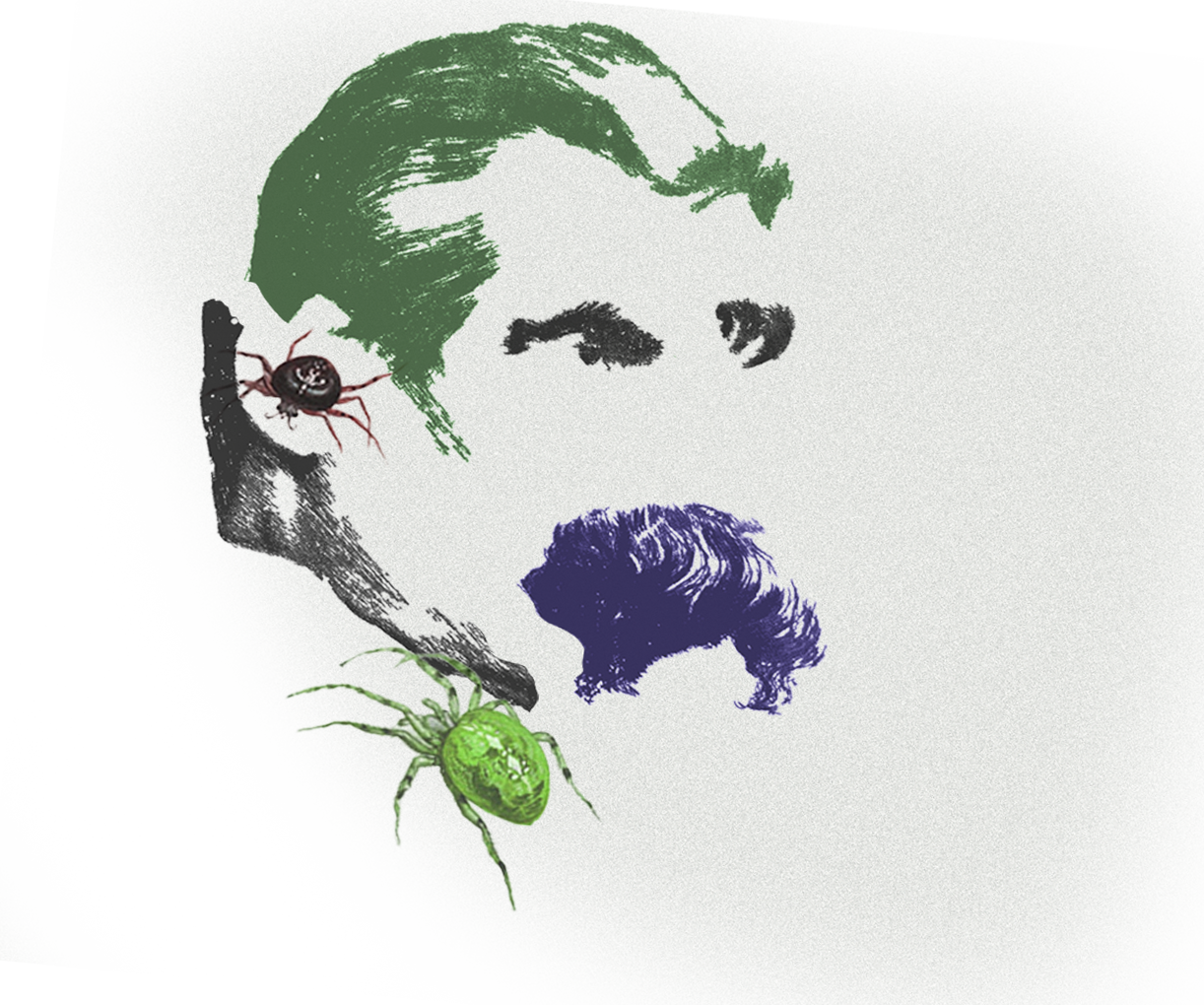
After Hans-Martin Schönherr-Mann has already dealt with Nietzsche's concept of resentment in two articles on this blog (here and there), he now addresses the question of how it can be applied to the current social situation.
His thesis: The current political landscape is characterized by many divisions based on resentment. They are due to the weaknesses of their own arguments. This is how critics are defamed as “corona” or “climate deniers.” The objections are often branded as conspiracy theories. You can't ask 'Cui bono?' anymore. Or you break off contact without comment to protect yourself. This is not only in line with Nietzsche's understanding of resentment in many places, precisely because he himself is not free from it, but is looking for ways out of it.
“What is the topicality of Nietzsche's analysis and critique of 'resentment'?“ is also the question of this year's Kingfisher Award for Radical Essay Writing, in which you can once again win up to 750 Swiss francs. The closing date for entries is August 25. The complete tender text can be found here.
If you'd rather listen to the article, you can find an audiovisual version on the Halcyonic Association YouTube channel, read by the author himself (link) and a listening-online version on Soundcloud (link).
Since the corona period at the latest, a word has had a career that has had a relevant meaning for a long time, but has had a rather limited meaning for decades, namely the “denier.”
Historically, it began with the denier of God when atheism spread during the Enlightenment, which was hated by many believing Christians.
The aggressiveness towards atheists, however, is based on the argumentative weakness that the existence of God simply cannot be proven. According to Kant, reason tries to do so, it engages itself in “eternal contradictions and disputes,” because it “could never go beyond the field of possible experience.”1. The end of all proofs of God! Like the famous one by Thomas Aquinas that everything in the world has a cause, so the world must also have one. So “you have to come to a first change person who is not changed by anyone else. And that is what everyone understands by “God” . ”2
This increases religious people's aversions to religious doubters. This process is similar to resentment, as Nietzsche said the word in On the genealogy of morality used, a constant need for revenge against the alleged 'injurer' resulting from a perceived inferiority.
Such hatred was also directed at Nietzsche; for what is it called in Zarathustra about the priests: “They are evil enemies: nothing is more vengeful than their humility. And the one who attacks them easily sullies himself. ”3
The critic as Denier
The word “denier” in corona policy has made a career. Of course, there were people among their critics who denied the disease as such. But the word “corona denier” also disqualified anyone who questioned the corona measures. Out of panic, opposition and criticism could motivate many not to take the measures adopted seriously, as well as from the knowledge that these measures are by no means self-evident, their political, media and medical advocates reacted with aggressive rituals.
The term “climate denier”, which appeared almost at the same time, is similar. Here, too, there are critics who reject the scientific debate. But others primarily doubt the apocalyptic vision of the end of the world derived from this, which evokes an urgency that is by no means self-evident. Scientific findings are based on methods, theories, experiments that are not ultimate truths. Only approximate forecasts can be made about future developments.
In this way, these findings can and must always be called into question. Disqualifying critics as “deniers” testifies to the weakness of one's own argument and the resulting resentment, which is reflected in turn through corresponding critiques.
In any case, Nietzsche is one of the critics of modern technologies when he writes: “Hubris is today our entire attitude to nature, our rape of nature with the help of machines and the so harmless technical and engineering ingenuity.”4.
How resentful the word “corona” such as that of “climate denier” is is shown by the fact that, in order to reinforce the urgency, it implicitly follows on from the “Auschwitz denier”, who is probably still the most famous denier today. On April 25, 1985, the German Bundestag passed a law prohibiting the Auschwitz lie, i.e. the claim that there was no murder of European Jews by the millions.
It was less about denying the more than well-established historical fact and more about insulting the victims and their families associated with it. This restriction on freedom of expression is therefore justified. Insults are not covered by this fundamental right.
Representatives of corona and climate policy similarly assume that their measures are intended to protect people. The decisive difference remains that no one is insulted by the 'corona' and 'climate denial. ' If the word “denier” is also used in this way, it puts the Holocaust denial into perspective.
However, because the advocates of climate and corona policies are propagating that they must save humanity, their critics even appear to them as enemies of humanity. All the more they must dramatize their concerns and all the more they can despise their enemies: pure resentment that provokes a corresponding reaction, so that opposing resentments stir up each other.
Who Is Not a Conspiracy Theorist?
As a result, the various “deniers” are regularly discriminated against as “conspiracy theorists.” It goes without saying that there are the craziest ideas about the world. But religious stories in particular are full of conspiracy theories. An outstanding example is the doctrine of the Trinity developed by church fathers that the Holy Spirit profoundly governs the world, i.e. the Invisible Hand: truly a conspiracy theory, still secularized in Adam Smith: “In fact, he <der einzelne>does not consciously promote the common good, nor does he know how much his own contribution is. [...] he is guided [...] by an invisible hand to promote a purpose that he fulfills did not intend in any way. ”5
Nietzsche aptly describes this Christian-liberal founding myth — and of course not just that — with the following words: “[A] lle life is based on illusion, art, deception, appearance, the necessity of perspective and error. ”6
History does not consist of simple facts, but is written by historians, who are mostly in the service of the powers that let history be written in their own sense. The facts must also be explained and acknowledged. Nietzsche aptly commented on this:
Against positivism, which stands still with the phenomenon that “there are only facts,” I would say: No, there are no facts in particular, only interpretations. We cannot determine any fact “in itself” [.]7
For Paul Ricœur, Nietzsche, Marx and Freud are the “three masters of doubt [...] three great 'destroyers'”8who are not satisfied with the appearance of reality, but want to lift the veil in which ideologies or the unconscious make the world appear: conspiracy theories! , about which the defenders of democracy, corona and climate policy do not want to know anything — a grandiose obsession with Marx in the service of saving humanity.
Therefore, the question “cui bono? 'no longer be asked at all. Or you're a conspiracy theorist. Of course, the question is who the conspiracy theorists are here: probably all of them, but especially those who wear such cloaks to others. And everyone reacts with resentment to each others' angry criticism, because they in turn know that their own arguments are weak.
Democracy, nature and health draw on contemporary science — as do their critics. Everyone hopes that this will give good reasons for their ideas and suppress the fact that the sciences must constantly review and change their insights. And behind this are economic, political interests or the simple will to power. This applies to Nietzsche as well as to all science critics when he writes:
[W] ir myself, we free spirits, are already an “transformation of all values,” a physical Declaration of war and victory to all old terms of “true” and “false.” The most valuable insights are found the latest; but the most valuable insights are the methods.9
But Paul Feyerabend demonstrates that the results of the sciences always remain methodological relative and that the methods used by Nietzsche in antichrist still understood as the actual progress. As Feyerabend writes,
that the idea of a fixed method or a fixed theory of reasonableness is based on an overly naive view of man and his social conditions.10
Methodological orientation therefore does not protect against the accusation of being dependent on interests, which certainly affects modern sciences much more than Nietzsche. In turn, this can only be offset by more aggressive defense, which thus reproduces the resentment with which scientism defends itself not only in corona and climate policy.
On the other hand, Nietzsche in Zarathustra was already a huge step ahead when he wrote: “Oh my brothers, is now Not everything in Rivers? Didn't all railings and walkways fall into the water? who held Still thinking of “good” and “bad”? ”11 And who still believes in scientific truth? Quite a lot and anyone who does not do so is a “conspiracy theorist” for scientism and established politics who approaches the sciences with resentment, i.e. with unfounded rejection and aggression. Of course, rejection, like resentment, is mutual.
Ghosting as The End of the Social Band
Since the sixties, left-wing critics have been questioning democracy as it developed in the Western world after the Second World War. In the seventies, this was followed by ecological criticism.
But only the environmental issue has been tackled quickly and diligently in all political camps since the eighties. In a certain sense, this therefore became a new social band that brought large sections of society into communication with one another. This culminates in the climate crisis as an even global issue.
These similarities, this type of social bond, were shaken by the corona policy, which divided society. There were hostile camps that met each other with massive resentment, not least because the previous similarities in the corona friendly camp fuelled the expectation that everyone would support the corona policy, it was ultimately about the high level of human and ecological value of health and life protection.
When, on the other hand, many in the liberal camp appeared patronized and commanded, there was great disappointment on the side of the corona policy and the opponents were met with harsh rejection. Conversely, the individualistic opponents of the corona policy lost confidence in democracy, which suddenly appeared as a dictatorship because it regulated life down to the most intimate spheres.
The rift is deep and runs across the political camps, which leads to friendships suddenly breaking up without communication, because people assume unfair attitudes to each other: individual freedom or fundamental rights vs. protection of life. This speechless break of friendships was called “ghosting” as a mutual resentment of each other.
In mid-October 2025, German President Frank-Walter Steinmeier once again called on people to end this speechlessness and thus the 'ghosting' in order to overcome this private and social division.
Steinmeier could have relied on Nietzsche if he in Zarathustra writes: “For that man is redeemed from revenge: that is the bridge to the highest hope and a rainbow after long storms. ”12 Revenge is due to resentment and speechlessness among former friends.
Even Nietzsche, with his contempt for his fellow human beings, is not free from such resentment. How does he still write in On the genealogy of morality: “We don't see anything today that wants to get bigger, we suspect that things are still going downwards, downwards, into [...], more good-natured, smarter, more comfortable, mediocre, [...], more Christian — the human being, it is no doubt, is becoming more and more 'better' . ”13
This can be related to both corona and climate discourse, which are conducted with high moral standards and thus want to make people “better” and “better.” Nietzsche, on the other hand, does not want to moralize people, make people 'good', as climate activists or defenders of the corona policy are striving for, for which people should submit to their moral requirements and not develop their own values. Rather, it is intended to serve political powers that are concerned with health and climate and thus with the moral “good.”
“Get on the ships, philosophers! ”
In any case, Nietzsche's philosophy of resentment allows contemporary conflicts to be analysed, especially when Nietzsche's own resentment is included. But Nietzsche has also developed a conciliatory perspective that does not threaten the future like the scientific climate and corona advocates. He writes:
[E] a new righteousness Don't do it! A new solution! And new philosophers! The moral earth is round too! The moral earth also has its antipodes! Even the antipodes have their right to exist! There is another world to discover — and more than one! Get on the ships, philosophers!14
But the future is open. Karl Löwith Nietzsche attests “that, as the philosopher of our age, he as contemporary as it is untimely Is” 15. Timely, because you can use your term of resentment to shed light on current events! Outdated, because he creates a far-reaching perspective that hardly anyone who is actively involved in the resentful conflicts at the beginning of the 21st century will appreciate.
Sources
Feyerabend, Paul: Against the use of methods. Outline of an anarchist theory of knowledge (1975). Frankfurt am Main 1976.
Kant, Immanuel: Critique of Pure Reason (2nd ed. 1787). Academy edition Vol. 3. Berlin 1968.
Loewith, Karl: From Hegel to Nietzsche. The revolutionary break in nineteenth-century thinking (1941). Complete writings 4. Stuttgart 1988.
Ricoeur, Paul: Hermeneutics and Psychoanalysis. The conflict of interpretations II (1969). Munich 1974.
Smith, Adam: The prosperity of nations. An investigation of its nature and causes (1776). Munich 1974.
Thomas Aquinas: Summa theologica I 2.1, (1265-73). Opera Omnia, Vol. 4 Rome 1886.
Footnotes
1: Critique of Pure Reason (2nd ed. 1787), p. 460 f.
2: Summa theologica I 2.1 (1265-74), P. 31.
3: So Zarathustra spoke, From the priests.
4: On the genealogy of morality, paragraph III, 9.
5: The prosperity of nations (1776), P. 371.
6: The birth of tragedy, an attempt at self-criticism, paragraph 5.
7: Subsequent fragments 1886 7 [60].
8: Hermeneutics and Psychoanalysis (1969), P. 68.
9: The Antichrist, paragraph 13.
10: Against the method requirement (1975), P. 45.
11: So Zarathustra spoke, From old and new boards, paragraph 8.
12: So Zarathustra spoke, Of the tarantulas.
13: Zur genealogy of morality, Paragraph I, 12.
14: The happy science Aph 289.
15: From Hegel to Nietzsche (1941), P. 240.