"There are no facts, only interpretations."
From Nietzsche's Critique of Knowledge to Radical Constructivism
"There are no facts, only interpretations."
From Nietzsche's Critique of Knowledge to Radical Constructivism


Nietzsche questions truth as an adequate understanding of the world. This implies there is no longer a true world, as modern sciences assume. Radical constructivism, emerging in biology, which posits that living beings perceive their environment only as their internal structures allow, confirms Nietzsche's analyses and, consequently, postmodern philosophy, where truth is also considered merely a construction and not an objective grasp of something. From this, it follows not only that the world can be interpreted in various ways, but also that there is no single, uniquely correct truth and, therefore, no single correct way of life.
If you prefer to watch or listen to this article, read by the author himself in German, you can also find it on YouTube and Soundcloud.
So what is truth? A movable host of metaphors, metonymies, anthropomorphisms"1, Nietzsche wrote in 1873, laying the groundwork for a debate that would only escalate 100 years later, when postmodern philosophy began to argue that there is no scientific truth that adequately represents its objects, but rather that sciences construct their knowledge.
But don't modern natural sciences finally grasp nature correctly? Radical constructivism, however, has been disputing this since the 1960s. For one of its main proponents, the Chilean biologist Francisco J. Varela, "reality is not simply given: it depends on the perceiver, and that is [...] because what counts as a relevant world counts, is inextricably linked to the structure of the perceiver."2
Nietzsche paved the way for this when he argued against the positivism dominant in the 19th century, "which stops at the phenomenon 'there are only facts'": "[N]o, there are no facts, only interpretations. We cannot establish any fact 'in itself'"3.

1. The Will to Power as Interpretation
The background to this is Nietzsche's doctrine of the Will to Power. At first glance, it appears merely as a kind of driving force of biological beings, when in Zarathustra means: „Only where there is life, there is also will: but not will to live, but – as I teach you – will to power!“4 This is further confirmed by Henning Ottmann, who, commenting on Nietzsche's writings of the 1880s, observes: "'Will to Power' was everything that 'acted' and was in motion, on its way to more strength"5.
Yet in Nietzsche's Nachlass it says: „The Will to Power interprets: in the formation of an organ, it is an interpretation; it delineates, determines degrees, power differences. […] In truth, interpretation itself is a means, to become master over something.“6 Thus, Will to Power means taking possession of the world by interpreting it accordingly. For, according to Nietzsche, philosophy "always creates the world in its own image; it cannot do otherwise; philosophy is this tyrannical drive itself, the spiritual Will to Power, for the 'creation of the world,' for the causa prima."7
Marx refuses to be satisfied with mere interpretation, reads the famous eleventh Thesis on Feuerbach: "The philosophers have only interpreted the world in various ways; interpreted, the point is to change it."8 Martin Heidegger, who plays an important role in the postmodern debate, objects to this: "In following this statement, one overlooks that a change in the world presupposes a change in the conception of the world and that a conception of the world can only be gained by adequately interpreting it"9, which, for Heidegger, Marx only inadequately achieves.
However, Marx initially grounds his thesis in the philosophy of history, as history was a leading discipline at the time. And after that, he would spend a long time on economic analyses. With both, he would interpret the world in such a way that it could be changed.
And if one objects to this with: "It's all just interpretation!", then Marx could refer to Nietzsche, who concedes as much: "Suppose that this too is only interpretation – and you will be eager enough to object to this? – well, so much the better."10 Facts are always already the result of an interpretation. This is also supported by the postmodern philosopher Gianni Vattimo: The doctrine of understanding and thus of world-understanding, "hermeneutics is itself 'only interpretation'. It does not base its claims to validity on an alleged access to things themselves."11
Radical constructivism views this similarly. As Chilean neurobiologist Humberto Maturana states: "One only sees what one believes."12 A biological being always perceives the world only according to its perceptions, which it must interpret. Sensory data must be understood.
Thus, Nietzsche, in Daybreak paves the way for radical constructivism: "The habits of our senses have woven us into the deception and illusion of sensation: these, in turn, are the foundations of all our judgments and 'knowledge', – there is absolutely no escape, no secret paths or detours into the real world!"13
This corresponds to what radical constructivist Ernst von Glasersfeld writes: "Our sense organs always 'report' to us only a more or less hard impact against an obstacle, but never convey to us features or properties of that which they encounter."14 If pain suddenly appears, one must first clarify its origin and where it spreads. This is where the 'errors', distortions, differences, and above all, varying interpretations begin. But only interpreted perception says something about the world and the pain. Perception alone says almost nothing.
Therefore, one cannot rely on an original perception, which does not provide an object in itself. As von Glasersfeld remarks: "[N]o one will ever be able to compare the perception of an object with the postulated object itself, which is supposed to have caused the perception."15 The object in itself is neither an object of perception nor of experience.
2. Mathematics and Causality as Idealizations
But haven't modern natural sciences solved these problems? For Galileo Galilei, the book of nature is written in mathematical script. Everything in the world can be accurately grasped quantitatively with mathematics, because nature consists of bodies whose proportions can be measured. For Galileo, this provides an adequate explanation.
But do "triangles, circles, and other geometric figures" truly exist in nature,16, as Galileo claims? Nietzsche precisely contradicts this: "We operate with things that do not exist at all, with lines, surfaces, bodies, atoms, divisible times, divisible spaces"17. These are ideal constructs of geometry that do not occur in nature. In 1936, Edmund Husserl would confirm this: "In the Galilean mathematization of nature, nature itself is now idealized under the guidance of the new mathematics"18.
Nietzsche, however, had already recognized this: "[W]hen we first turn everything into an image , our own image! It is enough to consider science as the most faithful humanization of things possible; we learn to describe ourselves ever more precisely by describing things and their succession.”19 It is precisely this that the founder of quantum mechanics, Werner Heisenberg, would remind physics of in 1955: "Even in natural science, therefore, the object of research is no longer nature in itself, but nature exposed to human questioning, and to that extent, man also encounters himself here again."20
For Nietzsche, this calls into question the fundamental epistemological principle of Western thought, namely, the principle of causality, of cause and effect, with which one seeks to explain the world. In contrast, Nietzsche asks: "[H]ow is explanation even possible, [...] Cause and effect: such a duality probably never exists – in truth, a continuum lies before us, from which we isolate a few pieces."21. With the principle of causality, an effect is explained by a cause, meaning one thing by another. But what are the precise connections?
And for that, one must know the matter precisely. Therefore, Michel Foucault, whose post-structuralism, even before postmodernism, questioned truth as a correspondence between word and object, asks: "Why does the genealogist Nietzsche at least occasionally reject the search for origins? Primarily because it implies the search for the precisely defined essence of the matter."22.
Is it not an arbitrary division or a determination of events dictated by scientific methods? As Nietzsche remarks: "People have always believed they knew what a cause is: but where did we get our knowledge, or more precisely, our belief that we know here?"23 For many religious believers, God is considered the creator of the world and thus the first cause. Those who trust in the natural sciences accept their Big Bang theory. Similar to Nietzsche, Maturana notes: "Explanations are thus statements about generative mechanisms accepted by a listener."24
Is the principle of causality not merely due to the urge to make the world comprehensible, i.e., scientifically today? From this, von Glasersfeld concludes, "that we expect the world we live in to be a world with certain regularities, a world that functions according to certain rules."25
For if one cannot attribute a headache to the weather, it is unsettling: a brain tumor? If, however, one knows the causes, one hopes to be able to do something about it. This then leads to, as Nietzsche says: "To trace something unknown back to something known is alleviating, reassuring, satisfying, and moreover, gives a feeling of power."26
3. The End of the 'True World'
Furthermore, there is never just one interpretation to explain an event, but always several. This is actually the self-critical principle of modern sciences, which should distinguish them from religions and ideologies. Of course, scientists quickly forget this when they claim their doctrines are the only correct ones, for example, when it comes to funding.
This is simply misapplied science. Nietzsche already pointed this out to the sciences when he distinguished various forms of nihilism: "The radical nihilism is the conviction of the absolute untenability of existence, when it concerns the highest values one recognizes, plus the insight, that we have not the slightest right to posit a beyond or a thing-in-self, which is 'divine', which is morality incarnate."27 If one can no longer adequately explain the world, then no morality can be derived from it either.
From this, Nietzsche distinguishes the most extreme form of nihilism: "That there is no truth ; that there is no absolute nature of things, no 'thing-in-itself' – this is itself a nihilism, and indeed the most extreme.28 Christianity, like the modern natural sciences, thereby loses not only the foundations of its ethics but, above all, its understanding.
Then one must interpret the world differently. This also opens up perspectives for various ways of life, so that one can declare no particular way of life as the correct one, neither scientifically nor religiously; "for one recognizes," according to Maturana, "that statements cannot be justified by 'the real,' that the idea of objective reality should primarily serve as a strategic argument for the validity of explanations, and that one can, in fact, delineate many operationally coherent domains that are just as livable and sustainable as the 'sole real one' once was."29
Nietzsche had encapsulated this in a central aphorism: "We have abolished the true world: what world remained? the apparent one, perhaps? . . . But no! with the true world, we have also abolished the apparent one!"30 If there is no truth as a correspondence between statement and fact, neither a true nor an apparent world exists, but many worlds that owe their existence to different interpretations. Thus, Maturana demands recognition "that the distinction between reality and appearance is a questionable construct, from which, in turn, other, in principle explainable consequences must arise."31 With this, radical constructivism completes Nietzsche's most extreme nihilism.
All insights are due to different understandings of the world. One should account for such things from the outset. Thus Nietzsche writes programmatically: "There is only a perspectival seeing, only a perspectival 'knowing'; And [...] the more eyes, different eyes we manage to apply to the same matter, the more complete will our 'concept' of this thing, our 'objectivity' be."32 Therefore, one should not be content with a single perspective on the world.
This leads to many different paths to knowledge for radical constructivism, as it does for Nietzsche. Von Glasersfeld writes:
Since for the constructivist, knowledge is never an image or reflection of ontological reality, but always only a possible way to navigate among the "objects," finding a satisfactory way never excludes the possibility that other satisfactory ways can be found.33
Then the situation after the end of the true world – regardless of whether it is religiously or scientifically assumed – presents itself as follows: "What were we doing when we unchained this earth from its sun? Whither is it moving now? Whither are we moving? Away from all suns? Are we not plunging continually? And backwards, sideways, forwards, in all directions? Is there still an up and a down?"34 To this day, most people, especially many scientists, really dislike reading this, because then the latter can no longer dictate to the former how they should live.
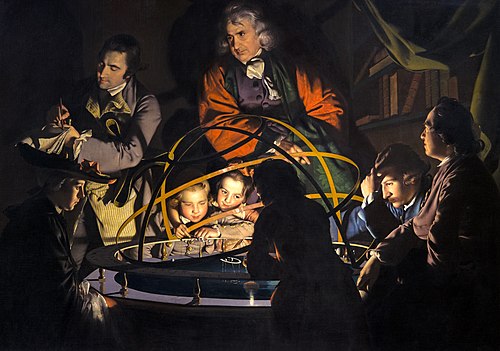
For the article image (Source) is the painting An Experiment on a Bird in the Air Pump (1767/8) by the English painter Joseph Wright of Derby (1734–1797). It depicts a famous experiment in which the Irish natural philosopher Robert Boyle (1627–1692) sought to prove that animals require air to live by extracting it from a bird trapped in a glass sphere using a specially commissioned pump, then considered high-tech. The animal died in agony – quod erat demonstrandum.
Literature
Martin Heidegger in Conversation with Richard Wisser (ZDF 24.9.1969). In: Emil Kettering & Günther Neske (eds.): Answer. Martin Heidegger in Conversation, Pfullingen 1988.
Foucault, Michel: Nietzsche, Genealogy, History (1971). In: Idem: Of the Subversion of Knowledge, Frankfurt a. M. 1987.
Galilei, Galileo: Il Saggiatore (1623). In: Le opere di G. Galilei, Florence 1932.
von Glasersfeld, Ernst: The Logic of Scientific Fallibility (1987). In: Idem: Ways of Knowing. Constructivist Explorations through Our Thinking, 2nd ed. Heidelberg 2013.
Idem: Construction of the Reality of the Concept of Objectivity (1992). In: Heinz Gumin & Heinrich Meier (Eds.): Introduction to Constructivism, 10th ed. Munich 2010.
Heisenberg, Werner: The Image of Nature in Contemporary Physics. Hamburg 1955.
Husserl, Edmund: The Crisis of European Sciences and Transcendental Phenomenology (1936). Husserliana Vol. VI. The Hague 1954.
Marx, Karl: Theses on Feuerbach (1845). In: MEW Vol. 3, Berlin 1969.
Maturana, Umberto: What is Cognition? (1992). Munich & Zurich 1994.
Ottmann, Henning: Philosophy and Politics in Nietzsche (1987), 2nd ed. Berlin & New York 1999.
Varela, Francisco J.: Ethical Competence (1992). Frankfurt a. M. & New York 1994.
Vattimo, Gianni: Beyond Interpretation. The Significance of Hermeneutics for Philosophy (1994). Frankfurt a. M. & New York 1997.
Footnotes
1: On Truth and Lies in a Nonmoral Sense, Sec. 1.
2: Ethical Competence, p. 20.
3: Posthumous Fragments No. 1886 7[60].
4: Thus Spoke Zarathustra, On Self-Overcoming.
5: Philosophy and Politics in Nietzsche, p. 354.
6: Posthumous Fragments No. 1885 2[148].
7: Beyond Good and Evil, Aph. 9.
8: Theses on Feuerbach (1845), p. 7.
9: Martin Heidegger in conversation with Richard Wisser, p. 22.
10: Beyond Good and Evil, Aph. 22.
11: Beyond Interpretation, p. 155.
12: What is Knowing?, p. 31.
13: Daybreak , Aph. 117.
14: Construction of the Reality of the Concept of Objectivity, p. 21.
15: Ibid., p. 12.
16: Il Saggiatore, p. 232.
17: The Gay Science, Aph. 112.
18: The Crisis of European Sciences and Transcendental Phenomenology, p. 20.
19: The Gay Science, Aph. 112.
20: The Concept of Nature in Contemporary Physics, p. 18.
21: The Gay Science, Aph. 112.
22: Nietzsche, Genealogy, History, p. 71.
23: Twilight of the Idols, The Four Great Errors, Sec. 3.
24: What is Knowledge?, p. 43.
25: The Logic of Scientific Fallibility, p. 73.
26: Twilight of the Idols, The Four Great Errors, Sec. 5.
27: Nachlass No. 1887 10[192].
29: What is Knowledge?, p. 47.
30: Twilight of the Idols, How the "True World" Finally Became a Fable.
31: What is Knowledge? p. 53.
32: On the Genealogy of Morality, 3rd Essay, Sec. 12.
33: Construction of the Reality of the Concept of Objectivity, p. 32.