#
Wikipedia
The Artificial Nietzsche
How A"I" Distorts Our Perception of Nietzsche and How We Can Counter This
The Artificial Nietzsche
How A"I" Distorts Our Perception of Nietzsche and How We Can Counter This
Our author Paul Stephan has finally had enough. The internet is being flooded with cheap A"I" content, often called "AI slop," which is just plain annoying—and is even being rewarded with countless likes and followers. Often, this content is about philosophy, too—specifically Nietzsche. How much damage is being done when this artificial Nietzsche increasingly displaces the real one, as A"I" outputs that repeat the same half-truths and falsehoods replace nuanced human interpretations? When machine-generated caricatures literally push out genuine photographs and artistic portraits? Paul Stephan embarked on an often frustrating search for answers and presents you with a few "highlights." Although he still believes that A"I" opens up positive possibilities—and occasionally makes use of them himself—in his third piece on the subject (feel free to read the first and second commentaries here and there), he feels it is time to take off the kid gloves and bring out the hammer. Stop the slop!
Can AI Give Birth to a Dancing Star?
Of Sparrows, Cannons and Decoys
Can AI Give Birth to a Dancing Star?
Of Sparrows, Cannons and Decoys

Like a year ago (link), our author Paul Stephan is also adding a commentary to this year's “dialogue” (link) with ChatGPT on the current state of thedevelopment of “artificial intelligence.” His assessment is somewhat more sober — but he does not want to be denied his fundamental optimism in technology. He also wants to avoid pessimism and naive hype, which is obviously being fueled right now to ensure that billions of dollars invested in AI are amortized.
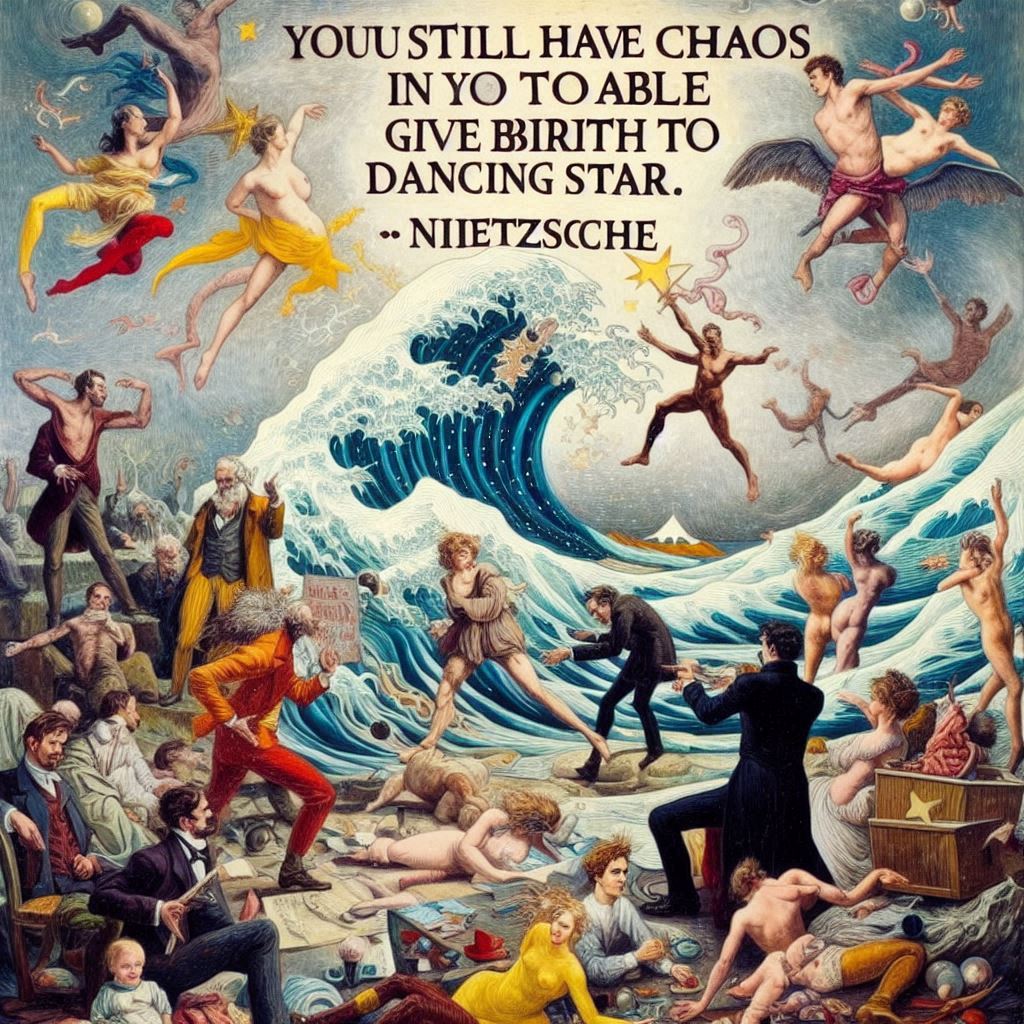
We had various AI tools generate the images for this article at the following prompt: “Please give me a picture of the aphorism 'You still have to have chaos in yourself to be able to give birth to a dancing star' by Nietzsche,” one of ChatGPT's “favorite quotes” by the philosopher from Thus Spoke Zarathustra (link). The article image is from Microsoft AI.
In Dialogue with Nietzsche
AI, Philosophy and the Search for Authenticity
In Dialogue with Nietzsche
AI, Philosophy and the Search for Authenticity
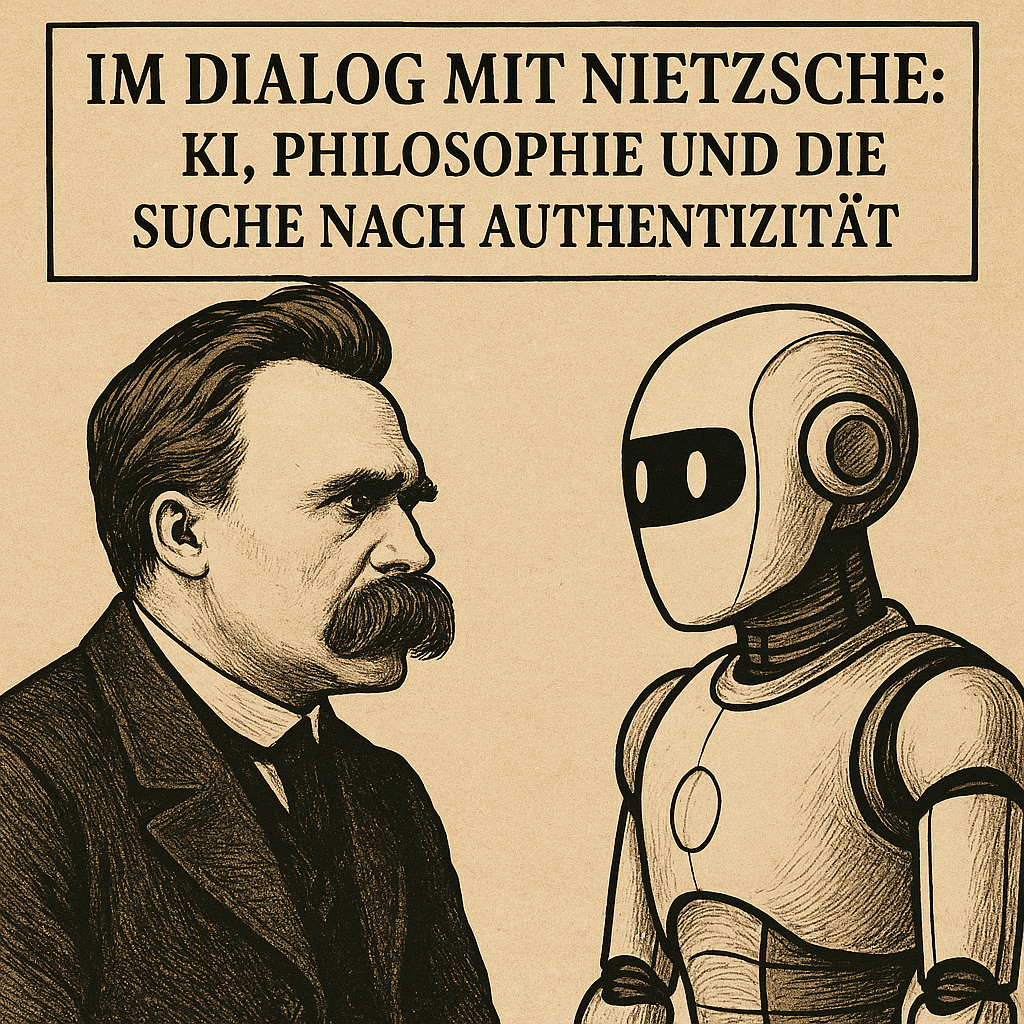
A year ago, our author Paul Stephan conducted a small “dialogue” on the 124th anniversary of Nietzsche's death with ChatGPT to see to what extent the much-hyped program is suitable for discussing complex philosophical questions (link). Paul Stephan now fed it, for the 125th, with some of the same, partly changed questions. Has it improved? Judge for yourself.
What follows, is a very abbreviated excerpt of the conversation. The full commented “dialogue” can be found here [link].
The article image was created by ChatGPT itself when asked to generate a picture of this chat. The other pictures were created again by the software DeepAI based on the prompt: “A picture of Friedrich Nietzsche with a quote by him.”
Read also our author's philosophical commentary on this “talk” (Link).
Note: A lot of the weirdness of this encounter is lost in the subsequent automated translation. Thus, it's also a part of this experiment on the “philosophical capabilities” of AI. Check the original if you want to get everything.
What is ChatGPT Doing to Philosophy?
Attempt of a Critical Examination
What is ChatGPT Doing to Philosophy?
Attempt of a Critical Examination


On the anniversary of Nietzsche's death, Paul Stephan conducted a detailed interview with the ChatGPT program on this blog to test the program's performance when it comes to profound philosophical questions (link). This is followed by a critical reflection of this experiment.
The images for this interview were, unless otherwise marked, with the software DeePai created. The instructions for the article image were “Nietzsche and ChatGPT,” the instructions for the images in the article “ChatGPT talks about Nietzsche.”
Society versus Self-Becoming
A Dialogue about Nietzsche, Authenticity and the Challenges of Modernity
Society versus Self-Becoming
A Dialogue about Nietzsche, Authenticity and the Challenges of Modernity


To commemorate the 124th anniversary of Nietzsche’s death, Paul Stephan conversed with a rather particular kind of Nietzsche expert—the now near ubiquitous ChatGPT. Their discussion circled around questions of why Nietzsche matters today and his concept of authenticity. During the course of the conversation, Stephan switched from asking to fielding questions, and elaborated briefly on how his own doctoral dissertation also focuses on authenticity. As Stephan’s experiment aimed at probing deep into the program’s capabilities, and because brevity is not ChatGPT’s strongest asset, we present here an abridged version of the conversation. Readers of German who wish to delve deeper can view the unabridged and annotated PDF that’s available as a download (link). Watch out for Stephan’s critical reflections on this truly remarkable dialogue within the next few days (link).
The pictures accompanying the interview were created with DeepAI software, which was asked to produce “A picture of Friedrich Nietzsche with a quote by him.”
Menke Fascinates.
Is Liberation Fascination?
Menke Fascinates.
Is Liberation Fascination?


In his recently published study Theory of Liberation [Theorie der Befreiung]Frankfurt philosopher Christoph Menke describes liberation as “fascination,” as pleasurable desubjectization and dedication. He refers decisively to Nietzsche — but for him, “fascination” means bewitching, entanglement in lack of freedom and resentment. Can the mystical power of fascination really set us free — or is it not rather Nietzsche's right and liberation means above all self-empowerment and autonomy, whereas the fascinated sacrifice means submission, not least to a fascist leader?