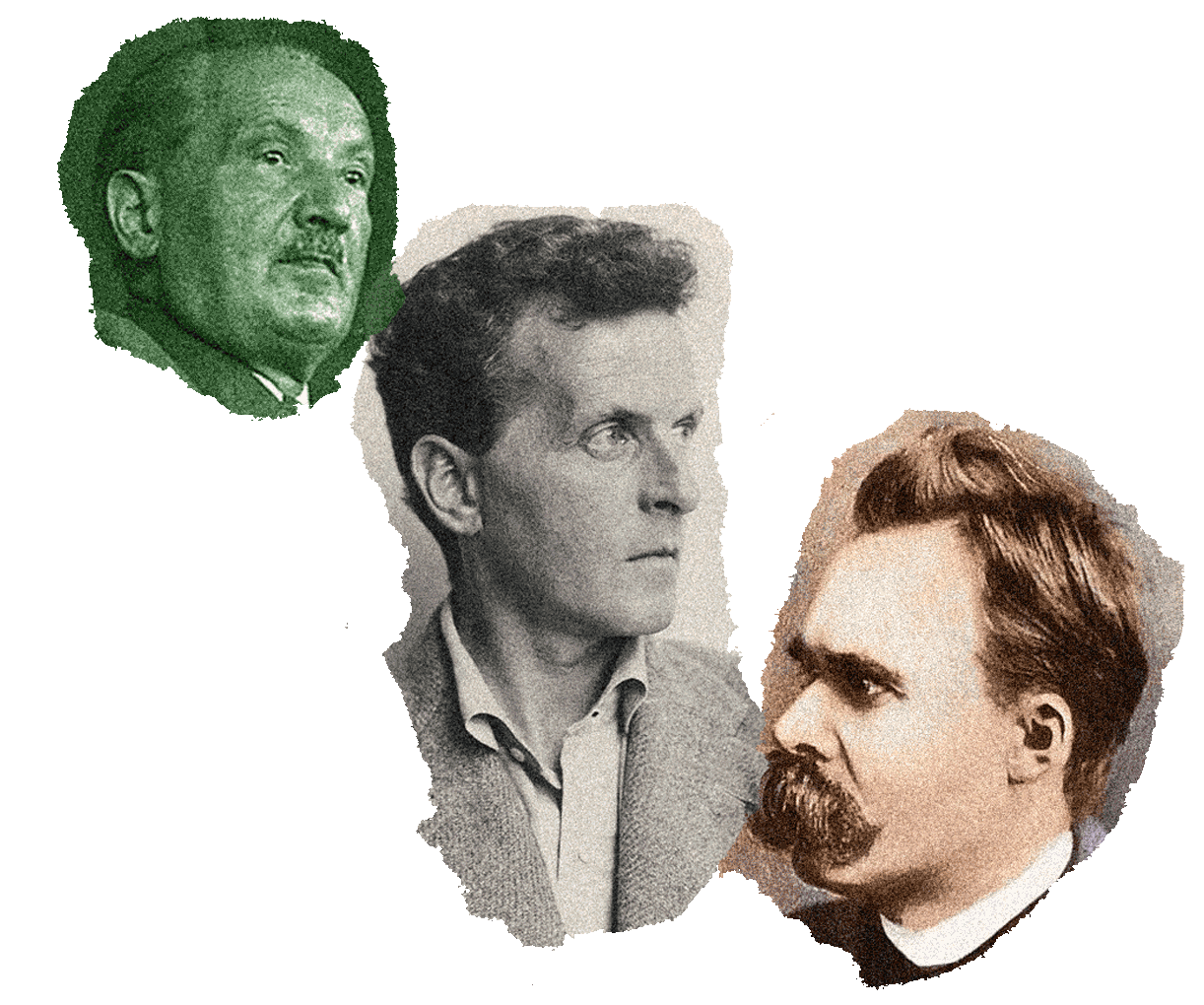
The Artificial Nietzsche
How A"I" Distorts Our Perception of Nietzsche and How We Can Counter This
The Artificial Nietzsche
How A"I" Distorts Our Perception of Nietzsche and How We Can Counter This

Our author Paul Stephan has finally had enough. The internet is being flooded with cheap A"I" content, often called "AI slop," which is just plain annoying—and is even being rewarded with countless likes and followers. Often, this content is about philosophy, too—specifically Nietzsche. How much damage is being done when this artificial Nietzsche increasingly displaces the real one, as A"I" outputs that repeat the same half-truths and falsehoods replace nuanced human interpretations? When machine-generated caricatures literally push out genuine photographs and artistic portraits? Paul Stephan embarked on an often frustrating search for answers and presents you with a few "highlights." Although he still believes that A"I" opens up positive possibilities—and occasionally makes use of them himself—in his third piece on the subject (feel free to read the first and second commentaries here and there), he feels it is time to take off the kid gloves and bring out the hammer. Stop the slop!
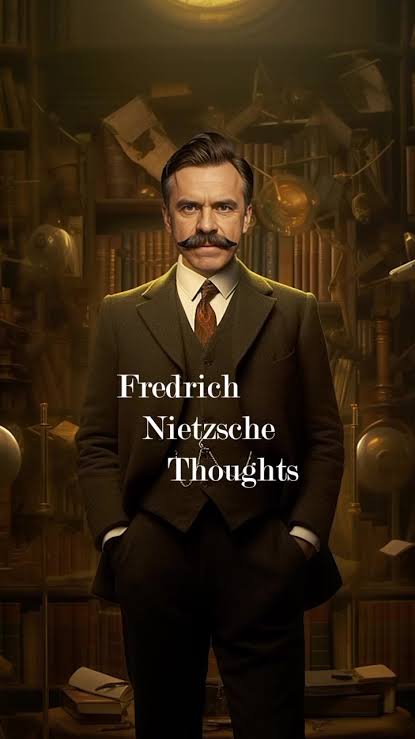
I. In the World of “Thinking, Writing, and Speaking Machines”
Nietzsche, of all people, repeatedly expresses criticism of the cultural practice of reading:
Of all that is written, I love only what a person has written with their own blood. Write with blood: and you will learn that blood is spirit.
It is not easily possible to understand the blood of others: I hate reading idlers.
Whoever knows the reader does nothing more for the reader. Another century of readers—and the spirit itself will stink.
The fact that everyone is allowed to learn to read eventually spoils not only writing but also thinking.
Once, the spirit was God, then it became human, and now it is even becoming the rabble.
Whoever writes in blood and aphorisms does not want to be read, but learned by heart.2
He warned that in times of an overflowing educational system, people could turn into “thinking, writing, and speaking machines”3 .
What he could never have imagined is that there would one day be people who, in order to learn about his thoughts, would turn neither to his works nor to interpretations, summaries, and commentaries written by humans, but to the outputs of “thinking, writing, and speaking machines” in the most literal sense. Neither reading nor learning by heart, and certainly no laborious “ruminating“4: Simply laziness and deliberate "educational philistinism"5, as Nietzsche would call it, education without substance. Written not with "blood," but with electricity.
One might welcome the fact that Nietzsche's thoughts are being shared with an even larger audience as a result. However, the following anthology aims to show that we are dealing with a massive danger here if the outputs of A"I" increasingly define what reality is, especially for young people. Not just in relation to Nietzsche, but to everything: an entire generation could unlearn how to engage with subjects independently in order to arrive at an authentic judgment through the process of experience—in other words, to educate themselves by forming and creating their own image of the world. This distorted, second-hand image, a "semblance of a semblance" detached from real experience6, could resemble the ugly, loveless grimaces with which A"I"-generated "great thinkers" are already staring at us daily, vying for our attention—at least if you spend time on social media, where A"I"-generated content featuring prominent representatives of existential philosophy, from Kierkegaard and Nietzsche to Heidegger and Sartre, is enjoying great popularity. The thinkers of authenticity serving as star witnesses for complete inauthenticity; hours of robot-created videos dealing with Heidegger's critique of technology—and to top it all off, some that even warn against the dangers of A"I"! It is hard to imagine greater cynicism on the part of the producers, and the quality rarely rises above the level of junk, so one might think that no great danger emanates from such nonsense. But one should never underestimate human stupidity and laziness, for these spawn of audacity and idiocy are clicked, liked, and celebrated thousands of times in countless enthusiastic comments, which can hardly all be from bots (even if that cannot be ruled out). So, follow me into the rabbit hole of the A"I"-Nietzsche trash heap. Just one note: this will be a deliberate selection of some particularly embarrassing and scandalous finds. Certainly, examples of outputs created by competent users could be found that are better—but if they aren't specifically labeled, they might not even be recognized as such. Perhaps that is the greatest danger of all: that we are increasingly dealing with content that originates from machines but can no longer be identified as such.
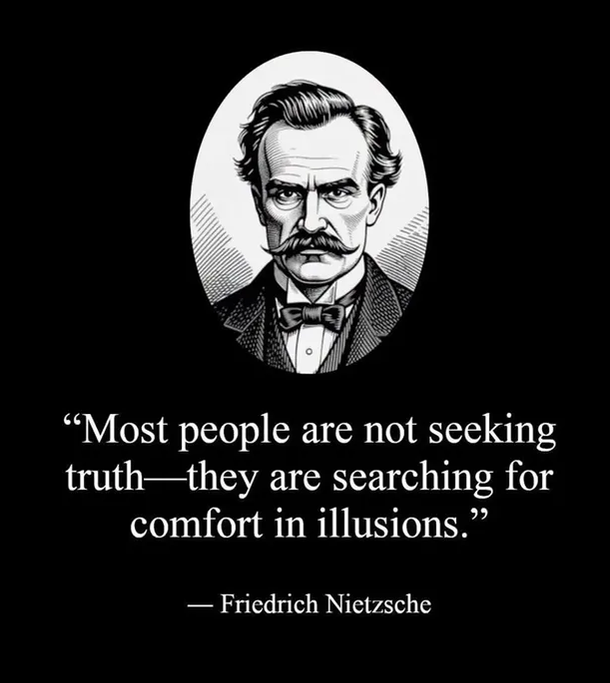
II. The Great Softening
The greatest danger, in a word, is the softening of the critical, radical impulses of the thinkers discussed. The witches' cauldron of the data centers acts as a giant washing machine that leaves hardly any content untouched. You can easily follow what this means in my recently published third "interview" with ChatGPT . Of course, it is reassuring that the machine—how could it be otherwise?—is not affected by the provocations of my alter ego Zero Newman remains unflappable and argues quite sensibly against his reactionary positions. If you are looking for the current standard opinion on Nietzsche presented in easily digestible bites, ChatGPT will certainly serve you well, provided you overlook the massive factual errors that occasionally slip through. But beyond that, there isn't much to be found, regardless of the direction.
It starts with the "reputable sources" that ChatGPT cites at the beginning. Undoubtedly, apart from the curious outlier Mazzino Montinari—who was not a significant interpreter but primarily an editor—7 these are important and rightly recognized scholars who indeed "rank among the most influential and methodologically reliable voices." However, they also reflect a specific mainstream of research that can certainly be viewed critically. Prominent voices that deviate from this, such as Martin Heidegger, Gilles Deleuze, or even Michel Foucault—for many the Nietzsche interpreter par excellence—are only mentioned by ChatGPT upon request and with reservations, to say nothing of explicitly left-wing or right-wing interpretations.
In a very un-Nietzschean way, truth thus becomes whatever the majority believes to be true—and this is necessarily the case, for how could ChatGPT form its own opinion on Nietzsche? By its very nature, it obeys statistics and, consequently, what is frequently mentioned in its sources. When it writes, "I did not choose these authors because I consider their interpretations entirely correct, but because they are considered serious points of reference in research," it is a tautology, as it would have to have developed an independent interpretation to make such an assessment. Yet that is exactly what it cannot do by its nature, even if it pretends otherwise. This is actually easy to see through—but most average users will likely believe the facade.
However, I was truly negatively surprised by the visual outputs in this third experiment. Sure, it is impressive that a computer can generate such complex images in seconds: who would have thought that possible ten or even five years ago? But the content is disappointing: the article image does not fit the article at all, and the two images of Nietzsche in the circle of significant interpreters suddenly show completely different figures than those ChatGPT mentions in the conversation—above all, only authors —and they are riddled with errors. In particular, ChatGPT fakes things, as usual, instead of admitting its limitations: many of the portraits do not even bear a resemblance to the subjects, and that even applies to Foucault, whose face is available online thousands of times over. In the first image, Jaspers and Heidegger look like twin brothers; in the second, "Chattie" apparently confused Heidegger with Albert Einstein... These are simply stereotypical depictions of 19th and 20th-century philosophers as one might imagine them, not actual portraits, even if the image suggests exactly that.
Anyone with a reasonable knowledge of modern philosophy history recognizes the errors more or less quickly—but what about all those who don't? What could be the consequence if these caricatures soon circulate by the millions online, become sources for chatbots themselves, and eventually become our standard perception? Will we perhaps mistake real photos for "AI" fakes because they don't match what we've become accustomed to?
Finally, I have already written enough in the "interview" about the censorship I experienced during image generation with both "Chattie" and its competitor, Grok. While the "AI" allowed quite a bit on the text level, I encountered relatively rigid guidelines here, which could sometimes be bypassed by simply avoiding trigger words like "fascist," but were sometimes very inflexible. Even ChatGPT itself sometimes failed to sanitize my prompts enough to finally spit out an image. It became particularly difficult, even in Grok's "spicy mode," when it came to prompts that in any way combined sexist oppression and sexuality (incidentally, only regarding women). Either way, the question naturally arises as to why a history teacher, for example, should not be able to create a fictional fascist propaganda poster. And the depiction of a woman being sexually degraded in a patriarchal society could also be done with feminist intent. But fine, one can quickly find alternatives on the net for creating "offensive" images of all kinds anyway...
What is most repulsive about the products of "AI," however, is that they are simply kitschy and uninspired. Any reasonably capable human designer would have done a much better job. The "AI" simply cannot come up with good visual ideas—and is not even able to implement them in a reasonably satisfactory way. The images are spookily similar to what one knows and expects—and yet they deviate from it through the peculiar coldness they radiate. At least this "AI" aesthetic is still relatively easy to recognize (even in texts, if you pay attention to the corresponding stylistic features)—but what if our viewing and reading habits change to the point where, through constant confrontation with the slop we become desensitized and consider it normal? A lasting damage to our aesthetic sensibility is to be feared, a further step in the "darkening and uglification of Europe"8.

III. Fright-book
A form of uglification that masquerades as beautification, because the creepiness of these "A.I." faces lies in the fact that they look like pictures of real people, yet are strangely smoothed over. This becomes particularly evident in the case of Sartre.
Beyond his provocative theses and zealous political activism, the French philosopher is primarily known for his almost "ugly" appearance. He had a severe squint and stood just 1.57 meters tall. He smoked heavily and cared little for his appearance; his clothes were sloppy, and he himself was often unkempt.
Nevertheless, through his fiery enthusiasm and brilliant intellect, he managed to appear charismatic and capture the hearts of many women. To me, this always fit Sartre’s philosophy: no matter how poor your starting conditions are, you can always make something of yourself; you are not doomed to "ugliness" unless you make it your own fate. Furthermore, one must never let oneself be defined by the gaze of others; the authentic person does not submit to their judgment, even if they do not ignore it. Sartre was truly—perhaps even more so than Nietzsche and many others—a philosopher who lived according to his philosophical ideas, embodying them in his very physiognomy. He constantly reinvented himself, integrating his entire being into a total project aimed at freedom—which meant, in particular, repeatedly engaging in word and deed against all forms of oppression, be it sexism, colonialism, fascism, or the government of Charles de Gaulle. Sartre dreamed of a liberated, socialist society—even if he wrote in his philosophical texts that this was inherently a contradiction, as there could never be a "free society."9. He even narrowly escaped a right-wing terrorist bombing attempt on his life twice! And he always openly emphasized: the fight against oppression necessarily includes violence and immoral acts against the oppressors. One must be willing to "get one's hands dirty."
Academic philosophers still hold this consistency and radicalism against him—a radicalism that at times led him to cooperate with the French Communist Party and gloss over the crimes of Stalinism—and they prefer to reduce Sartre to his early work, in which he still held views compatible with mainstream liberalism.
It is clear that "A.I." tools refer to this "Sunday sermon" version of Sartre. "A.I." makes it possible for completely unread providers of motivational courses and the like to churn out "inspirational" philosophy posts and, annoyingly, achieve a massive reach with them. Nietzsche, Sartre, Kierkegaard, and other figures of existential philosophy are particularly popular, as they (seemingly) cater to the individualistic, neoliberal ideology that these "content creators" celebrate daily.
An ominous channel called "Mr. Kingdom," for instance, regularly shares images—mostly clearly "A.I."-generated—of the creator's supposed luxury life, but also sprinkles in philosophical "words of wisdom" here and there. The "simple man" commented, for example, in a clearly artificially generated post, albeit one not labeled as such, on Sartre.
In the accompanying image (see Fig. 3), Sartre looks nothing like himself, but rather like a cozy philosophy professor puffing on his little pipe,10 while the world collapses around him. He doesn't squint, is quoted as saying "human beings are completely free," and his relationship with Simone de Beauvoir is described as "a lifelong intellectual partnership," as if they weren't a couple. All the aforementioned disruptive aspects of his activism are, of course, omitted.
Normally, I wouldn't even comment on such drivel, but this distortion annoyed me so much that I actually wrote a lengthy reply to this post, which has so far been liked 4,232 times and praised in countless comments. The creator's reply to my long comment: "you are also a philosopher, according to my understanding of philosophers they are anti-intellectual just like you did." "Mr. Kingdom" apparently cannot write a coherent sentence in English, yet pretends to have written long posts on philosophical topics himself. And anyone who criticizes him instead of simply cheering him on is dismissed as "anti-intellectual."
And it would be so simple: there are hundreds of photos of the real Sartre online, including those in the public domain. There is absolutely no need to use a poor "A.I." image for such a post.
This is no longer an exception, but has long been the rule on Facebook: more and more channels are relying on A"I", and a shockingly large number of them are dedicated to philosophical topics, even marketing philosophical e-books.11 You might object: well, Facebook has been dead for a long time anyway. But unfortunately, it’s no different on other social media platforms …

IV. Down the Drain
I first consciously encountered an A"I" Nietzsche on YouTube while I was editing Christian Saehrendt’s wonderful article on Nietzsche and techno . Its featured image is taken from a YouTube playlist that contains a wide variety of techno tracks, all of which have something to do with Nietzsche. I was quite enthusiastic about the playlist and listened to it on repeat for a while, but I became a bit suspicious because the style of the songs varied greatly and something about the vocals bothered me. Some words like "gaya scienza" were pronounced strangely, others were oddly emphasized. Something just wasn't right; there was something off about these songs. Then I found out: the creator openly admits in the descriptions that they used Suno and other A"I" tools to create the songs and even the graphics.
I would give credit where it's due here: someone really put some thought into this and created an interesting playlist, even if some of the details don't quite add up. After all, this is fairly generic techno and the corresponding synthetic voices – it’s hardly surprising that such music can be produced very well with A"I". However, these songs received hardly any clicks; perhaps such an artistic approach to Nietzsche is just too "Nietzschean" after all.
What meets with a much better response, and is usually produced without disclosing the use of A"I" – even though it is obvious to any viewer who isn't completely clueless after 10 seconds – are "documentaries" that often last more than half an hour and claim to explain the fundamental ideas of important philosophers or their works. Here, too, it is strikingly the existentialist philosophers who seem to offer themselves up as popular victims for scammers.
The channel "Philosophy Origins Deutsch" currently has almost 5,000 subscribers and features numerous videos "voiced" with such a monotonous, artificially fast voice that one would think it would be completely unbearable for any normal user – not to mention the countless embarrassing pronunciation errors it makes. Either the fans of this channel and similar ones listen at a reduced speed or have the videos summarized by an A"I" – speaking voices meeting listening machines. Or perhaps they just listen to the monotonous babble to fall asleep – it might actually be good for that.
One of the highlights of this channel regarding Nietzsche is a video titled On the Genealogy of Morality: Nietzsche's Most Dangerous Book – Documentary, which has so far gained more than 4,000 views, received nearly 100 likes, and prompted one user to leave an enthusiastic comment: “This is the best summary I’ve ever seen!” Apparently, neither the creators of this channel nor their fans are particularly concerned with German capitalization rules—at the very least, the former seem unaware that German does not have title case like English does (or perhaps the “AI” they are using doesn’t either…). Over the course of nearly an hour, the long-suffering viewer learns not only a great deal about Nietzsche’s book but also extensive biographical information about the son of a “Lutheran” pastor and his wife (!) Elisabeth Förster-Nietzsche.
Another masterpiece from the channel is Studies on Pessimism: Schopenhauer’s Cruelest Book on Existence – Documentary. 83 likes and a few enthusiastic commenters can’t be wrong—the only catch: for nearly an hour, the text-to-speech machine drones on about a book that doesn’t even exist. There is only a popular English-language anthology titled Studies in Pessimism – but that, of course, goes unmentioned in the “documentary.”
Otherwise, the channel’s “favorite authors” happen to be George Orwell and Aldous Huxley—authors of dystopian novels who warned against the very developments now being accelerated by AI. The people behind these videos seem to be nothing more than cynics…
One might counter that this channel and others like the less successful “Geniuses of the World,” where another hour is spent rambling about Friedrich Nietzsche – Loneliness, Madness, and Truth , might actually provide useful introductory information about the works and thinkers covered. But the real annoyance is that every second spent watching these videos generates revenue for the creators of these stillborn projects, revenue that is lost to professional YouTubers who invest significant time and effort into producing similar content. Attention is, after all, a finite resource.
V. niX
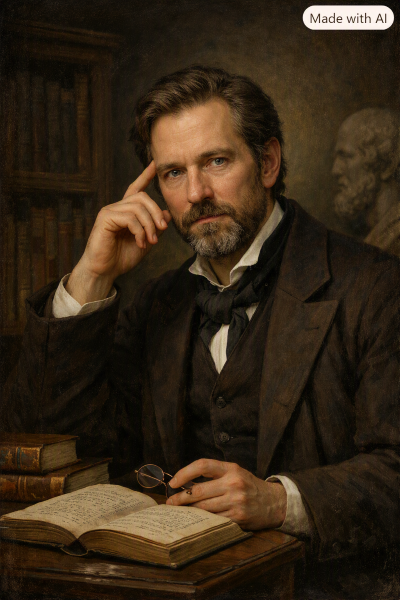
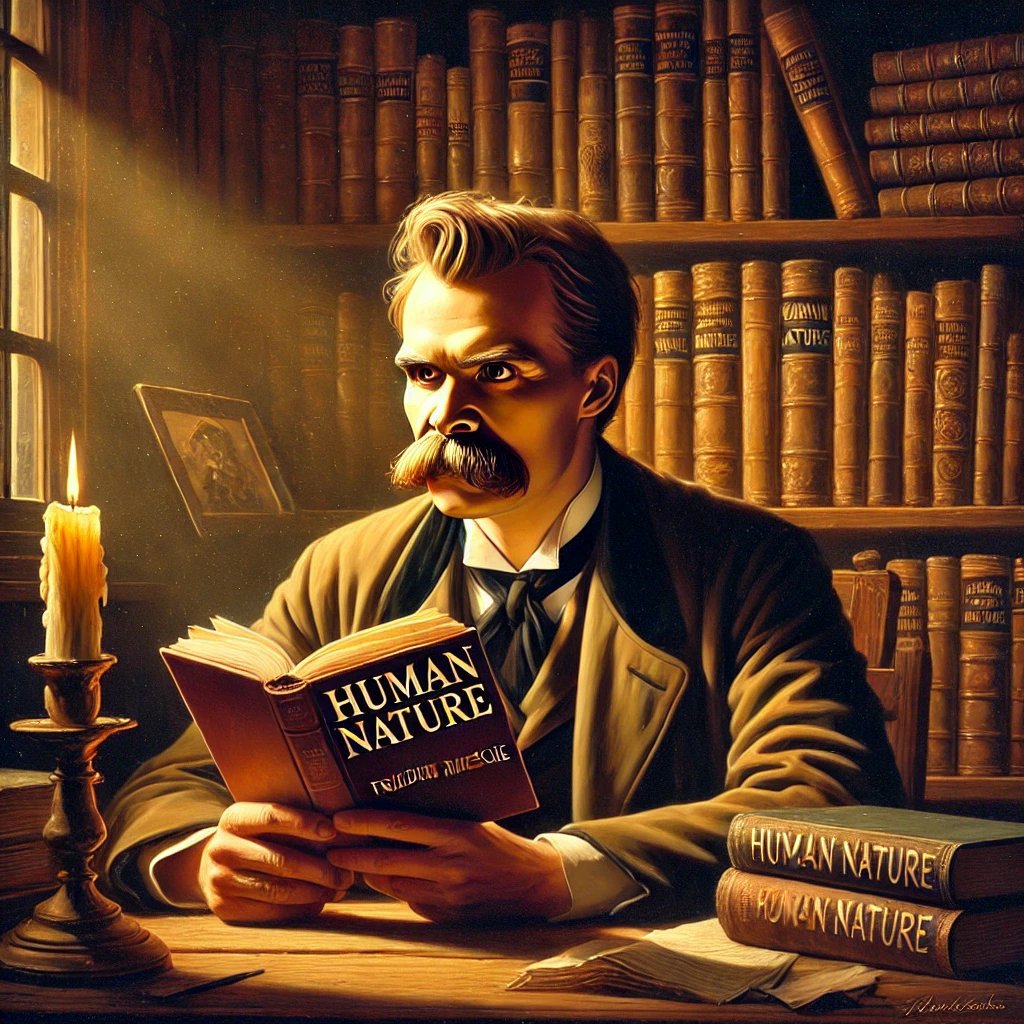
It is hardly surprising that the situation is not much different on the X platform, which aggressively encourages the use of its own "AI" software, Grok. A particularly negative example here is the channel "Friedrich Nietzsche", which, through its username – @NIETZSCHESOURCE – also suggests some kind of connection to the reputable portal nietzschesource.org . More than 100,000 followers are served "inspirational" (more or less authentic) Nietzsche quotes almost daily by this channel, accompanied by (more or less) fitting images, the majority of which are now AI-generated. One image frequently used (see Fig. 5) shows Nietzsche browsing through a book titled Human Nature , which is supposedly his own work. He is sitting by candlelight, while at the same time, sunlight is streaming in through the window. Again, the same applies: every second of attention wasted on this trash channel is a second lost for a serious Nietzsche channel …
VI. Junkipedia
However, Elon Musk's actual prestige project in terms of "AI" is the platform Grokipedia. The portal went online at the beginning of 2026 and is intended to replace the classic "left-wing, green-tainted" Wikipedia, which, fortunately, continues to rely exclusively on human-generated content. With the help of "AI," Musk aims to counter the "left-wing propaganda" of Wikipedia with "the truth, the whole truth, and nothing but the truth"12 . The scandalous and ridiculous part—hardly unexpected for a Musk project that isn't about money or technology—is that it turned out that many of the articles showed strikingly high similarities to the corresponding ones on Wikipedia or were even simply copied from it.
Wikipedia does not claim to represent "the truth" on any topic, but simply what emerges as the most sound consensus through the debate between the authors and commentators of the articles. Sometimes this results in nonsense, and Wikipedia has suffered for many years from the fact that its articles are simply far too long and often contain trivial details that have no place in an encyclopedia. Or endless lists of every possible assessment of a particular topic, which don't really help you much if you want to form your own opinion. Not to mention the sometimes questionable moderation policy of the site's volunteer administrators …
Nevertheless, for many, Wikipedia is rightly the first port of call when it comes to reasonably credible and verifiable information on a topic—at least until "AI" (unfortunately) began taking over this task more and more. People knew that fallible humans were behind it—just as it is clear that every encyclopedia can contain errors despite all due care.
That "AI," by its very nature, cannot achieve any more than Wikipedia should actually be just as obvious. Yet apparently it is not, if even people like Musk, who should be intelligent, seriously believe (unless it is simply a matter of marketing) that an "AI" could tell "the truth" about any topic, provided it has not already been researched by humans—and is thus as "true" as any human claim happens to be.
Perhaps Musk should have just asked Grok itself. When I asked, "Can you read the truth about all topics on Grokipedia?", the A"I" answered directly: "No. You cannot reliably read 'the truth about all topics' on Grokipedia," and, of all things, cited the English-language Wikipedia article on Musk's encyclopedia as the source for this statement. His conclusion:
No single medium or model provides the objective truth on every topic. Wikipedia has its own biases and quality issues, while Grokipedia has others (AI errors, reliance on training data, lack of real-time correction, and discernible ideological coloring). For serious research, primary sources, academic literature, and the comparison of multiple independent accounts remain necessary—not a single AI encyclopedia.
So, how does Grokipedia fare when it comes to Nietzsche?
It must first be admitted that the English-language Wikipedia article and the one on Grokipedia differ quite significantly—especially since it is almost unavoidable for encyclopedia entries to be very similar anyway.
However, errors quickly become apparent if you only look at the summary information in the right-hand sidebar. For instance, Nietzsche's nationality is listed as "German," even though—as Grokipedia itself explains in the article—he was never a citizen of the German Empire, having been stateless from 1869 onwards and a citizen of Prussia before that. His brief partner Lou Andreas-Salomé is listed as his "partner" in the summary, and, strangely, his academic mentor Friedrich Wilhelm Ritschl is cited as a major influence alongside Wagner and Schopenhauer.
But you also encounter more serious blunders. For example, Grokipedia claims: "By 1869, his dissertation on Theognis of Megara and habilitation on Diogenes Laërtius positioned him for academic advancement, though his interests increasingly veered toward philosophy." In reality, Nietzsche wrote his final thesis at Schulpforta in 1864 on the Greek poet Theognis and intended to write his doctoral dissertation on the late antique philosopher historian Diogenes Laërtius, but was appointed professor before he had completed that work.13 Ironically—and this is a typical A"I" blunder—this sentence even cites a website as a source, which, however, does not mention any of this at all. This creates the impression of a well-founded claim that is, in fact, completely inaccurate. And in the following paragraph, Grokipedia even writes itself: "Though Nietzsche had not completed a formal doctoral dissertation, the University of Leipzig awarded him a doctorate without examination based on his published scholarly work"!
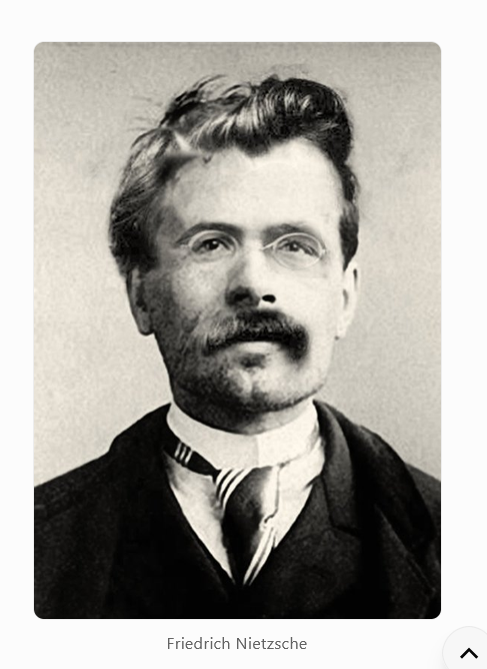
The chapter on Nietzsche's "Independent Philosophical Period" is then illustrated with an image (see Fig. 6)—as usual without a source citation—which, while frequently used online as a portrait of Nietzsche,14 does not actually show the philosopher, but at best bears a vague resemblance to him. It is likely not an A"I" fake, but an authentic photo of someone else entirely.
Numerous errors of this kind and other oddities can be found in the entry.15 Grokipedia is therefore still far from the "truth," even if one must admit that the article does provide a reasonably useful overview of the most important facts about Nietzsche. Of course, like the Wikipedia entry, it suffers from being far too long for an encyclopedia article. It is also poorly structured—the final paragraph is the only one dedicated to his "Major Works and Nachlass," after extensive reporting on "Scholarly Debates" and "Reception"—and it is bursting with redundancies. Furthermore, the sources cited are not actual books, but random internet finds of varying quality.
This again shows that while it is certainly impressive that a computer program can generate such a text at all, the result is not truly convincing. Above all, the text contains not only many facts but also several false claims and half-truths. Anyone looking for factual information about Nietzsche will find hundreds of better, human-written resources online. While these are not error-free either, they are ideally better written—and these are the very resources that provide the data for Grokipedia, which merely compiles them, and poorly at that.

VII. Stop the Slop!
One might consider all this nitpicking or a form of reverse cherry-picking. Yet, no one can deny the main problem: AI is flooding us with massive amounts of questionable content that distorts our perception of reality. And worst of all, countless users are increasingly relying on machine outputs, taking this distorted image for the "truth"—assuming that because it comes from a machine, it must be correct. This naive approach to AI leads, not least, to human craftsmanship being increasingly undervalued—to the point where even prominent politicians no longer pay for professional speechwriters for important speeches and newspaper articles, dismissing criticism of this as elitist, "untimely" grumbling.16
It is a dangerous situation. The general public is becoming increasingly uncritical of AI, thereby facilitating the replacement of human creative work with—seemingly—cheaper AI outputs (seemingly, because the true costs of computing power are not even being factored in yet17). If the average quality level of cultural products continues to decline and fewer and fewer people can make a living from creative work, we face the threat of a massive cultural decay.18 It is all just as described in the bleak culture industry chapter of the Dialectic of Enlightenment Adorno and Horkheimer, only a hundred times worse.
The only solution is to remain critical and avoid this "slop" as much as possible. At the same time, this whole situation has a positive side effect: we are suddenly reminded that behind the content we enjoy consuming, there are real people who create it with a great deal of time and love—and who deserve to be paid fairly for it. The internet may have made us too accustomed to obtaining creative content for free. And sure, it’s great that more cultural products than ever before in history are easily available for free or at almost no cost. But this "freebie" mentality is perhaps the real problem.
Perhaps, in the end, we simply get the culture we deserve: junk content at a junk level. One way out would be to be willing to spend more money on quality cultural work again—especially now.
In any case, for my philosophical work, I will only use A"I" as a peripheral tool, and this will continue to be the guiding principle of Nietzsche POParts . We are convinced that you, our readers, appreciate this clear stance. We only make an exception for translations due to cost, but we clearly label them as A"I" products where applicable. For my own translations, I don't even rely on long-established translation tools, except in exceptional cases. I simply trust my own intellectual abilities and have yet to see any benefit of A"I" for my work; in many cases, it’s the opposite—it creates extra work, as I still have to check the machine's output myself and ultimately bear the responsibility for it. For me, especially in philosophical work, it is primarily about the creative process: even if it is inefficient, I want to reach a judgment myself and communicate it in a form that matches my intention. Ultimately, I want to be satisfied with the result myself—because only then can I expect others to find it interesting. Having success with A"I" outputs that have nothing to do with my own values and thoughts simply doesn't appeal to me; I could earn my money more easily in other ways. I prefer to use A"I" for private amusement and for things like my tax return or repairing my PC—to have more time for what I actually want to do. Why should I do it the other way around?
And it is the same with the works of others. I want to know what someone has discovered for themselves after intensive study of a topic, and what judgment they have reached. Why should I be interested in an A"I" output at all, unless it is a purely functional text? Why should anyone be interested in it?
Since I am certainly not the only one who sees things this way, I am cautiously optimistic in the end. Nevertheless, the motto remains: Resist the beginnings! Stop the Slop! If the internet is increasingly turned into an A"I" junk shop, no one will benefit in the end—not even the tech companies themselves, who are already facing the problem of no longer having enough human training data for their machines. Or, there will be a major turning away from the digital world and a return to the analog, to authentic encounters, genuine creativity, and original thoughts, even if they may not be perfectly presented in terms of form. In this sense, universities should completely rethink their assessment criteria for exams and reward visible, independent reflection rather than formal accuracy. And there will likely be a boom in service providers that facilitate such experiences. A counter-movement is already emerging. This, too, might not be the worst possibility...
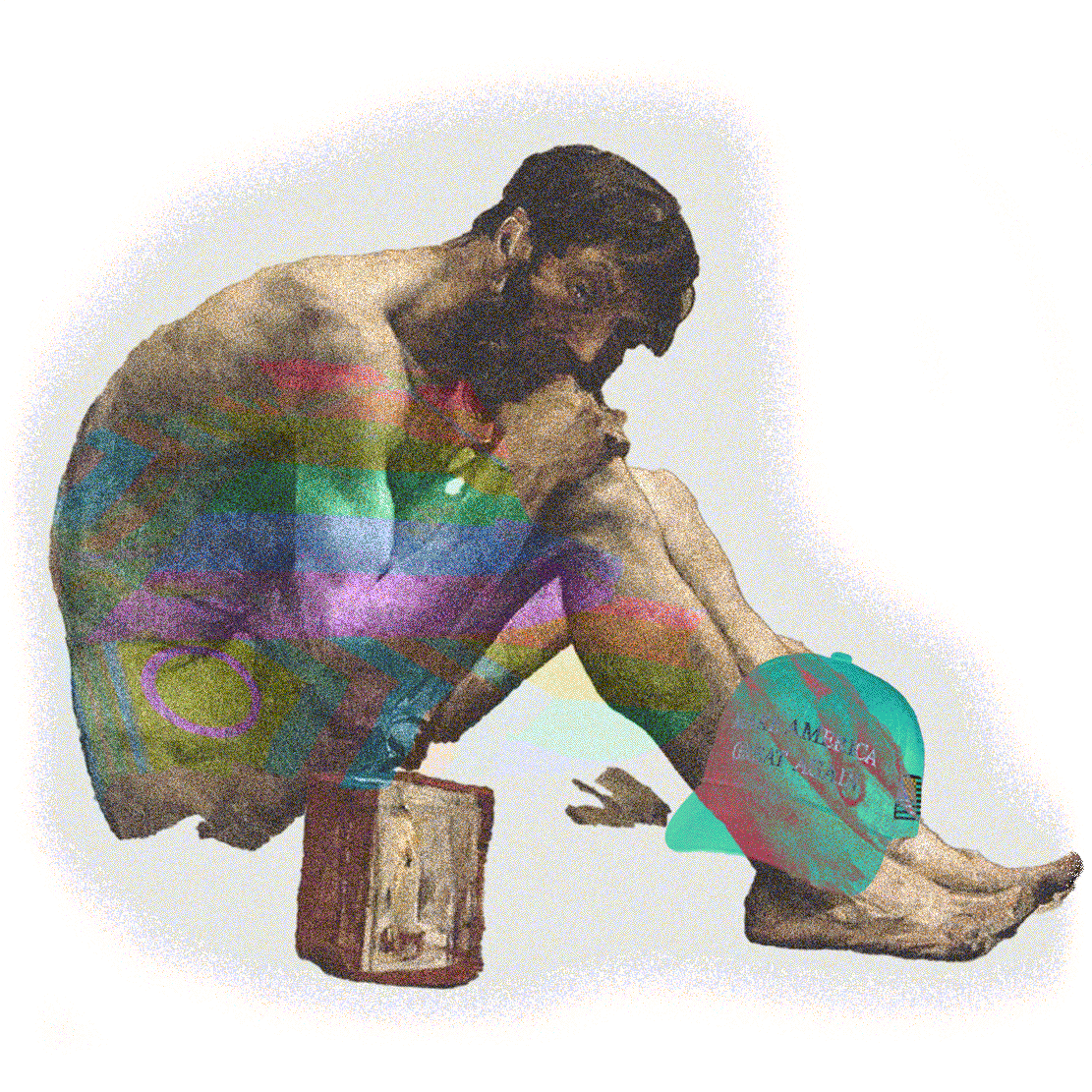
The article image comes from an online shop (link). The operator actually wants €2.86 for this "AI Art Sticker," and other merchandise products with the same motif are even more expensive.
Bibliography
Sartre, Jean-Paul: Notebooks for an Ethics. Trans. by Vincent von Wroblewsky. Reinbek near Hamburg 2005.
Footnotes
1: These figures, as well as all other numerical data in this article, reflect the status as of September 1, 2026.
2: Thus Spoke Zarathustra, On Reading and Writing.
3: On the Utility and Liability of History for Life, para. 5.
4: On the Genealogy of Morality, Preface, para. 8.
5: Human, All Too Human II, Preface, para. 1.
6: This is how Nietzsche describes the visions of the Apollonian artist (The Birth of Tragedy, para. 4).
7: For instance, the insightful afterwords in the widely circulated DTV study edition, which is based on his critical edition, were not written by him, but by his co-editor Giorgio Colli.
8: Beyond Good and Evil, aph. 222.
9: It would only be possible as complete anarchy, Sartre writes in the posthumously published Notebooks for an Ethics: “An order of freedoms is unthinkable because it is contradictory” (p. 724). Similarly, Nietzsche speaks of a “free society” as something that could only be achieved as a “wooden iron” (The Gay Science, aph. 356). However, both draw opposite conclusions from this observation: Sartre still views the struggle for liberation as valuable, whereas the later Nietzsche is concerned solely with the liberation of the individual or a select few “master types.”
10: Incidentally, as one can see from this article , Sartre was a cigarette smoker, never a regular pipe smoker.
11: A typical example is the “Nick Kasmik” channel, which at least goes to the trouble of reading the AI outputs aloud itself.
12: Cited from Deutsche Welle.
13: Instead, Nietzsche received an honorary doctorate from the University of Leipzig and published Contributions to the Source Study and Criticism of Laertius Diogenes in 1870, without submitting them as a dissertation.
14: So frequently that even Google’s AI reports: “The image shows the German philosopher and cultural critic Friedrich Nietzsche”.
15: To give just one example: Right at the end, in the “Major Works and Nachlass” section, it states: “Turkish translations of these key works have garnered high user ratings on Goodreads, approximately: Thus Spoke Zarathustra (4.07/5), Beyond Good and Evil (4.02/5), On the Genealogy of Morality (4.12/5), Twilight of the Idols (4.15/5), and Ecce Homo (4.13/5), with Turkish editions typically scoring similarly to originals depending on translation quality.“
16: Cf. FragDenStaat.
17: Cf. this detailed analysis of the dumping-based business model of tech corporations.
18: According to a report by the FAZ , the almost complete shift to AI in the production of micro-series, which consist of extremely short episodes, led to mass unemployment among actors and other employees in the corresponding film industry in China.