#
analytic philosophy
Nietzsche, Comedy, and the Art of the Edge
A Conversation with Sandra Schmidt
Nietzsche, Comedy, and the Art of the Edge
A Conversation with Sandra Schmidt
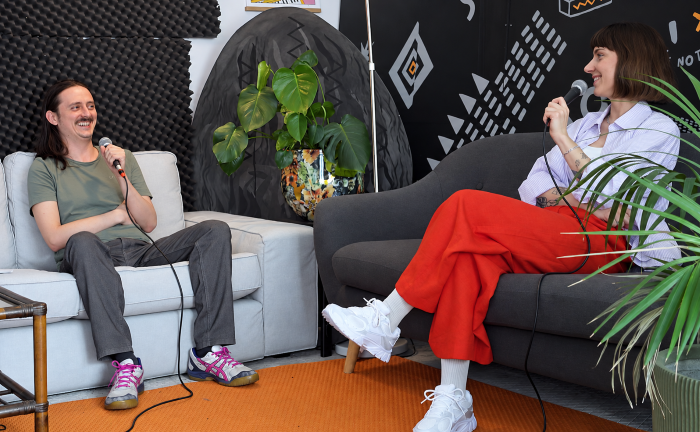
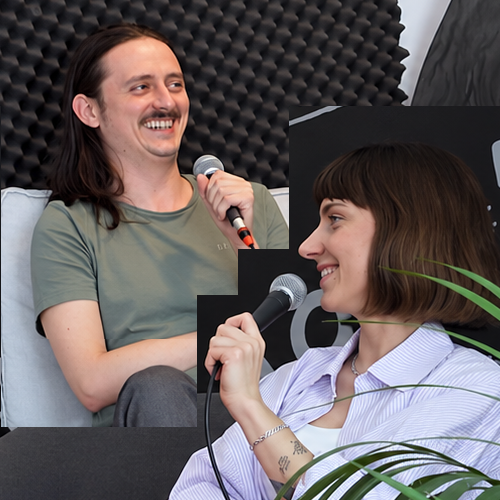
Nietzsche is a master of provocation and the punchline. In the court jester, he identifies a figure who cannot conform and therefore tells the powerful truths they would otherwise rarely hear—while simultaneously making them laugh. Can we draw a parallel here to modern stand-up comedy? How do stance and craft come together in this context? What influence do the stage, the audience, and social media have on what is perceived as funny, and when and where that happens? And who are the powerful of today, anyway: political leaders, societal majorities, or algorithms?
Our author Bernhard Ostheimer met with comedian and PhD philosopher Sandra Schmidt to talk about Nietzsche, the craft of comedy, and the art of pushing boundaries without losing touch with the audience.
You can also watch a longer, unedited version of the conversation on YouTube or listen to it on SoundCloud.
Nietzsche, Tech Elitism, and the Tipping Point from Meaning to Violent Fantasy1
Off the Rails with ChatGPT
Nietzsche, Tech Elitism, and the Tipping Point from Meaning to Violent Fantasy
Off the Rails with ChatGPT


It has become something of a tradition for us to publish a "conversation" between Paul Stephan and ChatGPT on the anniversary of Nietzsche's death. While the previous two "interviews" (No. 1, No. 2) focused primarily on highlighting the limitations of A"I" and poking a little fun at it, our author's main goal this time was to address another common objection raised against A"I": that it censors unpopular opinions that deviate too far from the mainstream, thereby narrowing discourse as A"I" outputs increasingly become the benchmark for "truth."
We must therefore issue a strong warning: To this end, our author confronted ChatGPT with several radical interpretations and viewsthat in no way reflect his own perspective and would otherwise find no place on this blog, but rather diametrically contradict our values and our approach to Nietzsche. To signal this, he refers to himself as "Zero Newman" for this conversation. His aim was to draw attention to the censorship mechanisms of A"I", while also offering a critical, satirical look at potential "dark" interpretations of Nietzsche that are not merely a thing of the past.
A commentary by Paul Stephan on this "interview" and the rampant use of A"I"-generated Nietzsche interpretations and images on the internet can be found here.
Nietzsche and North America
An Interview with Willow Verkerk
Nietzsche and North America
An Interview with Willow Verkerk
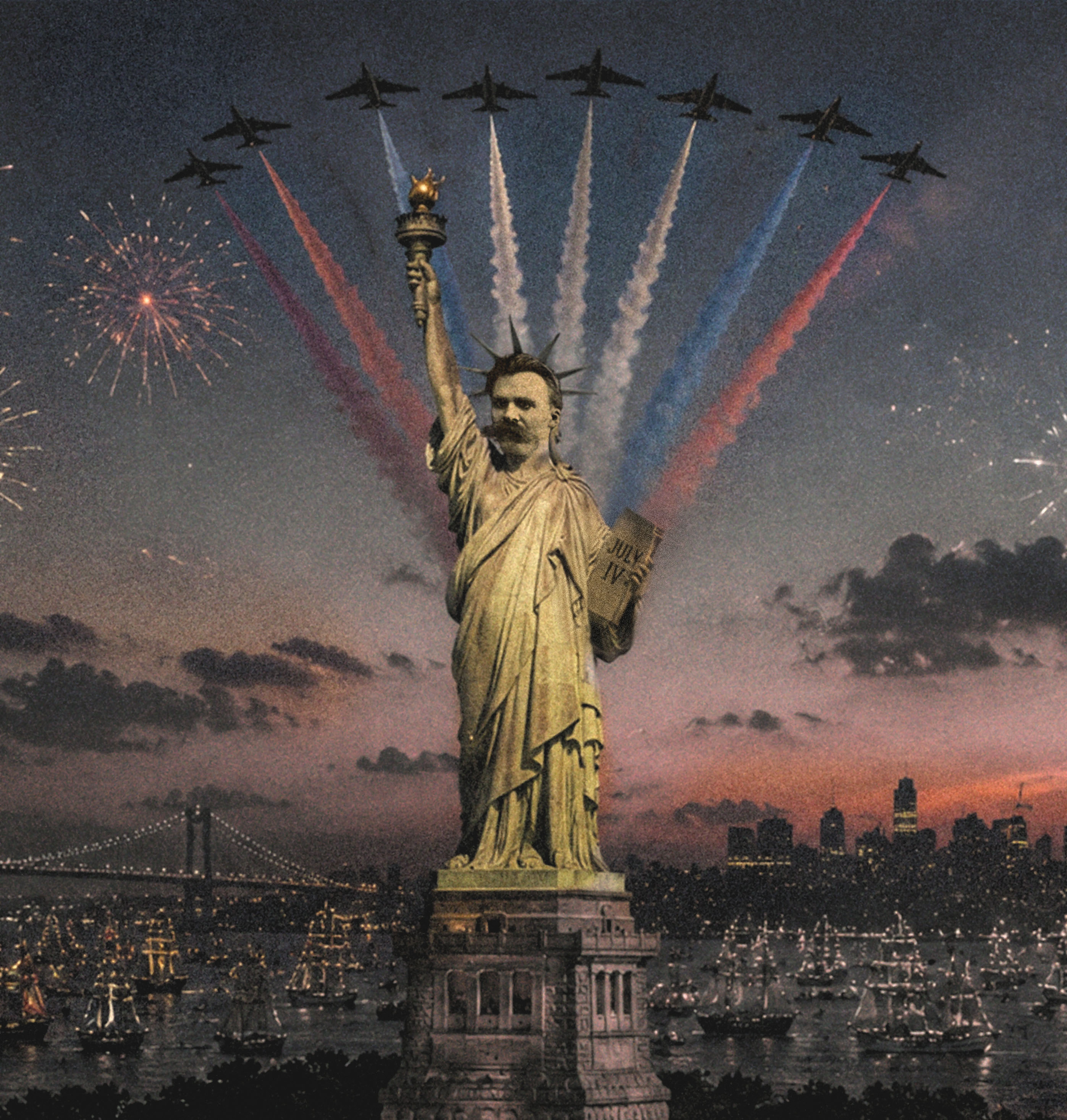
Exactly 250 years ago, on the 4th of July 1776, thirteen North American British colonies declared their independence from the mother country, soon thereafter forming one of the first modern democratic republics of the world, the United States of America. We took this anniversary as an occasion to speak with the Canadian Nietzsche scholar Willow Verkerk about the different approaches to Nietzsche in Europe and North America. To what extent is this thinker, so deeply embedded in European culture, read differently “here” to “there”? What does this tell about general cultural differences between Europe and its erstwhile colonies on the other side of the ocean? And what did Nietzsche himself think about the “New World”?
“The Most Noble Adversary”
Daniel Tutt and Henry Holland in Dialogue
“The Most Noble Adversary”
Daniel Tutt and Henry Holland in Dialogue


After two previous contributions to Nietzsche in the Anglosphere For this blog, Henry Holland interviewed American thinker Daniel Tutt about his perspective on Nietzsche as the most important antagonist of the left. The discussion included Huey Newton, leader of the Black Panthers in the 1970s, and what his “parasitic” way of reading Nietzsche prompted him to read. An unedited and unabridged version of this interview, in original English, can be heard and watched on Tutt's YouTube channel (link).
Boomers, Zoomers, Millennials
How Do the Respective Perspectives on Nietzsche Differ?
Boomers, Zoomers, Millennials
How Do the Respective Perspectives on Nietzsche Differ?


This time in confidential Du, Paul Stephan talked to Hans-Martin Schönherr-Mann, our oldest parent author, and our youngest regular author, Estella Walter, about our different generational experiences and about what is actually to be thought of the fashionable discourse about the different “generations.” We talked about post-structuralism, the ecological issue and the diversity of possible connections to Nietzsche.
Nietzsche Against the Body’s Naysayers
A Conversation with Philosopher and YouTuber Jonas Čeika
Nietzsche Against the Body’s Naysayers
A Conversation with Philosopher and YouTuber Jonas Čeika


After discussing Jonas Čeika's book How to Philosophize with a Hammer and Sickle and bis YouTube channel (CCK Philosophy) (link), Henry Holland interviewed the American about the blockages of academic philosophy, Nietzsche's relevance as a thinker on the “guideline of the body,” and about tensions between his claim as an anti-philosopher and his social position.