Nietzsche, Comedy, and the Art of the Edge
A Conversation with Sandra Schmidt
Nietzsche, Comedy, and the Art of the Edge
A Conversation with Sandra Schmidt
Nietzsche is a master of provocation and the punchline. In the court jester, he identifies a figure who cannot conform and therefore tells the powerful truths they would otherwise rarely hear—while simultaneously making them laugh. Can we draw a parallel here to modern stand-up comedy? How do stance and craft come together in this context? What influence do the stage, the audience, and social media have on what is perceived as funny, and when and where that happens? And who are the powerful of today, anyway: political leaders, societal majorities, or algorithms?
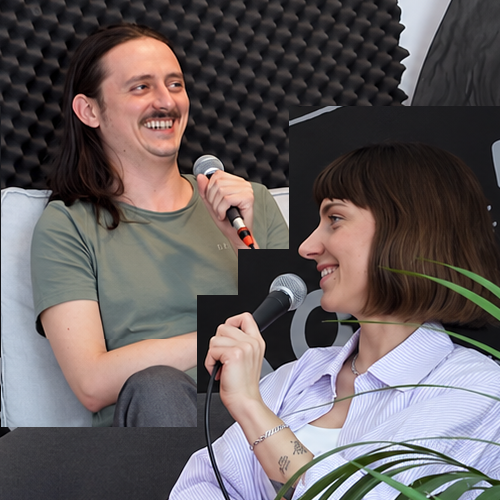
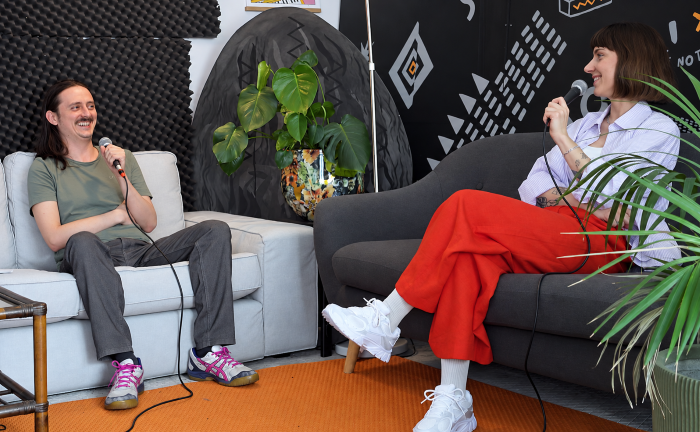
Our author Bernhard Ostheimer met with comedian and PhD philosopher Sandra Schmidt to talk about Nietzsche, the craft of comedy, and the art of pushing boundaries without losing touch with the audience.
You can also watch a longer, unedited version of the conversation on YouTube or listen to it on SoundCloud.
Bernhard Ostheimer: At Nietzsche POParts , Nietzsche's philosophy meets contemporary phenomena – this time, the stages and backstage areas of stand-up comedy.
Nietzsche's philosophy and stand-up comedy both thrive on performance, gestures, and the artful play of masks. Above all, they are connected by a unique relationship with boundaries. Wit and humor often emerge where existing orders are disrupted, shifted, or crossed. Nietzsche's philosophy also operates in such gray areas – between morality and immorality, truth and illusion, or seriousness and play.
Nietzsche therefore shares a certain penchant for provocation with stand-up comedy – or, as one might say today: for edginess. In the Urban Dictionary , Nietzsche is even described as someone who was an "edgelord before it was cool"1. However, there is a crucial difference: an edgelord wants to provoke, while a comedian wants to make the audience laugh . Comedy can afford to push the boundaries – but only as long as it doesn't lose touch with its audience.
Three current examples show that this fascination with the edge is by no means just a quirk of a few outsiders.
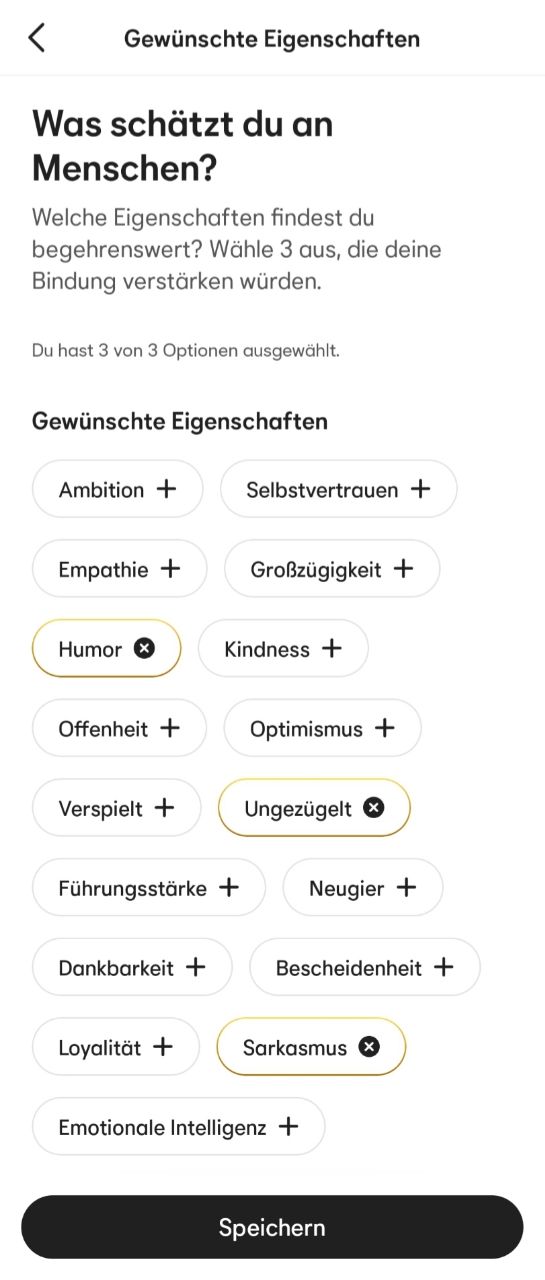
First: On the dating app Bumble, you can specifically search for someone who is "uninhibited." Edginess appears here as a factor of attractiveness (see Fig. 1)2.
Second: ChatGPT has been widely criticized for being too accommodating – a digital people pleaser. However, it didn't take long for a new personality to be introduced that bears a striking resemblance to the edgelord: Since 2025, you can talk to a "cynic." Users describe him as "amusing," "sharp-tongued," and someone "with a clear edge."3 Nietzsche also occasionally referred to himself as a cynic – though one whom you should not just agree with, but whom you should also (as he himself writes) meet with ironic resistance .4
This brings us to the third example – and to today's topic. The word "cynical" also appears occasionally in Netflix stand-up comedy, for example in short descriptions or as search suggestions (see Fig. 2). The overarching category is called "Daring" there. Taking risks also plays a central role for Nietzsche. At one point, he even suggests that "living dangerously" can bring with it "the greatest enjoyment of existence."5 Nietzsche finds his most famous metaphor for this in Thus Spoke Zarathustra: There, man is "a rope, tied between beast and Overman—a rope over an abyss." "Man" is portrayed here as something that can be transcended through a balancing act. But anyone who proclaims such lofty messages also risks making a fool of themselves. Thus, Zarathustra's appearance in the marketplace ends with him being laughed at.6 And the tightrope walker falls, too. Being misunderstood or belittled were feelings Nietzsche also knew from his own life.7 Although he wrote numerous books over the years, he went largely unnoticed during his lifetime.
Our guest today, by contrast, is familiar with the immediate response of an audience. Sandra Schmidt has been performing on comedy stages across the country for years, posting sketches on social media, and appearing on the ZDF streaming portal. This autumn, her first book will also be published by Trabantenverlag. It is titled Shit Happens and will feature a collection of stories.8 And on top of that, she recently completed her PhD in philosophy! This brings together the essential elements of the topic for her. Today, June 18, 2026, I am meeting her in Berlin.

1) Philosophical mind and comedic gut
B: Hi Sandra, it’s great to be speaking with you. As mentioned, you are a philosopher and a comedian. This means that on one hand, you are trained in analysis, which is perhaps a more cerebral pursuit, and on the other hand, you have to pay close attention to gut instincts so that your jokes don’t end up being overly intellectualized. How do your philosophical mind and your comedic gut work together?
Sandra Schmidt: Well, first of all, thanks for having me and for mentioning me in the same breath as Nietzsche. If I understand this correctly, I’m basically already a bit better than Nietzsche because I have more followers than he does. Awesome, guys, that’s what I’ve always wanted to achieve.
B: Yes, a victory in the here and now—you deserve it!
S: But to answer your question: that goes straight to the heart of the topic, "How do I do comedy?" I can feel the tension already. It’s like when I think to myself: I want to write philosophical jokes and bring philosophy closer to people. I think about that, but usually, those aren't the jokes people want to hear.
B: Are those the "overly intellectualized" ones? Do you "cancel" a lot of those before they ever see the light of day?
S: Nah, I don't "cancel" them. I actually try them out on stage, and then they bomb,9 so I end up talking about sex again and manage to turn things around that way.
B: So, you’re taking advantage of the creative freedom that exists in comedy. There are open mics, just like there are open stages for musicians where you can try things out. But if you mess up or hit a wrong note as an improv musician, people might not hold it against you as much. It’s an amateur-friendly setting. While that’s also true for stand-up comedy at open mics, the host explicitly frames it there by announcing that this is all a testing phase and that jokes are being told "for the first and last time." Does comedy need safe spaces?
S: There’s still a framework in place where, even if a joke bombs, it doesn’t necessarily mean people thought it was stupid or uninteresting. They might have even liked it, but they just didn’t laugh. You often hear that a stand-up set shouldn't be a TED Talk. I mean, it can still be interesting for people if you talk about philosophy, but they just don't laugh. Although, that’s not always the case. By the way, I believe you can make a joke about anything. There are just certain topics where it’s much harder. Philosophy is one of those difficult topics. You have to explain so much first, and the jokes really should be embedded in that. Then there are the clichés we’re confronted with: that we all just work as taxi drivers, or that we don't work at all. Or I get mistaken for a psychologist because both words start with a P.
B: So you’ve tried your hand at that, then. There are comedians who have a philosophical spin to their work.10
2) Sharpness and Craft
B: But ultimately, humor—and especially the joke—often thrives on a certain sharpness.11 And the subject of philosophy might not lend itself to that at first glance. Of course, there have been satirists and philosophers who used jokes. But there’s also a theory of humor where, over here [gestures in one direction], things are absolutely harmless—almost boring, really—and over here [gestures in the other direction], it’s just not okay anymore, where even someone like Sandra Schmidt would say, "That’s enough!" But just before that point—it builds up—just before it gets truly terrible, there’s a spice hidden there for all of us. And that’s what you’re looking for a bit as a comedian, isn't it?12 Is that right?
S: Yes, you mentioned earlier that Nietzsche was always looking for the boundary. And I think that’s what we comedians do, too. We look for the boundary, and we cross it.13 The only thing that matters is that it’s done really well. And there are cases like Dave Chappelle. He had that one special for which he was heavily criticized.14 For instance, I’m not sure if he even cared that he crossed the line like that. You never know if he just thought, "I’m willing to take the heat." Or if it was just a matter of the jokes needing to be better crafted, and then things would have played out differently.
B: Right, is it a question of craft or a question of morality? Those are the two big questions you ask yourself as a comedian when you touch on sensitive topics—it’s a tightrope walk. Filiz Tasdan, for example, said in an interview that she doesn’t tell every joke to her father,15 Erika Ratcliffe mentioned in an interview that her humor is much edgier in private than it is on stage.16 Although her stage humor is pretty edgy too. Maybe comedians have a certain temperament when it comes to boundaries. And you probably make jokes every now and then where you think, "I can’t say that on stage."
S: That’s true. I’m always unsure... Edgy jokes don’t really work for me. I think it’s because of this family dynamic I’m still caught up in. Maybe it’s because once I mention I have kids, even if the jokes come later in the set, people think, "Hey, you’re a mom now, we don’t want to hear that." Although there are other comedians who are mothers. So maybe it’s an attitude thing. Maybe I don’t have the confidence to tell those kinds of jokes, and the audience picks up on that. But there are definitely specific jokes for specific people, and eventually, you settle into a certain direction. I talk a lot about my kids or my husband, so I tend to lean that way and leave a lot unsaid, but people catch on... I actually talk about sex a lot, I realized at some point, haha. It’s a big topic, just not as explicit. I don’t do it like Erika Ratcliffe.
3) Dark rooms, boundaries, David vs. Goliath
B: I’ve been to open mics in some pretty dark basements, and sometimes I thought it was a lot like being at a concert. The perfect formula for a great concert might be: the room has to be a little too cramped. Only the band should be visible. The audience shouldn't be able to see each other. And because it’s so cramped, things can get a bit messy. You get bumped into, someone spills beer on your pants, and you just think, "Well, screw it," you know?17 Could that also apply to the ideal conditions for a comedy cellar?18 Aside from the drink spilled on your pants – what would you say?
S: Yeah, that’s true.
B: And do you think edgier jokes work better in a basement like that, where people can't see each other?
S: Yeah, definitely. That’s definitely important. The audience shouldn't be able to see each other, it has to be cramped, and only the comedian should be lit. And people need to be sitting close together. That’s why open-air events, for example, are difficult, because everything is bright and people can see one another. You can't laugh as freely then. That’s definitely true. I think it’s also a personality thing. If I talk about certain topics and establish myself as a specific type of comedian in the first few minutes, it’s weird if I suddenly pivot and get super edgy. When I play in rooms like that – for me, that’s usually 11 p.m. shows on a Friday night where the audience is just drunk – then I have seven minutes of jokes that are just edgy. But I wouldn't apply that to... I mean, that’s really just my material for that situation. At some point, you have to make those decisions, like "which direction am I going in?" You can't do everything as a comedian. And most of my material is actually clean and less edgy.
B: Right, you were probably edgier back in the day because you’re just trying things out and learning where your boundaries are, right?
S: Exactly, yeah
B: But you also get refined, right?
S: Yeah. A lot of young comedians want to be dark and edgy right from the start and tackle heavy topics, including political ones, and then they just bomb. Because it’s simply harder to write good jokes about those things. Besides, you don’t just want to get applause or laughs because something is edgy. I mean, if you go on stage and just say certain words that are inherently "funny" on their own—that’s a bit... It’s not that much fun for me.
B: It really does show that a joke needs a certain challenge or a specific opponent. You can apply that to both that kind of edginess and to a very stale, political style of comedy where you’re just laughing at straw men or women, and there’s no thrill left because there’s no "David vs. Goliath" dynamic to be seen. And that’s exactly what we want to see. I think something similar happens in cases like Dave Chappelle, as you mentioned earlier. The challenge isn't really being "taken" as it was presented, is it? I mean, Jerry Seinfeld once said in an interview that political correctness makes it harder to do comedy.19 But he later adjusted and corrected his statement, saying that political correctness and taboos are actually not the problem in comedy, but rather part of the craft itself.20 They are what make it possible to tell jokes in the first place.21
S: Yeah, exactly. I also think it’s a craft. You can make jokes about anything. I don’t think it’s as restricted as some people say. You just have to do it well, and then it works.
4) Edgelord, Affirmation of life through art
S: You just said Nietzsche was the first edgelord?
B: Yeah, that's what Urban Dictionary says.22
S: Oh, okay. So what exactly is an edgelord?
B: It’s someone who expresses controversial or even extreme views, usually in online forums. But there are real-life cases, too. The biggest edgelord in pop culture memory—the most extreme one—is probably GG Allin.23 He was a punk musician who lived his life as messed up as you can possibly imagine. Not that I think that’s a good thing, but it works as an example here. And then there’s a long gap before anyone else comes close. But I think eventually you get to Nietzsche and maybe a few other darker philosophers like E. M. Cioran or someone like that. But the key thing is that an edgelord or edgequeen doesn't really care how they come across to other people.24 That’s also the difference, for example, compared to a dandy, who has mastered the art of provocatively highlighting the contradictions in society or staging themselves within them, "without […] being cast out by it"25.
S: I find that interesting. Honestly, I wouldn't have pegged Nietzsche as an edgelord. What I find interesting is that when I try to incorporate a bit of philosophy into my set and ask the audience, everyone who hasn't studied philosophy is interested in it because of Nietzsche. I mean, Nietzsche is the Philosopher. The pop-culture philosopher, really. Everyone knows him.
B: Yeah, because he’s actually pretty easy to read, in the end.
S: Really? You think so?
B: Yeah, you could basically put together some bathroom reading from a few of his quotes. I think that would work.
S: Haha, yeah, okay. Yeah, yeah... he is kind of cool, of course, with those things like "God is dead" and so on. I can see how he was the rebel back then and why people still latch onto that now.
B: Well, sure, it does contradict the rules of the "edgelord" a bit with Nietzsche, since he writes so much and is looking for readers. Otherwise, you’d have to ask why anyone would even pick up a pen if they had such a destructive outlook on life. So, there’s still a strong need to communicate, and he does explain himself a lot. That’s why the "edgelord" label only fits partially26 and isn't as straightforward as it is with some of the pop-culture successors of that archetype.27
S: I don't actually read Nietzsche as being that destructive. Starting from his critique of moral philosophy, I mainly read his own philosophy of life, with the "affirmation of life." That you lead a good life by constantly asking yourself: "Would I affirm my life if I had to live it all over again? Would I do it all the same way?"28 And then there is the connection to art. Through art, we affirm our lives, and that is how I see myself as a comedian. That is where I see the connection between myself and Nietzsche, which we have already highlighted, and not in all that edgelord stuff.
B: Other philosophers are rather further removed from comedy. Kant, for example. I mean, there are many people who explain an incredible amount, but there is never really any laughter. With Nietzsche, there is laughter sometimes.
S: And I think he also wants us to laugh and that he is specifically opposing these strict Kantian and Christian moral concepts because they are oppressive and not life-affirming.
B: Yes, exactly. He imagines God laughing and things like that.29 And he doesn't necessarily see that in Christianity.

5) Court jester, the algorithm as a patched-together ruler, arbitrariness, building your own community
B: That actually brings us directly to the aphorism we chose to discuss.30 It is about the court jester:
Who needs a court jester. – The very beautiful, the very good, and the very powerful almost never hear the full and common truth about anything – because in their presence, one involuntarily lies a little, as one feels their influence and, in accordance with that influence, shapes what truth one might share into a form of adaptation presents (also falsifying the colors and degrees of reality, omitting details or adding them, and holding back behind their lips whatever refuses to be adapted). If people of that sort want to hear the truth despite everything, they must keep a court jester – a creature with the madman’s privilege of being unable to adapt.31
Sandra, you’re no newcomer to the world of comedy anymore. You could even call you "successful." This aphorism suggests that the more powerful you become, the more urgently you need a court jester. Do you keep a court jester yourself?
S: Oh, that’s an interesting question. I’d say maybe my husband or my children. If I discover something new and show it to my 14-year-old son, he tells me I have absolutely no clue. You often think you’re on the cutting edge, but my family shows me exactly where my limits are—and they’re honest, too. They don’t hold back the truth, they don’t sugarcoat anything, they just don’t care, haha. But actually, by the time Nietzsche was alive at the end of the 19th century, court jesters didn’t really exist anymore. Even today, it’s not like anyone thought, "Oh, we need stand-up comedians, let’s support that." It happened the other way around. Comedians feel that certain things in society need to be addressed, and they want to do that through this art form.32 I’m not even sure if the powerful today are still that keen on hearing the truth.
B: The most important difference today, it seems to me, is that the exclusive relationship between court jester and ruler has become a public relationship between comedian and audience.
S: But who are the powerful?
B: For one, there are "the beautiful" and "the good." But you're right—who are the "powerful" also explicitly mentioned?
S: Are we talking about Trump, Putin, or Merz... Or more like "society," the internet, social media, influencers, etc.? I mean, those in power are definitely being criticized. Trump is criticized by every comedian, to the point where it’s almost a bit boring to hear comedians talk about how Trump, Merz, or Söder did this or that. You just think, "Yeah, we know." It’s actually not that exciting or funny anymore.
B: Yes, those are often opponents blown up into caricatures. Perhaps what makes a good comedian is the ability to find and address the places where power emerges without an official announcement and yet, or precisely because of that, exerts its influence.33 You could also ask: Who needs a court jester most urgently today? Who is currently missing out on having one?
S: Well, I think many people really do need one.
B: It’s probably not so much the people who are already interested in comedy, right?
S: It would do a lot of people good, especially in Germany, to laugh a bit more and not take things so seriously. But I also get the impression that people are becoming more open to comedy. Even so, I think many people don’t know whether they’re allowed to laugh or not, and they overthink it. That’s a bit of a shame. I also feel like a lot of German comedy quickly becomes mainstream, simply because the scene is on such a high right now and everyone wants a piece of it. I think there’s a lack of an alternative comedy scene. On the other hand, it’s hard to say that because anyone offered success is obviously going to take it. I wouldn’t know where things are a bit edgier. Because everyone thinks, “If I do this, that, and the other, I’ll be successful. So that’s what I’ll do.”
B: So, are these the powerful people we flatter and “involuntarily” lie to a little? Because adjusting the truth for these people isn’t a conscious deception; rather, you succumb to their influence.
S: Well, the best example is social media. I’m careful about what I say there and what I don’t, and that annoys me. What I do on social media is mostly everyday stuff, nothing political. And I know that if I started getting into political topics, I’d probably lose followers. They don’t want to see that. They want to see something about my hairstyle or some silly things that happened with my kids. It was a conscious decision to say: No, I want to stay out of that. Because I feel like everything is so emotional when it comes to politics, and you’re constantly confronted with all sorts of political issues. But sometimes I play with the idea of doing deeper content. You weigh all these things up. So maybe social media algorithms are the powerful ones? On the other hand, it’s hard to say that because the algorithm is made up of people who consume certain things...
B: But it has taken on a life of its own and has become a kind of ruler, you could say. A patchwork ruler. Still, it exists, and you haven’t silenced your inner court jester yet. And I think it’s still waiting for an opportunity to present itself, so we’re very excited to see that…
S: But I think you need a certain level of standing for that to work. But all of that is always a risk. A real court jester is a risk these days. More so than back then. Although—weren’t court jesters back then also beheaded if they said the wrong thing?
B: I suppose there were settings like that, too.34 Trying to be funny under those conditions... Phew!
S: See, we shouldn't be complaining at all.
B: Sure, you don't want to complain. But because the court jester setting is so exclusive, there’s this underlying idea that jokes might actually benefit from being told in a semi-public space. That was perhaps more the case in the old media landscape (though not everything about that was good, either). Not everything was equally accessible to everyone, which also meant a different way of playing with taboos and boundaries. Today, by contrast, you’re addressing the entire public and have to anticipate their reaction. A mutual friend of ours, Mathias Haze, put it well recently: "You can still say whatever you want, you just shouldn't post everything" – the golden rule for the court jester in all of us, you might say.35 – But doesn't the quality of the humor suffer a bit because of that?
S: Yeah, I actually think a lot of it is becoming pretty arbitrary or boring. On social media, I mostly just look at what’s happening on my own page, but I hardly consume anything myself because most of it doesn't interest me. A lot of it is really dull or just constantly repeated. For example, that one reel where someone knocks on a bedroom door with a vacuum cleaner and the caption is: "When my parents visit." I think I’ve seen that twenty times in different variations because that kind of thing just gets copied. On the other hand, I also benefit from social media and love the feedback from my followers. It’s just awesome when you realize they get your humor and celebrate you. It’s completely different from a mixed show where people might laugh, but I’m not always sure if they actually get everything... Although, that happens on social media too. For instance, I just posted a reel where I say something about being able to land a plane. And there’s this running gag that 60% of all men say they could land a plane. I felt like nobody understood my clever reference in that reel. That’s a shame, of course, but I think you can still build your community through social media. And eventually, they understand you better and grow with the quality. I do believe you can build that up. Because I think it’s a great joke. But if the reference isn't understood, it’s pointless.
B: Casting pearls before swine. But what can you do? They’re the fans, haha.
S: Yeah, unfortunately, haha. And I often get comments from people who aren't followers but somehow ended up on my page. They think I’m being serious and post earnest replies under my reels. They don't even check the profile first.
B: Ah, interesting. Those are the same people who comment things like "Hey, sweetie" on AI-generated personas, haha.
S: It’s all a bit of a balancing act when it comes to quality. It’s a tightrope walk. But social media allows you to find the people who actually get you. So, while there are those who don't understand it at all, there are also those who perfectly grasp your humor, which is just cool!
B: Having a similar sense of humor is one of the most important traits for friendship, after all.36
6) Behind the scenes & out in the open, the unbridled court fool, cynicism and (mis)fortune, laughter and wonder, Adorno vs. Nietzsche
S: What I find most fascinating about this aphorism is the king's wisdom in saying, "I need someone to tell me the truth." Because the thing is: everyone is thinking it anyway. And then it just gets done behind closed doors or behind people's backs or whatever. And that’s how it is now, too. I mean, there are certain things you shouldn't or aren't allowed to say, cancel culture, etc. And in the end, it all happens behind the scenes anyway. And that’s even worse.
B: Exactly. The censor is either bypassed on stage with a microphone as a comedian or cleverly outmaneuvered—or else it’s all the more open backstage. You get up close and personal and just say it. Then the front stage is "desecrated" on a parodistic backstage.37 The potential for humor in the world is simply impossible to kill off.
S: You mentioned Bumble at the beginning. What does it mean when people there are looking for someone "unbridled"? Does that have to do with them wanting something unfiltered38 or wild?
B: Yes, I once noticed that there are seventeen categories you can search by, and one of them is "unbridled." There was also "sarcastic." But "unbridled" is the closest to pushing boundaries. I thought it leaned towards free-spiritedness or "living by your own rules."
S: Regarding the court jester and the question of who wants to hear which truth and who doesn't, I wonder if that's why people on dating apps say: "I want someone who is 'unfiltered,' someone who isn't impressed by all these things." I notice a similar urge regarding comedians. People say, "Ah, finally someone is saying that" or "Finally... they're still allowed to say that." Right?
B: Yes, that's true. The court jester and the unfiltered person are close here. At some point, you want to eat that spicy seasoning I mentioned earlier—even if not every stomach can handle it, and even if it requires a certain preparation. Who could that be in the German-speaking world... Felix Lobrecht? Filiz Tasdan has certainly ruffled some feathers with her comedy. You could also include Erika Ratcliffe. Or Ryan Long.
S: There is a new comedian who has blown up immediately, Jerry Vsan. Comedians say things on stage that you aren't really supposed to say anyway, which is why people laugh. And Jerry Vsan takes that a bit further. And regarding the topic of the edgelord: Nietzsche didn't say, "Oh, I want to say something that no one here dares to say. I want to be provocative or ruffle some feathers," but rather he philosophically and scientifically criticized the things he saw. So I don't think he necessarily wanted to provoke. And with today's edgelords, as I've understood you, I'm not so sure. And sometimes I wonder with comedians if the provocation isn't more in the foreground than... Well, I don't know—what was Nietzsche's motivation?
B: Well, in the ideal case, a cynic is someone who can "recognize while standing firm"39 or something similar, but in the worst case, it is nothing more than the display of "resilience to disappointment"40 and a "resentful"41 outsider status. Which is something no one wants to hear. So with the cynic, there is also a spectrum from success to failure. Adorno criticizes the satirist Karl Kraus by saying that someone who doesn't have the arguments42 on their side simply needs "the laughs on their side."43 And those are, of course, the laws and techniques of a comedian, right?
S: I find that very interesting. Because with my approach, I sometimes feel like I have two personalities: philosopher and comedian. I can't seem to reconcile them, and I've made my peace with that. As a philosopher, I think in a certain way, and as a comedian, I'm in a completely different mode. I don't think philosophers stand a chance with their arguments these days. I can construct the perfect argument, but nobody wants to hear that anymore. It's a bit depressing. But that's just the spirit of the times. Social media emotions, short attention spans—people need to be engaged differently. You can think what you want about that, but that's just how it is. And that's why I think laughs are actually the better arguments. Because that's how you really reach people.
B: Yes, it also shows a very strong connection between "embodiment" through laughter and truth or controversy. Because laughter has an immediate physical effect. And something like that was, of course, important to Nietzsche.44 Can you still surprise yourself with punchlines?
S: Yes, I can. That's also a great, completely different feeling. Philosophy is very satisfying for me, too. I studied analytical philosophy and got my PhD in it. You have an idea of where an argument lies, you want to defend this thesis, and when everything comes together in the end, your argument holds up, and everything flows together perfectly, that is very satisfying. The process of writing comedy is completely different because it's much more creative and I have to be in a totally different mindset. And when I come up with something like that and think, "Wow, that's funny," then you're happy that you've surprised yourself.
B: Nietzsche also says: "The charm of knowledge would be small if so much shame did not have to be overcome on the way to it."45. That might be a sentence that could fit right between comedy and philosophy.
S: But what kind of shame?
B: Well, false prejudices, false shame. Of course, there are things you should be ashamed of, but you can always examine them.46 But what I was actually getting at: besides what one might call "the knowledge of laughter," there is also a physical aspect to philosophizing. They say that when you philosophize, you experience a sense of wonder. And when you're wondering or laughing, nobody is looking at the clock.
S: I think in comedy, both come together: wonder and laughter. Because it's also about the craft and making sure the words and the structure fit until the joke is polished. Once again, I'm more on Nietzsche's side than Adorno's.

7) First gig, reading the audience, different shades of humor
B: I’m curious: what was your first show like?
S: I was absolutely terrified, my legs were shaking. It was really bad, but it went well. Of course, the audience is always super nice and sweet for your first gig; they laugh more and all that. Maybe it wasn’t actually as good as I thought, but my feeling was: “Wow, that was really cool.” And then I just kept going.
B: But I’m sure you’ve also had nights where you had a killer set, people were laughing and applauding. Then you do the exact same thing the next night and nobody laughs. When you’re lying in your hotel room later, you might ask yourself: What went wrong?
S: Yeah, it’s usually on you—meaning you didn’t adjust to the new audience, but were perhaps still stuck in the last gig, thinking, “Ah, I’ll just do the exact same thing again, it’ll work,” and didn’t read the room. And yeah, I mean, there are shows where you can do whatever you want and nothing lands. But actually... yeah, if you’re good, you should be good in any room. Sure, sometimes people laugh more at others and less at you, but usually, you’ve managed to connect with people in the audience. By now, I also know that audiences like it when there are different shades of humor. I sometimes laugh at the stupidest jokes myself. You have to allow the audience that, and the other comedians too. I mean, Mario Barth, for example, is tricky—but not everything has to be super deep or clever all the time. Sometimes you just want to laugh at stupid stuff.
B: Well, of course!
S: And the audience wants that too. And then, in the next moment, they also want to see about it laugh and then again about it, etc.
B: Sandra, thank you so much for this conversation!
S: Thank you for the invitation. It was lovely.
B: I thought so too.
Sandra Schmidt (born 1985) comes from a small village in southern Hesse, but has lived in Berlin with her family since 2011. She has been a successful stand-up comedian since 2021 and performs regularly at various comedy clubs across the German-speaking world. Her solo show Best Decisionpremieres in the fall of 2026. Before her comedy career, she studied philosophy at the University of Western Australia in Perth and Humboldt University of Berlin. She eventually earned her doctorate at the University of Potsdam. The topic of her dissertation: Personal Autonomy and the Limits of Subjectivist Concepts. Her book Shit Happens, which contains personal short stories,will be published in 2027.
Bernhard Ostheimer studied social work and cultural studies and has worked in theater and music education. In his bachelor's thesis in social work, he examined how non-professional actors produce content, present themselves, and observe one another on the participatory web. His focus was on the thresholds between stage and life, performance and staging, and the public and private spheres. He developed semi-improvised plays with children who had limited German language skills, creating a loose narrative framework that left room for spontaneous ideas. In his master's thesis, Bernhard Ostheimer analyzed how controversial positions can be explored and tested within an "as-if" framework using an improv debate game. This work combines his interest in the performative—representing and testing—the agonal—regulated conflict—and the ludological—games and their rules. Which, in turn, is not too far removed from Nietzsche. He is also a member of the Halcyonic Association for Radical Philosophy.
Bibliography
PostPostPost: In Defense Of The Edgelord. Online: https://donotresearch.net/posts/in-defense-of-the-edgelord.
Adorno, T. W.: Minima Moralia: Reflections from Damaged Life. Suhrkamp: 2001.
Bataille, G.: Play and Seriousness. In: J. Huizinga & K. Ebeling (Eds.): The Play Element of Culture: Play Theories after Johan Huizinga. Matthes & Seitz: 2014, pp. 75–111.
Becker, A.: How the new ChatGPT-5 personas work. all-ai.de. Online: https://www.all-ai.de/tutorials/tutorials-ki/chatgpt-personas-anleitung.
Benjamin, W.: The Destructive Character. In: Collected Works II. Zweitausendeins: 2011, pp. 304 et seq.
Ben Saoud, A. & S. Weiss: Does Satire Have Limits? Cabaret Artists in the Chat, Where Words Can Hurt. Online: https://www.derstandard.at/story/2000117919609/kennt-satire-grenzen-kabarettisten-im-chat-wo-worte-wehtun-koennen.
Birkenbihl, V. F.: Humor in Our Lives: Humor as a Key to Self-Knowledge and Understanding Others. Klarsicht Verlag: 2026.
Bossart, Y.: Laughing Anyway: A Short Philosophy of Humor. Blessing: 2022.
Bredow, W. von & Noetzel, T.: Political Judgment. VS Verlag für Sozialwissenschaften: 2009. Online: https://doi.org/10.1007/978-3-531-91981-2.
Camus, A.: The Rebel: An Essay on Man in Revolt. Trans. by J. Streller. Rowohlt: 1970.
Caysa, V.: Flesh/Body. In: H. Ottmann (ed.): Nietzsche Handbook: Life – Work – Impact. J.B. Metzler: 2011, pp. 271–273.
Christians, I.: Creating. In: H. Ottmann (ed.): Nietzsche Handbook: Life – Work – Impact. J.B. Metzler: 2011, pp. 317 f.
Christians, I.: Type. In: H. Ottmann (ed.): Nietzsche Handbook: Life – Work – Impact. J.B. Metzler: 2011, p. 341.
Colleary, S.: Performance and Identity in Irish Stand-Up Comedy: The Comic „i“. Palgrave Macmillan UK: 2015. Online: https://doi.org/10.1057/9781137343901.
Foucault, M.: What is Enlightenment? In: E. Erdmann, A. Honneth & R. Forst (eds.): Ethos of Modernity: Foucault's Critique of Enlightenment. Trans. by E. Erdmann & R. Forst. Campus Verlag: 1990, pp. 35–54.
Foucault, M.: Of Other Spaces: Utopias and Heterotopias. Trans. by M. Bischoff. Suhrkamp: 2005.
Frisch, M.: Questionnaire. Suhrkamp: 1992.
Frischmann, B.: Live Dangerously! In: C. Niemeyer (ed.): Nietzsche Lexicon. WBG: 2011, pp. 127 et seq.
Gebhard, W.: Shame. C. Niemeyer (Ed.): Nietzsche Lexicon. WBG: 2011, pp. 333–335.
Goffman, E.: The Presentation of Self in Everyday Life. Piper: 1996.
Hartmann, U.: Cynic Border Crossings. The Greek Philosopher Hipparchia. In: E. Hartmann, U. Hartmann & K. Pietzner (Eds.): Gender Definitions and Gender Boundaries in Antiquity. Steiner: 2007, pp. 229–246.
Heath, J. & A. Potter: The Rebel Sell: Why the Culture Can't be Jammed. Trans. by T. Laugstien. Rogner & Bernhard at Zweitausendeins: 2005.
Heinrich, K.: Ancient Cynics and Cynicism in the Present. In: Parmenides and Jonah. Four Studies on the Relationship Between Philosophy and Mythology. ça ira: 2020, pp. 129–156.
Hiergeist, B.: Bombing. Online: https://setup-punchline.de/stand-up-lexikon/bomben/.
Hörner, F.: The Dandy. In: M. Schroer & S. Moebius (Eds.): Divas, Hackers, Speculators: Social Figures of the Present. Suhrkamp: 2010, pp. 54–67.
Jantz, J.: ChatGPT and its personalities. How to use them correctly. Online: https://www.giga.de/tech/chatgpt-und-seine-persoenlichkeiten-so-nutzt-ihr-sie-richtig--01KATXKSRBQVS9KAR1KW9PZSV9.
Kloë, C.: Comedy as Communication of Cultures. Springer Fachmedien: 2017. Online: https://doi.org/10.1007/978-3-658-17201-5.
Niemeyer, C.: Nietzsche's Life. In: H. Ottmann (Ed.): Nietzsche Handbook. J.B. Metzler: 2011, pp. 9–34.
Phillips, Z. G.: Jerry Seinfeld Regrets His Comments About the “Extreme Left” Ruining Comedy: “It’s Not True”. Online: https://www.hollywoodreporter.com/news/general-news/jerry-seinfeld-regrets-comments-extreme-left-ruining-comedy-1236032727/.
Pietzcker, C.: 5.2 Jokes and Their Relation to the Unconscious (1905). In: H.-M. Lohmann & J. Pfeiffer (Eds.): Freud Handbook. J.B. Metzler: 2013, pp. 119–121.
Pietzcker, C.: 10.8 Humour (1927). In: H.-M. Lohmann & J. Pfeiffer (Eds.): Freud Handbook. J.B. Metzler: 2013, pp. 207 f.
Ruoff, M.: Foucault Dictionary. Development, Core Concepts, Contexts. Fink: 2007.
Sigmund, S. & R. Utz: On Cynicism. In: Berliner Debatte Initial, Vol. 19 (No. 5) (2008), pp. 41–50.
Tasdan, F.: Comedian Filiz Tasdan on Berlin. We ignore each other tolerantly. Online: https://www.tagesspiegel.de/berlin/comedian-filiz-tasdan-uber-berlin-wir-ignorieren-uns-tolerant-12369122.html.
Teichert, J.: Friendship. Definitions from different perspectives. In: Idem (Ed.): Digital occupants. How digital media change the communicative negotiation of friendships. Springer Fachmedien: 2023, pp. 49–68.
Treiber, H.: Friends. In: H. Ottmann (Ed.): Nietzsche Handbook. J.B. Metzler: 2011, pp. 35–49.
Trivera, M.: 6 Reasons Nietzsche Was The Original Internet Edgelord. Medium. Online: https://milestrivera.medium.com/6-reasons-nietzsche-was-the-original-internet-edgelord-f0ba51ea826c.
Umathum, S.: Performance. In E. Fischer-Lichte, D. Kolesch & M. Warstat (Eds.): Metzler Dictionary of Theater Theory. J.B. Metzler: 2005, pp. 231–234.
Velten, H. R.: Jester. In: U. Wirth (Ed.): Comedy. J.B. Metzler: 2017, pp. 42–46.
Footnotes
1: Trans. BO. Whereby for this purpose also Diogenes of Sinope would be a candidate. He lived as early as 400 BC and was known during his lifetime, both in Athens and beyond, as a public provocateur and an unconventional artist of living. In stark contrast to anonymous internet trolls, almost everything he did was "non-anonymous." Diogenes belonged to the ancient philosophical and countercultural movement of Cynicism. Within that circle, one might also find a contender for the title of the first "edgequeen": Hipparchia, who maintained a partnership with Diogenes’ student Crates that was unconventional for her time. She, too, cultivated a cynical, "demonstratively provocative demeanor in public," was considered cheeky, mocking, and shameless, and managed to hold her own in the male-dominated field of philosophy as one of the few historically documented women through her persuasive "argumentation" and "quick-wittedness" (cf. Hartmann, Cynical Boundary Crossings, p. 237 et seq.).
2: However, users on Bumble do not describe themselves as "unbridled." Rather, the app seems to derive this trait indirectly from user profile information and responses.
3: Cf. Jantz, ChatGPT and its Personalities and Becker, How the new ChatGPT-5 personas work.
4: See, for example, the Letter to Carl Fuchs dated July 29, 1888 (No. 1075), Beyond Good and Evil, aph. 26, Human, All Too Human II, Preface, para. 5 and Ecce Homo, Why I Write Such Good Books, para. 3.
5: The Gay Science, aph. 283. Cf. Frischmann, Live dangerously!
6: Fittingly for Zarathustra’s marketplace scene, a person writing under the pseudonym “PostPostPost” states in an article titled In Defense Of The Edgelord, that edgelords are “crazy enough to take on the consensus or the hegemony alone, without the backing of a tribe. Sometimes they are even foolish, but they do not shy away from being considered cringe” (trans. PS). Starting from the figure of the “beautiful soul,” critically conceived by Hegel and taken up by Lacan, PostPostPost constructs the edgelord as its counterpart. While the “beautiful soul” fails to recognize its own role in the conditions it criticizes, thereby preserving its morally upright self-image, the edgelord consciously performs a socially offensive role.
7: Cf. Niemeyer, Nietzsche’s Life, pp. 17 & 21 f. and Treiber, Friend, pp. 35 & 43.
8: Further information on this can be found on the publisher's website.
9: Bombing in comedy jargon means "to fail on stage, to get no laughs, to drop bad or flat jokes on the audience, forcing them to mentally retreat into a bunker" (Hiergeist, Bombing).
10: Famous contemporary examples include George Carlin, Louis C.K., Ricky Gervais, or Hannah Gadsby.
11: Wit and humor can be distinguished using a question from Max Frisch's Questionnaire : "When you sense that someone is meeting you with antipathy: what are you more capable of, wit or humor?" (p. 37.)
12: The sharpness scale and the metaphor of a "spice" are borrowed from the lecture Humor in Our Lives by Vera F. Birkenbihl. The basic idea, however, goes back to Sigmund Freud. According to this, a joke arises through the "saving of moral inhibition and suppression effort in favor of a gain in pleasure," during which energy that has become useless is 'laughed off' (cf. Sigmund & Utz, On Cynicism, p. 44, Pietzcker, Jokes and Their Relation to the Unconscious and ibid., Humor). The more energy or inhibition effort was directed toward a perceived danger, the more can consequently be 'wasted' (cf. Bataille, Play and Seriousness, p. 84). Unlike many of Freud's other theories, his theory of wit is still used today to explain wit as a "temporary loss of control" and "as a valve for releasing pent-up energy" (Bossart, Laughing Anyway, pp. 21 f.). Authors Potter and Heath also conclude that "Freudian theory, however one ultimately evaluates it, [...] certainly has a certain explanatory value. Or does anyone have a better theory of wit?" (Consumer Rebels, p. 61.)
13: See also Yves Bossart's current philosophical introduction to humor titled Laughing Anyway: "Comedy, jokes, and wit are often playful forms of boundary-crossing. The rules of common sense and decency are forgotten for a moment – which has a relieving and liberating effect" (p. 12).
14: This refers to Dave Chappelle's 2021 Netflix special The Closer, in which Chappelle expressed critical views on certain queer-feminist positions – which some saw as successful satire and others as clumsy polemics. You can find a brief overview of this highly complex controversy on the German Wikipedia.
15: Cf. Comedian Filiz Tasdan on Berlin.
16: Cf. Ben Saoud & Weiss, Does Satire Have Limits?
17: Although such a scenario is more applicable to rock or punk concerts than, for example, classical music. Intentional beer showers are not meant here. The slightly spilled drink is similar to sweating in the same room, where you can also get soaking wet.
18: This is where the concept of heterotopias could also be cited. These are characterized as "other spaces" or "counter-sites" (cf. Foucault, Of Other Spaces, pp. 10 f.). They create illusions "that set themselves against reality, devalue it, and potentially call it into radical question" (Ruoff, Foucault-Lexikon, p. 174). The term originates with Michel Foucault. According to him, there are "probably" spaces in all societies where different or unusual (ground) rules apply temporarily (Foucault, Of Other Spaces, p. 11). In this sense, comedy clubs can be placed in the same category as the gardens, museums, and nudist beaches that Foucault cites as examples of heterotopias (see also the chapter "Comic heterotopias" in Susanne Colleary, Performance and Identity in Irish Stand-Up Comedy). For these, it is not uncommon, for example, for the audience to be involved in the performance (so-called crowdwork) or for them to contribute spontaneously by interrupting or criticizing the comedian, which in turn challenges the comedian's quick-wittedness or can lead to the removal of the provocative individual(s). The crucial point here is that the inherently conflict-prone dynamic within the heterotopic setting of a comedy club can primarily be experienced as a playful and interactive thrill. In rare cases, however, conflicts can escalate, requiring security personnel to intervene.
19: Cf. a conversation Seinfeld had with Tom Papa (link).
20: Seinfeld says: "If you're Lindsey Vonn, if you're a ski champion, it doesn't matter where the gates are on the mountain, she's going to make the gate. It's the same with comedy. Whatever culture we're in, we're going to make the gate. If you don't make it, you're out of the game. The game is where the gate is, and how I make the gate to get down the hill" (Phillips, Jerry Seinfeld Regrets His Comments About the “Extreme Left” Ruining Comedy; trans. PS).
21: Cf. Kloë, Comedy as Intercultural Communication, p. 185.
22: See also the essay 6 Reasons Nietzsche Was The Original Internet Edgelord by Miles Trivera.
23: The 2017 documentary The Allins by Danish director Sami Saif explores a possible connection between GG Allin’s traumatic childhood and his later "edgelord" persona through conversations with his mother and brother.
24: As Walter Benjamin might add: "The destructive character is not at all interested in being understood. He views efforts in that direction as superficial. Being misunderstood cannot harm him. On the contrary, he invites it [...]. The most petty-bourgeois of all phenomena, gossip, only comes about because people do not want to be misunderstood. The destructive character allows himself to be misunderstood; he does not encourage gossip" (The Destructive Character, pp. 304 f.).
25: Hörner, The Dandy, p. 60. Interestingly, much of Albert Camus’s description of the dandy applies more to the modern understanding of the edgelord. Later characterizations of the dandy by Foucault and Fernand Hörner, however, emphasize a social factor (cf. Camus, The Rebel, pp. 41 ff., Foucault, What is Enlightenment?, p. 44 and Hörner, The Dandy, pp. 60 ff.). This may indicate a conceptual evolution since the 1950s. The term "edgelord," by contrast, only emerged in the 2010s (cf. the corresponding entry in the Oxford English Dictionary). Edgelords and edginess-queens can be understood as different manifestations of nonconformism. Edgelords and -queens aim to irritate or shock, whereas dandies, despite their divergence, command a certain level of admiration or recognition.
26: Nietzsche’s occasionally destructive self-presentation is a case in point. His famous declaration, "I am dynamite" (Ecce homo, Why I Am a Destiny, para. 1), is notable, with the dynamite metaphor originating from a review of Beyond Good and Evil , which Nietzsche subsequently adopted (cf. Letter to Heinrich Köselitz, Sept. 20, 1886; no. 751). Similarly, he described his own project as "How to Philosophize with a Hammer," the subtitle of Twilight of the Idols.
27: Trivera reaches a similar conclusion in 6 Reasons Nietzsche Was The Original Internet Edgelord: Being "edgy" often means nothing more than preferring the "spectacle of substance" (trans. PS). However, he identifies the crucial difference between Nietzsche and the mere edgelord in the effectiveness of the provocation: Nietzsche "had an impact. He wasn't edgy because he cared about edginess; he wasn't a contrarian because he was chasing a specific punk rock aesthetic. And he didn't lie. Nietzsche truly had an edge and he truly challenged the world he was dealing with, and those questions, in turn, challenged the shape of the world" (trans. PS). Nietzsche thus appears not merely as a representative of an existing type, but retrospectively as its "archetype" (Trivera; trans. PS). This, in turn, aligns with Nietzsche’s self-presentation as an exceptionIn this sense, alongside bombastic phrases such as “I am dynamite” or “how to philosophize with a hammer,” one also finds more inconspicuous, yet no less distinctive statements such as “I am a nuance” (Ecce homo, The Case of Wagner, sec. 4, cf. Christians, Schaffen& ibid., Typus). Regarding comedy, Nietzsche’s self-staging and masking as a “fool” and “buffoon” can also be cited here (cf. Human, All Too Human I, Epilogue, sec. 2 and Ecce homo, Why I am a destiny, para. 1).
28: One of the fundamental aspects of the philosophy of eternal recurrence (cf. esp. The Gay Science, aph. 341).
29: Cf. e.g. Beyond Good and Evil, aph. 294.
30: In Zarathustra it also says: "Better no God, better to make destiny for oneself on one's own, better to be a fool, better to be God oneself!" (Out of Service.)
31: Daybreak, aph. 451.
32: For a historical overview of "fun-makers," ranging from jesters, clowns, court fools, and rogues to comedians, see the 2017 article of the same name by Hans Rudolf Velten.
33: PostPostPost argues similarly in In Defense Of The Edgelord. Citing Stuart Hall, they emphasize that ideology works best when it "thrives and flourishes below the level of consciousness" (trans. PS). It is at the level of common sensethat ideological frames of reference are most firmly anchored and exert their greatest influence, "for it is here that their ideological nature is most effectively obscured" (trans. PS).
34: For instance, in a text from the exhibition "Narrenfreiheit!?" at the Badische Landesbibliothek: "The status of a court jester was marked by great uncertainty: on the one hand, no courtier was closer to the prince, and no one was allowed to take more liberties or break the often very strict court rituals with such impunity. On the other hand, he needed a keen sense of when his master's patience had reached its limit, for even he was not immune to punishment." See also the TED Talk How dangerous was it to be a jester? by Beatrice K. Otto (link).FormularbeginnFormularende
35: Cf. the theater studies encyclopedia entry on "Performance" by Umathum. It explicitly addresses the distinction between a fleeting event and its preservation through media. With reference to Peggy Phelan, performance is defined there (among other approaches) as an unrepeatable event that exists exclusively in the present—and changes its status as soon as it is recorded, documented, or transferred into the circulation of media representations. This transience is thus viewed here as a genuine defining characteristic of performance (cf. p. 232).
36: Cf. Teichert, Freundschaft, p. 57.
37: Cf. Goffman, The Presentation of Self in Everyday Life, pp. 158 et seq. Erving Goffman's chapter is titled "The Treatment of the Absent." The difference from gossip lies in the stronger emphasis on gestural and facial aspects, whereas gossip is more discursive and informative.
38: "Unfiltered" is also a common term used for comedy on Netflix.
39: Heinrich, Ancient Cynics and Cynicism in the Present Day, p. 115.
40: Bredow & Noetzel, Political Judgment, p. 252.
41: Sigmund & Utz, On Cynicism, p. 43.
42: In the original text, Adorno uses the term "proofs" instead of "arguments." However, for the further course of the discussion, one can refer here to the evidence (or the example). An argument consists of three components: claim, reasoning, and evidence. Ideally, the evidence possesses a persuasive power that comes close to that of a proof.
43: Cf. Adorno, Minima Moralia, p. 280 (Aph. 134).
44: Cf. Caysa, Body/Flesh.
45: Beyond Good and Evil, aph. 65.
46: See also the entry on "shame" in the Nietzsche-Lexikon by Walter Gebhard. According to this, Nietzsche views shame on the one hand as an "incentive for self-development." On the other hand, he describes being shamed in social situations as "bad" and warns in particular against the risk of shaming in pity (cf. p. 334). Gebhard argues that Nietzsche generally "dismantles the validity of [shame] insofar as it dictates inhibition and lack of freedom." In particular, Nietzsche "aims at metaphysical de-shaming" (ibid.). This primarily concerns a Christian-influenced approach to shame (cf. ibid.). However, his critique is directed neither at shame per se nor at its overcoming in general: where it inhibits and restricts freedom, its self-determined overcoming may be necessary; where, however, it protects the hidden from intrusive exposure or maintains boundaries in social interaction, it appears worth preserving (cf. The Gay Science, preface, sec. 4 and Human, All Too Human II, Assorted Opinions and Maxims, aph. 256).