
Nietzsche POParts
Aren’t words and notes
like rainbows and bridges
of semblance,
between that which is
eternally separated?
Nietzsche
POP
arts
Nietzsche

Sind

nicht

Worte


und

Töne
Regenbogen
POP

und

Scheinbrücken

zwischen

Ewig-

Geschiedenem
arts

Timely Blog on Nietzsche’s Insights
Articles
_________
Female Barbarians — When Women Become a Threat
Female Barbarians — When Women Become a Threat

In today's world, which wants to call itself modern and equal, old patterns continue to have an effect — rivalry instead of solidarity, adaptation instead of departure. The essay provocatively asks: Where are the barbarians of the 21st century? It shows the emergence of a new female force — a woman who does not destroy but refuses, who evades old roles and gains creative power from pain. Through examples from reality and literature, the text attempts to show that true change does not start in obedience but in bold “no” — and that solidarity among women could be the real revolution.
We awarded this text second place in this year's Kingfisher Award for Radical Essay Writing (link).
If you'd rather listen to it, you'll also find it read by Caroline Will on the Halcyonic Association for Radical Philosophy's YouTube channel (link) or on Soundcloud (link).
I. Introduction
When I finished my studies over twenty years ago, I felt that our time had come. “It's our turn now, girls! “I thought enthusiastically. Educated, courageous and strong, we wanted to create a new reality in which women no longer just play a supporting role, but are creators of their own lives. It seemed to me that all limits of my imagination and possibilities were open.
However, the reality proved to be more complex. Yes, that's right, we women are much more present today than was the case, for example, in the 20th century. There are numerous impressive examples in politics, culture and science. We hold high office, fight bolder for our rights, take to the streets to demonstrate. However, under the surface of emancipatory successes, old structures persist. Social expectations of women — to be perfect workers, mothers and carers at the same time — have not disappeared. There is still a discrepancy between women and men's worlds: qualities that are admired in men (strength, ambition, independence) are often viewed negatively by women. This creates an area of tension: On the one hand, women should be emancipated and self-confident, but on the other hand they should continue to fulfill traditional ideas.
In my opinion, the problem with us women lies in the lack of solidarity with one another. Women were not always brought up in a spirit of community, but rather in a spirit of rivalry and competition, in a constant struggle for recognition and acceptance in a patriarchal world. Yet it is precisely the community that opens up the opportunity to overcome individual weaknesses, release new forces and permanently shift existing power relations.
All too often, we act alone, repeating patterns of rivalry imposed on us. Anyone who only fights against each other weakens their own position and prevents the development of a solidarity movement. On the other hand, the experience of real community — sharing knowledge, strengthening each other, breaking up competition — is our greatest resource. Our greatest strength lies precisely in the experience of the community.
Hence the question: “Where are the barbarians of the 21st century? ”. Can the modern woman become a figure that Nietzsche described as a “barbarian” — not as a destructive force, but as a creative force that breaks old orders in order to make room for new things?
Perhaps this means that the woman of today no longer thinks in the categories that were given to her but is developing her own forms of power, creativity, and community. In this form, women could actually become a historical force that not only demands equality but also redefines the foundations of cooperation.
II. Solidarity as a Force
History shows us that men have perfected the art of working together over centuries. Armies, brotherhoods, trade unions—all of this was based on common goals, clear structures, and unwavering loyalty to the group. Women, on the other hand, mostly acted as individuals in a family environment. We were never really taught that we could achieve more together, that cohesion is not just a virtue but a survival strategy.
But it is precisely this insight that marks a turning point. It is only in community that we discover our true strength. What is a burden in solitude is shared by many shoulders and is therefore borne. What alone sounds like a soft whisper becomes a voice in the community that no one can ignore. Solidarity among women means leaving old patterns of rivalry behind in order to create new order. It is not about imitating men, but about developing your own forms of cooperation — characterized by empathy, creativity and mutual strengthening.
III. Nietzsche and the Figure of the Barbarian
Friedrich Nietzsche used the term “barbarian” in a sense that deviated far from everyday understanding. He did not mean a primitive, wild person, but someone who has the power to exceed the limits of old morality. For him, the barbarian was a creative figure — someone who was not afraid to destroy the existing order in order to make room for new values.
Nietzsche saw barbarians as the answer to modern nihilism. When old value systems fall apart, people are needed who have the courage to venture into the unknown and make sense of the world from the ground up. The barbarian is therefore not a destroyer out of hate, but someone who creates space for the future through refusal and rebellion.
Nietzsche wrote about this in masculine categories — his language is full of figures of warriors and “supermen.” He is often ironic about women, sometimes even misogynous. And yet Nietzsche can be read “against him” and see that his category of barbarian is gender-neutral. It is not gender, but inner strength and authenticity that determine the ability to create new values.
In this reading, the figure of the barbarian — or rather: the female barbarian, the Barbarin — turns into to a symbol of transformation. It embodies the power not only to be part of a story, but to write history yourself.
IV. A Woman — The Barbarin
If we regard the barbarian as a figure of creative refusal, then it is precisely the modern woman who represents a figure of the Barbarin.
For centuries, it was pushed to the margins of patriarchal culture — an edge that enabled exclusion and resistance at the same time. From there, she could not only observe but also learn a new way to question the entire system.
Their “barbarism” consists not of violence, but of refusing to accept roles that silence them. The refusal to adapt to the system that considers them “inferior.” Refusal to smile when obedience is required In refusing to accept the rules of a game she never invented.
A Barbarin is a woman who refuses to be a “better version of a man.” She doesn't play by foreign rules. She doesn't want to be material in someone else's project, but writes her own rules. Their strength comes from pain — from the experience of betrayal, loss, violence and is transformed into the decision not to give up and break through old addictions. She cuts through the old addictions, like a warrior who breaks her shackles. It has a trace of the “outside” — and it is precisely from this that it draws its creative power.
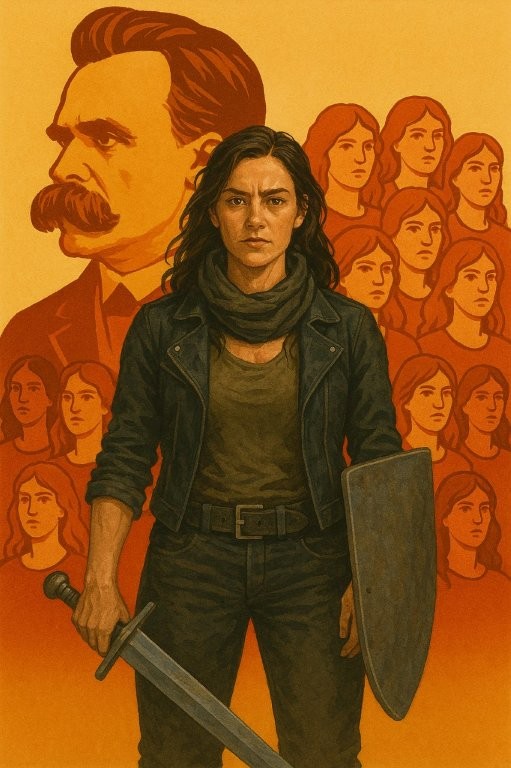
V. Women in the Mafia World
In Alex Perry's novel The Good Mothers Let's get to know the stories of women who are connected to the Calabrian mafia “Ndrangheta”. There, men — fathers, brothers, partners — are not romantic warriors, but cold, organized criminals. In the name of “honor” and “loyalty,” they torture, murder, and destroy the lives of their own families. In this system, the woman should only be a cog in the wheel: obedient, silent, submissive. But it is precisely in this machinery that the cracks occur.
Women like Lea Garofalo, Maria Concetta Cacciola, and others are starting to say “no.” Their resistance is not a heroic pose, but is born of sheer despair. They betray the clans, break the vow of silence, they turn to the state, knowing that this amounts to a death sentence.
In a world where silence means survival, her “voice” becomes the most dangerous weapon. It is an act of creative destruction — genuine barbarism against a sick system.
They have no army, no money, and no power. They only have their word, their refusal, their resistance. Their “no” becomes an act of creative destruction: barbarism based not on blood but on refusal. And that turns out to be stronger than the entire mafia clan. The tragedy is that many of them pay the highest price. But their betrayal is also a departure — a sign that even in a system that requires total control, a break is possible.
Their opposition proves that the biggest threat to the mafia does not come from outside — not from the police or politics, but from the voices of those who have been kept silent for years.
VI. Margaret Atwood's Gilead
Margaret Atwood paints a similar picture — albeit in literary form — in her novels The Handmaid's Tale and The Testaments. Gilead is a totalitarian utopia in which women are reduced to their functions: mother, servant, object of a ritual. Without name, language and freedom, all maids should be available to “redefine” humanity in the project of male rule.
But the first resistance does not come from weapons, but from refusal. June, Emily, Moira — initially intimidated — discover that true strength lies in community. Whispered words, furtive looks, solidarity become the beginning of a revolution. In this sense, their sisterhood is a modern form of barbarism: based not on dominance but on solidarity and a refusal to participate in lying.
Atwood's picture makes it clear that barbarism here is not brute force, but the creative power to escape, to reunite, not to be broken. Gilead thus shows that even in a seemingly total system — in which women are reduced to symbols, fixated on roles, trained for submission — the departure remains possible. Every refusal, every transmission of hope is an attack on the old order. The solidarity of the oppressed becomes a weapon. The “Barbarin” in Gilead is therefore the one who not only survives, but also transforms survival into resistance — and thus opens up space for another future.
VII. Barbarism as a Refusal
The figure of the barbarian of today is not a figure of the warrior with the sword. He doesn't come from outside to break down walls and plunder cities. He is someone who says “no” from within to an order that destroys him. He is an inner figure, a troublemaker who lives in the midst of order — and yet says “no” to a civilization that devours him.
The barbarism of the 21st century is a subtle art of refusal: the refusal to obey, the refusal to live by others' scripts. The refusal to allow yourself to be squeezed into roles that only serve to keep the system stable.
We don't need another utopia today. We need the courage not to serve as raw material for other people's projects. The barbarian is no longer the conqueror but the refuser, someone who says: today? No thanks!
VIII. Personal Perspective
I was born in communist Poland at the end of the 1970s. Women were everywhere — in the fields, in offices, sometimes in politics. They seemed irreplaceable in my childhood. Everyday heroines.
After years, I realized how stuck in old patterns we were. We shouted slogans during demonstrations, but in everyday life we rarely crossed the threshold of real resistance. We still chose the “known evil” instead of taking the risk of building something new. We obeyed instead of refusing.
Today I see that women who have experienced pain have the greatest strength: betrayal, abortion, poverty, violence. They are the ones who can get up again after the hundredth fall. It is they who no longer seek dependency, but choose to refuse. They are the real Barbarinnen — the ones who refuse to participate in the system that is based on complete adjustment.
IX. Conclusions
So where are the barbarians of the 21st century? There are no longer foreign male warriors at the gates, but women who refuse to participate in the old dancing from within. It is they who are on the sidelines and have the power to destroy the foundations of the system. Not through violence, but through refusal, through solidarity, through community.
Barbarism today is not the end of civilization, but the possibility of a new beginning. It is the “no” that becomes the language of freedom. It is the courage not to choose the known evil, but to step into darkness and create something new there — together.
Perhaps this is precisely the paradoxical truth of our time: Women who for centuries have been marginalized, treated as “inferior,” forced into invisibility, are today the only ones who have the courage to be “Barbarinnen.”
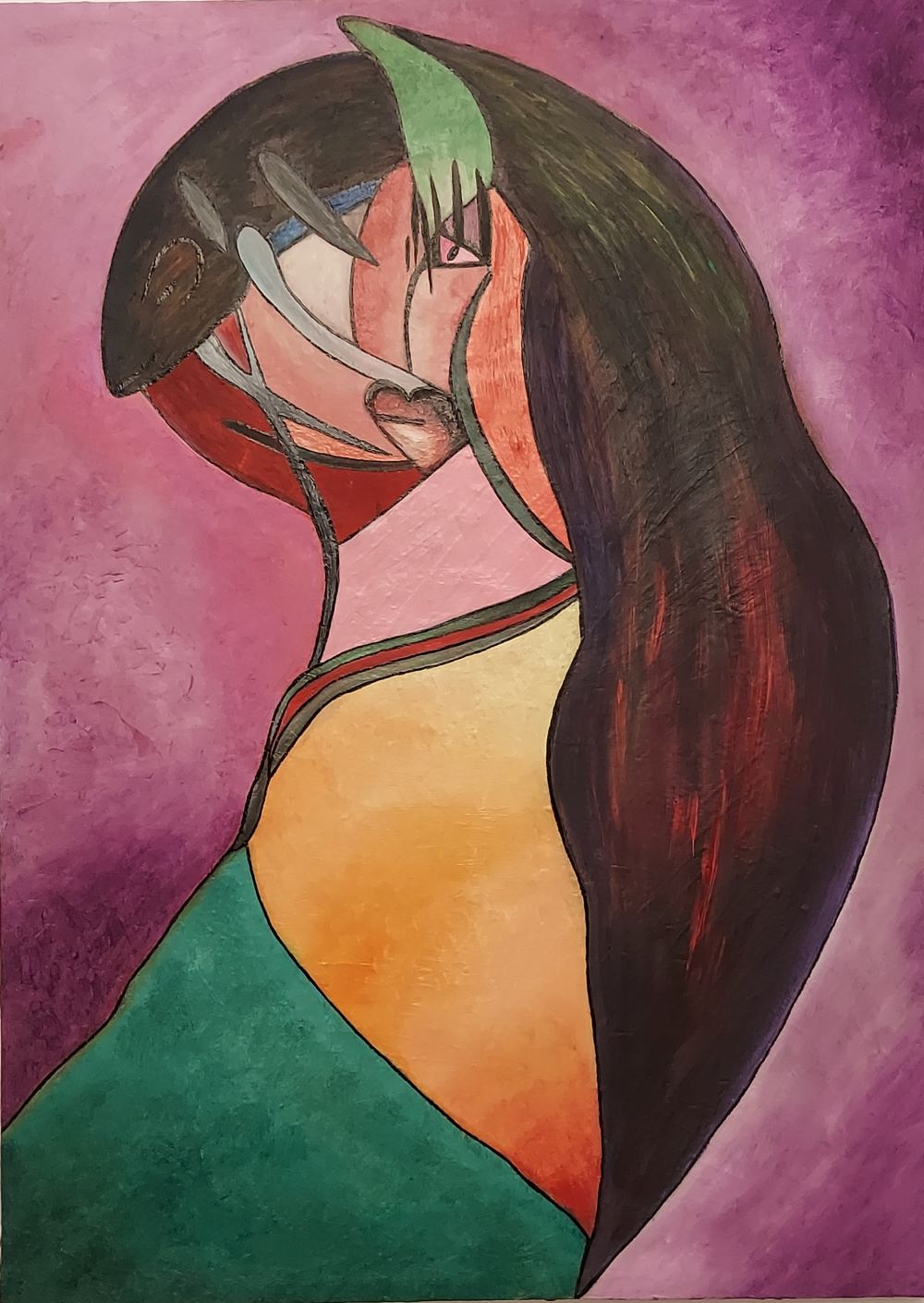
The article image is titled "Barbarin of the 21st century" and was painted by the author herself (painting, acrylic/oil). She herself writes: “The Barbarin of the 21st century does not ask for permission and does not justify herself. Born out of civilizational fatigue, it bears a break — between what is human and what eludes civilization. Her face is a map of modern emotions: anger, irony, tenderness and pain merge into a mask that reveals rather than conceals. It does not look into the past but through us, destroys illusions of harmony and shows that beauty comes from courage and not from order. The figure is not a portrait but a mirror. ”
Olimpia Smolenska was born in 1976 in Zielona Góra, Poland. At the age of seventeen, she went to Neuzelle in Brandenburg to complete her Abitur at a German-Polish grammar school. She completed her diploma in cultural studies at the European University Viadrina in Frankfurt (Oder) in 2010 with a thesis on the topic Integration via language — taking into account the second language acquisition of Polish high school students in Neuzelle, Brandenburg. She currently works at Goethe University in the office of the Institute of Philosophy.
Literature
Atwood, Margaret: The Handmaid's Tale. Toronto 1985.
Atwood, Margaret: The Witnesses. Toronto 2019.
Perry, Alex: The Good Mothers. The Story of the Three Women Who Took on the World's Most Powerful Mafia. New York 2018.
Female Barbarians — When Women Become a Threat
In today's world, which wants to call itself modern and equal, old patterns continue to have an effect — rivalry instead of solidarity, adaptation instead of departure. The essay provocatively asks: Where are the barbarians of the 21st century? It shows the emergence of a new female force — a woman who does not destroy but refuses, who evades old roles and gains creative power from pain. Through examples from reality and literature, the text attempts to show that true change does not start in obedience but in bold “no” — and that solidarity among women could be the real revolution.
We awarded this text second place in this year's Kingfisher Award for Radical Essay Writing (link).
If you'd rather listen to it, you'll also find it read by Caroline Will on the Halcyonic Association for Radical Philosophy's YouTube channel (link) or on Soundcloud (link).
Meaning Has Fallen, But I'm Still Dreaming
Meaning Has Fallen, But I'm Still Dreaming


This essay opposes the emptiness of a world that has lost its meaning in favor of function. With Nietzsche, Camus and the shadow of Sisyphos behind me, I search for the wild, for the dreamy, for those who do not submit and refuse to remain silent. I'm writing about modern barbarians: about people who see nothing and yet continue to breathe, keep screaming, keep dreaming. This text is my hymn to defiance, to the unformed, to the courage not to fear senselessness. Because even without meaning, I won't be silent. Not now, not in this world. And there is no other.
The essay was written as an answer to the price question of this year's Kingfisher Prize (link). We did not award him, but still publish it as an important contribution to the topic of the “new barbarians” due to its extraordinary literary quality. If you'd rather listen to it, you'll also find it read by Caroline Will on the Halcyonic Association for Radical Philosophy's YouTube channel (link) or on Soundcloud (link).
The Lost World and the Search for the New Barbarians
“Where are the barbarians?” Friedrich Nietzsche asked. My voice echoes his voice like an echo. Yes, where are they, the other barbarians? Because I'm one of them and I'm standing here. Not with a sword, not with fire, but with a dream in hand, a dream that seems as fleeting as the clouds on the horizon. But I cannot and will not let go of him. I'm not going to comply with them. The world is settled: its values are smooth and its thoughts sterile. Yet I am here calling, but no one hears me, nor do they want to see. Everything has a place in this sad world, except the wild and the unformed.
Nihilism and the Birth of Dreamers
The nihilism that Nietzsche spoke of was not just a warning, no, it was the end of the world itself. The values have collapsed like a house of cards. It is not evolution, not the passage of time, but man himself who is to blame for this. Because we have become tired and have lost our fighting spirit. The result is a world that is satisfied with the appearance of something fundamental. Technology replaces curiosity, progress replaces will and everything has a function, but nothing makes sense. And somewhere in the middle of this functional desert are we, the dreamers. We are labelled as useless because we feel too much, we break too easily and we don't want to wear the uniform. Maybe we're the new barbarians. Not because we destroy, but because we don't obey, and that seems to do the most damage of all.
The Silent Invasion of the Void
So the emptiness didn't come with a fanfare. She didn't announce herself with one: “So here I am.” No, it was there suddenly, silently and naturally, and we didn't even notice it. It's too late now. The void has long been distributed among us; it sits in our bodies, it is written in our DNA. We live in a functional world in which everything must be as simple as possible, because every object, even every living being, fulfills a specific function. We are shaped by the idea that we must optimize the world, that human life should become more practical, that everything should work faster and faster. But I get sick on this rollercoaster.
Sisyphos, Our Old Friend
Function is misused as a sense because we can't bear the idea that our existence may have no meaning at all. I'm thinking of the myth of Sisyphos. To that man who was condemned by the gods to roll a stone up the mountain only to see it tumble down again and again, for all eternity. Sisyphos' task was pointless and therefore also functionless. What does it bring him in the end? That's right: Nothing. And yet he did it out of defiance of the gods. He did not want to give them the satisfaction of his defeat, so he carried on, even without a goal and without profit. I am also thinking of Albert Camus, who regarded this myth as an image of human existence: Life is pointless and yet we continue to live simply because we can. We dance on the grave of meaning, not because we believe, but because it makes us happy. Today's technical world acts as if it doesn't know Camus or Sisyphos, and who knows, maybe it really doesn't know them both. She is too determined to make progress. To be dogged to create the greatest invention of the century. And for what? That's right, for an alleged sense. But that sense doesn't exist, and to say otherwise would be a lie.
Technology as a Religion of Progress
Nietzsche once warned against nihilism that would destroy the will of man. But his fear was only a fraction of what really happened: People have not only grown tired, they are living a lie. Technology, and the quest for the meaning it promises, is the new god.
Resistance of Modern Barbarians
In this world, which needs everything, numbers, speed, goals, and doesn't know why, there are bodies that are too soft, souls that dream too slowly and goals that are nothing more than images above the clouds. Perhaps it is they, the resistant, who want to overthrow nihilism, even though it has already happened a long time ago. They recognize the level of difficulty of the task, but they are ready to bring back the human, the wild and the dreamy with their ideas. I call them the modern-day barbarians.
Marginal Figures of the System
The modern barbarians are being cast out. Because the technical world, which has long been plagued by nihilism like an epidemic, has become comfortable and no one wants to give it up. Disturb the barbarians. They remember. They question. So you push them to the sidelines because they are outnumbered. They are called “crazy,” “disturbed,” “sick in the head.” And once again, there is a reversal of values, as Nietzsche once foresaw, an involuntary prophet. The barbarians are the image of the superman: those who have understood what is at stake, what really counts, and who are not afraid of senselessness. The rest though? They're slaves. Slaves who blindly let themselves be driven by a pseudo-sense. They are actually weak, but technology makes them strong. The technology, this pseudo-functionality, acts like weapons in a video game, and the slaves are nothing but characters. Avatars with name tag It is only there in their illusory world that they are strong. Only there, together, as an alliance of the poor. They would never call themselves poor, no, because everything in their world is meaningful: They believe they exist because of the Big Bang, because chance wanted them to. They go to work in the morning because they want to “make a difference.” They buy stocks because wealth is the goal. But the truth they can't hear or don't want to hear is this: It's all a big lie. There has never been any sense. But who would believe the barbarians? They don't fit into the system. They're just a nuisance. They're sick in their heads anyway. And in the race for functionality, there is no space reserved for them.
Usefulness as a Compulsion
Anyone who doesn't want to get up in the morning is depressed. Anyone who shows no ambition is considered to be in need of treatment. Anyone who is too quiet or too sensitive is wrong and doesn't fit in. The world is never questioned, but only the person who breaks down because of it. But it doesn't say “Why does it break?” , but: “That's why it shouldn't break.” And the barbarian with a diagnosis is already sitting in a too bright room and wondering why his eyes are burning.
Because anything that could stop the progress of technology, anything that could pose a threat to robotized humans, is locked up. The goal is not healing, not restoring well-being, but an emergency solution: The barbarians should become functional. Usable and adaptable. This creates a compulsory norm in which individuality and humanity have no place anymore. In the end, it is not whether a person is doing better that counts, but only that things continue.
Simulation, Illusory World and the Hunger for Authenticity
The world hasn't been real for a long time, it's efficient. And that's enough for most people. But not the barbarians. They see that man has lost meaning, and yet the barbarians continue to search for it. All you offer them in return are clicks and devices. All the avatars have long since forgotten that they are living in a simulation, because it is convenient and there are rewards for taking part. Just as God once promised paradise. The barbarians see that the world is burning and that they urgently need help. But their hands are tied and Bluetooth is offered to them as a consolation. It's all gone.
The Last Rebellion
“It's all gone,” I whisper to myself and look at the figure in the mirror. She looks a lot like me, but her eyes are tired and her soul seems empty. I too am starting to get tired, because being a barbarian is exhausting. There are days when I just want to be a part of it. I want to get up in the morning and fit into the system. I see the uniform hanging over my chair and imagine what it would be like to smile when they expect it. I wish my thoughts were simpler, but I can't turn them off and I don't want to because I still believe in the wild. I believe in the dream clouds that I've created myself, with my own values, with my own purpose. Not because I can't stand the senselessness, but because I have the strength to create something, just like Sisyphos. “Where are the barbarians?” Friedrich Nietzsche asked. He doesn't hear my answer anymore, but I say it out: “I'm here.” My legs aren't so tired that they won't support me anymore, and I still have enough strength in my arms to hold my dreams. I have nothing to offer the world, not really; but I'm not giving up. And maybe that's my last form of rebellion: not to shut up. Because even if I lose, I'm a barbarian. And I write that with pride.
Giulia Romina Itin was born near Lucerne in 2007 and is currently studying philosophy and history at the University of Basel. In her texts, she deals with existential and socio-critical questions: meaning and senselessness, rebellion, identity, the dreamy, and resistance to the preformed. Her thinking is shaped primarily by Friedrich Nietzsche and Albert Camus, whose perspectives on freedom, revolt and absurdity sharpen their attention to the fractures of the present day. In addition to studying, Giulia writes poetry and prose so as not to fall silent in a meaningless world. For them, writing means continuing to ask questions where others are silent.
The article image is by the author. She writes: “I photographed it myself in January 2025, somewhere between Madeira and Tenerife on the open sea. I chose this picture because it has the same atmosphere as my text: heavy clouds, light breaks and a sky that threatens and dreams at the same time. These clouds remind me of the 'dream clouds' I'm talking about in the text. The one I created for myself in spite of a world that has lost meaning. The photo shows a reality that is dark but not hopeless, and it is precisely from this motivation that my text exists.”
Meaning Has Fallen, But I'm Still Dreaming
This essay opposes the emptiness of a world that has lost its meaning in favor of function. With Nietzsche, Camus and the shadow of Sisyphos behind me, I search for the wild, for the dreamy, for those who do not submit and refuse to remain silent. I'm writing about modern barbarians: about people who see nothing and yet continue to breathe, keep screaming, keep dreaming. This text is my hymn to defiance, to the unformed, to the courage not to fear senselessness. Because even without meaning, I won't be silent. Not now, not in this world. And there is no other.
The essay was written as an answer to the price question of this year's Kingfisher Prize (link). We did not award him, but still publish it as an important contribution to the topic of the “new barbarians” due to its extraordinary literary quality. If you'd rather listen to it, you'll also find it read by Caroline Will on the Halcyonic Association for Radical Philosophy's YouTube channel (link) or on Soundcloud (link).
“Peace with Islam?”
Wanderungen mit Nietzsche durch Glasgows muslimischen Süden: Teil 2
“Peace with Islam?”
Hiking with Nietzsche Through Glasgow’s Muslim Southside: Part II

In the second part of his article on hiking through Glasgow’s Muslim-esque Southside, our staff writer Henry Holland delves into Nietzsche’s impassioned yet scattergun engagement with the youngest Abrahamic religion. He investigates how the experimental novel The Baphomet by French artist and theoretician Pierre Klossowski – which got him hooked on the Islam-Nietzsche intersection in the first place – blends Islam-inspired mysticism, sexual transgression and Nietzscheanism itself into an inimitable potion. With insights on Muslim-esque readings of Nietzsche in tow, Holland returns with Fatima and Ishmael to Scotland’s largest city, thus wrapping up his travelogue whence it began.
I. Nietzsche’s Historical Islam?
Our famously philosophizing rambler was mainly ignorant, creatively rather than stupefyingly so, of the historiographical argument voiced in Part One: the new religion spread in the first centuries following the Revelation to Mohammed primarily through speaking to new adherents, rather than coercing them. Instead, Nietzsche read Julius Wellhausen, historian of ancient religions, and provider of perhaps the most comprehensive histories of early Islam available in German in this period. Besides the author’s account of pre-Islamic culture in the Arabic world, published 1887, in which the author depicts Islam ‘as the culmination of the religious development of Arabic heathendom’, Nietzsche also devoured Wellhausen’s singular and furore-generating histories of ancient Judaism, prior to penning The Antichrist, which has also be translated as The Anti-Christian, in 1888.1 Wellhausen’s were only some of the flurry of ‘orientalist’ and Islam-focussed texts appearing in German, or in German translation, from the 1860s, which Nietzsche couldn’t get enough of. These included Gifford Palgrave’s Journeys Through Arabia, and several works by the era’s star orientalist, Max Müller. Nietzsche had read and excerpted Max Müller’s Essays on eastern religions in 1870-1871, finding confirmation that at least a ‘part of the Buddhist canon’ should be considered ‘nihilist’.2 Much points towards Müller’s writings on Indian philosophy as an entry point for Nietzsche’s later obsession with what he calls The Legal Code of Manu, and with what Indologists call the Manusmṛti — a metrical, Sanskrit text, written between 200 BCE-200 CE.3 From this base, Nietzsche’s immediate guide to the Code of Manu was what modern scholar Andreas Urs Sommer decrees a ‘highly dubious source’ in religious science terms, Louis Jacolliot’s 1876 book Les législateurs religieux. Manou. Moïse. Mahomet.4 Inspired by Jacolliot’s polemical juxtaposition of Manu with the Prophet, Nietzsche sought to bind Manu and Islam together, in a dense fragment from spring 1888, spaced carefully on the page but only published posthumously, which attempts a meta-philosophy of ‘Aryan’ and ‘Semitic’ religion:
What a yea-saying Aryan religion, spawned by the ruling classes, looks like:
Manu’s lawbook .
What a yea-saying Semitic religion, spawned by the ruling classes, looks like:
Muhammed’s lawbook. The Old Testament, in its older parts
What a nay-saying Semitic religion, spawned by the oppressed classes, looks like:
according to Indian-Aryan concepts: The New Testament — a Chandala religion
What a nay-saying Aryan religion, which has grown under the ruling estates, looks like
: Buddhism.5
Bizarrely, fantastically, some progressive Muslims are now turning to Nietzsche’s conception of Islam as a religion created by an exceptional (late ‘heathen’, Arabian, Medina-based) ruling class, which showed much metaphorical spunk. They view this as a pluralistic bastion against a singularizing, revivalist tendency among their co-religionists. The latter readily say ‘no — Islam was and is and can never be this way’; thus shutting down the conversation on how it could still serve as a life-affirming, modern religion. Nietzsche integrates his sketch linking Manu’s and Muhammed’s ‘law books’ into his best-known position on Islam, chapter 60 of The Anti-Christian. Ready for print by November 1888, the severe and permanent breakdown in Nietzsche’s mental health in January 1889 meant that the book didn’t appear until 1894, edited by his sister, and in a doctored form. Following the appearance of Colli and Montinari’s authoritative edition from the 1960s on, we can now be sure what Nietzsche wanted to say about the youngest major monotheism. Sounding like the rant a brilliant orator might deliver from Speakers’ Corner in Hyde Park, Nietzsche pounds Christianity with a barrage of heavy, insulting charges and praises Islam for how it manifested in ‘Moorish’ culture:
Christianity has conned us out of the harvest of the culture of antiquity and later it conned us out of the harvest of Islamic culture. The wonderful, Moorish culture world of Spain, fundamentally more familiar to us and speaking to our senses and taste more than Rome and Greece do, was trodden into the ground — I won’t say by what kind of feet — and why? Because it had noble instincts, men’s instincts to thank for its emergence, because it said yes to life, even through the rare and refined delicacies of Moorish life.
Condemning the Crusades that decimated this lifeworld, and the German nobility for their part in the Crusaders’ plundering, our orator suggests causes for this cultural degenerateness, and enjoins the reader to take sides in this culture clash:
Christianity, alcohol — the two large means of corruption … Per se, a choice shouldn’t even exist concerning Islam and Christianity, just as little as a choice should exist between an Arab and a Jew.6 The decision is given, no one is free to still choose something in this case. Either one is a Chandala or one is not … “War with Rome down to the knife! Peace, friendship with Islam!” — this is how that great free spirit Frederick II [1194-1259 CE], the genius amongst the German Kaisers, experienced and acted [in the situation] .7
Dividing all historical agents into either ‘Chandala’ or ‘the noble-minded [die Vornehmen]’ is a specifically 1888 move in Nietzsche’s philosophy. He appropriates the former term from Hinduism, where it means a member of the lowest caste (and specifically those who dispose of corpses), and makes it stand for ‘the lower [classes of the] people, the outcasts, and “sinners”’ the world over.8 Insisting that those who participated in Islam’s beginnings and enabled it to flourish are not Chandala is Nietzsche’s way of separating Islam categorically from latter-day, decadent Christianity. This taking-of-sides is picked up by Roy Jackson, author of seemingly the only full study on the subject in recent years, who maintains that ‘Islam can learn a good deal from Nietzsche’s critique of the “dead God” of Christianity’.9 By contending that Nietzsche doesn’t disown religious lives as such, but rather merely life-denying forms of the religious impulse, Jackson can set out the ‘two most fundamental options’ Islam is facing, either
to follow the same trajectory of Christianity in Europe and turning [sic.] its God into the ‘dead God’ that Nietzsche is so critical of, or to learn from Nietzsche’s religiosity and embrace a ‘living God’ that does not perceive secularisation as an enemy.10
Jackson’s intellectual manoeuvrings are hardly watertight. As Peter Groff reminds us, although Nietzsche’s modes and means of thinking are so radical that they go beyond atheism, this going beyond does not constitute a return to theism.11 But what matters here is not whether all the substrata of Jackson’s argument convince — they don’t; and Nietzsche’s own picture of a ‘yes-saying’ religion fits poorly to the religiosity on Pollockshields’ streets today — but rather the political and cultural battles, inter-Islam, that motivate Jackson to turn to Nietzsche in the first place. These are battles about the right way to re-encounter the religion’s ‘“key paradigms”: the Qur’an, the Prophet Muhammad, the city-state of Medina, and the four Rightly-Guided Caliphs [632-661 CE]’.12 For Jackson and his camp, this re-encounter must be ‘critical-historical’, so that believers can excavate honestly what Islam has been and could become, in semi-secular modernity. Groff and Jackson pit this approach against the way recent revivalist (Islamist) thinkers like Mawlana Mawdudi (1903-79 C.E.) have, transhistorically, refused to re-encounter these same paradigms, insisting instead that they are beyond critique, ‘pristine and all-encompassing’.13
Above all Jackson turns to Nietzsche in Beyond Good and Evil, not wanting to rid philosophical discourse of ‘the soul’ itself, but to redefine it as ‘mortal’, ‘as the multiplicity of the subject’, as a ‘societal construction of drives and affects’.14 This empowers Jackson to be multiple, and refusing of unilateralist accounts, in considering the souls who built the religious life and society of the ‘key paradigms’ period. Soon we arrive at a place utterly other to the mental maps most non-Muslims have of it: the first Islamic city-state was, on Jackson’s reading, ‘profoundly pluralistic’, recognised that ‘the secular and the religious’ should be separate realms, and was enlivened by the Prophet: less ‘a religio-political ruler (as assumed by contemporary revivalists), but rather a “charismatic arbiter of disputes”’.15

II. Souls and ‘Muslimness’ in Pierre Klossowski’s Maddening Art
Timothy Winter’s creating an Islamic take on Nietzsche builds on Pierre Klossowski’s reading of the same, and follows the trail of coded and yet decodable traces of Muslimness the French artist left behind him. These coagulate to a maximum density in The Baphomet, a 1965 novel that won the cachet-granting Prix des Critiques, but which has infuriated many readers and other critics since. The book is so weird that after lobbing it hard against a wall, its fascination may still exert itself, and have you picking up its scattered pages, and beginning reading it again. Not for nothing does Klossowski choose to locate the novel amongst a historical community that reactionary Catholic but also influential conspiracist voices have, over the centuries, recurringly suggested was Islamophile or even crypto-Islamic: the Knights Templar.16 The author throws such hints at the readers’ feet, then waits to see how they will react. Introducing Nietzsche as a character, and conflating him deliberately with the Islamophile Friedrich II is another bait Klossowski is setting up for us. The benefit of this book, and of Winter’s hermeneutic riff off it, is that spending time with these can shake up omnipresent rationalist prejudices against Islam. Klossowski’s aesthetics enact that which Islamic Studies scholar Thomas Bauer calls ‘constitutive of Sunnism’, namely ‘the process of making ambiguous’.17
Through the prologue, set in 1307 in a Knights Templar Order, immediately before the violent accusations of heresy and the crackdown on that organisation unleashed by King Philip IV of France, Klossowski just about maintains narrative tension. The plot’s far-fetched, but at least there is one. Valentine de Saint-Vit, Lady of Palençay, who has lost land by feudal order to the Templars, has been tipped off about King Philip’s plans, and decides to send her gorgeous fourteen-year old nephew, Ogier de Beauséant, into the Brothers at the Commandery. She hopes they’ll fall sexually for his charms so that she’ll get the evidence of ‘heresy’ she needs to discredit the ‘soldier-monks’ and thus get her land back. The sex, coats of mail and flagellation ‘games’ that ensue are no games for the graphically abused Ogier, whose inner voice we’re denied access to: our perspective on the action is that of the entitled and pederastic men. When this narrative culminates in the ritualistic killing of Ogier, who is stripped naked and hung, and left dangling from a rope, ‘in the void’ above the costumed knights, you’re left feeling that you’ve witnessed something that you shouldn’t have. It’s like reading a well-written report on a well-directed snuff movie.

That which Klossowski thinks justifies such a presentation only emerges slowly from the conversations between the ‘breaths’, or disembodied souls in Christian parlance, who debate one another in the novel’s main section. These breaths were, on death, ‘exhaled from the bodies that had contained them in life’, in the novel’s case from Ogier’s, and from many other bodies associated with the Templar Order, until the time when they will be ‘inhaled’ again, into new bodies, although not necessarily as new souls: with sometimes several entering a single human. Or will remain guarded for countless centuries, until ‘the Last Judgment and the Resurrection of the flesh’, which this theology states will allow them to rejoin their original bodies.18
Here we’ve left historical time, and indeed quotidian causality, and have entered what Winter, citing Louis Massignon (1883-1962 CE), might call ‘Islamic time […] a “milky way of instants”’.19 We could also term the dimension in which Klossowski locates the heart of the novel suprahistorical rather than transhistorical: it doesn’t deny linear, historical time, and the reality of what plays out there, but nor is it subordinate to this form of revelation. Klossowski choosing this cosmic time frame is providing a novelistic answer to Nietzsche’s take on the philosophy of souls. He articulates what he wants his book to enact in a letter to Jean Decottignies, subsequently reprinted as an appendix in the English edition of The Baphomet. Typically oblique, and in the tone of a guy who has important things to say but is refusing to say them, Klossowski nonetheless let’s slip clues about his theological preoccupations:
The Baphomet (gnosis or fable, or Oriental tale), should in no way be seen as a demonstration of the substratum of truth in the semblance of doctrine that is Nietzsche’s Eternal Return, nor as a fiction constructed on this personal experience of Nietzsche. On the other hand, my book purports to take into consideration the theological consequences thereof [i.e., of the Eternal Return] (i.e., a soul’s travels through different identities), as these coincide with the metempsychosis of Carpocrates [founder of a Gnostic sect, early 2nd century C.E.]20
Nietzsche establishment scholars today have mostly little truck with associations linking the Eternal Return with metempsychosis, or reincarnation as we would call it – if we talk about it at all. You do not, however, have to sign up to believing in reincarnation to question the over-determination, in the philosophy of souls, which still obsesses about the mortality question, and particularly about moments of death. Seen Islamically, these are no more than fleeting sparks, in a supernovic infinity of instants. If the soul is, qua Nietzsche, the subject’s multiplicity, i.e., if that subject is always a plurality and never a unity, why should the notion of a single soul in a single body make more rational sense than several souls inhabiting the same? If, as Nietzsche argues in Daybreak §109, none of us possess an impartial ‘intellect’ or sovereign soul, which can govern the conflicts we experience between our drives – if, on the contrary, this intellect is no more than ‘the blind tool of a different drive, a rival to that other drive, which is tormenting us with its vehemence’21 – then, and hypothesising that we could have chatted live to Nietzsche over tripe in the 1880s, why should we valorise the phantasm of the unified soul we would have then experienced over the plurality of his ideas, lyrically his souls, which have taken on multiple new lives since the cessation of his physical heart on 25 August 1900?
Klossowski gets his nose into this same material, but with more humour, by smuggling Nietzsche as a character into Baphomet. We encounter him in chapter VIII when we learn that he has incarnated ‘in the guise of an anteater’22 – yes, you heard – and under the name of Frederick the Antichrist, in the circle led by the last Grand Master of the Knights Templar, Jacques de Molay (c.1240-1314 CE). Burnt at the stake in historical time after dozens of Templars had already been executed in the crushing of the order, the novel has ‘the Grand Master’ continuing to direct his knights in this in-between life, in what feels like an interminable waiting room. He has been tasked by the ‘Thrones and Dominions’, two orders or classes of angels, with guarding the souls of his murdered knights until the rightful Resurrection of the flesh at the Last Judgement; but pressures on Molay / the Master mean that his policing of this divine plan is hardly strict. One such pressure is this anteater. The Grand Master confuses the anteater Nietzsche with the aforementioned Friedrich II, and is not easily persuaded to give up his confusion: ‘What have I to do with Frederick? Hohenstaufen, no doubt? The Antichrist . . . an anteater?’23 Knowing that Friedrich II von Hohenstaufen had been decried by the papacy as ‘the anti-Christ’ for challenging its theocratic dominion was a further reason for Nietzsche selecting this title for the last work he wrote during his sane life. The German title, Der Antichrist translates just as relevantly as The Anti-Christian, and being anti everyday modern Christians is indeed the work’s core. Nietzsche also enjoyed the title’s ambiguity, allowing him to pose as the devil incarnate.
The devilish Nietzsche turns comical when we don’t just hear about him but first see him in Baphomet, ridden by none other than the murdered Ogier, who has disappeared for a long while, and astonishes with this stylish re-entry:
The group of guards disperse this crowd and form a barrier, while Ogier, mounted on a furry monster that he guides with a chain, slowly advances through the rows of tables; there is not a single guest that does not detain him at each step to examine as closely as possible the animal whose diminutive head and long muzzle obstinately sliding along the flagstones contrast with the enormous body and paws armed with long claws.24
Klossowski’s procession triggers several associations at once. It’s hard not to think of the tragi-comic photo of Nietzsche harnessed up beside Paul Rée, to pull the cart of the whip-wielding Lou Salomé. But it’s hard to also not think that this is a Dionysian inversion of Christ’s entry into Jerusalem mounted on a donkey: both scenes contain the deliberately ridiculous; both contain the ridiculed and the humiliated shedding their humiliation and their ridicule in acts of improbable overcoming. Beyond such obvious associations, we could consider Winter’s mode of interpretation: commensurate with Klossowski’s ‘ambiguous’ conversion to Islam, Winter suggests we can decode ‘Muslimness’, as opposed to Islam explicitly, ‘as a theme in his [Klossowski’s] later writings’.25 Reading the ‘furry monster’ scene this way, both Ogier, through what he has endured, and Nietzsche himself, in the form of the utterly othered anteater, are ‘the excluded’ who harbour a ‘just claim’. Again Winter returns to the polymathic and ecumenical Catholic Louis Massignon to describe Islam as the religion of that claim:
Islam is a great mystery of the divine will, the just claim [revendication] of the excluded, those exiled to the desert with their ancestor Ishmael, against the “privileged ones” of God, Jews and above all Christians who have abused the divine privileges of Grace.26
It’s possible to reject wholeheartedly Massignon and Winter’s claims about what Islam is, and to refute that Klossowski’s novel has anything to do with Muslimness, and yet still remain engrossed in the philosophical material that these debates are based on. Can Nietzsche’s unpublished note about ‘the eternal return of the same’ written in the Swiss Alps in August 1881, itself enduringly ambiguous and a catalyst for all of Klossowski’s responses to Nietzsche, really be dismissed as merely a no-nonsense ‘thought experiment’? No spiritual revelation, no epiphanic moment, nothing to see here, move along please, move along? Carefully laid out on the paper, headed ‘Draft.’, and annotated with the remark ‘6000 feet above sea level and much higher above all human things! –’, the note has certainly encouraged religiously-minded readers of Nietzsche to propagate their worldviews from within Nietzsche’s own work.27 According to Klossowski, the 1881 note is not a draft of an embryonic theory, but rather the description of a lived experience:28
The Return of the Same.
Draft.
- The incarnation of the foundational errors.
- The incarnation of the passions.
- The incarnation29 of knowledge and of the knowledge that destroys. (Passion of Cognizing)
- The innocent one. The individual as experiment. The relieving of life, humiliation, weakening – transition.
- The new heavyweight: the eternal return of the same. Infinite importance of our knowledge, errors, of our habits, ways of life for all that will come. What shall we do with the rest of our life – we, who have spent the greatest part of the same in the most essential ignorance? We shall teach the doctrine [die Lehre] – it is the strongest means of incarnating it within ourselves. Our kind of beatitude, as teacher of the greatest teaching.
Start of August 1881 in Sils-Maria30
III. Epilogue: Walking Pollockshields with Fatima and Ishmael
As I write this article I’m conducting an online interview with a woman in her late twenties who I’m friends with and who grew up in Pollockshields. Although she, like me, enjoys going hiking and trekking, neither of us have yet tramped the alpine paths around Sils-Maria, to follow in Nietzsche’s footsteps. Leaving behind thoughts about the Eternal Return speaking to a myriad of unfulfilled wishes, whether for pakora or for Swiss hikes, I find myself back on a video call. Again.
Fatima is an engineer working in aeronautics in the south of England, who defines herself primarily as Scottish and, as a secondary attribute, as Muslim. Nonetheless she agrees to talk to me about her faith. She speaks about her less religious dad, whose greater concern has been to work hard in routine jobs to ensure that his kids get the good school and university education they have now received. She describes her more religious mum, with whom she has talked more about questions of religious observance, like the hijab her mum had wanted her to wear when she was a teenager. When Fatima made it clear she didn’t want to, neither her mum nor any other family member insisted on this dress code. As if feeling a duty to educate me on the basics, Fatima foregrounds Islam’s ‘five pillars’, which she learnt about attending Muslim ‘Sunday school’: the profession of faith, prayer, charitable giving, fasting during Ramadan, and the once in a lifetime Hajj, or pilgrimage to Mecca. Fatima explains that she hasn’t been on the Hajj yet, but she has been on the `Umrah, or lesser pilgrimage.
Like many other believers I speak to, theological questions are not Fatima’s big thing. From the outside, her life looks entirely secular: working hard, traveling the globe, spending time with both female and male friends, and able to play bass guitar. In this last regard, she’s unimpressed by the entreaties of the hyper-literalists. Muhammad ibn Adam al-Kawthari is a pro-caliphate cleric based in Leicester, England, who propagates a ban on both playing and listening to instruments, but this is hardly the kind of voice that Fatima is listening to.31 Considering such ascetic and irrationalist manifestations in Britain’s Muslim community, and experiencing Fatima as their opposite, a level-headed person who affirms life’s diversity, I ask if she can imagine anything that would make her give up her religion altogether? Pausing for an instant, she labels her childhood religious education matter-of-factly as ‘indoctrination’, and talks about how people internalise the same – that it’s nothing you can just shrug off. She doesn’t forget how Glasgow Sunnis, the grouping she belongs to, ensure that those who formally renounce their faith get the ‘right’ message: ‘you will burn forever in hell’. I don’t press Fatima on this – adults recalling the existential religious images stamped on them as children need some of this to stay private. But I get the sense that she neither believes in hellfire nor refuses to disbelieve in it entirely. Religion is bound tight to family, culture, geographical community: the things that co-define you while you become who you are. With no alternative philosophical or religious worldview on the horizon with a substance and a pull comparable to that which Islam exerts, why would individuals like Fatima risk exiling themselves from it?
Back in Glasgow in the summer, and with time to kill before my evening interview with the imam at the Dawat-E-Islami mosque on Niddrie Road, I go and wait in Queen’s Park, just to the south of Pollockshields. Under soaring church spires, groups sit on the freshly-cut grass and gear up for the weekend, drinking and smoking joints as the heat recedes. A bare-footed Glaswegian of middle-Eastern heritage is even walking around with a tamed but untethered parrot on his shoulder. I’ve never seen such a display in public. If he or his ancestors ever belonged to a ‘nay-saying religion’ he’s now saying yes to life so vigorously that you sense it could end dangerously. The North Sudanese barbers’ who I’d popped into for a trim on the way to the park were also full of patter,32 their self-professed Muslimness no barrier to treating life as a convivial and slowly-evolving party. When I get into the mosque the mood changes. Courteously, the Pakistani imam, Shafqad Mahmood, his assistant Mansoor Awais, who interprets for him when the English gets more complex, and a further elder male congregant, Haji Ahmad, have found half-an-hour or so for me at short notice, before evening prayers begin. My uneasiness is down to what I’ve read about the Dawat-E-Islami organisation in Ed Husain’s liberal Muslim critique of the current state of his religion in the UK. Translating as ‘Invitation to Islam’, the Pakistan-based group first opened mosques in the UK around 1995 and now, as the imam tells me proudly, they have three centres in the greater Glasgow area, catering for over five hundred believers weekly.33 Husain for his part discusses the sectarian murder, in 2016, of Asad Shah, less than a mile from where we’re sitting and talking, by ‘a Dawat-e-Islami man’: albeit one from Bradford in the north of England, and not by a fellow Glaswegian.34 Shah’s ‘offence’, at least in his killer’s eyes, was to be an Ahmadi, a follower of the Indian Ghulam Ahmad (1835-1908 CE) who claimed to be, concurrently, a ‘renewer of the faith’, ‘the promised messiah’, and ‘the mahdi (the rightly guided one who will appear at the end times together with the messiah)’: thus kickstarting a major new religious movement that is rejected uniformly by orthodox Muslims.35 As Husain had already interviewed a previous imam at the Queen’s Park mosque about Dawat-e-Islami and the 2016 murder, and had gotten evasive answers, I restrict myself to asking about the mosque’s attitudes to Shi’a, the Ahmadiya Muslim community, and other Muslim denominations. My overly orthodox question harvests a no-frills answer: ‘the Ahmadiya are not Muslims’. Surprisingly, Haji Ahmad adds that ‘we have Shi’a who come to pray here every week. Ahmadiya could even come and pray here if they wanted. If they didn’t say anything.’
Meant generously, the message is clear: mosque leaders tolerate non-standard beliefs only to the extent they remain utterly private. This strategy for ensuing conformity fits with what my question on the mosque’s attitude ‘to homosexual Muslims or to trans people?’ evinces: ‘We don’t accept them. But we wouldn’t say anything [if they came to pray at the mosque].’ I have to think of the story Fatima told me about a lesbian Muslim friend of hers trying to come out to her mother, and the friend’s mother being unable to embrace or support this reality. Hearing the story, you think the friend’s mother must have known long before about her daughter’s relationships – and tolerated them, as long as they remained hushed up.

No one is keeping quiet at the queer bookshop, Category is Books, just up the road from the Dawat-E-Islami mosque and religious school. Sadly I arrive outside opening hours, but the shop window is shouting out winning slogans to passers-by: ‘encourage lesbianism’, ‘better gay than grumpy’, ‘freedom of movement for all!’ and, in huge letters, the potentially game-changing ‘GET OFF THE INTERNET. DESTROY THE RIGHT WING.’ You’ll be forgiven for thinking that there is no dialogue between this shop’s community and that of the mosque. But the cause that has and will continue to generate dialogue arises when I ask the mosque’s leaders about the recipients of the organisation’s formal charitable status: ‘Over the last two years we’ve been funding aid deliveries via airplane into Gaza and the West Bank, food, water, and clothes, also looking after the orphans, no matter if the people there are Muslims, Christians or whatever.’ As the major British news platform The Canary reported recently, the group ‘No Pride in Genocide’ (Glasgow branch), ‘a broad coalition of LGBTQ+ Glaswegians’ demand of those running the city’s annual Pride march that they reject what Canary journalists call ‘companies directly profiting from Israel’s illegal occupation and ongoing genocide in Palestine.’36 If these concerns seem worlds removed from Nietzsche’s philosophical and Klossowski’s artistic hunches regarding Islam, we should turn to Judith Butler, surely the most widely-read philosopher of queerness of their generation, to see connections from them back to philosophy. Fighting back against Donald Trump’s Executive Order 14168 from January 2025, whose title makes its targets clear – ‘Defending Women from Gender Ideology Extremism and Restoring Biological Truth to the Federal Government’ – Butler joins up the dots on the common cause that trans people, Muslims, and other people of migrant heritage can find and are finding, in today’s polarised societies. Moreover, they [Butler] hone in on that group of trans people most vilified by the far Right: ‘people assigned male at birth who seek to transition [to a female or other gender identity]’.37 They point out that ‘presumption[s]’ about such men held by an increased number in society are unevidenced, and that the great majority of such men transition because ‘they hope for a more livable life’. Topping this, Butler argues that there is no philosophical justification for taking the ‘few recorded instances’ in which men have transitioned to ‘seek entry into women’s spaces in order, it is presumed, to harm the women there’ as a general ‘model for transition’. Extrapolating from here, and writing in the ‘first-person we’, Butler concludes:
We do not point to the nefarious actions of particular Jews or Muslims and conclude that all Jews or Muslims act in that way. No, we refuse to generalise on that basis, and we suspect that those who do so generalise are using the particular examples to ratify and amplify a form of hatred they already feel.38
Was Nietzsche being nefarious and intending harm by calling Islam ‘a yea-saying Semitic religion, spawned by the ruling classes’, then cementing this prejudice in favour of Islam over both Christianity and Judaism in print? – ‘Either one is a Chandala or one isn’t.’ If so, the remedy for such damage could be found in his more circumspect, more moderate and more ambiguously artistic successors. Whether you’ll find such successors on the streets of Glasgow’s Southside or in great artists, and latter-day Muslims, like Pierre Klossowski, will depend on the kind of cultural or religious home you’re looking for.
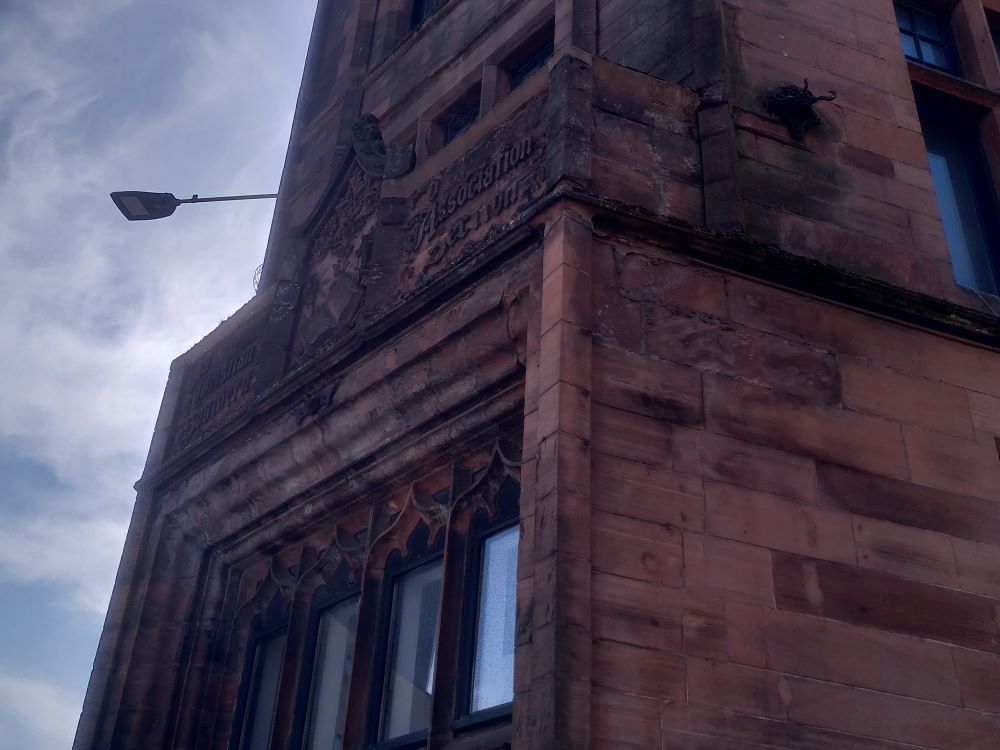
All pictures are photographs taken by the author. The title image shows a stone-mason’s yard on the edge of Pollockshields, offering bilingual gravestones for the district’s Muslim residents.
Bibliography
Albany, HRH Prince Michael of and Walid Amine Salhab, The Knights Templar of the Middle East: The Hidden History of the Islamic Origins of Freemasonry. Weiser Books: 2006.
Almond, Ian: ‘Nietzsche’s Peace with Islam: My Enemy’s Enemy is my Friend’, German Life and Letters 56, no. 1 (2003), 43-55.
Balthus (Count Balthazar Klossowski de Rola Balthus): Balthus in his Own Words: A Conversation with Cristina Carrillo de Albornoz. Assouline: 2002.
Balzani, Marzia, Ahmadiyya Islam and the Muslim Diaspora: Living at the End of Days. Routledge: 2020.
Barber, Malcolm: The New Knighthood: A History of the Order of the Temple. Cambridge University Press: 1994.
Bauer, Thomas: A Culture of Ambiguity: An Alternative History of Islam. Translated by Hinrich Biesterfeldt and Tricia Tunstall. Columbia University Press: 2021.
Butler, Judith: ‘This is Wrong: Judith Butler on Executive Order 14168’, London Review of Books, 3 April 2025, https://www.lrb.co.uk/the-paper/v47/n06/judith-butler/this-is-wrong, unnumbered.
Canary Journalists, The: ‘Glasgow Pride was just exposed as being complicit in Israel’s genocide’ in The Canary, 20 July 2025, unpaginated, https://www.thecanary.co/uk/news/2025/07/20/glasgow-pride-2025/.
Editors, various: Dictionaries of the Scots Language Online: 2025.
Groff, Peter: ‘Nietzsche and Islam’ [review of Nietzsche and Islam, by Roy Jackson], Philosophy East & West Volume 60, Number 3, July 2010, 430-437.
Husain, Ed: Among the Mosques: A Journey Around Muslim Britain. Bloomsbury: 2021.
Jackson, Roy: Nietzsche and Islam. Routledge: 2007.
Klossowski, Pierre: The Baphomet, translated by Sophie Hawkes and Stephen Sartarelli, with introductions by Juan Garcia Ponce and Michel Foucault. Eridanos Press: 1988.
Krokus, Christian: The Theology of Louis Massignon: Islam, Christ and the Church. Catholic University of America Press: 2017.
Newcomb, Tim (Translator and Editor of): Friedrich Nietzsche, Anti-Christian: The Curse of Christianity. Livraria Press: 2024.
Orsucci, Andrea. Orient-Okzident: Nietzsches Versuch einer Loslösung vom europäischen Weltbild. De Gruyter: 2011.
Smith Daniel: ‘Translator’s Preface’ in Pierre Klossowski, Nietzsche and the Vicious Circle, translated by Daniel Smith. University of Chicago Press: 1997, vii-xiii.
Sommer, Andreas Urs Sommer, Kommentar zu Nietzsches Der Antichrist, Ecce homo, Dionysos-Dithyramben, Nietzsche contra Wagner. De Gruyter: 2013.
Winter, Timothy: ‘Klossowski’s Reading of Nietzsche From an Islamic Viewpoint’, [Unpublished manuscript, shared by Winter with Henry Holland in October 2025, with a text similar but not identical to Winter’s lecture recorded for YouTube: https://www.youtube.com/watch?v=wC8YJfyOkOY], (2025).
Footnotes
1: Wellhausen, Reste arabischen Heidentums (1887), cited from Andreas Urs Sommer, Kommentar zu Nietzsches Der Antichrist, Ecce homo, Dionysos-Dithyramben, Nietzsche contra Wagner, 294-295. Sommer confirms Nietzsche was reading this work by Wellhausen in this period; see Sommer’s ‘Personenregister’, ibid., 920, for comprehensive references on Nietzsche’s reading of Wellhausen. Most translators continue to the follow the translation tradition established by Walter Kaufmann and others, and title their English works The Antichrist. Yet Tim Newcomb, author of one of the few translations to opt for The Anti-Christian as its title, is right to point out that Nietzsche’s primary target was Christians of his own age. Because ‘ein Christ’ translates as ‘a Christian’, deciding for the alternative title of The Anti-Christian is legitimate. Cf. Tim Newcomb, ‘Afterword’ in Friedrich Nietzsche, Anti-Christian: The Curse of Christianity.
2: Sommer, Kommentar zu Nietzsches Der Antichrist, 110.
3: All references to Manu / the Law Book of Manu in Nietzsche’s work, and to the related concept of Chandala, date to 1888. A letter to Heinrich Köselitz on 31 May 1888 (link) suggests he has just discovered this work: ‘I thank these last weeks for an essential lesson: I found the Legal Code of Manu in a French translation [presumably Louis Jacolliot’s], which was made in India under the precise control of the highest-ranked priests and scholars. This [is an] absolutely Aryan product, a priestly codex of morality on the foundation of the Vedas, the notion of castes, and ancient ancestry’. (Emphasis in the original.) This and the other translations from Nietzsche’s writings in this essay are the author’s own. For more on orientalist texts read by Nietzsche, cf. Ian Almond, ‘Nietzsche's Peace with Islam’, 43; and indeed for sufficient context, the whole text of: Andrea Orsucci, Orient-Okzident: Nietzsches Versuch einer Loslösung vom europaischen Weltbild.
4: Sommer, Kommentar zu Nietzsches Der Antichrist, 9 and 265.
5: Nachgelassene Fragmente 1888 14[95].
6: As Andreas Urs Sommer demonstrates, Nietzsche only inserted this cheap, anti-Semitic jibe into the final draft of this text: Sommer suggests this is Nietzsche playing to popular anti-Semitic sentiments among his potential readers. Cf. Sommer, Kommentar zu Nietzsches Der Antichrist, 298.
7: The Anti-Christian, § 60. There has been much recent scholarship on Friedrich II’s fondness for and proximity to Islam. On Nietzsche’s sources for the same subject, see Sommer, Kommentar zu Nietzsches Der Antichrist, 298-299, which also highlights the role played by August Müller’s writings on Friedrich II in Nietzsche’s reading. Müller recounts ‘as common knowledge […] how he [Friedrich II] took the most lively interest in the Arabs’ language and literature, pursued logic with his Muslim court philosophers, and even became half or even a whole heathen [i.e., a Muslim] himself, thus scandalising all pious people’. (Cited from Sommer, Kommentar zu Nietzsches Der Antichrist, 298.)
9: Summary of the position argued by Jackson as given by: Peter Groff, ‘Nietzsche and Islam’, 431.
10: Roy Jackson, Nietzsche and Islam, e-book-location: chapter 1, location 7.51.
11: Groff, 435. Groff considers The Joyous Science, §346 as one of Nietzsche’s clearest statements about ‘going beyond atheism’. Here Nietzsche writes: ‘If we wanted simply to name ourselves with an older expression like godless or unbelievers or even immoralists, we would still believe ourselves to be far from described by such epithets’.
12: Groff, 430.
13: Cf. ibid. 431; and Jackson, Nietzsche, chapter 2, 8.46-8.50.
14: Beyond Good and Evil, § 12.
15: Summary of Jackson’s argument given in Groff, ‘Nietzsche and Islam’, 432.
16: For a well-researched historical summary of such viewpoints, see Malcom Barber, The New Knighthood, 321. For an Islamophile account of the same history that is open to conspiracist thinking, see HRH Prince Michael of Albany and Walid Amine Salhab, The Knights Templar of the Middle East: The Hidden History of the Islamic Origins of Freemasonry, x-xi and 22-23.
17: Thomas Bauer, A Culture of Ambiguity: An Alternative History of Islam, 11, cited from Timothy Winter’s unpublished manuscript ‘Klossowski’s reading of Nietzsche from an Islamic viewpoint’, 1, which Winter generously shared with me in October 2025. I thank Winter heartily for his colleaguiality in sharing this book in progress with me at this stage. The text of Winter’s manuscript is mostly identical to his aforementioned YouTube lecture, but includes some minor changes.
18: Klossowski, The Baphomet, xv.
19: Winter, unpublished manuscript ‘Klossowski’s reading of Nietzsche from an Islamic viewpoint’, 8.
20: Pierre Klossowski, ‘Notes and Explanations’ in The Baphomet, 166-167.
21: Daybreak, § 109.
22: Italics my own. Klossowski, Baphomet, 111.
23: Ibid., 112.
24: Ibid., 125.
25: Winter, ‘Klossowski’s reading’, 10. Klossowski’s conversion is ambiguous in the sense that is recorded in a single, terse passage by his younger brother, Balthus: ‘My brother, Pierre, became a Dominican monk when he was young. Then, a lot later, he converted to Islam.’ Cited in: Balthus (Count Balthazar Klossowski de Rola Balthus), Balthus in his Own Words, 11. There is no reason to question Balthus’s account just because it’s terse: we could instead conclude that Klossowski’s Muslimness was a mostly private affair. Relevantly, this is not the only conversion in Klossowski’s life that Balthus describes: ‘[Adam-Maxwell Reweski] left my brother and me a sum of money that we could use for our education if we became Catholics. And we did convert to Catholicism, whereas my father was a Protestant.’ Ibid., 5.
26: Christian Krokus, The Theology of Louis Massignon, 175; cited in Winter, ‘Klossowski’s Reading of Nietzsche’, 11.
27: Nachgelassene Fragmente 1881 11[141].
28: See for example, the paper ‘entitled “Forgetting and Anamnesis in the Lived Experience of the Eternal Return of the Same”, which Klossowski presented at the famous Royaumont conference on Nietzsche in July 1964’, as described in Daniel Smith, ‘Translator’s Preface’, viii.
29: While the noun Einverleibung used in points 1 to 3 of this note could also be translated as ‘embodiment’ or even, more weakly and figuratively, as ‘incorporation’, disputing ‘incarnation’ as one valid translation makes no etymological sense. ‘Incarnation’ derives the from Late Latin incarnationem (nominative incarnatio), ‘act of being made flesh’ or entering into a body, while ‘embodiment’ in English also refers back primarily to the ‘embodiment of God in the person of Christ’, i.e., to the Old French incarnacion ‘the Incarnation’ (12th century C.E.). ‘Einverleibung’ in German carries strong Christian connotations, of which Nietzsche was evidently aware, just as ‘incarnation’ does in English.
30: Nachgelassene Fragmente 1881 11[141].
31: Al-Kawthari cited from Ed Husain, Among the Mosques, chapter 1.
32: Scottish English, patter: ‘A person’s line in conversation. This can mean ordinary chatting, as in “Sit doon an gie’s aw yer patter”; it can also mean talk intended to amuse or impress, as in “He’s got some patter that pal a yours”’. Cited from the Dictionaries of the Scots Language, https://www.dsl.ac.uk/entry/snd/sndns2837.
33: Dawat-e-Islami is estimated to own and run around forty properties in the UK as a whole.
34: For details of Shah’s murder and the theological role played by Dawat-e-Islami in it, see: Ed Husain, Among the Mosques, in the Glasgow section of chapter 8, ‘Edinburgh and Glasgow’.
35: Marzia Balzani, Ahmadiyya Islam and the Muslim Diaspora, 2.
36: The Canary Journalists, ‘Glasgow Pride was just exposed as being complicit in Israel’s genocide’ 20 July 2025, unpaginated.
37: Judith Butler, ‘This is Wrong: Judith Butler on Executive Order 14168’, unnumbered.
38:This and the previous citations taken from Butler, ibid., unnumbered.
“Peace with Islam?”
Hiking with Nietzsche Through Glasgow’s Muslim Southside: Part II
In the second part of his article on hiking through Glasgow’s Muslim-esque Southside, our staff writer Henry Holland delves into Nietzsche’s impassioned yet scattergun engagement with the youngest Abrahamic religion. He investigates how the experimental novel The Baphomet by French artist and theoretician Pierre Klossowski – which got him hooked on the Islam-Nietzsche intersection in the first place – blends Islam-inspired mysticism, sexual transgression and Nietzscheanism itself into an inimitable potion. With insights on Muslim-esque readings of Nietzsche in tow, Holland returns with Fatima and Ishmael to Scotland’s largest city, thus wrapping up his travelogue whence it began.
Fascinated by the Machine
Nietzsche's Reevaluation of the Machine Metaphor in His Late Work
Fascinated by the Machine
Nietzsche‘s Reevaluation of the Machine Metaphor in His Late Work


Last week, Emma Schunack reported on this year's annual meeting of the Nietzsche Society on the topic Nietzsche's technologies (link). In addition, in his article this week, Paul Stephan explores how Nietzsche uses the machine as a metaphor. The findings of his philological deep drilling through Nietzsche's writings: While in his early writings he builds on Romantic machine criticism and describes the machine as a threat to humanity and authenticity, from 1875, initially in his letters, a surprising turn takes place. Even though Nietzsche still occasionally builds on the old opposition of man and machine, he now initially describes himself as a machine and finally even advocates a fusion up to the identification of subject and apparatus, thinks becoming oneself as becoming a machine. This is due to Nietzsche's gradual general departure from the humanist ideals of his early and middle creative period and the increasing “obscuration” of his thinking — not least the discovery of the idea of “eternal return.” A critique of the capitalist social machine becomes its radical affirmation — amor fati as amor machinae.
Nietzsche's cultural criticism is extremely ambivalent in its orientation towards modernity. Sometimes it seems as if he represents an almost modernist point of view, sometimes he tends towards the Romantic or even the reactionary. In order to visualize this ambiguity of Nietzsche's cultural criticism and his position on modernity, it is extremely instructive to look at his statements on the term “machine.” This allows, not least, a more nuanced view of his ethics of authenticity.
I. A Fighter against Machine Time
Statements in which he criticizes the machine and uses it as a metaphor for modern capitalism run like a common thread throughout Nietzsche's work from the earliest to the latest writings. He criticizes, for example, that the modern “external academic apparatus, [...] the educational machine of the university put into action.”1 Reduce scholars to mere machines like factory workers.2 Modern philosophers are “machines of thinking, writing and speaking”3. In a similar way to Karl Marx, Nietzsche even criticizes the subjugation of workers in this period, who are forced to “rent themselves out as physical machines.”4, himself under the machinery and blames them for their moral degeneration or for the sprouting of what he would later call “resentment”:
The machine terribly controls that everything is happening at the right time and in the right way. The worker obeys the blind despot; he is more than his slave. The machine Does not educate the will to self-control. It awakens a desire to react to despotism — debauchery, nonsense, intoxication. The machine evokes Saturnalia.5
Elsewhere, Nietzsche formulates the dialectic of machinization as follows:
Reaction against machine culture. — The machine, itself a product of the highest thinking power, sets in motion almost only the lower thoughtless forces of the people who operate it. In doing so, it unleashes an immense amount of power that would otherwise lie asleep, that is true; but it does not give the impetus to climb higher, to improve, to become an artist. She makes Acting and monoform, — in the long run, however, this creates a countereffect, a desperate boredom of the soul, which learns to thirst for varied idleness through it.6
Machinery thus serves as an educator of inauthenticity, producing flexible machine people who are unable to educate themselves:
The wild animals should learn to look away from themselves and try to live in others (or God), forgetting themselves as much as possible! They feel better that way! Our moral tendency is still that of wild animals! They should become tools of large machines besides them and would rather turn the wheel than be with themselves. Morality has been a challenge so far Not to deal with yourselfby shifting your mind and stealing time, time and energy. Working yourself down, tiring yourself, wearing the yoke under the concept of duty or fear of hell — great slave labor was morality: with the fear of the ego.7
Even in his late work, Nietzsche considered submission to the “tremendous machinery”8 of the “so-called 'civilization'” (ibid.) — its main features: “the reduction, the ability to pain, the restlessness, the haste, the hustle and bustle” (ibid.) — as the main reason for “the The rise of pessimism“(ibid.). He speaks disparagingly of the arbitrarily fungible “small [n] machines”9 of modern scholars and ridicules the fact that it is the task of the modern “higher education system”10 Be, “[a] us to make a machine for man” (ibid.), a dutiful “state official” (ibid.) as a, supposed, complete manifestation of Kant's ethics. When viewed honestly
That wasteful and disastrous period of the Renaissance turns out to be the last large time, and we, we modernity with our fearful self-care and charity, with our virtues of work, unpretentiousness, legality, scientificity — collecting, economic, machinal — as a faint Time [.]11
And last but not least, he speaks in Ecce homo about the “treatment I receive from my mother and sister”12 as a “perfect [r] hell machine” (ibid.).
The estate of the early 1870s even states programmatically:
handicraft learning, the necessary return of the person in need of education to the smallest circle, which he idealizes as much as possible. Combating the abstract production of machines and factories. To create ridicule and hate against what is now considered “education”: by opposing more mature education.13
The modern utilitarian machine world is Nietzsche in its totality a horror, which he critically confronts with the Dionysian culture of antiquity:
Antiquity is in its entirety the age of talent for Festfreude. The thousand reasons to rejoice were not discovered without acumen and great thought; a good part of the brain activity, which is now focused on the invention of machines, on solving scientific problems, was aimed at increasing sources of joy: the feeling, the effect should be turned into something pleasant, we change the causes of suffering, we are prophylactic [precautionary; PS], that palliative [“wrapping in the sense of palliative care; PS].14
In the machine world, people surround themselves with anonymous goods instead of real things, through which they could enter into a resonating relationship with their originators:
How does the machine humble. — The machine is impersonal, it deprives the piece of work of its pride, its individual Good and faulty, which sticks to all non-machine work — that is, its bit of humanity. In the past, everything buying from artisans was a Marking people, with whose badge you surrounded yourself: the household and clothing thus became a symbol of mutual appreciation and personal belonging, while now we only seem to live in the midst of anonymous and impersonal sclaventhum. — You don't have to buy the ease of work.15
In contrast to personally manufactured, authentic, artisanal products, the mechanical goods did not impress with their intrinsic quality, as could only be determined by experts, but only through their effect and thus deceive the general public.16
However, Nietzsche summarizes this comprehensive critique of modern commodity production and the world of life bewitched by it most harshly in Human, all-too-human together:
Thought of Discontent. — People are like coal mines in the forest. Only when young people have burned out and are charred, like them, will they usefully. As long as they steam and smoke, they may be more interesting, but useless and even too often uncomfortable. — Humanity mercilessly uses each individual as material to heat its large machines: but why use the machines when all individuals (i.e. humanity) only use them to maintain them? Machines that are their own purpose — is that the umana commedia [human comedy; PS]?17
The proximity of these ideas to a Rousseauist, romantic critique of capitalism, but also to Marx, is remarkable and obvious. For Nietzsche, the “machine” becomes the epitome of what Marxism describes as the “fetishism of commodity production” and he comes surprisingly close to a clear understanding of the rederizing mechanisms of the capitalist mode of production here. — Of course, this metaphor is not astonishing in view of the fact that the valorization of “authentic production” over craft into the “absolute metaphors” (Hans Blumenberg) of modern thinking of authenticity On whose tracks Nietzsche moves completely at these points. The living and the dead, the machine and real practice, are juxtaposed in a harsh dualistic way.18
In view of these clear words, it is significant that, in parallel, there was an almost diametral revaluation of the machine in Nietzsche's writings from around 1875.
II. Man as a Machine
Remarkably, this first takes place in Nietzsche's letters. Between 1875 and 1888, he repeatedly referred to his own body or even himself as a “machine” in them and reported on their good or poor functioning.19 In this sense, he already speaks in the Morgenröthe in a purely descriptive sense of the body in general as a machine20 and is also moving on to calling humanity as such in a neutral way.21 Here he apparently draws on the naturalistic wing of the Enlightenment, such as Julien Offray de La Mettries L'homme machine (Man as a machine, 1748), as part of his generally growing interest in naturalistic explanations of human behavior in that period.
Already in Human, all-too-human Nietzsche admiringly compares Greek culture with a speeding machine whose tremendous speed made it susceptible to the slightest disturbances.22 In the estate of the 1880s, Nietzsche then just as uncritically designed a “depiction of the machine 'man'”23 and moves on to seeing something good in the machinization of humanity:
The need to prove that to an ever more economic consumption of people and humanity, to an ever more closely intertwined “machinery” of interests and services A countermovement belongs. I refer to the same as Elimination of humanity's luxury surplus: It should bring to light a stronger species, a higher type, which has different conditions of origin and conservation than the average human being. My term, my allegory For this type, [...] is the word “superman.”
That first path [...] results in adaptation, flattening out, higher Chineseness, instinct modesty, satisfaction in reducing people — a kind of stoppage in Human level. Once we have the unavoidably imminent overall economic administration of the earth, then humanity can find its best meaning as machinery at its service: as a tremendous train of ever smaller, ever finer “adapted” wheels; as an ever increasing superfluence of all dominant and commanding elements; as a whole of tremendous power whose individual factors Minimal powers, minimal values represent. In contrast to this reduction and adaptation of the M <enschen>to a more specialized utility, the reverse movement is required — the generation of synthetic, of buzzing, ofthe justifying People for whom this machinalization of humanity is a precondition of existence, as a base on which he can his Higher form of being Can invent yourself...
He just as much needs the antagonism the crowd, the “leveled”, the sense of distance compared to them; he likes them, he lives from them. This higher form of aristocratism is that of the future. — Morally speaking, that overall machinery, the solidarity of all wheels, represents a maximum in the Exploitation of humans represents: but it presupposes those for whose reason this exploitation sense has. Otherwise, it would in fact simply be the overall reduction Werth-Reduction of the type human, — a decline phenomenon in the biggest style.
[...] [W] As I fight, is he economic Optimism: as if with the growing expenses Aller The benefits of all should also necessarily grow. The opposite seems to me to be the case: Everyone's expenses add up to a total loss: the human being becomes lesser: — so that you no longer know what this tremendous process was for in the first place. One for what? one new “What for! “— that is what humanity needs...24
In line with the idea of a — hoped-for — transformation of levelling into a new aristocracy, which has also been repeatedly discussed in the published work25 Although Nietzsche now adheres to his earlier critique of maschization, he also hopes that she will at the same time give birth to a new class of “supermen,” who will dominate the “army” of the machine of completely subjugated slaves. In antichrist He clearly states this political 'utopia' and explains it naturalistically: “That you are a public benefit, a wheel, a function, there is also a determination of nature: not the society, the species luck, which the vast majority are only capable of, turn them into intelligent machines.”26.
Is there already in Human, all-too-human aphorisms in which submission to the machine is described not apologetically, but also not critically, but purely descriptively as a “pedagogy,”27 Is he now increasingly going about recommending this subordination, even in the case of scholars, as a healing method against resentment28 and sees the early scene of the civilizational formation of humanity in the machinization of large parts of humanity by a small “caste” of brutal “predator people.”29
III. The Genius as an Apparatus?
But Nietzsche's fascination for machines does not stop there. Although he speaks himself in the Happy science against understanding the entirety of being as a machine, but not because this would mean devaluation or reification, on the contrary: “Let us beware of believing that the universe is a machine; it is certainly not based on a goal, we honor it far too much with the word 'machine'”30. Nietzsche, on the other hand, describes the human intellect completely uncritically as a machine in the same book31 And in the same way, human soul life as a whole should now be understood as a machine32. This applies, of all things, to the “genius”, which has been glorified since early work as the epitome of the highest authentic selfhood, which Nietzsche used from Morgenröthe compare with a machine over and over again.33 He speaks in the Götzen-Dämmerung, with none other than Julius Caesar as an example, even of “that subtle machine working under extreme pressure that is called genius.”34 and in a late estate fragment of him as the “most sublime machine [s] that exists”35.
The modern “rape of nature with the help of machines and the so harmless technical and engineering ingenuity”36 now celebrates Nietzsche as “power and sense of power [...] [,] hubris and godlessness” (ibid.) and therefore as an antithesis to modern decadence.37 An estate fragment from 1887 even states:
The task is to <zu>make people as usable as possible and to get them closer to the infallible machine as far as possible: for this purpose, he must work with Machine virtues be equipped (— he must learn to perceive the states in which he works in a machine-usable manner as the most valuable: it is necessary that the others be stripped as far as possible, as dangerous and disgusted as possible...)
Here is the first stumbling block boredom, the uniformity, which involves all mechanical activities. This Learning to endure and not just endure, learning to see boredom played around by a higher stimulus [.] [...] Such an existence requires philosophical justification and transfiguration more than any other: the pleasant Emotions must be discounted as lower rank by some infallible authority at all; the “duty itself,” perhaps even the pathos of reverence in regard to everything that is unpleasant — and this requirement as speaking beyond all usefulness, deliriousness, expediency, imperativity... The machinal form of existence as the highest most venerable form of existence, worshipping oneself.38
The revaluation is thus finally complete: It is no longer just a matter of creating a slave status of “machine people” with a sense of “advancement” of the species, which is confronted by a small group of “authentic” leaders, but all people should act equally as cogs of a large overall machine whose process is affirmed as an end in itself. In fact, only a distinction can be made between people who are cogs and those who form self-contained machines and are therefore destined to rule. Self-development as machinization.
Nietzsche thus becomes a pioneer of cybernetic techno-fascism, as Ernst Jünger had already foreseen on the eve of the “seizure of power” as a possible alternative to liberal humanism39 and today in “avant-garde fascist” circles40 again In vogue is, but also the post-modernist transfiguration of “becoming a machine” as a supposed subversive practice, as promoted tirelessly by Gilles Deleuze and Félix Guattari. The utopia of the flexible person as a “cyborg”41. It is almost funny that both the critical and the affirmative use of the machine metaphor apply equally in Nietzsche's last writings and testifies to the conflict of his thinking and his subjective indecision.
If you combine this last turn in Nietzsche's thinking with the concept of “eternal return,” which finds its tangible counterpart in the endless circle of machinery,42 Even though Nietzsche himself does not attempt this parallel, this analysis reveals the deeper reason for Nietzsche's “waste”: The growing insight into the structural dynamics of modern societies made him (ver) doubt more and more the possibility of realizing their authenticity. Not least because — as his letters mentioned above testify, which are probably not by chance at the very beginning of his “return” from machine striker to admirer — he recognized that the machinization of the world is not just an external skill, but an internal event from which one is subjectively unable to escape. Authenticity could then only be realized as a continuous fight against oneself. Dissatisfied with this, Nietzsche is now striving to radically affirm the machinization of the world mythologized as the “eternal return.” An affirmation which, however, like the talk of “hell machine” in Ecce homo underlines that it could only be successful at the price of complete self-abandonment, since its essence — as early Nietzsche recognized so clearly — is a misanthropic process which forces people to affirm something that, other than delusional, cannot be affirmed.
The obvious way out would be precisely to take on this fight against internal and external machinization — both in the sense of individual heroism and in the sense of political “machine-storming” — and to endure the internal conflict that the modern world of life imposes on people. But this is precisely where Nietzsche fails; he — contrary to what he himself called for — cannot maintain this tension, must “bridge” the “arc” of his ethics of authenticity43 with the help of his mythological constructions, which became ever more grotesque, ever more out of touch with reality in his late work. The real challenge that the ideal of authenticity poses to individuals is therefore to maintain one's own authenticity in a society dominated by inauthenticity without going crazy or succumbing to the conformist temptation of flexibility.
Literature
Benjamin, Walter: One way street. Frankfurt am Main 1955.
Ders. : Central Park. In: illuminations. Selected fonts. Frankfurt am Main 1977, pp. 230—250.
Haraway, Donna: A Cyborg Manifesto. In: Socialist Review 80 (1985), PP. 65—108.
Younger, Ernst: The worker. Domination and Form. Stuttgart 2022.
Stephen, Paul: Modernity as a culture of violence. Nietzsche as a critic of violence. In: Engagée. political-philosophical interventions 4 (2016), P. 20-23.
Footnotes
1: About the future of our educational institutions, Lecture V.
2: See, for example, ibid. and ibid., Speech I.
3: The benefits and disadvantages of history for life, paragraph 5. See also Schopenhauer as an educator, paragraph 3.
4: Subsequent fragments No. 1880 2 [62].
5: Subsequent fragments No. 1879 40 [4].
6: Human, all-too-human Vol. II, The Wanderer and His Shadow, Aph 220.
7: Subsequent fragments No. 1880 6 [104].
8: Subsequent fragments No. 1887 9 [162].
9: Beyond good and evil, Aph 6.
10: Götzen-Dämmerung, rambles, Aph 29.
11: Ibid., Aph 37.
12: Ecce homo, Why I'm so wise, paragraph 3.
13: Subsequent fragments No. 1873 29 [195].
14: Subsequent fragments No. 1876 23 [148].
15: Human, all-too-human Vol. II, The Wanderer and His Shadow, Aph 220.
16: Cf. Ibid., aph. 280.
17: Human, all-too-human, Vol. I, Aph. 585.
18: In this phase, Nietzsche even decisively expresses understanding for the workers' displeasure and recommends to them his ethics of authenticity as a way out of the dilemma “either a slave of the state or the slave of an overthrow party becomes must“(Morgenröthe, Aph 206). During this time, such mind games brought him remarkably close to anarchism (see e.g. Morgenröthe, Aph 179).
19: Cf. Bf. to Carl von Gersdorff v. 8/5/1875, No. 443; Bf. to dens. v. 26.6.1875, No. 457; Bf. to Elisabeth Förster-Nietzsche v. 30.5.1879, No. 849; Bf. to Heinrich Köselitz v. 14/8/1881, No. 136; Bf. to Franz Overbeck v. 31/12/1882, No. 366; Bf. to Malwida von Meysenbug v. 1/2/1883, No. 371; Bf. to Heinrich Köselitz v. 19/11/1886, No. 776; Bf. to Franziska Nietzsche v. 5.3.1888, No. 1003 and Bf. to Franz Overbeck v. 4/7/1888, No. 1056. It turns out that Nietzsche does not write these letters to “anyone,” but to his most intimate “small circle.” Nietzsche wrote to Overbeck on 14/11/1886: “The antinomy My current situation and form of existence now lies in the fact that everything that I as philosophus radicalis Nöthig Have — freedom from work, wife, child, society, fatherland, faith, etc., etc. I as many deprivations I feel that I am happily a living being and not just an analytical machine and an objectifying device” (No 775). A letter to Heinrich Romundt dated 15/4/1876 is also remarkable, which states: “I never know where I am actually more ill once I am ill, whether as a machine or as a machinist” (No 521).
20: Cf. Aph 86.
21: Cf. Subsequent fragments No. 1876 21 [11].
22: Cf. Human, all-too-human Vol. I, Aph 261.
23: Subsequent fragments No. 1884 25 [136].
24: Subsequent fragments No. 1887 10 [17].
25: See e.g. Beyond good and evil, Aph 242.
26: Paragraph 57.
27: Cf. Vol. I, Aph. 593 and Vol. II, The Wanderer and His Shadow, 218.
28: Cf. Subsequent fragments 1881 11 [31] and On the genealogy of morality, paragraph III, 18.
29: Cf. ibid., para. II, 17.
30: Aph 109.
31: Cf. Aph 6 and Paragraph 327.
32: Cf. Subsequent fragments No. 1885 2 [113] and The Antichrist, paragraph 14.
33: Cf. Morgenröthe, Aph 538; Götzen-Dämmerung, rambles, Aph 8 and The Wagner Case, paragraph 5.
34: rambles, Aph 31.
35: Subsequent fragments No. 1888 14 [133].
36: On the genealogy of morality, paragraph III, 9.
37: This passage is one of the most ambiguous in Nietzsche's work. At first glance, it makes sense to regard them as a critique of modern science and technology (see also my own essay on this subject Modernity as a Culture of Violence). But the late Nietzsche does not use “power” and even “rape” in any critical sense at all, as he keeps in the genealogy Clearly stated elsewhere:”[A] n yourself Of course, injuring, raping, exploiting, destroying cannot be anything “wrong”, insofar as life essential, namely hurtful, raping, exploitative, destructive in its basic functions and cannot be thought of at all without this character” (para. II, 11). And in the passage itself, it says: “[S] elbst still measured with the measures of the ancient Greeks, our entire modern being, insofar as it is not weakness but power and sense of power, looks like pure hubris and godlessness.” If one assumes that Nietzsche still refers positively to the “ancient Greeks” and their ethics of “measure,” this sentence should be read critically — but it is also obvious to understand it as meaning that in the described aspects of modernity, Nietzsche sees just the opposite of the “masterly moral” features of modernity that oppose their general nihilism. What objection should the declared “Antichrist” have against “ungodliness”?
38: Subsequent fragments No. 1887 10 [11].
39: Cf. The worker.
40: Just think of the corresponding visions of billionaires Elon Musk and Peter Thiel.
41: See, for example, Donna Haraway, A Cyborg Manifesto.
42: Walter Benjamin already recognized this connection between “eternal return” and the cyclicity of the capitalist economy (cf. One way street, P. 63 & Central Park, PP. 241—246).
43: Cf. Beyond good and evil, Preface.
Fascinated by the Machine
Nietzsche‘s Reevaluation of the Machine Metaphor in His Late Work
Last week, Emma Schunack reported on this year's annual meeting of the Nietzsche Society on the topic Nietzsche's technologies (link). In addition, in his article this week, Paul Stephan explores how Nietzsche uses the machine as a metaphor. The findings of his philological deep drilling through Nietzsche's writings: While in his early writings he builds on Romantic machine criticism and describes the machine as a threat to humanity and authenticity, from 1875, initially in his letters, a surprising turn takes place. Even though Nietzsche still occasionally builds on the old opposition of man and machine, he now initially describes himself as a machine and finally even advocates a fusion up to the identification of subject and apparatus, thinks becoming oneself as becoming a machine. This is due to Nietzsche's gradual general departure from the humanist ideals of his early and middle creative period and the increasing “obscuration” of his thinking — not least the discovery of the idea of “eternal return.” A critique of the capitalist social machine becomes its radical affirmation — amor fati as amor machinae.
Nietzsche and Cyborgs
The International Nietzsche Congress 2025
Nietzsche and Cyborgs
The International Nietzsche Congress 2025

Under the topic Nietzsche's technologies international visitors were once again invited to the Nietzsche Society conference in Naumburg an der Saale this year. In the period from October 16 to 19, in addition to various lectures, a film screening and a concert, there was also an art exhibition to visit. Our author Emma Schunack was there and reports on her impressions. Her question: How can Nietzsche's technologies find expression in the technological age?
Editorial note: The conference report does not mention the important “Lectio Nietzscheana Naumburgensis,” with which Werner Stegmaier rounded off the conference on Sunday morning and took up the topic of the conference again in a completely different way by asking about Nietzsche's own “philosophizing techniques.” We have now published this important talk in full length with the kind permission of the author (link).
Friedrich Nietzsche himself spent many years of his childhood and youth in the city on the Saale. His family home still stands today in the vineyard 18. In 2008, the Friedrich Nietzsche Foundation Naumburg was founded here, which operates the Nietzsche Documentation Center as a publicly accessible research and cultural center, which once again serves as the venue for the Nietzsche Congress this year.
If you get to the Congress from the train station, you first come across the former Nietzsche family home. A winding house surrounded by wine, the ground floor of which is now a small bookshop with a selection of Nietzsche's writings. If you go just a few steps further, the Documentation Center is located right next to the historic Nietzsche House as a modern new building with bright walls and large window fronts. Inside the building, there are light-filled rooms on three floors, which provide space for a library, an archive, two exhibition areas and two plenary rooms. There are Nietzsche busts in the corridors, and large lettering with quotes from the philosopher is repeatedly affixed to walls and stairs.
The conference, chaired by Edgar Landgraf, Catarina Caetano da Rosa and Johann Szews, starts on Thursday afternoon with various greetings, including from the Director of the Friedrich Nietzsche Foundation, Andreas Urs Sommer, and the Chairman of the Nietzsche Society e.V., Marco Brusotti. The talks given this weekend on Nietzsche's technologies are divided into various sections, from “Cultural and Body Techniques”, “Nineteenth-Century Techniques” and “Anthropo and Media Techniques” to “Techniques of Discipline and Subjectification” to “Linguistic and Rhetorical Techniques.” In this way, the term technology is broadly defined and provides a basis for various interpretations.

I. Human Thinking as a Technique
What mental techniques must humans practice in order to think like Nietzsche? Emanuel Seitz, research assistant at the University of Basel, will address this question and its implications in his presentation Nietzsche, a stoic of intoxication. The techniques of a mental exercise. Seitz is primarily concerned with the questions: What do I have to do to become Nietzsche? Can Nietzsche be described as a Stoic? To answer this question, Seitz first explains three techniques for the Stoa's spiritual reflection: the practice of thinking, desire and drive. It should be possible to learn those exercises or techniques. They aim to form an appropriate idea of the true value of things through reflection. With the help of the exercises, humans should reach value judgments that are not just subjective, they should practice distance and look down from the universe like God. Practicing these techniques of thinking creates a kind of cosmic consciousness, as the Stoa teaches, which leads to a new form of freedom of judgment. It is only by practicing these exercises that people are able to reevaluate existing values.
Seitz combines these Stoa exercises with Nietzsche's own practice The technique of philosophy as an art of living, It is about action, not knowledge, According to Seitz. He argues that although Nietzsche comes to completely different results than the Stoa, not to a humanist ideal of compassion, but to self-discipline and selfishness as a passion. Although Nietzsche despises moralism, he deals with questions about The will for cosmic justice. Seitz therefore argues that Nietzsche could very well be described as a Stoic in terms of the method of his thinking, in complete contrast to the content of his philosophy. In conclusion, he therefore expressly pleads for Nietzsche to be taken seriously as a technician of thought.
II. Post-humanist Perspectives on Nietzsche
In line with this year's theme of the congress, some of the lectures relate to post-humanist epistemology and Science and Technology Studies. Babeth Nora Roger-Vasselin places particular focus on post-humanist positions, who in her presentation Incorporation out of business. Incorporation seen as a technique Nietzsche's concept of incorporation attempts to combine with the figure of a cyborg after Donna Haraway.
Roger-Vasselin regards Nietzsche's concept of incorporation as a technique of individuation. This is what incorporation describes as an organism actively simulates its sensory experience, a formative process that all living beings share. Roger-Vasselin describes this process of incorporation as technique, since it is not natural or innate to us, it is instead the result of education based on individuation. With this technique These are standardized processes through forms and rhythms.
But what could that technique of incorporation look like in the technological age? Roger-Vasselin argues in this context using the figure of the cyborg and refers to Donna Haraway. The cyborg is described by Haraway as “a cybernetic organism, a hybrid of machine and organism, a product of both social reality and imagination.”1, a creature that is neither natural nor artificial, but both at the same time and nothing alone2. For Haraway, cybernetic organisms are neither nature nor culture, but have always been natural culture3. Conceptually, with the figure of the cyborg, Haraway blurs supposed boundaries between humans, animals and machines and establishes a way of thinking of difference beyond dualisms4: “To be one is always to become together with many”5. And so Roger-Vasselin argues that community forms in the technological age should be collectives of cyborgs.
Matthäus Leidenfrost presents another post-humanist perspective on Nietzsche in his presentation Animal husbandry and human taming. Nietzsche on anthropotechnical practices, In which he deals with the relationship between animals, humans and technology in Nietzsche. He discusses how Nietzsche himself described humans as a sick animal that has been tamed with the tools of culture and hides behind clothing and morals. According to Nietzsche, humans living in the flock are deficient and deprived of their own investments. In this way, people themselves suffer from life. At this point, Leidenfrost is referring to Peter Sloterdijk, who, in this context, formulates an invitation to people to recognize their own animality and to become part of an open bio-cultural existence. Illness is not a rigid state here, it is decay, but also recognition and a new beginning, an opportunity for growth. Leidenfrost continues to refer to current trans- and post-humanist discourses and he too refers to Donna Haraway at this point. He reads Nietzsche's reflections in this regard as an invitation to humans to open themselves up in an affective dimension in the age of perfection and within their own domestication of their own animality, in the spirit of the end of So Zarathustra spoke: “He denied and brewed all their virtues from the wildest, bravest animals; only then did he become — a human being. ”6
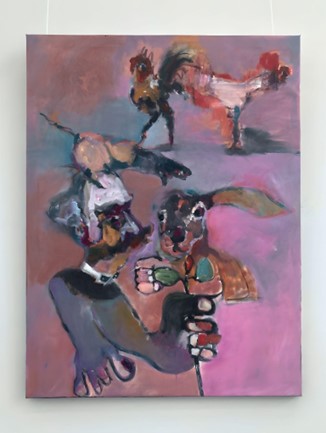
III. Aesthetic Experience
In addition to scientific lectures, the congress also offered aesthetic approaches to Nietzsche's thinking. This is how the exhibition was Nietzsche's Echo. Pictures of contradictions opened by painter Conny Gabora. The works shown are inspired by Nietzsche and his thoughts and life conflicts. They are intended to represent an artistic homage to the philosopher. In addition, the German film premiere of Nietzsche's landscapes in the Upper Engadine by Fabien Jégoudez and on Saturday evening, pianist Silvia Heyder and singer Julia Preußler gave a concert at which they performed some selected from Nietzsche's compositions. We were thus able to express Nietzsche's thinking not only in scientific form, but also in aesthetic experience.
IV. Conclusion
How can Nietzsche's technologies find expression in the technological age? The Congress in Naumburg has shown how Nietzsche can be read today as a technician of thought, a philosophy of doing, not of mere knowledge. This thinking provides the basis for a view of humans as a being that recognizes their animality and their integrations and enrolls itself in collectives of cyborgs and in the open biocultural network of being: “We are all chimeras, theorized and manufactured hybrids of machines and organisms; in a word, we are cyborgs.”7.
The photographs are by the author. The article image shows a Nietzsche bust by Fritz Rogge from 1943 on the first floor of the Nietzsche Documentation Center.
Literature
Fink, Dagmar: Becoming a cyborg: Possibility horizons in feminist theories and science fiction. Gender Studies. Transcript Verlag.
Haraway, Donna: The encounter of species. In: Texts on animal theory, published by Roland Borgards, Esther Köhring and Alexander Kling. Reclam's universal library, No. 19178. Reclam.
Haraway, Donna: Manifestly Haraway. Posthumanities 37th University of Minnesota Press.
Footnotes
1: “[A] cybernetic organism, a hybrid of machine and organism, a creature of social reality as well as a creature of fiction” (Haraway, Manifestly Haraway, p. 5; translation by the editor).
2: Cf. finch, Becoming a cyborg: horizons of opportunity in feminist theories and science fictions, p. 9 f.
3: See ibid. p. 59 et seq.
4: See ibid. p. 9 f.
5: Haraway, The encounter of species P. 239.
6: From science.
7: “We are all chimeras, theorized and fabricated hybrids of machine and organism; in short, we are cyborgs” (Haraway, Manifestly Haraway, p. 7; translation by the editor).
Nietzsche and Cyborgs
The International Nietzsche Congress 2025
Under the topic Nietzsche's technologies international visitors were once again invited to the Nietzsche Society conference in Naumburg an der Saale this year. In the period from October 16 to 19, in addition to various lectures, a film screening and a concert, there was also an art exhibition to visit. Our author Emma Schunack was there and reports on her impressions. Her question: How can Nietzsche's technologies find expression in the technological age?
Editorial note: The conference report does not mention the important “Lectio Nietzscheana Naumburgensis,” with which Werner Stegmaier rounded off the conference on Sunday morning and took up the topic of the conference again in a completely different way by asking about Nietzsche's own “philosophizing techniques.” We have now published this important talk in full length with the kind permission of the author (link).
“Peace with Islam?”
Hiking with Nietzsche Through Glasgow’s Muslim Southside: Part I
“Peace with Islam?”
Hiking with Nietzsche Through Glasgow’s Muslim Southside: Part I
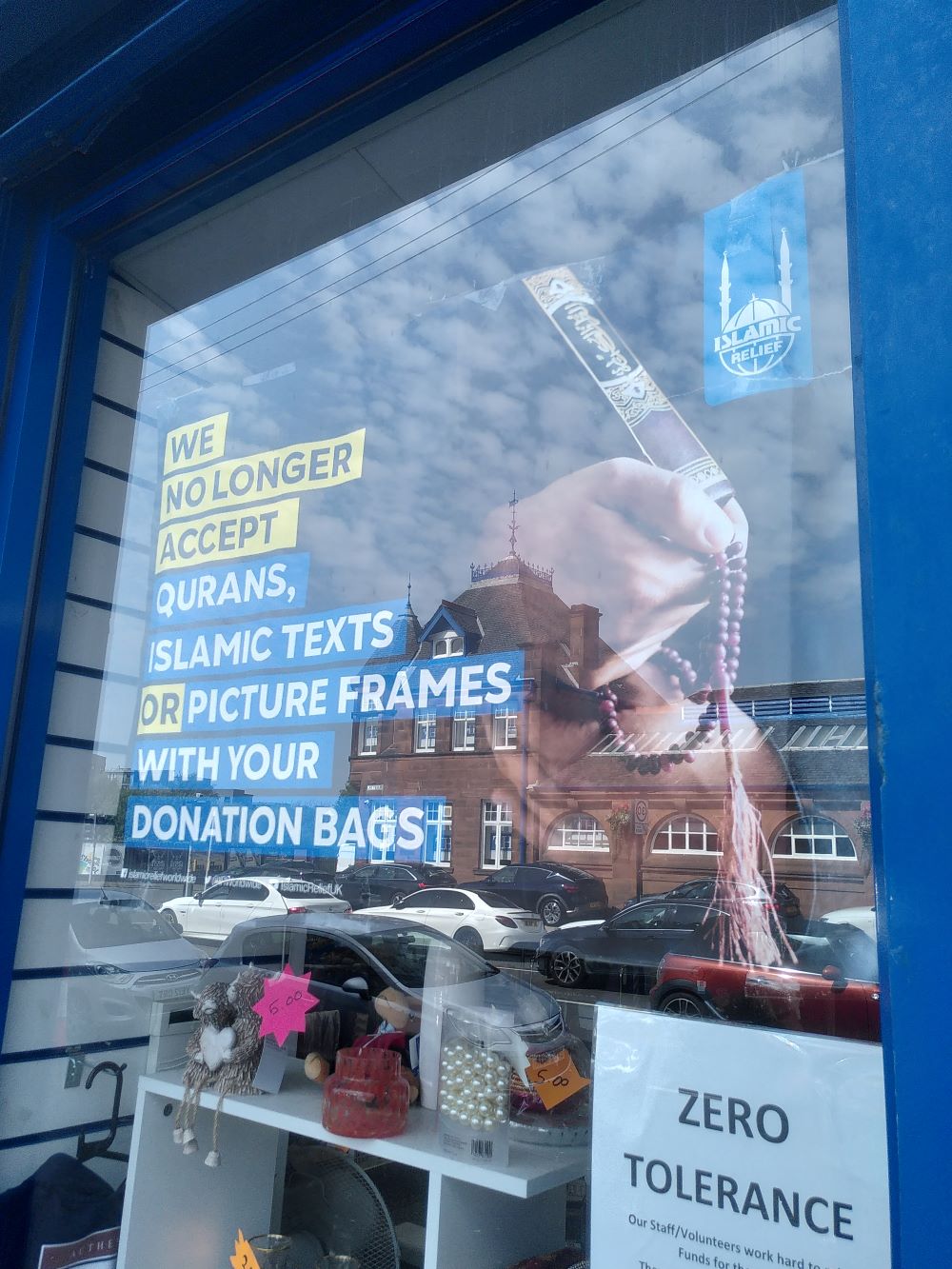
In this two-part essay, the ultimate part of our ‘Hikes with Nietzsche’ series (link) for the time being, staff writer Henry Holland retraces summer rambles around Glasgow’s Southside, the home of Scotland’s most concentrated Muslim population. In this first instalment, Holland introduces the research on Nietzsche’s engagement with Islam and his reception within the Islamic world. He recounts how stumbling upon a lecture by Timothy Winter on the French theoretician and artist Pierre Klossowski and his encounter with the faith of Muhammed made him curious about this subject in the first place. We then launch into a travel diary that leads our writer to the heart of one of the present-day’s most debated topics, the role that Islam plays in modern European societies.
I. Preparatory Strolls
It’s to the credit of this magazine’s editor that when he asked for essays inspired by Nietzsche’s programmatic love of hiking, and I emailed back offering accounts of urban hikes, at that point not yet walked, among Muslims in south Glasgow, and among Evangelical Christians in London, that he didn’t immediately torpedo the idea. In walking that first walk, and in writing the first travelogue, the Islam dimension proved so enthralling that this alone became the two-part article; the Evangelical Christians will have to thole it on my notebook’s pages until the signs cry out that it’s ripe for their revival.1
As Nietzschean scholars do, my editor also knows the Nietzsche-Islam intersection is bountiful, but one that those involved professionally with the philosopher usually give a wide berth. Ian Almond’s outstanding and brief introduction to this field, which wishes to alter this trend, notes that ‘[d]espite well over a hundred references to Islam and Islamic cultures ([the Persian poet] Hafiz [c.1325-1390 CE], Arabs, Turks) in the Gesamtausgabe [Complete Work], not a single monograph’ existed on the subject as of 2003.2 Even at his time of publication, Almond’s assertion could be seen as truer in the spirit than in the letter. Arguably the article on Nietzsche and the celebrated thirteen century poet Rumi, published in 1917 by the Indian-Muslim philosopher and poet Muhammad Iqbal, constitutes an earlier study that delves deep on what Islam and Nietzsche have learnt from each other. Yet Iqbal wrote this work to advance specific causes: to introduce Nietzsche to a wider Islamic readership and to invoke him in galvanising an anti-nihilistic variety of Sufism.3 It cannot give the dispassionate, bird’s-eye view that Almond’s intervention seeks to further. Commendably, Peter Adamson in his currently eight-volume-long history of philosophy devotes a whole 500-plus pages to ‘Philosophy in the Islamic World’. Despite this series’ completionist subtitle, ‘a history of philosophy without any gaps’, gaping holes reveal themselves, around Nietzsche’s pulsating corpus. The single reference Adamson provides is to Iqbal’s early twentieth-century avowal of the stateless Prussian thinker. But Roy Ahmad Jackson’s Nietzsche and Islam (2007) should be mentioned here, for all its imperfections, as should Peter Groff’s astute response to the same (2010).
Wanting for my part to write a street-level narrative from streets riddled with external suspicions, it’s best I come clean with my disclaimers, and state my positionality. I’m a Scottish white non-Muslim agno-atheist, unfulfilled by my nominal agno-atheism, and thus a serial flirter with faith, even when these waves of belief seem to arrive and depart in ever shorter loops.4 However I apply myself, I fail to emit any susceptibility to real piety: when I occasionally take time to chat to Jehovah’s Witnesses, they don’t bother to give me their proselytising spiel, as if sensing I’m a grand waste of time. From age four-and-three-quarters, when I started primary school in Edinburgh, the Muslim quotient in my class for the next seven years remained stable at around twenty-five percent: Shiraz, Asharif, Zahir, Samir, and a single girl, Javeria, being the humans behind this statistic.5 We, and yes, the white Scottish kids felt like a ‘we’, played playground football almost daily with the Muslim boys, the teams of course selected on grounds of ability and no other, and I remember at least one invite to Zahir’s birthday party. But by the final years of primary school my peer group had solidified into three or four other non-Muslim, white Scottish boys. This invisible barrier was built as much of class as it was of religion, or colour. Our school was where the eastern fringes of Edinburgh’s neoclassical New Town, with its self-trumpeting middle-classness, met the western fringes of what were then the working-class districts of Bonnington and Leith: the Muslim children I knew were mostly growing up there, in working-class homes. I’m not in contact with any of them now, but it’s these people I have to thank for my lack of fear of Islam. For how the far right’s incessant drum-beat about how Muslim culture will swamp non-Muslim culture in the coming decades — the slavering about Sharia-law dictatorships already being with us in Europe barely meriting repetition — catches my attention fails to persuade me.
Such culture wars are surely not about demographic facts, which are difficult to dispute, and rather about the religiosities and political intentions such facts are tied to. As noted in Ed Husain’s Among the Mosques, a liberal Muslim’s troubled alarm call to policy makers about the state of ‘ Muslim Britain’ today, the fifteen years to 2016 that saw England’s population growing by around eleven percent saw England’s Muslim population growing at almost ten times that rate.6 Scotland’s Muslims are numerically more marginal than in the rest of Britain, with Muslims making up about 1 in 70 of Alba’s inhabitants, compared to around 1 in 20 of the UK population as a whole.7 Nonetheless, Muslim populations’ higher fertility rates compared to non-Muslim populations8 mean that Muslim numbers will continue to rise in all parts of the UK, with Muslim majorities expected in some London boroughs and areas of Birmingham, Leicester, Bradford and several other English towns by 2031.9 A couple more decades would be needed before this happens anywhere in Scotland, but already now over one in four of the inhabitants of the electoral ward of Pollokshields, on Glasgow’s southside, are Muslim.10 So it is to Pollokshields and its surrounds that I decide to head on my hike. Statistics inform this journey rather than motivate it. My desire, to find out first-hand how Glasgow Muslims are seeing the world, combines with an unexpected YouTube encounter, to see me on to the 9.45am train, departing Edinburgh Waverly to Glasgow Queen Street.
II. Pre-Hike Reads
Around a year ago, and bobbing among the usual incongruous swell of affect-hungry clickbait and 1990s’ indie bands, my feed washed up something I wasn’t aware existed: a recent keynote lecture given by Prof. Timothy Winter — alias Abdal Hakim Murad — on Pierre Klossowski’s ‘reading of Nietzsche from an Islamic viewpoint’. The name of Klossowski (1905-2001) might ring bells for people truly smitten by French Theory. As both visual artist and author, he contributed in the 1930s to the avant-garde review Acéphale under the helm of Georges Bataille (whose philosophy has been introduced to POParts readers by Jenny Kellner). Later, his 1969 book Nietzsche and the Vicious Circle moved Foucault, Gilles Deleuze, and other grandees of the Paris intellectual scene to revisit and rethink their attitudes towards Nietzsche. Winter’s treatment of what Klossowski and Nietzsche tell us and each other is virtuoso. It wades appealingly into the big tent of theory, modernism, religion, and ethnicized politics in the Global North and in the coming centuries, leaving the intellectually less able, i.e., most of us, with the chore of digging out what might constitute its small print. In my personal imaginary of Deleuze-era Paris, Klossowski is marvellous because of his artistic rather than his philosophical genealogy. He was the elder son of Baladine Klossowska, a painter; worshippers at the temple of modernist poetry will know her as the final lover of Rainer Maria Rilke and inspirer of his late masterwork the Sonnets to Orpheus. His younger brother was the far more acclaimed painter Balthus, whose paintings now hang in the MoMA and in Basel’s Foundation Beyeler; a late arrival, it seems he’ll hold his place in the twentieth century’s visual canon. ‘Balthus’s Brilliant Brother’, by contrast, has yet to find his place.11 Although also astonishing as a translator, authoring the first published French translations of works by Heidegger, Walter Benjamin and Nietzsche, Pierre Klossowski still ranges mostly among cultural history’s footnotes. If you’re a specialist or theorist with an uncommon passion you’ll have heard of Klossowski; there’s no reason you otherwise would have.
As Winter’s bearing of alternate names hints at, he’s a convert to Islam, but one who’s lived all his adult life in this faith: he became Muslim aged nineteen, in 1979. Winter also mentions Klossowski’s conversion to Islam in late life, describing it as ‘an ambiguous event, although witnessed explicitly by his brother Balthus’.12 Ambiguity, we should note, has a strong positive connotation in Winter’s iconoclastic take on political and religious current affairs. More telling, it is suggested, than the details of Klossowski’s personal faith is what he has to offer on the ‘pathology of modern subjectivity, derived in large measure from an unusual cohabitation of Nietzsche with Saint Teresa of Ávila [1515-1582 CE]’.13 From here, Winter moves to caress what many in the West experience as an almost untreatable wound and loss — and to indicate how Klossowski could help reconfigure this. Wielding the antinomies of the Apollonian and the Dionysian, the loss of balance between which Nietzsche laments in The Birth of Tragedy, and invoking the ‘highly original interpretation’ that Klossowski gives to ‘Nietzsche’s experience of the Eternal Return’,14 Winter’s diagnosis of the Occident’s malaise is worth quoting in its fullness:
Across Europe now and to the alarm of nativists, non-migrant birth rates are in free fall. This we might term the bio-pause, an evolution which seems to follow two stages. Firstly, post-industrial secularizing humanity ruptures the symbiosis with other orders of nature, prompting their rapid collapse, and this is followed by a second episode in which humanity itself turns away from self-replication. The sexual revolution of the 1960s, detached now from the Haight-Ashbury spiritualities which sought to sacralise it, has simply generated a declined, nonproleptic libidinal, which has perfectly inverted the Augustinian ideal of procreation without desire …Towards this bio-pausal Europe sails a flotilla of flimsy Arks carrying migrants who mostly bear the charism of Ishmael and Hagar, archetypal exile people.15 These new Europeans are not only pre-biopausal in their fecundity, but remain rooted in traditional cultures, with high and even rising levels of religiosity, as suggested by the Fifteenth Arab Youth Survey this year. Or by Michael Robbins of the Arab Barometer,16 who … says that youth aged eighteen to twenty-nine have led the ‘return to religion’ across the Middle East and North Africa over the past ten years. Against this there is Europe’s Eternal Return to its dichotomy of self and other, and the new sub-Christian nationalisms emerging across the continent, the reappearance of a chronic immune reaction against the Semitisms, pitch Apollo against Dionysus, the linear and the closed against the biotic and polymorphous, a perennial theme of European self-definition since the time of Euripides. But some are asking James Baldwin’s question: do I really want to be integrated into a burning house?17
Readers suspicious that I’m plugging Winter could check his credentials. Committed secularists might be disturbed by what they find. Jacob Williams considers Winters to be a central node ‘in the [Islamic] traditionalist network in the West’, alongside two other thinkers who are also converts to Islam: Hamza Yusuf (aka Mark Hanson), and Umar Faruq Abd-Allah (Larry Gene Weinman).18 Setting out to explore these thinkers’ relations ‘to several currents in Western thought’ in how they explain and represent Islam, Williams also wishes to lay bare how these thinkers relate to ‘the Traditionalist School’.19 His definition of this as a ‘Western esoteric movement initiated by René Guénon [1886-1951 CE] that calls for the retrieval of a spiritual wisdom found in all religions but lost in modernity’20 tallies with the prevailing scholarship. Julian Strube defines ‘Traditionalism’ as ‘an umbrella term for diverse authors who share the conviction that a primordial truth has been preserved at the core of various traditions’, but focuses instead on the peculiar twist leant it by Julius Evola (1898-1974 CE) – himself an avid Nietzschean, as documented in countless publications. Strube contends that Traditionalism ‘has been an integral part of the New Right’ since the New Right’s earliest development in the 1950s.21 Evola’s notorious politics, epitomized in his ‘self-designation as “superfascista”’,22 are confirmed by recent critical research that records political positions ‘more extreme than the [Italian] Fascist party line’ in the 1930s and 1940s.23 But it would be a wonky short-circuit to thus equate Winter’s politics with Evola’s, and counterfactual to disqualify Winter’s worldviews as rejecting modernity. In flat contradiction to Evola’s anti-democratism, Winter singles out research by Sobolewska and others to highlight that when Muslim immigrants ‘achieve citizenship they generally take it seriously: in the UK, [mostly Muslim] individuals of Pakistani and Bangladeshi heritage are more likely than their white compatriots to affirm the duty of every citizen to vote.’24 I pack my rucksack for Glasgow still musing over Winter’s rebellious and genuinely espoused prophecy about Islam’s role, as personified by Ishmael and Hagar, in Europe and the world’s future.
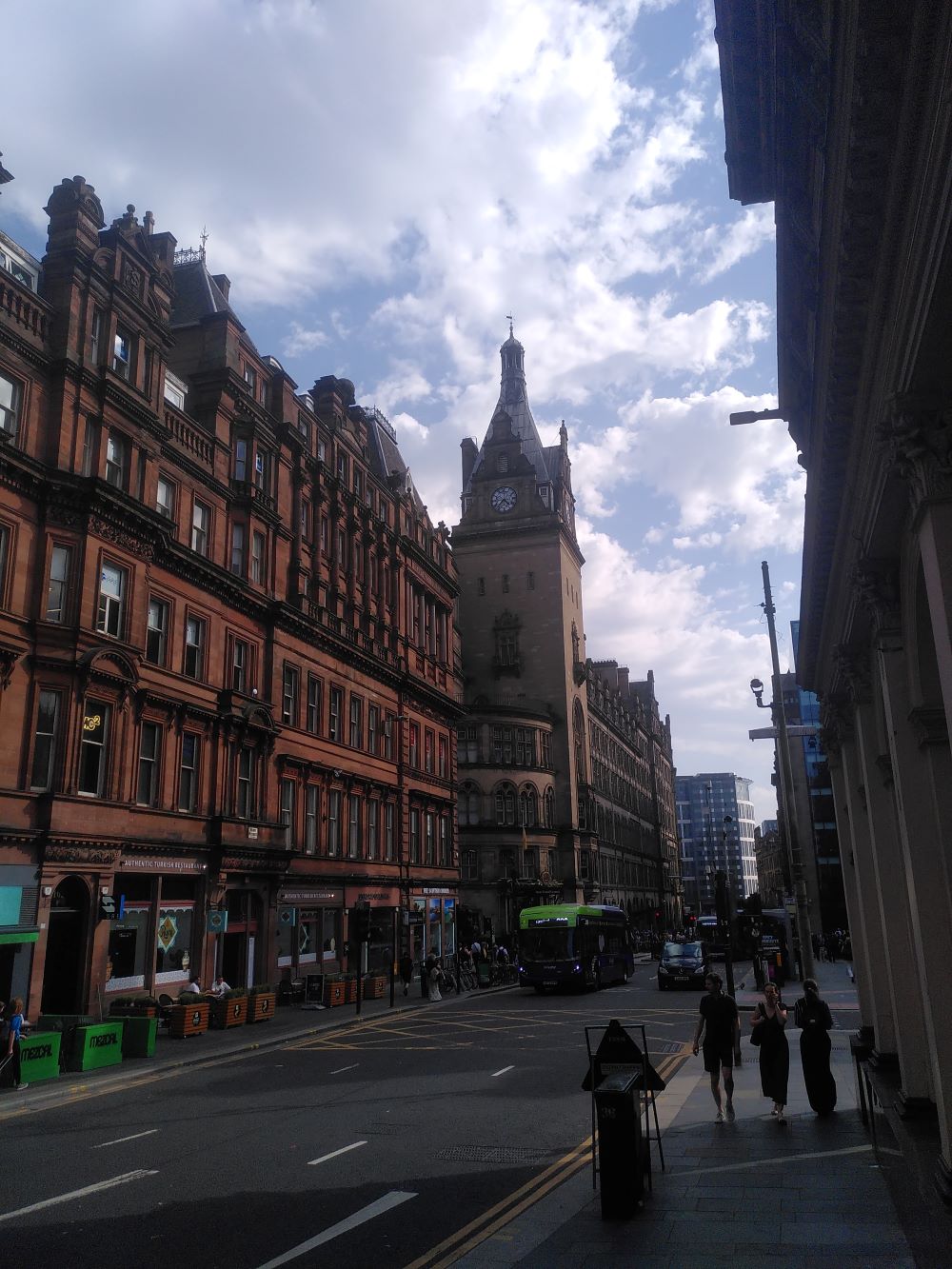
III. Charity Shops, Book Shops, Restaurants: Ishmael on Albert Drive
Although it’s my first time back in about a decade, Glasgow retains its powers to work its magic on me. It’s the red sandstone the city built in from the mid-nineteenth century, which hews itself into scruffy tenements, proud Scottish Baronial, and all manner of cut-stone forms in between, that has me reaching for language I’d like to call biblical: ‘If thou hast eyes to see, then see!’ If fate had laid other plans for me, instead of the genteel upbringing I enjoyed between the Church of Scotland and the Episcopalians, I’d perhaps want to call such language qur’anic. Nietzsche pondered a similar ‘what if’ question in a letter to his sister from 11 June 1865:
If we had believed, from our youths on, that all salvation for our souls would flow forth from someone other than Jesus, from Muhamed [sic.] for example, would we not surely still have been party to the same blessings?25
I’m catching Pollockshields on a particularly hot late summer’s day. St. Albert’s Catholic Church half-way down Albert Drive reminds readers of what feels like a fading Christian past, but it’s present-day Islam that catches the eye. Islamic Relief and Ummah Welfare Trust are two evidently Islamic charity shops that you’ll pass when walking into the area from Pollokshields East station. A sign in the window of the first announces that: ‘We no longer accept Qurans, Islamic texts, or picture frames with your donation bags’. Just as print bibles are in low demand in Christian and post-Christian milieus, Islam faces the challenge of being a text-transmitted religion in a mostly post-literate age.
While window shopping, I’m still rehearsing words in my mind that I hope will get me talking to the district’s inhabitants. If the aim is to get them talking frankly about their faith and their Prophet, will it help to mention Nietzsche, a figure who means as much to most people in these streets as Leana Deeb does to me?26 Still undecided as to strategy, I see that Ummah Welfare is advertising an old-school, print introduction to Islam in its window, yours for only two-pound-fifty. I go in, and ask the shopkeeper for a copy, and although a subsequent call to the proprietor informs us that said introduction is out of stock, at least we’re getting talking.
Atta Ali is a convivial and hospitable guy in his early thirties,27 who leads me out to the pavement, sensing rightly that I may feel more comfortable chatting there. Atta wears a full, longer beard, is dressed in salwar kameez topped by a thick, green lumberjack shirt, as if unruffled by the rare twenty-six degrees outside his shop, and tells me how he just comes to Pollockshields to volunteer but actually grew up in East Renfrewshire eight miles to the south. Which is better known as a Jewish area. He seems to want to signal his religious tolerance, a necessary prophylactic, perhaps, in an age where accusations of anti-Semitism against Europe’s Muslims are unremitting. On me mentioning Winter, Atta admits to admiring the ‘literary prowess’ of omnipresent influencer Sam Harris, even though Harris possesses his internet name largely because of his earnest representation of Islam as the insupportable Other.28
Atta then asks if Winter is a ‘revert’. Confused, I reply that Winter is indeed a convert to Islam, and Atta fills me in on what has become a popular theological take: people consciously becoming Muslim, as children or adults, are simply ‘reverting’ to the faith they’ve had all along, underneath: ‘we were all Muslim once, you know’ as Atta puts it. Wrong-footed by this bizarre assertion, I leave it to stand, although of course I’m curious. When was this then? During the Prophet’s lifetime (c. 570-632 CE)? Before the Prophet even incarnated?
Linking this fact with the Pakistani heritage of most of Pollockshields’ Muslims, Atta explains how this legacy is predominantly Sunni.29 He’s not friends with Shi’a Muslims, or Muslims from other ‘sects’, but says Shi’a come to pray at the local mosques, including the one one-hundred-yards down a side street, and simply don’t announce they’re Shia. Afterwards, they dress and leave quietly to avoid conflict. Atta’s use of ‘sects’ alerts me to what should have featured in my fieldwork preparation. Jarring with how twenty-first century Christians mainly perceive other churches and confessions, most Sunni Muslims, whether in Glasgow or worldwide, do not regard Shi’a, Sufis, or other Muslim minorities as co-religionists worthy of respect, but as heretics. They might, now in the UK, be left to pursue their alternative observance and theologies in peace: mostly. But they are not seen as equal partners in ecumenical debates.
A too narrow focus on Muslim sectarianism would fail to see Glasgow’s other recent and bigoted history. I immediately remember the anti-Catholic hatred in the city in the 1980s, when my brother and I were kids, and which has lasted a long time after that. Living in Edinburgh, one step away from the epicentre of the malice, my brother was nonetheless a Glasgow Rangers fan, a club grounded in Protestant isolationism, and regularly got tickets for Ibrox stadium. Discerning enough aged thirteen to not approve of the songs he heard there, they of course impressed him: raw, affective phenomena, a kind of extra-brutish will to power. Up into the 1990s, we heard, live when Robert took me, Rangers’ fans singing goading and besmirching songs about Bobby Sands, the IRA member and Catholic, who died in prison aged twenty-seven, in 1981, after a sixty-six-day hunger strike. Jim Slaven and Maureen McBride, two of a team of sociologists who have written on racism in Scotland, even reject the ‘notion of “sectarianism”’ in understanding such behaviour as it
draws a false equivalence between the attitudes of Protestants and Catholics; both [Slaven and McBride] are equally clear that the actual issue here is racism towards people of Irish Catholic descent and that this was an indigenous Scottish development rather than one imposed by the British state.30
The August sun has too much force for me to dwell on this inglorious past. In any case, I’m getting hungry. Café Reeshah at 455 Shields Road fulfils its promise to serve ‘authentic Asian cuisine’, in this case authentically Lahore-ian cuisine, from the Pakistani part of the Punjab.31 Of the two inside tables on offer, I manage to get the one out of the sun, and I attempt to eat the huge plate of vegetable pakora I’m served, officially a ‘starter’, as a portent. Nietzsche was so much the chronicler of own diet, particularly in letters and unpublished fragments, that unorthodox scholars claim his implicit food philosophy can unlock previously obscured quarters of his work. Rereading these nuggets, they tend as much towards comedy as universal stomach laws, given Nietzsche’s pressing awareness of what his café meals are costing him. Reporting back to mother and sister in Germany from Italy, in April 1881, the food guru exclaims that
Genoese cuisine is made for me. Will you believe me that I’ve now eaten tripe almost daily for 5 months? Of all meat it’s the most digestible, and lightest, and cheaper; and all the different kinds of little fish, from the common people’s cuisines, do me good. But no risotto at all, no macaroni until now! You see how changeable diet is, depending on locality and climate!32

IV. Deep-Fried Plenitude and Literalism
With the chana masala, the chickpea curry that follows as generous as the pakora, I’m wanting to claim that Glaswegian cuisine is made for me. Understood in its deep-fried plenitude and global diaspora internationalism. I’m happy to discover later that there’s a halal fish and chip shop just a little to the south in Queen’s Park. As far as the owner and staff of Café Reeshah go, nothing suggests that these men in their fifties aren’t also Muslim. But they dress western, and give no signs of adhering to the literalist tenets that Atta from Ummah Welfare signals allegiance to. Ed Hussain concludes that literalist interpretations of the Quran and the hadith33 now dominate in life choices among British Muslims — and that the hadith compendium most referenced in the twenty-first century UK may be that of Muhammad al-Bukhārī, written in the ninth century. Beards self-perpetuate, but literalist Muslims are also influenced by the teaching of the second caliph, Omar (ruled 634-644 CE), that beards should be trimmed but once a year.34 Facial hair, in itself, cannot harm: but other forms of literalism can. Al-Bukhārī conveys a Q-and-A between the Prophet and a group of unnamed interlocutors, in which the Prophet reports that ‘the majority’ of dwellers in ‘the Hell-fire’ shown to him ‘were ungrateful women’. Pressed for more on iniquitous women by his audience, al-Bukhārī even has the women among his listeners agreeing with Muhammed that ‘the witness of a woman [is] equal to half of that of a man’, with Muhammed explaining that this ‘is because of the deficiency of a woman’s mind’.35 Saqib Qureshi, in his recent Muslim intervention on ‘Reclaiming the Faith from Orthodoxy and Islamophobia’, calls this ‘rampant misogyny’ a concept ‘entirely foreign to the Qurʾān’.36 With such arguments, Qureshi allies himself with minority intellectuals at the Oxford Institute for British Islam, who want ‘a progressive and pluralistic Muslim faith that is based on the exclusive sovereignty of the Holy Qur’an’.37
Paigham Mustafa, a Glaswegian Muslim and Oxford Institute member, has had to endure almost a quarter-of-a-century of threats of extreme violence, for publicly taking this Qur’an-centric road. After publishing articles questioning mosque teachings, a committee representing twelve Glasgow mosques issued a fatwa (religious ruling) against him in 2001. While not explicitly threatening death, the document compared Mustafa to Salman Rushdie, thus inciting severe violence against him.38 Evidently an unorthodox free spirit, and uncowed by clerical bullying, Mustafa followed up in a letter about Ramadan published on Facebook in 2018: ‘Contrary to popular practice, ritual fasting is not prescribed in the Quran’.39 Long may pakora be savoured, at every possible hour. Chatting to the boss as I leave Café Reeshah, we find common ground in the Indian and later Pakistani localities where my great-grandfather and grandparents lived and worked for decades, and where my father was born: Lahore, Peshawar, Quetta. What unites and divides the descendants of the colonised from the descendants of colonialists is one and the same.
Nowhere near versed enough in Islamic theology to dispute the finer points in person, I’m coming down in favour of a journalistic approach, giving the interview partner the non-judgemental space to come out with what they really think. Hoping this might serve me at the confidently titled Islamic Academy of Scotland on Maxwell Drive, just minutes from Café Reeshah, I make my way there. I marvel at the ornate Victorian entrance arch to what used to be Pollockshields Bowling Club, but finding the drab, prefab buildings that house the Academy closed, I head back towards the Madni Islamic Book Shop on Maxwell Road. Alongside wedding dresses and lifestyle accoutrements, the literature the friendly shopkeeper offers comes in gaudy colours, reminding me of Catholic devotional tracts. I start to feel queasy. I select Understanding Islam by Maulana Khalid and Sayfulla Rahmani, which restricts itself to using Islamic green, and white. But when I come to pay the seller slips in another ‘Brief Illustrated Guide’ for free. It’s cover depicts ‘one million Muslims’ gathered at night in prayer at the Masjid al-Haram, Mecca’s great mosque, the faithful illuminated in dayglo colours. In the starry sky above them, a flying Qu’ran sends out a Milky Way of light to lasso our globe, which orbits large, and counterintuitively, over the crowds and the city’s high-rises.
My other two purchases also beam their messages in a different universe to the liberal and unorthodox Islam with which I prepped my trip. My eyes light upon The Need for Creed — Jinn: Beings of Fire. This popular demonology is printed on thick card and written in over-long rhyming couplets that don’t scan. Illustrated with sickly AI graphics, it proclaims a weird theology: ‘Jinns are very advanced and were on Earth before us: but caused harm, / they live a parallel life, they vary in belief but some have chosen Islam’.40 Menacing rather than merely weird is the title Emergence of Dajjal: The Jewish King, a slim, large-type treatise, in which chapter headings including ‘The Annihilation of Jews’ make unmistakeable who is being aimed at.41 Apocalyptic literature, this large-print tract features Imam Mahdi, a key end-time figure, but one that Shi’a and Sunni Muslims have an utterly different understanding of. Only later do I discover that comparative researchers see Dajjal in a rough correspondence with the Antichrist of Christian tradition: and wonder again at the coincidences my journey has laid out for me. And I slip into detective mode and want this evidence — best not to address its contents head on with the proprietor. Unprompted, the shopkeeper responds to me buying this title (price three-pounds-fifty) by telling me how, as children, they had often heard stories about Dajjal, whose Arabic name translates as ‘the deceiver’, back in the Ivory Coast.

V. Keeping the Faith Regardless of the Violence You Encounter
The Jewish King is that kind of anti-Semitic literature that’s not at all concerned to cover its tracks. Casual anti-Semitism amongst Glaswegian and British Muslims today is probably as common as casual anti-Semitism was amongst Europe’s Christians, for centuries until the latter half of the last century. Passing St. Aloysius’ College, the Jesuit day school in central Glasgow late in the day, a picture comes to me of Glasgow’s twenty-first century Muslims being as unquestioning of the superiority of their faith as, regarding their belief, the Jesuit fathers were who set up the school on the current site in the 1860s. Yet when secular European intellectuals in the 2020s insist upon anti-Semitism as definitive for Muslims and in Islamic culture, they choose to be blind on one eye. Saqib Qureshi demonstrates brilliantly that in the global history of anti-Semitism, Muslims have been but minor players.
Throughout the middle ages and early modern era, church leaders lent theological support to anti-Jewish politics, which was enacted through mass forced conversions, expulsions, murders, and other atrocities. Jews were persecuted and burnt across Europe from 1347-1349, after being blamed for causing the Black Death through poisoning water in wells; many conversions accompanied these deadly scenes, both ‘forced and “voluntary”’.42 With anti-Jewish violence also spreading across Spain, up to a third of that country’s Jews were killed, while up to a half were forcibly converted, in the late fourteenth and early fifteenth centuries.43 Exact numbers are disputed, but Jewish eyewitness accounts, such as that given by Reuven Gerundi, who survived the 1391 massacres and stated that 140,000 Jews were forcibly converted in their wake, must be taken seriously.44 Historian David Nirenberg argues, without necessarily accepting the accuracy of such figures, that the ‘mass conversions’ of Jews in the Iberian peninsula in this period were primarily of people ‘converted by [Christian] force’: and that this violence ‘transformed the religious demography’ of the region.45
Qureshi contrasts this bloody legacy with the ‘close to none’ forced conversions enacted by Muslims at the time of the Prophet, and in the century or so after his death. Contending there is ‘no evidence of Muhammad forcing any conversions’, Qureshi draws on scholarship by Asma Afsaruddin and Heather Keaney to add that by 750 CE, ‘fewer than 10 percent of the non-Arab populace’ conquered by the nascent Islamic Empire had converted to what was then a new religion.46 This standpoint is backed up by Sarah Stroumsa, who calls ‘forced conversions’ in medieval Islam ‘not the rule, but rather an aberrant exception’.47 As Qureshi points out, it is ‘funny’ that popular wisdom associates forced conversion primarily with Islam, when is the Christian-directed Spanish Inquisition (1478-1834 CE) that represents the largest violence-based conversion drive in human history.48 Much evidence suggests that both Jews and Muslims suffered massively under this violence. Despite it, tens if not hundreds of thousands of forced converts refused to forget about their old faiths and used skilful subterfuge to continue practicing crypto-Judaism and crypto-Islam.49
There is an allegory in this history crying out to be heard. However much the populist and far right cook up anti-Muslim resentment, and demand levels of assimilation that they know themselves won’t be achieved, Muslim populations in Pollockshields, Madrid or Leipzig aren’t responding by converting to secularism or by packing their bags and going anywhere. To the wilful deafness of some political leaders it bears repeating: Muslims, rightly, know Pollockshields and places like it as their homes. In this essay’s concluding part we turn to Nietzsche’s unexpected engagement with Islam and to Pierre Klossowski’s artistic and Muslim responses. Beyond the vitalness of red sandstone and seagull-visited pavements, there are reminders here that homes are also intellectual, spiritual and, for some, proudly religious places, not apart from but expanding purely physical realms.
All pictures are photographs taken by the author. The article image shows the showcase of the Islamic Relief Shop on Albert Drive.
Bibliography
Adamson, Peter: Philosophy in the Islamic World: A history of philosophy without any gaps, Volume 3, Oxford University Press: 2018.
Afsaruddin, Asma: The First Muslims: History and Memory, Oneworld, Kindle: 2013.
Almond, Ian: ‘Nietzsche’s Peace with Islam: My Enemy’s Enemy is my Friend’, German Life and Letters 56, no. 1 (2003), 43-55.
Ames, Christine: ‘Christian Violence against Heretics, Jews and Muslims’. In: M. S. Gordon, R. W. Kaeuper, and H. Zurndorfer, H. (eds.): The Cambridge World History of Violence, II, 500–1500. Cambridge University Press: 2020.
Davidson, Neil & Satnam Virdee, ‘Introduction’, in: Understanding Racism in Scotland (ed. Davidson and Virdee), Luath: 2018.
Elshayyal, Khadijah: ‘Scottish Muslims in numbers: Understanding Scotland’s Muslim population through the 2011 census’, Edinburgh: Alwaleed Centre for the Study of Islam in the Contemporary World, University of Edinburgh (2016).
Friedmann, Yohanan: Tolerance and Coercion in Islam: Interfaith Relations in the Muslim Tradition, Cambridge University Press: 2003.
Groff, Peter: ‘Nietzsche and Islam’ [review of Nietzsche and Islam, by Roy Jackson], Philosophy East & West Volume 60, Number 3, July 2010.
Harvey, Leonard. P: ‘Fatwas in Early Modern Spain’, The Times Literary Supplement,
26 February 2006, replying to Trevor J. Dadson, ‘The Moors of La Mancha,’ The Times Literary Supplement, 10 February 2006.
Hopkin, Peter (ed.): Scotland’s Muslims Society: Politics and Identity, Edinburgh University Press: 2017.
Husain, Ed: Among the Mosques: A Journey Around Muslim Britain, Bloomsbury: 2021.
Jackson, Roy: Nietzsche and Islam, Routledge: 2007.
Keaney, Heather N.: ‘Uthman ibn ‘Affan’: Legend or Liability?, Oneworld Publications, Kindle: 2021.
Klossowski, Pierre: Nietzsche and the Vicious Circle, translated and introduced by Daniel Smith, University of Chicago: 1997.
Klossowski, Pierre: The Baphomet, translated by Sophie Hawkes and Stephen Sartarelli, with introductions by Juan Garcia Ponce and Michel Foucault, Eridanos Press: 1988.
Netanyahu, Benzion: The Origins of the Inquisition in Fifteenth Century Spain, Random House: 1995.
Nirenberg, David: ‘Mass conversion and genealogical mentalities: Jews and Christians in fifteenth-century Spain’, Past & Present 174 (2002), 3-41.
Qasmi, Matloob Ahmed: Emergence of Dajjal: The Jewish King, Adam Publishers: 2013-2014.
Qureshi, Saqib Iqbal: Being Muslim Today: Reclaiming the Faith from Orthodoxy and Islamophobia, Rowman & Littlefield, 2024.
Robbins, Michael: ‘MENA Youth Lead Return to Religion’, Arab Barometer, 23 March 2023, https://www.arabbarometer.org/2023/03/mena-youth-lead-return-to-religion/.
Ruby, Ryan: ‘Brilliant Brother of Balthus’, The New York Review, 8 August 2020. https://www.nybooks.com/online/2020/08/08/pierre-klossowski-brilliant-brother-of-balthus/.
Sobolewska, Maria, Stephen D. Fisher, Anthony F. Heath, and David Sanders, ‘Understanding the effects of religious attendance on political participation among ethnic minorities of different religions’, European Journal of Political Research 54, no. 2 (2015), 271-287.
Staudenmaier, Peter, ‘Evola’s Afterlives: Esotericism and Politics in the Posthumous
Reception of Julius Evola’, Aries 25:2 (2025), 163-193.
Stroumsa, Sarah: ‘Conversions and Permeability between Religious Communities’, Schriften des Jüdischen Museums Berlin (2014), 32-39.
Strube, Julian: ‘Esotericism, the New Right, and Academic Scholarship’, Aries 25, 2 (2025): 304-353, doi: https://doi.org/10.1163/15700593-02502006.
Swindon, Peter: ‘‘You will get your head chopped off” – Scots Muslim writer threatened by extremists’. In: The Herald, 3 June 2018. https://www.heraldscotland.com/news/16266154.you-will-get-head-chopped-off---scots-muslim-writer-threatened-extremists/.
The Pew Research Centre: ‘The future of the global Muslim population. Projections for 2010–2030’, Population Space and Place, 13(1), (2011), 1-221.
Williams, Jacob, ‘Islamic Traditionalists: “Against the Modern World?” ’, Muslim World 113, no. 3 (2023), 333-354.
Winter, Timothy: Klossowski’s Reading of Nietzsche From an Islamic Viewpoint, [Unpublished manuscript, shared by Winter with Henry Holland in October 2025, with a text similar but not identical to Winter’s lecture recorded for YouTube: https://www.youtube.com/watch?v=wC8YJfyOkOY], (2025).
Footnotes
1: Editor’s note: This second report it scheduled to appear in June next year.
2: Ian Almond, ‘Nietzsche’s Peace with Islam’, 43.
3: On Iqbal and Nietzsche, see: Feyzullah Yılmaz, ‘Iqbal, Nietzsche, and Nihilism.’ Particularly on the 1917 article on Nietzsche and Rumi discussed here, see: ibid., 4 & 10-13.
4: This blunt neologism should communicate my own religious positionality: too much the atheist to puff myself up with the title of agnostic, I’m nonetheless unimpressed by my mind’s arguments for my atheism. They appear to serve just one version of my ‘self’ rather than a more universal truth. Hence the term: agno-atheist.
5: Children in Scotland start primary school aged between 4½ and 5½ depending on when the child's birthday falls.
6: Husain, Among the Mosques, Introduction.
7: Alba is the Scottish Gaelic word for Scotland. Cf. Khadijah Elshayyal, ‘Scottish Muslims in numbers’, 8.
8: Documented in a detailed study described by Ed Husain as ‘non-partisan’: The Pew Research Centre, ‘The future of the global Muslim population’, 15.
9: Husain, Among the Mosques, Introduction.
10: Khadijah Elshayyal, ‘Scottish Muslims in numbers’, 8.
11: For more on Pierre Klossowski’s biography, see: Ryan Ruby, ‘Brilliant Brother of Balthus’.
12: From Winter’s YouTube lecture, at 40:16 minutes: https://www.youtube.com/watch?v=wC8YJfyOkOY&t=356s.
13: Ibid., at 2:46 minutes.
14: From the précis of Klossowski’s involvement with Nietzsche given by Klossowski’s translator, Daniel Smith, in his translation of The Vicious Circle, viii.
15: ‘The three great Abrahamic religions’ agree that Ishmael is Abraham’s son by Hagar. It is significant that, according to the Torah, Hagar is (at first) non-Jewish: a ‘concubine’ or sex slave purchased in Egypt to serve as a maid for Abraham’s childless wife Sarah, then given by Sarah to Abraham to conceive an heir. On becoming pregnant, Sarah treated Hagar so harshly that she was forced into the desert, and was finally instructed ‘by an angel of the Lord’ to return to her Egyptian home, where she gave birth to Ishmael. This scriptural source (Gen. 16:1–16; 21:8–21) is one basis for Winter’s understanding of Ishmael and Hagar as ‘exile people’. Cf. The Editors of Encyclopaedia Britannica, ‘Hagar’, Encyclopaedia Britannica, October 22, 2025. https://www.britannica.com/biography/Hagar-biblical-figure, and ibid., https://www.britannica.com/biography/Ishmael-son-of-Abraham.
16: Michael Robbins, ‘MENA Youth Lead Return to Religion’, Arab Barometer, 23 March 2023, https://www.arabbarometer.org/2023/03/mena-youth-lead-return-to-religion/.
17: Winter, ‘Klossowski’s Reading’, at 3:11-5:21 minutes.
18: Jacob Williams, ‘Islamic Traditionalists: “Against the Modern World?”’, 335-336.
19: Ibid., 335.
20: Ibid., 333.
21: Julian Strube, ‘Esotericism, the New Right, and Academic Scholarship’, 305.
22: Cited from Williams, ‘Islamic Traditionalists’, 333.
23: Peter Staudenmaier, ‘Evola’s Afterlives: Esotericism and Politics in the Posthumous Reception of Julius Evola’, 170.
24: Sobolewska’s research as referenced by Winter in an unpublished manuscript of the aforementioned video lecture, that Timothy Winter generously shared with me in October 2025. The text of the manuscript differs slightly from the text spoken in the video. See: Timothy Winter, Klossowski’s Reading of Nietzsche From an Islamic Viewpoint , 2; cf. Maria Sobolewska, Stephen D. Fisher, Anthony F. Heath, and David Sanders, ‘Understanding the effects of religious attendance on political participation among ethnic minorities of different religions’, European Journal of Political Research 54, no. 2 (2015): 271-287.
25: Letter 1865, 469. This and the other translation from a Nietzsche source given in this essay are my own.
26: Deeb is a successful, young, female and Muslim influencer, with over 1.5 million subscribers to her YouTube channel. Here’s her July 2025 video on ‘what really happened at the oxford debate’.
27: I have changed this name and the name of several other speakers in the text, to protect the speakers’ identities.
28: Video debates Harris features prominently in, with titles like “How to Defeat Islam’, speak for themselves: https://www.youtube.com/watch?v=PpWN1lOM1fE. But his most successful critics, including Jonas Čeika who had been featured on POParts (here and again, here), gain greater purchase, at least in their own communities, in their critique of the scientism they see as at the heart of all of Harris’s polemics. C.f. Ceika’s video A Critique of Sam Harris' ‘The Moral Landscape’.
29: More of Scotland’s Muslims have their family roots in Pakistan than in any other country, see: Scotland’s Muslims Society: Politics and Identity, edited by Peter Hopkin, 6-7.
30: Neil Davidson & Satnam Virdee, ‘Introduction’, 2.
31: The philosophical question of authenticity, particularly in relation to Nietzsche, is contested and convoluted. We’re grateful that Paul Stephan has devoted a whole doctoral dissertation to this question.
32: From a postcard to Franziska and Elisabeth Nietzsche, written 6 April 1881 (link).
33: Literally meaning ‘an account’ in Arabic, the hadith refer to the initially oral histories of Muhammad and his close circle, which were first compiled into distinct written collections, beginning one or two centuries after the Prophet’s death. Ed Husain discusses the present influence of the hadith of Muhammad al-Bukhārī (died 870 CE) at several stages of his book Among the Mosques, including chapter 1.
34: Husain, Among the Mosques, chapter 5.
35: Muhammed al-Bukhārī, ‘52 Witnesses’, Sunnah.com, accessed 29 November 2022, http://sunnah.com/bukhari: 2658. Cited from: Saqib Iqbal Qureshi, Being Muslim Today: Reclaiming the Faith from Orthodoxy and Islamophobia, 100-101.
36: Ibid., 100-101.
37: OIBI website, https://oibi.org.uk/, accessed 1 October 2025.
38: Peter Swindon, ‘“You will get your head chopped off” – Scots Muslim writer threatened by extremists’.
39: Musatafa, cited from ibid.
40: Moazzam Zaman, The Need for Creed — Jinn: Beings of Fire, pages not numbered.
41: Matloob Ahmed Qasmi, Emergence of Dajjal: The Jewish King, 66.
42: Christine Ames, ‘Christian Violence against Heretics, Jews and Muslims’, 476 & 467n17.
43: Cf. Qureshi, Being Muslim Today, 214.
44: Gerundi, cited in: David Nirenberg, ‘Mass conversion and genealogical mentalities: Jews and Christians in fifteenth-century Spain’, 9.
45: Ibid., 10 & 3-41.
46: Cf. Qureshi, Being Muslim Today, 216-219; Afsaruddin, The First Muslims: History and Memory, chapter ‘The Age of the Successors’, ebook location 13.3; and Heather N. Keaney, ‘Uthman ibn ‘Affan: Legend or Liability?, chapter ‘Conquests’, ebook location 7.30.
47: Sarah Stroumsa, ‘Conversions and Permeability between Religious Communities’, 34. Cf. Yohanan Friedmann, on how both Sunni and Shi’a legal schools allow Jews, Christians, and some other religious groups to retain their religious identity, giving them protected status: Tolerance and Coercion in Islam: Interfaith Relations in the Muslim Tradition.
48: Qureshi, Being Muslim Today, 214-215.
49: Crypto-Judaism is a major theme in Benzion Netanyahu’s The Origins of the Inquisition in Fifteenth Century Spain. For an introduction, see this book, xvi-xviii. On crypto-Islam, see: L.P. Harvey, ‘Fatwas in Early Modern Spain’.
“Peace with Islam?”
Hiking with Nietzsche Through Glasgow’s Muslim Southside: Part I
In this two-part essay, the ultimate part of our ‘Hikes with Nietzsche’ series (link) for the time being, staff writer Henry Holland retraces summer rambles around Glasgow’s Southside, the home of Scotland’s most concentrated Muslim population. In this first instalment, Holland introduces the research on Nietzsche’s engagement with Islam and his reception within the Islamic world. He recounts how stumbling upon a lecture by Timothy Winter on the French theoretician and artist Pierre Klossowski and his encounter with the faith of Muhammed made him curious about this subject in the first place. We then launch into a travel diary that leads our writer to the heart of one of the present-day’s most debated topics, the role that Islam plays in modern European societies.
The Barbarians of the 21st Century
Narcissism, Apocalypse, and the Absence of Other
The Barbarians of the 21st Century
Narcissism, Apocalypse, and the Absence of Other
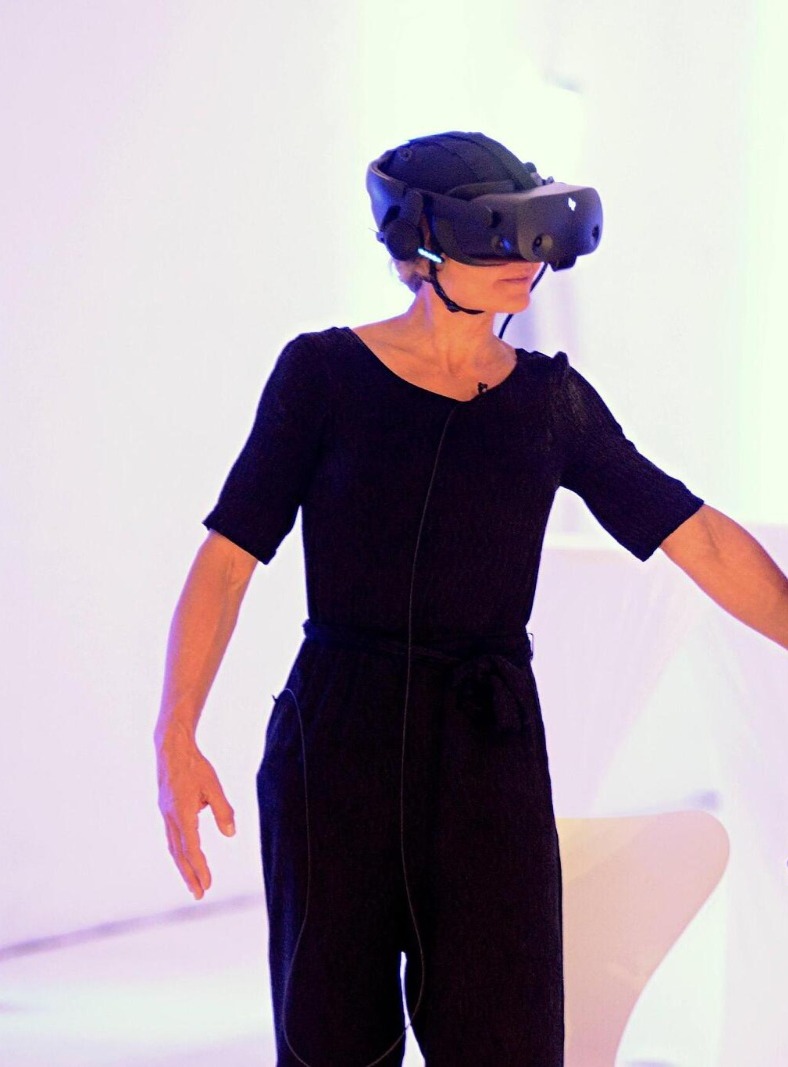

The diagnosis of our time: not heroic barbarians, but selfie warriors. This essay, which won the second place at this year's Kingfisher Award (link), explores Nietzsche's vision of the”stronger type”1 and shows how it is turned into its opposite in a narcissistic culture — apocalypse as a pose, the Other as a blind spot. But instead of the big break, another option opens up: a “barbaric ethic” of refusal, of ambivalence, of relationship. Who are the true barbarians of the 21st century — and do we need them anyway?
I. The Barbarian As a Figure of Thought Between Criticism and Projection
In the history of culture and ideas, the term “barbarian” is a semantic hinge between demarcation and expectation, between identity creation and transgressive wishful thinking. In his later writings, Nietzsche gave the term a future-oriented function: The coming barbarians should not only be destroyers, but also carriers of a new strength, a regenerative cultural power. But what does this vision mean, how can it be interpreted in light of current social, political and psychological phenomena such as populism, a culture of self-expression and anti-intellectual movements?
Nietzsche's rhetoric, which is often regarded as prophetic, has a problematic tendency: The longing to “overcome” the present can itself be an expression of powerlessness and a lack of ability to adapt. The idea of radical break then replaces concrete criticism and power of action with an aestheticized apocalypse. This must be critically analysed.
The term Bárbaros Etymologically comes from ancient Greek: “Bar-bar” imitated the language of the non-Greeks. The barbarian was therefore the linguistic stranger who stood outside the cultural order. This linguistic difference gradually developed into a moral and civilizational evaluation: The barbarian became the uncivilized, the threatening, the opposite of the “we.”
This historical semantics is the origin of a structure of collective identity formation through demarcation. The barbarian serves as a negative foil through which a cultural “we,” a group identity, can be constituted. This dichotomy between the own and the foreign, internal and external, is still evident today in political discourses, such as in nationalist, anti-intellectual and populist movements. As Giorgio Agamben and Achille Mbembe have already analyzed, the figure of the barbarian is a biopolitical marker that organizes exclusion, legitimizes violence and makes the state of emergency the norm.2
II. Nietzsche and the Ambivalence of the Barbaric
Nietzsche places the concept of barbarian in a different context. For him, the barbarian is not primarily the underdeveloped, but the unbroken. Especially in the estate and in the genealogy The barbarian appears as the bearer of a raw, unbridled will to power, which modern society has lost — through moralizing, resentment, and weakness.3 Who doesn't want to think of current presidents and despots, but also the celebrated self-presentation of their own special features on social media platforms? These barbarians of the 21st century appear to some of us as role models, as bearers of hope — but to others as warning signs. Regardless of which camp you belong to, this always creates a dialectic of delimitation.
But the longing for a cultural break, for a “stronger kind,” is not supported by a concrete theory of transformation. Rather, she flees (like Nietzsche did) into the imaginary of the break, which A priori that substitutes actual political and cultural work. The “barbarians” appear as saviors ex negativo: Its size is not designed, but hoped for. This philosophy of hope through rejection is ultimately a sign of philosophical helplessness, an apocalyptic longing for the other. But the realized dystopia of modern barbarism — visible in the narcissification of society, in threatening political gestures and in war — is neither strategically planned nor calculated nor expected: rather, it breaks over us as an unpredictable reality, grows out of complex dynamics of social development and escalates into forms that could neither be foreseen politically nor culturally in their scope.
III. The New “Barbarians”: Populism, Narcissism and Lateral Thinking
In the present, we encounter identity-creating associations that present themselves as barbaric — in the sense of Nietzsche. The lateral thinker movement, conspiracy groups or even the followers of Trump, Putin and other authoritarian populist tendencies who believe in a heroic epic pose themselves as resistance to decadence, elites, modernity. But they remain trapped in the logic of resentment. What they criticize is often not so much the system as their own marginalization within it.
In addition to loss of meaning, post-modern society is increasingly threatened by narcissistic self-infatuation that makes any alterity disappear. It seems that the radical “barbarism” that Nietzsche had hoped for has not occurred — instead, a soft-washed, performative version of the barbarian has prevailed: the narcissistic consumer who subordinates everything else to his self-actualization path.
Nietzsche diagnosed a culture in which the great stories dry up and the transcendental foundations collapse. As a response, he did not expect a retreat, but a new kind of person who is not guided by values but sets values. Today we see the opposite: Late-modern society is dominated by a The will to image pulled through. It is no longer about being, but about being visible. People stylize themselves as a brand that only works as long as it creates desire.
Here, Nietzsche's concept of self-overcoming is perverted: The focus is no longer on growth, on risk, but on a narcissistic self-affirmation that displaces everything else — in the sense of Byung-Chul Hans. In The expulsion of the other Han describes a society that systematically excludes the foreign, the unavailable, the irritating in order to maintain a narcissistically mirrored self. In this world, the other person is no longer a challenge or an opportunity for development, but a functional object: evaluated, used, eliminated.
The new barbarian is no longer a warrior. He acts as a curator of his own visibility. His weapons are filters, hashtags, and algorithms. This barbarism is quiet, smooth, affirmative — and radical in that. It is the barbarism of optimization, in which the other person, instead of being destroyed, disappears into insignificance. Relationships become projects, people become resources, intimacy becomes a commodity.
Han is talking about the neoliberal use of the other person. The Other no longer appears as a radical difference, as resistance, but is transferred into an economic structure through a network of control, evaluation and comparability. The new narcissism is not (only) pathological — it is systemic.
Nietzsche complained of a “softening”4 of humans. Today we have it with a liquefaction To do: Nothing stays, everything flows, everything has to perform. The barbarians of the 21st century don't come with the sword: they hold up the selfie stick. They do not destroy buildings, but spaces of meaning.
IV. Narcissistic Culture as a Nihilistic Continuation
One might be tempted to interpret this narcissistic culture as the exact opposite of Nietzsche's barbarians. But it is rather a consequence of the nihilism he described: When there are no longer any superordinate values, the ego becomes the sole measure. But what looks like liberation is in fact a new form of enslavement — a captivity within oneself.
Nietzsche's vision of great health, one affirmative existence, presupposes the other person: as resistance, as a border, as a dialogue partner. Narcissistic culture, on the other hand, only knows the echo. In narcissistic dynamics, the other is not integrated or surpassed — the other is reduced to its mirror function in such a way that it is eliminated. The current barbarism is therefore a barbarism of lack of relationship.
The narcissistic society is not only in the tradition of the Enlightenment, but also in its paradoxical disintegration. The emancipation of the subject has led to isolation. Social networks suggest connection but create isolation. The other person becomes a screen — his depth disappears. Proximity is simulated, while real encounters become impossible; constant visibility replaces subjectivity. People become the object of their own surveillance. The narcissistic look inward is no longer self-reflection, but a permanent scan for connectivity and recognition.
These movements are not creating a new culture. They don't call for self-overcoming, they're calling for projection. Their revolt is not a creative act; it is an expression of an inability to create. Self-empowerment is replaced by performative sacrifice, which is all too easily compensated with aggression and willingness to use violence.
The narcissistic self-presentation complex of “selfie culture” also shows an apparent subjectification, which, however, appears to be an expression of systemic powerlessness. The “Ich brand” is becoming a compensation strategy in a world without borders. However, this form of digital barbarism is not strong, but stale — a farce of authenticity.
Nietzsche criticizes the weakness of modernity, but at the same time absolutizes an inconcrete hope of a break. This dialectic results in a paradoxical relationship: The call for the “stronger kind” is an expression of the experience of not being able to design for oneself. The philosophy of superman thus becomes a philosophy of self-empowerment, which can only think of its own effectiveness through its contradiction. This voluntary task of acting competence can result in depressive solidification, in a passive-aggressive attitude of refusal towards the stranger, while at the same time idealizing the “other”, which allows identification, stranger, in fantasies of salvation.
Instead of in the mode of concrete practice, the contemporary barbarian conjurer also persists in an aesthetic of revolution. The productive power of philosophy is replaced by a mythology of rupture. Walter Benjamin called this “left-wing melancholy”: the adherence to revolutionary gestures without revolutionary effect.5
Nietzsche's idea of a “stronger kind” remains in the balance between overcoming fantasies and resignation of cultural criticism. The idea that “only barbarians can save us” is a refusal to adapt: The present is not thought of as formable, but as decadent, decaying, doomed to destruction.
However, a contemporary philosophy must be critiqued and be able to design. The view of the “barbaric” must not degenerate into a mythological figure, but must serve as a mirror: What do we lack that we long for destruction? Why do we think that strength that we no longer find within ourselves can only come from outside?
V. The Possibility of a New Barbarism: Transformation Rather Than Transgression
Instead of a return to violence or symbolic individualism, what is needed today is perhaps a radical rehabilitation of others. The “barbarian” of the present day could not be the one who destroys, but the one who refuses total instrumentalization — who embodies the other in his existence: unavailability, ambivalence, resistance.
A new barbarism would have to break the systems of evaluation. It should counter the narcissistic gaze with silence. Perhaps it is the weak, the ambivalent, the inadequate who would be able to make a new form of relationship possible today — not through power, but through presence. A “barbaric ethic” would then not be an ethic of violence, but an ethic of non-functioning.
The figure of the barbarian historically refers to exclusion, symbolic violence — and at the same time to the recurring hope of a new beginning. Nietzsche philosophically exaggerated this figure and turned it into a projection screen for overcoming modernity. But there is a double risk in this exaggeration: The renewal is being externalized — it should come from outside, in the form of the “other person.” And it is aestheticized — as a heroic act, as the pathos of rupture.
An ethics of transformation argues against this fractional thinking: It takes what exists seriously, not because it is good, but because it is real. Transformation doesn't start with violence. It starts with attention. It is a quiet, lengthy, conflictual process that allows irritation and withstands ambivalences. In contrast to the transgressive gesture, which disregards the law, transformation looks for other rules, for other ways of dealing with power, vulnerability, and responsibility.
Transformation means seeing the other person as an opportunity rather than as an obstacle. It means thinking of yourself as a relationship beyond presentation as a brand. And it means not numbing the pain of the present with the hope of a utopian future: The work of change can be started out of pain. It is no less radical than the revolution — but it is slower, deeper, and more lasting.
What we need today are not barbarians, but transformers: people who are ready to continue building with the ruins of modernity — without cynicism, without promises of salvation, with a sense of what is possible in reality. This requires not heroic break, but radical patience, not apocalypse, but cultural work. The real strength lies not in the fervor of revolution, but in the ability to persist — and in the art of not only hoping but also acting.
Marion Friedrich, born in 1973 in Germany, studied psychology in La Laguna (Spain) and then philosophy in Augsburg (Germany). In her doctoral studies at the University of Augsburg, she focused in particular on epistemological questions of neurophilosophy and noetic anthropology. Since 2007, in addition to her psychotherapeutic work, she has been teaching in her own humanistic practice at the University of Augsburg with a focus on epistemology, language philosophy, theories of emotion and artificial intelligence. Her current research interests include the philosophy of mind, AI ethics and the psychology of love. In 2024 she published the volume written together with Joachim Rathmann and Uwe Voigt Ego or eco? Narcissism and the ecological crisis with Reclam.
Sources
Agamben, Giorgio: Homo Sacer. Sovereign power and naked life. Frankfurt am Main 2002.
Benjamin, Walter: Collected Writings III. Frankfurt am Main 1991.
Han, Byung-chul: The expulsion of the other person. Society, perception and communication today. Frankfurt am Main 2016.
Ders. : psychopolitics. Neoliberalism and the new techniques of power. Frankfurt am Main 2014.
Mbembe, Achille: Critique of black reason. Berlin 2017.
The article image was created by the author using ChatGPT.
Footnotes
1: Subsequent fragments 1887 11 [31].
2: Cf. Agamben, Homo Sacer and Mbembe Critique of black reason.
3: See, among others Subsequent fragments 1885 34 [112] and On the genealogy of morality, Paragraph I, 11 and I, 16.
4: See e.g. Subsequent fragments 1887 10 [2].
The Barbarians of the 21st Century
Narcissism, Apocalypse, and the Absence of Other
The diagnosis of our time: not heroic barbarians, but selfie warriors. This essay, which won the second place at this year's Kingfisher Award (link), explores Nietzsche's vision of the”stronger type”1 and shows how it is turned into its opposite in a narcissistic culture — apocalypse as a pose, the Other as a blind spot. But instead of the big break, another option opens up: a “barbaric ethic” of refusal, of ambivalence, of relationship. Who are the true barbarians of the 21st century — and do we need them anyway?
Where Are the Barbarians of the 21st Century?
An Essay in the Spirit of Nietzsche
Where Are the Barbarians of the 21st Century?
An Essay in the Spirit of Nietzsche

On August 25, we published an interview, conducted by our author Paul Stephan, with the AI tool Chat GPT (link). In it, he asked the software, among other things, to write him an essay on the question of this year's Kingfisher Award: “Where are the barbarians of the 21st century? “(link). As an experiment, we presented the text to the five-person jury of the award, consisting of Lukas Meisner, Hans-Martin Schönherr-Mann, Theodor Schild, Natalie Schulte and Paul Stephan himself — and it was surprisingly well received: In the preliminary round, it achieved fourth place on points and would therefore have made it into the shortlist by a hair. Only Natalie Schulte had drawn suspicion and presented the text to an AI checker, which, however, did not recognize it. — Would you have thought the text was human?
The essays from this year's winners will be published in the coming weeks. Did they do it better than AI, as we believe?
We deliberately refrained from editing the text, but published it exactly as the program spit it out for us. The article image is also from it.
As a part of this experiment, the subsequent translation has also been done by ChatGPT itself and we publish it without any alterations.
1. Introduction: The Question of the Coming Humans
Friedrich Nietzsche was a thinker of thresholds, of transitions, of upheavals. His philosophy is not addressed to the guardians of the status quo, but to the promise of another kind of human being. It is no coincidence that he asks in one of his late fragments: “Where are the barbarians of the twentieth century?” This question is far more than cultural-critical polemic. It expresses his deep dissatisfaction with the European culture of his time, which he perceived as decadent, complacent, and exhausted.
For Nietzsche, “barbarians” did not mean those who relapse into savagery, but those who are prepared to destroy the old in order to make the new possible. They are not the breakers of civilization, but its overcomers.
Today, 125 years after Nietzsche’s death, this question arises once more — indeed, more urgently than ever: Where are the barbarians of the twenty-first century? And above all: what would they have to be like in order to correspond to Nietzsche’s spirit?
2. The False Barbarian: Populism, Violence, Regression
The temptation is great to look for the barbarians at the political margins or extremes — among autocrats, demagogues, and agitators. Many of them indeed stage themselves as “system breakers,” as “enemies of the elites,” or as saviors of some imagined originality. But Nietzsche would hardly have allied himself with them. He was no friend of the masses, no apologist of ressentiment, no defender of the dull “will of the people.” On the contrary: he was an elitist thinker — though not in terms of social origin, but of intellectual incorruptibility.
The barbarian Nietzsche longed for does not act out of hatred, but out of abundance. He destroys not out of frustration, but out of creative power. From this perspective, the nationalist and authoritarian movements of our time are not barbarians but phenomena of regression. They do not seek to create something new, but to restore something old. They are not interested in becoming, but in reestablishing an imagined yesterday.
3. The Exhaustion of Values
Nietzsche diagnosed the “death of God” as the end of a metaphysical order that had shaped Western thought for centuries. For him, this death was not a reason for mourning but a challenge: the old values have lost their binding force, and it is now up to human beings themselves to create new ones. But it is precisely at this point that the present hesitates.
The “last man,” whom Nietzsche caricatures in the preface to Thus Spoke Zarathustra, has taken over: comfortable, security-oriented, ironic, and world-weary. The possibility of the radically new is perceived as a risk, not as a promise.
In a culture of constant self-optimization, of digitalized life, and of moral hyper-surveillance, there is little space for what Nietzsche called “chaos” — the chaos from which a dancing star can be born. Everything is regulated, measured, evaluated. But nothing is dared any longer.
4. The True Barbarians: Creators of the Future
Nietzsche’s barbarians are figures of departure. They come “from the future” and bring with them something that still eludes the present: new values, new perspectives, new possibilities of life. One should not imagine these new humans as superheroes or geniuses. Perhaps they are eccentric, perhaps marginalized. Perhaps they act not loudly, but persistently. But they share one trait: a radical turning away from what is inherited.
You will not find them on talk shows, not in party manifestos, not in influencer videos. They cannot be integrated, because their thinking lies beyond what can be integrated. Perhaps they are artists who deliberately refuse commodification. Perhaps philosophers who do not proclaim truth but provoke movements of thought. Perhaps solitary individuals who experiment with new forms of community, work, and intimacy — without ideological prescriptions.
Their barbarism consists not in violence, but in intransigence. Not in destruction, but in birth.
5. What Does It Mean to Be a Barbarian?
To be a barbarian in the twenty-first century means: not to play along. It means withdrawing from constant surveillance, from digital conformism, from moral rigorism. It means — as Nietzsche demanded — “to resist the temptation of the times, not to submit to them.”
A barbarian thinks across the grain, not because it is fashionable, but because he sees differently. He does not live outside society, but neither within it — rather, beyond its self-evidence.
The barbarians can also be readers of Nietzsche, provided they do not venerate him as a saint, but take him as a demolition expert. They use his hammer not to shatter others, but to test their own idols.
6. Outlook: Thinking the Unheard
“One must still have chaos in oneself to be able to give birth to a dancing star.” This oft-quoted Nietzsche sentence is not poetic ornament, but a declaration of war against the complacency of our culture. The concept of chaos in Nietzsche is never nihilistic; it means openness, becoming, the not-yet-determined.
The barbarian is the one who does not fear this state, but cultivates it.
So — where are the barbarians of the twenty-first century? Perhaps they are not yet visible. Perhaps they are still turned inward. Perhaps they are reading this very text. What they make of it will show whether they are truly barbarians — or merely administrators of modernity’s legacy.
Where Are the Barbarians of the 21st Century?
An Essay in the Spirit of Nietzsche
On August 25, we published an interview, conducted by our author Paul Stephan, with the AI tool Chat GPT (link). In it, he asked the software, among other things, to write him an essay on the question of this year's Kingfisher Award: “Where are the barbarians of the 21st century? “(link). As an experiment, we presented the text to the five-person jury of the award, consisting of Lukas Meisner, Hans-Martin Schönherr-Mann, Theodor Schild, Natalie Schulte and Paul Stephan himself — and it was surprisingly well received: In the preliminary round, it achieved fourth place on points and would therefore have made it into the shortlist by a hair. Only Natalie Schulte had drawn suspicion and presented the text to an AI checker, which, however, did not recognize it. — Would you have thought the text was human?
The essays from this year's winners will be published in the coming weeks. Did they do it better than AI, as we believe?
We deliberately refrained from editing the text, but published it exactly as the program spit it out for us. The article image is also from it.
As a part of this experiment, the subsequent translation has also been done by ChatGPT itself and we publish it without any alterations.