Materialism and the Problem of Morality
Reflections with Deleuze/Guattari, Clouscard, and Levinas
PART 1: Morality Without a Place: Deleuze/Guattari vs. Clouscard
Materialism and the Problem of Morality
PART 1: Morality Without a Place: Deleuze/Guattari vs. Clouscard

As is well known, Nietzsche did not feel bound by conventional morality. In a world without an afterlife, strength and the will to power prevail. While Nietzsche was prepared to accept the brutal consequences of this perspective if necessary, some of his successors could not reconcile themselves to it, if only for political reasons. Using the work of Gilles Deleuze and Félix Guattari, this text examines the difficulties faced by a materialism that seeks to hold onto its Nietzschean inspiration while refusing to betray certain values. Michel Clouscard highlights this tension, yet he, too, fails to provide a justification for his moral convictions within the framework of his Marxist materialism. Is materialism fundamentally blind to morality?
I. Nietzsche or Marx or…?
About a year ago, Estella Walter put Nietzschean materialism on trial on this blog (link). The verdict went against it: Walter speaks of the failure of this materialism. She bases her judgment on a perspective informed by historical-dialectical materialism: from a Marxist point of view, Nietzsche must be accused of impermissibly naturalizing hierarchies and inequalities through his will to power, while simultaneously indulging in a moral relativism that is overcome in Marx’s reduction of moral values to social and, above all, economic conditions. Attempts to reactivate Nietzsche from the left, most prominently by Deleuze, are therefore doomed to failure "because, instead of successfully materializing the will to power, one attempts to idealize the material productive forces, i.e., to detach them from their very reality" (ibid.).
Walter’s critique is hard to dismiss. I want to build on it to deepen the understanding of "materialism" and to pinpoint the exact location of its problem with morality. For what is meant by "materialism" does not seem immediately clear if it encompasses both Nietzsche’s philosophy and Marx’s historical-dialectical materialism. I propose to designate as materialism all philosophical theories that do not assume any entities or levels of being beyond, above, or below the level of the truly experienceable, which forms an open universe of finite things. Thus, the task of philosophy is to explain the empirically existent only through other empirically existent things. This one and only dimension of the real is referred to by Deleuze and Guattari as the "plane of immanence."1 Materialism in this sense does not mean a denial of the mental, nor does it imply reductionism, but it does mean conceiving of the mental as a "product" of the physical—though it remains undecided how such a production takes place. In this sense, Nietzsche is just as much a materialist as Marx, and Spinoza as much as Deleuze.
The concept of morality is also used in a confusing variety of ways. I will use it to refer to all systems of thought, as well as practice, that become intrusive in the form of commands and prohibitions. They are always united by the imperative character of their appeal, which Kant articulated with particular sharpness. One often recognizes that one is dealing with morality (and not, for example, with rules of prudence) by the indignation it provokes: it is the characteristic reaction to a violation of what is morally commanded or forbidden.
First, it will be shown that morality finds its rightful place in very few materialist theories, including historical-dialectical materialism. It is subject to a peculiar gesture of denial. Second, it will become clear that this is not due to materialism per se but to a very specific conception of metaphysics that dominates most of its varieties. This time, the subject of discussion is not Nietzsche, but two authors who make extensive use of him.
II. Materialism of Machines
The Anti-Oedipus by Gilles Deleuze (1925–1995) and Félix Guattari (1930–1992) is one of the most ambitious philosophical projects of the 20th century. The two authors continue to spin the materialist approach of Nietzsche by consistently radicalizing the desubjectivization that is already regularly encountered in his work. Being is described in Anti-Oedipus as the emission and intersection of flows, the cuts of which take place in asubjective "machines." Each machine is coupled to other machines via the flows it cuts and subsequently releases. In this way, the machines form a precarious, living network of flows and cuts in which material reality vibrates.
However, the machines form provisional stabilities which, although all their existential efficacy stems from the machines, henceforth pose as their cause and ultimate purpose: the "bodies without organs." Thus, "my body" is indeed more than the sum of its parts, but whatever I can say and know about it still stems only from these. In the same sense, "peoples" consist of groups, individuals, classes, etc., yet claim to precede them; in states, peoples and institutions, etc., come together, but in such a way that the state poses as their basis rather than as a contingent result.
The ontology of the Anti-Oedipus fundamentally requires no further categories. It is entirely materialistic, insofar as it postulates no entities beyond physical machines and their multidimensional connection via equally physical flows. In doing so, Deleuze and Guattari employ a non-reductionist concept of the physical: my mouth is just as physical as global migration patterns, a cigarette just as much as a socius—that is, the political entities that Deleuze and Guattari roughly divide into the coded earth, the overcoded tyrant, and decoded, axiomatized capital. And in everything, desire is expressed, which is equated with the production of reality. (This alone makes it clear that one is not dealing with simple reductionism.)
Deleuze and Guattari understand their project within the horizon of a philosophy and politics of revolution. They draw on psychoanalytic and Marxist sources to establish their own unique, heretical form of Freudo-Marxism. Heretical with regard to Marxism is, above all, the departure from dialectics. While traces of dialectical thinking can be found throughout Anti-Oedipus, the metaphysical principles are decidedly non-dialectical.
This shift away from Marxist theory has two main consequences: On the one hand, reflection on the conditions of production is anything but absent in Anti-Oedipus, but within its framework, they are no longer considered the paradigm of the material. On the other hand, the dialectic of class contradictions is replaced by a more flexible, plural conception of interactions: between machines, and even more so between them and the body without organs, there will always be contradictions, conflicts, and struggles, but these relationships are, on the whole, more diverse and ambiguous. Struggle is only one modality of the countless ways in which machines and the body without organs interact. Thus, the historical dialectic is also removed from its central position; in its place comes a less clear conception of history: whether it has a goal, at any rate, can no longer be easily stated.
III. Marxism Strikes Back
Just one year after the publication of Anti-Oedipus , the Marxist sociologist Michel Clouscard (1928–2009) presented a scathing critique of the book under the polemical title Néo-fascisme et idéologie du désir . In short, he accuses Deleuze and Guattari of inverting the true material conditions: they engage in the mystification of an objectless desire, which is, in fact, merely the luxury version of need. They claim that the objects of consumption are affects, when it is obviously commodities that are being consumed. They locate production in desire and machines—ultimately everywhere—even though production actually takes place in factories and by the working class. In short, they design an ideology of desire that renders real material conditions and relations of production invisible, thereby providing the perfect camouflage for bourgeois hegemony. (Clouscard could therefore have agreed unreservedly with Walter's critique cited at the beginning.)
The dispute revolves not least around the question of what constitutes the material upon which a critical materialism can rely. In truth, however, it goes much deeper. Formulated this way, it would hardly be possible to account for the most striking feature of Clouscard's book: its polemical tone. Clouscard does not simply criticize; his critique is carried by holy wrath. The omissions and obfuscations he attributes to Deleuze and Guattari outrage him: they are not merely intellectual errors, but expressions of moral failure.
Where do this affect and its intensity come from? Clouscard systematically mobilizes the conceptual opposition between the serious and the frivolous. In doing so, he takes a firm stand for seriousness. The serious is expressed, for example, in the "ethics" of the popular classes, for this is founded on the awareness of the scarcity of goods, of hardship, and of the compulsion to work. By contrast, the "morality" of the bourgeoisie is frivolous, quite simply because there is always a choice there, not least the choice to oppose that "morality." This choice exists within the bourgeoisie because it does not exist elsewhere. It follows that "morality" and "anti-morality"—applied to the target of the critique: Oedipus and Anti-Oedipus, customs and the "liberation of desire"—are two sides of the same coin, and that they both belong to the self-image and self-stylization of the bourgeoisie. The critique of morality, as conducted by Deleuze and Guattari, is therefore not general at all, but concerns only the bourgeois sector, so that the critique is a dialectical part of bourgeois frivolity itself.
Bourgeois morality, and even more so anti-morality, both thrive on the disregard for the working class and the underprivileged classes. To be precise, the frivolity of desire and the aestheticism of pure pleasure express the contempt for others. The praise of schizophrenia is a luxury that, of all people, only the fittest can afford.2 Clouscard sees the work of anti-intellectual intellectuals as ultimately driven by a profound cynicism.
Clouscard’s indignation is morally grounded. While the historical materialist may struggle to philosophically justify their moral intuitions and imperatives—perhaps arguing that they are simply expressions of current production relations—the intensity of the affect proves that Clouscard does not actually feel themthat way, even if he might speakof them as such. Morality and its demands thus mark an exterior to the dialectic, which, in theory, should not have one.
What cannot appear in historical materialism in "intentio recta"—unvarnished and straightforward—but only with the relativizing index of historical contingency, is precisely its moral foundation. According to Clouscard, what cannot appear in bourgeois ideology (such as in the work of Deleuze and Guattari) is likewise the morally fundamental, as this would pull the rug out from under the ideology and rule of the bourgeoisie. In Clouscard’s reckoning, the moral demand is as central as it is unsituated.
Thus, Nietzschean-influenced materialism denies the morality that clearly defines it—at least in the case of Deleuze and Guattari—partly out of a metaphysical consistency in being unable to name a source for the commanding nature of morality, and partly, perhaps, out of fear of being accused of being "petit-bourgeois." On the other hand, dialectical materialism also fails to provide a convincing justification for its moral inspiration, not least because it would risk speculating on moral values that exist beyond history and its dialectical unfolding of truth. Both varieties of materialism are difficult to conceive without a fundamental moral impulse, yet both are forced, for different reasons, to deny this impulse. While both acknowledge the reality of morality, they interpret its imperative character as a product of other processes—thereby degrading it to mere appearance. In materialism, it seems, morality is placeless.
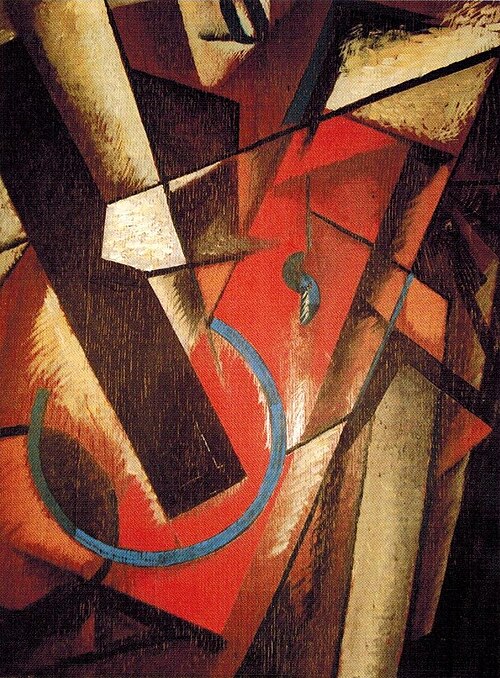
Article image: Lyubov Sergeyevna Popova: Composition (1921) (Source)
Robert Hugo Ziegler teaches philosophy in Würzburg. He is the author of several books on political philosophy, metaphysics, natural philosophy, and the history of philosophy. His most recent publications in 2024 include Kritik des reaktionären Denkens, Von der Natur and Spinoza und das Flirren der Natur.
Footnotes
1: Cf. Was ist Philosophie?, p. 42.
2: Clouscard, Néo-fascisme, p. 114.