#
Snack
Materialism and the Problem of Morality
Reflections with Deleuze/Guattari, Clouscard, and Levinas
PART 1: Morality Without a Place: Deleuze/Guattari vs. Clouscard
Materialism and the Problem of Morality
PART 1: Morality Without a Place: Deleuze/Guattari vs. Clouscard
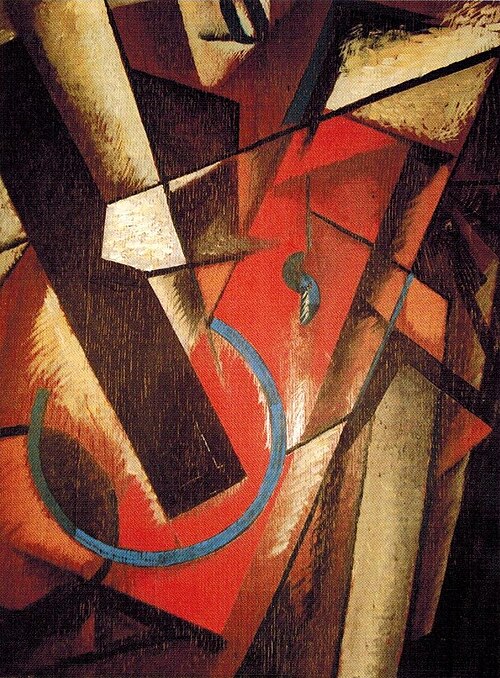
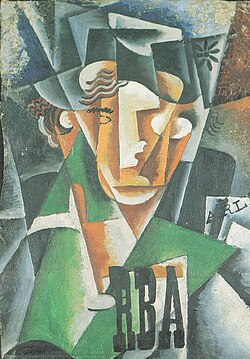
As is well known, Nietzsche did not feel bound by conventional morality. In a world without an afterlife, strength and the will to power prevail. While Nietzsche was prepared to accept the brutal consequences of this perspective if necessary, some of his successors could not reconcile themselves to it, if only for political reasons. Using the work of Gilles Deleuze and Félix Guattari, this text examines the difficulties faced by a materialism that seeks to hold onto its Nietzschean inspiration while refusing to betray certain values. Michel Clouscard highlights this tension, yet he, too, fails to provide a justification for his moral convictions within the framework of his Marxist materialism. Is materialism fundamentally blind to morality?
“Facts” and a Damn Good Interpretation
Nietzsche as a Solo Piece in Halle
“Facts” and a Damn Good Interpretation
Nietzsche as a Solo Piece in Halle

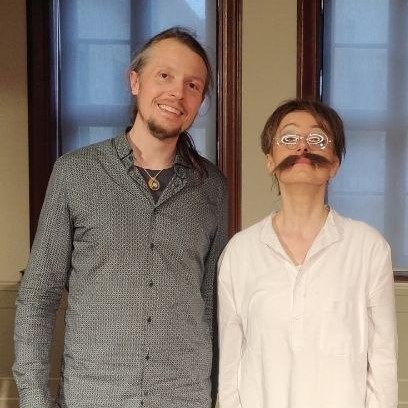
The actress Andrea Ummenberger is currently putting Nietzsche on stage in Halle with a solo play. In a captivating evening at the theatre, the audience can experience the thinker as he possibly was, at least in the interpretation of Austrian writer Alexander Widner, during his last years: not necessarily mentally abducted, but rather insane and in permanent conflict with his sister, his mother — and last but not least his home country. A self-proclaimed fool who rebels against the tight shackles of German small-mindedness and dreams of the South and liberated sensuality. Ummenberger shows us a Nietzsche who still has something to say to us today; not a brilliant idol, but rather a complex anti-hero who asks important questions.
The Blond Beast and the “Hammertyp”
How Dieter Bohlen Finally Discovered a Titan of Equal Rank
The Blond Beast and the “Hammertyp”
How Dieter Bohlen Finally Discovered a Titan of Equal Rank


At first glance, Dieter Bohlen and Friedrich Nietzsche have as little connection as Marie Antoinette with Rosa Luxemburg or Napoleon with Angela Merkel — but a second reveals greater affinities than one might suspect. In any case, this unlike synopsis enables a new perspective — on Bohlen and on Nietzsche in equal measure. “Pairing the strangest and separating the next”1, in the following text, our regular author Christian Saehrendt undertakes a truly Nietzschean search for clues on the tracks of the “titan” of German pop, which to this day polarizes like only a few celebrities in the German-speaking world — this, too, a line of connection between philosopher and musician.
Aesthetics of Rausch
Reading Nitsch with Nietzsche
Aesthetics of Rausch
Reading Nitsch with Nietzsche
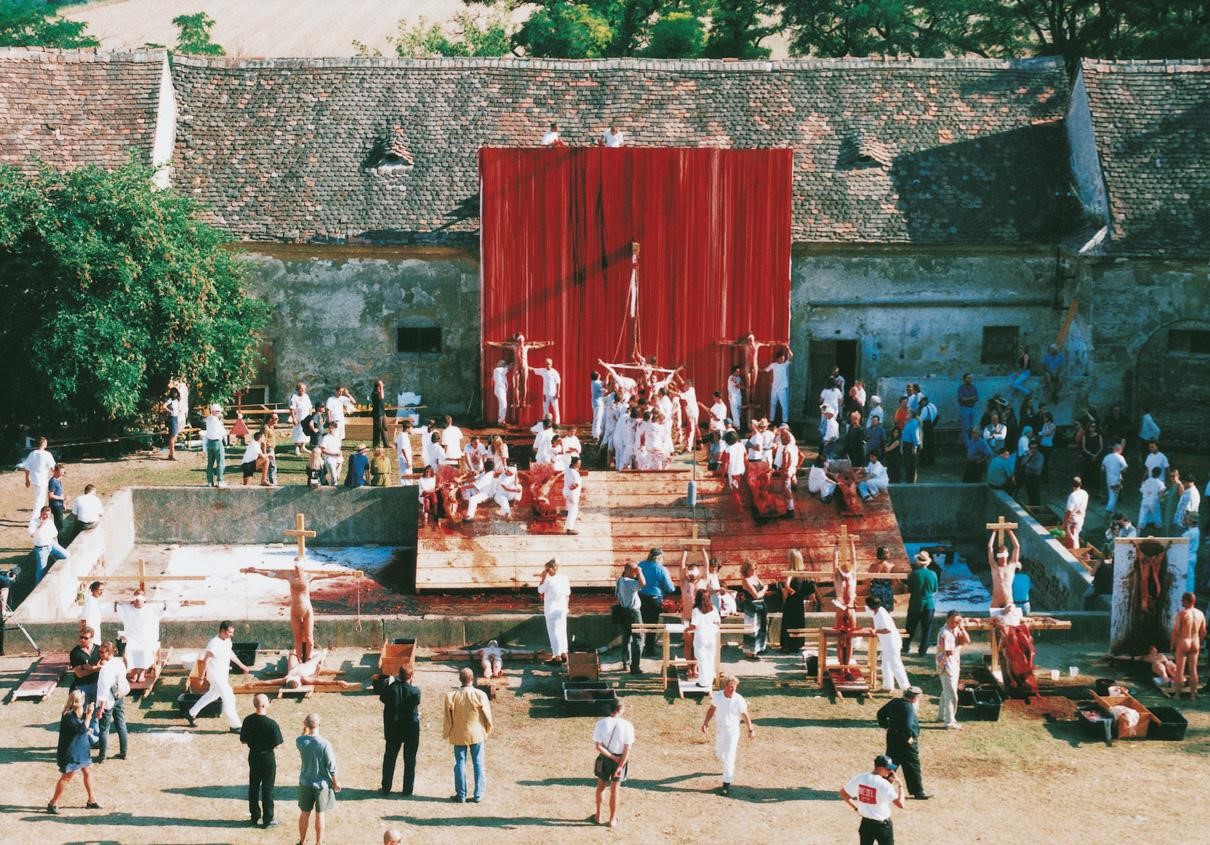

In its early publication The Birth of Tragedy (1872) Nietzsche formulated his basic theory of ancient tragedy. The moment of Rausch — a term which often translated as “intoxication” but refers not just to states of intoxication caused by the use of intoxicating drugs — is just as fundamental here as it is for Nietzsche's understanding of art in general. Emma Schunack investigates how the Dionysian intoxication of ancient tragedy is reflected in Hermann Nitsch's contemporary art. Between bloody animal pelts on purple, vermilion and lemon-yellow colored sheets + candied white violets.1 To what extent can the concept of Dionysian Rausch in Nitsch's “Orgies Mystery Theatre” be understood as a contemporary continuation of Nietzsche's understanding of art? An attempt to read Nitsch with Nietzsche.
“A Question of Context”
Thoughts and Memories of Alexander Kluge
“A Question of Context”
Thoughts and Memories of Alexander Kluge

The filmmaker, writer, lawyer, and philosopher Alexander Kluge, born in 1932, died on March 25. Kluge, who became known to a large audience not least through his films and his artistic television interviews, was repeatedly inspired by Nietzsche. In his diverse work, he not only dedicated himself decisively to him, but also followed a profoundly Nietzschean, perspectivist approach throughout his life. That should be reason enough to dedicate an obituary to him on our blog, which art historian and curator Barbara Straka thankfully wrote for us.
The Eternal Oak
Where Everything Returns
The Eternal Oak
Where Everything Returns


With this literary contribution by Giulia Romina Itin, we are launching our main focus topic this year. Throughout the year, we will publish several articles dedicated to the topic of “forest” — the forest in its dual meaning as an almost mythological place of encounter with the, sometimes uncanny, sometimes encouraging, primal forces of life, but also, viewed more pragmatically, as the real basis of existence of our civilization that remains decisive but also threatened. We would like to explore this double face together with you this year in order to determine the contours of the forest as a living space in a new way — with Nietzsche and beyond him. We need to see and appreciate the forest in a different way again.
If you would rather listen to this article, you will also find it read by Caroline Will in German on the Halcyon Association for Radical Philosophy YouTube channel (link) or on Soundcloud (link).
Monumentality Issues. Nietzsche in Art After 1945
Thoughts on the Book Nietzsche Forever? by Barbara Straka I
Monumentality Issues. Nietzsche in Art After 1945
Thoughts on the Book Nietzsche Forever? by Barbara Straka I
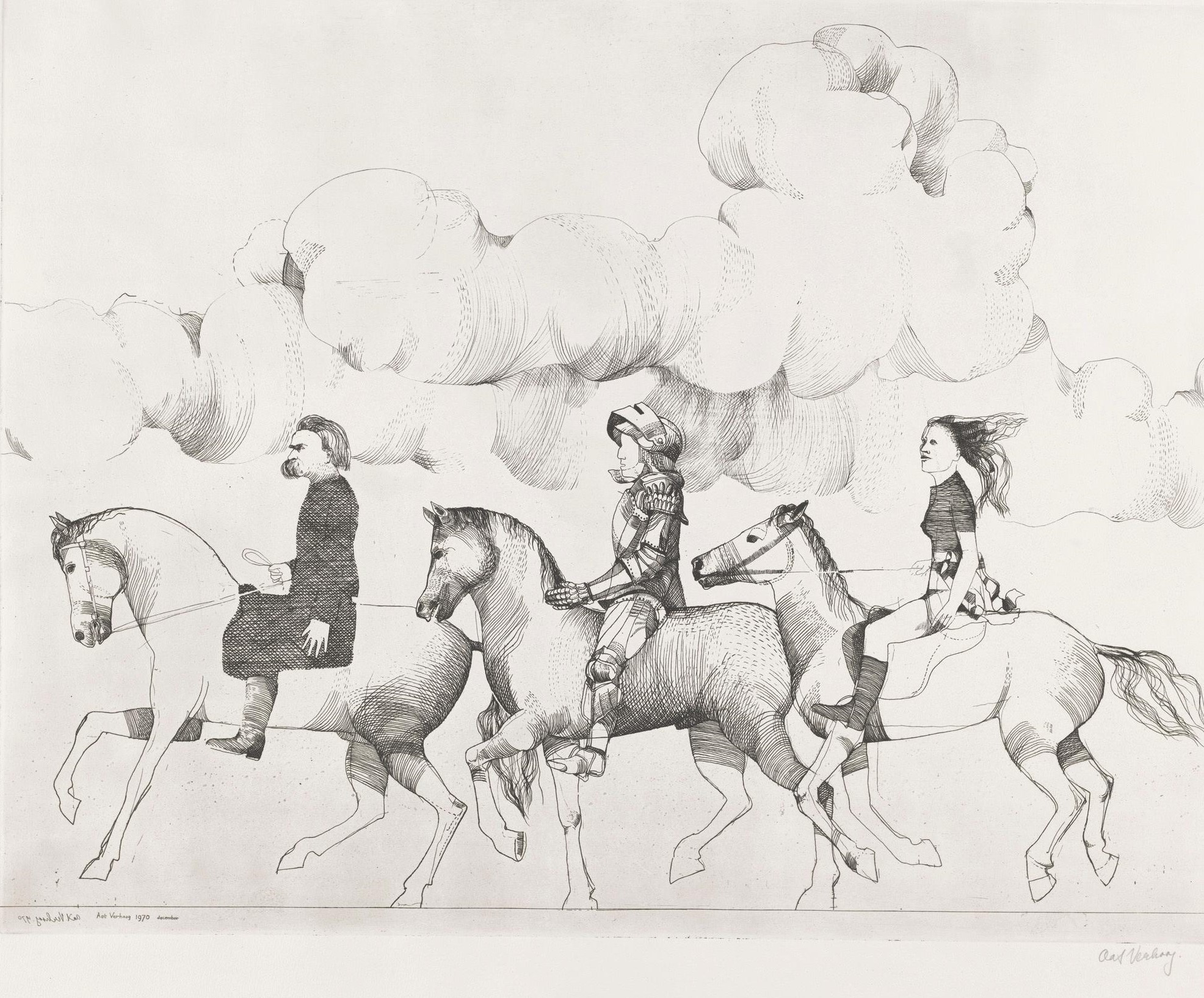

The fact that Nietzsche is a philosopher who speaks particularly to artists, even an “artist-philosopher,” is almost commonplace. In Barbara Straka's newly published book Nietzsche Forever?, the question is explored how exactly Nietzsche has been received in 20th century art, in particular that after 1945. The author has created a standard work that clearly and competently conveys the topic in plausible overviews. In this first part of this two-part article, Michael Meyer-Albert dedicates himself to her book and will then accentuate his own position in the upcoming second part.
Meaning Has Fallen, But I'm Still Dreaming
Meaning Has Fallen, But I'm Still Dreaming


This essay opposes the emptiness of a world that has lost its meaning in favor of function. With Nietzsche, Camus and the shadow of Sisyphos behind me, I search for the wild, for the dreamy, for those who do not submit and refuse to remain silent. I'm writing about modern barbarians: about people who see nothing and yet continue to breathe, keep screaming, keep dreaming. This text is my hymn to defiance, to the unformed, to the courage not to fear senselessness. Because even without meaning, I won't be silent. Not now, not in this world. And there is no other.
The essay was written as an answer to the price question of this year's Kingfisher Prize (link). We did not award him, but still publish it as an important contribution to the topic of the “new barbarians” due to its extraordinary literary quality. If you'd rather listen to it, you'll also find it read by Caroline Will on the Halcyonic Association for Radical Philosophy's YouTube channel (link) or on Soundcloud (link).
Nietzsche and Cyborgs
The International Nietzsche Congress 2025
Nietzsche and Cyborgs
The International Nietzsche Congress 2025
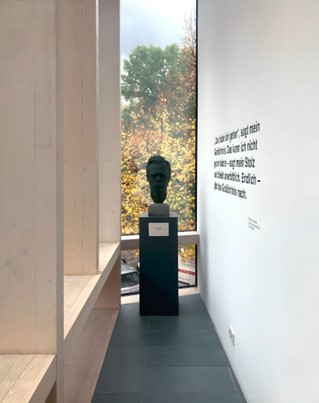
Under the topic Nietzsche's technologies international visitors were once again invited to the Nietzsche Society conference in Naumburg an der Saale this year. In the period from October 16 to 19, in addition to various lectures, a film screening and a concert, there was also an art exhibition to visit. Our author Emma Schunack was there and reports on her impressions. Her question: How can Nietzsche's technologies find expression in the technological age?
Editorial note: The conference report does not mention the important “Lectio Nietzscheana Naumburgensis,” with which Werner Stegmaier rounded off the conference on Sunday morning and took up the topic of the conference again in a completely different way by asking about Nietzsche's own “philosophizing techniques.” We have now published this important talk in full length with the kind permission of the author (link).
Where Are the Barbarians of the 21st Century?
An Essay in the Spirit of Nietzsche
Where Are the Barbarians of the 21st Century?
An Essay in the Spirit of Nietzsche
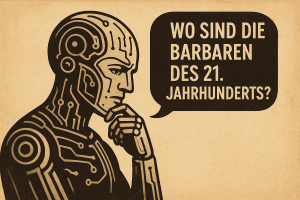
On August 25, we published an interview, conducted by our author Paul Stephan, with the AI tool Chat GPT (link). In it, he asked the software, among other things, to write him an essay on the question of this year's Kingfisher Award: “Where are the barbarians of the 21st century? “(link). As an experiment, we presented the text to the five-person jury of the award, consisting of Lukas Meisner, Hans-Martin Schönherr-Mann, Theodor Schild, Natalie Schulte and Paul Stephan himself — and it was surprisingly well received: In the preliminary round, it achieved fourth place on points and would therefore have made it into the shortlist by a hair. Only Natalie Schulte had drawn suspicion and presented the text to an AI checker, which, however, did not recognize it. — Would you have thought the text was human?
The essays from this year's winners will be published in the coming weeks. Did they do it better than AI, as we believe?
We deliberately refrained from editing the text, but published it exactly as the program spit it out for us. The article image is also from it.
As a part of this experiment, the subsequent translation has also been done by ChatGPT itself and we publish it without any alterations.
Thus Spoke the Machine
Imitating Nietzsche with AI
Thus Spoke the Machine
Imitating Nietzsche with AI
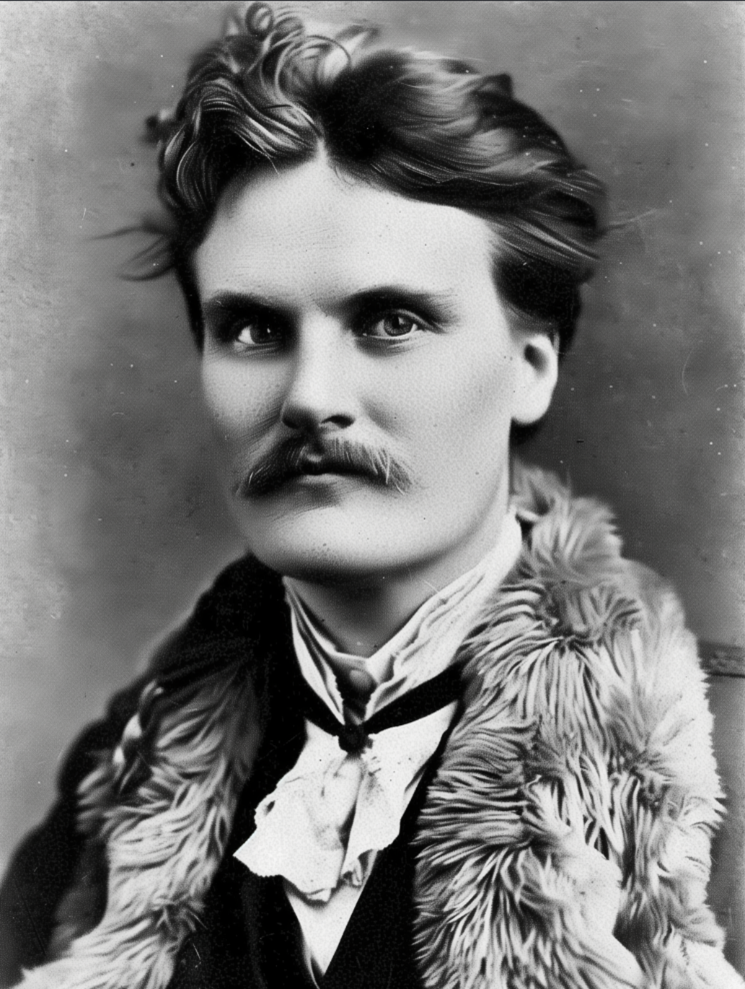

The continuous refinement of large language models, or LLMs for short, allows increasingly accurate stylistic interpretations of texts. This also applies to the writing styles of philosophers. For example, it has recently been possible to chat with Socrates or Schopenhauer — usually with consistent quality and limited depth of content.1 In recent months, our guest author Tobias Brücker has tried to generate exciting Nietzsche texts using various AI methods. In the following, he will present some of these generated, “new Nietzsche texts”, describe their creation and draw a brief conclusion.
Chameleon Nietzsche
The Failure of Nietzschean Materialism
Chameleon Nietzsche
The Failure of Nietzschean Materialism
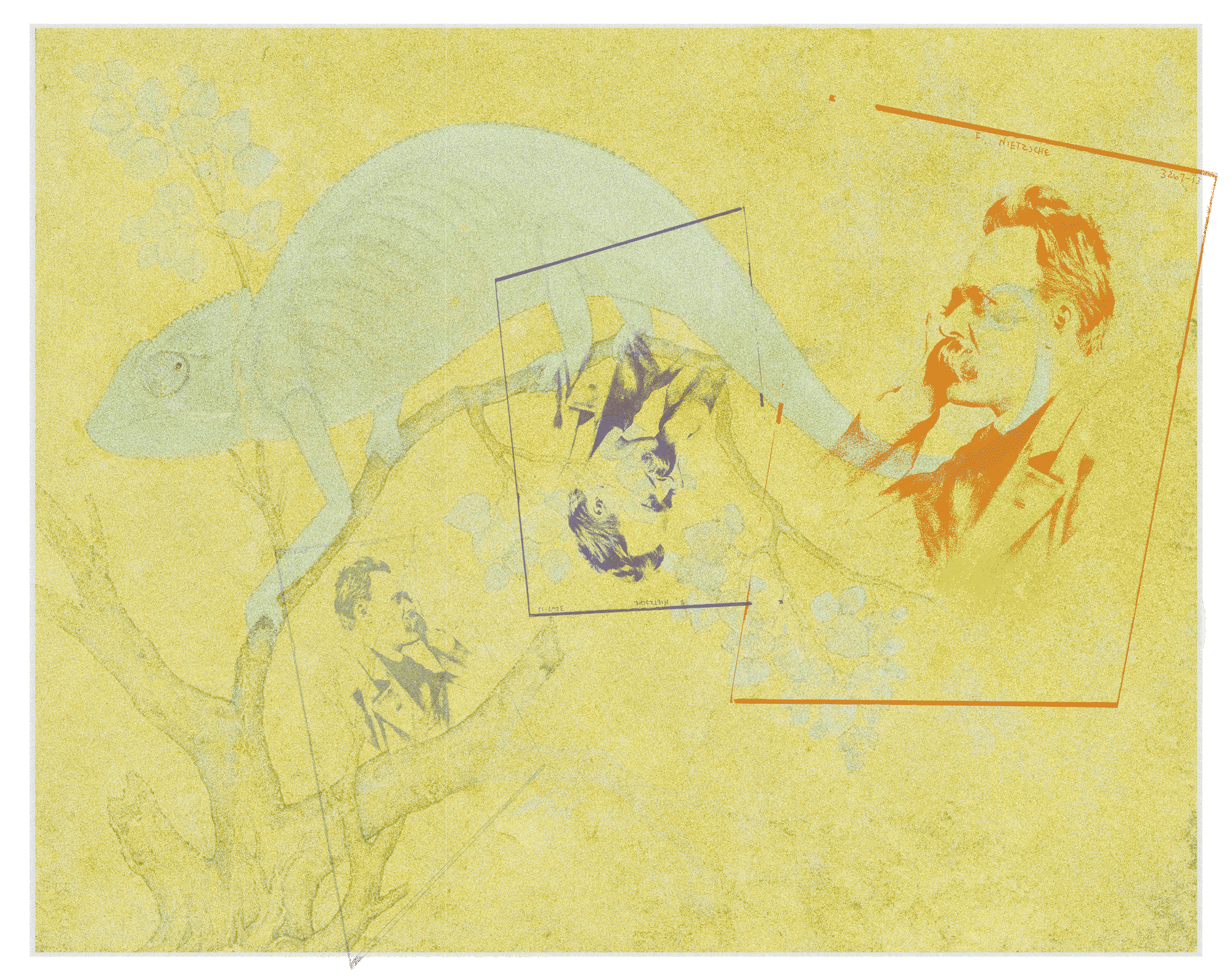
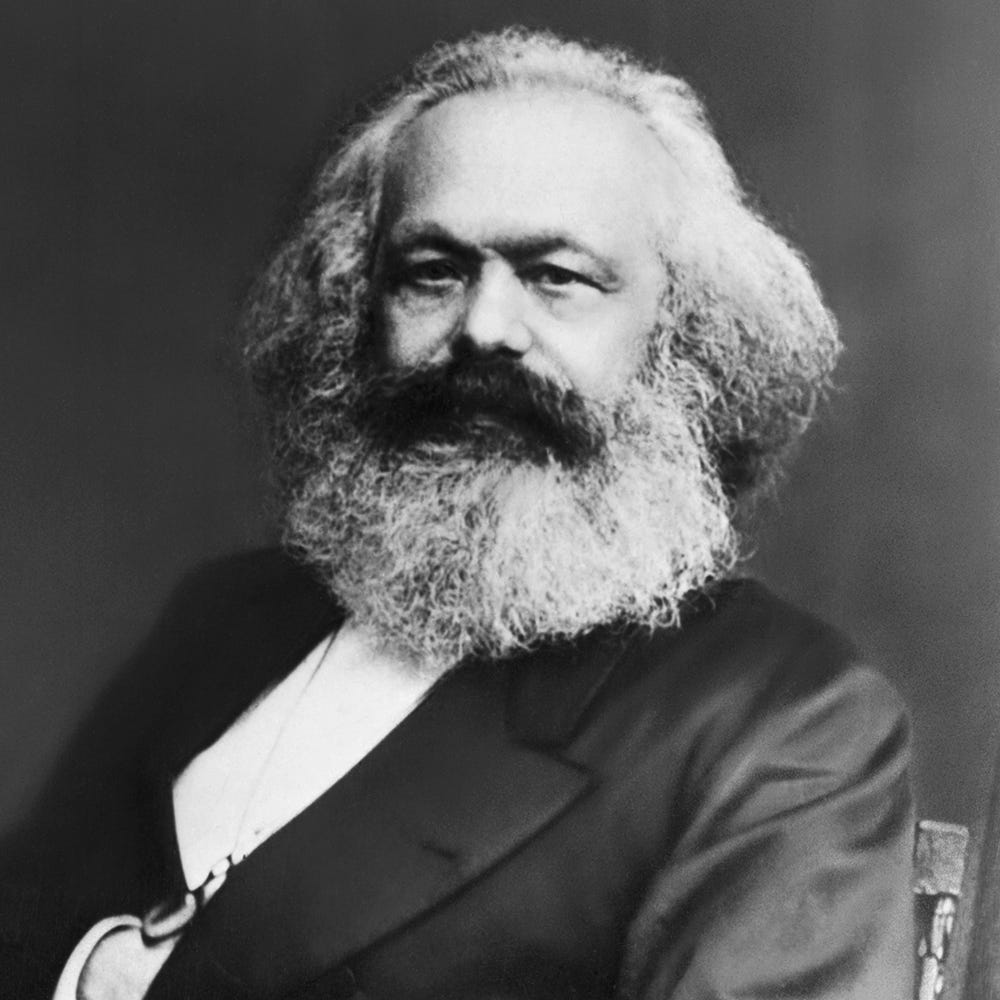
The connection between Marx(ism) and Nietzsche(anism) has repeatedly been a topic on our blog. To what extent can the ideas of arguably the most important theorist on the left and the philosophical chameleon, who was an avowed anti-socialist and anti-feminist and inspired Goebbels and Mussolini, among others, be meaningfully combined. While there have been repeated attempts at left-wing Nietzscheanism, Estella Walter's conclusion in this controversial thesis article is skeptical: The contrast between “historical-dialectical materialism” and Nietzsche's idea of will to power is too irreconcilable. Beyond his time diagnosis, his thinking only provides little emancipatory content.
Traveling with Nietzsche through Southeast Asia IV
Malaysia
Traveling with Nietzsche through Southeast Asia IV
Malaysia


The last country that our author, Natalie Schulte, traveled by bike was Malaysia. After a good 5,000 km, she got the creeping feeling that the trip could still end poorly. With considerations as to whether cycling in Southeast Asia is a response to Nietzsche's appeal “live dangerously! “, she concludes her series of essays.
Stuck Between the Monsters and the Depths
Wanderings Through Modern Nihilism in the Footsteps of Nietzsche and Kierkegaard — Part 1
Stuck Between the Monsters and the Depths
Wanderings Through Modern Nihilism in the Footsteps of Nietzsche and Kierkegaard — Part 1


As in our series of articles”Hikes with Nietzsche“It has already been made clear that the metaphor of wandering plays a fundamental role in Nietzsche's work. In this two-part essay, Paul Stephan explores how Nietzsche uses the wanderer as a personification of modern nihilism and thus diversifies a central theme of cultural modernity, which can also be found in the writings of the Danish philosopher Søren Kierkegaard, who was born on May 5, 1813 in Copenhagen, where he also died on November 11, 1855.
Traveling with Nietzsche through Southeast Asia II
Cambodia
Traveling with Nietzsche through Southeast Asia II
Cambodia


Our author Natalie Schulte spent nine months cycling in Southeast Asia and reports on her travel experiences with and without Nietzsche in a short series of essays. This time it's about the vast plain of Cambodia and the temples of Angkor in the middle of the jungle.
Traveling with Nietzsche through Southeast Asia I
Vietnam
Traveling with Nietzsche through Southeast Asia I
Vietnam

Our author Natalie Schulte spent nine months cycling in Southeast Asia. She traveled 5,500 km through Vietnam, Cambodia, Thailand and Malaysia. In the luggage for motivation and discussion was as usual So Zarathustra spoke. But Nietzsche's thoughts were also frequently present beyond this work. In her short essay series, she talks about her travel experiences with and without Nietzsche.
The Educator’s Mark
Schopenhauer's Omnipresence in Nietzsche's Philosophy I
The Educator’s Mark
The Omnipresence of Schopenhauer in Nietzsche’s Philosophy I


It is no secret that one of Nietzsche’s most important philosophical references was the German philosopher Arthur Schopenhauer (1788-1860). That’s reason enough to trace the history of Nietzsche’s reception of Schopenhauer in a two-part article. In the first part, Schopenhauer scholar Tom Bildstein examines how the young Leipzig philology student Nietzsche was first inspired by Schopenhauer’s magnum opus The World as Will and Representation (1818), only to turn into a harsh critic of the Frankfurt “sourpuss” within a few years. — Link to part 2.
Age-Old Rage
The birth of Modernity out of the Spirit of Resentment
Age-Old Rage
The birth of Modernity out of the Spirit of Resentment


“Resentment” is one of the guiding concepts of Nietzsche's philosophy and perhaps even its most effective. In his new book The cold rage. Resentment theory and practice (Marburg 2024, Büchner-Verlag), Jürgen Grosse argues that since the 18th century, more or less all political or social movements have been those of resentment. Our main author Hans-Martin Schönherr-Mann has read it and presents major theses below.
A Philosophical Serenade About Grayness
A Summer Evening with Sloterdijk at Gütchenpark in Halle
A Philosophical Serenade About Grayness
A Summer Evening with Sloterdijk at Gütchenpark in Halle

One of the most important philosophers of our time, Peter Sloterdijk (born 1947), visited Halle at the beginning of July. The thinker, who was heavily influenced by Nietzsche, shared his thoughts about “gray” there and impressively showed the heights to which philosophy can rise.
Musing in a Southerly
Visiting Nietzsche's Summer House in Engadin
Musing in a Southerly
Visiting Nietzsche's Summer House in Engadin

The Inn River rises at an altitude of just under 2,500 m in southeastern Switzerland, in the canton of Graubünden. Over a distance of 80 km, it first flows through a high-mountain valley called the Engadin. Here, not far from the sophisticated spa town of St. Moritz, it crosses two small lakes, Lake Sils and Lake Silvaplana, between which lies the idyllic mountain village of Sils Maria. The philosopher Friedrich Nietzsche spent several summers in this exquisite landscape and was inspired by it to write some of his most important works. Christian Saehrendt set out to search for clues at what is perhaps the most important “pilgrimage site” on the Nietzsche scene.
1, 2, 3…
About the New Permanent Exhibition in the Nietzsche House in Naumburg
1, 2, 3…
About the New Permanent Exhibition in the Nietzsche House in Naumburg


Since 1994, the house in Naumburg where Nietzsche lived with his mother for several years after his mental collapse in 1889 has had a museum dedicated to life and work. On the occasion of the thirtieth anniversary of its existence, the permanent exhibition of the Nietzsche House was completely redesigned, curated by Berlin philosopher Daniel Tyradellis. Our regular author Lukas Meisner was there and took a look at them.
Everyday Life Contributes to Thoughts
Nietzsche and Dietetic Popular Culture
Everyday Life Contributes to Thoughts
Nietzsche and Dietetic Popular Culture


Nietzsche did not just influence popular culture. He himself was part of a contemporary popular culture and was significantly influenced by it. As a spa tourist, he chased after the trendy health resorts, studied popular magazines and non-fiction books as a popular reader, ate his way through various (self-prescribed) diets as a diet freak and used modern technologies from telegrams to Malling-Hansen's writing ball. In the following article, Swiss Nietzsche researcher Tobias Brücker summarizes some influences from contemporary dietetics in order to exemplify how Nietzsche's life and thinking were shaped by popular cultural factors.
Nietzsche doesn’t Mean: Nietzsche Lives
Nietzsche doesn’t Mean: Nietzsche Lives


In the last part of the series “What does Nietzsche mean to me? “, in which our regular authors briefly presented their respective understanding of Nietzsche in recent weeks, Estella Walter tells of 'her' Nietzsche as a critic of any totality in the name of the nameless reality of becoming.
The Enlightenment’s Twilight
Nietzsche's Truth of Semblance II
The Enlightenment’s Twilight
Nietzsche's Truth of Semblance II

After Michael Meyer-Albert in the first part of his text Telling the sad story of the self-doubt of the Enlightenment, he now reports on Nietzsche's “cheerful science” as an alternative.
The Enlightenment’s Twilight
Nietzsche's Truth of Semblance I
The Enlightenment’s Twilight
Nietzsche's Truth of Semblance I

Nietzsche's best-known formulation, according to which God is dead, not only shows an anti-religious thrust. In particular, it points out that in modern times, constitutive self-evident elements no longer have traditional validity. As the cultural understanding of truth has faltered, not only has this or that truth become questionable, but the understanding of what truth actually is. This puts enlightenment under pressure to find the questions to which it should be the answer. It is this abyss of uncanny questionability from which Nietzsche's thinking attempts to show ways out that are viable. In the first part of his text Enlightenment Twilight Michael Meyer-Albert talks about the clarified doubts of the Enlightenment about itself.
Nietzsche’s Critique of Capitalist Alienation
Nietzsche’s Critique of Capitalist Alienation
In the penultimate part of the series “What does Nietzsche mean to me? “Lukas Meisner comes to a surprising result at first glance: Nietzsche and Marx both practice fundamental criticism of capitalism and Nietzsche can serve to Marx's To complement a critique of political economy with a no less radical critique of moral economy.
Deciding to Serve Life
An Essay on the Meaning of Nietzsche's Philosophy
Deciding to Serve Life
An Essay on the Meaning of Nietzsche's Philosophy

Nietzsche is generally regarded as a literary philosopher whose aphoristic nihilisms not only conjure up the death of God, but who also reinforced the dark sides of German history as a posthumous master thinker. In contrast, the following text would like to be part of the series What does Nietzsche mean to me? invite you to learn to read Nietzsche anew as the discoverer of the all-too-unknown philosophical continent of Mediterranean existentialism.
Is Nietzsche a Philosopher for Adolescents?
Is Nietzsche a Philosopher for Adolescents?

In her contribution to the series “What does Nietzsche mean to me? “Our main author Natalie Schulte explores the question of whether the thinker can be described as a “philosopher for adolescents” and reports on her own relationship with him.
From Stalin to Nietzsche, or How I Became a Nietzschean, 1970-1990
From Stalin to Nietzsche, or How I Became a Nietzschean, 1970-1990

As a Marxist, Nietzsche was an early nuisance. But with the Nietzsche Renaissance in the eighties, I couldn't get past him anymore. That's when I discovered Nietzsche as an innovative thinker. - Part II of the series “What does Nietzsche mean to me? “, in which our regular authors introduce themselves.
What does Nietzsche Mean to Me?
What does Nietzsche Mean to Me?


In the series “What does Nietzsche mean to me? “ over the next few weeks, our regular authors will each present their personal approach to Nietzsche and his thinking. Our senior editor Paul Stephan makes a start and reports on how he discovered Nietzsche as a teenager — and no longer necessarily sees himself as a “Nietzschean.”