On Life in Freedom
A Conversation with Jens Bonnemann about Sartre and Nietzsche
On Life in Freedom
A Conversation with Jens Bonnemann about Sartre and Nietzsche
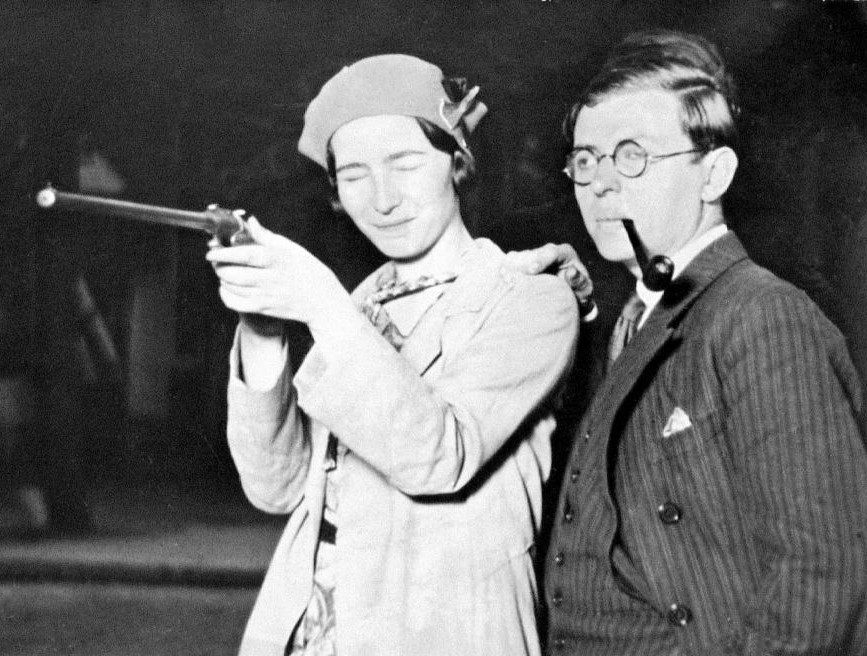

On April 15, 1980, one of the most important philosophers of the 20th century, Jean-Paul Sartre, died at the age of 74. Paul Stephan spoke with Jens Bonnemann, chairman of the German-speaking Sartre-Gesellschaft, about his basic ideas, his relationship with Nietzsche and his significance for our time. What does it mean to live in freedom after the “death of God”? What are the limits of individual freedom? What are the differences and similarities between Sartre and Nietzsche?
You can also view the unedited version of the conversation, in German, on YouTube and listen to it on Soundcloud.
“On the pages read
On all sides that are white
Stone blood paper or ash
I'll write your name. ”
(Paul Eluard, liberty1)
I. Unequal Funerals, Conflicting Conditions
It was crowds who arrived at the Montparnasse cemetery, with children on their shoulders so that they would not miss anything. It was a huge, colorful, unexpected meeting, a flocking crowd. Squirting, screaming, shoving. A man fell into the grave on the coffin. It was Saturday afternoon and over fifty thousand people had symbolically wanted to exist. On this day under a grey and heavy sky, “Sartre's people” traveled a Sartrean route of over three kilometers long in an atmosphere of spontaneity and crowding. Some claimed that at the famous restaurant La Coupole The waiters stood outside and bowed before the funeral procession. “Stepping into a dead person is like stepping into an open city,” Sartre had in his preface to Flaubert[2] written. The scenes of this funeral, the hustle and bustle seemed to confirm this: And the colorful, lively, agitated and likeable people of Sartre proved it. It was both dignified and humble, simple and uncontrolled. Sartre left, and his departure led to one of the strangest rallies of intellectuals at the end of the 20th century. The little lonely, isolated man, the anarchist, the childless father went down in a kind of legend that day. He was lifted into heaven against his will.3
Today we want to talk about the topic “Sartre and Nietzsche.” I think that as a proven expert in Sartre's philosophy and chairman of the Sartre Society, the leading association for Sartre research in the German-speaking region, you are exactly the right person to talk to, especially since you will give a presentation at the conference I co-organized Between life and existence Nietzsche and French existentialism , which took place from 31/7 to 02/08/2020 in Naumburg4 — So we've both already dealt with the big topic of “Sartre and Nietzsche.”
This conversation, which we are having on March 21, is due to be published on April 15 on the anniversary of Sartre's death. I have just read out from Annie Cohen-Solal's great Sartre biography, one of the standard biographies, what she has to say about Sartre's funeral, which was really a very impressive event. All you have to do is look at the photos. Around 50,000 people were on the streets of Paris to pay their last respects to Sartre.
A philosopher, Jürgen Habermas, who is very important in our time, died recently, and I find the comparison very surprising: I don't even know whether his funeral has already taken place. In any case, there were numerous obituaries for him5 His death was a big topic in the features section and for everyone interested in culture — but that there could be such a big funeral procession for him in Berlin seems impossible; and that certainly applies to every philosopher working at the moment.
Against this background, my initial question is: Was it not just Sartre that was buried in 1980, but an entire era of philosophy? What happened in the intervening years? Why is philosophy no longer able to “seize the masses” in this way?
Jens Bonnemann: That's when you start with a very difficult question. I don't even know whether there would ever have been a philosopher in Germany who would have been comparatively popular... Perhaps Adorno, who also worked beyond universities, who was therefore somehow important for cultural events — but when he died, no crowds came after his coffin, no. So maybe the difference is the cultural status of the intellectual in Germany and in France. In France, there is a completely different tradition when you think of Voltaire, of Émile Zola... These are intellectuals who don't necessarily stay in the ivory tower, who are engaged, who are popular, who are offensive, who have a sense of effect, and who are also more close to their respective cultures. In Germany, the distance between intellectuals and ordinary, non-university audiences is much greater. So when you think of Heinrich Böll, for example, he was certainly also popular — but now you can see the difference again, because Sartre was not just a philosopher. Sartre wrote plays, wrote novels, and was, of course, also a political intellectual. Sure, that was Habermas too, but Habermas limited himself to newspaper articles, Sartre was at demonstrations, he stood in a garbage can in 1970 and made speeches in front of the workers at the Renault plants, visited the RAF terrorist Andreas Baader in Stammheim... You can't imagine that with Habermas. So Sartre threw himself even more into the hustle and bustle, into the “scuffle”, while Habermas remained much more committed to the academic milieu, he was also a university professor, Sartre never. In fact, Sartre doesn't belong to a university at all, that is not his place at all, the coffee house much more than the university. I believe that is the decisive difference: First, that Sartre was not only a philosopher, but also a writer, and once that he was political in a completely different way than Habermas, for example; and then there is also a difference between countries that perhaps in no other country in the world is the intellectual as relevant as in France.
PS: Yes, at least since the French Revolution, when it was already the case that some lawyers came to Paris from the village, so to speak, who were enthusiastic about the writings of Voltaire and Rousseau, made big speeches and seized the masses — the monarchy was abolished. Whether that was exactly the case or not — that is exactly the founding myth of the French nation, to this day. There is nothing comparable in Germany. The great German philosophers and writers have always sought a certain distance from political topics — think of Kant or Hegel, Goethe or Schiller; and also of Nietzsche.
II. Philosophy and the Lifeworld
JB: Another factor is, of course, the way of philosophizing. When Habermas formulates his theses, i.e. when he says, for example, that the system imperative from the economy colonize the living environment, then you may be interested in it. But if you're not exactly a philosopher yourself, then these topics are rather alien to you. While Sartre does address topics that should actually interest everyone, even if you're not a philosopher. Sartre talks about the freedom that you can create yourself, that you can't give up responsibility for your life, and so on. And that you invent yourself. You don't have to be a philosopher to feel addressed by such questions — Habermas is much more academic in that regard. Of course, he also talks about philosophical topics that are relevant outside of philosophy, such as democracy. But such topics are not particularly relevant for someone who simply wants to live their life and is not interested in public affairs. Sartre has more to say to that.
PS: Exactly, I too would see the big parallel between Sartre and Nietzsche in this aspect. It was no coincidence that Nietzsche was a great admirer of France. At times, he even toyed with the idea of moving to Paris and read a great many French authors. Perhaps it was precisely this broad understanding of the intellectual that he found so exciting about French culture. In other words, the intellectual may also write poetry without immediately making himself impossible. Even in terms of the way he writes, it must be said that Nietzsche is actually more of a popular author, for example when you compare him with Kant or Hegel — but also in terms of the topics. He deals with exactly these topics that you raised, which really speak to the individual, from which you can barely escape as an individual in the world in which we live. That's where Nietzsche and Sartre meet — and to this day, the probability that a high school graduate will of her own free will The disgust or So Zarathustra spoke seems to be much larger than that of Habermas' main work, Theory of communicative action, works through.
JB: Nietzsche has also been read very heavily by people who don't see themselves as philosophers, just think of Thomas Mann. His worldview was decisively influenced by Nietzsche. Other examples include Hermann Hesse or Robert Musil.
So Nietzsche is someone you also read when you just want to think about life and about your fellow human beings, about life and death and so on. The big questions of life — that is not an issue for a Habermas, because he also believes that we now live in a post-metaphysical age and that philosophers can actually no longer give binding answers to questions about what the good human life is. From Habermas's point of view, this takes place in the individual living environments and the answers that you find there are culturally relative, finding them is no longer the task of the philosopher. From Habermas's point of view, this consists more of taking a mediating position, making sure that none of the different ideas of what the good life is treated unfairly, neutrality, and so on. How can we develop a process to treat the way of life fairly? That would be the approach of his discourse ethics and no longer to provide answers to the “big questions.”
III. The “Death of God” as a Condition of Freedom
PS: But isn't that even something connecting Habermas, Sartre and Nietzsche that they start from a post-metaphysical situation for which Nietzsche found the famous formula of the “death of God”?
JB: Yes, at least as far as Sartre is concerned, it is post-metaphysical in the sense that he does not say that we philosophers must now think about the West of man, which would be there eternally immutable, in order to then draw conclusions from the analysis of this being as to what a happy life should be like. That would be the approach of Aristotle, for example, who says that people are characterized by reason and that a reasonable life therefore also makes them happy.
We no longer find such metaphysical considerations in Sartre. And maybe you would disagree with me, but I would even venture to say even less so with Sartre than with Nietzsche. Because — and this is where we now come to a very decisive difference between Sartre and Nietzsche — in his remarks on existential psychoanalysis, Sartre rejects the thesis that there are basic human traits, such as the “will to power.” So Nietzsche would say that the will to power is active in everything alive and, of course, also in people. Therefore, if we want to understand what bothers people, then you are not wrong to say that it has something to do with striving for power. Sartre would counter this: No, it is neither as Freud assumes that sexual need forms the origin of man, is the most fundamental thing, nor how Nietzsche or even Freud students such as Alfred Adler assume that the will to power is such a basic need. He rejects both. He would probably say: The quest for power is a pleasant consolation for the actual basic problem and that is the experience of contingency; that we are simply in the world, but that it is not necessary for us to be there at all. Basically, we're all superfluous. If we didn't exist, the world would lack nothing. In his autobiography The words (1964) he sums it up well in the picture of the travelers without a ticket. You sit on the train and then the conductor comes and wants to see our ticket and Sartre says: We all don't have one, we are all travelers without legitimacy, without justification. And to stay in the picture: You then try to engage the conductor in a conversation, you try to entertain him in some way. The conductor is then the other person who gives you the feeling: “It is good that you are in the world.” “The will to power” would then mean: I make myself important, indispensable, make myself stand out in some way. That is, of course, a suitable way to forget this feeling of contingency, but at the beginning, at the origin, it is not power, but the experience of contingency.
PS: I wouldn't disagree with you in principle. It depends, of course, on how you interpret the “will to power.” So if you interpret it as a metaphor, for example as a metaphor for the fight against contingency — Nietzsche speaks in So Zarathustra spoke About turning chance into fate6 —, then you might even be able to establish a connection with Sartre. But in the late Nietzsche in particular, there is a very strong biologism, where the “will to power” is really reinterpreted as the biological and even cosmological principle of life. There are indeed worlds between this doctrine and Sartre's emphasis on human freedom.
JB: Exactly when Nietzsche says that we are actually nothing more than a bundle of contradictory urges that throw us back and forth and that cannot be reconciled, i.e. contradictions that can be endured7 — Sartre always rejected such substantial ideas of human subjectivity. Above all, he has this idea of nothing. Well, we're always kind of nothing. Basically, we — even such a contradiction — are of course part of being, we are also facticity through our physicality — you can weigh and measure us and so on, of course we are also in things — but we are also always a relationship to facticity, to being, and that requires that there is such a gap, a distance. And to say now: “But humans have certain urges,” for Sartre, that would mean that you refill this relationship with substances and then level it out again. Sartre thinks of people from this nothingness, which, however, is a reference, a reference to being. In this respect, you can choose the title of the main work, Being and nothingness (1943), don't translate like this: On the one hand, there are things, that is being, and the human being is nothingness. Of course, nothingness comes into the world with man, but man is always a dialectic of being and nothingness, a contradictory unity, a relationship to being that is only possible through nothingness, i.e. a non-reference.
IV. Freedom as Resistance
PS: You've already heard of The words Spoken, Sartre's great autobiography. For them, he was to be awarded the Nobel Prize in Literature in 1964, but as is well known, also as a grand gesture, he rejected this award. Which is funny, of course, because he still got the prize. This means that he can say at the same time “I am a prize winner, I have received this prestigious award”, but at the same time he can also present himself as a brave hero who did not allow himself to be deprived of his freedom again.
JB: Although he really didn't take the money. Yes, that is, of course, this existentialist attitude: You don't want to be determined. A crowned work is a finished work, and if Sartre hates something, it is to be finished. Sartre is always on the move, constantly redefining himself, he is not defined by what he has done in the past. You come across this gesture over and over again: “I'm not doing that anymore, I'm not thinking in a completely different way now.” Many people associate it with his attitude in the 1950s, when he gradually turned to Marxism, but when you read his diaries from the 1930s, this attitude is already there, this attitude: “No, I thought that before, I don't even think that anymore.” But sometimes there are only two weeks in between. — Well, that's kind of a pose too. On the one hand, he refused to receive the Nobel Prize because a crowned work is simply a completed work. On the other hand, it had political reasons: He did not want to be taken over by the West, so to speak.
PS: This is, of course, also a difference from Nietzsche, who has also written something about politics from time to time and has also been politically interpreted in very diverse ways — which is also significant — but for whom you cannot now say that he has developed a real political philosophy. So this whole idea of freedom is of course highly political and was then also applied by Sartre's colleagues, by Albert Camus, among others, to the fight against fascism, by Simone de Beauvoir to the question of women or the problem of sexism, by Frantz Fanon to the fight against the oppression of blacks and the colonized in general, which was also a very big issue for Sartre himself. Especially with the late Sartre, it is no longer the case anymore, as he was often accused, for example by Adorno, that freedom was such an ontological certainty on which one could rest — actual freedom already consists in the political struggle against lack of freedom, i.e. against patriarchy, against capitalism, against colonial exploitation, etc.
JB: Of course, the objection is obvious: “Sartre, you are convinced that the human being is free, i.e. the servant just as free as the master, the sick just as free as the healthy, the poor just as free as the rich, and so on.” These allegations came up, of course, as early as the 40s, when his thinking became popular. And he has already taken that seriously, this question: How can a being be free and yet still depend on being liberated? He already tried to explain this problem in his early articles in the 40s. Of course, it is always our decision whether we want to live a comfortable life or protest against grievances. But if a consequence of our decision is that our lives are in danger, that we are imprisoned, that we are tortured and so on, then those responsible for this must of course not be acquitted of allegations. In other words, we must ensure that none of our options is to put our lives in danger. If a decision results in us being shot, then there is reason to liberate our situation.
PS: That seems to be the crux of the matter to me. Sartre starts from freedom and this is logically associated with radical universalism. All people are equally free and therefore the freedom of all people must be taken into account, no one must be oppressed. There are, for example, these very famous sentences with which Sartre wrote his Considerations on the Jewish Question concludes, which appeared in 1945 and first bore the title “Portrait of the Anti-Semite”: “No Frenchman will be free as long as Jews are not in full possession of their rights. No Frenchman will be safe as long as a Jew in France all over the world, must tremble for his life.” (p. 190) So the oppression of individual, even small, groups is a problem that concerns everyone, not just the Jews or the anti-Semites or the Sinti and Roma and their enemies, for example — we all have to make sure that we combat these oppressive relationships, because it also affects us in our privileged position in our freedom when we are part of a society that tolerates these oppressive relationships.
JB: Yes, if I want my freedom, then I must also want yours and basically that of all people. Sartre attempts to push his existentialist individualism to universalism. However, I think Sartre never really succeeded in doing that. He also tries that in his Drafts for a moral philosophy, which he wrote at the end of the 40s but never completed, and which were only published after his death. And I suspect that one reason for the termination of this project is really that Sartre had a thought that Bertolt Brecht also formulated in his play The Good Man of Sezuan (1943): If the world is poorly arranged, then the good deeds of the individual do not help at all. He himself then wrote a play with the title The Devil and God (1951). It's exactly about the fact that a basically very angry person, Ritter Götz, decides to do something good now. But the problem is that his well-intentioned, well-intentioned actions always result in bad consequences: consequences that he did not intend. This means that the world is poorly arranged and every good intention must fail in it. You can then draw the conclusion from this: First, the world, the organization of the world, the situation must be fundamentally changed — and then we can think about individual morality. That would be one possible explanation for why Sartre abandoned morality and turned to Marxism.
PS: That is really also a complete contrast to Nietzsche, who, when he has spoken out on political issues, said: There should be free people, there should be masters who can develop their will to power at will — and a large army of slaves on whose backs this freedom is based. — Sartre would make exactly the opposite point: “That kind of freedom that you have in mind in your comic Dream image, that wouldn't be real freedom at all. Freedom cannot exist on the backs of slaves. ”
JB: Yes, Sartre really has an exceptional position within the philosophy of existence. So if you take Søren Kierkegaard in 19th century Denmark, he of course also sees his thinking as a defense against a certain measurement, a levelling. This is also due to the rise of big city life and industrialization. Against all of this, he emphasizes the relevance of the individual. But that always has such an aristocratic, arrogant gesture: “Of course I'm not like my stupid neighbors, these 'dozens of people, 'who actually just chase the conventions, who don't really lead a self-confident life at all, but just do what everyone does.” And even in Karl Jaspers, we often find the phrase “nobility of mind.” And even Martin Heidegger is not necessarily what you call a flawless democrat, not at all. — With Sartre, you never find anything like that, that is, such arrogance that he somehow thinks of himself as “something better.”
But I think you also have to be careful about that. When you The words When you read, you have the suspicion that he is thinking: “Well, I'm already like everyone else, but I'm already the intellectual. And when I help the weak, then I'm even better than those who oppress and exploit the weak.” Well, I wouldn't rule out the possibility that such secretive, hidden arrogance also plays a certain role in Sartre.
PS: That is perhaps another such difference between German and French culture. In Germany, including Nietzsche, there is this widespread idea that there is such a thing as “appointees,” “chosen people,” who by nature form a “special genius” and a kind of new “secret nobility.” That seems to me to be something that is rather alien to French culture and its republicanism.
JB: With Flaubert, however, we already find statements such as: “My political vote is of course worth much more than that of ten or twelve philistines.” So you don't have to look long for arrogance there either. But that's kind of alien to Sartre. I have never found such direct expressions of self-exaltation, although it is already the whole gesture in the 1930s to create oneself and so on to also see oneself as the center of the world, as the center from which meaning is ascribed. At its core, there is something arrogant about this radical individualism.8 But I've never found that Sartre directly contempts his fellow human beings. At most, that he laughs at the philistines. There is in The disgust Yes that famous passage where the protagonist Roquentin stands in the museum and makes fun of the stiff portraits of citizens. But it is always the citizens, the “big” citizens he ridicules, they are not the workers, not the lower ones.
V. My Freedom — and That of Others
PS: There is a passage from The words, which I find very appropriate at this point. In general, this book is full of aphorisms; there is something very aphoristic about it. It's not always that coherent. Time and again, you come across pointed formulations that could also come from Nietzsche. And there is one of them that made me think very strongly of Nietzsche while reading and where this existentialist social critique that you spoke of also comes out very well again:
Even deep faith is never completely uniform. You have to perpetuate it or at least refrain from ruining it. I was consecrated, I was glorified, I had my tomb at Pere Lachaise and maybe in the Panthéon. I had my main street in Paris and my back roads and squares in the province and abroad: alone in the heart of optimism, I kept — invisible, unnamed — suspicion of my lack of substance. In the Sainte-Anne Sanatorium, a sick person screamed from his bed: “I am a prince! They should arrest the Grand Duke.” They went to bed, they said in his ear: “Clean your nose,” and he brushed his nose; they asked him: “What is your profession? “, and he answered calmly: “Schuster,” and then he kept screaming. I mean, we all resemble this man; in any case, I was like him at the beginning of my ninth year of life: I was a prince and a shoemaker.9
As you can see, the early Sartre certainly still considered himself a kind of chosen one — but it is precisely this attitude that the later one distances himself from. The whole big theme of the book is actually how he frees himself from arrogance.
What Sartre is expressing here is the very radical idea that we are not at all different from these crazy people who pretend to be Napoleon or someone else, that we are all really just playing roles. We don't have a being that sets us apart. Regardless of whether we are king, “leader”, high priest — or worker, farmer, beggar: On this level of principle, we are actually not as different as people.
JB: Whereby this person who screams: “I am the prince” is of course not in a completely different way than he would be after Sartre Schuster. So, to give another example: If I now say that I am not a world champion in boxing heavyweight, then that is a very clear case, no one would say otherwise — but after Sartre, I should also not say: “I am a philosopher,” because, as a free existence, I cannot be as philosopher as a glass of water is a glass of water. I just can't do that being, I can't say, “I am philosopher”, “I am Politician” etc. I can't being Just as a glass of water is a glass of water, I must playto be it. There is also a very similar remark with Nietzsche that no one has really realized a personality, but that we are all just actors of a certain ideal.10
And that's also where you see what significance the other person has for existentialist individualism: Because who am I playing this for? Who do I have to convince that I'm a politician, that I'm a philosopher, that I'm an artist, whatever? Ich need the others. I have to convince the others, the others look at me, but of course I never know what the others are really thinking when they see me. When they smile, it can be an appreciative smile, an admiring smile, maybe a mocking smile, an ironic smile and they don't believe me at all... I always run after other people, so to speak, to get my identity from them. When the others confirm to me: “Yes, you are a great politician”, “You are a great philosopher”... then I can also believe it myself. But of course I'm never as philosopher as a hare is a hare. Only wooden and marble saints are true saints who are what they are. It can't be us humans, we always design ourselves, we trying To be it, but it only ever succeeds in the eyes of other people.
PS: I think Nietzsche already has this idea: “The gentleman is a force of nature like Napoleon, he stands above the others, so he doesn't need their gaze. The others are just scum to him and he stands there like a self-contained statue that only confirms himself, which doesn't need any outside confirmation at all.” — Sartre would just say: “No, that's just imagination. Just like in the famous fairy tale, a child just needs to come along and say: “The emperor is naked after all,” and everything falls apart and you are completely thrown back to your physicality. ”
I've always liked that about Sartre, this topic of others, which is often forgotten in superficial presentations, so I think it's good that we're talking about it now. For Sartre, there is not only society and the individual, but also this intermediate level of intersubjectivity. And that is one of his great philosophical merits, to have focused so strongly on this topic in Being and nothingness. Of course, this topic also appears in Nietzsche, but not on this fundamental ontological level.
JB: That I actually need the other person for self-realization, because I can actually only realize my identity through acting in the eyes of others. Whether that's the excellent politician or simply the good person. If I want to believe that I'm a good person, then I have to convince others of that. That is an important idea with Sartre and it goes down a bit because, of course, when it comes to intersubjectivity in Sartre, you always think of this famous sentence from the play Closed society (1944): “Hell, it's the others.” And of course Sartre also says yes in Being and nothingness: “Conflict is the normal case of being for others.” So the other person objectifies me and then I want to free myself from it, then I now objectify the other person for myself. The well-known phenomenologist Bernhard Waldenfels once spoke of “hell scenarios of intersubjectivity.” But I am of course also objectified by the look of admiration. If I am an object of admiration, an object of love — that sometimes falls a bit under the table in Sartre's examples, but that is not ruled out. And he has already seen himself as someone who needs his audience. Part of the quote from The words, which you have just read out, ties in with these aesthetic considerations, which are also described in The disgust take place. In his debut novel in the 1930s, Sartre had the idea: “Actually everything is pointless, everything is contingent, but writing about contingency just isn't.” So I can justify my life by becoming a writer. He calls that in The words then his “art religion.” He doesn't believe in God anymore, God doesn't save us, but art can save us. I am then the one who wrote this or that great novel, wrote this or that play. And that is then this consecration, this justification. However, the late Sartre describes this as a neurosis — and he claims that he is now finally free from it.
PS: Yes, you also talked about this at the conference mentioned above. And I also wrote on this blog a short article written, where I also argue that this famous final scene of The disgust, where a jazz song is played and Roquentin is then prompted to this existential turn, this conversion, through which he overcomes resentment against contingency, spoken with Nietzsche, in artistic creation, in which something necessary is created, is extremely Nietzschean. Nietzsche also speaks of this: Only through art, “only as aesthetic phenomenon Is existence and the world eternal warranted”11. The late Sartre sees himself more as a craftsman and writing as a craft to serve the general, to help society understand itself better, in the spirit of Hegel. That is, of course, a much more humble understanding of philosophy and literature.
VII. It is About Realism
JB: However, I see a big difference with Nietzsche, especially with early Sartre, which is noticeable when you The disgust read more carefully. And that is his understanding of reality. At Nietzsche, we have an interpretationism: The world is always an object of interpretation and that can be done in different ways. The famous chestnut root scene in The disgust However, that is actually an experience in which the world shakes off our interpretations of it. So when Sartre says, “Yes, I know it's a tree root — but that doesn't work anymore.” The terms slip away and we have nothing but a raw, naked, unfathomable fact. We can't believe it anymore. In other words, the idea that we can summarize everything we see and then derive from this concept everything that makes up this thing is exactly this idea in The disgust denied. I don't know whether Nietzsche has something similar to this realism, that's what you can actually call it, i.e. the recognition that the things of the world are more than objects of knowledge; the failure of idealism. There is also this description at the end of the book when such a bloody heap of meat suddenly jumps at us. Or we look in the mirror and our tongue has turned into a millipede. We're trying to rip out the millipede, but it's our tongue. So this unpredictability, unfathomability of the world, that is a really profound experience that Sartre describes there and it is of course also connected with contingency: If we could deduce the world from a subjectivity — be it the discerning person or be it a divine one — then it would have a meaning, then it would be justified, i.e. especially from divine subjectivity: Everything that would then be and also I, I am there because God wants me — but because that is not the case, because objectivity, reality always More than any subjectivity, knowledge only ever scratches the surface. It is not that there is something behind the insight, but it is always more, the reality is always more than I can recognize of it.
PS: I really wouldn't see the biggest contrast between Sartre and Nietzsche. So there are already very similar passages in Nietzsche where he says that you can't really believe life.12 — Good, then he suddenly says again:”This world is the will to power — and nothing else!”13 There is such a very funny paradox in his late work, which also cannot be resolved, which simply manifests an inner conflict, perhaps also on the part of Nietzsche's person. But in principle, this realism can also be found in Nietzsche.
JB: If you now look at Sartre's early work, Being and nothingness, then, especially in early reception, you often read, which would actually be very similar to Johann Gottlieb Fichte (1762—1814), subjective idealism, but it is the decisive difference that Fichte says: “The ego sets the not-ego.” So we have an act of Setzens, while Sartre says: “Subjectivity obtains yourself on the objectivity that independently consists of it. “It is therefore not the subject that is there first and the object is then derived from the subject as something that is set, but the subject presupposes that the object is already there so that the subject can distance himself from it. So the first thing Sartre does is actually to assert reality, the independence of the object from the subject, and thus to deny subjective idealism
VIII. The Perspective of Liberation
PS: These are definitely all really important insights that help us in our time, that we should remember, such as the contradictory relationship between individual freedom, society, the other... All these topics are actually still ours Topics, which is why I personally find it a bit of a shame that Sartre has now moved a bit into the second row.
JB: If anything, you want to be afraid.
PS: Of course, there are still many who The disgust or the plays, but now, I think, it's more Nietzsche who you would use as a layman, isn't it?
JB: Yes, I actually believe that too. Above all: If you read famous central phrases of existentialism — “I create myself” and so on — you can read that in the advice literature today, that has already become such managerial jargon. “Personal responsibility” — anyone who says “personal responsibility” today wants to dismantle the welfare state is more likely to have such ideas. — The only decisive factor is that Sartre never meant this in the sense of such a psychotechnical self-objectification program, i.e. that you somehow make yourself attractive on the labor market through such strategies. Sartre would say yes: We not only choose specific strategies to achieve goals, we also choose the goals ourselves. The main character from the play The dirty hands (1948), Hugo, she shouts at the end: “I am not usable, I refuse” when the captors arrive, the assassins, and threaten to shoot him: “You cannot use me.” So Sartre is precisely resisting such interpretations of existentialism as self-optimization in the sense of predetermined social goals. We also choose our goals.
PS: And society is also decisive. So especially when you read Sartre's second major work, the Critique of Dialectical Reason (1960), so there you are really partly, when you come from the early Sartre, downright astonished, because it is actually the case that this idea of “individual freedom” is ultimately a petty-bourgeois illusion for him, which actually only serves to maintain the great social machine.
JB: Yes, in Being and nothingness There is still talk of the fact that I can exceed and overcome what is given through my designs. But you actually have to be careful about that, because Sartre has the example: I am born and only have one arm — then one-arm is my factuality, and I must now react to it in some way in freedom. So I can either despair of it, I can just take it over in defiance or as an incentive now straight To do something, I can use that as an excuse and an excuse for my passivity... So I have a whole variety of options, but none of them is ever able to really overcome uniformity. I can choose myself again and again, but I have to choose my own arms, says Sartre. In this example, you can see very clearly how he thinks of the relationship between facticity and freedom, i.e. that freedom does not mean that I no longer have facticity at all. My factuality doesn't determine me, I have to give it meaning in freedom, but I can't avoid relating to it.
Nevertheless, liberation from social conditions is on the individual path in Being and nothingness Still possible. — In the Critique of Dialectical Reason On the other hand, is there the example of the worker, where Sartre says: Whether the worker is now taking any courses to further her education, buying a moped, getting married or divorced, having an abortion — they are actually just different ways of realizing her being a worker. So you don't have the impression of how in Being and nothingnessthat it is possible to blow up the cage. In the Critique of Dialectical Reason It seems that you only have the choice of which corner of your cage you want to sit down in. So really blowing up the cage, changing the circumstances, is actually in the Critique of Dialectical Reason No longer possible for the individual. But there is still an explosion in the group. Sartre is thinking of a spontaneously merging group, and he certainly also has in mind the storming of the Bastille during the French Revolution. It is possible that such a group can overcome the petrified conditions. But — and that's actually what she does Critique of Dialectical Reason to a very disillusioned, sad book: This group then tries to strengthen their group base and tends to petrify themselves. So you actually want to overcome the “steel-hard case” that Max Weber spoke of, and that also works, but you can only ensure the continued existence of the revolutionary group by setting yourself on the path to becoming part of the steel-hard case. In this respect, the liberating group immediately becomes a terrorist group again, contributes itself to strengthening the situation, a new group emerges, and so on and so forth. This short summer of revolution, which Sartre describes there with the merging group, always comes to a very early end. So when you read this, you get the impression that Sartre's Marxism doesn't really provide a perspective of liberation.
PS: You could then perhaps even connect this with Nietzsche's idea of “eternal return.” But the “eternal return,” which I shouldn't despair of, but should still stick to this idea of liberation and try again and again — or is there perhaps still some kind of progress even happening for Sartre? Or is the struggle for liberation actually an end in itself? Or is it perhaps like this: We can't help but, if we understand the ontological idea of freedom correctly, can't help but fight for liberation over and over again?
JB: That is difficult to answer. So the Critique of Dialectical Reason It is more like this internal law of the formation of groups. Groups form spontaneously under the pressure of social conditions. They overcome these conditions and then have to change themselves: They must organize themselves, they must then suddenly educate and produce their group members themselves. It is a relationship of brotherhood and terror. And then the group itself is transformed into a form of “seriality,” as Sartre calls the anonymous structures of societies as opposed to the specific personal structures of the group. And then it redevelops again. I found it interesting that you spoke of the “eternal return of the same thing.” As far as social practice is concerned, it looks completely like that. — In terms of content, it is of course the question: It could be that the social situation after the group's action is more humane than before.
PS: So is there some progress? If you have driven the German occupiers out of France, for example, Charles de Gaulle may be quite good, even though Sartre hates him.
JB: But Sartre would say that every revolutionary group turns to terror. He would almost establish this as a social law.
PS: But he doesn't mean that morally. Perhaps that would be another connection to Nietzsche. For example, there is also this famous preface by him to Franz Fanon's main work The damned of this earth (1961), which is accused of him by philosophers who are more oriented towards Habermas to this day, where he actually speaks out very clearly and clearly for violence. The colonized people, the “damned of this earth,” have only one way of becoming subjects, of liberating themselves: They must use violence against the Europeans, against us, which is of course very provocative, a very immoral, a very radical view. But maybe it's true, maybe you just have to admit that it's not all that wrong on a purely descriptive level.
JB: Sartre, however, already makes the distinction between legitimate and illegitimate violence and he would say that the violence that he rejects makes a person a master and another person a servant. And the power that Sartre affirms makes a man out of the master and a man out of the servant. This means that it creates a relationship of reciprocity and would therefore be a force that abolishes violence. But of course it's a game with fire, of course.
IX. Nietzsche vs. Sartre
PS: And then you might be more interested in Camus and his critique of revolutionary violence in Man in revolt (1951)... But to round things off a bit, I would like to ask you another question at this point: We have now talked a lot about gaps in Nietzsche, which Sartre perhaps covers better. Would you say the other way around that there might be something about Nietzsche that Sartre did not articulate or see? Or would you say that although Nietzsche is an important mastermind of Sartre, he is actually “abolished”, abolished in the Hegel sense — i.e. preserved, exceeded and overcome — in Sartre and that you really don't even have to read Nietzsche anymore?
JB: No, absolutely not. I would say that, by comparison, Nietzsche is probably the richer philosopher after all, so he deals with many more topics and has a much wider perspective. This is, of course, also based on the fact that Nietzsche does not shy away from contradictions, and yet Sartre always claims to philosophize systematically. And then, of course, you have the tendency to want to bring everything together. With Nietzsche, you can go on a journey of discovery a lot more. I am thinking in particular of the middle Nietzsche now, so Human, all-too-human, Morgenröthe, The happy science. You can simply leaf through it and you are always surprised. When I leaf through Sartre, I think: “Yes, it is Sartre. ”
PS: With Nietzsche, it starts with the fact that the question of what his basic ideas actually are is not easy to answer; no one can actually do that in two sentences with a clear conscience. While with Sartre, as we've seen, it actually works quite well, even though you might have to make a few internal differences after all.
JB: And in Nietzsche, you would find a philosophy of nature, you won't find that in Sartre. He says himself: I don't like nature. So a fascination for forces of nature, forces of nature and the idea that this also prevails in us in some fateful and profound way, that would dismiss Sartre everything. After all, he wants to have created everything out of himself. That is not the case with Sartre, because he simply thinks it is wrong. That we must see ourselves as part of nature and that our self-image is shaped by the fact that we are, is an idea that you will certainly find in Nietzsche and not in Sartre at all.
PS: Yes, humans are more likely to be singled out of “creation” if you want to speak that way.
JB: Sartre also has no sense of natural beauty. I don't think that would necessarily rule Nietzsche out, would it? Fascination for nature?
PS: There are always these mountain areas near Nietzsche. So for me, Sartre has simply grown together with the city of Paris. Sartre only exists in Paris and maybe Paris only because of Sartre, at least in my opinion. While everything in Nietzsche takes place at the sea, in the mountains, in the forest, these are more the landscapes in which he locates himself. The city — Nietzsche only fits into the city as a madman.
JB: This is also closely related to the common idea that the philosopher is a great lonesome person. Nietzsche stands for that, of course, but Sartre doesn't at all. Sartre is not lonely. No, not really. He sits in a coffee house, he is surrounded by people, he demonstrates, he publishes a newspaper. He is not that big lonely person like Nietzsche who turns away from everything with disgust.
X. A “Call to Life”
PS: In the end, both attitudes have something for themselves. In the spirit of both Sartre and Nietzsche, it will not be possible to make a clear verdict at all now. Perhaps it is simply a matter of your own experience, of your own taste, which you now find more plausible. Nietzsche and Sartre are in complete agreement that such basic philosophical questions can actually never be resolved objectively, that a thinker always depends on his subjectivity, his living environment and his experience how he would decide.
We have not yet touched on the question of exactly how Sartre read Nietzsche. We would probably have to negotiate them in a sequel if there is interest in doing so.14
At the very end, I would like to draw the link back to the beginning of our conversation and read out the very last sentences of Cohen-Solal's great biography, which once again summarize Sartre's basic attitude and perhaps also what connects him to Nietzsche:
“I don't think about death,” he had said two years earlier [before he died; PS]. “He is not in my life, he will be outside. One day my life is going to stop, but I definitely don't want it to be burdened by death. I want,” insisted the philosopher, “that my death does not invade my life, does not define it, I always want to be a call to life. ”15
I think “a call to life,” Sartre and Nietzsche are definitely shaking hands with each other — even though they may understand something a bit different by these terms.
JB: I think that, despite all the attention they paid to the gloomy side of life, they both had a life-affirming attitude overall.
PS: Exactly, you shouldn't give up. You shouldn't be intimidated by these hardships, these abysses, but you should just make something out of your life.
JB: What a final word!
Jens Bonnemann, apl. Prof. Dr. phil., studied philosophy, German and communication studies at the universities of Essen and Bochum, received his doctorate at the University of Ruhr-Universität Bochum and completed his postdoctoral qualification at the Friedrich-Schiller-University Jena. He was a research assistant and academic advisor there and worked as a chair representative and visiting professor at several universities. He is chairman of the Sartre Society in Germany. His main topics include the philosophy of perception, philosophy of life, social philosophy, aesthetics and film theory. His most important publications are the monographs The scope of the imaginary. Jean-Paul Sartre's theory of imagination and its significance for his phenomenological ontology, aesthetics and theory of intersubjectivity (Hamburg: Felix-Meiner-Verlag 2007), The aesthetic interaction between text and reader. Wolfgang Iser's implicit reader in the Hearts of Konrad von Würzburg (Frankfurt am Main, Berlin & Bern: Peter Lang 2008), The physical experience of perception. A phenomenology of the body-world relationship, (Münster: Mentis 2016) and Film theory. An introduction (Berlin: Metzler 2019).
Literature
Betschart, Alfred, Andreas Urs Sommer & Paul Stephan (eds.): Nietzsche and French existentialism. Berlin & Boston 2022.
Camus, Albert: The person in revolt. essays. Transacted by Justus Streller. Reinbek near Hamburg 2009.
Cohen-Solal, Annie: Sartre 1905—1980. Transacted by Eva Gröpler. Reinbek near Hamburg 1988.
Eluard, Paul: Poetry and Truth 1942. Paris 1942.
Fanon, Frantz: The damned of this earth. Preface by Jean-Paul Sartre. About Traugott König. Frankfurt am Main 1994.
Sartre, Jean-Paul: Considerations on the Jewish Question. In: Three essays. Berlin, Frankfurt am Main & Vienna 1975, pp. 108—190.
Ders. : Being and nothingness. Attempt at a phenomenological ontology. About Traugott König & Hans Schöneberg. Reinbek near Hamburg 2010.
Ders. : The disgust. novel. Transacted by Uli Aumüller. Reinbek near Hamburg 2004.
Ders. : The Idiot of the Family: Gustave Flaubert 1821 — 1857. 5th vol.E. Über. v. Traugott König. Reinbek near Hamburg 1977-1980.
Ders. : The devil and the good god. Three acts and eleven pictures. Transacted by Uli Aumüller. Reinbek near Hamburg 1994.
Ders. : The dirty hands. A piece in seven pictures. Transacted by Eva Gröpler. Reinbek near Hamburg 1995.
Ders. : The words. Transacted by Hans Mayer. Reinbek near Hamburg 1983.
Ders. : Blueprints for a moral philosophy. Transacted by Hans Schöneberg & Vincent von Wrobleswky. Reinbek near Hamburg 2005.
Ders. : Closed society. Play in one act. About Traugott König. Reinbek near Hamburg 2002.
Ders. : Critique of dialectical reason. Vol. 1.: Theory of Social Practice. About Traugott König. Reinbek near Hamburg 1978.
Footnotes
1: Paul Eluard: Poetry and Truth 1942, p. 5 (trans. PS).
2: What is meant is Sartre's unfinished late work The idiot of the family, a multi-volume monumental existential biography by French writer Gustave Flaubert (1821-1880).
3: Cohen-Solal, Sartre 1905—1980, p. 781 f.
4: The conference was included in the anthology Nietzsche and French existentialism documented, edited by Alfred Betschart, Andreas Urs Sommer and Paul Stephan. Recordings of the presentations can also be watched on YouTube become.
5: Paul Stephan wrote one of them himself for us. You can find it on X, facebook or instagram Read up. A lengthy obituary written by our regular author Hans-Martin Schönherr-Mann was also broadcast on Deutschlandfunk (link).
6: Cf. Of redemption.
7: See e.g. Beyond good and evil, Aph 12.
8: On student Sartre's bias in Nietzschean aristocratism, paradoxically paired with “a vague concept of equality in a non-existent society,” cf. Cohen-Solal, Sartre 1905—1980, p. 109; Sartre's own words).
9: Sartre, The words, P. 159.
10: “How? A big man? I only ever see the actor of his own ideal” (Beyond good and evil, Aph 97).
11: The birth of tragedy, paragraph 5.
12: For example, see very clearly The happy science, Aph 109. According to his long-time companion Raymond Aron, the student Sartre derived his harsh dualistic position and his view of contingency even decisively from Nietzsche (see Cohen-Solal, Sartre 1905—1980, P. 124 & 161).
13: Subsequent fragments No. 1885 38 [12].
14: Feel free to let us know. On Sartre's intensive Nietzsche reading as a student, see Cohen-Solal, Sartre 1905—1980, P. 133 & 160.
15: Ibid., p. 782.