Materialism and the Problem of Morality
Reflections with Deleuze/Guattari, Clouscard, and Levinas
PART 2: Eternity and the Other: Levinas, Ethics as First Philosophy, and Materialism
Materialism and the Problem of Morality 2
PART 2: Eternity and the Other: Levinas, Ethics as First Philosophy, and Materialism

Materialist metaphysics, as practiced by Spinoza, Nietzsche, or Deleuze and Guattari, has proven incapable of accounting for fundamental moral convictions. Nietzsche is at least radical enough to acknowledge this incommensurability and draw the corresponding conclusions. If one is unwilling to accept this, the only remaining path is to adopt the "view from eternity" alongside metaphysics: from that vantage point, one can only unconditionally affirm a groundless reality. Perhaps, however, the more promising answer is that of Emmanuel Levinas: his materialism allows morality to emerge from the encounter with the Other, and in doing so, he almost incidentally shatters the unity of metaphysics that even such radical thinkers as Deleuze and Guattari still took for granted.
IV. Moral Substitute
However, the fact that there is a deeply felt moral impulse behind the seemingly detached materialism of Deleuze and Guattari is evident not only from various anecdotes about their lives,3 but also, quite systematically, from the fact that they always resisted the great temptation of this metaphysics: for if reality can be reduced to an immanent field of forces and flows governed by no other laws or standards of value, there is little to stand in the way of a pathetic or cynical apotheosis of the strong and victorious. What the Genealogy of Morals demonstrated is consistently continued in some varieties of neo-reactionary thought that explicitly draw on Deleuze and Guattari (e.g., Nick Land, who has evolved from a philosopher trained in left-wing post-structuralism in the 1990s into a leading thinker of the reactionary "Dark Enlightenment").
The way out is obvious: one declares that an ethics of flows, if properly understood, must naturally lead to behavior that, as if by chance, is indistinguishable from what morality demands. Three such strategies can be distinguished:
First, one can show that the maximum realization of human potential for happiness can be achieved through mutual consideration and support. In Deleuze and Guattari, this is marked by the "revolutionary," "molecular" pole of desire, where machines show themselves to be maximally ready for connection and flexible. Spinoza captured this argument in the concise formula: "Nothing, then, is more useful to man than man"4.
However (as Spinoza's phrasing already suggests), this strategy approaches a utilitarian argument—and is therefore subject to all the well-known objections to utilitarianism. Not least, all utilitarianism is ultimately an extended form of egoism, meaning that all "altruistic" actions (despite any efforts toward universalism) remain subject to self-interest. In the same vein, it is also difficult to see what answer this strategy could offer if a desire were simply oriented differently, in a "fascistoid" way, and found its fulfillment in the subjugation and oppression of others.
Admittedly, the materialism that Deleuze and Guattari present in the tradition of Nietzsche can counter the charge of egoism: Second, egoism cannot be the final word because the ego itself is subjected to a systematic metaphysical deconstruction. Where other metaphysics see rigid, delimited identities as the ultimate elements, beings in the plane of immanence interpenetrate one another, so that my pursuit of happiness always already includes that of others: It should not considerthem, but since I and the others are never sharply distinguished, and we rather interpenetrate one another, it is never actually just about me, even if I mistakenly assume so. My desire is an integral of countless desires, both micro- and macroscopic, both "my own" and "those of others." Sadism, paranoia, the "addiction to survive"5, the will to power, which understands itself as the subjugation of all others: these are all names for a form of desire organization that still fatally misunderstands the nature of desire and reality as such.
However, as the phrasing already indicates, no "ought" follows from this perspective either. One searches in vain for the imperative of morality within this metaphysics of mutual interpenetration. At best, it yields rules of prudence that advise against ruthlessness toward others for the sake of one's own modicum of happiness. Moreover, the fact that other desires are integrated into my own remains so formal that the manner of this integration is left open. The path for a sadistic use of other desires is not blocked by this theory.
Third this materialism ascends once more to a higher standpoint, from which the play of finite currents and forces is transfigured in the light of eternity. In this elevation to eternity, the metaphysics of immanence testifies to its unbroken solidarity with the tradition of metaphysics, which it is otherwise so ready to criticize.
For Spinoza, this is the "viewpoint of eternity" under which everything presents itself to reason; for Nietzsche, it is the Eternal Recurrence; and even for Deleuze and Guattari, this perspective is always present when they extract the great regularities of the real. In the "roar of being," Deleuze, at the end of Difference and Repetition , found a particularly poignant formula for what presents itself to the philosopher under the viewpoint of eternity:
But Everything is equal and Everything returns can only be said where the extreme peak of difference has been reached. One and the same voice for all the many, which knows a thousand paths; one and the same ocean for all drops; a single roar of being for all beings.6
And this vision of the totality of being provides all ethics with a non-egoistic foundation: namely, in the absolute affirmation of being as such, which is conditioned by nothing else. Such an invitation—for it can be nothing more than an invitation—to absolute affirmation is found in Spinoza (there as the love of God, who is pantheistically identified with the totality of beings), in Nietzsche, and in Deleuze/Guattari. Admittedly, a justification for morality cannot be derived from there either: the affirmation of totality is a tuning into the movements of the Absolute itself, an agreement with them. And even if these movements prove continuously indifferent to the fate and suffering of living, feeling, and ultimately thinking beings, cynicism or indifference does not follow from them. On the contrary: the view of the entirety of the real, with all its brutality and meaninglessness, with its beauty and its abomination, with its life and its eternal coldness all at once, this view often causes us to soften and to recognize the other and their suffering as closely related to us and our own, perhaps even (as with Schopenhauer) identical. The vision of the suffering of all can bring others close to me as companions in this suffering. In this respect, the ethics of affirming the totality of being can have consequences for my behavior toward others; a moral obligation however, cannot be established even by this.
It remains the case, therefore, that the plane of immanence of materialism, even in its most advanced metaphysical form—in which it curiously converges again with very traditional notions of wisdom—cannot establish a moral obligation. Where would such an obligation come from, and how could it be justified? Morality, i.e., the idea of a normativity that is in some way binding and obligates us, cannot arise from nature; for that, sources are needed that lie beyond the merely natural—or so it seems.
Cynical appropriation seems to be a constant companion of this materialism: whether one reads Spinoza as a pioneer of capitalist competition, Nietzsche as a prophet of fascism, or Deleuze and Guattari as visionaries of disruption, accelerationism, and decoding—the rejection of moral judgments always carries the danger of a deliberately immoral interpretation. Can one counter these appropriations? Can the lust for fascism be effectively criticized within the framework of materialism? More generally, can one seriously dispense with morality and deny its unconditional character by equating production with artificiality? Or must all materialism fail in this regard?
V. Breaking with the Panorama
It is not possible to answer all these questions here with systematic depth. At the very least, one final point can be made: if, as suggested at the beginning, we define "materialism" as any philosophy that renounces transcendence in order to explain all finite beings solely through one another and their relationships, then it is not materialism in general that fails in the confrontation with morality. At least one materialist in this sense can be cited who draws entirely different conclusions from this limitation to the "plane of immanence": I am speaking of the philosopher Emmanuel Levinas (1906–1995).
Undoubtedly, Levinas would have resisted the label of materialism; yet in the specific sense I have in mind, it is fitting for him: while his philosophy has a strong religious inspiration, uses theological terms and topoi, and speaks of God, it never, as a philosophy, becomes a speculation or theory about what is expressed by these religious terms. The religious never denotes another level of being or a higher dimension from which the finite becomes intelligible. Levinas never employs the religious in the sense of a transcendence intended to serve as an explanation. Transcendence is what reveals itself in the Other, that is (to speak with Martin Buber), only in the Thou.7 This means that I can address transcendence at most in the way I address a person—that is, speak to them—but not in the way one speaks about a topic.
In the strict sense of establishing a plane of immanence, Levinas's philosophy is indeed materialism. And it is a description of the emergence—that is, the event—of normativity. The crucial point is that this only works because Levinas refuses the perspective of eternity. Metaphysics, insofar as it unfolds a panoramic view, is precisely the fundamental error of philosophy. Philosophy only arrives at the truth when it focuses on the asymmetrical relationship of the one to the other, of the I to the Other. As soon as one transcends this and searches for general laws and the like, one has lost the most real thing of all. Levinas thus practices a radical anti-metaphysics as metaphysics, from which morality, in the sense of an undeniable normativity, becomes comprehensible.
In a certain sense, Levinas is even more radical as a metaphysician than Deleuze. While the latter pursues the pluralization and de-identification of being with unprecedented consistency, in one decisive respect Deleuze proves to be downright old-fashioned: nowhere does he question the primacy of theory as theory even where he embeds it in political and social practice. This means that even this embedding still occurs as an act of theory—that is, the distanced observation of reality from a standpoint that is able to at least partially detach itself from its entanglement in being.
It is precisely this fundamental conception—which is so basic that we usually do not even notice it—that Levinas criticizes on the basis of a radicalized phenomenological "ontology": what tradition calls "ontology" is merely a derivative form of philosophical observation. This traditional ontology assumes the possibility of surveying reality as if in a panorama. The philosopher retreats to the commander's hill to overlook the essence and structure of reality from the outside. Everything lies before him, and he is sovereign, at least through his knowledge. Even the metaphysics of Deleuze and Guattari is committed to this idea of panoramic philosophizing.
But this is where Levinas's critique begins: the true elementary "structure" of the real is the relatedness to another who obligates me through their sheer existence. It is this other who "gives me the world," as Levinas puts it8 —although he is essentially pinpointing a fact so fundamental that most philosophers have dismissed it as trivial: namely, that everything we know must first be learned from others, including language, theories, knowledge, conventions, and so on. This reference to the other, this being addressed by them, never ceases; it is inscribed in the texture of the real. More precisely, all "reality" rises on the uncertain foundation of this relatedness. This foundation is uncertain not because it could cease or break off, but because the other remains radically transcendent, "external" to me, and therefore all attempts to subject them to my calculation and power must fail. In other words, Levinas's "materialism" breaks the hegemony of thinking in a panorama, in which everything real appears as vectors and power struggles as soon as there are no "higher" levels of being. In place of the panorama comes my relationship to the Other, who simultaneously gives themselves to me and withdraws. And in this encounter with the "face" of the other, I am primarily—that is, not incidentally or subsequently, but in the first instance—struck by the moral claim that the Other makes upon me. This materialism, therefore, knows the place of morality; more than that, it is capable of assigning to morality and its undeniable claim upon me a source in and from this world of purely finite things. (While Levinas often formulates this idea biblically and cloaks it in religious language, religion or theology never serve as supports or justifications at any point. God may enter into thought according to Levinas, but He is not its keystone. If anything, God in Levinas is thought on the model of the relationship to the other human being, never the other way around.)
This is not an idealism of consciousness, for the first "object" of this consciousness, upon which all others depend, is precisely a being that is both bodily present and eternally transcendent. Nevertheless, one could object that with this turn, Levinas departs from the circle of ontology so fundamentally that his conception—materialism or not—cannot be compared with the others at all. After all, phenomenology has a long history of distrust toward metaphysics—and vice versa.
On the one hand, it is true that Levinas is hesitant to elevate his description into the form of a general theory of the real. There are good reasons for this, above all the fear of thereby promoting the panoramic illusion that this description was actually intended to invalidate. On the other hand, there are in Totality and Infinity9 indications that a new image of the real can be derived from the description of those precarious and demanding relationships: that the real loses in them the reliability and stability so dear to metaphysics, which even persists in process ontologies (for even the process or duration are, after all, reliable and stable, namely as process or duration), is clear in any case.
It is not to be expected that such fundamentally different approaches to what philosophy is, even if they are all "materialistic" in their own way, can be reconciled. I am not even looking for a theoretical reconciliation, which is always easy to come by but rarely advances the work of thinking. First, we must accept the contradictions and incommensurabilities. For instance, there is no direct path from the classical, theoretical conception of metaphysics to the shattering of the ontological panorama in Levinas. The former can, regardless of the version of materialism, be treated as a systematic theory. The same cannot be said of Levinas’s radicalized phenomenological "metaphysics." On the other hand, Levinas is able to account for the moral sensibility that is also at work in Deleuze and Guattari, but which they deny in the name of a generalized theory of flows and cuts. Thus, it turns out that for materialism, not only is the precise determination of matter and reality an unfinished and perhaps unfinishable task, but so is the question of its own form as a theory.
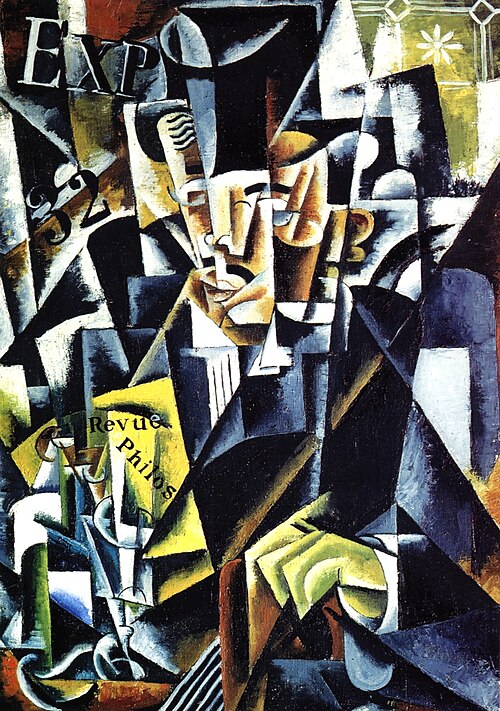
Article image: Lyubov Sergeyevna Popova: Portrait of a Philosopher (1915) (source)
Robert Hugo Ziegler teaches philosophy in Würzburg. He is the author of several books on political philosophy, metaphysics, natural philosophy, and the history of philosophy. His most recent publications in 2024 are Critique of Reactionary Thought, On Nature and Spinoza and the Shimmering of Nature.
Sources
Canetti, Elias: Crowds and Power. Frankfurt am Main 2006.
Clouscard, Michel: Néo-fascisme et idéologie du désir. Genèse du libéralisme libertaire. Paris 2017.
Deleuze, Gilles: Difference and Repetition. Translated from the French by Joseph Vogl. Munich 2007.
Deleuze, Gilles & Félix Guattari: Anti-Oedipus: Capitalism and Schizophrenia. Translated by Bernd Schwibs. Frankfurt am Main 2014.
Deleuze, Gilles & Félix Guattari: What is Philosophy? Translated from the French by Bernd Schwibs & Joseph Vogl. Frankfurt am Main 1996.
Dosse, François: Gilles Deleuze/Félix Guattari. BiographiesTranslated from the French by Christian Driesen. Vienna 2017.
Levinas, Emmanuel: Totality and Infinity: An Essay on Exteriority. Translated from the French by Wolfgang Nikolaus Krewani. Munich 1987.
Spinoza, Baruch de: Ethics Demonstrated in Geometrical Order. Latin-German. Newly translated, edited, and introduced by Wolfgang Bartuschat. Hamburg 2010.
Footnotes
3: Cf. e.g. Dosse, Gilles Deleuze/Félix Guattari, pp. 479 & 591.
4: Spinoza, Ethics, p. 411.
5: Canetti, Crowds and Power, p. 267.
6: Deleuze, Difference and Repetition, p. 377.
7: The Austrian-Israeli philosopher Martin Buber (1878–1965) was one of the leading figures of the renaissance of Jewish consciousness in the German-speaking world after the First World War, through his studies on Hasidism and his translation of the Bible (begun together with Franz Rosenzweig), and, through his philosophical works, above all I and Thou from 1923, an important precursor for Levinas.
8: Cf. Totality and Infinity, p. 302 et seq.
9: Cf. in particular pp. 318–328.