
Nietzsche POParts
Aren’t words and notes
like rainbows and bridges
of semblance,
between that which is
eternally separated?
Nietzsche
POP
arts
Nietzsche

Sind

nicht

Worte


und

Töne
Regenbogen
POP

und

Scheinbrücken

zwischen

Ewig-

Geschiedenem
arts

Timely Blog on Nietzsche’s Insights
Articles
_________
Dionysos als rolling stone
An Attempt to Understand Nietzsche with Rock Music
Dionysus as Rolling Stone
An Attempt to Understand Nietzsche with Rock Music
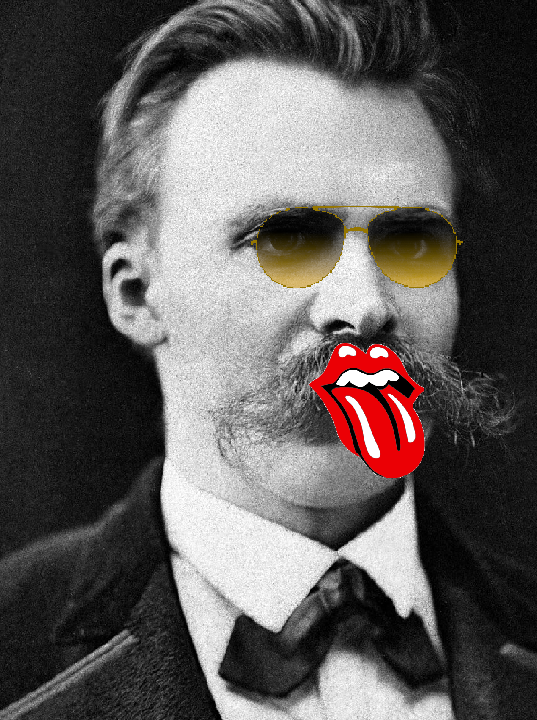

On the one hand, Nietzsche's distinction between the Apollonian and the Dionysian helps to understand the development of the rock music of the Rolling Stones both internally and externally. On the other hand, Nietzsche's philosophy is reflected in many places in their songs. But above all, it is also illuminated by the Stones, and their songs show what Nietzsche is thinking — an Apollonian act. If Nietzsche is aesthetically oriented towards intoxication, then you can also learn from the Stones how to receive Nietzsche's poetry in a Dionysian way. It is therefore not just about understanding the Stones with Nietzsche, but vice versa: with the Nietzsche Stones.
An audiovisual version of this article with clips of the quoted songs can be found on the YouTube channel of the Halcyonic Association for Radical Philosophy and on Soundcloud.
If you meet me, have some courtesy/Have some sympathy, and some taste. If you are unable to do so, the devil threatens to destroy your existence: Or I'll lay your soul to waste. — Sympathy for the Devil Compares Jochen Hörisch with the “best Schubert-Schumann-Mahler tradition of German art song”1.


1. The Devil and the Last Men
Who is this devil supposed to be? So Jagger sings: I Rode a Tank, Held a General's Rank/When the Blitzkrieg Raged. — According to Friedrich Kittler, the success of the Blitzkriege was based on VHF radio. Ergo: “All car radios that carried us to the sound of the Stones to their beloved Cote d'Azur have only adopted this Blitzkrieg trade secret. ”2 Did the devil pave the way for the Stones?
Who is this devil? Kurt Flasch explains his origins: It was not Judaism, not Islam, “it was the Christians who made him God's most powerful adversary. [...] [A] ber he also looked a hell of a lot like him. ”3
Nietzsche accuses Christians of this, while Buddhists do not need the devil: “[M] an had an overwhelming and terrible enemy — there was no need to be ashamed of suffering from such an enemy. ”4
Who is the devil? God's Helper for Flasch! An excuse for Nietzsche! In the middle of the song is the explanation: Who killed the Kennedys? When after all/It was you and me.
Who is the devil? The people who use the devil as an excuse in the sense of Nietzsche! According to Zarathustra, this would be “the last person to make everything small. ”5 Are we all devilsJust as every cop is a criminal?
The Stones implement Nietzsche's remark: “But the worst is the small thoughts. Truly better yet bad than thought! ”6
This is how the song on the LP reflects Beggars Banquet The restless spirit of 1968. The devil appears as a gentleman with manners: Please allow me to introduce myself/I'm a man of wealth and taste. Are the rich capitalists the devils?
Are the Stones on the side of the protesting youth? In the monarchy, such people were called “rabble.” Played, Nietzsche is appalled: “[I] ch once asked and almost choked on my question: How? Does life also need the rabble? ”7
Does the rabble also include dropouts or relegations? Bob Dylan narrates 1965 in the song Like a Rolling Stone from a socially smoked lady:
You used to laugh about
Everybody that was hanging out.
Now you don't talk so loud,
Now you don't seem so proud
About having to be scrounging your next meal.
This is how Dylan asks in the refrain:
How does it feel, how does it feel?
To be on your own, with no direction home
A complete unknown, like a Rolling Stone.
Men play a significant part in the descent of women:
You used to be so amused
At Napoleon in Rags and the Language That He Used
Go to him he calls you, you can't refuse
When You Ain't Got Nothing, You Got Nothing to Lose
You're invisible now, you've got no secrets to conceal.
The phrases of the lyrics require reflection like many of Dylan's songs, which inspire critical thought, less to sing along devotedly.
2. Bob Dylan's Apollonian Ballads or Dionysian “get louder” (Grace Slick)
Was this song too Apollinan for the Stones? In fact, Nietzsche distinguishes between two aesthetic forms, the Dionysian and the Apollonian. Apollo, as the god of the visual arts, uses art to comfort people in the face of their isolated existence. Nietzsche writes: “Apollo [.] shows us, with sublime gestures, how the whole world of torment is necessary so that it urges the individual to produce the redemptive vision.”8.
This is how Max Horkheimer and Theodor Adorno comment about Odysseus while driving past the Isle of Sirens: “The bound person attends a concert, listening motionlessly like the concert-goers later, and his enthusiastic call for liberation fades away as applause. ”9
The Stones played Like a Rolling Stone himself at various concerts and even together with Dylan, including at a concert in Buenos Aires in 1998, at which the audience sings along exuberantly, does not behave in an Apollinan way at all to reflect what is being sung to him, but in Dionysian.10 Dionysus, the god of intoxication, makes people forget their isolated existence. Nietzsche writes: “Under the magic of Dionysian, it is not only the bond between man and person that reunites. ”11
Herbert Marcuse, on the other hand: “The 'group' [...] is' totalitarian '[...]. It is true that the audience actively takes part in such a spectacle: the music moves their bodies make them 'natural'. But their (literally) electrical excitation often takes on hysterical features. ”12
Marcuse mocks at the comment made by Grace Slick from Jefferson Airplane: “Our constant goal in life, says Grace with a completely expressionless face, is to get louder. ”13
Of course, Marcuse could have learned from Arthur Danto that the Dionysian element of art is by no means irrational. So Danto 1965:
It would be too superficial to equate Nietzsche's pair of categories [Apollinian/Dionysian] with rationality and irrationality. In the end, dreaming is nothing more rational than dancing, and music [...] is also no less rational than poetry.14
The Stones included Dylan's song in 1972 Tumbling Dice towards a programmatic song: The rolling stone becomes a tumbling cube, also a social outsider:
Women think I'm tasty, but they're always tryin' to waste me
And make me burn the candle right down,
But baby, baby, I don't need no jewels in my crown.
Women want to retain the attractive man who was still able to talk his way out of financial and drug problems at that time:
Honey, got no money
I'm all sixes and sevens and nines.
Say now, baby, I'm the rank outsider
You can be my partner in crime.
Then she gets at least what Nietzsche writes:
She's got spirit now — how did she find him?
A man lost his mind as a result of her recently
His head was rich before this pastime:
His head went to hell — no! No to the woman!15
Jagger was a Homme des femmes, who embodied the male sexiness of that time like hardly anyone else and was accordingly idolized. Because he can only ever partially accept the far too many offers, he doesn't lose his mind: Baby, I can't stay, you got to roll me/And call me the tumblin' dice.
The infinitely repetitive Got to roll me, keep on rolling Reminds all the more of Like a Rolling Stone, thus to the name of the band, and various forms of outsider existence that the Stones themselves were in their beginnings and which they still continued in 2023 in Whole Wide World thematize:
When the whole wide world's against you
And you're standing in the rain,
When all your friends have let you down
And treat you with disdain.


3. Dionysian Farewell to Apollonian Reflection
In May 1965, the Stones released Satisfaction, which states:
When I'm watchin' my T.V.
And a man comes on to tell me
How white my shirts can be
But he can't be a man 'cause he doesn't smoke
The same cigarettes as me
I can't get no...
Even then, the Stones concealed their song lyrics in places in such a way that they appear confusing. The song critiques consumption in Apollonian terms.
When I'm Ridin' Round the World [..]
I'm tryin' to make some girl
Who tells me: “Baby better come back maybe next week,
“Cause you see, I'm on a losing streak.”
The sexual revolution of that time also included the refusal if the courted lady doesn't feel like it despite contraceptive pills, which, according to Hans Blumenberg, “are the only really significant change in human behavior in our century.”16 evokes.
On the other hand, rock concerts can be seen as a return to old traditions of Dionysian festivals. This is how Nietzsche writes:
From all ends of the ancient world [...] we can prove the existence of Dionysian festivals [...]. Almost everywhere, the center of these festivals was an exuberant sexual lack of discipline, the waves of which flooded every family home [.]17
In ancient times, people had a positive understanding of sexual pleasure, which is not devalued as a sin as in Christianity. According to Michel Foucault, negative is rather when “you remain passive in the face of your desires. ”18
The original song Satisfaction It sounds like Dylan's songs from 1965 as an Apollonian protest song. The Stones later transform the song to give it a Dionysian character that sweeps the audience away and lets them sing along, e.g. in concert Havana Moon 2016.19
Of course, there have been strong Dionysian tendencies since the early days of the Stones. This is how Jagger sings in 1967: Let's spend the night together now. And he says what it's about:
This doesn't happen to me every day, oh my,
No excuses offered anyway, oh my,
I'll satisfy your every need
And now I know you will satisfy me.
Oh come on now
Oh baby, my, my...
Yet prudery was widespread in the sixties. So you might think that Zarathustra's claim is still relevant as it was in 1967, when the US government thought it was winning the Vietnam War. So Zarathustra spoke:
That is how I want man and woman: warlike one, childbearing the other, but both ready to dance with head and legs. And let us lose the day when people never danced once!20
Rock music was also the music of the Vietnam War. Dancing and intoxication with hashish and LSD belong to war. Jagger had to admit in 1969: Now you can't (always get what you want), yeah,/And if you try sometimes, you just might find:/You get what you need.
You are not completely unsuccessful, as Camus notes: “Feel your rebellion [...] as strongly as possible — that means living as intensely as possible. ”21 The Stones everyday the famous nonetheless that Camus hurled at the Nazis. Resistance takes place on a small scale.
In a conflict of the sexes, you don't get what you want, but you get hurt. This is how Nietzsche makes Ariadne complain: “[M] an executioner god! ../No! /Come back! / With to all your torments! /[...] My pain! /My last luck! ”22 The Stones sing:
And I saw her today at the reception.
In her glass was a bleeding man.
She was practiced at the art of deception.
Well, I could tell by her blood-stained hands.
Nietzsche laments about George Sand: “The worst, of course, remains female coquetry with masculinities, with the manners of naughty boys. — How cold she must have been in all this, this obnoxious artist! ”23
Rock music, whether in front of the gramophone or in the arena, is comfort and distraction. This is how Nietzsche writes about Dionysian art: “[W] r are forced to look into the horrors of individual existence — and yet should not freeze. ”24 Or a bit simpler and yet highly Dionysian: You can't always get what you want.
Problems of having to express sexual innuendo discreetly disappeared largely in 1981 — but certainly only in the Western world. However, the Stones are popular almost all over the world and give concerts everywhere. This is how a double sense goes through Start Me Up. The beginning of the song sounds harmless: If you start me up,/I'll never stop. But suggestive words immediately follow: I've been running hot,/You got me ticking, now don't blow my top. The following line is unequivocal: You make a grown man cry.
The song culminates in the unequivocal sentence, which you could of course read innocently if the Stones didn't sometimes do half-naked gymnastics on stage: You, you make a dead man come.
Does this make Nietzsche's poem understandable:
”The world is deep
“And deeper than the day thought.
“Her pain is deep —
“Pleasure — even deeper than heartbreak:
“Woe says: Go away!
“But all pleasure wants eternity —
“— wants deep, deep eternity! ”25
However, pleasure comes from playing with displeasure. That is why, according to Vladimir Jankélévitch, ironic love follows the principle”A little of everything and not: Everything of one. ”26
Then receive comments in Start me up a non-technical sense: My eyes dilate, my lips go green,/My hands are greasy, she's a mean, mean machine.
Is that discriminatory? If you understand it innocently, not if you read it suggestively. This is how Nietzsche can be interpreted:
For there to be art, [...] a physiological precondition is unavoidable: intoxication. The intoxication must first have increased the excitability of the entire machine: sooner there will be no art. All [..] Types of intoxication have the power to do so: in particular the intoxication of sexual stimulation [.]27
4. Sweet Sound of Heaven “beyond good and evil”
Have the Stones turned away from Dionysian in recent years? This is how the gospel-like begins Sweet Sound of Heaven from 2023 with: Bless the Father, Bless the Son.
But it's hard to blame the Stones for what Nietzsche complains about:
[T] he artists of all time [.] are the glorifies of the religious and philosophical errors of humanity, and they could not have been so without believing in the absolute truth of them [.]28
In fact, you will hardly find any absolute truths in the Stones' songs. Dionysian is relativism. The Apollinan in art tends towards immutable truths. But Jagger sings:
No, I'm not, not goin' to Hell
In Some Dusty Motel [.]
I'm gonna laugh, [..], I'm gonna cry.
Eat the bread, drink the wine
'Cause I'm finally, finally Quenchin'
My thirst, yeah.
And what do the Stones want? I want to be drenched in the rain of your heavenly love.
It sounds hyper-erotic, almost pornographic. And not humble at all, but sinful:
And we all feel the heat
Of the sun,
Let us sing, let us shout
Let us all stand up proud
Let the old still believe
That they're young.
For pride or pride is the highest Christian mortal sin.
Even Nietzsche's poem Sils-Maria doubts self-evident things:
I sat here, waiting, waiting, but for nothing
Beyond good and evil, soon of light
Enjoying, soon the shadow, just playing,
All lake, all noon, all time without a destination.
There, suddenly, girlfriend! became one to two —
— And Zarathustra passed me by.29
Rock music had Dionysian features right from the start, but it also still had an Apollonian character, which was increasingly lost with the Stones over the decades. It is more and more about intoxication, not about reflection. Where this still persists in the texts, it is more due to the ambiguity, which is becoming increasingly superfluous to reflect on Dionysically, as in Nietzsche Sils-Mariawhen you refrain from reflecting it and enjoy it as a kind of rock 'n' roll.
Article image
The Stones on a Leipzig house wall on Wurzener Straße, painted by an unknown artist, photographed by Paul Stephan, who passes by here almost every day.
Literature
Adorno, Theodor W. & Max Horkheimer: Dialectic of Enlightenment (1944), Frankfurt am Main 1971.
Blumenberg, Hans: Description of the person. From the estate. Frankfurt am Main 2006.
Camus, Albert: The myth of Sisyphus (1942). Hamburg 1959.
Danto, Arthur C.: Nietzsche as a philosopher (1965). Munich 1998.
Flasch, Kurt: The devil and his angels. The new biography. Munich 2015.
Foucault, Michel: The use of delights. Sexuality and Truth 2 (1984), Frankfurt a.M. 1989.
That's right, Jochen: A Man Of Wealth And Taste. Jaggers Lucifer meets Goethe's Mephisto. In: Albert Kümmel-Schnur (ed.): Sympathy for the Devil. Munich 2009.
Jankélévitch, Vladimir: The irony (1964). Berlin 2012.
Kittler, Friedrich: When The Blitzkrieg Raged. In: Albert Kümmel-Schnur (ed.): Sympathy for the Devil. Munich 2009.
Marcuse, Herbert: Counterrevolution and revolt (1972). Frankfurt am Main 1973.
Footnotes
1: A Man of Wealth and Taste, P. 29.
2: When The Blitzkrieg Raged, P. 139.
3: The devil and his angels, P. 77.
5: So Zarathustra spoke, Preface, paragraph 4.
6: So Zarathustra spoke, From the compassionate.
7: So Zarathustra spoke, From the rabble.
8:The birth of tragedy, paragraph 4.
9: Dialectic of Enlightenment, P. 34.
10: Cf. this recording of the concert on YouTube. The Stones appeared five times in a row in Buenos Aires in short succession and reached a total of 272,000 spectators. They made a concert film from the recording of the last of these concerts.
11: The birth of tragedy, paragraph 1.
12: Counterrevolution and revolt, P. 135.
13: Ibid., p. 135, footnote.
14: Nietzsche as a philosopher, P. 66.
15: The happy science, prelude, No. 50.
16:Description of the person, P. 479.
17: The birth of tragedy, Paragraph 2.
18: The use of delights, P. 35.
19: Cf. this recording of the concert on YouTube. The concert in the capital of Cuba, which was celebrated on Good Friday despite the Vatican's intervention, was attended by 500,000 enthusiastic fans and was recorded as a movie.
20: So Zarathustra spoke, From old and new boards, paragraph 23.
21: The myth of Sisyphus, P. 56.
22:Dionysus Dithyrambi, Ariadne's Lament.
23: Götzen-Dämmerung, rambles, paragraph 6.
24: The birth of tragedy, paragraph 17.
25: So Zarathustra spoke, The Nightwalker Song, paragraph 12.
26: The irony, P. 35.
27: Götzen-Dämmerung, rambles, Aph 8.
Dionysus as Rolling Stone
An Attempt to Understand Nietzsche with Rock Music
On the one hand, Nietzsche's distinction between the Apollonian and the Dionysian helps to understand the development of the rock music of the Rolling Stones both internally and externally. On the other hand, Nietzsche's philosophy is reflected in many places in their songs. But above all, it is also illuminated by the Stones, and their songs show what Nietzsche is thinking — an Apollonian act. If Nietzsche is aesthetically oriented towards intoxication, then you can also learn from the Stones how to receive Nietzsche's poetry in a Dionysian way. It is therefore not just about understanding the Stones with Nietzsche, but vice versa: with the Nietzsche Stones.
An audiovisual version of this article with clips of the quoted songs can be found on the YouTube channel of the Halcyonic Association for Radical Philosophy and on Soundcloud.
Monumentality Issues. Nietzsche in Art After 1945
Thoughts on the Book Nietzsche Forever? by Barbara Straka II
Monumentality Issues. Nietzsche in Art After 1945
Thoughts on the Book Nietzsche Forever? by Barbara Straka II

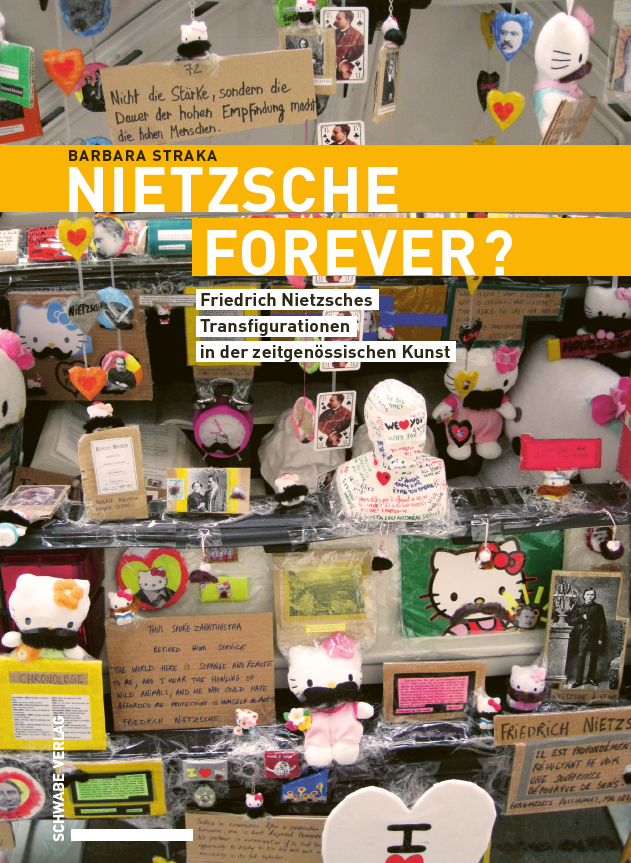
Barbara Straka's newly published book Nietzsche Forever? explores the question of how Nietzsche is received in 20th century art, in particular that after 1945. But the reception of Nietzsche's reception raises the question of whether the philosopher's monumentality is lost sight of. Does this reveal a fundamental problem of our age with monumentality? In any case, starting from Nietzsche, Michael Meyer-Albert argues against Straka for a “post-monumental monumentality” as an alternative to aesthetic postmodernism. In the first part of the two-part series, he dedicated himself to her book, and now he is accentuating his opposite position.
III. Horse Hug
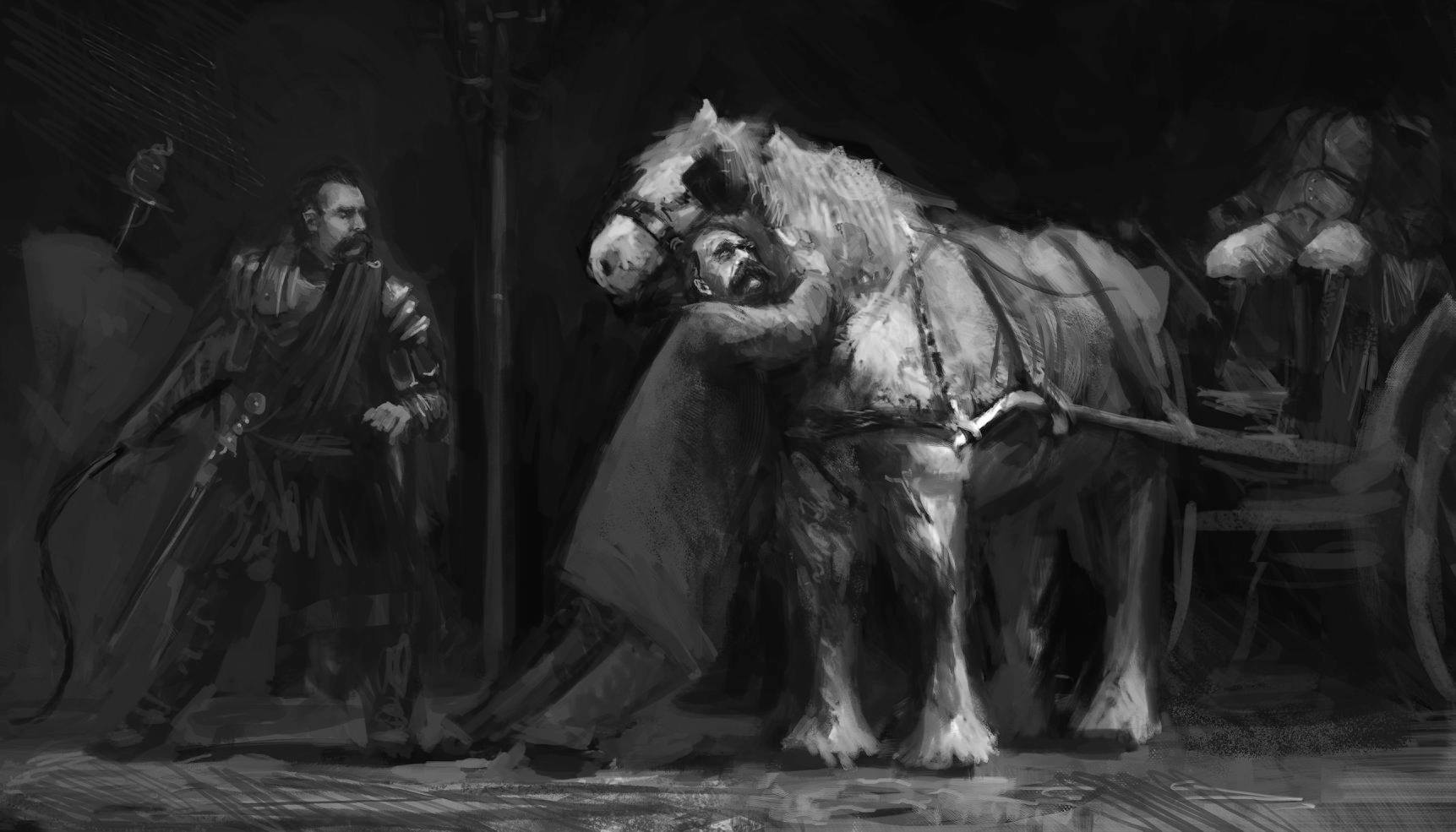
Straka's observation that it was primarily certain details from Nietzsche's work and life that became decisive for art after 1945 gains particular significance for the philosophically interested reader. The gesture of hugging a horse is central to this. In January 1889, according to an anecdote, which probably happened one way or another, Nietzsche saw a coachman mistreating a horse in Turin. He ran to the horse, hugged it and thus protected it from the blows. From this scene, which caused quite a stir, Nietzsche was perceived as having a mental disorder and spent his life in nursing care.
Straka captures this moment in Nietzsche's life succinctly: “After the Turin Incident, the philosopher Nietzsche no longer existed.” (p. 517) The significance for Nietzsche's reception lies in the fact that his philosophy of affirmation of life, which sometimes turned into a metaphysics of will with social Darwinian features even before, but especially in his later thinking, often turned into a metaphysics of will with social Darwinian features. The truth of life prevailed over a philosophy of absolute victory. Straka sums up:
The “Turin Horse Hug” is a legend, but it is not suitable for making Nietzsche a myth again in contemporary art or stylizing it into a cult figure; it actually makes him a human in the first place because it depicts the fall of a delusional self-proclaimed god. She thus plays a key role within the themes and motifs of recent Nietzsche art. [...] [F] for posterity, Nietzsche is not a failure; his mental collapse in Turin did not set an end point, but a starting point for a new, empathetic view of person, life and work.1
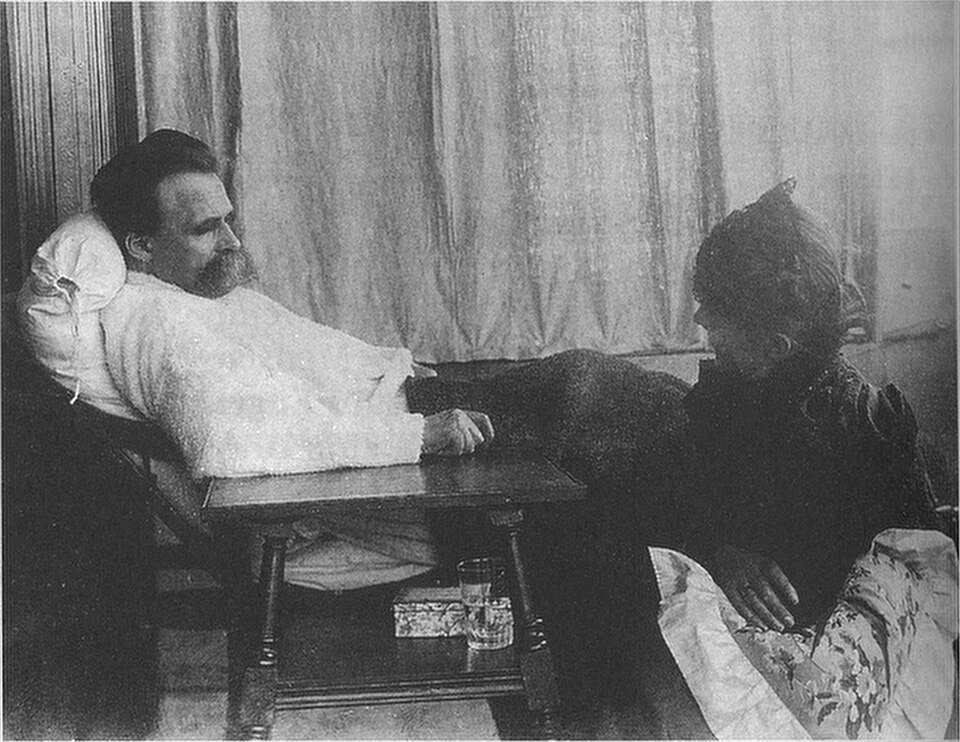
Nietzsche now appears no longer as a monster of creativity who embodied a precarious triumphalistic philosophy of life, but as a vulnerable thinker who suffered from massive health problems (such as cluster headaches) and was forced to travel constantly in search of tolerable and affordable places to stay socially placeless. Photographs taken by Hans Olde in 1899, which document Nietzsche's nursing case and which “have contributed significantly to a convincing characterization of the philosopher to this day” (p. 568), were decisive for the reception.
The gesture of hugging a horse implicitly refutes the extremist statements of late Nietzsche, who falsely substantiated the transfiguration of the truthful animal into an ontology of chaos, which then legitimizes lethal naturalism as a will to power. The sick Nietzsche is not the true Nietzsche, but the truer Nietzsche. The weakness of Nietzsche's painting, which emphasizes his failure in life, is, however, the concealment of the strong vitality that this life was ultimately about. Sensitive iconoclasm immediately deconstructs encouragement with the cult. For Straka, it borders on cynicism that the contemporary depictions of a vitalist Nietzsche no longer relate to Olde's paintings (see p. 664).
IV. A New Nietzsche Cult?
Where there was a cult, people should become: This is how the path Nietzsche left behind in art could be described. When receiving the reception of art, it is obvious that Nietzsche may have fallen victim to a cult for the second time. He was first over- and then under-monumentalized in the arts. Nietzsche becomes human as a sufferer, a sick person, a fragile person, and Nietzsche becomes a person in the manifold humanizations that appear most expressive in pop culture, but also dominates access to Nietzsche in more ambitious contemporary art. Straka affirms this trend:
The heroism, pathos and monumentalization that characterized the Nietzsche cult after 1900 have given way to differentiated representations of a contradictory, offensive, but also human, personal, even private Nietzsche who no longer fits on a memorial base.2
However, this anti-monumental tendency can not only be understood as a beneficial neutralization of excessive interpretations, as the “final phase of the deconstruction of the former cult image of Nietzsche” (p. 663), but it also bears the features of a new cult. It can be seen as a derivative of an iconoclastic cultural movement spanning the entire modern era. Everything old is brought before the court of reason. This gives the value of the new one the highest value. Culture as an imitation of excellence gives way to compulsive freedom, which can only believe in itself as an innovation and is self-referentially dynamic as a distance from competing innovation as innovative innovations. You imitate yourself in your worldless and world-poor innovation in order to stabilize yourself as a cult in the market of attention. You become a culture that imitates yourself because the imitation of past cultural greatness, which worked through reality resonance, is taboo. Committed to nonsense.
Four characteristics characterize modern traditional phobia in the field of art: It sacralizes firstly the spectacular excesses of subjective creativity — including Damien Hirsts For the Love of God (2007; link) or Wim Delvoyes Cloaca (2000; link) — who vie for attention, to the classical cultural dynamics of reverent imitation and careful variation, which wrestle within a decoration for inspiring emotionality, gives it secondly Meaning through billboard concepts, it creates thirdly Attention through the new power of exhibition as an attribution of quality and embodies it fourthly an informal morality that gains the “goodness” of works by simply revaluing the value of “degenerate art”:
A) Fuck it! Just express yourself!
The new cult of anti-monumentalism is evident as a sacralization of creativity in works that do not present a world, but only themselves as hypercreativity. Nietzsche's thinking can be heard here insofar as a legitimizing idea for self-referential spectacle creativity can be found in it. Nietzsche's “revaluation of values” is understood as a license to reject the “conventional” patterns of canonical works and to pursue a frivolous perspectivism in which maximum originality appears as a phenotype of creative vitality. The motto is: generating attention through excitement and no longer the traditional development of astonishing emotionality. One example of this is the leaves The Dark Child God, Transsilvannietzsche and DR. N. by Jonathan Meese (see p. 151), by whom Straka is delighted: Jonathan Meese succeeded in distorting Nietzsche to the point of recognition (see p. 153).
B) Readymade content
The reference to Nietzsche as the philosopher of the mask is once again becoming a mask in the context of contemporary art itself. The pop Nietzsche is explicit what the new art Nietzsche is usually implicit: aura markers for one's own products. Nietzsche serves as readymade content for content-free art. They outsource to him a depth of the works that the works themselves no longer own. The canonical authority of the works of which Mörike wrote is now over: “But what is beautiful, it seems blissful in himself.” Content is delegated to Nietzsche in order to evade the responsibility of the forms for the “sensual appearance of the idea” (Hegel). The works can only be “understood” as a “concept.” They become pure signs for which there is no language. Your concept says what they should mean. Her hypercreative hermeticism is deciphered by the hermeneutics of expressiveness without clarity.
Examples: Felix Dröse's drawings from the cycle Untitled (“I'm dead because I'm stupid, I'm stupid because I'm dead.”) from 1981 (see p. 614 ff.) show clumsy sketches made by the artist in the dark, thinking intensely of Nietzsche, according to his concept. Stephan Hubers Zitronstadel (originally: “Zarathustra im Zitronstadel”), from 2005 shows a wooden box quoting from “Also spoke Zarathustra” in the Allgäu dialect (see 464 f.; link).
C) “Exhibition Power” (Heiner Mühlmann)
Works that no longer display a world become works of art through the location where they are exhibited. The presentation in museums, in public spaces or even in a book about contemporary art gives the dignity of the highly cultural.3 The implicit competence of the aesthetic work gives way to the emotional state of the “exhibition trance” (Mühlmann), which refines pseudo-cultural water into highly cultural wine. The pedestal from which all monumentalist works are to be retrieved lives on hidden in the gesture of presentation. After the decorative ornament has been ennobled into “abstract art,” the museum is used as an installation by Casimir Malevich's4 Work concept for the white 3D square as a work of art naming work. Art is the power of the spatial effect. “The museum is no longer exhibiting anything. It turns itself off. ”5 In this exhibition, the mere aura of the exhibition results in meaningless, uninformative cultural imitation, which is called”Selfish cultural variant”6 (Mühlmann) occupies the valuable capacities of imitation, from which something could be learned. Sloterdijk adds to Mühlmann's observations:
The path of art follows the law of alienation, which proves the power of imitation precisely where imitation is most strongly denied: It leads from artists who imitate artists, to exhibitors who imitate exhibitors, to buyers who imitate buyers. From the motto L'art pour l'art Is the concept before our eyes The art system for the art system became.7
D) Entenatary art
The new cult of anti-monumentalism manifests a charge of meaning and value through morality. It is not the good that dominates, but the good. The aesthetic structure is charged with quality because it is in the tradition of what used to be “degenerate art.”8 A “framed ornament” (Mühlmann) can thus appear as anti-fascist “abstract art.” The truth of antinacian art is therefore the good that it stands for. There is no question of an in-depth response to realities. The absence of references to the work is reinforced externally through the rituals of reception. A moral view of art as a degenerate stabilizes it tribalistically. It sends harmony inwards, aggression outwards. Criticism of the lack of content is responded to in a maximally moral way by not responding to the objection, but by launching an automatic insinuation that, for example, brings criticism of contemporary works as mere “framed patterns” (Mühlmann) into the highly problematic tradition of fascist propaganda.
V. The Struggle for Monumentality
It is precisely this moralizing of aesthetics that motivates Straka's book to the extent that it contradicts Christian Saehrendt's views positioned; expressly at the end of her book in the acknowledgments (see p. 739). Sährendt, a regular author of this blog, speaks loudly in Trump's sometimes hard-to-bear tones for a remonumentalization of Nietzsche — “Make Nietzsche great again! “(see p. 585) —, gladly as a large monument above the Saale. Straka, on the other hand, defends himself against them with a more differentiated but also very affirmative view of the art world — probably as a deliberate provocation Cum grano salis — sounds and smells in Sährendt's statements, reflecting his polemical escalation in a way that is difficult to bear, even an update of the contempt of modern art as “degenerate” (see p. 598).
Perhaps this constellation could be used to gain an extended term for the understanding of reception? Is the opposition between Straka and Sährendt, insofar as he represents the point of view assumed by Straka to him in the first place, not about more than aesthetics? Does this particular confrontation over Nietzsche's legacy not also reflect the general rift that runs through the Western world and is embodied in a cultural struggle that is no longer just a cold one? Is there not the question in the background whether the modern struggle for recognition should emphasize justice in the sense of anti-monumentalist equal treatment or rather the monumentalist uniqueness in the sense of brilliance? Could Nietzsche possibly gain a comprehensive concept of monumentality that is ignored in this cultural struggle?
The question of how Nietzsche appears in art is a question of the form of relationship that is assumed with tradition. By deconstructing the monumentalist Nietzsche in the arts after 1945, the monumentalist is actually deconstructed as a form of reference to tradition.
Appropriately enough, Nietzsche himself wrote an essay that explores the question of the relationship to tradition. He distinguishes in his second Unexpected viewing with the title The benefits and disadvantages of history for life From 1874, three ways of dealing with history: One antiquarian Dealing that respectfully overlooks and wants to preserve the past; a monumentalist Dealing that strives for even greater things and instrumentalizes the past as motivation and role model; and a critical People who suffer from the past and want to emancipate themselves from it. Nietzsche primarily criticizes the dominance of antiquarian treatment of history in his time. Through this philosophically staged attitude by Hegel, contemporaries are brought into the position of viewers in a drama in which they themselves play a part. The belief that you are only a spectator of your own story demoralizes and creates cynicism.9
Nietzsches Untimely viewing Translated into the contemporary, shows a current overemphasis on the critical approach to tradition, but without suffering from it. It stabilizes itself in a cult of absolute innovation. The idea of canonical classicity as an admirable imitation model fails. Everything should be pushed off the base. There must be no superhumans and superpowers, because the shock of mastery and his works is too deep. There is no such positive connection to monumentality. As compensation, this shortcoming then creates a neo-monumentalism that bears the traits of areflexive, defiant self-affirmation and strives for a modernized size without being able to do it. The truth of anti-monumentalism in aesthetics is empathy for time and a sensitivity for its way of presentation. The truth of neomonumentalism is a critique of ignoring historical grandeur and a sense of the sublime. What is missing is well-tempered monumentality.
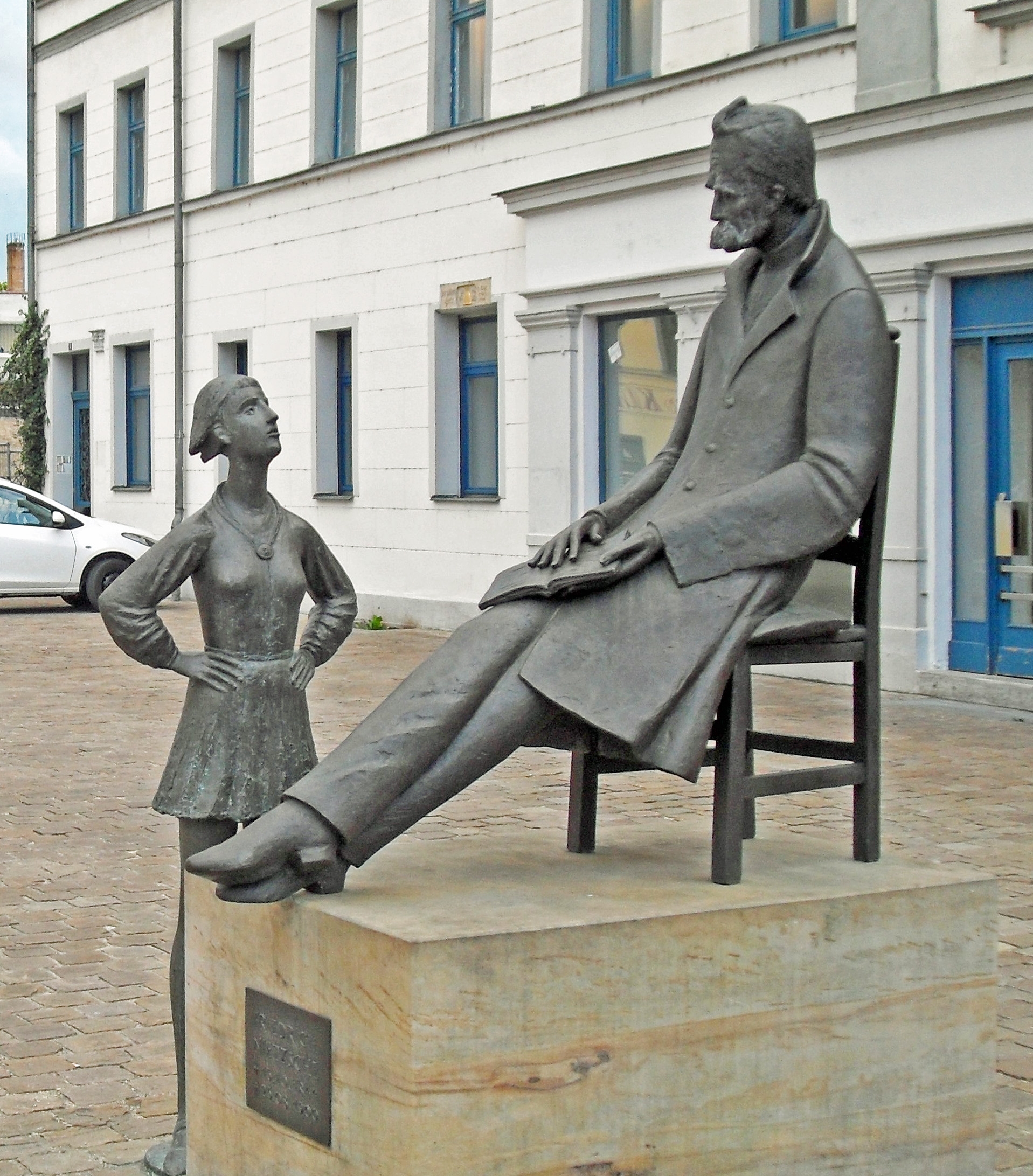
VI. Post-Monumental Monumentality
Perhaps, following a clue in Sloterdijk notebooks,10 Put forward the thesis that the sublime, which Nietzsche first located in art and then criticized in religion, was converted to the grandeur of the state and the military in the phase of its monumentalist reception. In the phase of anti-monumentalist reception, these forms of grandeur were criticized, but the sublime was thus ignored in the first place. What both phases so omit is the grandeur of evidence, which comes to the center of post-Wagnerian Nietzsche and allows post-metaphysical high notes in philosophy. What deserves the utmost seriousness, what is the most effective and can claim higher rank — even in the egalitarian states of the super-correct, hypersensitive, consensual zeitgeist — is the power of truth. God is dead, art is opiate, the state is bureaucracy and the military is a place of pre-modern heroic. But the truth is that the heart of modern grandeur beats. Paradoxically, this “sense of truth” (Sloterdijk) appears in Nietzsche as a discovery of the semblance necessary for life. Truth as a truth of illusion, which is intended to stimulate and protect, does not come with the old European pathos. It does not appear in the preaching or commanding apostle form, but as a therapeutic experiment with possible facilitations. The most serious can thus be understood as clarification, as relief and as an invigorating and motivating lie.
This decisive point of Nietzsche's concept of grandeur is also found in his second Unexpected viewing. Nietzsche puts forward the thesis that appearance as a constitutive aspect of life means a kind of minimal monumentality. Life requires the primacy of one's own over the foreign as a protective cocoon, a sealing atmosphere, an “enveloping delusion.”11, which limits and ignores the horizons of the incoming newcomer to such an extent that a positive self-image is stabilized as:
And this is a general law: every living person can only become healthy, strong and fertile within one horizon; if it is unable to draw a horizon around itself and in turn too selfish to include one's own gaze within a stranger, it taint or hastily seeps away at present doom.12
This cultural immune system of therapeutic hubris protects “the irreverent illusion in which everything that wants to live can live alone.”13. The truth of life is not neutral. It is the exact opposite of a perspective that wants to think of the truth as lack, alienation, robbery, exploitation. The pessimist Adorno is wrong: Wanting to think of the whole thing as untrue is untrue. There is a wrong life in the right one. History understood monumentally becomes a “remedy against resignation”14 and motivates people to become more lively.
In the following years, after turning away from Wagnerism, Nietzsche himself succeeded in uncovering perspectives that show an advanced idea of monumentality. According to this, the monumentality of modernity is to be seen as an “age of comparisons.”15 has to do cultural-psychological preparatory work for a cosmopolitan location within a global post-metaphysical ecumenism. This involves an evaluation of all cultures with regard to a new idea of noble vitality that distances itself from resentful retaliatory logics and from nihilistic lethargies, which can be imitated by future generations in an exemplary manner. Monumental about our time is the practising ritualization of civil, globally compatible monumentalism as an archive search and an attempt at construction. Nietzsche himself speaks of a cultural experiment that could satisfy any heroism.16 And he also mentions the attitude of a resentful relationship with tradition: “There are, of course, strange human bees who only ever know how to suck the bitterest and the most annoying out of the cup of all things; [...]” and at a “bee basket of malaise.”17 build.
In the “age of comparisons,” art has the task of co-constructing an exemplary minimal monumentalism — a bee basket of comfort — which, even in view of the task and the abysses of the course of the world, makes an affirmation of the situation appear plausible in a locally concentrated symbolism. It is important to find an expression for a hope that can be believed in. Transfiguration of all countries, unite! Art is thus in productive competition with religion and philosophy when working on global civil transfigurations of a life of not only economic prosperity. The categorical imperative of post-monumental monumentalism is: Act in such a way that the choice of cultural role models that you imitate and who educate you embodies the permanence of sustainable, creative and generous liberalism so much that your life can also become a possible inspiration for others.
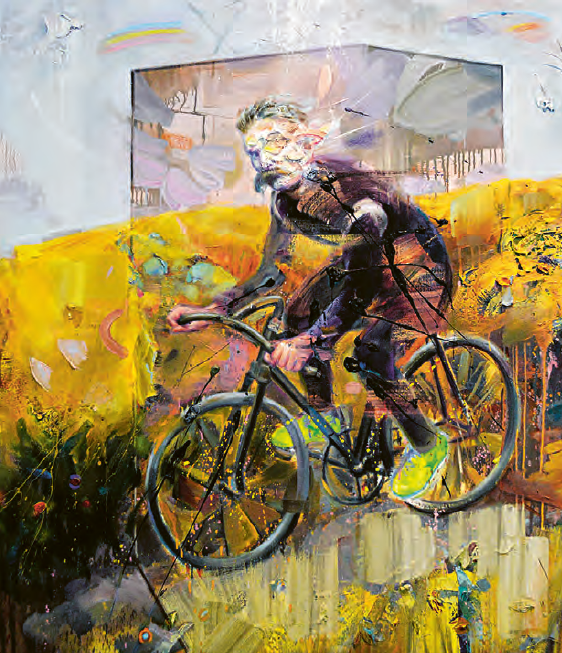
VII. “Nietzsche on a Bike”
Straka's book contains several works that reveal a post-monumentalist monumentality. This shows that we have the successful works of art to make the existence of the art business even more bearable.
Mathieu Laca's painting is particularly noteworthy Nietzsche on a Bike from 2016 (see p. 665). It shows the philosopher wearing glowing sports shoes on a racing bike. He looks up at the viewer like someone who is absorbed by his performance — the indicated cube around the figure reinforces this impression — and his gaze oscillates between being watched by surprise and an appeal. If you want to project thoughts into this view, they could read: “Oh. What do you want? Get on your bike yourself. Make something out of yourself! “Nietzsche is thus exposed as a trainee who affirms life as an overcoming in a physiological way, 6,000 feet beyond Übernietzsche and TINY-Nietzsche.
The impression of Nietzsche in Laca's painting can also be transferred to other areas of life. After the mobilized masses of red-brown and brown-red professional revolutionaries of the 20th century, for whom the struggle continues, come the athletized masses who, infected by sport, achieve brilliant achievements.18 The charism of the millennial empires and world revolutions is losing its luster. The betterment of the world begins in private life as a search for lost magnificence. Make yourself great again and again. In the spirit of Nietzsche: Seek disciplines and cultivate rituals that weaken the grumpy desire for retaliation because they do not interpret the empty hours as “abandonment of being” (Heidegger) and alienation. The time allows studies that are dedicated to the admirable, that invites imitation and that sparks their own success story of brilliant monumentality. As an example, Nietzsche's broken monumentality motivates people to set life up monumentally. His life rises into the modern age as a monument to a “resolution to serve life” (Thomas Mann). Because the power of the great that once was is still ongoing, we have the space to become more than we are. This enables pride that radiates jovial generosity and becomes immune from projecting feelings of grandeur into excessive imperial desire. Some victories and defeats are no longer necessary. The story is over. The fight is no longer going on. The training starts.
Article Image
Mitchell Nolte: The Turin Horse (2019; source) (Used with permission by the artist.)
Sources
Mühlmann, Heiner: countdown. Vienna & New York 2008.
Sloterdijk, Peter: You must change your life. Frankfurt am Main 2009.
Ders. : Lines and days III. Notes 2013-2016. Berlin 2023.
Straka, Barbara: Nietzsche Forever? Friedrich Nietzsche's Transfigurations in contemporary art. Basel 2025.
Footnotes
1: p. 548 f.
2: P. 610.
3: In this regard, see Mühlmann, countdown, p. 91 ff.
4: Editor's note: The Eastern European artist Kasimir Severinovich Malevich (1879—1935) is regarded with his painting The black square (1915) as the progenitor of aesthetic modernism.
5: Ibid., p. 74.
6: “Self-related cultural variant.”
7: Sloterdijk, You must change your life, P. 689.
8: Cf. Mühlmann, Countdown, p. 63 ff.
9: Cf. On the benefits and disadvantages of history for life Paragraph 8
10: Cf. Sloterdijk, Lines and days III, p. 239 f.
11:The benefits and disadvantages of history for life, paragraph 7.
12: The benefits and disadvantages of history for life, Paragraph 1.
13: On the benefits and disadvantages of history for life Paragraph 7.
14: The benefits and disadvantages of history for life, paragraph 2.
15: Human, all-too-human I, Aph 23.
16: Cf. The happy science Aph 7.
17: Human, All Too Human, II, Mixed Opinions and Sayings, Aph 179.
18: Sloterdijk instructively pointed this out — cf. You must change your life, p. 133 ff. — that with the appearance of the “athlete” type since the reinstatement of the Olympic Games in 1896, a rebirth of antiquity in the passion for sport succeeded en masse. From sport, the impulse of the Renaissance as a broad-based force forms wide sections of the population.
Monumentality Issues. Nietzsche in Art After 1945
Thoughts on the Book Nietzsche Forever? by Barbara Straka II
Barbara Straka's newly published book Nietzsche Forever? explores the question of how Nietzsche is received in 20th century art, in particular that after 1945. But the reception of Nietzsche's reception raises the question of whether the philosopher's monumentality is lost sight of. Does this reveal a fundamental problem of our age with monumentality? In any case, starting from Nietzsche, Michael Meyer-Albert argues against Straka for a “post-monumental monumentality” as an alternative to aesthetic postmodernism. In the first part of the two-part series, he dedicated himself to her book, and now he is accentuating his opposite position.
Amor fati — A Guide and Its Failure
Reflections between Adorno, Nietzsche, and Deleuze
Amor fati — A Guide and Its Failure
Reflections between Adorno, Nietzsche, and Deleuze


This article attempts to approach two of Nietzsche's most puzzling ideas: the Eternal Return and Amor fati, the “love of fate.” How exactly are these ideas to be understood — and above all: What do they have to tell us? How can we not only affirm fate, which is interpreted as an eternal return, but really love learn?
Among the philosophers, it was in particular the “main philosopher” of the Institute for Social Research, Theodor W. Adorno (1903-1969), who was skeptical or negative of these ideas of Nietzsche. Where remains, from the point of view of Amor fati, of critique and utopia whose banner Adorno and his intellectual companions held up?
As a result of the general failure of Marxisms to deal with fascism theoretically, the Frankfurt Institute tried to reorient itself from the 1930s onwards. The success of this movement seemed understandable to many unorthodox Marxists not only on the basis of economic laws; in their opinion, greater consideration was needed of the “subjective factor,” i.e. the psychological structure of the bourgeois individual. As part of this paradigm shift, Adorno turned to Sigmund Freud as well as Nietzsche. For the rest of his work, the German philosopher was a recurring point of reference for him.
Adorno, however, remained stubborn towards Nietzsche in an aspect that is typical of Marxist Nietzsche interpreters time and again: the insistence on the orientation towards a state of redemption for humanity in some way — the anticipation of which is manifested above all in the devaluation of the present. From this point of view, he also criticizes in his main aphoristic work Minima Moralia (1951) — according to him, a “sad science [...] of the right life”1 — Nietzsche's concept of Amor fati. Nietzsche's will to “just be a yes-sayer at some point”2, he thinks is a kind of Stockholm syndrome in the philosophy of life. However, such a task — not only of affirmation, but even of the will to affirm — would amount to abandoning the basis for every living appropriation of Nietzsche's philosophy. Taking up Adorno's critique, with reference to the interpretation of the important French Nietzsche interpreter Gilles Deleuze (1925-1995), it is intended to explore what Nietzsche provides for the universal and yet always very personal question of why existence — here and now — wants to be affirmed.
I. Do We Want the Eternal Return?
Nietzsche's practical philosophy is often somewhat baffled. Amor Fati, Eternal Recurrence — What is that? What should you not only endure from (quasi-) imperatives such as “the necessary, [...] but love! ”3, “I just want to be a yes-man someday! ”4 and the question “Do you want to do this again and countless times? ”5 start? How are you supposed to make yourself want something if you don't want it? Reasons could at best establish that something is “necessary” and would be “accepted” as such — but love? In Zarathustra The “cripples” ask the protagonist of the book how they too could be convinced of his teaching. Nietzsche's “prophet” “answers” them by stringing together questions: “And who learned him [the will] reconciliation over time, and is higher than all reconciliation? [...] Who also taught him to want to go back? ”6 In other writings, Nietzsche does not become more direct in this regard: “[W] e would you have to be good for yourself and life to ask for nothing more than this last eternal confirmation and sealing? ”7 This lack of answers can be frustrating and gradually feels like a dead end.
And yet the Eternal Return in particular continues to develop a very natural appeal and an intuitive understanding of what is at stake here. Isn't it amazing that it's somehow understandable what the cryptic metaphor of the Eternal Return is about, even though it seems insoluble as a problem? Why don't you reject them as ludicrous or don't even understand what that's supposed to do? What is actually surprising is not the insolubility of the problem of eternal return, but that we still understand it, do not let go of it. It is precisely because we understand the problem (and possibly the answer as well) that anything can be done with the problems and frustrations that arise when trying to conceptually describe what this is about.
So why? I mean that the Eternal Return doesn't really teach us anything. It gains this natural appeal from its response to what we already have and understand within ourselves. Anyone who cannot accept the past, present or future cannot want their life to repeat itself forever. But this is precisely the germ of a Amor Fati who wants to affirm the Eternal Return. All negations are filled with the desire to answer in the affirmative. We know that the negation doesn't want itself. Although we can postpone it as a state of affairs, we only endure it. We feel that we should really fully develop the will to affirm. Otherwise, we would not be baffled by the problem of how to want the Eternal Return — we would reject the request as pointless and would not even be faced with a problem at all. As a matter of course, you would come to terms with a situation.
But for now, we find ourselves in a funny space between affirmation (of another state yet to be achieved) and acceptance (of the current state in its facticity) when we deny a state of affairs. For this reason and as a result, the Eternal Return motivates us. It shows that a state of negation or even just of yielding does not want itself (recurring). There is therefore a will for a state of affirmation which makes the affirmation of the Eternal Return perceived as a promise and as a problem — because it is simply not yet capable of reaching such a state. But how do you get there?
It is clear that you should not accept some things, but other times you should still refrain from unrealistic expectations. But it is so difficult to judge here; fundamentally, this question makes you rummage within yourself: What hopes do you release yourself from... and which hopes should you also fight through despair? Often enough, you should persist with the latter against “common sense,” which can only ever be limited to what can be said, imagined, felt here and now. “The fact that you despair is much to honor. For you did not learn how to surrender.”8, says Zarathustra to the “higher people.” Because “[a] ll that suffers wants to live, that it becomes mature and funny and longing — longing for something more distant, higher, brighter. ”9 Only when you keep up the bar of hope against the now can the pressure of “Woe speaks: Go away! Go away you woe! “(ibid.) turn against the world and yourself and create something in which the once uncertain “yes” of former hope completely unfolds.
If at some point you just want to be a yes-man and want the eternal return but can't, it can't be a question of finding a general answer and solution. What prevents you from saying yes? You have to ask the question of who you are. You won't find a ready answer — you can only give the answer by becoming it. In this way, the question of how you can want the eternal return of your existence falls apart.
But the insight that you shouldn't look for the answer doesn't solve the question yet. How can you assess which claim should be maintained and which should be abandoned or modified? And how should one know whether such doubts should not also be attacked against Amor Fati? Are there not conditions that should be denied, even if you cannot work towards changing them?
II. Adorno's Criticism of Nietzsche's Amor Fati
That is exactly what Adorno asks: “And it would probably be the question to ask whether there is any more reason to love what happens to you, to affirm what is there because it is than to believe what you hope for to be true. ”10 Especially in conditions of incarceration, when you can no longer defend yourself against the circumstances, the will to assert yourself would turn against your own indignation and claims so that you could at least somehow assert yourself: “[S] o you could find the origin of Amor Fati in prison. People who no longer see and have nothing else to love fall in love with stone walls and barred windows.” (ibid.) If you can't rely on the fact that you should live up to the need to become a yes-man — then what can you rely on? “In the end, hope is how it escapes reality by negating it, the only form in which truth appears. Without hope, the idea of truth would be hard to think about” (ibid.). Although it sounds similar for now, Adorno gives a radically different answer than Nietzsche. It is not the here and now that would be answered in the affirmative, but in favour of the affirmation of something that may be unreachable, a hope.
It was stated above that with Nietzsche, practical philosophy is based on the task: Existence requires to be answered in the affirmative. Is there anything truer? Something more important? That is now threatening to slip away again. How could an argument be made against Adorno here? On what basis can you still judge here?
For now, a step back again. Adorno writes that it is hope that reveals the view of truth. It would therefore not be the case, as is usually thought, that the cool and realistic look would make it clear what was right — for example, the subsequent, negating hope or Nietzsche's affirmation. It is exactly the other way around: hope first, then truth. You would then probably recognize that you are deluding yourself with Amor Fati and not with negating hope.
This appears as and is a self-fulfilling line of argument. But let us not dismiss them by wishing back the deceptive certainty of a supposedly objective look, which would clear the truth just by thinking really seriously. Let's just let ourselves fall. What can then be countered with Nietzsche Adorno? Are we finding a new reason on which it can be proven that the task of existence is to affirm oneself and the Eternal Return must be affirmed?
III. The Impossibility of an Objective Evaluation of Life
Nietzsche also knows that there is no objective reason for judging life: “[E] in drive without a kind of discerning assessment of the value of the goal does not exist in humans. ”11 And in the event that life makes judgement about life, you must therefore bear in mind that here an assessment can only ever show how it appears to itself. It is important to “grasp this amazing finesse that the value of life cannot be estimated. Not from a living person, because such a party is an object of dispute and not a judge.”12. As a result, such judgments “only have value as symptoms” (ibid.).
Now you can avoid the intrusiveness of Adorno's argument that hope — the perspective of a better world — would somehow be more true. But there is also nothing left. All settings open up perspectives in which they then appear to be the right one for each case. We can't trust anyone that she's really the real one now. The question of whether life and eternal return must be answered in the affirmative now seems pointless. A swarm of different urges. And they either say yes to life — or they just don't. The question of how the Eternal Return can be answered in the affirmative now seems almost embarrassing. What should any guidance be based on? We all fall back on ourselves—to who we are, where there is nothing to praise, reprimand, or argue about.
In Human, all-too-human Nietzsche also doesn't know how to navigate any further when he hits on this determinism: “I believe the decision about the aftermath of knowledge is made by the temperament given by a person”13. In Nietzsche's confrontation with this complex, people's existence thus appears questionable. The bottom line is that life creates more suffering than pleasure and the fact that people stuck to life is due to their instincts. But something must have changed in Nietzsche's thinking that, in this initial situation, he found something that made him portray the Eternal Return as something to be wanted. What did Nietzsche understand and why doesn't he simply share it with you? And how can you ask for it?
IV. Why the Will is Affirmative...
At this point, I want to turn the problem around: What did you actually hope to get from getting an answer? A theoretical answer, which could make you understand the necessity, would therefore compel you. Or should it be a secret whose hearing transforms us, as it were, in order to become what we actually want to be? It has the taste of self-abandonment to hope that the necessity would be able to impose on you what you were unable to do yourself. The reasonably perceived need may give rise to “its essence for any purpose Roll off”14 If you could, you would be tired of this responsibility yourself. Honestly speaking, however, there is still a whole separate space of consideration where self-respect does not allow us to simply surrender to what is necessary, even if there is nothing to counter it. It also looks quite funny when Hannah Arendt (1906-1975), for example, sees Nietzsche's Amor Fati as a simple identification with what is necessary: “Obviously, it is not about changing the world or people, but about 'evaluating' them.” A transformation that would consist in the “psychologically highly effective trick,”to want, which is happening anyway. ”15 In this way, the wish to be a yes-sayer would lead the will to silence in order to look away from everything to the negative.16 Such self-reliance is a simple matter and is not worth much simply because it costs a lot. But we really don't just want to endure “[d] what is necessary, [...] but love...”17. And would such a manifestation of the world's love for itself turn away from its denials? Or does real self-love not also include one's own growing pains?
The affirmation of the Eternal Return must therefore be something that comes out from within us for no reason. Why say yes? Why say yes to anything at all? Because all will has always been an affirmation! That “the will to power is not a being, not a becoming, but a pathos [is] the most elementary fact that results in becoming, having an effect...”18. Pathos: This means a force, a movement, an interpretation of the world and its change. Yet there is not one thing that wants to change anything. Change is what exists as a will. Or as Deleuze says: “Power is That, what willingly. ”19 The will “does not seek, it does not desire, and above all it does not desire power. He giveth”20. But he doesn't pass it on to anyone: The will to power is a diverse, ever-renewing gift of affirmation to oneself. For Nietzsche, this circumstance is expressed in a person in such a way that in him what is commanding and obedient at the same time: “Freedom of will — that is the word for that multiple state of pleasure of the willing person who commands and at the same time sets himself as one with the performer.”21. There is nothing upstream in humans that could decide; a balance is only a symptom, for example, of an unfinished battle of different wills. Asking the question why the will is affirmative is therefore ignoring the will. Affirmation is not an optional state of will; it is its necessary mode of existence. Affirmation certainly not as an accounting judgment, but as a way of being. Every will, as long as it exists, stands firm against influences, resistance and time. His affirmation does not have to be an emphatic thanksgiving. His affirmation is his own, always unfounded maintenance and improvement, which creates the basis for judgment and evaluation in the first place. Nor is such an affirmation about happiness or absence of suffering. Nietzsche writes of pessimism that it “absolutely does not have to be a theory of happiness: by triggering strength that was squeezed and accumulated to the point of torment, Does she bring luck. ”22 That latter happiness is the affirmation of being and doing what you have to be and do.
V.... and Why People Say No
Whether you follow me at this point or not, such a point of view gets ridiculous at second glance. Human conditions are known, observable or imaginable which do not seem alien to themselves, but which grieve the world that this has happened. Situations in which you wish things had happened differently. This makes it look like there is a general standpoint of judgment from which we deplore our specific ego and, as it were, do not affirm it. That should not be denied. But it is that “second look” at existence that can make existence questionable for us. For a “first glance,” however, the question of affirmation cannot arise at all, because the concrete will has always been an immanent affirmation. As we imagine it with animals, only the first look — which makes everything impossible beyond affirmation — comes into consideration.
The affirmation of the Eternal Return at the level of second glance is the affirmation of the whole, of the great coincidence that existence exists in general and in its present form. Again: It is of no use to interpret one's own concrete being, the world, or the whole as necessary in this form. Not only can this not produce love, you also deceive yourself that nothing is completely necessary in the last resort, because the existence of the whole thing can only be understood as a coincidence. Deleuze writes:
For the eternal return is the return differentiated from progress, is the contemplation different from progress, but also the return of progress itself and the return of action [...].23
He imagines a child immersed in his game who also delights when he takes a step back and then feels like playing again. Such a second affirmation is therefore needed. Even on this second level, it cannot be about theoretical insights, no imperative. Just as naturally as every individual will wants himself on the first level, the person of Amor Fati will want the whole thing and also in that respect “the eternal pleasure of becoming self [...] being”24. So how to answer in the affirmative? No explanation does the work. Nietzsche's cocky descriptions of bravely saying yes in the midst of all suffering have their charm, but then they also exhaust themselves. Once again, it helps to ask why it doesn't actually work. That brings us to the problem of resentment25.
VI. What Does Resentment Want?
It has often been described how low the resentment is that it harms everyone involved. But you can also try to understand the resentment. The word “resentment” is a substantiation of “to feel again.” You can understand it as the fact of not being able to let go of a feeling — or better yet: that a feeling cannot let go of itself. This happens during experiences of loss, insults, and disappointment. Why does this happen to us so often? With regard to the “fight [it] for life,” Nietzsche accuses Darwin of having forgotten the mind; the weak repeatedly reaches for the spirit in order to master the strong.26 Instead, the human imagination gives all our pain the means not to have to go into catharsis, the spiritual purification, but to survive or even to dominate. It is therefore too easy for us not to have to admit that something is over or never existed and to live through the full severity of the loss. Instead, we can ask again and again: “Why me? ”, “Why hasn't this person decided otherwise? ”, “Why are people and the world like this? ”. But in their will to power, such feelings become even more creative; unfortunately, the imagination has no limits. Didn't Adorno, with his standpoint of hope, give an interpretation of the world within which it is good to suffer from the world as it is, because in it there is another world accessible through hope, which is the true one? But we all practice the little moralisms in our everyday lives through which we do not let the world, others and ourselves be as they are. Or we accuse them of being bad because they're not what we wanted them to be. What's all this for? It is usually not a question of recovering a beloved object that would redeem. There is only the pain that is constantly reinterpreted, that should also be done to others, acknowledged or felt again. By creating a world in which it is right to suffer for yourself and the world, resentment blocks every exit. In this way, it can survive as a will that in a certain way does not want itself because the catharsis has only been postponed — and yet cannot let go. Like a broken record, the same track plays out over and over again.
All of this puts people in a questionable aspect. A will that keeps itself alive — and would actually rather not be? This is what is manifested in resentment and articulated in the inability to affirm the Eternal Return. Wanting, you could want your own return, but still remain something that does not want to repeat yourself and the world — what is that actually supposed to be? In the main, we can't do anything about it. At the “Try [...] Man”27 Is “[d] he consciousness [...] the last and latest development of the organic and therefore also the most incomplete and ineffective about it. Countless mistakes originate from consciousness, which cause an animal, a human, to perish.”28. Far too many opportunities give us the awareness and imagination to postpone the pain of fatality a bit without knowing what impasse we are entering. When we first ask, both large and small, “Why this way... and not something else? “If we go somewhere else, we certainly don't stick to fate; this is how an Amor Fati becomes more and more alien to us. “Why is the world so and so? ”, “That person could have made a different decision! “— Such thoughts do not remain thoughts. They create a new, imaginary world, we then feel in it, we feel it. But it is a steep path away from the world which must be answered in the affirmative.
VII. Who Overcomes Resentment and How?
What next? “Will — that is the name of the liberator and the bringer of joy”29. But we still have the “half-will”30 and are not “[s] olks who can want to”31. The “human attempt” is not responsible for ending up in an awkward impasse — in fact, she is himself. However, this should not give rise to a blunt desire to return to a time before consciousness. The traces have already been blurred and everything that could possibly be desired — that is simply not who we are anymore. But the fact that we are not responsible for our situation does not mean that we cannot take responsibility for ourselves here and now. In fact, another direction is emerging: no return, no leisurely furnishing, but a merciless and welcoming consideration of what has actually happened to us in our existence — and a whole will to do so again. Because we cannot lean back on nature, but must regard and perceive ourselves as a piece of new nature, Nietzsche speaks of his naturalism as “coming up” into nature instead of returning.32 In the case discussed here, coming up in nature means: Affirming existence without deception and with full awareness on the said second level, i.e. affirming the big picture and wanting to repeat our role in it. But we're not there yet. First, we need compassion for the part of us that doesn't want to return. In Zarathustra It says: “But all immaturity wants to live: woe! ”33 The resentment persists in the space between wanting to continue and not wanting more. There is nothing concrete that it can want more from the world; it simply persists in any hope of redemption. Once again, it says: “What was perfect, all maturity — wants to die! ”34 This applies not only to all affirmative wishes, which like to be inherited by new affirmations. However, there can also be perfection for suffering:
Everything that suffers wants to live, mature and funny and longing — longing for something more distant, higher, brighter. “I want heirs, so says everything who suffers, I want children, I don't want myself”.35
All the suffering in resentment is not in any way degenerate and must be recklessly rejected. Instead, there can be an understanding and agreement. Resentment itself is still part of the nature that wants to rise up and be inherited. Was it not what was waiting for when the suffering of farewell was still too blunt? And wasn't it precisely the resentment that insisted that the Eternal Return was something to be affirmative? An oh-so-masculine conduct of will is not enough here; Zarathustra also knows that: “Woe says: 'Break, bleed, heart! Walk, leg! Wings, fly! Inan! Get up! pain! 'Well! Well done! Oh my old heart: Woe says: Go away!”36 The resentment that, looking at itself, understands that it should and wants to pass away and only had to gather the strength to do so — that is also ourselves! There is no subject behind this who could calculate anything. The “Vergeh! “, which a pain speaks to oneself, can only be an intrinsically motivated journey into nothingness, behind which there is nothing more waiting: no justification, no rebirth, no redemption. How can that be wanted? How can an eternal return still be wanted here? This cannot be about a necessity, but only a matter of course: “Pain is also a pleasure”37. And those affected in this way would speak to pain: “[V] go, but come back! ”38 Such pleasure does not want the offense as something that could be quickly put behind. By wanting the becoming and the whole, she also wants such offense with unconditional “yes” and recurring forever. “[S] he is thirstier, heartier, hungrier, more terrible, more secret than anything hurt, she wants yourself, she bites into yourself, the will of the ring wrestles with her —”39. Something like that happens or not. In any case, there are no reasons and any further justification would be misplaced.
If we followed Adorno in saying that only hope would open up the perspective of truth, we would limit ourselves. Would that be the whole truth? A truth limited by what we can and must hope for in the here and now? Nietzsche, on the other hand, tries to open his mind to the possibility of love that goes beyond us. In such love, the fatal, actual world is not longed for, asked away or hoped away. But it is not a selfless sacrifice to fate. Precisely by not accusing the world, it gives us the space to express our suffering and despair directly. Like any mature love, however, such self-love does not retain its object but liberates, shows us that we do not have to be limited to what we want, that we are not and do not want to be an end. Such love, in that it is the pleasure of creating, becoming and passing away that we are, makes us become something that will one day continue to arrive in the world and be at home. If we set ourselves up to the eternal desire to be ourselves and push it ever higher and farther, the question of Amor Fati also dissolves into a matter of course.
Moritz Pliska (born 1999) studies sociology and philosophy in Kiel. There he tries to be a good epistemological experiment for himself.
Sources
Adorno, Theodore: Minima Moralia. Reflections from damaged life. Frankfurt am Main 1951.
Arendt, Hannah: Of the life of the mind. Thinking, Wanting. Berlin & Munich 1979.
Deleuze, Gilles: Nietzsche and philosophy. Hamburg 1991.
Footnotes
1: Adorno, Minima Moralia, P. 13 (Assignment).
2: The happy science, Aph 276.
3: Ecce homo, WArum I am so clever, paragraph 10.
4: The happy science, Aph 276.
5: The happy science, Aph 341.
6: So Zarathustra spoke, Of redemption.
7: The happy science, Aph 341.
8: So Zarathustra spoke, From the higher person, 3.
9: So Zarathustra spoke, The Nightwalker Song, 9.
10: Adorno, Minima Moralia, p. 110 (Aph. 61).
11: Human, all-too-human Vol. I, Aph 32.
12: Götzen-Dämmerung, The problem of Socrates, paragraph 2
13: Human, all-too-human Vol. I, Aph 34.
14: Götzen-Dämmerung, The Four Great Mistakes, paragraph 8.
15: Arendt, On the life of the mind, P. 398.
16: See ibid., p. 400.
17: Ecce homo, Why I'm so smart, paragraph 10.
18: Subsequent fragments No. 1888, 14 [79].
19: Deleuze, Nietzsche and philosophy, P. 93.
20: Ibid., 94.
21: Beyond good and evil, Aph 19.
22: Subsequent fragments No. 1887, 11 [38].
23: Deleuze, Nietzsche and philosophy, P. 30.
24: Ecce Homo, The birth of tragedy, paragraph 3.
25: Editor's note: This year's Kingfisher Prize for Radical Essay Writing is also dedicated to the problem of resentment and its topicality (link).
26: Cf. Götzen-Dämmerung, Journeys of an Out-of-Date, Aph 14.
27: So Zarathustra spoke, Of the gifting virtue, 2.
28: The happy science, Aph 11.
29: So Zarathustra spoke, Of redemption.
30: So Zarathustra spoke, On the diminishing virtue, 3.
31: Ibid.
32: Cf. Götzen-Dämmerung, Journeys of an Out-of-Date, Aph 48.
33: So Zarathustra spoke, The Nightwalker Song, paragraph 9.
34: Ibid.
35: Ibid.
36: Ibid.
37: So Zarathustra spoke, The Nightwalker Song, paragraph 10.
38: Ibid.
39: Ibid.
Amor fati — A Guide and Its Failure
Reflections between Adorno, Nietzsche, and Deleuze
This article attempts to approach two of Nietzsche's most puzzling ideas: the Eternal Return and Amor fati, the “love of fate.” How exactly are these ideas to be understood — and above all: What do they have to tell us? How can we not only affirm fate, which is interpreted as an eternal return, but really love learn?
Among the philosophers, it was in particular the “main philosopher” of the Institute for Social Research, Theodor W. Adorno (1903-1969), who was skeptical or negative of these ideas of Nietzsche. Where remains, from the point of view of Amor fati, of critique and utopia whose banner Adorno and his intellectual companions held up?
As a result of the general failure of Marxisms to deal with fascism theoretically, the Frankfurt Institute tried to reorient itself from the 1930s onwards. The success of this movement seemed understandable to many unorthodox Marxists not only on the basis of economic laws; in their opinion, greater consideration was needed of the “subjective factor,” i.e. the psychological structure of the bourgeois individual. As part of this paradigm shift, Adorno turned to Sigmund Freud as well as Nietzsche. For the rest of his work, the German philosopher was a recurring point of reference for him.
Adorno, however, remained stubborn towards Nietzsche in an aspect that is typical of Marxist Nietzsche interpreters time and again: the insistence on the orientation towards a state of redemption for humanity in some way — the anticipation of which is manifested above all in the devaluation of the present. From this point of view, he also criticizes in his main aphoristic work Minima Moralia (1951) — according to him, a “sad science [...] of the right life”1 — Nietzsche's concept of Amor fati. Nietzsche's will to “just be a yes-sayer at some point”2, he thinks is a kind of Stockholm syndrome in the philosophy of life. However, such a task — not only of affirmation, but even of the will to affirm — would amount to abandoning the basis for every living appropriation of Nietzsche's philosophy. Taking up Adorno's critique, with reference to the interpretation of the important French Nietzsche interpreter Gilles Deleuze (1925-1995), it is intended to explore what Nietzsche provides for the universal and yet always very personal question of why existence — here and now — wants to be affirmed.
Monumentality Issues. Nietzsche in Art After 1945
Thoughts on the Book Nietzsche Forever? by Barbara Straka I
Monumentality Issues. Nietzsche in Art After 1945
Thoughts on the Book Nietzsche Forever? by Barbara Straka I
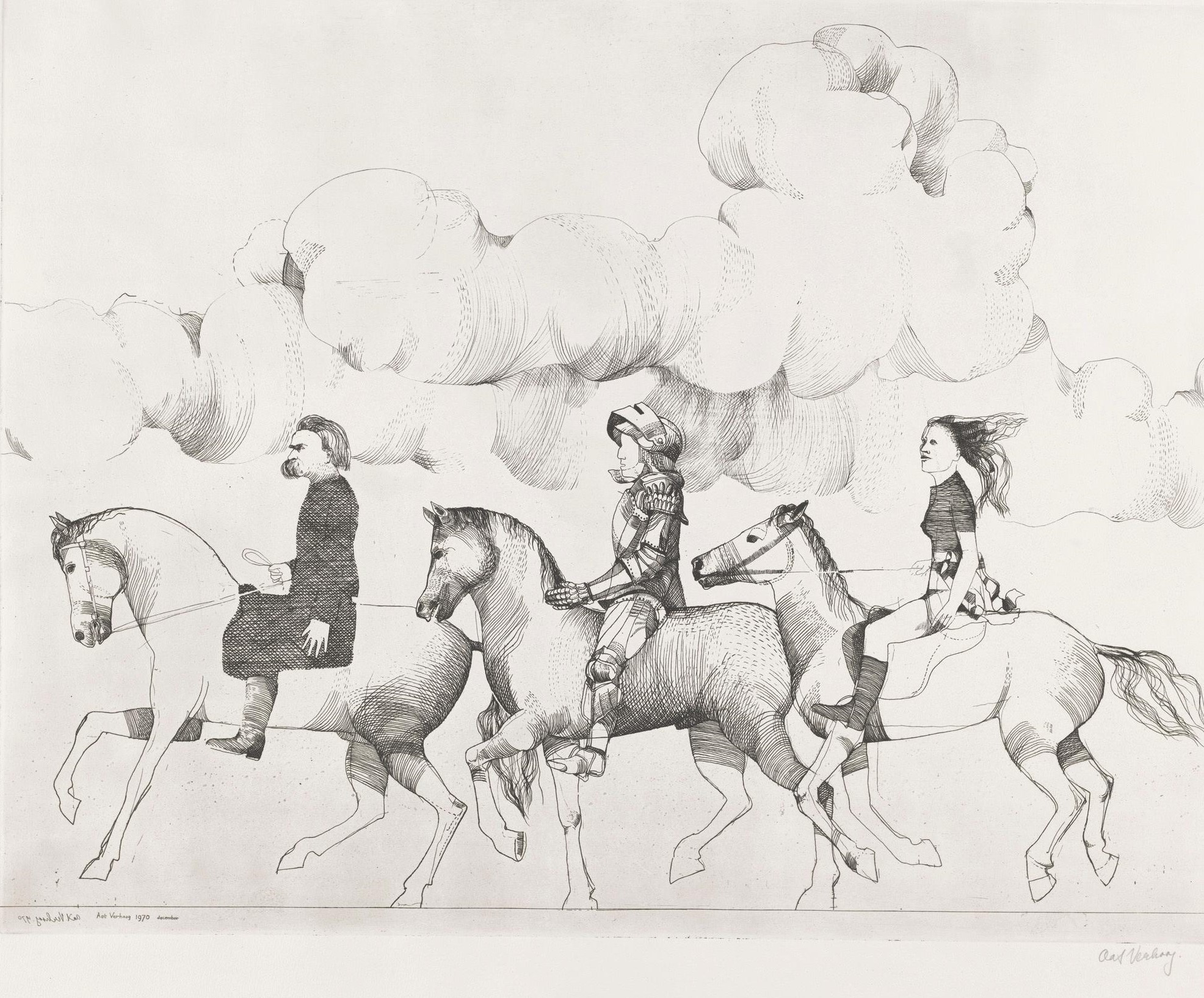
The fact that Nietzsche is a philosopher who speaks particularly to artists, even an “artist-philosopher,” is almost commonplace. In Barbara Straka's newly published book Nietzsche Forever?, the question is explored how exactly Nietzsche has been received in 20th century art, in particular that after 1945. The author has created a standard work that clearly and competently conveys the topic in plausible overviews. In this first part of this two-part article, Michael Meyer-Albert dedicates himself to her book and will then accentuate his own position in the upcoming second part.
“So how does the monumental contemplation of the past, the study of the classic and rare of earlier times, benefit the present day? He deduces from this that the great thing that was there once was in any case possible once and will therefore probably be possible again [.]
On the Benefits and Disadvantages of History for Life, § 2

I. Übernietzsche
In his first publication The birth of tragedy (1872) Nietzsche still represented a pathetic understanding of art, as a result “only as aesthetic phenomenon [...] existence and the world forever warranted”1 be. The operas of his idol Richard Wagner were intended to bring about a rebirth of the tragic myth of antiquity, a comprehensive cultural revolution under the banner of the double-faced power of Dionysian and Apollonian. Nietzsche's philosophical art now consisted in liberating a new concept of art from this late Romantic aestheticism. In an emancipatory “art of living”2 Should we, the “free spirits” become “poets of our lives”3 and learn to philosophically glorify our own being — and “in the smallest and most mundane first” (ibid.) — through the appearance of life-affirming perspectives.
Nietzsche thus invented an understanding of truth as art, which was intended to vitalize Europe as an intensified enlightenment. Precisely because the truth is too hard to be lived, it is true to keep it at a distance. For Europe, this means that even though the gods may be dead, we have the cunning cockiness of ideas to make life friendly with life. In this respect, successful art can be measured by whether it enriches life by transfiguring it in such a way that it remains motivated to value life. It is interesting to ask how the philosopher of appearances appears in the main medium of appearances.
It is the claim of Barbara Straka's book Nietzsche Forever?, which was published by Schwabe-Verlag in 2025, to depict Nietzsche's reception of art after the Second World War.4 As an art historian and former curator, she sets herself apart from the history of reception before 1945, which was determined by the will to monumentalize that Nietzsche's sister embodied in her manipulative marketing as estate administrator. Analogous to the cult of Wagner, which Nietzsche renounced philosophically productively from 1876, he himself became a mythical heroic cult object and, spiritually reneged since 1889, from 1897 until his death in 1900 as a “living exhibit” (p. 21) in the Weimar Nietzsche Archive. He was mystified as a Christ-like Antichrist, as a philosophical prophet of nihilism, as a Germanic thinker of superman in the sense of fascism. Nietzsche became Übernietzsche.
Straka states that these reductive revaluations of Nietzsche's philosophy of revaluations have an effect. Nietzsche appeared as the thinker for Hitler's actions. Only the complete text-critical edition by the two Italian philologists Giorgio Colli and Mazzino Montinari in the 1960s allowed an unobstructed look at Nietzsche's works and a gradual removal of the taboo of this supposedly proto-fascist thinker. After all, it took a generation for the effects of the history of manipulative reception to recede so far into the background that, starting in 1980, Nietzsche was gradually and always ambivalently rediscovered as a “free spirit” for art.

II. Transfigurations of the Nietzsche Image
Straka's book provides an overview of art's diverse engagement with Nietzsche beyond cult and Hitler, with reference to her subject, alleging a “failure of art history in dealing with the subject” (p. 46). Straka methodically analyses the work of 220 artists — primarily from the years 1980 to 2000 — sorted into 14 thematic clusters (for example: Nietzsche's physiognomy, his travels, his loneliness), each of which she illustrates with exemplary works. However, it is also pointed out that the immense increase in production of the art market since the 1970s, the expansion of the art zone through globalization and the lack of digital archiving of works before 1990 have fundamentally affected the exemplary documentation of art history after 1945.
Nevertheless, with regard to Nietzsche in contemporary art, it is clear for Straka that it is above all the change of inspirational source that influenced Nietzsche's image. Away from the concrete image of Nietzsche in the genre of portrait towards the images that evoke Nietzsche's work and life. It is these “transfigurations” that Straka wants to highlight.
The impact of Nietzsche's thinking on art — particularly of So Spoke Zarathustra, The Happy Science, Ecce Homo and the literary Dionysus Dithyrambi — is eminent for Straka: “Without Nietzsche's writings, yet fundamental statements on art and aesthetics, which played an inspiring role for modern and contemporary art, recent art history would probably have taken a different course.” (p. 10) She adds at the end of her book: “For the arts, their theory formation and development in the 20th and 21st century, the legacy of the most controversial of philosophers is likely to have taken a different course.” (p. 10) She adds at the end of her book: “For the arts, their theory formation and development in the 20th and 21st century, the legacy of the most controversial of philosophers is likely to have taken a different course.” (p. 10) She adds at the end of her book: “For the arts, their theory formation and development in the 20th and 21st century, the legacy of the most controversial of philosophers yet be undisputed.” (p. 726)
Straka differentiates roughly between three phases of Nietzsche's reception: “As an object of the visual arts, Friedrich Nietzsche's portrait has experienced an unprecedented process of construction (around and after 1900), of deconstruction (after 1945) and reconstruction (since the 1980s).” (p. 628)
The last phase of the new construction had an increased impact with the Internet. Nietzsche “not only became popular, but also became a pop idol and superstar.” (p. 628) Straka's differentiation of the various forms of the Nietzsche pop phenomenon is instructive:
1. Nietzsche funny — the joke figure (professor, bookworm, owl, clumsy, anti-hero, misogynist); 2. Over-Nietzsche — the superman (saint, action hero, savior, fighter, athlete); 3. Nietzsche now — the human-all-too-human contemporary (teacher, helper, friend, advisor); 4. Nietzsche cool — the idol (pop star, superstar); 5. Nietzsche cute — the cute (doll, dwarf, toy, devotional items); 6. Tiny Nietzsche — the tiny (baby, toddler).5
As diversely trivialized, Nietzsche becomes a human being. In it, Übernietzsche is inoculated with normality so much that he shrinks and comes on equal footing with the “last people.” Straka points out this culturally critical “phenomenon of (too) humanising” (p. 663), but also notes that “the final phase of deconstructing the former cult image of Nietzsche” (ibid.) could be realized in this delta of typologies. The story of Nietzsche's reception in the arts ends with a plural neutralization of the former cultic monumentality and thus opens the horizon for a wide variety of creative approaches.
In her analyses, Straka pays particular attention to the possibility of whether, as a result of Nietzsche's now liberated reception, art could play a mediating role between philosophy and the general public. Art as a more cosmopolitan sister of Nietzsche who popularized the true heroism of Nietzsche's cheerful heroism beyond myth and banality? After the Völkisches, not the popular but still more popular Nietzsche? Straka mentions that the Nietzsche House in Sils Maria was the most likely to achieve this utopian task (see p. 727).
Straka's book succeeded in turning the sheer incomprehensible extent of Nietzsche's reception in contemporary art into plausible thematic overviews. It thus presents a standard work against which any future examination of this topic will have to be measured. The richly illustrated book impresses with comprehensive knowledge of the art market and Nietzsche's world of ideas, which gains depth of focus through extensive quotations and vivid details.
Link to the second part of the essay.
Article Image
Aat Verhoog: Three Riders (including Nietzsche) (1970; source)
Sources
Straka, Barbara: Nietzsche Forever? Friedrich Nietzsche's Transfigurations in contemporary art. Basel 2025.
Footnotes
1: The birth of tragedy, paragraph 5.
2: Human, all-too-human II, The Wanderer and His Shadow, Aph 266.
4: The body text of this book is quoted below.
5: P. 662.
Monumentality Issues. Nietzsche in Art After 1945
Thoughts on the Book Nietzsche Forever? by Barbara Straka I
The fact that Nietzsche is a philosopher who speaks particularly to artists, even an “artist-philosopher,” is almost commonplace. In Barbara Straka's newly published book Nietzsche Forever?, the question is explored how exactly Nietzsche has been received in 20th century art, in particular that after 1945. The author has created a standard work that clearly and competently conveys the topic in plausible overviews. In this first part of this two-part article, Michael Meyer-Albert dedicates himself to her book and will then accentuate his own position in the upcoming second part.
From Denier to Conspiracy Theory to Ghosting
Nietzsche and the Social Upheavals Caused by Today's Widespread resentment
From Denier to Conspiracy Theory to Ghosting
Nietzsche and the Social Upheavals Caused by Today's Widespread Resentment

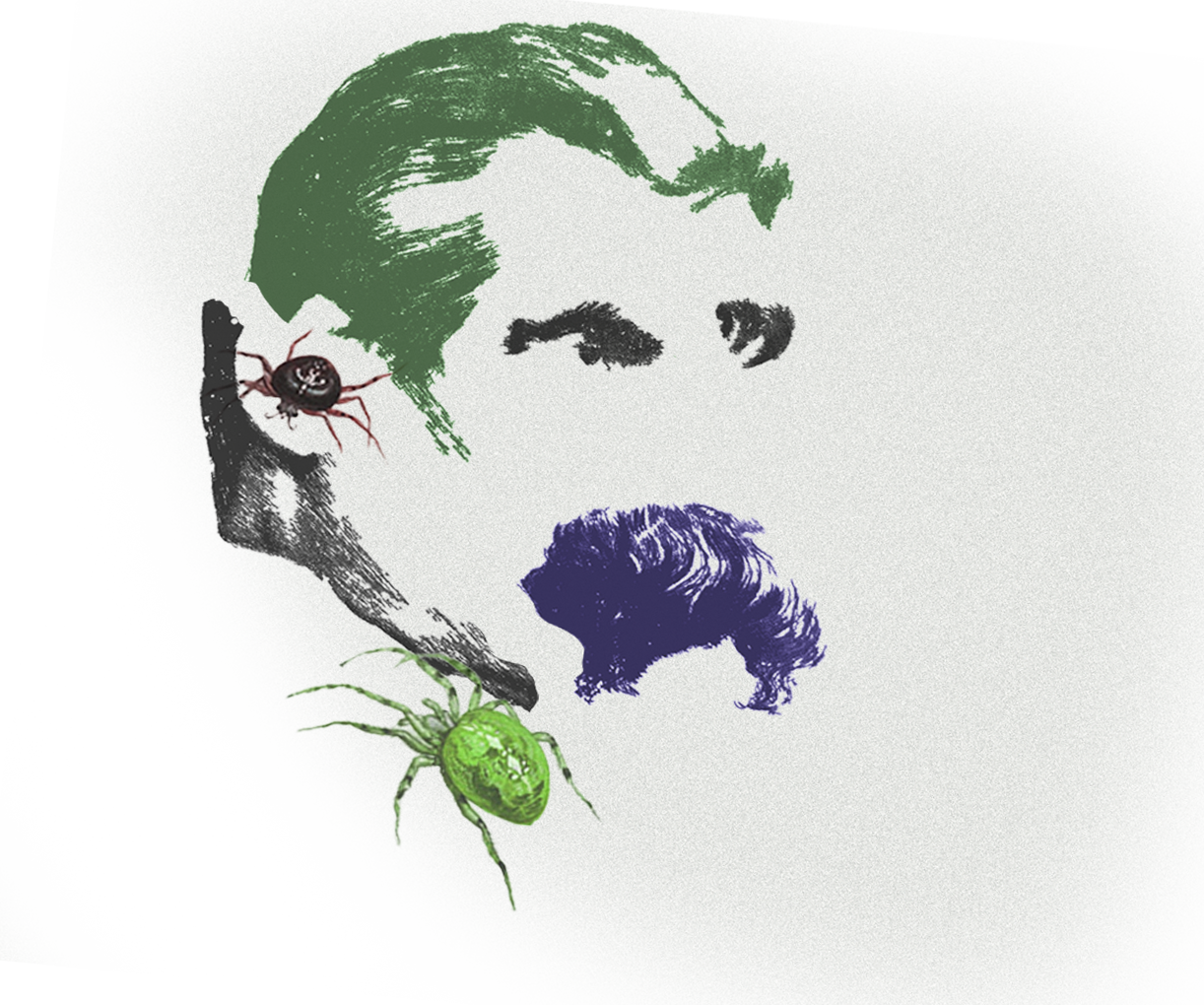
After Hans-Martin Schönherr-Mann has already dealt with Nietzsche's concept of resentment in two articles on this blog (here and there), he now addresses the question of how it can be applied to the current social situation.
His thesis: The current political landscape is characterized by many divisions based on resentment. They are due to the weaknesses of their own arguments. This is how critics are defamed as “corona” or “climate deniers.” The objections are often branded as conspiracy theories. You can't ask 'Cui bono?' anymore. Or you break off contact without comment to protect yourself. This is not only in line with Nietzsche's understanding of resentment in many places, precisely because he himself is not free from it, but is looking for ways out of it.
“What is the topicality of Nietzsche's analysis and critique of 'resentment'?“ is also the question of this year's Kingfisher Award for Radical Essay Writing, in which you can once again win up to 750 Swiss francs. The closing date for entries is August 25. The complete tender text can be found here.
If you'd rather listen to the article, you can find an audiovisual version on the Halcyonic Association YouTube channel, read by the author himself (link) and a listening-online version on Soundcloud (link).
Since the corona period at the latest, a word has had a career that has had a relevant meaning for a long time, but has had a rather limited meaning for decades, namely the “denier.”
Historically, it began with the denier of God when atheism spread during the Enlightenment, which was hated by many believing Christians.
The aggressiveness towards atheists, however, is based on the argumentative weakness that the existence of God simply cannot be proven. According to Kant, reason tries to do so, it engages itself in “eternal contradictions and disputes,” because it “could never go beyond the field of possible experience.”1. The end of all proofs of God! Like the famous one by Thomas Aquinas that everything in the world has a cause, so the world must also have one. So “you have to come to a first change person who is not changed by anyone else. And that is what everyone understands by “God” . ”2
This increases religious people's aversions to religious doubters. This process is similar to resentment, as Nietzsche said the word in On the genealogy of morality used, a constant need for revenge against the alleged 'injurer' resulting from a perceived inferiority.
Such hatred was also directed at Nietzsche; for what is it called in Zarathustra about the priests: “They are evil enemies: nothing is more vengeful than their humility. And the one who attacks them easily sullies himself. ”3
The critic as Denier
The word “denier” in corona policy has made a career. Of course, there were people among their critics who denied the disease as such. But the word “corona denier” also disqualified anyone who questioned the corona measures. Out of panic, opposition and criticism could motivate many not to take the measures adopted seriously, as well as from the knowledge that these measures are by no means self-evident, their political, media and medical advocates reacted with aggressive rituals.
The term “climate denier”, which appeared almost at the same time, is similar. Here, too, there are critics who reject the scientific debate. But others primarily doubt the apocalyptic vision of the end of the world derived from this, which evokes an urgency that is by no means self-evident. Scientific findings are based on methods, theories, experiments that are not ultimate truths. Only approximate forecasts can be made about future developments.
In this way, these findings can and must always be called into question. Disqualifying critics as “deniers” testifies to the weakness of one's own argument and the resulting resentment, which is reflected in turn through corresponding critiques.
In any case, Nietzsche is one of the critics of modern technologies when he writes: “Hubris is today our entire attitude to nature, our rape of nature with the help of machines and the so harmless technical and engineering ingenuity.”4.
How resentful the word “corona” such as that of “climate denier” is is shown by the fact that, in order to reinforce the urgency, it implicitly follows on from the “Auschwitz denier”, who is probably still the most famous denier today. On April 25, 1985, the German Bundestag passed a law prohibiting the Auschwitz lie, i.e. the claim that there was no murder of European Jews by the millions.
It was less about denying the more than well-established historical fact and more about insulting the victims and their families associated with it. This restriction on freedom of expression is therefore justified. Insults are not covered by this fundamental right.
Representatives of corona and climate policy similarly assume that their measures are intended to protect people. The decisive difference remains that no one is insulted by the 'corona' and 'climate denial. ' If the word “denier” is also used in this way, it puts the Holocaust denial into perspective.
However, because the advocates of climate and corona policies are propagating that they must save humanity, their critics even appear to them as enemies of humanity. All the more they must dramatize their concerns and all the more they can despise their enemies: pure resentment that provokes a corresponding reaction, so that opposing resentments stir up each other.
Who Is Not a Conspiracy Theorist?
As a result, the various “deniers” are regularly discriminated against as “conspiracy theorists.” It goes without saying that there are the craziest ideas about the world. But religious stories in particular are full of conspiracy theories. An outstanding example is the doctrine of the Trinity developed by church fathers that the Holy Spirit profoundly governs the world, i.e. the Invisible Hand: truly a conspiracy theory, still secularized in Adam Smith: “In fact, he <der einzelne>does not consciously promote the common good, nor does he know how much his own contribution is. [...] he is guided [...] by an invisible hand to promote a purpose that he fulfills did not intend in any way. ”5
Nietzsche aptly describes this Christian-liberal founding myth — and of course not just that — with the following words: “[A] lle life is based on illusion, art, deception, appearance, the necessity of perspective and error. ”6
History does not consist of simple facts, but is written by historians, who are mostly in the service of the powers that let history be written in their own sense. The facts must also be explained and acknowledged. Nietzsche aptly commented on this:
Against positivism, which stands still with the phenomenon that “there are only facts,” I would say: No, there are no facts in particular, only interpretations. We cannot determine any fact “in itself” [.]7
For Paul Ricœur, Nietzsche, Marx and Freud are the “three masters of doubt [...] three great 'destroyers'”8who are not satisfied with the appearance of reality, but want to lift the veil in which ideologies or the unconscious make the world appear: conspiracy theories! , about which the defenders of democracy, corona and climate policy do not want to know anything — a grandiose obsession with Marx in the service of saving humanity.
Therefore, the question “cui bono? 'no longer be asked at all. Or you're a conspiracy theorist. Of course, the question is who the conspiracy theorists are here: probably all of them, but especially those who wear such cloaks to others. And everyone reacts with resentment to each others' angry criticism, because they in turn know that their own arguments are weak.
Democracy, nature and health draw on contemporary science — as do their critics. Everyone hopes that this will give good reasons for their ideas and suppress the fact that the sciences must constantly review and change their insights. And behind this are economic, political interests or the simple will to power. This applies to Nietzsche as well as to all science critics when he writes:
[W] ir myself, we free spirits, are already an “transformation of all values,” a physical Declaration of war and victory to all old terms of “true” and “false.” The most valuable insights are found the latest; but the most valuable insights are the methods.9
But Paul Feyerabend demonstrates that the results of the sciences always remain methodological relative and that the methods used by Nietzsche in antichrist still understood as the actual progress. As Feyerabend writes,
that the idea of a fixed method or a fixed theory of reasonableness is based on an overly naive view of man and his social conditions.10
Methodological orientation therefore does not protect against the accusation of being dependent on interests, which certainly affects modern sciences much more than Nietzsche. In turn, this can only be offset by more aggressive defense, which thus reproduces the resentment with which scientism defends itself not only in corona and climate policy.
On the other hand, Nietzsche in Zarathustra was already a huge step ahead when he wrote: “Oh my brothers, is now Not everything in Rivers? Didn't all railings and walkways fall into the water? who held Still thinking of “good” and “bad”? ”11 And who still believes in scientific truth? Quite a lot and anyone who does not do so is a “conspiracy theorist” for scientism and established politics who approaches the sciences with resentment, i.e. with unfounded rejection and aggression. Of course, rejection, like resentment, is mutual.
Ghosting as The End of the Social Band
Since the sixties, left-wing critics have been questioning democracy as it developed in the Western world after the Second World War. In the seventies, this was followed by ecological criticism.
But only the environmental issue has been tackled quickly and diligently in all political camps since the eighties. In a certain sense, this therefore became a new social band that brought large sections of society into communication with one another. This culminates in the climate crisis as an even global issue.
These similarities, this type of social bond, were shaken by the corona policy, which divided society. There were hostile camps that met each other with massive resentment, not least because the previous similarities in the corona friendly camp fuelled the expectation that everyone would support the corona policy, it was ultimately about the high level of human and ecological value of health and life protection.
When, on the other hand, many in the liberal camp appeared patronized and commanded, there was great disappointment on the side of the corona policy and the opponents were met with harsh rejection. Conversely, the individualistic opponents of the corona policy lost confidence in democracy, which suddenly appeared as a dictatorship because it regulated life down to the most intimate spheres.
The rift is deep and runs across the political camps, which leads to friendships suddenly breaking up without communication, because people assume unfair attitudes to each other: individual freedom or fundamental rights vs. protection of life. This speechless break of friendships was called “ghosting” as a mutual resentment of each other.
In mid-October 2025, German President Frank-Walter Steinmeier once again called on people to end this speechlessness and thus the 'ghosting' in order to overcome this private and social division.
Steinmeier could have relied on Nietzsche if he in Zarathustra writes: “For that man is redeemed from revenge: that is the bridge to the highest hope and a rainbow after long storms. ”12 Revenge is due to resentment and speechlessness among former friends.
Even Nietzsche, with his contempt for his fellow human beings, is not free from such resentment. How does he still write in On the genealogy of morality: “We don't see anything today that wants to get bigger, we suspect that things are still going downwards, downwards, into [...], more good-natured, smarter, more comfortable, mediocre, [...], more Christian — the human being, it is no doubt, is becoming more and more 'better' . ”13
This can be related to both corona and climate discourse, which are conducted with high moral standards and thus want to make people “better” and “better.” Nietzsche, on the other hand, does not want to moralize people, make people 'good', as climate activists or defenders of the corona policy are striving for, for which people should submit to their moral requirements and not develop their own values. Rather, it is intended to serve political powers that are concerned with health and climate and thus with the moral “good.”
“Get on the ships, philosophers! ”
In any case, Nietzsche's philosophy of resentment allows contemporary conflicts to be analysed, especially when Nietzsche's own resentment is included. But Nietzsche has also developed a conciliatory perspective that does not threaten the future like the scientific climate and corona advocates. He writes:
[E] a new righteousness Don't do it! A new solution! And new philosophers! The moral earth is round too! The moral earth also has its antipodes! Even the antipodes have their right to exist! There is another world to discover — and more than one! Get on the ships, philosophers!14
But the future is open. Karl Löwith Nietzsche attests “that, as the philosopher of our age, he as contemporary as it is untimely Is” 15. Timely, because you can use your term of resentment to shed light on current events! Outdated, because he creates a far-reaching perspective that hardly anyone who is actively involved in the resentful conflicts at the beginning of the 21st century will appreciate.
Sources
Feyerabend, Paul: Against the use of methods. Outline of an anarchist theory of knowledge (1975). Frankfurt am Main 1976.
Kant, Immanuel: Critique of Pure Reason (2nd ed. 1787). Academy edition Vol. 3. Berlin 1968.
Loewith, Karl: From Hegel to Nietzsche. The revolutionary break in nineteenth-century thinking (1941). Complete writings 4. Stuttgart 1988.
Ricoeur, Paul: Hermeneutics and Psychoanalysis. The conflict of interpretations II (1969). Munich 1974.
Smith, Adam: The prosperity of nations. An investigation of its nature and causes (1776). Munich 1974.
Thomas Aquinas: Summa theologica I 2.1, (1265-73). Opera Omnia, Vol. 4 Rome 1886.
Footnotes
1: Critique of Pure Reason (2nd ed. 1787), p. 460 f.
2: Summa theologica I 2.1 (1265-74), P. 31.
3: So Zarathustra spoke, From the priests.
4: On the genealogy of morality, paragraph III, 9.
5: The prosperity of nations (1776), P. 371.
6: The birth of tragedy, an attempt at self-criticism, paragraph 5.
7: Subsequent fragments 1886 7 [60].
8: Hermeneutics and Psychoanalysis (1969), P. 68.
9: The Antichrist, paragraph 13.
10: Against the method requirement (1975), P. 45.
11: So Zarathustra spoke, From old and new boards, paragraph 8.
12: So Zarathustra spoke, Of the tarantulas.
13: Zur genealogy of morality, Paragraph I, 12.
14: The happy science Aph 289.
15: From Hegel to Nietzsche (1941), P. 240.
From Denier to Conspiracy Theory to Ghosting
Nietzsche and the Social Upheavals Caused by Today's Widespread Resentment
After Hans-Martin Schönherr-Mann has already dealt with Nietzsche's concept of resentment in two articles on this blog (here and there), he now addresses the question of how it can be applied to the current social situation.
His thesis: The current political landscape is characterized by many divisions based on resentment. They are due to the weaknesses of their own arguments. This is how critics are defamed as “corona” or “climate deniers.” The objections are often branded as conspiracy theories. You can't ask 'Cui bono?' anymore. Or you break off contact without comment to protect yourself. This is not only in line with Nietzsche's understanding of resentment in many places, precisely because he himself is not free from it, but is looking for ways out of it.
“What is the topicality of Nietzsche's analysis and critique of 'resentment'?“ is also the question of this year's Kingfisher Award for Radical Essay Writing, in which you can once again win up to 750 Swiss francs. The closing date for entries is August 25. The complete tender text can be found here.
If you'd rather listen to the article, you can find an audiovisual version on the Halcyonic Association YouTube channel, read by the author himself (link) and a listening-online version on Soundcloud (link).
Nietzsche’s Techniques of Philosophizing
With Glances Towards Wittgenstein and Heidegger
Nietzsche’s Techniques of Philosophizing
With Glances Towards Wittgenstein and Heidegger
A fixed feature at the annual conference of the Nietzsche Gesellschaft [Nietzsche Society] conference is the Lectio Nietzscheana Naumburgensis: a particularly distinguished scholar delivering an extended lecture on the conference theme on the final day, thereby providing a pointed conclusion. The most recent conference in October 2025 awarded this special honor to Werner Stegmaier to recognize his long tenure as editor of the influential Nietzsche-Studien [Nietzsche Studies] and his authorship of numerous seminal monographs on Nietzsche’s philosophy. Running from October 16-19, 2025, the conference focused the theme “Nietzsche’s Technologies,” as Emma Schunack reported.
Generously granting his permission to publish his lecture in full and in this translation, Stegmaier takes on the conference theme from an unexpected perspective. Rather than examining what is commonly understood as “technologies”—machines, cyborgs, or automata—he explores instead Nietzsche’s philosophical techniques, both intellectual and rhetorical. Weighing up the original and idiosyncratic methods Nietzsche deployed while writing, Stegmaier reflects on how best to interpret and assess them. How were they able to enthuse and win over successive generations of readers? What can we learn from these today?
Comparing Nietzsche’s techniques with those of two other modern philosophical giants, Martin Heidegger (1889–1976) and Ludwig Wittgenstein (1889–1951), Stegmaier retraces all three philosophers’ break with the classical and conceptually oriented techniques of thinking inherited from antiquity, and their discoveries of radical and experimental means of developing philosophy in the age of “nihilism.” Replacing a one-dimensional, metaphysical understanding of rationality, these means cultivate a plural, perspectival mode of thought that necessarily relies on entirely different techniques. Situating Nietzsche’s methods within these broader developments in intellectual history, the Lectio establishes an utterly new framework for understanding his thought and its place within modern philosophy.
Translated by Henry Holland.
I. Nietzsche’s Philosophizing Techniques Continue to Fascinate
Nietzsche recounts how his great adversary, Socrates, had “fascinated”—in our twenty-first century argot we might say bewitched—the noble Athenians with his dialectical method. With it, he claims, Socrates had a “ruthless instrument to hand,” one by means of which he “depotentiated” his opponents’ intellect.1 For Nietzsche, dialectics, and with it the West’s whole rationalist tradition, was a technique [Technik] for producing a semblance of truth.1.5 A note of Nietzsche’s from 1880 recorded the general conviction had taken hold “that we do not possess the truth”:2 a condition he would later call nihilism. After a long struggle to understand the meaning and import of this state of affairs, he finally came to recognize in it the “normal condition” in which we live once again now that metaphysics has left us:3 A condition in which what metaphysics, together with the Christian dogmatics that followed it, had elevated to supreme values loses its credibility. After grasping that there were no longer any absolute certainties, Nietzsche consistently de-metaphysicized and emptied the morality out of the language of philosophy, so we might achieve a new “deepening into reality.”4 Only hesitantly do we begin to fathom these new depths, as we’re still strongly bound to metaphysical–moral idealizations.
As is only fully clear today, Nietzsche did not construct a new “system.” The very “will to [create] a system is a lack of moral fiber,” as he memorably put it.5 Instead, one of Nietzsche’s favorite techniques was to place doctrines in the mouth of his best known protagonist, Zarathustra, which—especially since Heidegger—were later taken to form the core of such a system: the doctrines of the overhuman [Übermensch],5.5 the will to power, and the eternal recurrence of the same. Yet we cannot forget that Nietzsche let his anti-hero fail with these same doctrines at every turn. No one understands them as he intends: not the ordinary people, not his disciples, not his animals, not even the group he calls “the higher humans.” Ultimately, Zarathustra is left moving alone toward a sign meant only for him. Under his own name, by contrast, Nietzsche introduces the concept of the will to power in Beyond Good and Evil (aph. 36) as a mere hypothesis and as a means of being thrifty with principles: as a means of giving the simplest and easy overview of the entire reality. Such a world, “seen from inside,” would be “‘will to power’ and nothing besides.” As the now completed edition of the late-career part of Nietzsche’s posthumously-published papers [Nachlass] demonstrates, Nietzsche’s initially worked at this textural juncture with the hypothesis of the eternal recurrence of the same, inserting the will to power in its place only later.6 These two hypotheses evidently appeared to him functionally equivalent for the radical reorientation of philosophy demanded by nihilism. They are not dogmas but rather stores in his technique-arsenal for philosophizing.
And they weren’t treated as dogmas either in later philosophies. There was no Nietzsche School comparable to the Hegelian, and later the Kantian schools of the nineteenth century. Meanwhile, Nietzsche scholars have learnt to stop fixing his thought to clear-cut doctrines and to follow, rather, his process of orientation in all its facets, and with all its hesitations and turns—to observe Nietzsche at work.7 Doing this, we may try to learn how one might orient oneself even amid a state of nihilism, under nihilistic conditions, and how, while traversing this path, one might gain readers for this topic across the world. Keeping faith with this congress’s theme, I thus pursue Nietzsche’s techniques of philosophizing to better understand how, from within the prevailing nihilistic condition, he achieved an orientational security that continues to fascinate.
To avoid fixing too exclusively on Nietzsche, I also glance sideways at Heidegger’s and Wittgenstein’s philosophizing, the two most innovative twentieth-century figures to pursue this artful craft. Both born in 1889, the year Nietzsche collapsed into madness, Wittgenstein noticed Nietzsche, but from quite some distance. Heidegger, by contrast, put him on the pedestal of being a major opponent, against whom he could define his own “other beginning.”8 Yet both accomplished something rare and remarkable—something Nietzsche would have called self-overcoming. They subverted the foundations of the philosophies that had made them world famous in the first place. Wittgenstein came to recognize in the Tractatus Logico-Philosophicus— by which he initially believed to have attained the “unassailable and definitive” truth that would resolve the philosophical problems—a doctrine that could not be sustained; Heidegger came to see in Being and Time a wrong turning in the path towards the “meaning of being.” Both thus refocused towards the issue of the techniques of philosophizing: to the ways in which philosophy has been led, hitherto, into doctrines, and to the means by which it can throw off these doctrinal chains. Like Nietzsche before them, they now spoke emphatically of their philosophizing rather than of their philosophy. They, too, set aside inherited standards and created radically new ones. And like Nietzsche, they embarked on this adventure without a preconceived plan, exposing themselves intentionally to surprises even in their own thinking. Neither of them arrived at a goal; both ended up only at a provisional end. And yet it was through these very technique-based operations that they enacted their most efficacious philosophy.9
II. Mastering the Most General of Concepts, or: The Technique of Philosophizing
Techniques are nothing that one holds to be true; we judge them, instead, solely by their functioning, by their success or failure. Neither technique should be generally suspected of being a kind of metaphysics, as the later Heidegger suggested. Moreover, it’s more than merely the mechanical technology that Nietzsche liked to use—typewriters, trains, etc.—and which the engineering student Wittgenstein devoted himself to so intensively that he arrived via mathematics at philosophy. Techniques also include, for both Nietzsche and Wittgenstein, ways to compose and make music, means of writing poetry—and thus also techniques for and of philosophizing. According to Nietzsche, Greek tragic poets knew how to learn the same from one another;10 techniques can be acquired in education;11 and Richard Wagner “profoundly overcame all scholarliness, transforming it into instinctive technique.”12 Nietzsche also speaks of techniques of commerce and hunting,13 and of linguistic expression.14 Summarizing matters in late 1887, he posits “the natural sciences’ great technique and inventiveness” as a tremendous bulwark against the “moralizing of all previous philosophy {and appreciation}”; against Christian idealization “(e.g., {in music}, in socialism)”; against Rousseau’s “hatred of aristocratic culture”; against a “false and derivative form of superior humanity” stemming from Romanticism; and finally against the “hatred” of “all forms of rank order and distance.”15 Indeed, and on this view, all that “{which is born {relatively} out of abundance}—in the 19th century with contentment is … technique.” Moreover, and alongside “{cheerful music, etc.},” and perhaps also “{history (?)},” such technique is a “{relative product of the 19th cent.[ury]’s strength and self-confidence}.” It lends our language a new security of orientation, making nihilism bearable. By contrast, as Nietzsche writes in The Anti-Christ (chapter 44), Christianity makes a “technique” of its “art of lying sacredly” developing it to the point of “ultimate mastery.”15.5
In this sense, techniques need not be conscious practices. On the contrary, when we become conscious of them, for example while someone’s playing the piano or carrying out a simple movement process such as walking, they can—through this “making conscious”—such techniques can even be disturbed, as Heinrich von Kleist described in his famous essay On the Marionette Theater. Comparably, Nietzsche reflected on how we generally write only poorly about our own techniques.16 They are learned through trial and practiced in action until we can eventually “do them,” without having to explain why. They can be learned by observing others but cannot be easily taught, as aptitudes for them differ hugely. In any case, they must be “skilled,” and philosophizing must be skilled in this sense. Whether it is in fact practiced skillfully is best judged, as with any craft, by practitioners themselves.
The later Wittgenstein noted privately: “We go through common or garden movements of thoughts, automatically transitioning from one thought to the other based on the techniques we’ve learned. And now we have to first review what we have said.”17 The later Heidegger also emphasizes that the “craft of thought” must be learned and practiced.18 This leads onto a “technical” concept of philosophy itself: no longer determined by preconditioned issues including world and truth, or being and time, but apprehended rather as a skilled handling of the most general concepts of this kind. And we’ll now look at what this skill genuinely involves, by taking the examples of Nietzsche, Wittgenstein, and Heidegger.
III. Nietzsche’s Techniques of Philosophizing
A. Nietzsche’s Techniques as Responses to Specific Problems
Regarding Nietzsche’s characterization of Socrates’ “magic of the extreme,” I have already demonstrated how Nietzsche, proceeding down the trails of his own work, responded to particular problems confronting him with specific techniques for their resolution.19 I found seven such techniques:
First, in The Birth of Tragedy, he responded to the problem of the “theoretical human,” which he alleged Socrates had created, with the technique of embedding this figure within a radically reinterpreted Greek culture;
Second, in Human, All Too Human, he responded to the problem of the earth’s overall governance with the technique of comparing cultures in an “age of comparison” (vol. I, aph. 23);
Third, in Daybreak, he responded to the problem of Europe’s self-misrecognition of its morality with the technique of a moral critique of morality, from which On the Genealogy of Morality later emerged;
Fourth, in The Joyful Science,19.5a he responded to the problem of nihilism with the technique of a fundamental reorientation of philosophizing through incorporating art into it;
Fifth, in Beyond Good and Evil, he responded to the problem of the will to truth—which persists even once one knows that truth cannot be possessed—with the technique of expanding the horizons of human orientation (all the “human’s basic drives” have “once practiced philosophy” [aphorism 6]);19.5b
Sixth, in Book V of The Joyful Science, he responded to the problem of rank order—which also encompasses the right to problems—in an era of unstoppable democratization with the technique of shifting from equalities to differences;20
Seventh, in Twilight of the Idols and the final works prepared for publication, he responded to the “problem of the value of life as such” (“Morality as Anti-Nature,” 5) with the technique of affirming everything that happens, or of liberation from ressentiment.21
All of these techniques—embedding, comparison, self-referential critique, incorporation of art, expansion of horizons, breaking with habitual equations, and affirmation of what is given—expand the scope of Nietzsche’s philosophizing while at the same time giving it their own foothold. In this sense, they are techniques of orientation.22 We always orient ourselves towards something without thereby committing ourselves to that thing irrecoverably, and Nietzsche’s philosophical orientations are themselves marked by their questionability and provisionality. He turns the truth that one “cannot have” into a part of the game, the “rendezvous […] of questions and question marks”23 that experience routinely reveals itself to be. Philosophizing, understood as the skillful handling of the most general of concepts, accordingly becomes a permanently evolving technique of orienting oneself in the world. It involves vigilant and constant self-critique, or, to put it in Nietzsche’s words, ceaseless “self-overcoming.”
These techniques are also valid to describe the ways in which Wittgenstein and Heidegger worked: to an extent. But to make our core argument more explicit still, we shall first look at
B. Nietzsche’s Techniques of Philosophizing as Such
Again, I name seven techniques. We must see how far we are willing—and able—to follow them up today.
1. Radically Destroying Dogmatic Truths – Toward Nihilism
Nietzsche, and similarly Wittgenstein and Heidegger in their late periods, consistently destroy what they see as the dogmatic truths of nearly all previous philosophy: except those of Heraclitus. A new departure in philosophy is hardly possible without clearing out old junk. Yet more than just a crude throwing out, one could, and following the literal sense of the Latin destruere, merely dismantle this inheritance “layer by layer”: aware that the inheritance could still guide thought. This means that all these three figures no longer approach destruction as systematically as Hegel did, but rather strike selectively where traditional doctrines seem to obscure philosophical reorientation, usually setting their sights at figures including Socrates, Plato, Aristotle, Augustine, Descartes, Spinoza, Kant, and Hegel. Yet it is not individuals but standards of philosophizing that have become seemingly self-evident that they attack, encompassing logic with its principle of non-contradiction, or the epistemological isolation of faculties like sensibility, understanding, feeling, and the will. All three of them accept logical paradoxes and rely actively on them. Nietzsche for instance embraces the certainty of uncertainty;24 untruth as a basic condition for life;25 the teaching of unteachable things (cf. the entire Zarathustra), the communicating of the incommunicable,26 and the acceptance of the inacceptable (amor fati).27 For his part, Wittgenstein works with paradoxes in the play with rules within rules-based language games, while Heidegger focusses on the incomprehensibility of the all-decisive Being [Sein] writing it down with a strange “y” as “Seyn” and crossing it out at the same time.27.5 By that, they all follow Heraclitus, who clung to time, which has no permanence, Socrates, who knew that he knew nothing, and Plato, who wrote that he would never write down doctrines. Surpassing this, Nietzsche attacks morally the apparently untouchable morality insofar as it forces philosophy into telling lies: heedless of its own intrinsic deceitfulness.
Gained from what Heidegger explicitly calls a technique of destruction is an emancipatory release, from which to stretch for new footholds and horizons, paths and modes, standards and dispositions for philosophizing beyond system boundaries.28 This, for Nietzsche, includes bodily functions, drives, instincts, moods, and rhythms, phenomena he sums up as the “music of life,”29 an orientation toward other cultures and languages, the deceptions and self-deceptions necessary to stay alive, and a solemn seriousness of playing with everything in philosophizing. The later Wittgenstein achieves, through the destruction of the one-dimensional Augustinian image of language, the breakthrough into the manifold functions of language leeways, as I call them, of diverse forms of life, and into the techniques of reassurance they disclose. The later Heidegger envisages, regarding the clearing of the meaning of Being—now released from ontological predeterminations—the “incoming pass” of “other beginnings” into a “precipitous” and groundless “space-of-time-and-play”, into which thought must find its way.30
2. Deepening Deconstruction – Toward the Immediately Plausible
Purely destructive philosophizing would render one completely unanchored; it must also lead constructively forward. Derrida happily combined destruction and construction in the term “deconstruction” while cautioning against seeing it as a generalizable method.31 Likewise, the technique of deconstruction, as employed by Nietzsche, Heidegger, and Wittgenstein, also never goes to work in a purely destructive manner. The same applies to the gradual deepening of concepts in Hegel’s dialectics. It transforms previously gained concepts which proved contradictory in a way that it leads constructively to “deeper” concepts which unites the former ones. Contradictions and paradoxes thus become productive tools for the task of philosophical orientation. Using this technique of deepening, or digging deeper, concepts gain a foothold in relation to one another, without needing to or even being able to anchor themselves to something existing per se. The foothold in each case is the immediate plausibility of the “deeper” concept that transforms the previous ones. In Nietzsche’s philosophy, this is the concept of life, in which philosophizing itself moves: “[a]ll philosophizing until now didn’t deal with “truth” in the slightest, but rather with something else, say health, future, growth, power, life …”32 Wielding this concept of life, Nietzsche incorporates into philosophical orientation all that the concept of pure thought had excluded for being uncertain and unanchored: first bodily functions and sensibility, then increasingly the impenetrably interwoven contexts and complexities of all world experience. Nietzsche deepens the concept of life further into that of will to power, explicitly following the technique of ontological parsimony developed by William of Ockham (ca. 1287-1347 CE), also known as “Ockham’s Razor.”33 Thus, “will to power” is not used metaphysically but rather technically, as a method of consistent conceptual work: while simultaneously electrifying a wide audience with its immediate plausibility.
In what has become known as the “Midnight Song,” which Nietzsche places at the end of Parts Three and Four of Thus Spoke Zarathustra like a solution to all philosophical and perhaps also everyday problems—the text engraved into a prominent rock on Chastè Peninsula on the banks of Lake Sils, spellbinds passersby to this day—he demonstrates the technique of deepening most impressively.34 Here “deep” [“tief”] itself becomes a kind of banner–pronounced eight times in eleven lines—for the unity of life to rally around all its opposites of day and dream, pain and pleasure, decay and eternity. The depth of philosophizing felt here immediately requires no justification; even the concepts of life and will to power no longer appear, and the “deep, deep eternity” that concludes the song is not that of the eternal recurrence of the same but what desire/pleasure [“Lust”] wants: “But all desire wants eternity —, / — wants deep, deep eternity!” Thus, the Midnight Song creates desire for living.
In the language of the later Heidegger, the deepening of concepts, providing hold in philosophizing, consists of “joinings” [“Fügungen”], which guide it even through the abysses.34.5 He develops his own poetic language, whose joinings are intended to make the forgotten Being [Seyn] audible in the silence, and thus immediately plausible, rather than logically comprehensible. Wittgenstein, for whom logic initially had “a special depth—general significance” as if it lay “on the ground of all sciences,”35 observes later—after becoming skeptical about anything profound in philosophy—that “the depth of the essence [“Wesens”]” alleged here corresponds merely to “the deep need of agreement.”36 So-called “deep meaning” acquires something through its “surroundings,” a specific context that confers “importance on it”: no less, but also no more.37 Above all, the philosophically esteemed technique of seemingly deepening the observation of people through the assumption of an inner human life, which seeks to explain observable actions through recourse to unobservable psychic or mental processes seemed to him a “con trick.”38 Nietzsche would hardly have disagreed.
3. Pushing Strategic Generalizations – Toward Extremes
Deepening concepts is simultaneously a technique of generalization. By concepts one detaches from the situation in which they are used, gaining a broader overview; a progressive deepening and generalization of concepts allows us to better situate ourselves and make more of the situation we find ourselves in. Philosophy, with its most general concepts, seeks an overview of the whole of world events, in order to intervene whenever possible.
Since Aristotelian metaphysics, philosophers and other interested parties have believed that a fixed foothold existed in a pyramidal structure of increasingly general concepts; and at the top stood the ultimately utterly empty concept of sheer being. Nietzsche, Wittgenstein, and Heidegger break with this, exposing abstraction according to genus proximum and differentia specifica to be nothing more than an orientation technique.39 From any particular standpoint, concepts can be generalized in various directions and to varying degrees, but each generalization must be responsibly handled. Daily life and philosophy cannot do without generalizations, yet those operating them do not invoke a pre-existing universal; generalizations are always strategic, serving specific needs.
Nietzsche criticized his teacher Schopenhauer’s typical “philosopher’s rage for generalization”: working with a “rough hunch” regarding intrusive and pervasive sexual drives, that teacher created the “poetic metaphor” of a blind will, asserted the absolute “primacy of the will over the intellect,” placed it “into a gap in language,” and “misused it for false reification”; “all fashionable philosophers” then went on to expand and disseminate this “mystical nonsense.”40 Nietzsche, by contrast, characterized his own philosophizing as “dizzyingly broad survey of what is experienced, guessed, inferred” and simultaneously as “{the will to consequence}, a fearlessness when facing harshness and dangerous consequence.”41 Leaving metaphysics and a pyramidal building of concepts for dust, he pushes to extremes the technique of generalization.
He addresses this explicitly in his Lenzer-Heide Note, written in Graubünden, Switzerland, after completing Beyond Good and Evil and the fifth book of The Joyful Science, sketching an overview of the ideas guiding his own philosophizing.42 He observes how the extreme of believing in a single omniscient, omnipotent, and just God, which had provided humans with an absolutely certain hold for orientation, now turns into the extreme of believing that being is characterized by a complete absence of order, meaning, and worth, which, among the masses who are now confused and disoriented, must now become a will to destroy all order and to self-destruction. His thoughts of eternal recurrence and will to power are to serve as a strategic means to escalate this process of making things extreme. They are targeted, on the one hand, to destructively intensify discouragement and paralysis and, on the other hand, constructively, to provoke a new “rank order of forces.” They are consistently aimed at effect and no longer at truth.
The “extreme’s magic”43 lies in its ability to fascinate without reasons, even when there are a lot of counter-arguments. This is exemplified in the Lenzer-Heide Note’s claim that the “God” we’ve had until now was “a far too extreme hypothesis.”44 Yet all universal statements are extreme, including this statement itself; philosophizing as such turns out to be something extreme. Like the concept of a god, who rules the entire word, concepts like “pure reason” and “transcendental subject”, which are used to turn away from the whole rest of the world, and also “‘will to power’—and nothing else” are extreme generalizations.45 Zarathustra, Nietzsche’s figure of the philosophical teacher, is created to be an extreme of mental and physical superiority.46
Yet “extremization,” as we might call it, is no sufficient basis for philosophizing in itself, because one extreme can always flip into another. It must also be handled skillfully. Nietzsche famously concludes the Lenzer-Heide Note by observing that it is those “most moderate individuals” who “need no extreme beliefs” that turn out to be “the strongest.”47 The strongest philosophical technique, therefore, would be to think extremes without succumbing to them, only using them to orient oneself. Not committing to extremes allows experimentation and thought experiments. In The Joyful Science (aph. 109), Nietzsche attempts to conceive of a complete chaos where no law yet applies and in which there is not the slightest order, i.e. an extreme nihilistic state. He wants to see what is possible under these circumstances. At last, he considers, as a counter-extreme, the “great ambition” to “master the chaos {that one is}; to force {one’s} chaos to become form; [to become] necessity in form: logical, {simple, unambiguous Mathematics} […] law.”48 Extremes in philosophizing are meant to open up the maximal, unrestrained leeway for it. Nietzsche programmatically connects the greatest and farthest topics with the smallest and nearest ones, tying the general to the concrete. This technique carries the added bonus of granting everyday plausibility to his far-reaching philosophizing.
Large leeways also entail uncertainty and instability of orientation, in both everyday life and philosophy. For the later Wittgenstein, “in every more serious philosophical problem […] uncertainty reaches to the very roots. / One must always be prepared to learn something completely new.”49 He turns this necessity into a virtue, and questions the need people have for certainty in their philosophical orientation: “Only when we think in a much crazier fashion still than the philosophers can we solve their problems”50. Heidegger, too, after departing from metaphysics, explicitly does not seek certainty. As he writes in his Black Notebooks: “Renunciation of all safety valves and of uncertainty—which stem only from a welling up of self-interest of the human being,” i.e., in Heidegger’s metaphysical interpretation, from the will to power.51
4. A Personalized Perspectivizing – Toward Compromising Oneself
With their grand thought experiments, productive philosophers most are alone—the larger the experiments, the fewer others dare to participate. Even summit meetings among contemporaries are rare and rarely fruitful: after Lou Salomé and Paul Rée, Nietzsche found no one left with whom he could philosophize on an equal footing; Heidegger and Jaspers became estranged rather too quickly; Heidegger and Wittgenstein ignored one another entirely. All lamented the plight of not being understood—at least in their own lifetimes.
Thus, under nihilism as the normal condition, one ultimately depends on one’s own orientation. Nietzsche boldly put his own person into play from the very beginning, especially strikingly in Unfashionable Observations;51.5 later, in the new prefaces and in Ecce homo, he places his person entirely in the foreground. When he lays out his “practice of war,” he explicitly counts among its strategies or techniques that of “compromising” himself.52 All those who philosophize inevitably reveal a particular standpoint. Even if one attempts to hide behind the apparent consensus of a “one” or a “we,” one finds oneself—also among “‘good friends’” who Nietzsche invokes here–, his scare quotes leading us to doubt how “good” they are—in a “leeway and playground of misunderstanding.”53 Positively speaking, a good part of Nietzsche’s impact may consist precisely in his open and honest avowal of the personal character of his philosophizing, including his account of how he arrives at his thoughts—not seated at a desk, but during long walks—how thoughts emerge unexpectedly and only gradually take shape, how they learn to fly, but can also get stuck on tracks from which they are hard to dislodge. For someone with a “will to system” this would indeed be compromising; in a philosopher like Nietzsche, it generates trust in his sincerity.
Philosophically, Nietzsche famously proceeds from the “phenomenalism and perspectivism” of all orientation.54 He turns the desperation of nihilism, understood as the loss of all general certainties, into a virtue: the technique of “disengaging and re-engaging” perspectives, thereby creating “precisely the diversity of perspectives and affect-interpretations from which cognition can reap the harvest.” All this takes place beyond “the dangerous old conceptual fables” that assumed “a ‘pure, will-less, painless, timeless subject of cognition’,” a “pure reason,” an “absolute spirituality [Geistigkeit],” a cognition “in itself.”55 Philosophical problems thus present themselves differently to each individual. What matters, according to Nietzsche, is again “whether a thinker stands by his problems personally, so that he has in them his destiny, his plight, and also his best happiness—or handles them ‘impersonally.’”56 Under conditions of nihilism, one can persuade people only by standing by one’s standpoints, horizons, and perspectives even in philosophizing.
Heidegger and Wittgenstein did not go this far. In line with the “scientification” of philosophy that had already become dominant in their own day, they keep their respective persons largely out of their writings, or confine personal remarks to prefaces. The later Heidegger seeks to let Seyn speak itself; the later Wittgenstein, in his much-admired short dialogues, regularly leaves readers in the dark about which side he’s actually gunning for.
5. An Elastic Linguistic Formation – Expressed Extremely Precisely
Through his literary and linguistic art, Nietzsche is able to render what he writes immediately plausible, mostly without further justification. He consciously exploits the mobility of concepts along metaphors—a possibility he had already clarified in On Truth and Lie in an Extra-Moral Sense and later condensed in On the Genealogy of Morality into the terse clause: “The form is fluid, but the ‘meaning’ is even more so …”.57 Concepts convince people, precisely when they are not terminologically fixed, by becoming alive themselves—by undergoing “processes of overpowering that delve more or less deep, that are more or less independent of one another”(ibid.). In short, concepts are convincing by moving with the times in which orientation itself is changing, whereas rigid definitions quickly prove inadequate and inhibiting. Nietzsche thus forms what Wittgenstein would later call elastic concepts.58 In order to engage different thematic complexes in different ways, Nietzsche employs a huge variety of writing forms: the treatise, the essay, the book of aphorisms, the dialogues, the didactic poem, the pamphlet, and the song,59 shaping them all through a technique of musical composition, because music itself is convincing.60 This includes the technique of linguistic abbreviation, of concision; Nietzsche boasts—perhaps rightly—that he may be the greatest master of achieving, with a “minimum regarding extent and number of signs […] a maximum in terms of the signs’ energy.”61 Added to this is his technique of making things “credible” through images and parables, by which one “convinces” without wanting to “prove,” precisely where—unlike in the sciences—there is nothing really to prove.62
Wittgenstein was, I guess, Nietzsche’s equal in linguistic precision and concision. Just as Nietzsche philosophized in aphoristic books, which make it possible to effortlessly switch between themes and contexts and allow to immediately let flash up new insights (“I tackle deep problems as I would a cold bath—quickly in, quickly out”),63 Wittgenstein, in his later period, philosophized only in scattered “remarks,” which he assembled like “landscape sketches” into “albums,”64 in which each reader is left to their own devices as to how they might orient themselves. The guiding concepts of his late career—“language game,” “life form,” and “family resemblance”—are kept deliberately close to everyday language, and deployed within flexible leeways, and never strictly defined. Since we can assume that everyday language, over time, settles into the most suitable possibilities available for mutual orientation, Wittgenstein remains as close to it as possible in his philosophizing. He even surpasses Nietzsche’s Heracliteanism by extending, in his last remarks On Certainty, the image of the river that cannot remain the same when stepped into twice by evoking the riverbed, which itself changes irrecoverably with the river’s flow: not only human orientation, but also that which conditions it, are in constant flux.65 And Wittgenstein, too, understood himself above all as an inventor of new similes.66
The later Heidegger elevated the technique of avoiding mechanized terminologies, and of letting everyday language speak philosophically instead, almost to the level of a mania in order to allow the ineffable and unmasterable Seyn to speak. He did this by returning to the roots of current words, lending them deeper and more allusive meanings, which he then recombined in surprising ways.67
6. Fittings of Mere Footholds – in the Greatest Possible Density
The Platonic Socrates distinguished himself from the Sophists by differentiating rhetorical persuasion from convincing argumentation that works with defined concepts and mutually acknowledged reasons, thereby founding philosophy as an independent discipline.68 From this, Aristotle elaborated in Topics and Analytics the standards of logic on which he concurrently built his metaphysics.68.5 For Nietzsche as much as for Heidegger and Wittgenstein, the standards of logic restrict philosophizing from the outset, precisely because concepts—even in philosophical usage—are always in flux, as today’s Historical Dictionary of Philosophy sufficiently demonstrates.69 Moreover, the terminological fixation of concepts through definitions ultimately leads back to undefined concepts, and arguments, as Plato already shows in dialogues such as the Protagoras or the Gorgias, never convince everyone—thus never in general. They are “good” when they “fit” in particular situations, that is, when they convince the respective interlocutors with their respective standpoints, horizons, and perspectives. Fitting is the deeper unity of the opposition between “persuading” and “convincing.”
Criteria for what fits or is fitting vary widely. Aphorisms in volumes of the same must fit together without following from one another. In Nietzsche’s “joyful science”, they fit together according to artistic criteria. “One is an artist at the cost,” he concludes ultimately, “of experiencing what all non-artists call form as content, as the matter or cause [die Sache] itself.” He adds: “one thus certainly belongs to a topsy-turvy world.”70 This, however, is neither as new or as topsy-turvy as it may seem. For Aristotle already, it’s form that carries the greater weight, correlating form and content as the decisive path of European philosophy. According to him, form shapes contents, giving them recognizable configuration. This configuration, which in living beings shows itself in their constant appearance (eîdos), and is preserved through the continuous reproduction of the individuals of a species, is a real and distinct foothold for the formation of enduring concepts, thus also grounding systematic philosophies in today’s sense. Aristotle merely hypostatizes forms metaphysically into eternal beings (ousíai), a move no longer tenable today.
Post-metaphysically, we are dealing with established and stabilized fittings in observing footholds such as: individual and general appearance; words and states of affairs; words, images, and concepts in sentences; sentences in texts; arguments in procedures of proof; forms and colors; landscapes and moods; feelings and facial expressions, and so on, all the way to the fitting together of individual human beings into groups and societies. Fittings continually develop further and can always assume new forms. According to Nietzsche, one arranges one’s world so that it fits one’s needs and expectations; in the sense of his concept of the will to power, these are fittings at almost any price:
The Epicurean selects the situation, the persons, and even the events that fit or suit his extremely sensitive intellectual constitution, and renounces the rest—almost everything, that is—because it would be too strong and heavy fare for him. The Stoic, by contrast, trains himself to gulp down stones and worms, shards of glass and scorpions, without feeling disgust; his stomach ought thus to become indifferent to everything that the chance of existence pours into it.71
As Nietzsche had noted earlier, “ethical needs must fit as if they were tailored to our bodies!”72
When orientating ourselves, we only have footholds or points of reference to which we hold fast provisionally, because infinitely many matters may hide behind them; we trust them all the more the better they fit with others in a particular situation under a particular perspective. If they fit sufficiently well together, they become plausible; one can “do something with them,” as Wittgenstein and Heidegger, no less than Nietzsche, like to say. This holds in philosophy just as much as in everyday life. If methods are introduced here, they too must fit the respective matter in order to convince. It is therefore a common—though mostly unnoticed—technique of philosophizing to find what fits and, if it cannot be found, to invent it. Ultimately, as Wittgenstein—who works very strongly with the concept of fitting—writes at a central point of his Philosophical Investigations, what is at stake is “surveyable presentation” (no. 122).73 Heidegger formulated this more poetically and pathetically with his wordplay using semantic variants of “Fügung” (whose meaning ranges from “acquiescence” to “providence”) and “Fugen”: literally: “joints,” but also used in everyday German and by Heidegger figuratively, e.g., when the latter questions whether “world history” is actually “out of joint?”73.5 Such interplay between meanings culminates in the aphorism: “Alles Fügen des Gefüges wird nur aus der Fügsamkeit zum Fug“ – this may mean: “All joining of the structure into justice [Fug] arises only from compliance.”74 Fitting [Passung] is for Heidegger the technique—though he would not call it that—with which to provide the clearing of [Lichtung] and for Seyn: and clearing should also be understood in the strongly metaphorical sense that a sunlit woodland clearing can convey. No one has found such rich, and above all such every day and immediately plausible, footholds for his philosophizing, which fit together so convincingly—without being reconstructible as a system—as Nietzsche. The density of his fittings persuades in its own right.
7. Generating Pathos – by Appealing to the God Dionysus
Philosophizing ultimately requires pathos, and no one understood the technique of pathos quite like Nietzsche. The very generality of the concepts employed in philosophy creates a sublime mood. This sublimity is enhanced when one ascends to the divine. Nietzsche, Heidegger, and Wittgenstein still do this, and perhaps they do it because of the current nihilism, albeit in utterly different ways. Wittgenstein professes belief in God, but only personally, and mainly in his Secret Diaries [Geheime Tagebüchern] and in letters—in the Christian God who monitors and punishes human sinfulness, yet also provides unshakable support. From his actual philosophizing, Wittgenstein consistently keeps God out. This makes him skeptical of any pathos in philosophy:
“Language (or thought) is something unique”—this proves itself to be a superstition (not an error!), that is even produced by grammatical deceptions. And it is to these deceptions, to these problems, that pathos now falls back.75
Heidegger, by contrast, who decisively rejected Christianity, waits in his late philosophizing—guided by Hölderlin, the “only” poet for him— for a wholly different god than the Christian one: the “last God” of a new and “different beginning” for philosophizing.76 The “decision about the flight and arrival of the gods” is “the opening of a wholly different time-space for a—yes, the first grounded truth of Being (des Seyns)—the event (das Ereignis).” This ought to be a god who passes by silently, remaining alien and unpredictable, offering only “hints” for a new orientation from the ground up. According to Heidegger, this god should embody “purest concealment and highest transfiguration, sweetest enchantment and most terrible exaltation” and yet still, himself, require Being, which must clear itself on its own. But this clearing must be “pre-liminarily” (vor-läufig) prepared by “great and hidden individuals” through their philosophizing.77
Such pathos can cause shivers and seize one, whether it has substantive justification or not. Nietzsche, in contrast, cheerfully proclaimed Dionysus the god of his philosophizing.79 Dionysus is his idea of a god who continuously destroys and reshapes everything and, as we might now say, aligns things in an unfathomable way, sovereignly orienting himself even within nihilism. Nietzsche makes of the pathos and paradox of metaphysics—the appeal to a god through whom one can understand everything without grasping him—an explicit technique of his philosophizing. In aphorism 56 of Beyond Good and Evil, he portrays the initially unnamed god as “the ideal of the most overconfident, most alive, and most world-affirming man, who has not only come to terms with what was and is but has learned to endure it,” who justifies it and “wants it again just as it was and is, for all eternity.” Only from a divine standpoint can the idea of the eternal recurrence of the same be comprehended. From this standpoint, the entirety of worldly events, which so fascinate and irritate humans, may repeatedly occur and ultimately lack meaning, yet appear as a spectacle like in a Greek amphitheater, from which one looks down from elevated seats onto the orchestra, participates in it, listens to it, and simultaneously maintains distance. Dionysus was the god of theater; the Athenians had built it in his honor, him who “precisely needs—and makes necessary— this spectacle – –” (ibid.). Philosophy remains committed to him: when one philosophically tries to survey the world, one inevitably adopts a divine standpoint. Dionysus, as Nietzsche then models him in aphorism 295 of Beyond Good and Evil, in which he declares him the god of his philosophizing, simultaneously “descends to the underworld of every soul,” understands every mask and semblance as a theater god, and, by letting them perform, engages with all of this in a “daring honesty, truthfulness, and love of wisdom.” He loves humanity, Nietzsche has him say in a staged dialogue, because he “still finds his way through all labyrinths.” But this is simply another term for orientation—here, for philosophical orientation. Dionysian philosophical orientation keeps everything open, dares new beginnings, and approaches the observation of world events using a variety of techniques. Nietzsche sees the god’s role as going “always many steps ahead” of humanity, so as not to let them become stuck in any determinations, convictions, or dogmas upon which they need desperately to rely, but which hinder their further orientation.
Finally, however, Nietzsche also exposes his appeal to a god—this enticing and sly god Dionysus—as merely a technique of his philosophizing. For the gods in their sublimity never had to learn to orient themselves and therefore never had to philosophize.79 Thus, Nietzsche concludes the aphorism: “in some ways the gods may altogether go to school with us humans.” The gods, to whom humans so pathetically cling in philosophizing, must themselves adhere to humans—circulus vitiosus deus.80
As a mode of orienting itself, every philosophizing knows that it is tied to an earthly standpoint. Today it can remain sober and without pathos keep its feet on the ground.
Werner Stegmaier, born on July 19, 1946, in Ludwigsburg, was Professor of Philosophy with a focus on Practical Philosophy at the University of Greifswald from 1994 to 2011. From 1999 to 2017, he served as chief co-editor of Nietzsche-Studien. International Yearbook for Nietzsche Research, the leading journal in international Nietzsche studies, as well as the important publication series Monographs and Texts on Nietzsche Research. He has published numerous monographs and edited volumes on Nietzsche’s philosophy and on philosophy more broadly. These include the Philosophie der Orientierung [2008], translated in an abridged and renewed version under the title What is Orientation? [2019], and the books, which have not yet been translated into English, especially: Orientierung im Nihilismus: Luhmann meets Nietzsche [Orientation in Nihilism], 2016, Nietzsche an der Arbeit. Das Gewicht seiner nachgelassenen Aufzeichnungen für sein Philosophieren [Nietzsche at Work: The Significance of His Posthumous Writings for His Philosophizing, 2022, and most recently Wittgensteins Orientierung: Techniken der Vergewisserung [Wittgenstein’s Orientation: Reassurance Techniques], 2025. Further developing the “Philosophy of Orientation” that he founded, he gave a survey on the most interesting innovations in the history of philosophy in his Orientation in Philosophy: Courageous Beginnings, 2024. Additional information about him and his work is available on his personal website and on the website of the Foundation for Philosophical Orientation.
Bibliography
Aristotle. (1928). Prior Analytics and Posterior Analytics (A. J. Jenkinson & G. R. G. Mure, Trans.). In W. D. Ross (Ed.), The works of Aristotle translated into English (Vol. 1). Oxford, UK: Clarendon Press. (Original work written c. 350 BCE)
Aristotle. (1928). Topics (W. A. Pickard‑Cambridge, Trans.). In W. D. Ross (Ed.), The works of Aristotle translated into English (Vol. 1). Oxford, UK: Clarendon Press. (Original work written c. 350 BCE)
Derrida, Jacques. (2002). Force of law: The “mystical foundation of authority” (M. Quaintance, Trans.; G. Anidjar, Ed.). Stanford University Press. (Original work published 1991)
Heidegger, Martin. (1989). Gesamtausgabe: Vol. 65. Beiträge (Vom Ereignis). Vittorio Klostermann.
Heidegger, Martin. (2015). Gesamtausgabe: Vol. 97. Anmerkungen I–IV (Schwarze Hefte 1942–1948). Vittorio Klostermann.
Heidegger, Martin. (1986). Sein und Zeit. Max Niemeyer Verlag. (Original work published 1927)
Heidegger, Martin. (1999) Contributions to Philosophy (From Enowning) (P. Emad & K. Maly, Trans.). Indiana University Press. (Original work published 1989)
Kaiser, K. U. (2013). Gespräch mit Hölderlin I. In D. Thomä, Florian Grosser, Katrin Meyer, Hans Bernhard Schmid (Eds.), Heidegger‑Handbuch. Leben – Werk – Wirkung (2nd rev. & enl. ed., pp. 184–188). Springer Nature.
Marafioti, Rosa Maria. (2024). Heideggers ‚Schwarze Hefte‘. Das Seynsdenken und unsere Geschichte. Karl Alber.
Müller, Enrico. (2015). Das Pathos Zarathustras. In G. Pelloni & I. Schiffermüller (Eds.), Pathos, Parodie, Kryptomnesie. Das Gedächtnis der Literatur in Nietzsches Also sprach Zarathustra (pp. 11–31). De Gruyter.
Nietzsche, Friedrich. (1967–2022). Werke. Kritische Gesamtausgabe (G. Colli & M. Montinari, Eds.; continued by V. Gerhardt, N. Miller, W. Müller‑Lauter & K. Pestalozzi). Walter de Gruyter.
Nietzsche, Friedrich. (1967–2022). Digitale kritische Gesamtausgabe Werke und Briefe (eKGWB) (G. Colli & M. Montinari, established critical text; P. D’Iorio, Digital Editor). Nietzsche Source. http://www.nietzschesource.org/#eKGWB/
Nietzsche, Friedrich. (2001). “Band 1 Bd. 1. Notizheft N VII 1. Bd. 2. Notizheft N VII 2. Bd. 3. Notizheft N VII 3. Notizheft N VII 4” in Abteilung [Section] 9: Der handschriftliche Nachlaß ab Frühjahr 1885 in differenzierter Transkription [9/1-3]. De Gruyter.
Nietzsche, Friedrich. (1999). The birth of tragedy (R. Speirs, Trans.; R. Geuss & R. Speirs, Eds.). Cambridge University Press. (Original work published 1872)
Nietzsche, Friedrich. (1995). Unfashionable observations (R. T. Gray, Trans. & Afterword). Stanford University Press. (Original works published 1873-1876)
Nietzsche, Friedrich. (1996). Human, all too human (G. Handwerk, Trans.; R.-P. Horstmann, Ed.). Stanford University Press. (Original work published 1878–1879)
Nietzsche, Friedrich. (2023). The joyful science / Idylls from Messina / Unpublished fragments from the period of the joyful science (A. Del Caro, Trans.; afterword by Adrian Del Caro). Stanford University Press. (Original work published 1882)
Nietzsche, Friedrich. (2002). Beyond good and evil (J. Norman, Trans.; R.-P. Horstmann & J. Norman, Eds.). Stanford University Press. (Original work published 1886)
Nietzsche, Friedrich. (2005). Thus spoke Zarathustra: A book for everyone and nobody (G. Parkes, Trans.). Oxford University Press. (Original work published 1883–1885)
Nietzsche, Friedrich. (2007). On the genealogy of morality (C. Diethe, Trans.; K. Ansell-Pearson, Ed.). Stanford University Press. (Original work published 1887)
Nietzsche, Friedrich. (2007). Ecce homo (D. Large, Trans.; A. Ridley & J. Norman, Eds.). Stanford University Press. (Original work published 1888)
Nietzsche, Friedrich. (2008). Twilight of the idols. In Twilight of the idols and The anti-Christ (D. Large, Trans.; M. Tanner, Ed.). Cambridge University Press. (Original work published 1888)
Rauschelbach, Uwe. (2022). Die singende Seele. Denken und Schreiben „durch“ Musik bei Nietzsche. Nietzscheforschung, 29, 85–118. De Gruyter.
Sommer, Andreas Urs. (2016). Kommentar zu Jenseits von Gut und Böse. Historischer und kritischer Kommentar zu Friedrich Nietzsches Werken (Vol. 5/1). De Gruyter.
Stegmaier, Werner. (1999 [2000].) Das Zeichen X in der Philosophie der Moderne. In W. Stegmaier (Ed.), Zeichen-Kunst. Zeichen und Interpretation V. Suhrkamp.
Stegmaier, Werner. (2008). Philosophie der Orientierung. Walter de Gruyter.
Stegmaier, Werner. (2017). Was spricht die tiefe Mitternacht? Erläuterungen zu Nietzsches Gedicht „Oh Mensch! Gieb Acht!“. Nietzsche lesen (No. 2). Wallstein.
Stegmaier, Werner. (2021). Die „Magie des Extrems“ in philosophischen Neuorientierungen. Nietzsche-Studien, 50, 1–25. De Gruyter.
Stegmaier, Werner. (2021). Formen philosophischer Schriften zur Einführung. Junius.
Stegmaier, Werner. (2022). Nietzsche an der Arbeit. Das Gewicht seiner nachgelassenen Aufzeichnungen für sein Philosophieren. Vittorio Klostermann.
Stegmaier, Werner. (2024). Friedrich Nietzsche zur Einführung (4th rev. ed.). Junius.
Stegmaier, Werner. (2025). Wittgensteins Orientierung. Techniken der Vergewisserung. Vittorio Klostermann.
Stegmaier, Werner. (in press). Aspekte der Rezeption und Wirkung [Nietzsches]: Philosophie. In R. Krause, A. U. Sommer et al. (Eds.), Nietzsche-Handbuch. Leben – Werk – Wirkung (2nd completely revised ed.). J.B. Metzler.
Stegmaier, Werner. (in press). Nihilismus und andere Anfänge. Wege zu einer neuen Orientierung. In H. Zaborowski (Ed.), Heidegger und die Frage nach dem Nihilismus. Karl Alber.
Stegmaier, Werner. (in press). Wie ein Gott philosophieren? Nietzsches Anmessung an Dionysos als Gott seiner philosophischen Orientierung. In J. Kerkmann (Ed.), Religionsphilosophie nach Nietzsche. Der Verlust der Wahrheit und die Suche nach Gott. Karl Alber.
Wittgenstein, L. (2006). Philosophical Investigations (G. E. M. Anscombe, Trans.; P. M. S. Hacker & J. Schulte, Eds.; Vol. 1). Wiley-Blackwell. (Original work published 1953)
Wittgenstein, Ludwig. (2006). Werkausgabe: Vol. 1. Philosophische Untersuchungen. Suhrkamp. (Original work published 1953)
Wittgenstein, Ludwig. (1984). Werkausgabe: Vol. 6. Bemerkungen über die Grundlagen der Mathematik. Suhrkamp.
Wittgenstein, Ludwig. (1984). Werkausgabe: Vol. 7. Bemerkungen über die Philosophie der Psychologie. Suhrkamp.
Wittgenstein, Ludwig. (1984). Werkausgabe: Vol. 8. Bemerkungen über die Farben. Suhrkamp.
Wittgenstein, Ludwig. (1984). Werkausgabe: Vol. 8. Über Gewißheit. Suhrkamp.
Wittgenstein, Ludwig. (1984). Werkausgabe: Vol. 8. Vermischte Bemerkungen. Suhrkamp.
Wittgenstein, Ludwig. (1991). Geheime Tagebücher: 1914-1916, ed. Wilhelm Baum. Turia & Kant.
Zittel, Claus. (2016). Der Dialog als philosophische Form bei Nietzsche. Nietzsche-Studien, 45, 81–112. De Gruyter.
Footnotes
1: Nietzsche, Twilight of the Idols, “The Problem of Socrates,” 7 (emphasis in the original; translation amended).
1.5: Translator’s footnote: Technik in German conflates the two English terms technique and technology, suggesting, at least on a semantic-philosophical level, that we cannot strictly divide these concepts. While Technologie is also an option in contemporary German, and is directly translatable using “technology,” Stegmaier doesn’t use the term at all in this article, and nor does Nietzsche use it at all in his Complete Works. I tackle this translation challenge pragmatically, switching between using “technique” and “technology” to translate the author’s Technik, depending on the respective point being made.
2: Nietzsche, Nachlass 1880, 3[19], H. Holland’s translation.
3: Nietzsche, Nachlass 1887, 9[35] / KGW IX 6, W II 1, 115, H. Holland’s translation. Quotations from Nietzsche’s Nachlass [literary estate, but used in this translation to particularly mean those notes and papers published posthumously] follow the IX. Section of the Kritische Gesamtausgabe [Critical Complete Works], initiated by Giorgio Colli and Mazzino Montinari, and continued by Marie-Luise Haase, Michael Kohlenbach and others. This reconstructs the manuscripts of 1885–1889 with maximal fidelity and minimal editorial intervention; what is provisionally the final volume of this division appeared in 2023. The curly brackets {} indicate additions that Nietzsche made to his manuscripts at a later date.
4: Nietzsche, On the Genealogy of Morality, III, 24 (translation amended).
5: Nietzsche, Twilight of the Idols, “Maxims and Arrows,” 26 (Henry Holland’s translation).
5.5: Translator’s footnote: This is the option preferred by Graham Parkes in his OUP translation of Zarathustra. If it sounds clunky at first, it is more faithful to the breadth of the concept of the Übermensch than other translations, e.g., “overman,” “superman” are. Mensch is certainly a human being in German, not a male, and the translation needs to reflect this.
6: Cf. Werner Stegmaier, Nietzsche an der Arbeit, 223–234.
7: Cf. Werner Stegmaier, “Aspekte der Rezeption und Wirkung [Nietzsches]: Philosophie.”
8: Cf. Werner Stegmaier, “Sein zum Tode – Leben mit dem Tod” and “Nihilismus und andere Anfänge.”
9: On Heidegger, I draw primarily on the Black Notebooks, which—much like Nietzsche’s Nachlass—make visible how his philosophizing advances step by step. Put differently, it drives itself forward. Wittgenstein’s later work consists largely of individual “remarks” [“Bemerkungen,” also in the titles of the posthumously published volumes in the German-language Wittgenstein edition, the Werkausgabe]” that he repeatedly revised, rearranged, and expanded: and chose not to publish in his lifetime. Only gradually does this process make clear to Wittgenstein what his philosophizing is aiming at and which techniques come into play in securing it. Cf. Werner Stegmaier, Wittgensteins Orientierung. Techniken der Vergewisserung [Wittgenstein’s Orientation. Techniques of Reassurance]. – (Editorial note: The Black Notebooks, Heidegger’s philosophical diaries from 1931 to 1975, which have been published in stages since 2014, drew broad public attention primarily for political statements embedded in them, including antisemitic passages. However, these constitute but a small fraction of all the notebook entries.)
10: Cf. Nietzsche, Socrates and Tragedy, 1st lecture (translation amended).
11: Cf. Nietzsche, On the Future of Our Educational Institutions, 2nd lecture (translation amended).
12: Nietzsche, Nachlass 1873, 19[274], H. Holland’s translation.
13: Cf. Nietzsche, The Joyful Science, aphorism 31 (translation amended).
14: Cf. Nietzsche, The Joyful Science, aphorism 101 (translation amended).
15: Nietzsche, Nachlass 1887, 10[2] / KGW IX 6, W II 2, 141, H. Holland’s translation.
15.5: Nietzsche, The Antichrist, chapter 44, H. Holland’s translation.
16: Cf. Nietzsche, Human, All Too Human, Vol. 1, aphorism 196 (translation amended).
17: Wittgenstein, Vermischte Bemerkungen, 541 (H. Holland’s translation).
18: Heidegger, Anmerkungen I–IV [Schwarze Hefte 1942–1948], 71, 76–81, 118 & elsewhere (H. Holland’s translation).
19: Cf. Stegmaier, Die „Magie des Extrems“ in philosophischen Neuorientierungen.
19.5a: Translator’s footnote: Although generally rendered as The Gay Science in translation history, this translation is outdated for several reasons: almost no one in contemporary English uses “gay” to express “fröhlich.” Doing so would be to choose antiquated, pretentious sounding diction. Adrian del Caro is but one of several translators no opting for: The Joyful Science.
19.5b: Cf. Nietzsche, Beyond Good and Evil, aphorism 6, H. Holland’s translation.
20: Cf. The Joyful Science, aphorism 373: “It follows from the laws of rank order that scholars, as far as they are part of the intellectual middle estate [or class: Mittelstande], must not even be allowed to catch sight of the truly great problems and question marks; in any case, neither their courage nor their gaze can stretch that far.” (Emphasis in the original, translation H. Holland)
21: Cf. Nietzsche, Ecce Homo, “Why I Am So Wise,” chapter 6, translation amended.
22: Cf. Stegmaier, Philosophie der Orientierung. Editor’s note: readers wishing to learn more about Stegmaier’s own philosophy of orientation, which he applies here in exemplary fashion, should read our interview from October 2025 directly with the University of Greifswald’s professor emeritus (link).
23: Nietzsche, Beyond Good and Evil, aphorism 1, H. Holland’s translation.
24: Cf. ibid, H. Holland’s translation.
25: Cf. Beyond Good and Evil, aphorism 4, H. Holland’s translation
26: Cf. Beyond Good and Evil, aphorism 27, translation amended.
27: Cf. The Joyful Science, aphorism 276, translation amended.
27.5: For more on late Heidegger’s particular use of crossings see Stegmaier, Das Zeichen X in der Philosophie der Moderne.
28: Cf. Heidegger, Being and Time, § 6, translation amended.
29: The Joyful Science, aphorism 372, translation amended.
30: Heidegger, Beiträge (Vom Ereignis), pp. 69, 169, 379 & 408, H. Holland’s translation.
31: Cf. Jacques Derrida, Force of Law: The “Mystical Foundation of Authority”.
32: The Joyful Science, Preface, Section 2, H. Holland’s translation
33: For Nietzsche’s reference to the same, see Beyond Good and Evil, aphorism 36.
34: Cf. Stegmaier, Was spricht die tiefe Mitternacht?
34.5: Cf. Emad & Maly (as Heidegger’s translators), 1999: pp. xiv-xv.
35: Wittgenstein, Philosophical Investigations, no. 89, translation amended.
36: Wittgenstein, Bemerkungen über die Grundlagen der Mathematik, I 74, p. 65. Emphases in original, H. Holland’s translation.
37: Wittgenstein, Philosophical Investigations, nos. 583; cf. also no. 594.
38: Ibid., no. 308; cf. Stegmaier, Wittgenstein’s Orientation, pp. 45–68.
39: Editor’s note: The Latin formula “genus proximum et differentia specifica” in medieval scholasticism designated the rule for defining any concept: always by referencing the “next higher general kind” and a “specific difference.” One could, for example, define Nietzsche as “the philosopher (genus) who wrote Thus Spoke Zarathustra (differentia)” or winter as “the season (genus) in which it is coldest in the Northern Hemisphere (differentia).”
40: Human, All Too Human, Vol. 2, Mixed Opinions and Maxims, aphorism 5, translation amended.
41: Nachlass 1888, 14[25] / KGW IX 8, W II 5, 178, H. Holland’s translation.
42: Nachlass 1886, 5[71] (dated “Lenzer Heide [Heath], 10 June, 1887”) / KGW IX 3, N VII 3, 13–24; cf. Stegmaier, Nietzsche, pp. 319–358, H. Holland’s translation.
43: Nachlass 1887, 10[94] / KGW IX 6, W II 2, 72, H. Holland’s translation.
44: Nachlass 1886, 5[71], 3 / KGW IX 3, N VII 3, 15, H. Holland’s translation.
45: Beyond Good and Evil, aphorism 36, translation amended.
46: Cf. Enrico Müller, Das Pathos Zarathustras.
47: Nachlass 1886, 5[71], 15 / KGW IX 3, N VII 3, 24, H. Holland’s translation.
48: Nachlass 1888, 14[61] / KGW IX 8, W II 5, 152, H. Holland’s translation.
49: Wittgenstein, Bemerkungen über die Farben, I 15, p. 16, emphasis in the original, H. Holland’s translation.
50: Wittgenstein, Vermischte Bemerkungen, p. 557 (1948), H. Holland’s translation.
51: Heidegger, Anmerkungen I–IV, p. 64, H. Holland’s translation.
51.5: Translator’s footnote: Previously translated almost uniformly as Untimely Meditations, R.T. Gray broke rank by publishing his 1998 translation of Unzeitgemässe Betrachtungen under the title of Unfashionable Observations. This new title is superior for several reasons, as Gray explains in an afterword to the publication.
52: Nietzsche, Ecce homo, “Why I Am So Wise,” 7 (translation amended).
53: Nietzsche, Beyond Good and Evil, aphorism 27, translation amended; cf. Stegmaier, Nietzsche an der Arbeit, pp. 67–83, H. Holland’s translation.
54: Nietzsche, The Joyful Science, aphorism 354 (translation amended).
55: Nietzsche, On the Genealogy of Morality, III, 12 (translation amended).
56: Nietzsche, The Joyful Science, aphorism 345 (translation amended).
57: Nietzsche, On the Genealogy of Morality, II, 12 (translation amended).
58: Cf. Wittgenstein, Bemerkungen über die Philosophie der Psychologie, I 243–246, p. 385.
59: Cf. Stegmaier, Friedrich Nietzsche zur Einführung, pp. 98–113; Claus Zittel, Der Dialog als philosophische Form bei Nietzsche.
60: On the concrete refinements of this technique, research remains insufficient; even Uwe Rauschelbach’s learned study Die singende Seele largely confines itself to theoretical considerations.
61: Nietzsche, Twilight of the Idols, “What I Owe to the Ancients,” 1 (translation amended).
62: Nietzsche, Human, All Too Human, Vol. 2, The Wanderer and His Shadow, aphorism 145 (translation amended).
63: Nietzsche, The Joyful Science, aphorism 381 (translation amended).
64: Wittgenstein, Philosophical Investigations, Preface, translation amended.
65: Wittgenstein, Über Gewißheit, 96–99 (1949–1951), p. 140; cf. Stegmaier, Wittgenstein’s Orientation, pp. 199–205.
66: Wittgenstein, Vermischte Bemerkungen, p. 476 (1931), H. Holland’s translation.
67: On Heidegger’s choice of form for his second major work, the posthumously published Beiträge, cf. Stegmaier, Formen philosophischer Schriften zur Einführung, pp. 225–234.
68: Editor’s note: Our knowledge of Socrates’ thought comes almost exclusively from its presentation in the dialogues of his student Plato, who does not necessarily present the “Socratic Socrates,” but rather his own interpretation of Socratic teaching.
68.5: Translator’s footnote: Ross’s 1928 edition of these two works lists the second title as “Prior Analytics and Posterior Analytics.”
69: Editor’s note: The Historisches Wörterbuch der Philosophie (Historical Dictionary of Philosophy) was edited from 1971 to 2007 by Joachim Ritter, Karlfried Gründer, and Gottfried Gabriel, and published by Schwabe (Basel). The thirteen volumes are regarded as a standard reference work and trace the historical development of 3,670 central concepts of Western philosophy.
70: Nietzsche, Nachlass 1888, 18[6] / KGW IX 12, Mp XVI, 56v, H. Holland’s translation.
71: Nietzsche, The Joyful Science, aphorism 306 (translation amended).
72: Nietzsche, Nachlass 1880, 7[155], H. Holland’s translation.
73: Cf. Stegmaier, Wittgenstein’s Orientation, pp. 170–179.
73.5: Cf. Heidegger, Anmerkungen I–IV, p. 146, H. Holland’s translation.
74: Heidegger, Anmerkungen I–IV, p. 32, H. Holland’s translation. Translator’s notice: It must be said that Heidegger’s original German is a good deal more obscurantist than this translation, and sounds like a tautological and cryptic tongue-twister: “Alles Fügen des Gefüges wird nur aus der Fügsamkeit zum Fug.” By the time Heidegger wrote this in the 1942-1948 period, the Fug with which the aphorism concludes was thoroughly antiquated, though as the Deutsches Rechtswörterbuch [German Legal Dictionary] and other sources demonstrate, it had been used, in legal and other written contexts, up to ca. 1835.
75: Wittgenstein, Philosophical Investigations, §110.
76: Heidegger, Beiträge (Vom Ereignis), pp. 403, 405 & 411. On the significance of Hölderlin for Heidegger’s thought, see Kaiser, Gespräch mit Hölderlin I, pp. 184–188; Marafioti, Heideggers „Schwarze Hefte“, pp. 150–151 and following pages (translation amended).
77: Heidegger, Beiträge (Vom Ereignis), pp. 405–415.
78: Nietzsche, Beyond Good and Evil, aphorism 295, translation amended. Cf. Stegmaier, Wie ein Gott philosophieren? – Using Dionysos as a provocative pseudonym, Nietzsche intended to dedicate a separate text to his “attempt to philosophize divinely”: Nachlass 1885, 34[182] / KSA IX 1, N VII 1, 68 (translation: Henry Holland).
79: Andreas Urs Sommer, Kommentar zu Jenseits von Gut und Böse, pp. 804–807, cites the passage from Plato’s Symposium (203e–204a) in the translation used by Nietzsche: “None of the gods philosophizes or desires to become wise, for they already are; nor, if anyone else is wise, does this person philosophize.”
80: Jenseits von Gut und Böse, aphorism 56. Editorial note: the Latin phrase “circulus vitiosus deus” literally means “the defective circle God” or “the vicious circle as God.” Pierre Klossowski, the French philosopher, used this formulation in the title of his main monograph on Nietzsche, Nietzsche et le Cercle Vicieux (1969; cf. also Henry Holland, “Peace with Islam?” on this blog).
Nietzsche’s Techniques of Philosophizing
With Glances Towards Wittgenstein and Heidegger
A fixed feature at the annual conference of the Nietzsche Gesellschaft [Nietzsche Society] conference is the Lectio Nietzscheana Naumburgensis: a particularly distinguished scholar delivering an extended lecture on the conference theme on the final day, thereby providing a pointed conclusion. The most recent conference in October 2025 awarded this special honor to Werner Stegmaier to recognize his long tenure as editor of the influential Nietzsche-Studien [Nietzsche Studies] and his authorship of numerous seminal monographs on Nietzsche’s philosophy. Running from October 16-19, 2025, the conference focused the theme “Nietzsche’s Technologies,” as Emma Schunack reported.
Generously granting his permission to publish his lecture in full and in this translation, Stegmaier takes on the conference theme from an unexpected perspective. Rather than examining what is commonly understood as “technologies”—machines, cyborgs, or automata—he explores instead Nietzsche’s philosophical techniques, both intellectual and rhetorical. Weighing up the original and idiosyncratic methods Nietzsche deployed while writing, Stegmaier reflects on how best to interpret and assess them. How were they able to enthuse and win over successive generations of readers? What can we learn from these today?
Comparing Nietzsche’s techniques with those of two other modern philosophical giants, Martin Heidegger (1889–1976) and Ludwig Wittgenstein (1889–1951), Stegmaier retraces all three philosophers’ break with the classical and conceptually oriented techniques of thinking inherited from antiquity, and their discoveries of radical and experimental means of developing philosophy in the age of “nihilism.” Replacing a one-dimensional, metaphysical understanding of rationality, these means cultivate a plural, perspectival mode of thought that necessarily relies on entirely different techniques. Situating Nietzsche’s methods within these broader developments in intellectual history, the Lectio establishes an utterly new framework for understanding his thought and its place within modern philosophy.
Translated by Henry Holland.
Being a Father with Nietzsche
A Conversation between Henry Holland and Paul Stephan
Being a Father with Nietzsche
A Conversation between Henry Holland and Paul Stephan
Nietzsche certainly did not have any children and is also not particularly friendly about the subject of fatherhood in his work. For him, the free spirit is a childless man; raising children is the task of women. At the same time, he repeatedly uses the child as a metaphor for the liberated spirit, as an anticipation of the Übermensch. Is he perhaps able to inspire today's fathers after all? And can you be a father and a Nietzschean at the same time? Henry Holland and Paul Stephan, both fathers, discussed this question.
We also published the complete, unabridged discussion on the Halcyonic Association for Radical Philosophy YouTube channel (Part 1, part 2).

I. We as Fathers
Paul Stephan: How can you be a father with Nietzsche? Does studying his philosophy help you be a better father — or not? We want to discuss this topic in a completely open-ended manner below. But perhaps we should first clarify what, apart from the fact that we are Nietzsche researchers, qualifies us to talk about it in the first place. In fact, we will also start from our personal experiences, as we are both fathers too. Henry, you're the one of us who's a “more dad,” so to speak. How many children do you have and what is the personal background from which you look at this topic?
Henry Holland: I am the father of four children who are now between six and 23 years old. That means I first became a father when I was 26. All of these four children come from the same wife, my wife Rebecca, which can of course be completely different these days. There are two boys and two girls. It is also perhaps a bit unusual that we had actually already completed the life phase of having children and raising small children when Rebecca became pregnant again in 2018 and our youngest son Louis was born in 2019. The fact that Rebecca became a mother again shortly before her 42nd birthday is not so unusual these days — it was completely different in Nietzsche's time. But it was still a very nice surprise for us. — But what about you, Paul?
PS: I have to stress first that we will be recording this conversation on October 30 and will only publish it shortly before Christmas. Well, I have a son, Jonathan — he is now three but will be four on November 18th — and I am very excited right now and the topic of “fatherhood” is of great concern to me personally right now because my partner Luise is currently pregnant with our second child. It's still on the way now, but when we publish the conversation, it might be that time already.1 What we already know is that it will be a daughter, which actually makes me very happy. I wouldn't have a problem being the father of two sons either, I would love that too, but at least I imagine it to be another experience raising a girl.
HH: Yes, I can understand that and I was very happy back then that the first child was a girl. This may sound like an essentialist point of view, but when viewed from a constructivist perspective, it means that the children grow up necessarily influenced by existing gender roles — you simply cannot deny that, even if you want it to be different. I myself have tried to provide my daughters with all the freedoms and playrooms that I would have given to a boy — but I still notice in my own milieu: The more 'difficult' children are mostly boys, those who are more likely to stand out or rebel, who do not want to adapt socially, who rebel in the classroom. Even though many of us would like to free ourselves from existing gender norms, it can be assumed that these roles have and will have a long aftermath. Nietzsche articulates this perfectly in the Happy science:
After Buddha died, people continued to show their shadow in a cave—a tremendous dreadful shadow. God is dead: but the way people are, there may be caves in which you show your shadow for thousands of years to come. — And we — we must also conquer his shadow!2
PS: I would like to build on that, even if it takes us away from our actual topic. For me, an important aspect of being a father is that, as a father, you suddenly get to know a lot of other parents who have children of the same age as your own child. And in doing so, you can really make numerous surprising observations and findings. Although, of course, what you already said applies here: We cannot speak for “the fathers themselves.” We are starting from a specific milieu to which we both belong, a middle class intellectual milieu that primarily includes cultural workers and academics. And in this milieu, there is a fairly homogenous view that great care must be taken to educate children as “gender-sensitive” as possible, i.e., whenever possible, one should not make much difference between daughters and sons. I too think this development is generally very good and have set out to do so — but it was precisely against this background that I found it very interesting to observe that even very small children of one or two years, who are therefore still very “naughty”, are uninfluenced and are also brought up by parents who are very careful not to follow any stereotypes, often behave very stereotypically. Just one example: When my son was very young, around 1½, I went to early musical education with him once a week. That was very nice. It was a group of about six, seven children, boys and girls. It was really quite obvious that it was always the boys who roamed around the room, who tried to go outside and discover the room, who were rather loud and made 'nonsense' or even disturbed from an adult's point of view, that is, wild, while the girls were almost always sitting with their parent and were more 'too quiet, 'as opposed to that, insecure and shy.
I could give many such examples now. And of course I also know little girls in my circle of acquaintances who are very 'wild. ' But my average observation is really that you can notice all these cliché differences at a remarkably early stage — even with children whose parents are very 'gender-sensitive. ' This experience has led me to the conclusion that there is perhaps a greater influence of biology, genes, than you often think and claim. Of course, this is difficult to differentiate from the role of the unconscious character you were talking about. You will never be able to clearly differentiate between them and I don't even want to start the basic discussion of 'Nature vs. Culture' here — but the experiences mentioned have given me a somewhat differentiated opinion.
II. Nietzsche's Problematic Understanding of Man and “Woman”
HH: Perhaps this is a good reason to talk about Nietzsche and certainly the worst side of Nietzsche in terms of parenting, motherhood, fatherhood. We could perhaps work our way from his worst to his more witty and interesting statements. It must be emphasized that Nietzsche is hitting the table in some places with biological statements, for example when he writes: “Everything about woman is a puzzle, and everything about woman has a solution: it is called pregnancy.”3. This sentence is really one of Nietzsche's ten worst statements. It really seems — especially when you look at these sentences in isolation, which you shouldn't do — as though for Nietzsche, women are only there to become pregnant and serve the general good through this biological reproduction. And the women who don't do that should just shut up.4 Well, it's a very misogynistic statement. With regard to parenting, how do you deal with this very biological side of Nietzsche?
PS: Yes, I see this page the same way you do. It shows once again the big difference that separates us from Nietzsche. And there are countless places where he accordingly repeatedly expresses the clear view that women should be primarily responsible for raising children and having children, but men should, as is also the case in the passage you quoted from the Zarathustra means being a “warrior” and not worrying about the household and the children. In one sentence: “That is how I want man and woman: warworthy one, childbearing the other”5. And that may lead us to the actual main point of this conversation: Isn't it actually a contradiction to be a Nietzschean and a father in some way? Does Nietzsche even have anything to say to us fathers in the 21st century, who see us in a very different way? I think it is true for both of us and for most members of our milieu that we have a completely different understanding of fatherhood, as no one in the late nineteenth century has ever held: that you actually share the tasks of caring more or less with your mother, even when it comes to the very young children. These are things that might have been completely unthinkable even 30 or 40 years ago, which are perhaps not as widespread in other milieus even today, but which have already become very self-evident in our milieu. If Nietzsche could hear this development, he would probably, to say the least, put his hands over the head and diagnose the final “fall of the West,” the complete “feminization” and “softening.”6 The men, the final triumph of resentment-driven “general Ugliness Europe's”7. Do you feel the same way, Henry?
III. Paternity and Authenticity
HH: It seems to me that we can do that after all, that we can be Nietzscheans and yet be progressive parents in the 21st century. In this regard, I would actually come back to the concept of authenticity again and again — it just comes up again and again. You are much more familiar with this than I am, after all, you have just written and submitted an entire doctoral thesis on this topic. Authenticity is a very central concept for Nietzsche and I believe that what children are looking for primarily in us parents, both in fathers and in mothers, is authenticity. With fathers, however, in a slightly different form, because they tend to be more absent from the relationship and because the child expects this parent to remain authentic. And that means: Not only is static, but strives for authenticity, certainly in the spirit of Nietzsche's idea of selfBecoming as a creative, inexhaustible process of self-creation.
I'll try to make this concrete based on my eldest daughter, Alma. So she clearly shares my left-wing political views with me, which definitely expects, perhaps even as a basic condition, that I do not express myself in a gender-discriminatory or otherwise discriminatory way — and I actually am not, I don't do that. But that is not their main expectation of me that, to put it somewhat flatly, I always express myself 'politically correct', but that I remain authentic in my nature, in my actions, even outside the family, and that this authenticity can be retrieved and verified in some way.
Perhaps to make it even clearer and to build a bridge with my own father, who is still alive: He grew up in the final phase of British imperialism, when there were completely different values. One of the main values was this idea of “service.” You stand, you live life in service The other person — that's what you're there for. So you're there as a family man to earn money by doing a decent job in your outer life. The “self” doesn't come into conversation that much. So there is a certain class of British men, the very last thing they would talk about would be themselves. You hardly talk about it, it's more about this service principle. As a young man and as a young father, I often asked myself: What is my father's authentic self behind this existence in the service of others? What is its authentic core? And that often left me with nothing but a question mark, which is remarkable.
PS: Yes, it's very interesting and we seem to have had a very similar experience there. We came to the point shortly after during the preliminary discussion that it has become very difficult these days to gain an authentic understanding of one's own paternity, because the existing role models, which you could use to orient and work through in your own self-design, have become very fluid. It used to be very clear: The father is the one who earns the money. For example, there is this television series Breaking Bad, where this happens several times: “A man provides,” “a man provides,” even if those he provides don't even respect or love him. He doesn't care much about the kids at all. We are trying today to develop a different understanding of a present and caring, loving father.8
It was now very similar to yours with my father. Perhaps that is also the reason why I am so interested in the topic of 'authenticity. ' You have to know that my father grew up in the GDR. There is this catchphrase of “homo sovieticus”, which the Soviet philosopher and dissident Alexander Zinoviev coined in the 80s to describe the extremely adapted type of person that was called for and promoted in the states of the “socialist world.” As a hyper-opportunistic implementation of Nietzsche's dystopia of the “last person,” who imagines himself at the end of the story; a person without an inner center, who doesn't even strive for authenticity, but is completely absorbed in service to the community.9 I believe that this concept can also be applied to the GDR. Education in the GDR was even more strongly focused on the ideal of “service” than in the West; I think this keyword is very good. You shouldn't start from yourself; there were certain social expectations and you should meet them. I have always perceived my father, who is still alive, as a very inauthentic person. He is still a mystery to me in many ways, he is a very ironic person who hardly ever talks about his feelings and what is actually bothering him. You get the impression that he just doesn't have a good relationship with himself, and I noticed that even as a child and led me, I think, to try to become another man, another father. In this respect, my father actually served as a negative example for me, even though I don't want to blame him for anything. Especially when I was a little boy, he was also a very good father and took care of a lot. But I also felt this deficit, this distance from him, very early on.
And yes, there is indeed a close connection between these topics of “authenticity” and “fatherhood.” In any case, it appears often in my doctoral thesis, more often than I would have thought possible at the beginning of my research paper. But that may lead us to a slightly different understanding of masculinity. As already indicated, there is, on the one hand, this understanding of the man as a servant who sacrifices himself for the community, as Hegel articulated, for example, but then also the understanding of man as someone who completely stubbornly only thinks of himself, who places his own self-realization above everything else. And that is precisely the idea of masculinity that you actually find in Nietzsche, and around which his entire understanding of authenticity revolves — which, in my opinion, represents a huge problem. Just look at the following passage from the genealogy:
In this way, the philosopher perhorres [rejects with disgust] the wedlock Collect what would like to persuade her — marriage as an obstacle and disaster on his way to the optimum. Which great philosopher has been married so far? Heraclitus, Plato, Descartes, Spinoza, Leibniz, Kant, Schopenhauer — it wasn't them; what's more, you can't even look at them think As if married. A married philosopher belongs into comedy, that is my sentence: and that exception is Socrates, the spiteful Socrates, it seems, married himself, specifically at just this sentence to demonstrate. Every philosopher would speak as Buddha once said when the birth of a son was reported to him: “Râhula was born to me, a shackle is forged for me” (Râhula means “a little demon” here); every “free spirit” would have to have a thoughtful hour, given that he had previously had a thoughtless one, as it once came to the same Buddha — “closely pressed, he thought to himself, is that Life in the house, a place of uncleanliness; freedom is in leaving the house”: “Since he thought so, he left the house.” In ascetic ideal, there are so many bridges to independence indicated that a philosopher cannot hear the story of all those determined people who one day said no to all lack of freedom and in some desert Giengen: Assume that they were only strong donkeys and completely the counterpart of a strong spirit. So what does the ascetic ideal mean for a philosopher? My answer is — it will have been guessed long ago: the philosopher smiles at the sight of an optimum of the conditions of the highest and boldest spirituality, — he says no not Therefore “existence”, he rather affirms it being Existence and only his existence, and perhaps to the extent that the wicked wish does not abide by him: Pereat Mundus, Fiat Philosophia, Fiat Philosophus, Fiam! ...10
The following therefore applies: Even if the world were to end, philosophy should live, the philosopher should live, I should live. I think this quote contains a great deal of Nietzsche's understanding of freedom and authenticity, which is simply not compatible with fatherhood. The son is only described here as a “little demon” — and there are many such passages from which it is clear that Nietzsche, who was also known not to be a father himself, does not want to know anything about it. He believes that being a father is completely incompatible with philosophical, but also authentic, existence.
IV. Philosophers as Fathers — a Good Idea?
HH: Yes, that is an interesting passage. Although Nietzsche's thesis is, from an empirical point of view, contestable. Hegel had about two legitimate sons and another illegitimate son,11 Marx even had seven children with his wife Jenny, three of whom reached adulthood.12 — Although it is disputed whether Marx was also a good father.
PS: I would like to protect Nietzsche a bit there. It is remarkable that there are so many philosophers who have remained childless, lived partly as bachelors, and in some cases may have had a child.13 Well, you and your four children are definitely noticeable, I would say. Even more these days. But in the 18th/19th century, it was more the rule that you had five or six children, very large families — and philosophers were usually more of an exception. That this is the case has of course also to do with the image that the man should be the provider of the family and of course — as is still the case today, but it wasn't very different back then — it is often very difficult for philosophers to fulfill this duty.
HH: Although I wouldn't describe myself as a philosopher at all, but as someone who is interested in and works with philosophy! — In any case, my answer to this Nietzsche passage would be, in order to approach it a bit more economically and neutrally, that if he had lived in a middle-class household with marriage and children, he simply could not have written. His writing style, the writing process, his texts would have changed. This way of working, which was characterized by very short periods of productivity lasting nights and days, and then long phases in which Nietzsche suffered so severely from his symptoms of illness that he could put absolutely nothing on paper — it was impossible for a father to pull off this' ecology 'in a halfway' normal 'environment. The opposite is the case with the family fathers Hegel and Marx, whose main works came about much more slowly and are therefore much more saturated, have a completely different form and stringency.
Referring to Nietzsche's claim that so many great philosophers remained unmarried, I would simply like to ask the classic Marxist question: Who then did the reproductive work? So not only in terms of having children and raising children, but also: Who cooked lunch? Who cleaned? Who did the laundry? And the answer to this question, even in the case of Nietzsche, will surprise no one: 95% of them were women, mostly unnamed. I am thinking, for example, of Alwine Freytag, the long-time servant in the mother's household, who helped to care for Nietzsche in his last years — who knows her? There are always several people who did all this reproductive work in the background so that the “great philosopher” could write his works.
This may be self-evident to some, but it is often lost in the history of philosophy. And that, I think, is also the reason why we may no longer see works such as Nietzsche's. There is simply no woman or man, no one who could afford such a lifestyle anymore — I don't mean that purely economically, but from the point of view of what you feel responsible for yourself and what you don't.
PS: Yes, Nietzsche was completely dependent on the care of women for many years, as a child anyway and then again when he had mentally changed his mind. I recently attended the last annual meeting of the Nietzsche Society14 A very interesting and entertaining presentation was given by Ralf Eichberg about Nietzsche's failed plan to buy a portable oven. Based on the correspondence between his mother and him, it became very clear that, however, it was also a problem for the reindeer Nietzsche that he could not really afford servants but simply could not cook at the same time — much to his mother's concern. So his position wasn't that privileged — but in principle I agree with you, of course. It is true in general that philosophical work for centuries has largely been based on the work of women in the background, whether as servants, but also as secretaries or even unnamed co-authors.
When it comes to today's philosophy, that is of course the question: Is it progress or perhaps also a step backwards? Yes, Nietzsche's extravagant writing style has something to do with the almost stereotypical masculinity that he not only propagates in his works, but which this style also performs himself. But it is just an immature, puree masculinity. In the speech From old and young women, which, as already quoted, actually shows that women should not only have and educate children, their task is more comprehensive:
The man should be brought up for war and the woman for the warrior's recovery: everything else is foolishness.
Too sweet fruits — the warrior doesn't like them. That is why he likes the woman; bitter is even the sweetest woman.
The woman understands the children better than a man, but the man is more childlike than the woman.
There is a child hidden in ostracized man: he wants to play. Come on, women, and discover the child in the man for me!
A toy is the woman [.]
So in Nietzsche's imagination, the man remains a child all his life and should not grow up at all. And of course: This childishness, this immaturity that you retain, can, as in the case of Nietzsche and in many other cases, release great creative potential. But I do think that it is not bad for philosophy to start from a somewhat more mature and responsible attitude, as a father must automatically display and develop. I would also say the same for my own thinking, for my own philosophical, intellectual work. So becoming a father is of course a loss, not only a loss of time, quantitatively speaking, but also a loss of concentration in terms of quality. You can no longer write through for nights if you are woken up by a child every morning or have to take them to daycare. You are pushed more and more into a responsible and caring position, which, however, is not necessarily a hindrance to thinking, but rather leads to a deepening of thinking, which in particular involves thinking less strongly about yourself, but really engaging in this relationship with the other being — and I actually see this as a great asset both for myself as a person and for myself as an intellectual. It is simply not true, as Nietzsche mantraically asserts, that a “great culture” can only be created in such a way that a small caste of “masters” is unconcerned about the little things in life on the backs of millions of “slaves” and above all “slave”inside“live out — this leads to a castrated culture, this leads to exactly that decadence and alienation of life that Nietzsche so verbally warns about; and knows exactly that he himself is: A typical Decadent, the tragicomic result of a recent flourishing of a culture that was already in decline in its time and was based on exploitation and separation. The way out of cultural decadence can only lie in a non-decadent lifestyle — into production and even reproduction; overcoming the separation of head and manual work — but Nietzsche was only able to glimpse such an option when he jealously looks at the “birthing” ability of women and elevates it to a metaphor of authentic creative creation. As a caring father, he would also have been able to participate in this on a completely non-metaphorical level. — Although I don't want this to be understood as moral criticism, after all, it would hardly have been possible for Nietzsche to live another life in view of his illness.
V. Nietzsche's Personal Experiences
HH: Yes, I would like to take up this keyword of 'thinking about relationships with other people. ' Although I find it difficult to describe Nietzsche's style and attitude as 'immature. ' This is indeed a challenge, because if you didn't have this' halfway 'and' immaturity ', it wouldn't be Nietzsche again, his work would not have the authenticity that makes it so unique. It really is Nietzsches work.
But back to thinking in and about relationships. This deeper thinking in and about relationships with other people or about society, about political forms — I would say, for example, that Hegel has more to say than Nietzsche when it comes to the relationship between the individual and the state, which, I believe, remains an important philosophical issue. Nietzsche is on a genuine Societal thinking Not interested at all, that is not his topic.
As you have already indicated: Nietzsche has just, in line with his teaching of Amor Fati, made a virtue out of necessity. Nietzsche had a very difficult time in human relationships. He hardly cultivated those that could be described as “normal” in any sense, especially if they had any sexual component. This is perhaps most clearly shown by his brief friendship with Lou Salomé. He may simply have lost the ability to have long-lasting relationships, especially romantic and especially erotic ones — and he succeeds in creating an entire philosophy out of this coincidence. This conversion of philosophical coincidences into philosophers seems to me to be a general characteristic of Nietzsche's work. Why not? But that naturally raises the question of what other people can make of it.
Against this background, perhaps we should also talk about Nietzsche's own relationship with his father. That seems to me to be very central to our topic. He died when Nietzsche was five years old, so really early. However, this relationship was quite intense. Little Nietzsche was the only one who was allowed to stay in his father's study while he, a Protestant pastor, wrote his sermons and took care of the written community work. Perhaps because, unlike many other small children, he was very quiet and did not disturb so much. Although that is also noticeable. There are few signs that little Nietzsche played a lot with other toddlers and let off steam. Nowadays, his father might have taken him to the therapist earlier — and the early death of his beloved father has certainly reinforced this unusual tendency in little “Friedrich.”
There is a quote that is very relevant to our topic, about abandonment by one's own father, about his absence and about how much this experience shaped early Nietzsche. It is a childhood memory of Nietzsche, which he wrote down shortly before his 14th birthday, in one of the remarkably numerous autobiographical writings from his youth. It is about the time after the death of his father and the death of his little brother Ludwig Joseph shortly after:
At that time, I once dreamt that I heard organ sound in church just like at a funeral. Since I saw what the cause was, a grave suddenly rose and my father in death-dress emerges from it. He hurries to church and returns shortly with a small child in his arms. The burial mound opens, it climbs in and the ceiling sinks back onto the opening. The rushing organ sound is immediately silent and I wake up. — The day after that night Josephchen suddenly becomes unwell, gets the cramps and dies within a few hours. Our pain was tremendous. My dream was completely fulfilled. The small corpse was also placed in the father's arms.15
Of course, you can't know whether this is a real memory and how much Nietzsche poetically added to it as a teenager in view of his lyrical tendency. But there is still a memory that is about being abandoned and farewell — and it raises the question for me how much Nietzsche has brought to a philosophy that revolves very much around the “strong individual,” in which it is made a virtue that you isolate yourself, that you should not rely on the other person, that as a man you should not marry and not have children. And this seems to me to be diametrically opposed to our understanding of fatherhood, which is primarily about being there for the child, being there for conversations, playing actively with the child, i.e. creating an active relationship with the child.
PS: Yes, the absence of his father is mentioned in almost all biographical texts on Nietzsche as an essential factor in his personal development and I completely agree with that. Perhaps there is in fact also, unconsciously, repressed, a lot of disappointment and anger, spoken with Nietzsche himself: resentment, towards the father. Because as a child, you may experience such an event not so much as a stroke of fate, but as if the deceased parent had deliberately abandoned you. You have to struggle with this experience all your life. And even in the case of Nietzsche, that may be a decisive reason why, it must be said so clearly, he really generally fails in interpersonal relationships.
So what I would also like to emphasize very clearly at this point: I am of course not of the opinion that you absolutely have to become a father in order to enter into a caring, responsible relationship with others as a man; there are of course many other ways of realizing this. Fatherhood is one of them, a romantic relationship of two too, of course, there are many options. But you can certainly say that Nietzsche has generally failed in this regard. So there is no example almost in his life of a really successful interpersonal relationship over a longer period of time at eye level — which is of course absolutely sad, but should also shed some light on his thinking.
And then there is also this somewhat funny story with Lou Salomé. It makes sense to counter Nietzsche: He says that the married philosopher belongs in comedy — but the philosopher, who has had a large number of failed marriage proposals behind him, belongs there much more. In any case, he certainly wanted it for a while. However, you also have to see that letters repeatedly show that he wanted to marry primarily for pragmatic reasons in order to be better provided for materially — or even to have a “free nurse” or assistant, so to speak. Although this is certainly something else in the case of Lou Salomé, he certainly saw her as an exchange partner at eye level and probably also as a romantic-erotic object of desire in some form — although I don't want to address the topic of Nietzsche's exact sexual orientation at all, especially since it has already been discussed extensively on our blog anyway.16 But the pragmatism, sometimes downright cynicism, when it comes to marriage, which he sometimes allows to shine through in his letters, certainly doesn't exactly speak for him.17
But, as always with Nietzsche, there is also a passage in the work on this subject where he represents exactly the opposite. I have found at least one from his middle creative phase, a short note from the estate of 1881, which states:
Having descendants — that is what makes people stable, cohesive and able to do without: it is the best education. It is always the parents who are brought up by the children, and by the children in every sense, even in the most spiritual sense. It is our works and students that give the ship of our life the compass and direction.18
Unless I've overlooked anything, this passage hasn't made it into the published work either, but I think it's really great. It is also much more in line with my own position than the almost somewhat creepy passage from the genealogy, from which I quoted above. The fact that children also “educate the educator,” that education must generally be understood as an interplay, as a maturing process in which parents also mature first — I think that is a very clever idea. From my own experience, I can definitely confirm that this is the case, and I would therefore say that it would have been very good for Nietzsche to be able to take this further step of education. As I said: That is not a moral criticism, it was rather his fate and he certainly understood how to make the best of this fate and then he just ex post thinks of a philosophical justification for this. Just like most philosophers.
I see two possible scenarios. One day, that Nietzsche as a father would have stopped dealing with philosophical topics and really only cared about “providing” — or that he would have continued his philosophy anyway and perhaps even better books would have come out if he had succeeded in, this childish narcissistic aspect, which he definitely has very strong, and a somewhat more responsible view of society, of the big picture, in which you as a Father is almost brought up to bring together. Perhaps then he would really have become the greatest philosopher of the 19th century. It's possible, isn't it?
HH: Yes, it is possible and I really like this mind game. Although I would of course prefer the second option. If he had found someone on equal footing, if he had succeeded, he would certainly have created a very different work, perhaps a much more mature work.
What else I find important to mention at this point: What were Nietzsche's encounters as an adult with small children? There aren't many, all notable meetings took place in the Wagners' household, from 1869, when Nietzsche had just taken up his professorship in Basel and was regularly invited to the Wagners' country estate in nearby Tribschen. At this point, Cosima was still married to her first husband Hans von Bülow, but Richard Wagner and she had already been in a relationship since 1864 and had lived together since 1867, had even begun founding a joint family with two daughters, Isolde (born 1865) and Eva (born 1867). In May 1869, Nietzsche visited Tribschen for the first time and Siegfried, the couple's third child, was born as early as June. And this is where it gets interesting: The biographer Sue Prideaux19 Does it actually mean that Nietzsche was so far removed from life in everyday life that he almost did not notice that Cosima was pregnant when he visited the Wagners in May — which would have been a piece of art, in fact it couldn't have been the case at all. And it was even the case that Nietzsche was there the night Siegfried was born, and he simply did not even notice it, not even the screams that certainly accompanied it. He only realized the birth at breakfast, when the new person present could no longer be overlooked. — That's the version of the events, as Prideaux tells them, anyway. And even though that may be an exaggeration, this anecdote very well reflects something of Nietzsche's great alienation from the world.
PS: Yes, he was certainly not the most emphatic person, always lived something in his own world, you can imagine that very well.
HH: Although Cosima and especially Richard later played seriously with the idea that Nietzsche should take on a kind of teaching role for Siegfried. In 1872, Wagner uttered such simulation games to Nietzsche in two letters, going so far as to bring Nietzsche into the game as a kind of substitute father for “Fidi” — and accordingly Nietzsche himself as Wagner's surrogate son.20 However, Nietzsche showed no interest in this, because both times he simply ignored the request of his “beloved master,” as he still called Wagner during this time.21 So it seems that Nietzsche did enjoy his repeated visits to Tribschen in the midst of a household of young raging children, but that he did not find a way to further expand on this experience in his own biography.
PS: Yes, I think building such a relationship with a child would definitely have been good for Nietzsche. But you also have to see that the Wagners did not always have the best intentions towards Nietzsche. Christian Sährendt speaks in an article about the Nietzsche/Wagner relationship on our blog also from a “terribly nice family” that the young professor went to there. Perhaps this plan was also about simply exploiting Nietzsche — but perhaps he had also felt that it would have promoted Nietzsche to take on a kind of father role.
HH: I think we should start from good intentions, even though bad intentions cannot be ruled out, of course. In any case, it should be noted that there was certainly this phase in which Nietzsche, as the Wagners' 'house friend, 'had regular contact with small children — but it is unlikely that he used this opportunity to establish an intensive relationship, for example with the young Siegfried. Siegfried Wagner will hardly have noticed any kind of father figure in Nietzsche; it stuck to a mind game. — Perhaps this will take us on to address what Nietzsche wrote about childhood in general.

VI. Nietzsche's Affirmation of Childhood
PS: Yes, we should definitely talk about this topic! It is really remarkable that Nietzsche hardly ever had anything to do with real children, but is certainly one of the thinkers who said the best things about childhood and pregnancy.
The pregnancy metaphor is found primarily in So Zarathustra spoke. It has, of course, a misogynistic component in the sense that Nietzsche, as we have already discussed, starts from a strict division of the sexes in this regard and fixes both in a specific role. But it must also be said that Nietzsche also extremely values giving birth and sees it as a metaphor for the ability to create creatively. Men can also be “births” with him and have children, including Zarathustra or himself. Against this background, feminist interpreter Caroline Picart even speaks of “Nietzsche's incurable oath of childbirth [Womb Envy]”22. It is therefore in a certain sense a devaluation, but also an appreciation and there is a whole strand in the female-feminist reception of Nietzsche, in which women relate positively to this side of Nietzsche's work, starting, interestingly enough, with Lou Salomé to the important difference feminist theorist Luce Irigaray.23
But even more important for our topic is the metaphor of the child. There are numerous profound passages in Nietzsche's work here, which have inspired me time and again as a father, and which can only be explained by the fact that Nietzsche remained a “big child” throughout his life, retained a great childishness and was therefore able to write very well about childhood, even though he lacked empirical experience. To give just one of countless examples, I am thinking of this famous sentence from Beyond good and evil: “Man's maturity: that means having rediscovered the seriousness you had as a child while playing. ”24 That's a special term for “maturity,” of course, but when I watch my son playing, he shoots through my head over and over again and he already has a truth. Children are sometimes so incredibly absorbed in their games, they take them so seriously. The adult often makes fun of this and interprets this seriousness of the unimportant as childish and immature — but doesn't he also envy the child for this ability and are we adults so different when we get excited about something?
And there are also countless passages on this aspect in Zarathustra. There is, for example, a passage from the book that Swedish feminist author Ellen Key (1849-1926) also wrote her book The century of the child (1900), a classic of reform education, as the motto:
Yours Kinder Land You should love: this love is your new nobility — the undiscovered one in the farthest seas! After him, I'm looking for and searching for your sails!
On your children shall you Do wellthat you are children of your fathers: everything past shall you thus Redeem! I'm putting this new board above you!25
Interestingly enough, this could even be interpreted as a plea for fatherhood26 But it is primarily to be understood as a plea for childhood. That children's openness and creativity should almost be taken as a role model for a creative, life-affirming attitude. And there are also countless places where the playing child actually acts as a metaphor both for the creative person who is on the way to becoming superman and for the superman himself.27
Sure, that's a romanticizing understanding of childhood that, as a real father, you might not share 100% — and that's why Nietzsche knows that too28 —, but in principle, these are great sentences that should encourage us not to completely lose our own childishness even as fathers and perhaps also to learn from our children to rediscover our own childishness, that is also a side of being a father, isn't it?
HH: Yes, this impartiality or even indignity, this ability to completely lose oneself in the game, which we see especially with smaller children, is also found in many of Nietzsche's texts. I think what sets him apart from many other writers — and I tend to actually compare Nietzsche with particular writers rather than with other philosophers, I see him more and more as an artist and only as a subordinate philosopher: He often has very little self-censorship, just like small children. We experience this time and again with our six-year-old Louis, this complete openness even towards strangers in the message. On the train, for example, he meets a completely unknown person and simply starts talking about details of family life that no adult would ever tell just like that — because the vast majority of adults have internalized a certain self-censorship, we are already thinking pretty carefully about what can and cannot be said. Especially when we write, especially when it is something that goes in the direction of science, then we think even more carefully, then this self-censorship works even more strongly. I often think of George Orwell's insight that this self-censorship is even more powerful than censorship itself, i.e. what we filter out ourselves before we even submit a text.29
And that's the great thing about Nietzsche: Of course, he carefully edited his texts before they were printed, but they still seem as if he were talking straight ahead, as if he were not self-censoring, speaking completely authentically. And that can go both ways, of course — sometimes this openness makes him write terrible things, but sometimes it also leads him to real wisdom and jewels. That is almost the biggest thing we can learn from children.
And I also like this idea from the other quote that children are the educators of adults. It's a really great subject. And I don't find that romanticizing, it's already real. The challenge is simply to live this authentically in everyday life. For example, what our Louis wants to do with me often, less with my wife Rebecca, that is what he called Toy Fight, 'game fight. ' He often wants to do this right after getting up, around half past 7, even before breakfast. Above all, that means jumping on dad pretty wildly. Of course, there are a few rules of the game, so you can't scratch, don't bite, don't pull your hair and you can't hit certain sensitive areas — but apart from these four basic rules, it's relatively random, you can do more or less everything and that's another opportunity to live an uncensored self, which can contribute to the development of an authentic self. I think that is something that we, regardless of whether we are fathers and have children or not, lack in everyday life, because it is so incredibly structured and thoroughly scheduled. And digitization has also failed to bring the hoped-for liberation; rather the opposite is the case. Our time is simply becoming more and more economical; everything should be able to be planned. And I do believe that our children give us the opportunity to free ourselves from it, even if it is only for 20 minutes, to free us again and again — and that is something I would not like to miss.
VII. Once Again: Masculinity and Femininity
PS: Yes, I can only agree with that; I have a very similar experience there. Where I would like to follow up with regard to the topic of gender and gender roles: It is also interesting how children very intuitively assign different roles to parents and raise different expectations of them. It is also the case with us — and this is not possible, at least not consciously, on our part — that very different things are expected of my partner and I. From me in particular this fighting, it's almost exactly the same for us, there is always a lot of “fighting” — but Jonathan almost only wants to do that with me. Sometimes even with Louise — which of course doesn't work particularly well right now that she is heavily pregnant — but above all with me he wants to fight and do 'fighting things, 'which are more stereotypically masculine, while he is more likely to cuddle extensively with Louise, make out and do rather tender things. With him and me, on the other hand, he doesn't necessarily want to do such things and also makes me understand that — which is of course perfectly fine, even if it sometimes offends me a bit.
HH: We also have “toy fighting” just with me, Rebecca simply says “no” and doesn't feel like it — in return she does a lot of other things with Louis. You can speak of “stereotypes” here, but from a philosophical point of view, you could also call it something else. For example, you could bring the term “archetype” into play for her — but then you're moving on thin ice right away. Perhaps to put it more neutrally: Many specific behaviours remain counteracted, whether we like it or not, that is precisely our cultural heritage. A specific example: knitting. Maybe the circles I'm in are the wrong ones and not progressive enough, but I don't know a single man who knits. Of course I've seen photos of such men, but I don't know anyone. On the other hand, I know a number of women who knit — Rebecca, for example, knits very well, she makes insanely great fashionable sweaters and something like that that are almost works of art. She also taught Louis how to knit fingers; for example, he can make small scarves or something like that himself — that is a very real skill, a skill. In other words, these are skills that do not naturally belong to any gender, but which are also assigned only to one gender for cultural reasons and are passed on accordingly.
And perhaps to give another example, even though it may be a bit profane: In Great Britain, there are the “Ladybird Books”, which are small-format books for small children, comparable perhaps a bit to the German Pixi books, which have had a mass edition. So all middle class children in my generation had them, they simply had good quality and very good illustrations — but many were written in the 1950s and 1960s and therefore fall very much into gender stereotypes, both as regards girls and women as well as boys and men. It really uses all clichés. Recently, as a post-modern joke, the publishing house released something called “Ladybirds for Grown-Ups,” for adults, i.e.30 That takes this whole thing on the arm, there is something like a book that simply means The Dad. The father is stereotypically standing at the grill and there is something like — the lyrics are very short, just like in real children's books: “That's the dad. He seems complicated, but he simply lives off beer and sausages. “That's all it says. My wife Rebecca and I actually find that very funny because we know a lot of fathers who are really like that.
What I'm getting at is that this is the dichotomy in which fathers of our generation are stuck, that we still have a strong cultural and social heritage — we're talking about centuries that were very different — and have only been trying to get out of it for about 40 or 50 years, but we just can't do it right away. These simple fathers, who could not or barely show their feelings, let alone talk about them, who were somewhat simple in this regard — they remain in us as an inheritance that perhaps needs to be overcome.
PS: Yes, ten horses wouldn't get me to knit either, even though I enjoyed doing it for a while when I was around eight or nine years old. — But I wanted to say a little counterspeech at that point. Well, let's not go unmentioned, there is also no pure biologism in Nietzsche. There are, for example, in the Götzen-Dämmerung this remarkable sentence: “The man created the woman—from what? From a rib of his god — his' ideal '...”31 And there are many other such places where it is shown that Nietzsche, as a historically thinking person, is already aware that gender roles are absolutely changeable, “socially constructed,” as you would say today.32
The other thing is, as already indicated, that his statements about women are not meant to be derogatory at all. Even in From young and old women Among other things, it also says:
A toy is the woman, pure and fine, like a precious stone, irradiated by the virtues of a world that is not yet there.
May the ray of a star shine in your love! Your hope is: “May I give birth to Superman! ”
Similar to the playing child, it is not only the man as a “warrior,” but also the woman giving birth as a symbol and physical appearance of the superman and Zarathustra and even his own work are repeatedly equated with giving birth — even in this speech himself. And it should also be clear that the notorious “whip sentence” from this speech can also be interpreted in the sense of such constructivism.33 But even reading essentialistically, there are and were numerous women and feminists who have adopted this side of Nietzsche positively, affirmatively and were inspired by it in their definition of femininity.
So my position in this regard is very clear that it is a problem when there are these repressive norms, these stereotypes, and you have the pressure to adapt to them because they simply do not reflect the diversity of the human species and leave little room for deviation. It is a good process in that they are dissolving and becoming more flexible at the moment. But at the same time, you also have to see that these stereotypes are not only arbitrary, but that there is already something called a biological substrate in some form. This is of course difficult to determine; you will probably never be able to define it in its pure form. But there is evidence that this stereotypical behavior can already be observed in small children and therefore cannot be purely educated. This is a fact that, despite all criticism of repressive gender norms, cannot be ignored. It is also undeniable that certain hormones, such as testosterone in particular, have an effect on mental life. It just does something to people when they naturally have higher testosterone levels.34
You just have to be careful, and that's where Nietzsche comes into play again, that you don't replace one repressive morality with another. All people should be equal; as a man, you simply must not behave too masculine, and as a woman you must not behave too feminine. I would say: No, it's okay to live according to predetermined stereotypes. Why should you bend over there? That can certainly be an expression of authenticity.
Quite apart from biology, it also makes sense that there is this division of roles. Interestingly enough, homosexual couples are also often unable to break away from her and one partner is more likely to take on a “female” role in them and the other a more “male” role. This involves dividing up certain tasks, although care should of course be taken to design them fluidly and situationally so that both partners can develop equally.
HH: Yes, I completely agree with you that it makes no sense to replace one repressive morality with another. Although this could be seen as tricky in some circles. This whole topic of Manosphere, i.e. one Bubble On the Internet, which is about creating a new sense of 'real masculinity, 'in contrast to' wokeness' and feminism, and which is often perceived as very sexist and misogynous (and is certainly also in large parts), that has already become a very hot topic. Christian Sährendt has already addressed this topic on our blog in his article on the question of whether Nietzsche was an “Incel”. When there is talk of men and fathers in public discussion at all, it is usually about this topic of “toxic masculinity.” But what if you don't want to become or remain “toxic” — is there a public space to discuss it openly? Some have come to the interesting view that that is precisely why some men are so susceptible to this Manosphere- Get spelled because there are so few models of good, non-toxic masculinity or paternity so far. And it is also striking in this social equality debate — which must continue for good reasons — that a sub-chapter of this discourse is that both the best and poor life results in the global North are achieved by men. As a man, you are therefore more likely to be very rich or successful — but also to commit suicide, to suffer from an addiction, to die young, that you simply won't be able to eat properly, or become long-term unemployed — to name just a few of the worst life events that are particularly strongly associated with men. It's also part of being a father, managing the balancing act of being a good father without ending up with these worst results.
Or, to be more specific: Why do so many of these men and fathers vote for Donald Trump or right-wing populist parties? Of course, women also vote for him, but there are significantly more men. Not because they are all so well protected or privileged — on the contrary, it is the case that millions of them live so precariously that they are outside the social mechanisms and no longer have any confidence in making their own living conditions better; instead, they bet on a 'big throw, 'a 'Trump throw; this idea of being a 'tough man,' a toxic man, who you without any social Insurance gets through.
So it's definitely a bet on our part to publicly discuss such a topic as fatherhood at a time when public discourse about men is primarily characterized by this concept of 'toxic masculinity — I hope this bet turns out well.
PS: Yes, I also perceive that there is a vacuum, an absence of role models of non-toxic, responsible masculinity and fatherhood — which leads to great disorientation, especially among young men, and to the fact that they flock to replace wannabe “supermen” such as Trump, Musk or even Putin. The old “idols” have fallen, but no new ones have taken their place — and, paradoxically, this is leading to a frightening renaissance of such pseudo-archaic “barbaric” figures. But we emancipated men should not mourn this vacuum, in a completely Nietzschean way, nor fall into nostalgia, but as an opportunity for a new cultural start, to create a new, better understanding of masculinity and fatherhood. As fathers, we in particular are called upon not only to preach such an understanding, but above all also to live by, hopefully, to serve our sons not only as negative repulsive figures, but also as role models from which they can grow — and then of course repel ourselves from us again, that is unfortunately also part of being a father.
In essence, my point is that you should simply strive for your own, authentic understanding of fatherhood and masculinity — and, of course, of motherhood and femininity — which is independent of existing stereotypes. But it would also be inauthentic, and simply not particularly healthy, not healing for yourself, to now desperately want to free yourself from these stereotypes at any price — both in terms of your own self-image and in terms of your own educational practice. I already notice such tendencies in my environment that, for example, people want to avoid boys playing with weapons or being interested in war at all costs — and perhaps trying to force girls to do just that. And you get the boys to play with dolls. Well, this is of course an exaggeration, but there are already tendencies of this kind that I cannot approve of.
In general, I do not find this whole discourse about 'toxic masculinity unjustified. ' I think there is. By the way, there may also be a type of 'toxic womanhood, 'i.e. stereotypical female or even maternal behavior that is not particularly healing for those around them. They only appear more subtly, for example in forms of emotional manipulation and blackmail. Although, of course, the question is: What does “toxic” actually mean? Isn't that a very vague term?
So I think it's generally good that such behaviours are being questioned, both among women and men. But at the same time, I also observe a certain insight or even discrimination of typical male behavior, which is definitely At least It is hypocritical, because precisely these behaviours also have their social justification and are in many cases necessary in today's society. Even people who are very upset about typical male behavior may also be happy when there is a tough police officer who defends them in an emergency. And there is now a lot of talk about a “turning point” and rearmament — which I find problematic again for other reasons — but you just have to want both, you can't say that you have these masculine behaviors that you display as a soldier must, are very bad and problematic, but at the same time we need a lot more soldiers and at least everyone men — Why just them? Does this perhaps also have something to do with biology? — should do military service again. So I see a certain contradiction in our society and in the debates on this topic. Speaking in general terms, you should perhaps simply recognize that some of these typically male behaviours are not that bad at all and have their right, unless they are pushed to a certain extreme.
The best example is Nietzsche himself, who was perhaps in some way, if you want to use this term, a “toxic” or at least stereotypical man. We have discussed this and there is a lot to criticize about it, but this attitude in turn also enables him to create his great work. I believe that it would also have been good for the work if Nietzsche had questioned his own masculinity more — but would it really have come about without the infantile narcissism that Nietzsche cultivated?
And even with myself, I notice that, even though this is partly not my nature at all, I am being driven into such a masculine role, which I would define as having a slightly different parenting style, that in certain stressful situations, you are more likely to remain calm and make clear views. I think that is something that is simply needed, which you might then also achieve as a man must. Sure, on the one hand, I fail often enough, and secondly, there are also situations in which my partner takes on this part, but I think that this part, this perhaps slightly “authoritarian” part, is sometimes needed, and then it would perhaps be more important that you take on this male part in a non-toxic and responsible way, but also not completely reject yourself. I think that there is something very infantile about this new 'post-modern post-masculinity, 'that is to say again a' toxic 'masculinity in a different way — in Nietzsche's way. You actually remain a child, you relinquish responsibility, you no longer want to be' authoritarian 'at any price or something like that, you speak very softly, don't spread your legs when sitting... So this infantie It is linked to an extremely moral and self-negative attitude. This is once again a one-sided development, an escape from responsibility and also from authenticity, because I certainly perceive that such men are not in an authentic self-relationship, but rather artificially suppress a side of themselves that they should perhaps live out more strongly. You should learn to appreciate the 'inner man, 'the 'inner father' — that is perhaps our task in the current situation.
HH: Wouldn't that be a good way to end our conversation?
VIII. “Become like the children! ”
PS: I might add something else. We've talked a lot about Lou Salomé and about Nietzsche — it might make sense to talk about the poet Rainer Maria Rilke (1875-1926), who was about a generation younger than Nietzsche and, funnily enough, was not only friends with Lou Salomé, but perhaps succeeded in what Nietzsche dreamed of, i.e. was in a relationship with her. Funnily enough, he took on the role of a 'big child again and Lou a maternal one — that is perhaps not even that rare among poets and thinkers. In any case, there is a great poem by him in which he expresses this attitude of becoming a child in even more lyrical and impressive words than Nietzsche, and I would very much like to end our conversation with that:
Dreams that surge in your depths,
out of the darkness set them all free.
They're like fountains, and they'll fall
brighter, and in the intervals of a song,
back into their basins' lap.
And I know now: become like the children.
All fear is but a beginning;
yet endless is the earth,
and the trembling is only the outward sign,
and longing is its meaning —35
That may be a good final word: “And I know now how the children will be.” But maybe then you also have to take on more responsibility — but that's the philosophical level again.
HH: I really agree with that. Thank you Paul for this enlightening conversation.
The article image is a painting by Felix Nussbaum from 1931, Leierkastenmann. Photographer: Kai-Annett Becker. Source: https://www.deutsche-digitale-bibliothek.de/item/6CQPR6PYR3GSAEFLYDCJDO7VC7ZKNCK7
Bibliography
Who is the”Homo sovieticus“? A dialogue of Narthex-Editorial with Vitalii Mudrakov. In: Narthex. Radical Thinking Booklet 6 (2020), P. 56-63.
Diethe, Carol: Forget the whip. Nietzsche and the women. Transformed by Michael Haupt. Hamburg & Vienna 2000.
Key, Ellen: The century of the child. Transformed by Francis Maro. Berlin 1905.
Kimmel, Michael S.: Masculinity as Homophobia. Fear, Shame, and Silence in the Construction of Gender Identity. In: Harry Brod (ed.): Theorizing Masculinities. Thousands Oaks 1994, pp. 119-141.
Orwell, George: Animal farm. A fairy tale. Transated by Ulrich Blumenbach. Munich 2021.
Picart, Caroline: Classic and Romantic Mythology in the (Re) Birthing of Nietzsche's Zarathustra. In: Journal of Nietzsche Studies 12 (1996), PP. 40-68.
Prideaux, Sue: I am dynamite. The life of Friedrich Nietzsche. Transated by Thomas Pfeiffer and Hans-Peter Remmler. Stuttgart 2021.
Rilke, Rainer Maria: Poems 1895 to 1910. Works Vol. 1st ed. by Manfred Engel & Ulrich Fülleborn. Frankfurt am Main & Leipzig 1996.
Stephen, Paul: Left-Nietzscheanism. An introduction. 2 vol.E. Stuttgart 2020.
Ders. : “Don't forget the whip! ”. An examination of the metaphor of the “woman” in So Zarathustra spoke. In: Murat Ates (ed.): Interpreting Nietzsche's Zarathustra. Marburg 2014, pp. 85-112.
Wagner, Richard: Letter to Nietzsche v. 25/1872 (No. 333). In: Letters to Friedrich Nietzsche May 1872 — December 1874. Critical Complete Edition Correspondence Vol. II/4. Ed. by Giorgio Colli & Mazzino Montinari. Berlin & New York 1978, p. 29 f.
Ders. : Letter to Nietzsche v. 24/10/1872 (No. 372). In: ibid., pp. 102-106.
Footnotes
1: Status 12/20: Our daughter is still taking her time.
2: Aph 108
3: So Zarathustra spoke, From old and young women.
4: It is also said elsewhere: “We men wish that the woman does not continue to commit herself through enlightenment: what it was like caring for men and protecting women when the Church decreed: mulier taceat in ecclesia! “(Beyond good and evil, Aph 232) And with reference to the mentioned notorious passage from Zarathustra Does he write in Ecce homo: “'Emancipation of women” — that is the instinct hate of the wrongful woman, that is, the womanized woman against the well-behaved” (Why I write such good books, paragraph 5).
5: So Zarathustra spoke, From old and new boards, 23.
6: Human, all-too-human II, Preface, paragraph 3.
7: Beyond good and evil, Aph 232.
8: This concept of masculinity is also found in philosophy, especially in Hegel in his Principles of the Philosophy of Law (1820), this terrible apology of the inauthentic person who finds his “true freedom” in the victim, whether as a “marketplace man” — a term used in critical research on masculinity (see Michael S. Kimmel, Masculinity as Homophobia) —, be as a loyal bureaucrat in civil service, be it, in his highest form, as a soldier who falls for the “fatherland.” The Soldier and the “Warrior” — this is where, strangely enough, Hegel and Nietzsche meet, even though Nietzsche is more about the resolute will to self-actualize. Still in the 18th Century, Just Think of Rousseau's emile (1761), this big plea for an active father as a responsible educator of children, was thought about it in a completely different way — but it was precisely this image of the caring father that Nietzsche turned against when he spoke of the “softening” of Europe!
9: See also Who is the”Homo sovieticus“?
10: On the genealogy of morality, paragraph III, 7.
11: There is also a daughter who died very early. Hegel assumed educational responsibility for his illegitimate son, at least temporarily.
12: There may also be an illegitimate son.
13: The extreme case is perhaps Rousseau, who, as mentioned (see footnote 8), championed the idea of committed fatherhood — ideally only with one child, of course — but without exception gave his own children to the orphanage.
14: See Emma Schunack's report on this blog (link) .1
15: From my life, The adolescent years.
16: It is sufficient to point out here that it is anything but obvious that Nietzsche was interested in women in sexual terms at all. cf. Dionysus Without Eros by Christian Saehrendt and The interview I had with Andreas Urs Sommer about his new Nietzsche biography.
17: On Nietzsche's temporary efforts for a wife, cf. Christian Saehrendt's article Dionysus without Eros On this blog. However, it should be emphasized here that only one application to a woman, the young Russian woman Mathilde Trampedach, is actually clearly substantiated. As the commentator “Rafael” rightly points out, there are legitimate doubts about the thesis repeatedly put forward in research that Nietzsche, depending on the variant, asked Lou Salomé's hand once, two or even three times. There is no contemporary evidence for this story; it is based almost exclusively on Salomé's own autobiography (see also in more detail This blog article). — There is no doubt about Nietzsche's desire to marry, in any case temporarily (see e.g. Bf. to Malwida von Meysenbug v. 25/10/1874). On April 25, 1877, he told his sister about the plan to marry a “necessary [] woman” in order to be able to give up his arduous professorship (link). He Hopes for a Marriage at That Time, So In a letter to Meysenbug dated July 1, 1877, a “alleviation [s] of suffering.” He later writes to Franz Overbeck — ironically, briefly, Before He gets to know Lou Salomé in person, in view of his deteriorating health: “Now my friends have to invent a read-read machine for me: otherwise I will be left behind myself and will no longer be able to feed myself enough mentally. Or rather: I need a young person close to me who is intelligent and knowledgeable enough to work with me Work To be able to. I would even marry two years for this purpose” (Bf. v. 17/3/1882). He later reported to Overbeck that his mother wanted to marry him in order to provide him with a “caring nurse” (Bf. v. 6/10/1885) — but he had already completed this idea at this point, as he wrote to his mother himself at the end of April of the same year: “My dear mother, your son is ill-suited to getting married; Independently Being up to the last border is my need, and I have become extremely suspicious for my part in this Einen Points. An old woman, and even more of an efficient servant, would perhaps be desirable to me” (link). — These letters attest to Nietzsche's rather pragmatic relationship to the subject of marriage, which, as Carol Diethe Argues (cf. Forget the whip, p. 38), such statements always Cum grano salis In His Letters, Nietzsche often shows himself to be a great ironist. He also repeatedly emphasizes that a marriage should be based on friendship and gives his disgust at the usual “convention marriage [s]” (Bf. to Carl von Gersdorff from 15.04.1876) Expression. He is clearly looking for an educated woman and not a 'nice fool. '
18: Subsequent fragments 1881 16 [19].
19: Cf. I am dynamite.
20: Cf. Richard Wagner, Letter to Nietzsche v. 25/6/1872 & Letter to Nietzsche v. 24/10/1872.
21: The fact that he ignored it the first time implicitly follows from the fact that Wagner felt compelled to repeat the suggestion at all. However, in the surviving detailed letter of response to this repeated suggestion, Nietzsche does not respond to this offer with any syllable, as if he had “read over” it (cf. Letter to Richard Wagner from mid-nov. 1872, No. 274).
22: Classic and Romantic Mythology in the (Re) Birthing of Nietzsche's Zarathustra, p. 41. Trans. P.S.
23: In this regard, see Diethe, Forget the whip And also the corresponding chapters in Paul Stephan, Left-Nietzscheanism.
24:Aph 94.
25: From old and new boards, paragraph 12.
26: In general, there is Zarathustra The Ideal of Marriage as a Symbiosis in Order to Realize the Child Together as a Project of Joint “Self-Overcoming” (cf. in particular the speech Of Child and Marriage).
27: See in particular the key speeches Of the three transformations and Of the virtuous.
28: See his rather skeptical considerations in Human, all-too-human, Vol. II, The Wanderer and His Shadow, Aph 265.
29: See as a preface to Animal Farm Drafted text Freedom of the press (Link to original).
30: Cf. The publisher's website.
32: None other than Simone de Beauvoir cites this passage, for example, to underpin her constructivist position in The Other Sex (cf. Left-Nietzscheanism, Vol. 2, p. 354) and Judith Butler also repeatedly refers to Nietzsche in her radical constructivism (see ibid., pp. 473-478). Feminisms of all varieties can be recognized in Nietzsche's writings. (See also ibid., Vol. 1, pp. 50-55.) The strange thing about Nietzsche's sometimes essentialist statements on the subject of “man and woman” is precisely that they are in obvious opposition to his basic anti-essentialism — and he knows this when he, for example, In Beyond Good and Evil Underlines that these views are”My Truths” acts (Aph 231).
33: In this regard, see Stephen in detail, “Don't forget the whip! ”.
34: Just think of the relevant reports from people who have undergone appropriate hormone therapy.
35: Poems 1895 to 1910, P. 72.
Being a Father with Nietzsche
A Conversation between Henry Holland and Paul Stephan
Nietzsche certainly did not have any children and is also not particularly friendly about the subject of fatherhood in his work. For him, the free spirit is a childless man; raising children is the task of women. At the same time, he repeatedly uses the child as a metaphor for the liberated spirit, as an anticipation of the Übermensch. Is he perhaps able to inspire today's fathers after all? And can you be a father and a Nietzschean at the same time? Henry Holland and Paul Stephan, both fathers, discussed this question.
We also published the complete, unabridged discussion on the Halcyonic Association for Radical Philosophy YouTube channel (Part 1, part 2).
Übermensch Hustling
Nietzsche Between Silicon Valley and New Right
Übermensch Hustling
Nietzsche Between Silicon Valley and New Right

This essay, which we awarded first place in this year's Kingfisher Award for Radical Essay Writing (link), examines Nietzsche's question of the “barbarians” in a contemporary context and analyses how his philosophy is being politically exploited today. Against this background, the text shows how hustle culture, platform capitalism and neo-reactionary ideologies have been economizing the ”will to power“ and have become a new form of subtle barbarism: an internal decomposition of cultural depth through market logic, technocratic myths, and performative nihilism. Nietzsche's thinking, however, can be used precisely to describe these tendencies in their genealogy, to unmask their immanent nihilism, and to present an (over-)humane alternative to them.
“[W]here are the barbarians of the 20th century? ”1
This question from a fragment of Nietzsche's estate still provokes today: Who are the current forces that challenge the existing order — and not out of a desire to destroy, but as an answer to a culture that is increasingly exhausted in resignation and market logic? Who are they barbarians of our time? This essay takes Nietzsche's question as a starting point for a contemporary analysis: Who has anything to oppose the progressive nihilism of our time — and what is at stake when philosophy becomes a tool of political mythology? In order to grasp the scope of this question, it is first necessary to analyse the different interpretations of Nietzsche in political thought of the 20th and 21st century.
I. Power Mythology vs. Criticism
A clear difference between right-wing and left-wing Nietzsche reception lies in the way his texts are read and understood. Representatives of the New Right tend to take Nietzsche “at his word” and thus interpret it affirmatively. Terms such as”superman“or the”The will to power“are understood here as guiding principles for politics that are intended to justify hierarchy, elitist thinking and a fundamental rejection of egalitarianism. Here Nietzsche appears as a teaching prophet of a new aristocratic order. The appropriation of Nietzsche by right-wing movements represents a continuity and is exemplified by the collection of texts published posthumously by Nietzsche's sister Elisabeth Förster-Nietzsche The will to power Understand: Although never authorized by Friedrich Nietzsche himself, it became a reference text for an affirmative right Nietzsche reception — even under National Socialism, Nietzsche was misused as a supposed pioneer of a heroic, ethnic view of the world — even though he himself condemned anti-Semitism, nationalism and all authoritarian thinking. Martin Heidegger therefore initially relied on the falsified edition and reduced Nietzsche to a”Completion of metaphysics“— thus emptied his existential and genealogical radicality.2 In the New Right, from Alain de Benoist to Götz Kubitschek, Nietzsche continues to be stylized as a projection surface of post-liberal elitianism, while his critique of power, morality and resentment is deliberately reinterpreted or simply ignored. This is how an instrumental rather than philosophical reception takes place: pseudo-intellectually operating, ideologically inflated — and is thus at odds with every serious and dialectical, i.e. differentiated and reflecting rather than denying, Nietzsche's internal paradoxes of Nietzsche's work. It is also striking how the right-wing reception of Nietzsche is sometimes combined with neoliberal and libertarian views of the world: Is Nietzsche literally called the prophet of”Willens zur Macht“and read as a critic of egalitarian morality, based on this, a legitimation of unbridled competition and social hierarchy can be derived. The success of the strong — achieved in economic terms, for example by avoiding taxes — is no longer just an economic result, but is increased with the concept of morality: It appears as an expression of natural superiority. An originally cultural-critical stance thus tilts into a neoliberal ideology in which the market as a natural arena of”Supermen“is understood. In this way — paradoxically — morality itself becomes an instrument of domination. Opposite this is a (left-wing) Nietzsche reception, which reveals and criticizes precisely these mechanisms. Instead of reading Nietzsche as a pioneer of a new elite, she uses his thoughts genealogically to show how morality and discourse are misused to stabilize interests of power and profit. This is how the”The will to power“not affirmatively glorified — instead, it is analysed as what drives social norms, institutions and ideologies. Nietzsche's philosophy thus becomes a tool to visualize (“unmask”) rule as a culturally generated, not “natural” phenomenon — and thus to open up spaces for emancipation, solidarity and criticism.
II. Hustling in the Platform World
A literal Nietzsche reading, in which the”The will to power“and the success of the strong is morally transfigured, finds a contemporary equivalent in the”Hustle Culture“, which is being promoted en masse on social media platforms.3 Permanent self-exploitation — the Hustle —, optimization, self-marketing is regarded here as a sign of strength, of drive and, depending on the presentation, almost tips over into a heroic superhumanity. This Hustle Culture Based on Max Weber's analysis of the Protestant work ethic, can also be secularized doctrine of salvation Understand: Salvation is replaced by achievement and productivity thus becomes a moral duty.4 This ideology portrays work and performance pressure as an individual virtue, but deliberately conceals how much it supports existing power relations and ownership conditions at the same time: Because the platforms on which this cult is disseminated — whether on TikTok, Instagram or X (formerly Twitter) — belong to multi-billion dollar tech companies that themselves operate according to the logic of Willens zur Macht act and, by the way, make unimaginable profits from attention, data and unpaid work. Here, left-wing Nietzsche reception reveals the core of the problem: That morality and discourses — and also “self-realization” per se — are being exploited to legitimize platform capitalism and digital feudalism. While a few corporations receive the lion's share of the profits, it is suggested to individuals that they can Hustle for Supermen become — an illusion that cements the status quo instead of questioning it.
Against this background, the question posed at the outset appears as to who the”barbarians“in Nietzsche's sense today, in a new light: the right, often literal reception of Nietzsche interprets the”barbarians“often as a heroic elite who, with their will to power, will overthrow society in order to be able to establish new hierarchies; as”natural“Leaders in the age of decadent crowds. But if you look closely at the current reality of hustle culture, platform capitalism and digital feudalism, there is a clear turn of events: Now the very corporations and platforms appear that are the cults of absolute success, limitless self-optimization and Supermen promote as the actual barbarians; not in a romantic, heroic sense, but as destructive forces that destroy everything underground, everything fragile, everything humane in order to maximize profit. As a result, the mass of self-exploiters, who endlessly produce content on social media platforms and market themselves, are also becoming part of a new barbarism: not because they are the ones who brutally rule, but because they involuntarily reproduce the logic of the stronger and thus sacrifice cultural depth, critical reflection and solidarity. This shows how barbarism today means not only brute force, but also the cold, systematic eradication of difference, of real thinking: In other words, from what culture really means. Die barbarians From today, therefore, they do not (only) destroy from outside, but also act subtly from within when they normalize the rule of platforms and the myth of superman as a self-optimized entrepreneur. The so-called “hustle culture” is not a marginal cultural phenomenon, but an expression of a deeper ideology that also works in the spheres of tech CEOs and their discursive theoretical leaders. Where once Religion, morality and philosophy offered normative orientations, today an (avoidably) depoliticized aesthetic of success takes their place — fed by a technocratically oriented The will to power, who, as Adorno and Horkheimer would warn5 It no longer serves the purpose of enlightenment, but produces its dialectical opposite: myth in the mask of progress. This shift paves the way for trends such as the “neo-reactionary movement,” often abbreviated “NRx” — also known as “Dark Enlightenment” — which are based explicitly on Nietzsche, but in doing so shed all dialectical, historical-critical depth. NRx consistently puts this cult of success, which Hustle Culture stages emotionally on platforms, to the end: as a possibility of inhumanity, as a cybernetic reorganization of rule according to a market economy standard. The “theory” of NRx is based on pseudo-scientific concepts such as”Human Biodiversity”6 — an ethic of the stronger, based on racial ideological fallacies — or a right-wing libertarian understanding of the state as a corporate structure. In doing so, their representatives always refrain from contextualization, historical awareness, or moral reflection. The Dark Enlightenment performs nihilism where Nietzsche wanted to overcome it. Her followers cultivate the gesture of radicalism — but remain stuck in the pose, involuntarily funny. Your barbarian is a caricature: a cybernetic reactionary with a provocative social media profile, not a creative spirit. Anyone who takes the question of the barbarian seriously will have to evade this appropriation of Nietzsche: Are the true barbarians not the ones who deny cultural cynicism? (New) right-wing actors like to present themselves as the”stronger type“, which Nietzsche speaks of in the estate fragment quoted at the beginning: as those who could put an end to the “cosmopolitan chaos of affect and intelligence.” But their revolt is ultimately not aimed at new values (or even: morally based), but at the reactivation of old fantasies of order: authority, hierarchy — in the form of technological rule. They preach disenchantment but conjure up their own myths: the market as a machine of revelation, the code as proof of God, eternal life in the cloud, the CEO as sovereign. In this world, Nietzsche is not read, but utilises: as a (pseudo) aesthetic cipher of a The will to power.

III. A Left-Nietzschean Alternative?
The decisive difference here lies in the fact that Nietzsche's barbarians did not think as functionaries of a new system, but as existentially disruptors: as those who become capable and active of creation within and within themselves through radical work. In Nietzsche, it is the individual who counts, not the elite. “Superman is the meaning of the earth”7, Zarathustra calls out to “everyone and none” — and this superman is not created through technological progress: He is not a cyborg, not a post-human subject, but is capable of revaluation, transformation, artistic self-creation. So the question remains: Are the new tech CEOs really the barbarians Nietzsche was hoping for — or a post-ironic simulation of the same idea? Perhaps they are the caricature of the change that Nietzsche called for: forgetful of the future, strategically arrogant, metaphysically hollow. And yet it is precisely this radical, existential seriousness that is caricatured in the aesthetics of the New Right: What is there as barbarism staged — in podcasts, supposed guerrilla aesthetics and pseudo-intellectual tech-bro attitude — is not an answer to nihilism, but its performative implementation. The New Right and its sympathizers hide behind this mask of “(post) ironic barbarians“: a pose that at the same time rises above seriousness and yet asserts itself as an avant-garde. Her protagonists act like characters from a Kantian parody: They act As if they follow a transcendental maxim only to distance themselves from the character of their own actions in the next moment.8 Kant would not diagnose freedom here, much more heteronomy through cynicism, a moral mistake that Freud would describe as “rationalization”: A cultural superego is simulated, while the will to nihilism has long since reigned.9 Nietzsche would be the harshest critic of this game, because his idea of the barbarian sets a radical “psychological [] nudity” 10 ahead, an existential openness that is not fed by cynical laughter, but by the risk of self-creation. When Nietzsche writes that the”barbarians““the greatest harshness against yourself must be able” (ibid.), then he does not mean cold technocratism, but a critical examination of one's own entanglement in what you criticize yourself. The barbarian It is therefore not the one who ridicules existing orders, but the one who is able, after the collapse, to create a new order that is no longer based on the resentments of the old ones. The New Right, on the other hand, replaces design with the economy of affect: It imitates depth without suffering it. Your”barbarians“are actors in an ideological theatre. The result is not a new myth, but a nihilistic cultural struggle that is intoxicated by the rubble of modernity without thinking of or even building anything new.
The actual question of the “barbarian” thus ultimately leads back to a paradoxical movement: barely asked, this question reveals one's own longing for the outside that does not exist — a symptom of that decadence that one hopes to overcome (and which Nietzsche himself has strongly criticized). This essay here too remains — in addition to an analysis of the status quo — itself part of an order that he questions and continues at the same time. The barbarism of our present day is therefore not the raw outside, but the subtle inside: the total exhaustion that turns every revolt into pose; the boredom of a world in which “being against” also becomes an ornament of the market. The new barbarians do not appear as heroic figures, but as algorithms — which structure our attention while we are still Believe to vote. They are machines of power that mark themselves as progress and liquidate the actual culture in that process. In a state of entropy, becoming remains possible — just think of Deleuze's concept of becoming11: not as a harmonious solution, but as a risky affirmation of difference. Chaos is not only disintegration, but also a condition for creation, a movement within dissolution: the risk of acting without guarantee as an imperative. In the end, neither remains barbarian Still a humanist — just the question of whether it is possible to act differently in the awareness of one's own entanglement without knowing what this “different” can mean.
Tobias Kurpat (born 1997 in Leipzig) studies in the class for artistic action and research at the Hochschule für Grafik und Buchkunst Leipzig with Prof. Christin Lahr. In his work, he explores virtual spaces as ideologically charged territories and analyses the tension between technocratic power structures, artificial intelligence and immersive media. In doing so, he critically examines the myths of Silicon Valley and pseudo-scientific narratives. In essays, painting, and digital practices, he explores how post-digital infrastructures can be designed, instrumentalized and aesthetically recaptured.
Sources
Adorno, Theodor W. & Max Horkheimer: Dialectic of Enlightenment. Philosophical fragments. Frankfurt am Main: Fischer 1969 [first: Amsterdam: Querido 1947].
Dasgupta, Kushan, Nicole Iturriaga & Aaron Panofsky: How White Nationalists Mobilize Genetics: From Genetic Ancestry and Human Biodiversity to Counterscience and Metapolitics. In: American Journal of Physical Anthropology 175/2 (2021), pp. 387-398; doi:10.1002/ajpa.24150.
Deleuze, Gilles: Nietzsche and philosophy. Munich: Rogner & Bernhard 1976 [French original: Nietzsche et la philosophie. Paris: PUF 1962].
Deleuze, Gilles & Félix Guattari: What is philosophy? Frankfurt am Main: Suhrkamp 2000 [French original: What is it that philosophy? Paris: Editions de Minuit 1991].
Freud, Sigmund: The discomfort in culture. Vienna: Internationaler Psychoanalytischer Verlag 1930.
Heidegger, Martin: Nietzsche. European nihilism. In: Complete edition Vol. 47. Frankfurt a. M.: Klostermann 2004; available at https://www.beyng.com/gaapp/recordband/46.
Kant, Immanuel: Basics of the Metaphysics of Morals. Riga: Hardbone 1785.
Nietzsche, Friedrich: The will to power. Attempt to revalue all values, edited by Elisabeth Förster-Nietzsche. Leipzig: Naumann 1901 (retrieved via Project Gutenberg: https://www.gutenberg.org/files/60360/60360-h/60360-h.htm). [Not authorized by Nietzsche!]
Weber, Max: The Protestant Ethic and the Spirit of Capitalism. In: Ders. : Collected Essays on the Sociology of Religion I. Tübingen: Mohr Siebeck 1920 [first in: Social Sciences and Social Policy Archives 1904/5].
Photo Credit
Article images: Excerpts from the installation “Photo album (Made in GDR)” by Tobias Kurpat (photographer: Sven Bergelt)
Portrait: photo by Aaron Frek
Footnotes
1: Subsequent fragments 1887, No. 13 [31].
2: Heidegger, European nihilism, p. 7 f. (§ 1).
3: “Hustle culture” describes a social trend in which constant work, productivity, and professional ambition are glorified. “Hustling” is presented not only as a means to an end, but as a desirable lifestyle, often at the expense of free time, health, and sleep.
4: Cf. weaver, The Protestant Ethic and the Spirit of Capitalism
5: Cf. Theodor W. Adorno & Max Horkheimer, Dialectic of Enlightenment.
6: Cf. Kushan Dasgupta, Nicole Iturriaga & Aaron Panofsky, How White Nationalists Mobilize Genetics.
7: Thus Spoke Zarathustra, Preface, 3.
8: Cf. Immanuel Kant, Basics of the Metaphysics of Morals.
9: Cf. Sigmund Freud, The discomfort in culture. For an in-depth analysis of this phenomenon using the example of the neo-reactionary “avant-garde” artist collective The Unsafe House, see my article When the avant-garde marches backwards.
10: Subsequent fragments 1887, No. 13 [31].
11: Cf. Gilles Deleuze & Felix Guattari, What is philosophy? and Deleuze, Nietzsche and philosophy.
Übermensch Hustling
Nietzsche Between Silicon Valley and New Right
This essay, which we awarded first place in this year's Kingfisher Award for Radical Essay Writing (link), examines Nietzsche's question of the “barbarians” in a contemporary context and analyses how his philosophy is being politically exploited today. Against this background, the text shows how hustle culture, platform capitalism and neo-reactionary ideologies have been economizing the ”will to power“ and have become a new form of subtle barbarism: an internal decomposition of cultural depth through market logic, technocratic myths, and performative nihilism. Nietzsche's thinking, however, can be used precisely to describe these tendencies in their genealogy, to unmask their immanent nihilism, and to present an (over-)humane alternative to them.