"I confess that the deepest objection to the 'eternal return', my actually abysmal thought, is always mother and sister."1
On Nietzsche's Relationship with his Mother. Mother's Day Greetings
"I confess that the deepest objection to the 'eternal return', my actually abysmal thought, is always mother and sister."
On Nietzsche's Relationship with his Mother. Mother's Day Greetings

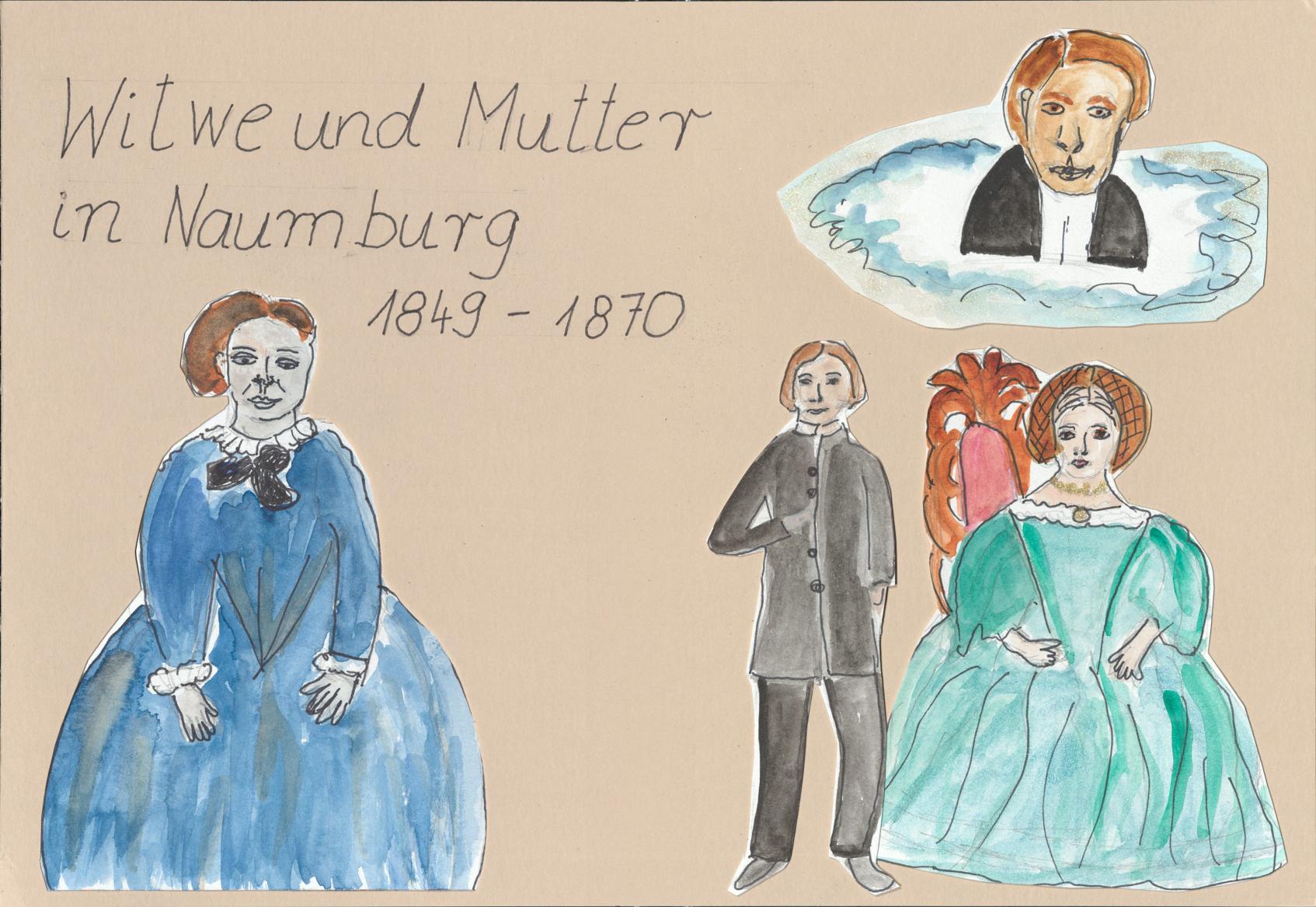
Nietzsche's philosophy is regarded as an act of self-liberation — but even the superman remained powerless against his own family. This essay highlights the pathological tension between the lonely thinker and the “canaille” relatives, mother Franziska Nietzsche and sister Elisabeth Förster-Nietzsche. While the philosopher (de)constructs “woman in itself” as flat, independent and mindless in his writings, he also has stockings stuffed and sausage boxes sent from Naumburg. An essay about the deepest objection to eternal return: one's own kinship.
This is the second part of a small series for this year's Mother's Day. In first part Henry Holland wrote about Franziska Nietzsche's life with a particular focus on her time before Nietzsche and her last years.
“I had the impression that he could possibly kill or strangle his mother in this condition. ”2 Köselitz wrote these lines to Overbeck in 1893 after a visit to Nietzsche, after he had already fallen victim to spiritual absenteeism, was cared for with sacrifice by his mother. Perhaps the aggressive behavior observed by Köselitz can only be interpreted as a symptom of insanity and Nietzsche's already decaying personality. More evil tongues could claim that the same aggressiveness reveals the suppressed feeling that Nietzsche would in reality have shown towards his mother: contempt that ignites into hatred beneath the surface.
Well, so we could ask, what does that actually concern us? Whether Nietzsche loved or despised his mother, whether her care was self-sacrificing, or whether she only wanted to meet social expectations of a “loving mother” regardless of her actual feelings? Whether she wanted to protect Nietzsche from the eyes of neighbors or herself from their talk as she increasingly locked him in the house? Whether she was spiritually limited and bigoted her Christian ideals, whether the “laundry of virtues” and the numerous “may God judge it.”3 stemmed from a brave, fateful soul or one of resentment who did not want to allow anyone and certainly not her children a life beyond the normative corset, which she would rather have seen unhappy, but married and leave the son sick in a regular job rather than permanently taking sick leave and vagabond in climatic cures that he himself considered good?4
Yes, that could of course not matter to us or just satisfy our personal curiosity if these considerations could not help us to like Nietzsche's philosophy a little more by readjusting, balancing and understanding better: When he becomes so abusive again in his misogyny, when he so rages against Christian charity, when he lets himself go in the fury of his contempt.
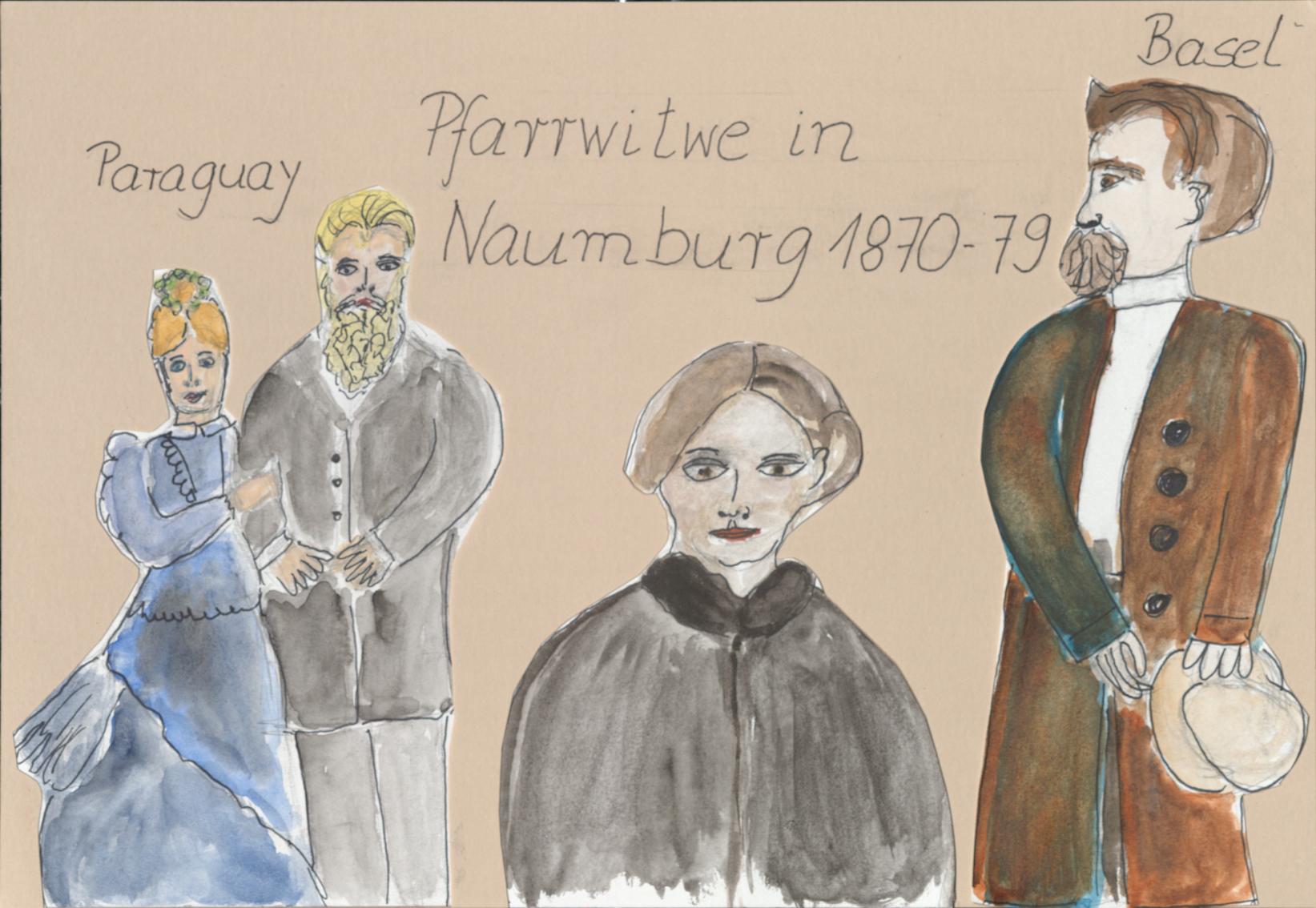
I. Between mom and llama
Well, we could say that he also knew Malwida von Meysenbug, Lou von Salomé, Meta von Salis and Ida Overbeck — all clever women — but he was influenced by two others. Because the family never completely lets you go, or at least not Nietzsche.
The fact that they are not good for him can be found again and again in his letters: “I don't like my mother, and hearing my sister's voice displeases me; I am invariably I got sick when I was with them. ”5 The fact that he gives his mother very limited insight into his inner life — or we could even say: none at all — that he advises her not to read his books, does not prevent him from having her send him food packages over and over again. This tradition begins in his school years, a box wanders back and forth, Nietzsche writes to his mother what his son's heart desires, and then the box filled with food and washed clothes comes back. Why stop doing that? Even a lonely philosopher can eat well for once:
When the sausage arrives at the end of next week, it would be the best time! Then I ask for 1) 1 pair of woolen stockings, 2) a glove (knitted) to wash (as the good llama used to do for me) (I mean to bathe in the morning) and 3) finally a pair of black knitted fairly long gloves with one thumb. Please please! ”6
And the much-maligned sister is also allowed to help make Nietzsche's life easier. In Basel, she manages the household for Nietzsche, who is suffering from time to time in terms of health, so that she “shares with him about a third of Nietzsche's time in Basel.”7 spends. And when she is called, she comes to Tautenburg, herself as a chaperone, where Salomé and her brother discussed and wandered together for about three weeks in August 1882. A Nietzscher mistake with ultimately fatal consequences for the friendship between Nietzsche and Lou von Salomé, at least from his later point of view. Because it remains questionable whether Salomé's sharp tongue would have grown without Sister Friedrich Nietzsche.
At least the two blood-related women Elisabeth and Franziska Nietzsche can hardly refuse anything to their hearts and you won't be surprised if something is expected in return for such service of love: a decent bourgeois life, that wouldn't be too much to ask, no abuses against authorities and a little more adjustment to the spirit of the times. You have such wonderful writing talent — your sister could have thought — and then he writes something like that of all things. The mother doesn't even read the books and that's probably better that way.
The big disagreement with mother and sister happened in 1882 as part of the “Lou Affair.” Elisabeth Nietzsche intrigues against Lou von Salomé, who, as you have to admit, probably treated her more than disparagingly. Jealousy certainly plays a part. How inappropriate the friendship between the two is, what Lou von Salomé claims about Nietzsche behind Nietzsche's back, these tips of Elisabeth Nietzsche reach both mother and Frederick. A visit to Naumburg ends in disaster. Nietzsche leaves and writes to Overbeck:
For example, I haven't forgotten for an hour that my mother called me a disgrace for my father's grave. I won't mention other examples — but a pistol barrel is now a source of relatively pleasant thoughts for me.8
As a thank you for all the attention and disappointed expectations — imposed by many Nietzsche researchers — mother and sister are now heavily blamed. All the unspeakable things Nietzsche wrote about women were attributable to them. And maybe even the bossy grandmother Erdmuthe and the aunt: the weak Auguste and the nervous Rosalie. What springs from such a household of women is misogyny, which is also a good part of self-loathing, because if we cannot live out our hate and do not free ourselves from it freely and cheekily, then it goes into the interior, then we just hate ourselves and those who have shaped us.
II. Nietzsche's Misogyny
Franz Overbeck writes about Nietzsche in his memoirs:
[S] I myself was by no means easy for him everywhere, and he may have developed the “will to power” into an ideal with such eloquence as was only possible for one who had this ideal in mind so much as such and had not actually become flesh of himself.9
How to deal with women who are constantly dancing on your nose? Some aphorisms from Human, all-too-human sound like reflections on this question. In his opinion, women with their “sudden decisions about the pros and cons” of a matter that is better considered thoroughly were romanticized far too often by men as “Sibylline Oracles,” although the diversity of things simply suggests that “the nature of things [...] is set up in such a way that women are always right.”10.
Is there a man who cannot defend himself against feminine, pragmatic reason speaking? “The intellect of women shows itself as complete mastery, presence of mind, use of all advantages. ”11 Once they are inflamed with hatred, the women after Nietzsche have no reluctance. No moral corset imposes them and so they practice “finding sore spots [...] and stabbing them: for which purpose their dagger sharpening intellect serves them excellently.”12.
After extensive squabbling, one sex remorses that it has hurt, while it bothers the other “that he has not done enough woe to the other because he is trying to make his heart heavy afterwards through tears, sobs and disturbed faces.”13. With these words, which reader would not like to imagine a family dispute in the house of Nietzsche? And imagine a Nietzsche who, instead of being beautifully independent, is free from “compulsion, disturbance, noise, business, duties, worries.”14 Moves in philosophical expanses, grumbles about domestic matters — and that too with a bad conscience. Nasty women's rooms!
It was precisely because they were able to poison the men's entire domestic lives (so, according to Nietzsche, Xanthippe first drove her husband Socrates out into the alleys and into philosophy15). The women rule, but on a small and covert basis16 — and that is also the only way women can do it — according to Friedrich Nietzsche. Therefore, for their own sake, they should not desire what they want to compete with the man recently: for emancipation.17 It's hard to imagine what that would mean for science if women got involved with their overly sharp, quick, contradictory thinking.18 And the further emancipation goes, the more women lose their original power over men. They masculinize themselves, which is why an age with a higher degree of emancipation paradoxically means less power for women.
Nietzsche also writes this in Beyond good and evil, where he does a lot more. Interestingly enough, he includes the aphorisms 231 to 239 from the Seventh Main Piece, our virtues (we already know — not women), with an introductory thought:
But at the bottom of us, completely “down there,” there is certainly something irteachable, a granite of spiritual fate, of predetermined decision and answer to predetermined questions. With every cardinal problem, an immutable “that's me” says; about man and woman, for example, a thinker cannot relearn, but can only learn out.19
These “decisions” will later be interpreted differently at different times and put on the thinker who said such things himself as
A guide to the problems that we are, - more correctly, to the great foolishness that we are, to our spiritual fate, to Unteachable completely “down there.” — Based on this abundant manner, as I have just committed against myself, I will perhaps be allowed to testify a few truths about the “woman herself”: provided that you now know from the outset how much it is — my Truths are.20
You can use this line to claim that Nietzsche makes fun of the prevailing prejudices against women in the following aphorisms by sharpening them and satirizing them as “foolishness.” However, we can also take him at his word that it was indeed his truth and that he knew how much it was part of his “unteachable right down there.” Perhaps every person will find in themselves a few ugly, low convictions that they would usually be afraid to express publicly, not because they do not believe in them, but because they are afraid of how people will then think of them.
III. An apology?
It may be difficult to distance yourself from the experiences you have, and at a time when women were patronized and kept small, they were largely the way they were formed. Let's think of Franziska Nietzsche, who met her spouse at the age of 17 (it's all right, “[d] he only mistake is that I'm so young mother”21), or because Ludwig Nietzsche presented her with a draft as a sample letter for how she should write as a pastor.22 Elisabeth Nietzsche, a graduate of a girls' school, used idiosyncratic punctuation throughout her life, which was mainly characterized by cut-outs. Her youthful writing style is aptly described by Kerstin Decker:
She usually sounded what a young girl should sound like according to general agreement, enthusiastic, uplooking, sentimental, not clinically stupid, but something, and shivering in front of male size: “Beloved Fritz! How long have I been longing to write to you, but the longing has been particularly vivid since the last eight days since I was intoxicated by your dear new book “[.]23
But is it possible to excuse the overall judgment that Nietzsche makes about women by describing the inculcated minelessness of women? In Nietzsche research, it is often argued that the alleged mental limitations of Elisabeth and Franziska Nietzsche provoked or even legitimized Frederick's misogynistic attitude. But this view is entangled in an absurd perpetrator-victim reversal: Victims of repressive education and intellectual incarceration are burdened with moral responsibility for a male system of thought that justifies precisely that oppression. It is the perfection of the circle: Women are blamed for providing the philosopher with the arguments for their own devaluation through their (forced) immaturity. The deformation caused by education and paternalism among women is transfigured as the cause of male resentment instead of seeing it as its product. And didn't Nietzsche have enough “countermaterial” from women in his hand that could just as easily have freed him from his “fate”?
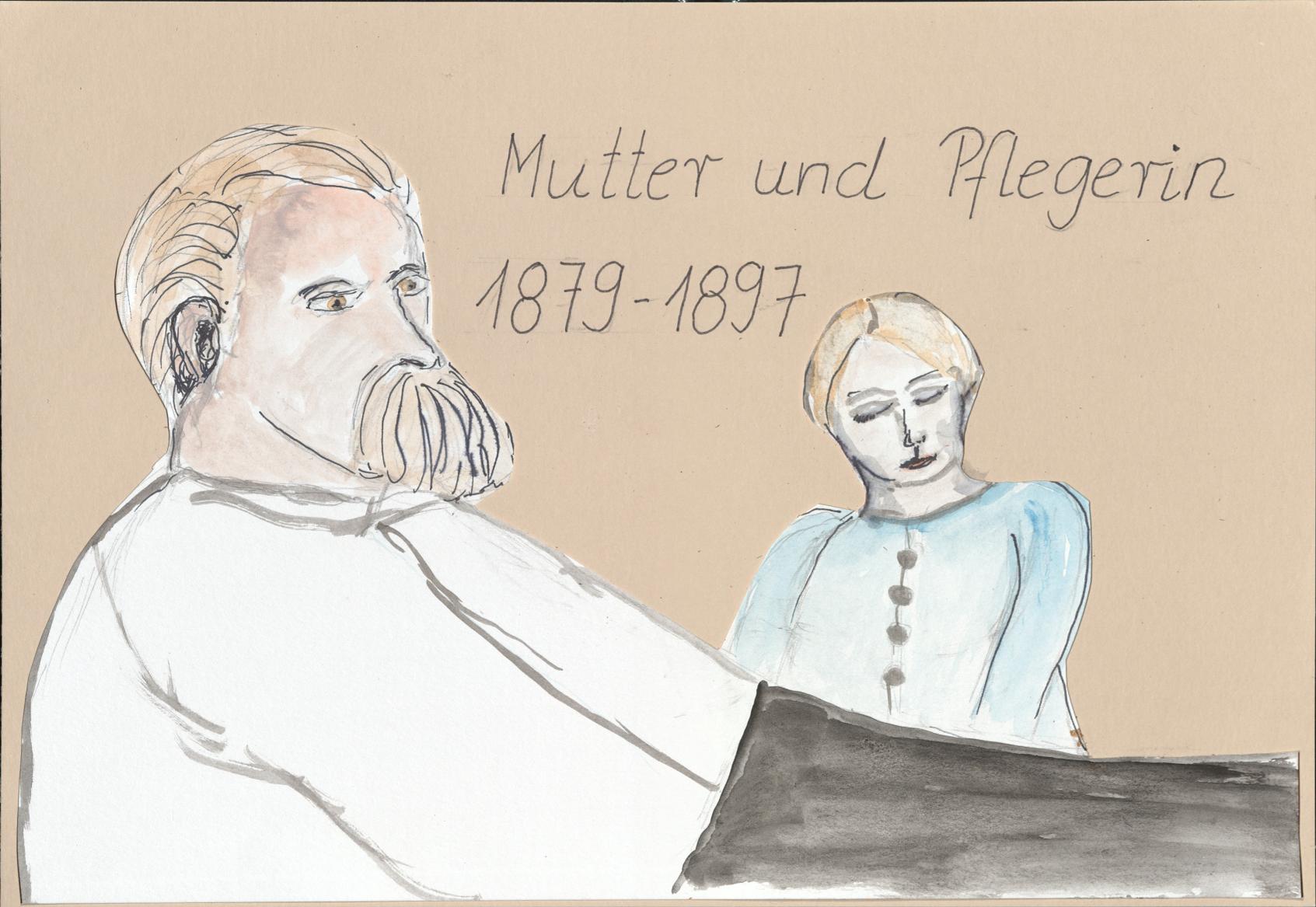
In contrast to Elisabeth Nietzsche, Nietzsche's mother never attempts to reach independent intellectual judgments herself. Whenever it is appropriate, she consults someone who can tell her what things look like. And when she does not feel what she is thinking about, she falls into inner turmoil. The attending physician imposes the following verdict on her lack of understanding that the insane Nietzsche is incurable: “Mother makes a limited impression.”24. Probably the most self-powerful act in her life will be the decision to take the sick Nietzsche25 and to keep him with her even in exchange for the sister's appropriations. She finally relinquishes authority over his spiritual inheritance26 Even though the publication of the Antichrists It hurts a lot27 And it remains questionable which work would have survived if the powers of attorney had remained in mother's hands and whether she had not yielded to the pastor's insistence to destroy one or the other document.
When it comes to woman-male relationships, we can regard both Friedrich, Elisabeth and Franziska Nietzsche as victims of their time. And anyone who has suffered more from others in the end will always remain our own imaginary product:
When I look for the deepest contrast to myself, the incalculable baseness of instincts, I always find my mother and sister—to believe I am related to such a canaille would be blasphemy against my divinity. The treatment I experience from my mother and sister, up to this moment, fills me with an unspeakable horror: here a perfect infernal machine works, with unfailing certainty about the moment when I can be wounded bloody[.]28
On August 15, 1900, Nietzsche, who had been mentally abducted for a good 10 years, dies in good custody by his sister Elisabeth Förster-Nietzsche at Villa Silberblick in Weimar.
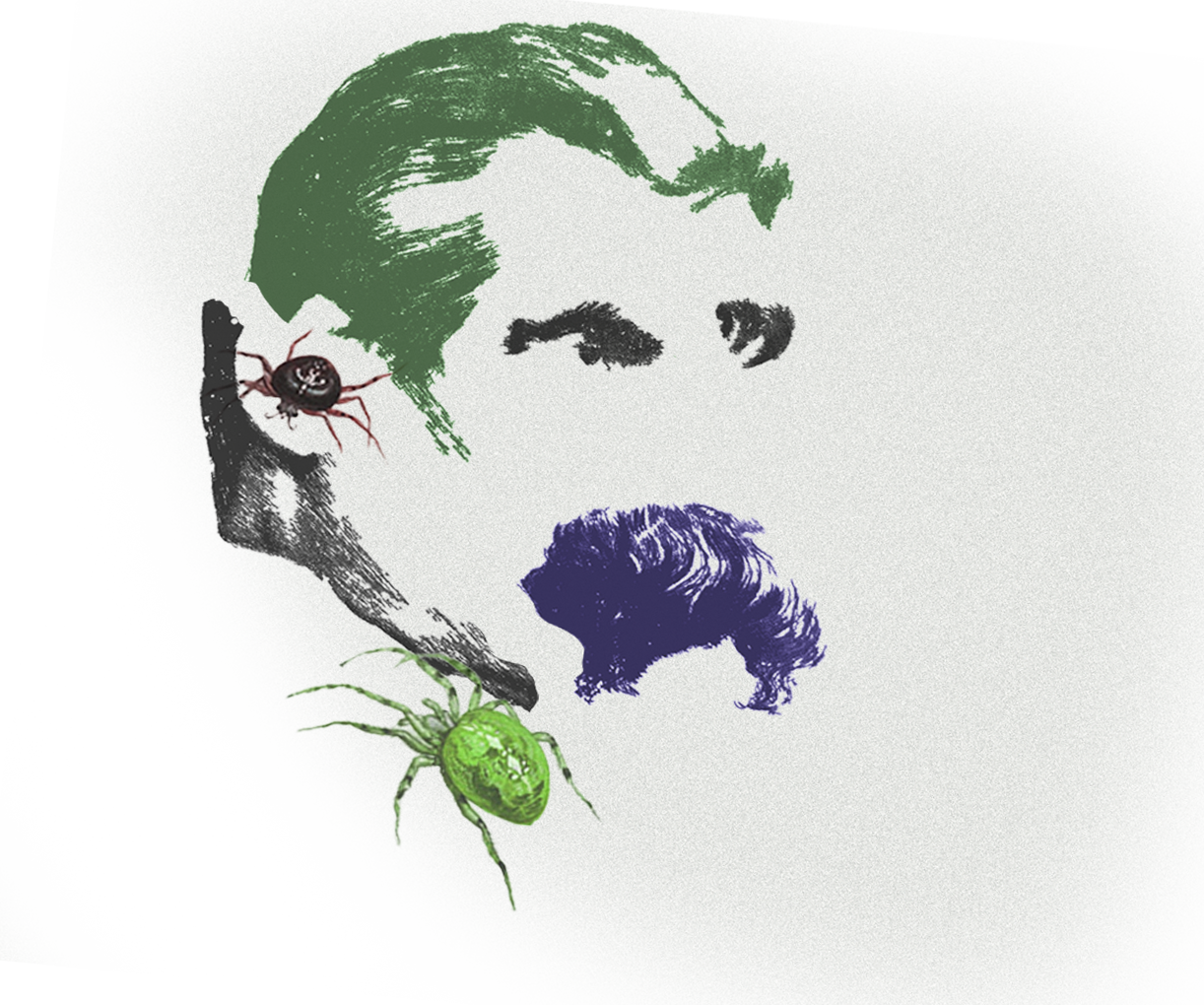
The article image was drawn by Zwickau artist Christina Stephan, who also inspired us to create this small series. Learn more about her and her art on her website. It shows Nietzsche's mother with her children Elisabeth and Friedrich and her husband who died young.
Literature
Decker, Kerstin: The sister. The life of Elisabeth Förster-Nietzsche. Berlin & Munich 2016.
Gabel, Gernot U. & Carl Helmuth Jagenberg (eds.): The incapacitated philosopher. Letters from Franziska Nietzsche to Adalbert Oehler from the years 1889-1897. Hurth 1994.
Janz, Curt Paul: Frederick Nietzsche. biography. The years of infirmity. documents. Sources and registers, Vol. 3. Frankfurt a.M. 1993.
Overbeck, Franz: Works and estate. Autobiographical. “My friends Treitschke, Nietzsche and Rohde”, edited by Barbara Reibnitz and Marianne Stauffacher-Schaub. Stuttgart & Weimar 1999.
Podach, Erich F. (ed.): The sick Nietzsche. Letters from his mother to Franz Overbeck. Vienna 1937.
Schmidt-Losch, Ursula: “a missed life”? Nietzsche's mother Franziska. Aschaffenburg 2001.
Volz, Pia Daniela: Nietzsche in the maze of his illness. A medical-biographical investigation. Würzburg 1990.
footnotes
1: Ecce homo, Why am I so wise, § 3; translation: Daniel Fidel Ferrer (Kuhn von Verden Verlag: 2023).
2: Quoted by: Pia Daniela Volz, Nietzsche in the Labyrinth of His Illness, p. 471.
3: On the Christian language in Nietzsche's parents' home, see the chapter”The good Lord will “... religious language in the house of Nietzsche 1844-1850 and its early (st) consequences at Ursula Schmidt-Losch, “a missed life”?, p. 105-120.
4: “I'm me Isn't it who has shown you an excess of undeserved kindness over the past year? Are you ungrateful through and through? Or lie in the last reason that the simplest truth is upside down with you? Who behaved badly against me if not you? Who has put my life at risk if not you? Who abandoned me as completely as you did, and when I needed comfort, answered me with ridicule and defile my entire life and aspirations? I know Even more so, and from childhood on, the moral distance that separates me and you, and I needed all my gentleness, patience and silence so as not to make you feel them all. Don't you understand anything about the reluctance I have to overcome to be so closely related to people like you are! What makes me vomit when I read letters from my sister and have to swallow this mixture of nonsense and audacity that even cleans itself up morally? “(Letter to Franziska Nietzsche in Naumburg (drafts), Nice, January/February 1884, No. 482.)
5: Letter to Franz Overbeck v. 06/03/1883, No. 386.
6: Letter to Franziska Nietzsche v. 13/07/1881, No. 126.
7: Schmidt-Losch, “A missed life”? Nietzsche's mother Franziska, p. 29.
8: Letter to Franz Overbeck v. 10/02/1883, No. 373.
9: Franz Overbeck, Works and estate, p. 25.
10: Human, all-too-human I, Aph 417.
11: Human, all-too-human I, Aph 411. Could Nietzsche also have thought of his mother, who was extremely adept at making financial provisions for herself and hers when it came to pragmatic housekeeping? Schmidt-Losch writes, taking Franziska Nietzsche's correspondence into account: “In doing so, she develops a degree of skill, even virtuosity, which is in astonishing discrepancy with assessments of her intelligence, to which Franziska was subjected by many biographers. Even the young Röcken widow knew how to pull out all the stops when it came to organising support; and towards the end of her seventh decade, Franziska brilliantly played out her mastery of requesting support “(”A missed life”? Nietzsche's mother Franziska, p. 27).
12: Human, all-too-human I, Aph 414.
13: Human, all-too-human I, aph. 420.
14:On the genealogy of morality III, paragraph 8.
15: Cf. Human, all-too-human I, Aph 433.
16: Cf. Human, all-too-human I, aph. 412 & Beyond good and evil, Aph 239.
17: Cf. Beyond good and evil, Aph 232 & 239.
18: Cf. Human, all-too-human I, Aph. 416, 419 & 425 and Beyond good and evil, Aph. 232, 233, 234 & 239. You can see a shift in the accent of judgment between the two works. While women's inability to do science in Human, all-too-human is described as a current situation which could also change one day (cf. Aph. 416 & 425), is used in Beyond good and evil asserts the innate flatness of women and the unnaturalness of their instincts when they are interested in the mind (cf. Aph. 234, 238 & 239). In this respect, the development can be described as an aggravation of misogynous thought within Nietzsche's philosophy.
19: Beyond good and evil, Aph 231.
20: Ibid.
21: This reminder and also her mother's response “'this mistake is improving every day my child, '” Franziska Nietzsche writes down in her memoirs (see: Franziska Nietzsche: My life. At: Schmidt-Losch, “a missed life”, PP. 80-103; 99).
22: This is how Schmidt-Losch describes Franziska Nietzsche's “re-education” in the new marriage as follows: “[A] us the natural and uncomplicated girl from the countryside should a woman become a pastor. In a concept book, she practices writing letters that her master and master will correct. A draft letter is obviously so lousy that the pastor finally drafts a sample letter based on Franziska's text, the pleasant wording of which Franziska will be well-behaved in the future” (“a missed life”?, P. 19).
23: The sister P. 157.
24: Curt Paul Janz: Frederick Nietzsche. Vol. 3, p. 51.
25: Even the decision to move Nietzsche from Basel to Jena can be understood as a compromise with Overbeck, who replies in a letter to Köselitz: “I was of the opinion at all a year ago that Nietzsche should stay close to me, fought in particular against the hasty way Nietzsche was taken away by his mother, demanding that she should first travel alone and first seek suitable accommodation near her Formal search” (cited below ibid.).
26: Although reluctantly: “I signed the just signed regarding the transfer of my son's intellectual property for foreign money only at the request and insistence of my daughter Mrs. Dr Föster and it was therefore done through a deliberate need” (Gernot U. Gabel & Carl Helmuth Jagenberg [eds.] The incapacitated philosopher. Letters from Franziska Nietzsche to Adalbert Oehler from the years 1889-1897, P. 74).
27: “[I] think that the terrible Antichrist and several poems could be omitted in the eighth volume, I feel bitter grief about this: has he already said more than enough about it in his works and I now understand his words twice: 'Don't read it mother, it is written from a completely different point of view. '” Franziska Nietzsche naively writes these complaining words about the document to Franz Overbeck, to whom she can fortunately report that, as a woman, she is also not able to judge at all with regard to philosophical books, because “[ue] in general I think that philosophy is not for women, we lose ground under our feet.” (Erich F. Podach [ed.], The sick Nietzsche. Letters from his mother to Franz Overbeck, p. 180 f.). The latter can certainly be understood as a side-swipe at the daughter, who sees herself as suitable for publishing her brother's philosophical works.
28: Ecce homo, Why am I so wise, § 3; translation: Daniel Fidel Ferrer. Elisabeth Förster-Nietzsche had the sheet with these lines picked up by Köselitz from publisher Naumann and destroyed it. However, Köselitz had already made a copy. Franziska Nietzsche only learned orally from her daughter of the derogatory body with the aim of injuring her.