Nietzsche on a Bike
A Declaration of Love
Nietzsche on a Bike
A Declaration of Love

What does the most radical thinker of modernity have to do with cycling? Officially nothing: Nietzsche was a passionate hiker, and bicycles were conspicuously absent from his biography. Yet, his philosophy brilliantly anticipated the bicycle.
From the Buddhist Kala-Chakra up to Zarathustra's vision of the "self-rolling wheel," this essay embarks on a fascinating quest. It shows why the bicycle is far more than a mere means of transport: It is a philosophical instrument that teaches us the dynamic balance of life and makes the "Eternal Recurrence of the Same" palpable in the wind. An invitation to set thought in motion.
What does Nietzsche have to do with cycling? Nietzsche was a passionate hiker. There are no documented bicycle excursions by him. However, as with many other things, he may have been 'too early' here too. Yet the invention was already in the world during his lifetime. In 1817, the eccentric tinkerer Karl von Drais, who shared more than one commonality with Nietzsche, had already constructed the velocipede. But just like Zarathustra in his first attempts to bestow his wisdom upon people, he too was only mocked, caricatured, and ridiculed by the crowd. It was not until long after his death in 1851, in the mid-1890s, that cycling became a general fashion. By this time, however, Nietzsche himself was no longer able to meaningfully participate in the technological developments of his era. Like the inventor von Drais, he had been incapacitated and removed from public life in his later years.1
Nietzsche would likely have appreciated the practice, or at least certainly the symbolism and philosophical depth.2 Two wheels, connected to form an infinity, propelled at their center solely by human will. Guided by a gentle movement, steered by a straight gaze into the distance. Such lightness required millennia of preliminary work. The wheel was humanity's simplest yet most challenging invention: only when perfect symmetry can be achieved does it roll effortlessly. No one could have foreseen the consequences when, at the beginning of the 4th millennium BCE, the first circular potter's wheels were made, and shortly thereafter, two were connected by an axle. This lifted a tremendous burden from people in more ways than one. What was previously laboriously carried, pushed, or pulled could now be: driven.
.jpg)
The Archetypal Bicycle
This is undoubtedly one of the reasons why the wheel is so deeply embedded in our cultural understanding of the world as an archetype of perfect motion. Like few other technical creations – e.g., mirrors, books, clockworks – the wheel has managed to become a key symbol of our existential orientation. Its role in several of the oldest still-existing world religions was correspondingly significant. Not only is our German word 'rad' traceable to the almost synonymous Sanskrit word 'ratha', which denotes an Indian temple chariot. Especially in the Avesta, it also becomes a central cipher for the cosmos itself. The 'Wheel of Time' (Kalachakra) symbolizes the cyclical eternal return of all existence, while the Sudarshana Chakra, the rotating, razor-sharp discus of the god Vishnu, protects and maintains cosmic order (Dharma). Even today in India, during the magnificent temple festivals, one can admire the splendidly painted and decorated mythical chariots, the 'Ratha Yatra', which are pulled through the city in large processions and each contain a deity statue. During this – dare we say? – 'bike tour', the deity gets an opportunity to inspect its creation and, if satisfied, will bless it.
In Buddhism, the wheel of the cosmos transforms into that of the great teaching. The Eightfold Path is materialized in the eight spokes of a wheel for good reason: it demands and promises movement, the journey to liberation from suffering and delusion.
For the historical Zarathustra, the Iranian prophet whose work is usually dated between 1500 and 600 BCE and whose name Nietzsche borrowed for his most esoteric work, the wheel and chariot are also essential: In the Gathas, the hymns of the Avesta, a collection of Zoroastrian sacred texts, he is attributed the threefold role as 'first herdsman' ('vāstryõ.fšuyant'), 'first priest' ('āθravan'), and very prominently as 'raθaēštar', as the "first chariot warrior"3, and thus as the founder of the three estates of the desired social order (herdsmen, priests, warriors/nobles)4 attributed. It is therefore hardly surprising that the wheel also occupied a central place in Nietzsche's thought. There is the "Wheel of Time"5, the "Wheel of the World"6, the "Wheel of Reason"7, the Wheel of "Delusion"8, the "Wheel of Being"9, the "Wheel of Taste and Vanity"10 and the "actual wheel in the machinery of things"11. Above all, however, we find – especially in Zarathustra – the fascinating image of the "self-rolling wheel"12. The passage is prominent in the chapter Of the Three Metamorphoses as the crown of the last metamorphosis:
Innocence is the child and forgetting, a new beginning, a game, a self-rolling wheel, a first movement, a sacred Yes-saying. Yes, for the game of creation, my brothers, a sacred Yes-saying is needed: its own will now wills the spirit, its own world the world-lost one wins.13
The hinted at, even lauded, way of life is self-sufficient, requiring no coercion, no external impetus, no strenuous effort. It draws from no other source than itself. Complete autonomy coupled with utmost serenity, an art of living where one glides along 'as if on wheels'. It promises creation purely out of joy, and with it, an unforced, unfeigned self-affirmation. Nietzsche's aphorisms provided a wonderful blueprint for numerous personal utopias of enthusiastic readers, who were inspired by the peculiar intensity of this image, by the fresh wind of freedom that permeates it – let's call it 'the wind of motion'. Who, when reading these relevant lines, doesn't think of that strange, invigorating and affirmative feeling that eventually permeates anyone who has been cycling long enough, of having rediscovered a way of life more appropriate to humans, perhaps because it is more primordially inscribed: that of the nomad?

Movement as an Art of Living
But there's another existential layer that every passionate cyclist is secretly aware of. A bicycle, once set in motion, continues to run and carry itself for quite a distance, transforming the rider's relationship with their environment in an astonishing way. Unlike motorized vehicles, you are not merely chauffeured on a bicycle. You ride on the momentum of the initial movement, you glide 'along', moving yourself in a state between activity and passivity, in the 'medium' voice, as found in Ancient Greek, which unfortunately has no grammatical equivalent in German. We are the originators of the forward motion, yet at the same moment, gradually relieved of the necessity to constantly maintain it. Fused with it and simultaneously carried by it. Just as we keep the bicycle in motion, the medieval God should have sustained being in existence; he certainly wouldn't have abdicated so prematurely. 'It' would run as smoothly as a wheel. It doesn't trudge and march, but rolls, meaning it pulls and pushes and is simultaneously pushed and pulled by its own successful past.
Certainly, roller skates and skis – or Nietzsche's favored ice skates – also enable this intermediate state, but all require specific external conditions, demanding asphalt, snow, or ice. Only the bicycle, however, is undemanding and adaptable. Any reasonably firm surface is, in principle, rideable with the right tires, from the root-strewn Black Forest floor to the gravel roads of Mongolia and the halfpipe in New York. The bicycle is an 'all-rounder' in every respect. And, like any other regularly practiced movement technique, it shapes its own physicality. Like horseback riding, to which it bears some resemblance (cf. 'to ride a bike' in English), cycling gives the rider – with the handlebars correctly adjusted – a posture that is both casual and regal. We maintain an overview: of our path, of our 'steed', of the pedestrians. Every exercise – every 'ascetic practice' – imprints itself not only on the body but also on the spirit of the practitioner. And thus, ideally, this 'over-viewing' becomes part of the cycling traveler's personality. Thinking is life, and life is movement. This physically mediated assimilation of character traits was very familiar to Nietzsche's thought. Like hardly anyone else, he not only emphasized the physicality of thinking but also powerfully demonstrated it poetically in some of his writings. Foucault, in particular, later prominently analyzed further historical manifestations of this connection (cf. e.g., Discipline and Punish), which in other theories today is known as 'embodiment'.
High repetitions of movements involuntarily embed themselves in the psychological fabric. The style of personal physicality corresponds to the style of the respective spirit. The bicycle trains its rider to have a fine sense for the middle ground between too much and too little effort, for the balance between active and passive. One must pedal just enough as required by the environment and one's will, but at the same time allow the wheels' own momentum to carry them, in order to stay optimally in motion. Conversely, anyone who refuses to add their own power for too long stops and – falls. Cycling means being able to maintain a dynamic balance. A rider at a standstill falls. We must move to be. Cycling cultivates that magical middle ground where becoming and being merge into one, and pours it into the cyclist's skill. The rest, as mentioned, is a matter of personal style. But for every style, the bicycle offers a suitable form. From a city or touring bike, the flaneur gazes dreamily over the landscape of life. For the peak-bagger, who seeks danger, the thrill of experience, and the proximity of the gods, the mountain bike is a loyal companion from ascent and climb to descent and – sometimes – departure. Finally, the road cyclist battles alone in the open country to overcome their resistances and (performance) limits.

The Wheel of Time
On long bike tours, we rediscover one last Zarathustrian teaching: the Eternal Recurrence of the Same. And not primarily in the feeling that one has seen everyone and everything before, the recurrence of unfamiliar faces, monotonous suburban streets, or interchangeable generic villages. Just as for Zarathustra, there is a good and a bad recurrence for the cyclist. The modern long-distance cyclist comes to know recurrence as an intuition, embedded in a physical spatial experience that, after a long time, becomes a familiar given. For within the rolling wheel lies another ancient wisdom, the truth of 'κύκλος' (Kýklus), the Greek word for circle. The rotating moment of recurrence is contained within the word 'cycle'. A point on the circle rises and sets in the cycle, just as the sun rises in the morning and sets in the evening, and the wheel of the seasons turns unfailingly year after year. The circle of Eternal Recurrence is not a mathematical circle – every point equally significant, neutral to the center, an eternally static perfection – but a wheel in motion, which we, who are stretched onto this wheel with our entire lives, experience ourselves as an arc. We never see the whole wheel, but we always sense it when we mentally extend our own journey. For us as finite beings, there can be no other eternity than that which we experience as progress and finally as decline and evening. The end, however, does not lie before us, as it were, like a wall of death on a flat plain, but until the last hour and beyond, always behind the horizon towards which we move. No other technical aid simultaneously teaches us about this so physically and mentally, uniting these insights within itself in such a mythical-symbolic, sporty-practical, and bodily-spatial way as the bicycle.
Does this instructive contraption, the self-propelled bicycle, have a future now that pedelecs and e-bikes, scooters, Segway PTs, and hoverboards glide across asphalted roads? Given its past, we have as much to fear as to hope for. While the path from the clever invention of the wheel as a universal tool to the all-encompassing 'ratha', the rotating circle of souls and things, remains hidden in prehistoric darkness for now, the subsequent development from symbolism laden with meaning back to useful multi-purpose tools can be called almost symptomatic of Western thought. Thus, the Romans quickly knew how to incorporate the 'rota' into all sorts of ingenious constructions. From the scoop wheel of the watermill to the wheels in pulley systems and transport structures for war machines, right up to the extremely popular breaking wheel ('τροχός'), which they readily adopted from the Greeks along with the practice of breaking on the wheel – the inventive spirit of early Western civilizations quickly found countless ways to apply what their ancestors' gods had once used to traverse the firmament to practical use here on earth. Some voices critical of culture in later centuries had much to lament about this transformation, which turned our societal existence into a single technically controlled mechanism. The bicycle represents a singular peak in the stream of outstanding inventions of this era; while many things followed it, few surpassed it. We may hope that, like the potter's wheel, it remains a continuous companion for a long time; though some technical ingenuity may be added to it, it will fundamentally remain what it always was: a self-rolling wheel. "But where danger threatens, / That which saves also grows."14, to invoke an old Hölderlin saying. For whoever dislikes the course of time, whoever gradually feels like a mere cogwheel instead of being at the center of existence, can and should flee to freedom. We recommend: with a good book and on two wheels.
About the Article Image
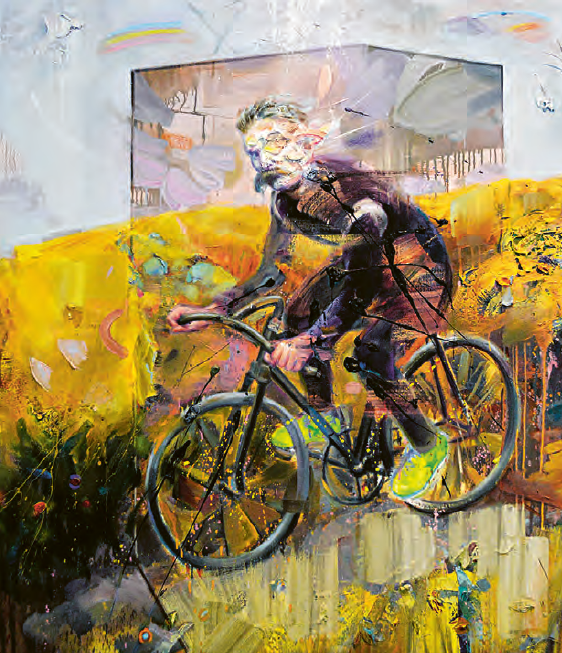
Mathieu Laca: Nietzsche on a Bike (2016, oil on canvas, 122 × 107 cm, private collection, © Mathieu Laca) (Source: Barbara Straka, Nietzsche forever? Friedrich Nietzsche's Transfigurations in contemporary art. Basel, Schwabe 2025, p. 665). Used with kind permission of the artist (Website, Instagram).
Bibliography
Bertz, Eduard: Philosophy of the Bicycle, newly edited with an appendix by Wulfhard Stahl. Paderborn, Snayder, 1900, reprint 1997.
Hölderlin, Friedrich: Complete Works and Letters in three volumes, Edited by Michael Knaupp. Munich & Vienna, Carl Hanser, 2019.
Nyberg, Henrik S.: The Religions of Ancient Iran. Leipzig, Hinrichs 1938.
Schenkel, Elmar: On the Ecstasy of Travel. With photographic impressions by Hans U. Alder. Basel, Futurum 2012.
Footnotes
1: Cf. Schenkel: On the Ecstasy of Travel.
2: In his "Philosophy of the Bicycle" from 1900, Eduard Bertz, not without reason, already dedicates an entire chapter to Nietzsche and Darwin.
3: Nyberg: The Religions of Ancient Iran, p. 301.
4: Cf. 13. Gatha, Yasna 88-95.
5: Five Prefaces to Five Unwritten Books, Sec. 1.
6: Human, All Too Human I, Aph. 106.
7: Thus Spoke Zarathustra I, Of the Pale Criminal.
8: Thus Spoke Zarathustra III, Of Old and New Tablets, Sec. 9.
9: Thus Spoke Zarathustra III, The Convalescent, Sec. 2.
10: Human, All Too Human II, The Wanderer and His Shadow, Aph. 215.
11: Ecce Homo, Why I Am a Destiny, Aph. 3.
12: Thus Spoke Zarathustra I, On the Three Metamorphoses of the Spirit.
13: Ibid.
14: Hölderlin: Patmos, Stanza 1, Lines 3-4.


.jpg)