“How Well Disposed Would You Have to Become to Yourself and to Life”
Prolegomena to Any Future Philosophy That Will Be Able to Present Itself as an Enlightenment — Part II
“How Well Disposed Would You Have to Become to Yourself and to Life”
Prolegomena to Any Future Philosophy That Will Be Able to Present Itself as an Enlightenment — Part II
After our author, in the first part of this article, described the current political-cultural situation with reference to Fukuyama as an outgrowth of deep-seated boredom, which numbs itself in excesses of anger and indignation, he tries in the following second to suggest a possible turn for this zeitgeist, which could manifest itself in a new Enlightenment verve and a new positive self-image of the Enlightenment. Our author, with Nietzsche, opposes the “four despairs” that afflict the present tense, “four transfigurations” and “fields of research” resulting from them. An ironic view of the world and oneself should help to practice a transfigurative perspective on the world, which would be able to overcome the lethargy of postmodernism and revitalize the modernist project. The program of self-reliant future Enlightenment.
4. Misothymia and Hybrithymia
With the deeper reflection made possible by Fukuyama, the phenomenon of illiberal polarization can be understood in more detail. Polarization results in bipolar disinhibition of isothymia and megalothymia, which can be seen as a reasonable form of recognition in the mirror of the other person.
The truth of these excesses lies in the fact that their intensity articulates a diffuse form of recognition of the desire for recognition. They are true as self-unclear forms of will to want to live thymotically. This is also where they get their attraction.
The charisma of polarization lies in the fact that it compensates for the lack of Thymos. Both poles offer thymotic stimulation. They act irresistibly as messengers with an aura of substance. In both struggles for recognition, drama flows unnoticed, which arise from a bored lack of substantial life. It's finally about something again. Important again at last. At last the “big moral words again, always the bumbum of justice”1 in the mouth.
The particular complexity of the current polarization results from the fact that the different forms of recognition are at war with each other in order to make themselves believe that the battle for recognition is not over and must continue with full force. This leads to an escalation of the forms of recognition described by Fukuyama. Through their cultural-fighting orientation, they transform themselves into illiberal figures that radiate into the community.
Isothymia becomes megalothymic as a fight against megalothymic and megalothymic mobilizes isothymically in the sign of pre-modern megalothymia. For some, the urge to show it to everyone and to win is the evil of the world. For others, striving to suppress the desire to be superior is evil par excellence. The terms “misomegalothymia” and “hybrithymia” could be used for these escalated aggregate states of isothymia and megalothymia.
Misomegalothymia describes an active hostility to any ambition in itself to develop a desire to be superior.2 It represents an escalation of the empathy of isothymic sense of justice. The prelude to this is the marginalization fixation of a hyperisothymia, which, as a permanent microagressivity, requires the world to adapt to its elaborate feelings of hurt. You are proud to be so rude in an overharsh world (think of Hugo Baal's phrase “Athletes of Despair” in reference to early Christian hermits). Hyperisothymia takes on an offensive form in polarization. Successes, victories, superiority are understood solely as an expression of an aggressive will to power, which must be eliminated. In the perspective of hyperegalitarian, selective solidarity, the quest to be better appears like a pre-modern relic of a virile warrior culture. Isothymia as support for marginalized groups towards equality becomes a fight against any ambition not to be equal.
Megalothymia feels threatened in its right to exist by misomegalothymia and reacts by radicalizing its own desire to be recognized — often with an “even more so” attitude, often as a local reaction of defiance. The prelude to this is often a relapse into old pride customs as an essential guiding culture that claims irreformable validity and activates the mere affiliation to certain cultural figures as a basis of superiority. This tendency is intensified in hybrithymia. The decoupling from a real basis of superiority is thus complete. Competence no longer matters. It is about an urge to be regarded as a performance of validity that does not have more to offer than that. Hybrithymia legitimizes itself as a mere disinhibition of superiority, which appears excessive and provocatively as a show of superiority. She is her own work as a trumpy lack of work, which feels so superior that she no longer needs any works. It proves itself to be the force of its appearance and as a coup against anything that only shows the appearance of withholding recognition.
5. The Four Despairs
If the struggle for recognition is recognized as a manifestation of indignant enlightenment that is reaching greater proportions in the current polarization, the question is whether there are not also rational reasons for thymotic resentment. If one continues in the direction of Fukuyama's analyses, a sharper picture emerges of the insulting conflicts that turn modern consciousness against its own freedom. There are also rational thymotic reasons that go beyond a lack of life-and-death struggle, which has hurt the Enlightenment's self-respect so much that it no longer feels comfortable in its own skin. This means that there is another component from the “middle” which means that the excess of enlightenment from the margins can continue to let off steam against itself. Even the “moderates” believe too little in their own as an enlightenment, because it is shown in the light of defects that make it doubtful. Contrary to Fukuyama's description, the main threat to liberal democracy is therefore not isothymically stimulated, megalothymically charged boredom that becomes pregnant with a will to fight for the sake of struggle. Rather, the story continues as a project against mass demoralizing lethargy. Four reasons for enlightened lethargy can be identified, all of which are rooted in tradition and — at least this integrity provides minimal reassurance — represent typical constants in modern culture.
a) Romantic Despair
Humans in the “Anthropocene” (Paul Crutzen) are increasingly aware of their nature-destroying potential. The fact that he cannot live in harmony with the earth weighs on his trust in the ability to cooperate. The crown of creation has embarrassed itself. This critique has its roots in Romanticism. The doubt itself widens to the question of whether the human is not fundamentally bionegative as an ignoble unwild. Titles such as “The Fall of the Earth in the Spirit” by Theodor Lessing from 1918 interpret the Enlightenment as rational, mechanical and hostile to life. Max Weber interprets capitalism as a “steel-hard case.” The ecocentrism of all countries sometimes declares that being human is an earth-incompatible way of life.
b) Humanistic Despair
The excesses of uninhibited freedom in the consumer sphere and on the world stage show a neglect of noble behavior. Freedom appears as the egomania of a will to power. The illustrative examples of authoritarian tendencies in the political world, which is no longer just non-Western, and the degree of destruction of nature that cannot be ignored provide evidence for an interpretation of Human condition as misery due to the will to power. Man becomes impossible. This negative view of freedom as recklessness is latently promoted by the massive influence of Augustine's thinking, who, with his merciless doctrine of grace, understands subjectivity solely from the perspective of “original sin.” Schopenhauer in the 19th century and Heidegger in the 20th century are philosophical titans of denial of goodwill for good opportunity who transform Augustine's heritage into secular. Heidegger's human ideal would be to be as a fundamental ontological “Degrowth“, in which man, as a “shepherd of being,” gently as the notorious mushroom collector and sparrow observer writer Peter Handke reoriented himself on bees and birches in his notebooks:
Birch trees never exceed their capabilities. The bee colony lives in its best possible way. Only will, which is omnipresent in technology, drags the earth into the confluence and use and change of the artificial. It forces the earth beyond the established circle of its possible [.]3
c) The Skeptical Despair
The increase in information and the increasing interconnection of everything with everything create a state of complexity that appears chaotic and in which you feel powerless. Freedom sinks into resignation from confusion. It contains dramas and concepts that set out around 1600. The modern skepticism, which began from Copernicus and Galileo's refutations of sensual appearance, had a philosophical effect on Descartes' thinking. This is the source of epistemic paranoia as to whether recognition can ever reach an objective world at all.
This paranoid doubt about everything in the modern age is reinforced by a change in public communication. On the one hand, the digital omnipresence of an information industry creates a flood of information about situations where nothing can be done about. The more informed, the more powerless. There is also a change in the quality of world messengers: So that the flood of information does not create chaotic effects on the part of information producers, there is a tendency to reduce complexity through narratives and reporting reporting. Mediumship is thus moving away from the work of interpreting and experiencing reality by “embedded journalism” and embedded philosophy. Uninvestigative intelligence amplifies the effect of confusion. This creates a mediumship of “last people,” that transform their resignation of complexity into new communities. Mind completely shields itself from stressful reality. As a community of conspiracy hordes, he hides into communicative caves and emigrates into an unassailable sovereignty that always knows exactly what is.
d) Existentialist Despair
Provoked by being surrounded by destruction of nature, the will to power and chaos, one's own leisure time appears not as dignified pride, but as an unpleasant state of diffusely insulting and degapping powerlessness. The self-transparency of the mind acquires the characteristics of absolute doubt, which attains the quality of a truth of despair.
In Western tradition, this mood is suggested and refined primarily by the philosophy of existentialism through philosophical abstraction, but has significant preludes in the culture of Belle Epoque between 1871 and 1914, who also belongs to Nietzsche. Kafka is probably the most brilliant representative of this attitude, but it also echoes in Schiller's term of “sentimental.” Notorious here are the exaggerated descriptions of modernity as “transcendental homelessness” (Lukács) or Weber's phrase of “disenchantment of the world.” Existentialism transforms aghast into a sign of the true. Mind alone becomes lethargic, not because you can't do anything and don't know what to do with yourself that could change anything about it, but because that corresponds to the contingency of existence, as with Sartre, who taught that existence precedes essence. In Heidegger, this emptiness is sacralized into “abandonment of being.” This can also result in a final stoicism that starts lethargy like a service. Time without being resolutely and radically authentically confronts the “throw” (Heidegger), the “absurd” (Camus), the “disgust” (Sartre).
6. The Goodwill to Appear
In view of these descriptions of the thymotic insults of enlightened consciousness, the central concept of appearance in Nietzsche's philosophy once again gains acute significance. Nietzsche recognized that the honesty of the Enlightenment as a “passion of knowledge” requires a regulatory idea in order not to lose its vitality.4 Precisely because the accumulation of knowledge has a harrowing effect on positive self-respect, Nietzsche votes in favor of an anti-Enlightenment “countervailing power.” Too much devastating truth provokes a transfigurative appearance. As a “goodwill to appear”, the quest for recognition is subdued in such a way that its vitality is not irreversibly damaged by the disillusioning results of its findings. It is important to establish a distance from the urge for truth in an “artificial distance” and to look at the dramas that go with it more conciliatory from this distance. When the truth is too cruel, relief is the real deal. Analogous to the romantic irony of the text, there is a philosophical irony of thought. Self-irony relieves the self-interpretation of the idea of being an atlas that not only has to handle the weight of the world, but also doesn't cut a good figure in the process. Philosophy becomes the art of turning philosophy.
In a thymotizing new version of Plato's concept of the three parts of the soul, it could be assumed, Nietzsche is thinking of an epistemic justice in which honesty and vitality are balanced by the controlling power of appearances. Before the Enlightenment falls into the maelstrom of rejecting itself and the world as insane and unjust — “The whole is the untrue” (Adorno) — Nietzsche philosophically appeals for a higher therapeutic justice that protects against excessive because masochistic demands. Paradoxically, Nietzsche takes thymotics seriously by ironizing it. The pathos of the true can thus be understood as clarification, as relief, as an invigorating and motivating lie.
The aim of this vital ironization is to maintain the “passion of knowledge” as a source of pride even with regard to chasms that, as Paul Valéry said, are known to be big enough for everyone. Nietzsche is therefore concerned with basal encouragement. Where there is despair, self-irony can still create the soothing veil of reconciliation. In this way, enlightenment preserves a “freedom above things” in situations that seem hopeless.
7. The Four Transfigurations
Nietzsche's idea of an enlightened thymotic irony towards the Enlightenment can be transferred to the current state of the times. The “goodwill to appear” must therefore prove itself fourfold in the depth of the enlightenment. A philosophical transfiguration attempts to show motivational ways of describing the debilitating phenomena: “He is a thinker: that is, he knows how to take things more simply than they are. ”5 This is intended to plausibly reveal realities that are also latent in the matter. Enlightenment explains itself “how you could regard yourself as a hero, from afar and, as it were, simplified and transfigured — the art of 'setting yourself in the scene' in front of yourself . ”6
a) The Romantic Transfiguration
With regard to the lack of cooperation with nature, reference can be made to the sub-areas of technology and science which, as “bionics”, expressly invent nature-imitating techniques. In it, they follow Francis Bacon's saying that only those who listen to nature can also conquer nature. Knowledge can only be power because it is obedience to nature. Paying attention to the intrinsic complexity of things and the contexts they produce highlights the act of humility of knowing. Obedience as the first scientific obligation thinks under the “primacy of the object” (Adorno). In doing so, natural acts of creation are partly accelerated, but partly also increased, improved and completely reimplemented through a more precise understanding.7 Humans live unsymbiotically with nature. The fact that humans can be counternatural is only something reprehensible in the light of an “original sin” devised by Augustine. This view continues unnoticed in the hysterical growth of growth phobia, which blocks the essential tendency to explain what needs to be improved. Humans can be nature-optimizing in nature and therefore produce a second improved earth on earth that creates improved stories of creation.
b) The Humanistic Transfiguration
The egomania of the will to power can be understood not only as imperious arbitrariness that wants to assert itself, but also as the authority of a competence that wants to convince through its ability. The will is thus atoned. He appears as an embodiment of a truth, not only as an “informal compulsion of a better argument” (Habermas), but as a betterment in a certain skill. In a reevaluation of Heidegger's thinking, one could speak of will as the conquest of unconcealment. He embodies the scope of gaining truth and colonizes them through his inventive initiative. The expansion of the reality zone is stabilized by the willingness to commit objectivities. Being is guarded not through the “will to not” (Heidegger), which is symbiotically oriented towards bees and birches, but through the pull of successful unlikely work. Think of the increases in life made possible by trade routes across the world's oceans, through better medical vaccines, of the accumulation of lovers through “online dating” (“Tinder children”). The will to want can also mean something for the gross domestic product and one's own body mass index to do.
On a social level, there is a culture of competition in a post-feudal social formation that is intended to evaluate the best performers. With Fukuyama, the will to win is to be interpreted as a form of megalothymia that has the ambition to show off its own excellence and to show it to the whole world. As a competitor, the other person doesn't have to be the enemy you have to destroy in order to be. Where there was killing, there can be victories. Ambition can once again strive to present works that are not regarded as arrogant works of art from the outset, but are evidence that training egomania can turn into admirable excellence.
c) The Skeptical Transfiguration
The aspect of complexity is particularly enhanced by Nietzsche, for example. The decisive event for him that God was dead has shaken and shadowed the values and transfigurations of the world and of life. Everything became more chaotic, more disenchanted, more doubtful. He registers the emotional pain that results from this omnipresent skepticism, but reinterprets Götterdämmerung. It may be dawn. Especially when the requirements of origin lose their decisive influences, this opens up the opportunity for initiative, recombinatorics, essay-like existence. The sea of interpretations is once again open and promising. As an ambiguous existence, the world as a “new infinity” tempts you to be discovered again and again. Life as an essay as a retreat from retreat.
d) The Existentialist Transfiguration
The desolation of existence in empty time in particular could be creatively transformed with Nietzsche as a prelude to a new energy of creative acts of knowledge. It is to be understood as a phase, as a lull that precedes new vigour. Unlike Heidegger, for example, who wants to present boredom as an indication of a new need as “need of necessity” and prematurely substantiates it into a mood of “abandonment of being,” Nietzsche distances himself from such metaphysical interpretations. Letting be also means abandoning the dogmas of abandonment, absence, misery. With Nietzsche, the diffuse pain of boredom receives the connotation of mental contractions that can announce new things and create them. Success is bubbling in the grey of everyday life.
8. The Four Fields of Research
Enlightenment is gradually regaining a trust in itself that can promise and a promise that it trusts. She tests herself as a work on plausible overviews with the belief that in what she shows, to better describe the real as it is, without claiming to be able to completely describe the “it is so.” She also knows a vacation from discerning life as “goodwill to shine”, which regenerates itself in a therapeutic, well-dosed escapism.
On a positive note, Enlightenment can theoretically address the content of their resentment as clarification against the Enlightenment. Once again, four points arise here that could serve as fields of research for future enlightenment.
a) Critique of Resentful Reason
With a rediscovered “passion of knowledge,” a critique of thymotic extremes should first be formulated. The starting point would be to understand misomegalothymia and hybrithymia as phenotypes of resentful reason. Nietzsche's backworld and world slanderers find themselves in the defamers of the western prosperity zone, who obscure this halfway optimal this world in the name of an over-optimal otherworldly world. Enlightenment as a critique of “critical theory” frees itself from the will to resignation and its desire to doom as a diffuse revenge against everything that is successful, creative and free as a healthy self-will. As anti-Adornism, an enlightenment enlightened by its enlightenment must tirelessly suggest that there is a real life in the wrong one.
The methodological starting point so that such critique does not just become a critical “critical theory” again is the mode of this anti-resentful critique, not a detailed examination of individual arguments of the affluents. Instead, it is important to repeat in a larger context a therapeutic philosophy such as the post-Aytic American philosopher John McDowell carried out with regard to paranoid modern skepticism. In a kind of philosophical exorcism, the context of minimal optimism is to be plausibly described, within which the suspicions of resentful reason settled themselves. You describe a credible different framework and the confused suspicions of the will to misery disappear “like a face in the sand on the seashore” (Foucault). Distress and distress are unnecessary.8 Ideas like those from a”Deep State“or one”patriarchy“As an interpretive film for the current situation in the West, with regard to established differentiations: the liberal rule of law, the way of life of the inventive entrepreneur, the research company, the healthcare system, the pension system, social security and, above all, the expansion of the cultural consumption zone. All this creates effects of life increases that increase literate life expectancy with massive expansion of leisure time, liquefy the constraints of origin and thus notoriously brighten up the metaphysically balanced feelings of life and constructs of reality that always locate the best in an afterlife and paint this world as scarcity, need and misery. Philosophy has endeavoured, in the jargon of alienation, to disparage this connection of prosperity to a “delusion connection” (Adorno). Peter Sloterdijk has at the end of his Opus magnum SPhären A lucid portrait of the relieved society and its enemies was given back in 2004:
The excessive victimism in the established era of prosperity can only be interpreted by the situational blindness of newly relieved people. [...] Today, it is gradually becoming apparent that the denial of levitation is the constant of the recent history of ideas.9
b) Half-Open Cosmopolitanism
The fact that enlightenment could fall into the trap of self-hating freedom of mind can be an occasion to reflect more deeply about the existence of existence. In this process, designs such as Heidegger's “Throwness” are massively de-dramatized and stripped of their existential pathos. The own must be emphasized over the primacy of the foreign. Being has always been taken for granted. This nestle shelter allows a non-animal cosmopolitanism that is impregnated by moods. A philosophical economy of the own and the foreign would have to formulate a more concrete concept of liveliness. The central perspective is, as much could be said here: Priority is given to one's own. Inclusion only works as an exception. Existence can only become more liberal as a conservative. The common fatherland of global citizens is attention that finds windows to the world in their local homes.
Nietzsche's idea of appearances serves as a basic thesis when formulating a maximally half-open cosmopolitanism: Life requires priority of one's own over the foreign as a protective cocoon that limits and blocks out the inflowing new to such an extent that positive resonances can stabilize. A cultural immune system functions as a therapeutic suppression, as “a certain warm fear-preventing narrowness and inclusion in optimistic horizons.”10:
And this is a general law: every living person can only become healthy, strong and fertile within one horizon; if it is unable to draw a horizon around itself and in turn too selfish to include one's own gaze within a stranger, it taint or hastily seeps away at present doom.11
c) Body and Mind and Training
Dealing with resentful upsets gives greater importance to the connection between body and mind. It is essential to write understandings of the relationship between mind and world, which emphasize corporeality more strongly than nervous openness to the world in the constitutive dimensions of mood and atmosphere. It is therefore not a question of physical strengthening, but of discovering the metaphysically coded phenomenon of “inspiration” as a somatic mood. As a result, a bodily grounded concept of intelligence requires a physical-atmospheric Work outto get in shape. He trains on soul equipment in a somatic-mental gym. It is essential to cultivate underlying sentiments and to disempower incorporated resentments. When humans, as an “animal with classics” (Ortega y Gasset), emphasized the primacy of the mind as a matter of course, the winning combination was reading large books in libraries. Today, it might be listening to inspiring podcasts while jogging. The decisive factor here is that mind-body formation is not a one-time climb from higher altitudes, from which a panorama of views suddenly emerges in brighter atmospheres. Qualified recognition is carried out as a daily exercise program during ascent. Human revolt is lifelong learning. Sisyphus as an eternal student. There is no waking up in the morning from restless dreams and you find yourself transformed into a tremendous cosmopolitan athlete in your bed.
d) Global Civilization Sciences
Overall, these projects open up the agenda of a civilization program of global reach. Nietzsche saw this as the battlefield for a post-heroic heroism of recognition. Viewed from an enlightened vitality, all local cultures are to be regarded as forms of training — in order to translate the term “breeding”, which Nietzsche uses more frequently, in a contemporary way. Locality is to be evaluated to see what contributions they could make to building a civil globality. Philosophy becomes comparative cultural studies as an experiment with sustainable concepts, sounds and rituals from the perspective of civilisation. What do the individual local cultures have to say? Can they be told anything? Who remains most loyal to Earth?
Regarding this issue, Hans Jonas has proposed an extended, irreversible version of the categorical imperative: “Act in such a way that the effects of your actions are compatible with the permanence of genuine human life on Earth.”12
Jonas' idea can serve as a basal yardstick. However, it requires significant development and expansion. Particularly in view of the growth of secular-eschatologically dramatized ecological growth phobia and a masochistic fixation of the Enlightenment on certain forms of social microviolence, it is necessary to point out the highly cultural dimension of a “principle of responsibility.” Nietzsche could be central to this. He trains a glimpse to comprehensively assess the various local cultures as global training cultures. Nietzsche emphasizes in particular the departure from end-time imperatives that lose sight of humanism as a quest for optimization by means of the individual's powers of knowledge, which morally grant themselves the license to immoral themselves and want to radically change what exists through revolution — think of the tradition of moral immorality, which ranges from the Inquisition to Georg Lukác's idea of “second ethics.”13 This aspect becomes even more important after the 20th century. After all these departures, thinking must be understood as an arrival, but this can no longer mean the finished world of creation of a metaphysics. Nietzsche's entire philosophy could be understood as a kind of advertisement for an ambiguous existence, an “open sea.”14that would have to be discovered. His formula for this: Remain loyal to the earth. It is important to recognize this world without gods, utopias and revolutions and to accept responsibility for the magical possibility of flights of fancy.
9. The Beautiful Own
The current zeitgeist can be described as the transition of an abundance of freedom into forms of identity that must react to the real existing globalization, insofar as they still value the status of enlightened consciousness.15 The illiberal upset, which is embodied in polarization and can be described more precisely by Fukuyama's thoughts, basically shows the difficulty of formatting in recognizing this new reality. Enlightenment must now ask itself how to develop an identity that could function without metaphysical dogmatics of obedience, without mobilizing revolutionary security and without resigned demoralization as a “passion of recognition” (Nietzsche).
As a guard of appearances that protect relief and stimulate resonance, Nietzsche reveals the first contours of existentialism that moves ascents horizontally. If secular loyalty to the earth succeeds, it is embodied as a differentiation in an economy of the own and the foreign, which has the “ambiguous character.”16 can let go of existence. This includes the habit of a stable openness to intellectual transgressions as “reverence for everything that goes beyond [one's own] horizon. ”17 Beyond tolerable obedience and permanent departure, the dynamics of a new humanism are philosophically tested, whose creative exuberance — ergothymia — demonstrates and thinks more intensively. The works, constructions, ideas that come out of arrival recognize you. As self-solarizations, they glorify life.18
Nietzsche ultimately tries to illustrate his understanding of arrival with the idea of the “eternal return of the same” as a cosmologizing thought experiment. In doing so, the idea of rebirth is changed. What would it be like if you had to relive your life this way and not otherwise? Could that be answered in the affirmative? The pain of truth and the truth of pain are not denied. But pain is no longer substantialized and as the grave, serious, tragic — think of the European mega imprints of Plato's melancholy concept of “anamnesis” — the good is always behind us, there are only traces of remembrance of it — and Augustine's gloomy idea of “original sin” — man is corrupt from birth, he can be saved by the grace of God alone — understood. Saying “yes” to a cosmos that allows everything to recur again in the same way affirms the uncertainty of life with an entrepreneurial commitment to actively shape the oscillation of arrival and overcoming as a new basic form of post-metaphysical life. In it, art expands into the art of living:
[H]ow well disposed would you have to become to yourself and to life to crave nothing more fervently than this ultimate eternal confirmation and seal?19
Article Image
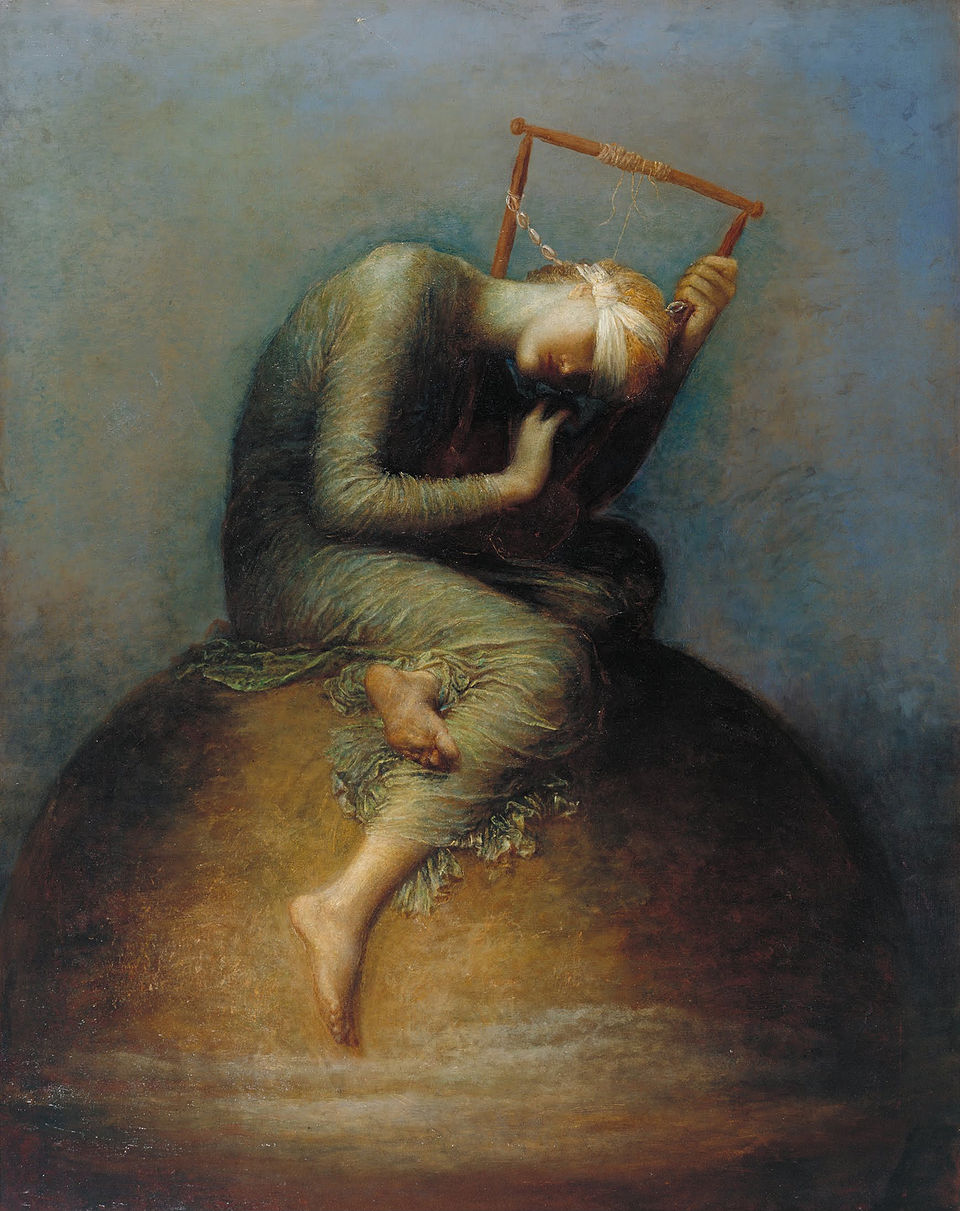
George Frederic Watts: Hope (1884) (source)
Sources
Adorno, Theodor W. & Max Horkheimer: Dialectic of Enlightenment, Frankfurt a.M. 1998.
Bejan, Teresa M.: Hobbes Against Hate Speech. In: British Journal for the History of Philosophy 32/2 (2022), PP. 247-264.
Fukuyama, Francis: The End of History and the Last Man, New York 2006.
Günther, Gotthart: The consciousness of machines. A metaphysics of cybernetics. 3., for an introduction and the German translation of Cognition and Volition extended edition. Baden-Baden 2002 (also available online).
Heidegger, Martin: Overcoming metaphysics, In: Talks and essays (1954). Pfullingen 1985.
Jonas, Hans: The principle of responsibility. Frankfurt am Main 1986.
Sloterdijk, Peter: foams. Spheres III Frankfurt am Main 2004.
Lukács, Georg: Tactics and ethics. In: Political essays I: 1918—1920. Darmstadt & Neuwied 1975.
Sontag, Susan: What's Happening to America (A symposium). In: Partisan Review 34/1 (1967), p. 57 f.
Footnotes
1: The happy science, No. 359.
2: The tendency to completely expel Thymos can be found among the fathers of liberal thought (see Fukuyama, p. 184 f.). Hobbes and Locke could therefore be described as the first woke. It fits in with the fact that Hobbes was the first thinker to use a mature language custom of political correctness than Agree not to disagree devotion, which provided for state penalties. Because even contradicting someone else's opinion is a source of aggression, its articulation should be prohibited, at least on fundamental issues, and especially vis-à-vis the state. Consensus becomes the first civic duty. Cf. Hobbes, From Cive, Sections five and six in the first chapter. See also Teresa M. Bejan: Hobbes Against Hate Speech. pp. 247-264. In defense of Hobbes, it could be noted that his thinking was hypnotized by the proximity to the Thirty Years' War (1618-48).
3: Heidegger, Overcoming metaphysics, p. 94 — It remains appealing to imagine how the cultural development of the West would have gone if Augustine's rival thinker Pelagius, who emphasizes free will for his own moral efforts and rejects the thesis of the original corruption of man as a sin being, had become formative.
7: Cf. Gotthard Günther, The consciousness of machines, p. 102 ff.
8: Cf. The happy science No. 56.
9: Sloterdijk, spheres III, pp. 690 & 696. The entire third chapter of this volume can be read as a canonical continuation of “cheerful science,” which masterfully strives to illustrate the relieving weight of the world in modern times.
10: The happy science, No. 370.
11: The benefits and disadvantages of history for life, Paragraph 1.
12: Jonas, The principle of responsibility, P. 36.
13: With the concept of “second ethics,” Lukács argues that a crime (such as violence or murder) has ethical value when the agent knows that it is actually wrong — the first ethics of law — but still commits the act in order to achieve the higher goal of the revolution. You sin for the absolute good: “Only someone who knows steadfastly and unquestionably that murder is not permitted under any circumstances can — paradoxically and tragically — commit murder as an ethically moral act” (Georg Lukács, Tactics and ethics (1919), P. 77).
14: The happy science, No. 343.
15: In addition to the path to mobilization through polarizing populisms as a kind of instant identity, the supermarket also lends itself to denying reality, which promises a vacation away from identity with increasingly sophisticated entertainment media. Gaming and streaming are digital paradises that accommodate “goodwill to shine.” Consumers are lucky enough not to need Thymos first-hand. However, there is also a paradoxical overconsumption which, in the form of connoisseurism, develops megalothymic superiority in an area aimed at complete neutralization of “courage.”
17: Ibid.
18: “If you consider how a philosophical overall justification of his way of living and thinking works on each individual — namely like a warming, blessing, fertilizing, shining specifically for him sun, how it makes self-sufficient, rich, generous in happiness and goodwill regardless of praise and rebuke, as it incessantly turns evil into good, all powers to blossom and mature Bringing and not letting the small and big weeds of grief and annoyance arise at all: — this is how you finally exclaim: Oh that many Such new suns would still be created! Even the bad guy, even the unfortunate person, even the exceptional person should have his philosophy, his right, his sunshine! “(The happy science No 289.)
19: The Gay Science, § 341 (translation: Walter Kaufmann. New York: Random House 1974, p. 274.