“Revolt, Slaves, Revolt!”
Hiking with Nietzsche Through Evangelical Christian London: Part I
“Revolt, Slaves, Revolt!”
Hiking with Nietzsche Through Evangelical Christian London: Part I


From the hedge-fund billions that bankroll Nigel Farage, and tie that funding to evangelical expansionism, to Nietzsche’s fulminating assault on Christianity as a “slave revolt”: this essay tracks the troubling way religion has reappeared at the heart of British public life. Arriving in London with walking boots, a rucksack, and a philosopher’s skepticism, the author follows the money, theology, and street culture surrounding charismatic Christianity and its seemingly unappeasable growth. At the centre stands Sir Paul Marshall: billionaire financier, Christian media mogul, and embodiment of a faith that feels entitled to reach for elite power.
But this is more than merely an unveiling of the knot that binds together wealth and religion. It is also a confrontation with Nietzsche’s deepest historical claim: that Christianity triumphed because the so-called weak learned to moralize against the strong. Wandering through churches, cafés, and city streets, the essay asks whether contemporary evangelical London represents a new form of that revolt—or its complete inversion.
Part I explores the rise of influential evangelical networks in modern Britain and their uneasy alliance with finance capitalism. Part II, which will appear shortly, returns to the first Christians themselves.
This article is a follow-up to Henry Holland’s account of hiking through Glasgow’s Muslim Southside (part I, part II).
Introduction
For readers who grew up, like me, during a high tide of secularism in the West, it has been a surprise and a shock to witness that tide turn. The secularist and consumerist wave probably peaked in the 1980s: this was a world captivated by the newest consumer gadget in the shops, the latest football star to move clubs for a world record transfer fee, and the advertising that told you sex with the sexiest was yours for the taking – if you could only rise high enough, Michael Jordan-like, to pass society’s cruel tests on who gets to have what.1 Religion and theology gathered dust somewhere in the psyche’s hinterlands. Born into a church-going and clerical family, I was of the minority still garnering religious experience, on Church of Scotland pews. But this was quaint tradition and ritual; middle-class, do-gooding whimsy; and it hardly felt like it really mattered.
Organized religion’s reclamation of a strong-arm role in British civic society flares up, highly visible, on certain city streets, but is also the result of a hundred big money deals conducted over restaurant tables or in closed rooms, which most of us only hear about years after they’ve been struck. One such spiritually minded dealer is Sir Paul Marshall. He started going to services at Holy Trinity Brompton, now commonly called HTB, in West London when in his late thirties, in 1997 – the same year he and accomplice Ian Wace got family, friends, and George Soros to chip in spare cash so that they could float their hedge fund with $50 million in seed capital. Knowing that this same fund, Marshall Wace, held $69 billion in assets as of 2025, helping the world’s richest get that tick richer, should remind us of one of the New Testament’s most conscience-nagging lines: ‘It is easier for a camel to go through the eye of a needle, than for a rich man to enter into the kingdom of God.’2 But fairness demands we also report Marshall’s consistent attempts to give away large chunks of his fortune. With assets and personal wealth estimated at around £900 million, this is easier for Jesus to encourage than for heavily moneyed Christians to do, despite the ‘hundreds of millions’ Marshall has poured into ‘schools, universities, and churches’, and into programs training Church of England priests.3
Are these phenomena necessarily suspect? And how can Nietzsche, with his infamous and still-reverberating polemics against Christianity, give us a novel perspective on it? These questions rattled around my head as my train drew into King’s Cross station early last August, fresh from my Islamic Studies jaunt around Glasgow (see my two-part article from November 2025 in this magazine4), rucksack strapped to my back and walking boots to my feet, my heart set on digging out answers from the ground up. In part one of this essay I set the scene regarding Marshall and charismatic or evangelical Christianity in London (shifting terms for the same entity), and how my urban pilgrimage walks there revealed a community that should be seen as an unexpected inversion of the ‘Slave Revolt’: Nietzsche’s catchy coinage for how an obscure, first-century Jewish sect became a world religion. In part two I turn the tables on Nietzsche’s meta-narrative on Christianity’s historical role, drawing on recent historical and religious studies research on the early Christians. As several leaders of this group did indeed grow up as slaves, or as children of slaves, shouldn’t their rebellion against a religious and social orthodoxy that was built on slavery be seen as an ethical act, and a justice-based movement, against the fatalistic and tyrannical Greco-Roman world that they were merging out of?
Marshall and Charismatic-Evangelical Christianity: Who Gets to Call who Names?
Marshall seeing religion and politics as two manifestations of a single endeavour comes into focus when you learn of which media he has bought into and pushed in the last five years. Following the launch of GB News in 2021, Marshall pledged to fund the platform to the tune of £70 million over its first two years. It’s a catchall cauldron of ‘breaking’ non-news, a politics of hate boiled and re-boiled to death, hounding its obsessions with all the grace of a terrier that’s carrying half-dead prey in its mouth. A terrier that would rather die than drop it. ‘Small boat arrivals [in the UK] on track to hit 200,000 TODAY with less than 8,000 deported in eight years’,5 the platform screams in a story that’s tweaked then recycled daily. This platform has no truck with the philosophical caveat declaring that the collective ethical agency of these 200,000 immigrants is no better or worse than the collective agency of any other randomly selected 200,000 UK residents. But another current affairs outlet that Marshall has spent millions on is incomparably more nuanced, even philosophical at times. This is a long-journalism outfit, to which non-conformist writers from both Right and Left contribute, and which goes by the distinctly Nietzschean name of UnHerd. Its financing opaque (though we estimate Marshall has forked out £17 million for the endeavour, in the nine years since it was founded)6, it manages, unlike GB News, to host genuinely great writing, through pairing unlikely voices. Terry Eagleton, for example, celebrated cultural theorist, Marxist, and paid-up anti-Nietzschean in political terms,7 has contributed dozens of articles, including the pertinent ‘Was Jesus a Revolutionary?’.
Eagleton’s colleagues representing the Right on the paper don’t hold back when it comes to opinionizing on Brexit, and what they see as its emancipatory consequences. Sohrab Ahmari, the US editor of UnHerd and a convert to Catholicism, published a fawning interview with US trade representative Jamieson Greer, parroting enthusiastically Greer’s words on the 2025 Transatlantic Trade Deal: ‘Brexit made it possible for the UK to do this’, i.e., to seal the agreement.8 Joining up the dots, the £100,000 donated by UnHerd’s owner to the Vote Leave campaign in 2016 seems like a flinging of loose change into the hat; Marshall’s bankrolling of Nigel Farage to the tune of £80,000 monthly, for the latter to present a show on GB News, reads, by contrast, like a strategic intervention to buy a neo-Conservative future for a particular walled-off island state.9
If none of this sounds faintly Christian in the colloquial sense of pity for and engagement with the poor and the meek, then it would be politic to step back a decade, or century, or two, to understand more about the evangelical or charismatic wing of the religion that Marshall is part of. We know of the etymological roots in the ancient Greek εὐαγγέλιον (euangélion), meaning good news or glad tidings, and of John (c. 6–100 CE), and the other gospel writers, as the Evangelists: the proclaimers of things ‘written, that ye might believe … and that believing ye might have life’: as John puts it.10 And from the time when other New Testament books took shape, between c. 60-90 CE, ‘evangelist’ was being used more broadly to name any wandering preacher of this same good news.11 Like the preachers whose training was paid by Marshall, these itinerants spoke with the will to convert, and with the self-empowerment belief can give you. Andrew Graystone, author of a recent book on the child abuse scandal implicating evangelical leaders that forced the resignation of Justin Welby as Archbishop of Canterbury (and thus as head of the Anglican Church) last year, sums up the anti-intellectual certainty that the HTB approach expounds: ‘You believe that your brand of Christianity is the only way to get to heaven. You believe that you were selected by God to govern.’12 The same author’s assertion that ‘Marshall’s money set the agenda of the Church [of England; hereafter C-of-E] under Welby’,13 seems justified, when we reconsider what ‘to govern’ means in the vendible system of UK democracy today. Marshall’s ‘generous’ funding of the HTB venture St Mellitus Theological College means it now educates one in four C-of-E clerics;14 the £10 million (a conservative count) that he’s funnelled into the Church Revitalisation Trust has enabled that organ ‘to plant’ 185 Marshallian ‘City Centre Resource churches in key cities across England and Wales’, a conquest that includes the recruitment of ‘worship leaders ... children’s workers ... and social action workers’.15 From out of the shadows, this figure seems to be at least co-governing what has historically been the world’s most influential Protestant church.
Everyday Londoners and Other Evangelicals
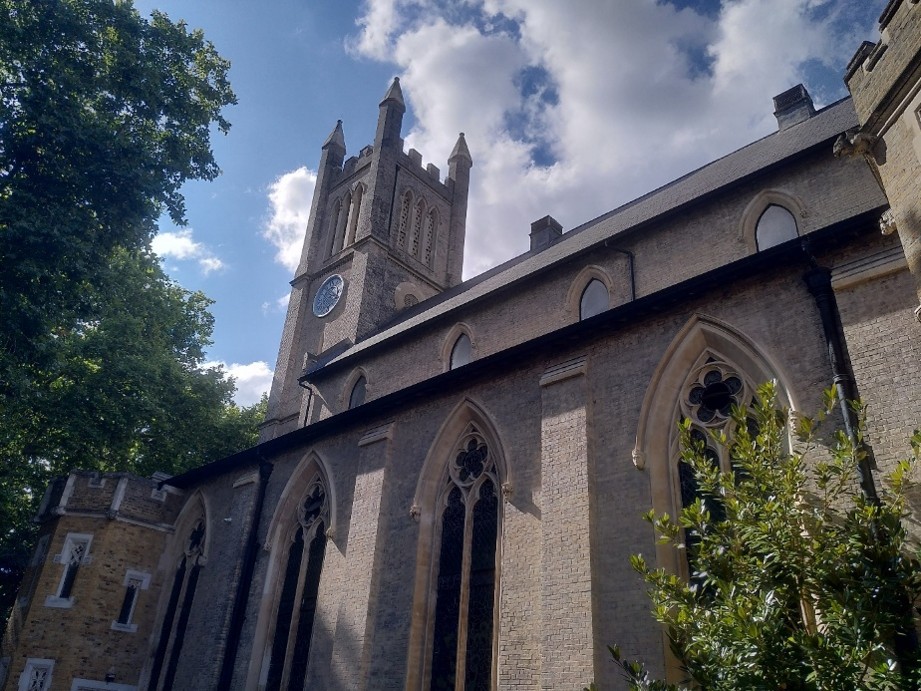
Knowing something of Marshall’s form, the HTB church is the natural place for me to start my investigative hike. Two minutes from Knightsbridge’s bling-bling denizens and shops, and encountered on a weekday with no services underway, the church feels all English pastoral, its tower topped with form rather than escape: a square, battlemented parapet. (It’s lovely irony to learn later that choosing this rather than a spire was a money-saving move by the church’s commissioners in the 1820s.) The polygonal vestry annex to the tower’s left is Gothic Revivalism in force, and the place where still today the clergy shed and don their vestments, to represent symbolically what Nietzsche calls ‘the priestly caste’.16 When I’m appalled again by the behaviour of flesh and blood Christians, it’s church architecture and indeed all the heights of sacred art that win me back, that leave me feeling that something here is worth preserving. Or even worth embodying. The boards up on the outside of the church advertising Alpha, the globally successful evangelising course launched from HTB in the 2000s, confirm that I’m in the right place for my investigations.17 Wanting to give everyday Christians another chance, I descend to the Bloom Cafe in the undercroft. Where I’m reminded that the UK now runs, any ethically responsible governing class that once served long since departed, mostly on a blend of hot beverages and kindness between ordinary inhabitants of the place.
Returning for a second Earl Grey, I get talking to Lisa, a South African, who’s preparing the drinks and serving the cakes behind the counter. I mention Alpha as a gambit, so Lisa asks me if I’m a Christian. I hedge: ‘good question’. ‘Well, then Alpha might be the very thing for you’, she responds, before pressing a slim paperback, A Life Worth Living, by Alpha-designer and former HTB vicar Nicky Gumbel, into my hands. Embarrassed by the God-talk, I return to peruse the notice on my table, informing me that revenue from my visit is going towards their ‘Social Transformation Ministry’, which prioritises those on society’s fringes ‘including women, displaced persons, prison leavers and those experiencing homelessness.’ Not doubting that those employed in this ministry work wholeheartedly to accompany these individuals, I’m fascinated how a project fuelled by Big Capital18 can talk authentically this socialist-sounding talk. The highlighting of ‘women’ as among the most marginalized is both reality – London women have substantially lower average incomes than London men, and are at higher risk of being victims of violent and sexual crimes – and a thinly-veiled political stand. Commentators in the HTB camp are fierce opponents of what they call the ‘ideology’ of ‘transgenderism’, going so far as to argue that it has ‘captured’ the BBC.19

The Christian Poets’ Streets of London
Covering miles on foot begins in godly earnest the next morning. I’ve chosen the London Martyrs’ Way, a leisurely and faithfully-curated route that meanders from Tower Hill in the city’s east, to Tyburn Tree in Hyde Park, in the city’s west.20 Follow it, and it will lead you to and past the sites of dozens of religiously-motivated executions, churchyards, and churches closed and open, pools of quiet yards away from briskly-walked streets, yards from the techno-like thrum that is London, and which never really gets switched off. The literature and history obsessed, including this author, could spend days on this trail: who wouldn’t nip round that next corner, and try that next church’s great metal door handle, to get a glimpse of the places Samuel Pepys or William Blake worshipped?21 Almost every step incarnates my bookishness. I’m led to ‘where Saint Mary Woolnoth kept the hours’, arrived at after, as T. S. Eliot reports in his epoch-making poem The Waste Land, ‘... each man fixed his eyes before his feet. / Flowed up the hill and down King William Street’.22 Aware of the tidings of The Waste Land as the mostly London terrain Eliot crosses between his infinitely talented and clever agnosticism, and his conversion to Anglo-Catholicism,23 makes seeing this church matter. But it’s not just white Anglo-American male seekers that the walk calls to mind. Soon after Tower Hill, where Catholic leaders John Fisher and Thomas More were beheaded in the summer of 1535 for resisting Henry VIII’s worldly overreach, you enter a square, ringed by skyscrapers, in which a cluster of inscribed columns meets you. These are the Gilt of Cain,24 a sculpture commemorating the bicentenary of the abolition of slavery in the British Empire. One column demands: ‘WHO WILL KICK OVER THE STALL AND TURN THE TABLE?’, a line by poet Lemn Sissay invoking Christ throwing over the tables of financial operators in the Temple,25 and thus rearticulating the unanswered question: who will finally put the brakes on the financial class and on the havoc they wreak? The class who built wealth through investing savvily the profits of slavery, and who still inhabit, representatively, the district in which this sculpture stands, the officiously named ‘City of London’?26
As unable to answer these questions as the next philosophically-inclined human, I stride on, past the entrance portico of the National Provincial Bank of England, whose deep barrel vault wants to induce the awe we can feel on the threshold to a Romanesque cathedral – or leaves us scrambling for our architectural guides, if we’ve forgotten such features’ names. I pass St Edmund, King and Martyr, its ancient plaque claiming ‘206 feet superficial’ of ‘the ground on each side of the doorway’ as its ‘freehold property’. Its modern, less pedantic sign calls it an ‘imprint church’. This is corporate but also God-given language, or so asserts Wole Agbaje, a Nigeria-born, South-London-raised evangelical, who refounded the congregation here in an HTB-backed manoeuvre, aged just 24. Agbaje retells the story of an earlier dream he had, seven nights running, of ‘forming a Gospel Showcase to tell the story of Jesus through creative media’, and of feeling ‘God say that it was going to be a movement called IMPRINT and it would bring his prodigals home’. With this divine green light leaving no room for doubt, Agbaje is seen as achieving the rejuvenation desired: just under ‘200 young people’ crowded into St Edmund for its September 2019 relaunch.27
Shining Faith With the Dullest and Greatest Music
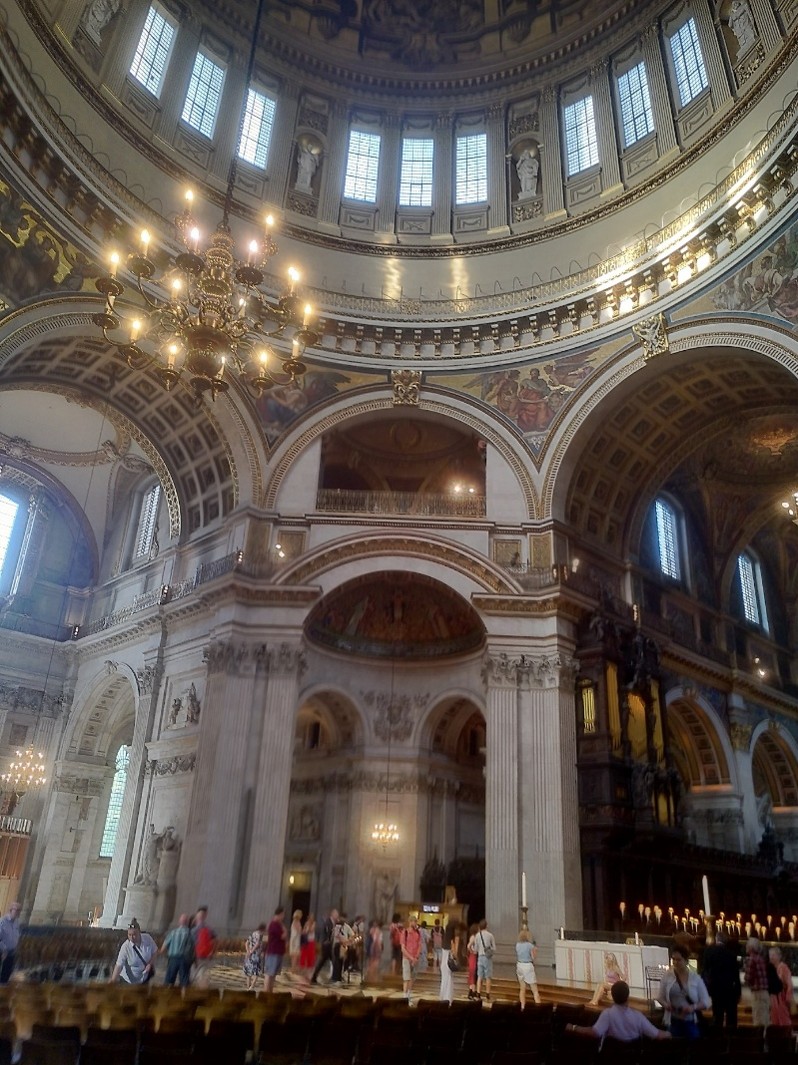
Agbaje’s partly realised dream is to synthesise the stage arts of ‘drama, poetry, dance, video visuals and music’ to tell the ‘story of Jesus’ to Londoners.28 I won’t judge his musical aesthetics until I’ve attended one the Christian jamborees he curates. But regarding the rest of the HTB crowd, as you’d hear for yourselves if you were to enter their services, it’s Christian guitar rock ad infinitum, upbeat, generic, and incredibly dull. Unquestionably, the singers and guitarists are competent, or even talented; yet you’d have to be a hardened believer not to soon desperately sicken of it. As the songs’ protagonists already realise their sinners’ status and need for Jesus’s redemption when the music begins, the utter absence of drama, or of an individualised voice, leaves sceptical listeners wondering how they’ll survive the next six minutes.29 Back in the US, the home of such holy guitar riffs, Johnny Cash manifested more compelling anguish in one single phoneme, or chord change, of his dozens of songs about being a Christian: just listen to ‘The Man Comes Around’.30 Only one person in creation’s history gets to be Cash, but with such a soul and mind expanding heritage of sacred vocal music in English to draw from, both popular and pre-electric, the HTB leadership decision to reproduce boilerplate Neo-Gospel-Rock down the line feels smugly philistine. Walking tall away from such mere repetition, as a Cash protagonist would teach us to do, I am led to a different aesthetic world. Quite unplanned, my boots to have taken me to the approaches to St Paul’s Cathedral, the midpoint of the London Martyrs’ Way, just as the bells are calling the curious to the 5 pm Sung Eucharist.31 This is held in the drum or tall cylinder that supports the building’s central dome, the unusually large windows for a church of this time (completed under Christopher Wren’s direction in 1708) allowing sunlight from this late summer day to pour in. Sitting waiting for the service to start, your eyes are drawn up the great masonry piers, clad in the typical fluting of these times, to the Whispering Gallery thirty metres above. The whole thing is certainly grand, but free of the too-much pinky-goldness that affects many Baroque churches. Both believers and committed secularists can find beauty here, the latter left pondering which agency this movement has wielded, a non-existent deity as its focus, enabling disciples to expend such energy and resources creating this.
The unaccompanied liturgical chants that form the service, the congregation responding in turn, are nothing new, yet aren’t even slightly repetitive.32 The Sursum Corda or ‘Lift up your hearts’ dialogue, sung just before communion is taken, is one of the church’s oldest, its text dating to the Canons of Hippolytus (written early 200s, CE)33. Its melody’s basic shape emerged around the same time, and is sung today in G Mixolydian – piano and guitar players: think G Major, with a flattened 7th (F sharp to F natural).
From London Slave Ship Captain to Participant in the Slave Revolt
A talented pianist, and occasional composer, Nietzsche wrote much about music,34 and occasionally about its churchy forms. While young, he was far from being the Christian-baiting devil he posed as in his later years. A twenty-five year old professor in Basel, Nietzsche writes to his friend Erwin Rohde to recommend the ‘godly Bach’, whose St Matthew’s Passion he’s heard ‘three times’ in the past week: anyone who has ‘completely lost their knowledge’ of Christianity will hear it again in this music, which is ‘genuinely like a Gospel [Evangelium]’.35 Such passion fits with his early theory of Christianity as affirmational rather than nihilistic, and as carrying cultural gifts forward from a Grecian and particularly Dionysian world view. His note 7[13] on this from late 1870 / early 1871 can’t be read in isolation, yet nonetheless pictures early Christianity as a juxtaposition or even friction between Johannine-Grecian attitudes on the one hand, and Judaic attitudes on the other:
The Gospel according to St John born out of Greek atmosphere, out of the soil of the Dionysian: its influence on Christianity in contrast to Judaism.36
However already at this stage of his career, Nietzsche is propagating original and dehistoricizing standpoints on early Christianity, in texts including the disturbing 1872 essay on ‘The Greek State’, which he distributed to a coterie audience but chose not to publish during his active lifetime.37 In a text that argues for slavery, no abstract topic after the American Congress had passed the Abolition Amendment in January 1865, thus liberating four million African Americans, Nietzsche has brass neck enough to claim that
The enormous social emergencies of the present are born out of the emasculation of the newer type of human, not out of genuine and deep compassion with that misery; and if it is true that the Greeks’ [system of] slavery was their ruin, then the counterpart of that is far more certain, that the lack of slavery will be our ruin: a quantity that neither ancient Christianity, nor the ancient Germanic nation [Germanenthum] regarded as the least objectionable, still less condemnable.38
The progress from this philo-Christian position, hardly tenable when newer historical research on Christianity and slavery is brought to bear on it, and Nietzsche’s later, and better-known genealogy of Christianity as an ultimately successful ‘Slave Rising’ [Sklavenaufstand], whereby a former slave class became, over the course of almost two millennia, the ruling, ‘priestly’ class in the West, subjugating almost everyone to its life-denying worldview, is convoluted. But it’s also the subject of a small army of excellent articles and books, both popular and scholarly in emphasis.39
I cannot summarize this discourse here, but do repudiate Nietzsche’s 1872 argument: early Christian clergy and laity, many of them slaves themselves, or their descendants,40 were so opposed to granting one group of humans the legal rights to physically use the bodies of other humans at will,41 that this opposition became their signature idea, the motor behind their paradigm shift in ethics and in ideas. How this shift played out, and in some senses collapsed from the late fifteenth century, when thinkers of European colonialism reread canonical Christian texts to justify the enslavement of non-European peoples as labour power for the new colonies will be returned to in part II. Here I’ll also illuminate new angles on Nietzsche’s writing on both Christianity and slavery. But we part for now by returning to the City of London. Wole Agbaje, who refounded St Edmund, King and Martyr in 2019, is also responsible for the parish church that ‘chapel of ease’ is attached to – St Mary Woolnoth – and speaks out about its history.42 John Newton, former slave ship captain turned abolitionist, and lyrics-writer for ‘Amazing Grace’, preached here as Rector in the late 1700s: and for abolition. Newton mentored William Wilberforce, evangelical Christian and leader of the parliamentary wing of abolitionism in Britain until parliament passed the Slave Trade Act in 1807, prohibiting the Atlantic Slave Trade within British Empire territory.43 Why Nietzsche sought to resuscitate this most brutal of practices, which Black abolitionists in his lifetime, including Frederick Douglass (1818–1895), Harriet Tubman (c. 1822–1913), and Sojourner Truth (1797–1883),44 were dedicating their lives to fighting – and what that partisanship means regarding Christianity as a ‘slave rising’ – will be addressed in this essay’s concluding part.
To be continued.
All photographs have been taken by Henry Holland. The article imagine shows the ‘Gilt of Cain’ sculpture, in Fen Court in the City of London. On it, one finds inscribed a verse by poet Lemn Sissay: ‘WHO WILL KICK OVER THE STALL AND TURN THE TABLE?’.
Bibliography
Ahmari, S. (2025, May 9). US trade chief: Brexit liberated the UK. UnHerd. https://unherd.com/2025/05/us-trade-chief-brexit-liberated-the-uk/
Bradshaw, P. F., Johnson, M. E., & Phillips, L. E. (2002). The Apostolic tradition: A commentary (H. Attridge, Ed.). Fortress Press.
Brown, C. L. (2006). Moral Capital: Foundations of British Abolitionism. University of North Carolina Press.
Burley, R. (2026, May 18). Inside the capture of the BBC: How transgenderism killed impartiality. UnHerd. https://unherd.com/2026/05/inside-the-capture-of-the-bbc/
CCX. (2019, October). Plant stories: IMPRINT Church London. The Gregory Centre for Church Multiplication. https://ccx.org.uk/stories/imprint-church-london/
Deleuze, G. (1994). Difference and repetition (P. Patton, Trans.). Columbia University Press. (Original work published 1968)
Douglass, F. (1855). My bondage and my freedom. Miller, Orton & Mulligan.
Eagleton, T. (2026). The Ideology of the Aesthetic — Friedrich Nietzsche. Twentieth-Century Literary Criticism (M. Lazzari, Ed.). Gale Cengage. (Article originally published 1990.)
Eagleton, T. (2022, April 15). Was Jesus a revolutionary? UnHerd. https://unherd.com/2022/04/was-jesus-a-revolutionary/
Eagleton, T. (2024, February 22). Seeds of What Ought to Be? London Review of Books. https://www.lrb.co.uk/the-paper/v46/n04/terry-eagleton/seeds-of-what-ought-to-be
Eliot, T. S. (2025). The waste land. Poetry Foundation. https://www.poetryfoundation.org/poems/47311/the-waste-land (originally published 1922)
Elgat, G. (2015). Slave revolt, deflated self-deception. British Journal for the History of Philosophy, 23(3), 524–544. https://doi.org/10.1080/09608788.2015.1013915
Foner, P. S. (1950). Frederick Douglass. Citadel Press.
Forster, M. N. (2022). Nietzsche: Three genealogies of Christianity. Genealogy, 6(2), 38. https://doi.org/10.3390/genealogy6020038
GB News. (2026, May 5). Migrant crisis: Small boat arrivals hit 200,000 with only 8,000 deported in eight years. https://www.gbnews.com/news/migrant-crisis-small-boat-arrivals-hit-200000-8000-deported-eight-years
Geoghegan, P. (2025, March 6). Making media great again: Peter Geoghegan on Paul Marshall. London Review of Books, 47(4). https://www.lrb.co.uk/the-paper/v47/n04/peter-geoghegan/making-media-great-again
Geoghegan, P. (2025, March 8). We need to talk about Paul (Marshall). Democracy for Sale. https://democracyforsale.substack.com/p/we-need-to-talk-about-paul-marshall-unherd-spectator-gb-news
Graystone, A. (2021). Bleeding for Jesus: John Smyth and the cult of the Iwerne camps. Bloomsbury Continuum.
Graystone, A. (2024, March 27). The Marshall Plan: Hedge fund manager Paul Marshall is on a God-driven mission to transform the religious fabric of the nation. Prospect Magazine. https://www.prospectmagazine.co.uk/ideas/media/65415/the-marshall-plan-paul-marshall-gb-news
Holland, T. (2019). Dominion: How the Christian revolution remade the world. Little, Brown.
Nietzsche, F. (1874/1997). On the use and abuse of history for life (Part II of Untimely meditations). In D. Breazeale (Ed.), Untimely meditations (R. J. Hollingdale, Trans.). Cambridge University Press. (Originally published 1874)
Nietzsche, F. (1887/2006). On the genealogy of morality (C. Diethe, Trans.; K. Ansell-Pearson, Ed.). Cambridge University Press.
Nietzsche, F. (2009). Notebook 7, end of 1870–April 1871. In R. Geuss & A. Nehamas (Eds.), Writings from the early notebooks (L. Löb, Trans., p. 33). Cambridge University Press.
Olshanetsky, H., Silverman, A., & Cosijns, L. (2026). Turning the tables: Re-evaluating the incident between Jesus and the money-changers. Cogent Arts & Humanities, 13(1), 2587102. https://doi.org/10.1080/23311983.2025.2587102.
Painter, N. I. (1997). Sojourner Truth: A life, a symbol. W. W. Norton.
Pollock, J. (1977). Wilberforce. St Martin’s Press.
Rayman, J. (2022). Nietzsche’s genealogy in its relation to history and philosophy. Genealogy, 6(2), 54. https://doi.org/10.3390/genealogy6020054
Seal, D. M. (2025). The intersectionality of gender and slavery: Paul’s social creativity within an unchangeable system. Journal for the Study of the New Testament, 48(1). https://doi.org/10.1177/0142064X241313487
Sernett, M. C. (2007). Harriet Tubman: Myth, memory, and history. Duke University Press.
Snelson, A. (2017). The history, origin, and meaning of Nietzsche’s slave revolt in morality. Inquiry: An Interdisciplinary Journal of Philosophy, 60(1–2), 1–30. https://doi.org/10.1080/0020174X.2016.1251167
Stauffer, J. (2008). Giants: The parallel lives of Frederick Douglass and Abraham Lincoln. Twelve Books.
Stewart-Kroeker, P. (2024). Nietzsche on Socrates, Jesus, and the slave revolt in morality. International Journal of Philosophy and Theology, 85(3–4), 142–164. https://doi.org/10.1080/21692327.2024.2423000
Truth, S. (1850). The narrative of Sojourner Truth. Printed for the author.
Tubman, H. (2023). Scenes in the life of Harriet Tubman. Graphic Arts Books. (Original work published 1869).
Footnotes
1: I don’t suggest that secularism and consumerism are in anyway identical. But they have often manifested themselves side by side in recent history. What secularism means in the light of Nietzsche’s writings would make a good standalone essay.
2: Matthew 19:24; these and all other bible quotes in this essay are cited from the King James Version, unless otherwise stated; for an informative and myth-busting essay on Marshall’s money and his politics, including the statistics given here, see: Peter Geoghegan, ‘Making Media Great Again’.
3: Ibid., unpaginated.
5: GB News, ‘Migrant Crisis’.
6: For more on the platform‘s financing, and Marshall’s economic-political role in it, see: Graystone, ‘The Marshall Plan’, and Geoghegan, ‘We need to talk about Paul (Marshall)’.
7: In ‘The Ideology of the Aesthetic — Friedrich Nietzsche’ Eagleton (1990) calls Nietzsche ‘a belligerent opponent of almost every enlightened liberal or democratic value who speaks up for “everything haughty, manly, conquering, domineering”’ (cf. Beyond Good and Evil, § 62). Thirty-four years later, Eagleton (2024) published again on Nietzsche’s ‘rancid politics’ (‘Seeds of What Ought to Be?’).
8: Greer cited in Sohrab Ahmari, ‘US Trade Chief: Brexit liberated the UK’.
9: Greer cited in Sohrab Ahmari, ‘US Trade Chief: Brexit liberated the UK’.
10: John 20: 31, King James Version.
11: Cf. Ephesians 4:11, and Acts 21:8.
12: Graystone cited in Geoghegan, ‘Making Media Great Again’, unpaginated.
13: Graystone cited in Geoghegan, ‘Making Media Great Again’, unpaginated.
14: Graystone, ‘The Marshall Plan‘, unpaginated.
15: Cf. Geoghegan, ‘Making Media Great’, and Graystone, ‘The Marshall Plan’, both unpaginated.
16: First developed in ‘On the Use and Abuse of History for Life’, Part II of Unfashionable Observations (1874) (see §8), Nietzsche only fully develops the notion of ‘the priestly caste’, who presides influentially, and in life-denying, ascetic manner over contemporary society, in The Genealogy of Morality, § I — 6 (1887), and in notes from this time that were published posthumously: NF-1887,11[280] — Posthumously Published Notes, dated to November 1887 —March 1888.
17: Cf. Graystone, Bleeding for Jesus, pp. 158-159. Here Graystone explains how Alpha was developed by former HTB vicar Nicky Gumbel, together with Charles Marnham and John Irvine, all of whom Graystone characterises as shaped by participation as children and teenagers in ‘the Irwerne camps’: evangelical holiday institutions, run primarily for the children of the British elite, and thus focussed on those attending Britain’s top public schools. The scandal surrounding the camps broke in 2017, when it emerged that John Symth (1941–2018), one-time Iwerne Trust chairman, had serially abused children in the camps in the 1970s and 1980s. Justin Welby, Archbishop of Canterbury from 2013–2025, also attended the camps while growing up, and maintained personal relations with Symth for decades, as described in this article from December 19, 2024: https://www.lrb.co.uk/blog/2024/december/technically-leading.
18: Rosa Luxemburg (1861–1919) and other Marxist thinkers of her generation routinely talked of Big Capital (Großkapital), by which they meant those capitalists that owned the means of production with the highest monetizable value: and those capitalists’ economic interests. With later Marxist thinkers agreeing that the means of production also (re)produce culture, the term remains relevant.
19: Rob Burley, ‘Inside the capture of the BBC: How transgenderism killed impartiality’.
20: For a route and thoughtfully made digital guide, see: www.britishpilgrimage.org/portfolio/london-martyrs-way.
21: Samuel Pepys (1633–1703): English naval administrator and diarist, best known for his detailed diary documenting daily life in Restoration England, including the Great Plague and the Great Fire of London. William Blake (1757–1827): English poet, artist, and printmaker whose visionary works, including Songs of Innocence and of Experience, combined Romantic poetry with distinctive visual art.
22: T. S. Eliot, The Waste Land, Section I.
23: This current within the Anglican Church, attractive particularly for artists and intellectuals in the twentieth century’s first decades, keeps faith with the Anglican Communion, while striving aesthetically and theologically to see itself as part of ‘the one church‘ that has its earthly headquarters in Rome.
24: A collaboration between sculptor Michael Visocchi (b. 1977), poet Lemn Sissay (b. 1967), and graphic designer Gareth Howat, the City of London Corporation commissioned the piece, which was unveiled in 2008.
25: Mark 11:15: ‘[A]nd Jesus went into the temple, and began to cast out them that sold and bought in the temple, and overthrew the tables of the moneychangers’, King James Version. The Greek word here for ‘moneychangers’, kollybistēs (plural kollybistai), means literally a currency exchanger who charged commission for their service. This job was necessary because the half-shekel Temple tax had to be paid with a Tyrian tetradrachma, a currency that many visitors to the Temple did not have. For historicizing research on this verse from Mark, see: H. Olshanetsky, A. Silverman, & L. Cosijns, Turning the tables.
26: Also known as the Square Mile, this is both a local government district in the middle of London, and a global centre for finance capitalism.
27: Statistics and quotes from: CCX (2019), ‘Plant stories’, unpaginated. This does not try to be a neutral source; impartial sources on HTB-backed ‘church plants’ are hardly to be found.
28: Ibid.
29: Listen in, for example, to the video of the HTB service from 10 August, 2025, from c. 6:20: https://www.youtube.com/watch?v=Hm7vP_sOI60.
30: 4.5-minute YouTube version: https://www.youtube.com/watch?v=k9IfHDi-2EA&list=RDk9IfHDi-2EA&start_radio=1.
31: In this communion service, a regular C-of-E fixture, the celebrant sings rather than speaks most of the liturgy.
32: The question of repetition versus difference deserves philosophical attention, but cannot be answered here on the fly. I advise readers wanting to explore here further to revisit this thorough, and Nietzsche-inflected treatment: Deleuze, Difference and Repetition.
33: Cf. Paul F. Bradshaw, Maxwell E. Johnson, and L. Edward Phillips, The Apostolic Tradition, p. 39.
34: For a first glance into Nietzsche’s deep biographical and philosophical connection to this form of art see two articles dedicated to the topic of ‘Nietzsche and music’ on this blog by Christian Saehrendt and Paul Stephan.
35: Nietzsche to Erwin Rohde on April 30, 1870. This and all other translations from original German-language texts are the author’s own, unless otherwise stated.
36: The posthumously published ‘Notebook 7, end of 1870 - April 1871’ in Nietzsche, Writings From the Early Notebooks, p. 33. German-original at: http://www.nietzschesource.org/#eKGWB/NF-1870,7[13].
37: Presented as a private print to Cosima Wagner, the essay is the third in the collection of Five Prefaces to Five Unwritten Books.
38: The Greek State. Emphasis in the original.
39: The best place to begin with this reading is Nietzsche’s own Genealogy of Morality (1887), section I – 7, and section I – 10. Section I – 7 characterises Christianity as a takeover led by a ‘caste of priests’, aimed ascetically against everything that lends ‘a blossoming, rich, foaming-over health’ and ‘bodilyness’ to life. Moreover, Nietzsche blames ‘the Jews’ for introducing this strain into the history of morality, and regards Christianity as a continuance of this intervention, and as no rupture from it: ‘Regarding the initiative, both monstrous and fateful beyond all measure, which the Jews have advanced with this most fundamental of all declarations of war, I remind us of the principle, which I touched upon at another juncture […] namely that it is with the Jews that the slave rising in morality begins: that rising, which has now put a two-thousand-year history behind itself, and which has only slipped out of our vision today because it – has been victorious…’ (emphasis in original). – Tom Holland’s history of early Christianity, outlined in his book Dominion, is also not neutral – Holland makes no secret of his own philo-Christian position – but is a hugely informative and fast-paced account. The best English translation of Nietzsche’s Genealogy was published in 2006 at Cambridge University Press. See also M. N. Forster, Nietzsche: Three genealogies of Christianity; P. Stewart-Kroeker, Nietzsche on Socrates, Jesus, and the slave revolt in morality; J. Rayman, Nietzsche’s genealogy in its relation to history and philosophy; A. Snelson, The history, origin, and meaning of Nietzsche’s slave revolt in morality; and G. Elgat, Slave revolt, deflated self-deception.
40: T. Holland, Dominion, chapter ‘Mission: AD 19: Galatia’ (unpaginated as cited from ebook edition), emphasises the role of the Galatians (who lived in what is modern-day Turkey) as a stateless nation formerly ‘enslaved’ by Roman Empire authorities, who were not only empowered by Christianity to escape slavery themselves, but who then also went on to reject the principle of slavery outright. In this regard, Holland cites the letter by Paul the Apostle (c. 5–64/65 CE) to the Galatians, 3.28–9: ‘There is neither Jew nor Greek, slave nor free, male nor female, for you are all one in Christ Jesus.’
41: T. Holland, Dominion, chapter ‘Mission: AD 19: Galatia’ (unpaginated as cited from ebook edition), cites Musonius Rufus and other 1st century CE sources, to argue that those males categorised as ‘free-born Roman’ in this period ‘no more hesitated to use slaves and prostitutes to relieve themselves of their sexual needs than they did to use the side of a road as a toilet.’ By contrast, Holland sees Paul and other participants in the Hagioi – the collective noun for the early Christian community of believers – of Rome as campaigners against this sexual subjugation of those who were not ‘free-born Roman’ males. He reconstructs these early Christian assemblies as anti-authoritarian spaces where Christians ‘would meet to commemorate the arrest and suffering of Christ with a communal meal, men rubbed shoulders with women, citizens with slaves.’ On this same history, see also: D. M. Seal, ‘The intersectionality of gender and slavery.’
42: For Agbaje’s attitudes to this history, see the interview from May 29, 2025 at Premier Christianity. On the structuring of Agbaje’s parish, note that St Edmund, King and Martyr is run as a ‘chapel of ease‘, attached organisationally to St Mary Woolnoth. Cf. https://register-of-charities.charitycommission.gov.uk/en/.
43: On Newton’s influence on Wilberforce, see J. Pollock, Wilberforce, p. 38 and C. L. Brown, Moral Capital, p. 383. The Slave Trade Act was an improvement, but did not emancipate those already enslaved, nor make keeping slaves illegal in British Overseas Territory. Slavery only became illegal there after the Slavery Abolition Act passed in 1833.
44: For more on these Black abolitionists, including their own writings, see: F. Douglass, My bondage and my freedom; P. S. Foner, Frederick Douglass; N. I. Painter, Sojourner Truth; M. C. Sernett, Harriet Tubman; J. Stauffer, Giants; S. Truth, The narrative of Sojourner Truth; and H. Tubman, H., Scenes in the life of Harriet Tubman.