
Nietzsche POParts
Aren’t words and notes
like rainbows and bridges
of semblance,
between that which is
eternally separated?
Nietzsche
POP
arts
Nietzsche

Sind

nicht

Worte


und

Töne
Regenbogen
POP

und

Scheinbrücken

zwischen

Ewig-

Geschiedenem
arts

Timely Blog on Nietzsche’s Insights
Articles
_________
Stuck Between the Monsters and the Depths
Wanderings Through Modern Nihilism in the Footsteps of Nietzsche and Kierkegaard — Part 2
Stuck Between the Monsters and the Depths
Wanderings Through Modern Nihilism in the Footsteps of Nietzsche and Kierkegaard — Part 2


In this two-part essay, Paul Stephan examines how Nietzsche uses the wanderer as a personification of modern nihilism. After he is in the first part (link) focused on the general cultural significance of movement metaphors and the metaphor of wandering in Nietzsche's important brother in spirit, the Danish philosopher Søren Kierkegaard, it will now primarily be about Nietzsche himself.
III. From Jutland to Engadin
It is not surprising that similar descriptions can also be found in Nietzsche as a “seismograph” (Ernst Jünger) of the trials and tribulations of the modern soul, and in doing so he repeatedly refers to the metaphor of wandering. Even though he never read it, the stateless pastor's son described modern nihilism in a similarly drastic way as the failed Danish parish candidate. It is only with the way out that things are less easy for the self-proclaimed “Antichrist.”
“Wandering”, which previously appeared only sporadically as a metaphor for Nietzsche, has its first prominent appearance in the second encore to Human, all-too-human, The Wanderer and His Shadow, published in 1880. Nietzsche later describes this work as the expression of a fundamental crisis — “This was my minimum: “The Wanderer and His Shadow” was created during it. Undoubtedly, I knew how to use shadows back then...”1 —, which, however, at the same time his “recovery”, his “return to me”2 I ushered in. For him, “wandering” becomes a metaphor of an initially purely negative liberation from the familiar:
“Better to die than here Live” — this is what the commanding voice and seduction sound like: and this “here”, this “home” is everything she had loved up to that point! A sudden terror and suspicion of what she loved, a flash of contempt for what was called her “duty,” a seditious, arbitrary, volcanically upsetting desire for wandering, strangers, alienation, cold, disillusionment, icing, a hatred of love, perhaps a temple-abusing grip and gaze reverse, to where she worshipped and loved until then, perhaps an ardor of shame about what she just did, and a rejoicing at the same time, that She did it, a drunken inner exulting shiver in which a victory is revealed — a victory? About what? about whom? A puzzling questionable victory, but the first victory anyway: — such bad and painful things are part of the story of the great detachment. It is at the same time a disease that can destroy people, this first burst of strength and will for self-determination, self-appreciation, this will to free Will [.]3
It is therefore not an easy triumph over the traditional, but with wandering, you are simultaneously entering the zone of danger and uncertainty. There is a risk of self-loss, which is perhaps even more terrible than the old captivity; a fundamental disorientation that would later give Nietzsche the name “nihilism.” Nietzsche will repeatedly describe this danger — his “shadow” — as his own danger, the abyss with which he constantly confronts and which threatens to swallow him up again and again. The hike is sometimes more positive than an adventure trip,4 but at the same time repeatedly described as a risk, as a “highly dangerous [] glacier and polar ocean migration”5, which threatens to lead the wanderer to nowhere; also a kind of way of the cross, but without redemption in the end.
Nietzsche shares with Rousseau a preference for the Swiss Alps, but this is about a completely different type of hiking, also a completely different kind of experience of nature. Even though you can't exactly imagine Nietzsche as a mountaineer — he was more of a walker who marveled at the peaks from the valley — the thinker comes forward to them at the risk of freezing to death. It is not contemplative rest from the misfortunes of civilization, but precisely the intensification of its restlessness and alienation that Nietzsche undertakes:
Or perhaps the entire modern historiography showed a more life-certain, more ideally certain attitude? Your primary claim is now mirrors to be; she rejects all teleology; she doesn't want to “prove” anything anymore; she disdains playing the judge and has her good taste in it — she says as little as she says no, she states that she “describes”... All of this is ascetic to a high degree; but at the same time it is to an even higher degree nihilistic, don't be mistaken about that! You see a sad, hard but determined look — an eye that Look outHow a lonely North Pole rider looks out (perhaps not to look in? so as not to look back? ...) There is snow here, life has stopped here; the last crows that make noise here are called “What for? ”, “For free! ”, “Nada! “— nothing thrives and grows here anymore, at most Petersburg metapolitics and Tolstoian “compassion.” But as far as that other type of historian is concerned, a perhaps even more “modern” kind, a pleasurable, voluptuous kind who is just as fond of life as with the ascetic ideal, who uses the word “artist” as a glove and has today leased the praise of contemplation completely and completely for itself: Oh what thirst do these sweet witches themselves still arouse for ascetics and winter landscapes! No! The devil may get these “contemplative” people! How much more would I like to wander through the darkest gray cold fog with those historical nihilists!6
Nietzsche is well aware of the high price of this heroism. That is what is perhaps one of his most famous poems, The free spirit:
The crows scream
And they fly to the city:
It will snow soon —
Probably the one who still has — a home now!
Now you're staring.”
Look backwards oh! How long ago!
What are you fool
Into the world before winter — escaped?
The world — a Thor
To a thousand deserts dumb and cold!
Who lost that
What you lose doesn't stop anywhere.
Now you're pale. '
Cursed to winter wandering,
Equal to smoke.”
Who is always looking for Kärtern Skies.
Fly, bird, snore
Your song in desert bird sound! —
Hideaway, you fool
Your bleeding heart in ice and derision!
The crows scream
And they fly to the city:
It's going to snow soon.”
Woe to him who has no home!7
At least that's the first section of the poem. But Nietzsche adds almost defiantly immediately afterwards:
That God is merciful!
The Meant I longed to go back
In's German Warm‚
Into dull German house luck!
My friend, what's here
Hinders and holds me back is your Reason'
Compassion with thee!
Compassion with German queer sense! (Ibid.)
It must So keep moving forward. Nietzsche also envisions his personal superman Zarathustra as such an eternal wanderer. The first speech of the third book is with The Wanderer and there the Prophet speaks “to his heart” i.e.: “I am a hiker and a mountaineer [...], I don't love the plains and it seems I can't sit still for long”8. Migration as a process of permanently overcoming ever new peaks, which must ultimately result in complete self-overcoming:
But you, O Zarathustra, wanted to look at the reason and background of all things: so you must rise above yourself — up, up, until you also still have your stars under You have!
Yes! Looking down at myself and still looking at my stars: that would first be called mine summitsThat was left to me as my last Summit! (Ibid.)
But doesn't that mean questioning the ideal of hiking yourself? Does the migration to its highest “peak” then cancel itself out and reach a dead end? The myth of the “eternal return” should probably fix it at the end of the third book, insofar as the eternal wandering person affirms himself as an eternally wandering person.
But even after that, doubts remain as to whether this self-affirmation is really seamless; in other words, modern humans can truly identify with their fate. In the fourth book, Zarathustra again meets his shadow. And he laments his fate in very similar words to Nietzsche in his unpublished poem:
I am a hiker who has already gone after your heels a lot: always on the go, but without a destination, even without a home: that is, I really lack little about the eternal Jew, unless I am not a Jew forever, nor am I a Jew.
How? Do I always have to be on the go? Whirled, restless, driven away by every wind? Oh earth, you were too round for me!
I was already sitting on every surface, tired dust and falling asleep on mirrors and window panes: Everything takes from me, nothing gives, I get thin — I almost resemble a shadow.
But I flew after you, O Zarathustra, for the longest time, and, if I hid myself from you, I was your best shadow: wherever you sat, I sat too.
I've dealt with you in the farthest, coldest worlds, like a ghost that voluntarily walks over winter roofs and snow.
With you I strove to every forbidden, worst, farthest: and if there is anything virtue about me, it is that I was not afraid of any prohibition.
With you I broke what my heart ever adored, I threw over all landmarks and images, I pursued the most dangerous wishes — truly, I once overcame every crime.
With you, I lost faith in words and values and big names. When the devil molts his skin, doesn't his name also fall off? Because he is also skin. The devil himself may be — skin.
“Nothing is true, everything is permitted”: I said to myself. I plunged into the coldest water with my head and heart. Oh, how often did I stand there naked as a red crab!
Ah, where did all the good and all shame and all faith in the good guys come to me! Ah, where is that false innocence that I once had, the innocence of the good guys and their noble lies!
Too often, indeed, I followed the truth close to my foot: that's when it kicked me in front of my head. Sometimes I thought I was lying, and look! That's when I met — the truth.
Too much clarified for me: now it's none of my business anymore. There is nothing alive that I love anymore — how should I still love myself?
“Live as I please, or not live at all”: that is how I want it, that is also what the Most Holy One wants. But woe! How do I still — feel like it?
Habe me — another destination? A port after my Sail is running?
A good wind? Oh, but who knows where He drives, he also knows which wind is good and his wind.
What was left behind for me? A heart tired and cheeky; an unstable will; fluttering wings; a broken backbone.
This search for my Home: Oh Zarathustra, do you know that this search was my Visitation, it eats me up.
“Where is — my Home? “After that I asked and searched and I did not find that. Oh eternal everywhere, oh eternal nowhere, oh eternal — for free!9
What does Zarathustra have to answer this lawsuit? Does the permanent migration of itself become a permanent standstill simply because every movement in it becomes meaningless, equal—valid? His answer is surprisingly defensive:
You're my shadow! He said at last, with sadness.
Your danger is no small, you free spirit and wanderer! You've had a bad day: make sure you don't have another worse evening ahead of you!
In the end, even a prison seems blissful to such wrongs like you. Have you ever seen captured criminals sleep? They sleep peacefully, they enjoy their new security.
Beware that you don't end up with a close faith, a harsh, strict delusion! In fact, you are now seducing and trying everything that is tight and firm.
You've lost the goal: Woe betide, how are you going to make up and get over this loss? So — you've lost your way too!
You poor sweetheart, you tired butterfly! Do you want a rest and home this evening? So go up to my cave!
That's where the road leads to my cave. And now I want to quickly run away from you again. It's already like a shadow on me.
I want to run alone so that it gets light around me again. I have to be funny on my feet for a long time to do that. In the evening, however, I do — dance! (Ibid.)
Can Zarathustra respond to the “shadow” at all?

IV. Walking as Dancing
From Nietzsche's point of view, Kierkegaard would probably be one of those apostate free spirits who set off courageously in order not to endure the heights of liberation in the end and allow themselves to be captured by a “harsh, strict delusion.” He describes aimlessness as just as much as the choice of any goal because you can no longer bear it.
Kierkegaard's answer would probably be: “It is not correctly understood that I chose the goal — faith — but faith chose me and brought me out of the desert into which you have fallen. Go within yourself and you will also hear the call within yourself.” The metaphor of “life.”10 suggests that Nietzsche imagines the way out of nihilism in a similar way: opening himself up to “something” that lies outside of one's own subjectivity and gives you a new orientation; for him, this simply has nothing to do with dedication to “God,” but is about opening up to the diversity of life itself, which inspires ever new goals. In order to stay in the picture, you probably have to imagine that it would be a matter of letting the environment dictate the route again and again. It's just a question of perspective: You haven't lost your way, on the contrary, you've always arrived.
But Nietzsche himself does not end up with a kind of faith himself, perhaps even with the western god, whom he describes, now strangely enough in a derogatory way, as an eternal wanderer: “In the meantime, just like his people themselves, he went abroad, he never sat still anywhere since then: until he finally became at home everywhere, the great cosmopolitan.”11. Isn't that Nietzsche's own dream, is being Isn't God actually the “god of all dark corners and places, of all unhealthy quarters in the whole world” (ibid.)?
The ambiguity of emphasis on migration and doubt is as much a part of the hiker's existence as his staff and footwear. We can infer both dimensions from Nietzsche's writings and feel invariably drawn to one, sometimes to the other — because it is the ambiguity of our own existence. We should avoid trying to separate one of the two — because what would we be without our shadows?
The dance, which Zarathustra also invites his shadow to do, describes an existence that exactly that ambivalence “[z] wipe saints and harlots, [z] wipe God and the world.”12 Able to take on yourself. Interestingly enough, Kierkegaard also uses this metaphor now and then to create such a successful existence in limbo, on “smooth [m] ice.”13 to describe. But it is, and here too both thinkers agree, a tightropeDance, one that also implies the risk of falling: “Man is a rope, tied between animal and superman, — a rope over an abyss”14. — In different ways, both thinkers lose balance on their own journey.
To sum up, metaphors of movement have always been used to describe basic modes of existence. In the sense of Hans Blumenberg's concept of “absolute metaphor,” they condense the lifestyle of an entire culture and from them it is possible to see what their approach to the world is.
sources
Kierkegaard, Soren: The term fear. In: The term anxiety/Prefaces. Collected works and diaries. 11th & 12th abbot. Translated by Emanuel Hirsch. Simmerath 2003, pp. 1—169.
Ders. : Fear and trembling. Collected works and diaries. 4th abbot. Transacted by Emanuel Hirsch. Simmerath 2004.
Item photo: Caspar David Friedrich: The Arctic Ocean (1823/24)
Source for all images used: Wikipedia
footnotes
1: Ecce homo, Why I'm so wise, 1.
2: Ecce homo, Human, all-too-human, 4.
3: Human, all-too-human I, Preface, 3.
4: See e.g. Morgenröthe, Aph 314.
5: Human, all-too-human II, Mixed opinions and sayings, Aph 21.
6: On the genealogy of morality, III, 26.
7: Subsequent fragments 1884, No. 28 [64].
8: So Zarathustra spoke, The Wanderer.
9: So Zarathustra spoke, The shadow.
10: See e.g. So Zarathustra spoke, The dance song and The other dance song.
11: The Antichrist, 17.
12: The happy science, An den Mistral.
13: The happy science, For dancers.
14: So Zarathustra spoke, Preface, 4. On the (rope) dance metaphor in Kierkegaard, see for example The term fear, p. 54 and Fear and trembling, P. 35.
Stuck Between the Monsters and the Depths
Wanderings Through Modern Nihilism in the Footsteps of Nietzsche and Kierkegaard — Part 2
In this two-part essay, Paul Stephan examines how Nietzsche uses the wanderer as a personification of modern nihilism. After he is in the first part (link) focused on the general cultural significance of movement metaphors and the metaphor of wandering in Nietzsche's important brother in spirit, the Danish philosopher Søren Kierkegaard, it will now primarily be about Nietzsche himself.
“Choose the right time to die!”
Nietzsche's Ethics of “Free Death” in the Context of Current Debates About Suicide. A Conversation with Filmmaker Lou Wildemann
“Choose the right time to die!”
Nietzsche's Ethics of “Free Death” in the Context of Current Debates About Suicide
A Conversation with Filmmaker Lou Wildemann


Lou Wildemann is a cultural scientist and filmmaker from Leipzig. your current feature film project, MALA, deals with the suicide of a young resident of Nietzsche City. Paul Stephan discussed this provocative project and the topic of suicide in general with her: Why is it still taboo today? Should we talk more about this? What role can Nietzsche's reflections, who repeatedly thought about this topic, play in this? What does suicide mean in an increasingly violent neoliberal society?
“The thought of suicide is a powerful consolation: it makes you get over many bad nights. ”
(Beyond good and evil, Aph 157)


I. Assisted suicide and “death tourism”
Paul Stephan: Dear Lou, thank you so much for your willingness to talk about this rather difficult and polarizing topic of suicide1. — The fact that this issue is so polarizing can be seen, for example, in the recent debates about the “death capsule” or “death machine” Sarco developed by Australian doctor and euthanasia activist Philip Nitzschke — “noun est omen,” you would almost say. Nitschke, also known as the “Elon Musk of assisted suicide”2 referred to, advertises a quick, uncomplicated death by suffocation in a plastic capsule that personally reminds me of a vacuum cleaner. Although assisted suicide is not prohibited in principle in Switzerland, the use of this equipment for the first time a few months ago caused some outrage. The public prosecutor's office is investigating; so far no result. Why do you think this invention of all things caused such vehement reactions?
Lou Wildemann: I'm not an expert on assisted suicide. I am also unable to judge this case legally at all. Why this causes such outrage may have something to do with the appearance of this device and the fact that you are there in the truest sense of the word encapsulated is and therefore very isolated. You may make a responsible decision, but in this way, there is almost something alien about the whole procedure.
In my opinion, however, the countless ethical questions that go with it are much more important. I don't have any final answers to them either, but the debate is very important to me. Because this is a very technological form of suicide and a form that potentially makes suicide usable, capitalizes, monetizes. In a society as profit-oriented as we are and how it will probably be even more powerful, this is a potential gateway for the question: In the worst case scenario, to whom is suicide suggested at some point because you are no longer usable — for reasons of age, illness or other reasons? That is a situation that we should not want to have. But yes, it's extremely complex and it's hard for me to side with either side. I do not want to deny the seriousness of their decision to the people who want to claim this for themselves, those affected. At the same time, the mechanization of such an existential step is At least questionable.
PS: I could also imagine that this type of suicide is a bit “too trivial” for people, so to speak. Although this whole matter can also be seen as a form of identification. What I found remarkable, for example, was that this method was said to be very “artificial”3 be. This choice of words naturally raises the question of why other methods should be “less artificial.” So the great outrage surrounding this one individual case seems a bit exaggerated to me.
LW: Yes, the term “artificiality” is of course interesting in this context and it probably means more “technologized.” And I understand that when I look at this capsule. I don't want to judge whether this is “worse” or “less bad” than taking a pill or choosing another method. I really find the question of usability more interesting. There seems to be a need that a market recognizes and obviously wants to get in there. The fact that there is a need may also have something to do with the taboo of the topic as such. I wonder if suicide were less taboo or not taboo at all, there would be such excesses. I don't know that, but I find it interesting to think about whether, as you said, the “identification” actually points to another problem.
PS: The fact that there is obviously a large market can definitely also be seen from the fact — which was also discussed in the context of the debate about the “death capsule” — that there is now quite considerable “death tourism,” as they say, in Switzerland. Swiss legislation not only allows Swiss citizens to be assisted in suicide, but also people from other countries. Recently, 1,700 people residing in Switzerland and 500 traveling from abroad for this reason made use of this option every year.4 That is already a lot. There is only one really substantial restriction in Switzerland, namely that assisted suicide is not “for selfish reasons.”5 may happen.
LW: What are “selfish motivations”?
PS: Yes, that is just the question of whether it is already rated as “selfish” if you want money for it at all or whether the criterion is stricter. Based on the legal text alone, this does not necessarily seem self-explanatory to me.
LW: Ah, “selfish” — doesn't it mean the person affected himself who commits suicide?
PS: No, the person who is assisting must not act out of selfish motives, this is stated very clearly in the corresponding paragraph. With the “death capsule”, it is also the case that its operators do not currently charge any money for its use or only want to be reimbursed for the costs of the gas, the nitrogen, which they use. But I agree with you that this “capsule” just because of its appearance does not unfairly give the impression that it could become a business model. And that is exactly what raises very, very big questions: Will such offers be advertised at some point? Will there ever be a “luxury suicide for the rich”? And many more.
LW: It is also interesting whether the general suicide figures in Switzerland, i.e. those who are not assisted, who happen silently, in secret, whether they have fallen — or whether the figures are more likely to rise as a result of this offer. That is a criticism that is often voiced. But I'm not sure about that.6 Just because something is possible doesn't mean that it is actually being used. But there seems to be a general concern that suicide is downright “contagious” and that people are only given the idea through this opportunity or the discourse about it. But you can certainly question that. I think you're either suicidal or you're not — but that's also a tricky field.
PS: Exactly, you mention an important reason why this topic is so taboo. In preparation for this conversation, I have read various articles on this topic on philosophical websites and the like, and there is actually no text that does not at least in the margins the big clue: “If you are thinking about killing yourself, seek help,” and the telephone number of a psychological counseling center is given. Does this caution seem excessive to you? Or do you think that such advice can also be helpful?
LW: Yes, that's the next big barrel... That immediately makes me think of the “trigger warnings” and how inflationary they are currently being used and whether they actually do what they're supposed to do. There is certainly a wide range of very sincere offers of help, but at the same time there is also a kind of etiquette that is followed ahead of time and provides such articles or even art that deal with these topics with trigger warnings or such information. I don't know whether this really helps anyone or changes something about the problem itself, but at least I'm critical of this trend of trigger warnings. This seems to have now become a kind of standard that reproduces itself. I sometimes ask myself what access to the world outside this points to — which we are not warned about either. But yes, making it clear again and again that there are offers of help is certainly no mistake. I prefer the offer of help to the trigger warning — let's put it that way.
.jpg)
II. MALA — a film about the suicide of a young woman
PS: We're sitting here today primarily because you're making a film about this taboo subject — and exactly with the claim, if I understand you correctly, to put your finger on the wound and bring the topic of suicide to the big screen in a very provocative way. Can you say it that way? After everything you've said so far, I assume that you won't prefix your movie with a trigger warning?
LW: So first about my reasons for doing this. My motive for making this film is not to provoke or trigger any social impact. My motive is to describe a very specific feeling and to bring it into a cinematic form. What I mean by that is the simultaneity of a seemingly very strong exterior and a hopeless interior and a very lonely decision that was made before the film even starts. The movie shows only the last few days of a young woman's life — after many years of torturing and weighing up; the experience of getting to the same point over and over again and failing because of her own futility. Her decision has been made and we only see her making a few final preparations. She cleans up in the truest sense of the word. But she does all this while meeting friends, doing her job, traveling a lot, and being read from outside as a tough, strong person. That's what it's all about for me: to show that you should actually look particularly well when it comes to seemingly resilient, strong people. Because these are exactly the ones who stumble across their own image, because they think it's completely impossible to talk about how they're really doing. They think they have to figure everything out with themselves and then make a very lonely decision. Her environment was then completely offended because they did not see it coming. These cases abound. Relatives report this time and again that they “would never have thought of that” with him or her in particular. So that is what I want, that is my motive: to describe a feeling, from the perspective of the suicidal person, which only a few know in this intensity or can only be very difficult to empathize with. Basically, it's about what it feels like when you're still taking part in life but have actually completed it. That is my motivation to do it. If that makes people feel provoked by this honest presentation, that is not my goal. But if it makes just one person understand this condition a bit better and may therefore be able to look more attentively at the people around them, then it's good. I am primarily moved by personal, intrinsic motives. Provocation and any possible reception in general played no role in writing the script.

PS: It should be emphasized at this point that the film is not yet available. You're in the preparation phase right now, aren't you?
LW: Yes, we are in the preparation and financing phase. It has also been going on for a very long time and is very, very bumpy and difficult. Because in Germany, there is a public film funding system and, even if you make a movie, you need a public broadcaster that participates in it and evaluates the film later after it has been shown in the cinema. It is difficult to find a partner who supports this issue and has so far failed time and again due to concerns about responsibility. Things like the “Werther effect” — i.e. fear of imitation — are put forward. It was then suggested to me that I should rewrite the ending and whether I could tell the same story without her ultimately committing suicide. So there is also a strong desire for a happy ending, quite obviously. All of this has led us to decide: Okay, we now have to finance this on our own. Because we don't want to change history. And if that doesn't work in this system, then we have to independent do. We're doing everything we can to shoot in summer, starting in August.
PS: That's right, and you've started a crowdfunding campaign, which is still running at the moment (link). So if you want to support this film, this project now, you're welcome to do that. How has the campaign been going so far?
LW: In waves. There are always days when it skyrockets and then it stagnates again. That is different. But we remain optimistic.
PS: Yes, that is important.
LW: And the nice thing is that there are associations of relatives and the German Society for Suicide Prevention that have read the script and who support us a lot in this and even think it is a valuable project from a prevention point of view — precisely because it shows so mercilessly how such a person can do. And that's an interesting observation anyway: I've been working on this project for six years now and what I find time and time again is that people who are really dedicated to the topic aren't as afraid of touch as people who haven't dealt with it yet. The shyness is significantly greater there. Affected people, relatives and experts are more in favour of greater openness. Because the taboo is still there.
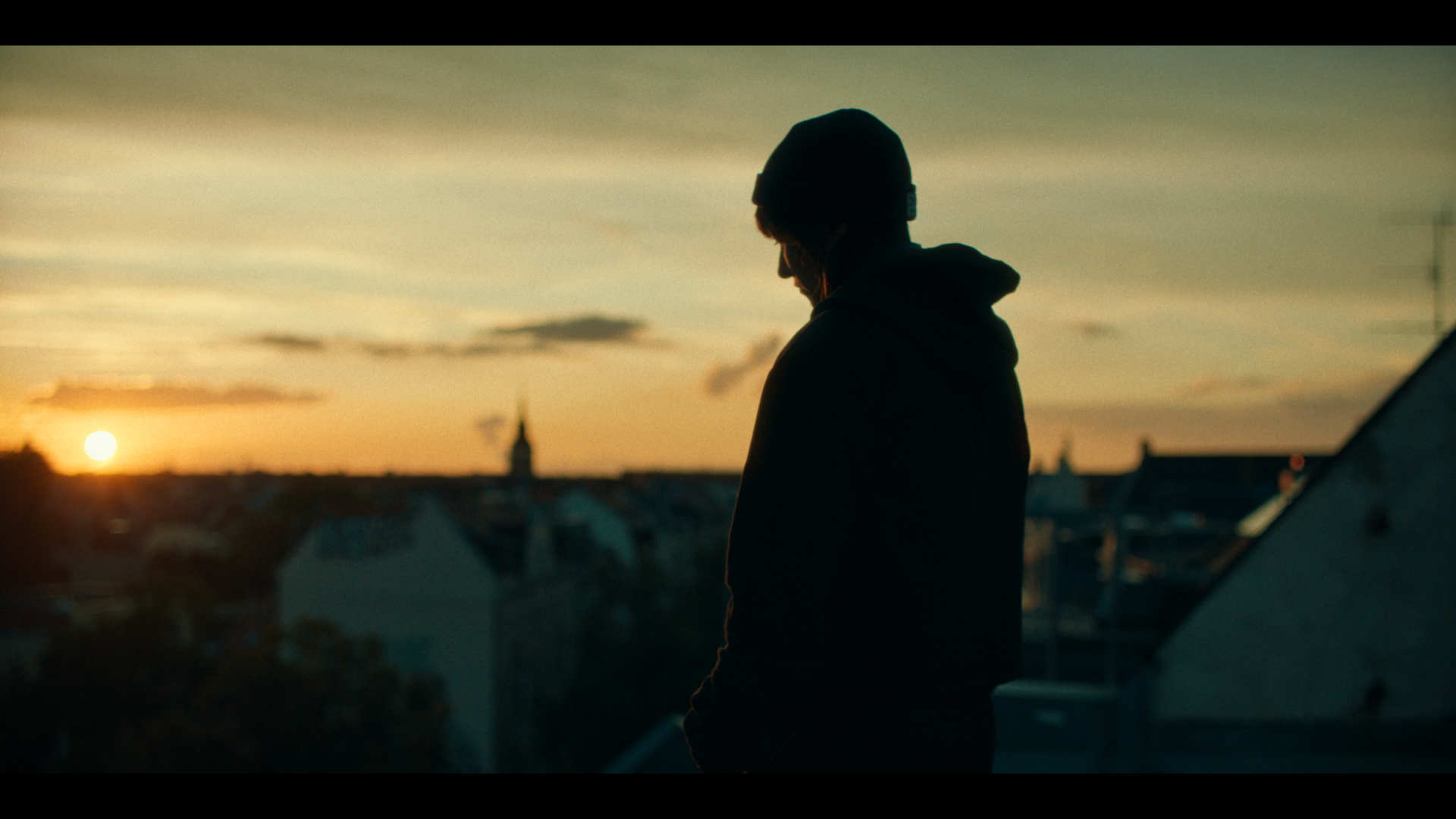
PS: Yes, definitely. You yourself spoke of the most famous example of the alleged “risk of infection” of suicide, this story that in the 1770s a great many young people, the Goethe's Werther have read, have taken their lives. Is that actually true as you tell yourself? Have you ever dealt with that? And aren't you afraid that there might be someone who, through your film, feels reinforced in their decision to kill themselves, might take this young woman as a role model in some way?
LW: As far as I know, the so-called “Werther effect” is not without controversy. That is the one thing. And the other thing is: I can understand the concern about imitation; it should be taken seriously. At the same time, I know that my script and the way I want to tell the film don't glorify suicide, that's not my approach either. But I'm not going to morally judge him either. I'm showing an individual story one person. And the story ends... bitterly. It is bitter for everyone involved, no one really won. It's no one's fault either. But Mila, the main character, hasn't made a mistake from her point of view either. I am generally convinced that you should never underestimate an audience and that people will take away what they want to take away. I think intentional happy endings, which you can tell that they are just trying to convey a moral message, are significantly worse for those affected, because then they don't see each other again and understand their feeling or condition even more lonely because someone shows them: Oh, look, and everything will be okay in the end. This may even make the situation worse. In my experience, the longing for happy endings comes more from those who are not affected.
The fact is: In Germany, over 10,100 people commit suicide every year. That means at least one person every hour. So as we speak, one or one. And if we have another coffee afterwards, another one or another. These are the facts for now. These cases exist and they exist despite the taboo. And for me, that suggests that not talking about it does not have a preventive effect. Clearly not. And that is why I do not think this concern of imitation that we spoke of is correct and I also find it interesting, even philosophically, to ask myself where this social taboo comes from. What does it have to do with religious heritage, what does it also have to do with the logic of exploitation, including power? We should all keep going, we should remain part of the system, we should sort ourselves out somehow, get help, get a coach, take psychotropic drugs — the main thing is that it somehow ends well again. When you look at it that way, suicide is of course a denial. It is — supposedly — not usable and an exit from the whole. And for that reason alone, it is not wanted. And as I say that, it sounds like I'm making a fire speech for suicide — I don't want that at all. But I find it interesting why such a widespread problem — it is uncanny Many: more than in road traffic, through violence and through drugs combined, every year — so unknown. Hardly anyone knows that. Almost no one I talk to about this topic knows these figures. Why is that so? Why do we avoid it like that? That can't be right. And that doesn't seem to have a preventive effect, otherwise the figures wouldn't be so high.


III. On the philosophy of suicide
PS: I can definitely follow that. And you're also addressing an important facet right now. Exactly, suicide has been an important topic in philosophy for many centuries, even millennia, about which a lot has been written. What can definitely be said very roughly and which is also often addressed by Nietzsche is that there is a very big contrast between the pre-Christian, i.e. the ancient, view and then the Christian view. Well, in ancient times, this taboo about suicide didn't even exist yet. On the contrary, it was entirely of the opinion that, under certain circumstances, it might be necessary to commit suicide in order to avoid dishonor. It was just more important to die an honorable death than to remain alive in any way, but to have to live under circumstances that would have been felt as completely unbearable. We know, for example, the suicide of Socrates: He has been sentenced to death and is now faced with the choice of fleeing and going into exile or of carrying out the death sentence on himself by drinking a poisonous cup. To the horror of all his friends, who really persuade him that he should choose the first option, he drinks the poison cup precisely for the reason that he says: Well, I've been fed by the city all my life, my whole identity depends on the fact that I'm a citizen of that city, I can't run away now if the city disagrees with me. Another, less well-known example is the philosopher Empedocles, who, according to legend, is said to have plunged himself into a volcano. — So yes, the great taboo was actually only brought into the world through Christianity. How do you perceive it: Would you also say that our culture is still very strongly influenced by Christianity today, or would you consider other motives to be more decisive?
LW: Yes, I think that is still very profound, the religious idea of original sin that you have to endure. And when you repent, keep commandments and so on, paradise beckons at some point. In such a context, self-chosen death is of course unthinkable. I do think that this still has very far-reaching effects. And in addition, there is certainly the fact that in our western way of life, this neoliberal system, there should also be a solution for every problem and a form of functioning and optimization. This makes it difficult for people who get to the point over and over again that they just don't function in it. And they don't work even with all sorts of tools and then break down. I think religion, the idea of suicide as a sin, has played a significant part in how little we talk about it today. How shameful that still is. The reception of violence against oneself and violence against others is generally astonishingly different. Violence against others, the exercise of power over others, is so accepted — and also completely normalized in the media and in art — but violence against oneself is taboo. That is very astonishing.
PS: Well, you're actually bringing us to the exact point of talking about Nietzsche, who, I think, is well known, is trying very hard in this regard, as in many other respects, to build on this pre-modern view. He speaks of “free death” at various points in his work. In Zarathustra For example, it says: “[S] tirb at the right time! ”7. So you shouldn't leave death to chance, you should determine the time at which you die yourself and you should choose it in such a way that in case of doubt you are not dishonored, i.e. you don't have to live an existence that you can't be responsible for or that is no longer compatible with your self-image.8 Nietzsche is of course very different from Christianity, but also from the philosophical mainstream actually, of his time. Both in Schopenhauer, who was his most important philosophical teacher, and in Kant and Hegel, there are very clear and very clear condemnations of suicide and Nietzsche is just trying to revalue this.
LW: What kind of convictions?
PS: For very different reasons. With Schopenhauer, you would think at first glance that he would support suicide.
LW: I would have guessed that now too.
PS: Yes, there is also a very interesting philosopher who should not be left unmentioned in this regard, who has also been read by Nietzsche: Philipp Mainländer, who in his main work — as far as I know his only work — with the title Philosophy of Salvation Based on premises similar to those made by Schopenhauer, suicide is virtually obligatory. You should kill yourself in order to extinguish the terrible will to live — and he also committed suicide shortly after completing this book. But Schopenhauer himself writes that suicide is virtually an imperfect way of “sneaking” out of life, since the motives for killing himself actually still correspond to the will to live; in other words, he sees a certain self-contradiction of the “suicidal person.”
LW: Because suffering alive still means a will?
PS: Exactly, the consistent denial of will for him is just asceticism, which also takes on the pain and suffering.
LW: What would Nietzsche say to that?
PS: I actually haven't found a place where he explicitly deals with this suicide criticism by Schopenhauer.9 His criticism is actually on a very fundamental level, because Nietzsche would say that you can't help but affirm the will to live: Even the Schopenhauer ascetic is actually someone who affirms life at heart, and for this reason the standard of Schopenhauer's criticism of Nietzsche no longer works at all.10 Can you follow me?
LW: Yes, I think that is the reason why there is a certain speechlessness between those affected and those not affected. From a life-affirming perspective, this is simply incomprehensible.
PS: Although for Nietzsche, the free death of the “master” would be precisely an expression of affirmation of life, not a negation, because a heroic, self-determined way of living is preferred over simply vegetating or an externally determined existence.
LW: That sounds like a very rational approach, it seems less about suffering.
PS: Yes, that's right. But what is exciting now is that there is another aspect in Nietzsche's thoughts on the subject. In fact, he would actually say that the entire Christian culture, i.e. actually the culture up to the present day, is characterized by the fundamental contradiction that, on the one hand, it is very life-denying,11 But on the other hand, it precisely forbids choosing this free death. In some places, he even goes so far as to say that the vast majority of people should actually kill themselves, but they are prevented from Christian morality and kept alive almost artificially.12 What do you say about this rather provocative view?
LW: I have to get to Roberto Espositos Immunitas think. He says there: In theology, also in law, and also on other levels, there is this image of immunization, of alleged immunization. You use something consciously, in the case of religion, an immanent sinfulness that you attribute to a person — in order to then protect him from sin through rules and coercion. In other words, through violence that reproduces itself so permanently. From the point of view of power, from a religious point of view, it is claimed that it is necessary to address human scarcity, sin, with norms and rules — in fact, people are only made sinful through a set of rules that no person could ever fully comply with. Violence or power consciously uses the shortcoming — the negative image of man — to underpin their position of power. It just sounded like I heard you talking about Nietzsche. I find that very understandable. There is a great lack of freedom in this.
Esposito also says that's where you actually cut off a bit of liveliness from life. A contradiction that is difficult to recognize if you can't afford the luxury of distance. This happens constantly, is almost institutionalized and at the same time, as I said, violence against oneself is such a taboo. I'm really interested in this paradox. Especially in such an increasingly individualized world; the circumstances in which we live; the way we do business; how we interact with each other; how we communicate; which technologies we use and so on: We are constantly curtailing ourselves in our vitality and that seems okay. But when someone ends their life, that's a problem.
PS: You could even with Nietzsche, who writes just that,13 It certainly raises the question of, for example, when soldiers go to war or if any martyrs sacrifice themselves for their faith, whether these are not also forms of suicide de facto, which, however, are not framed as such and are considered completely okay. When people sacrifice themselves for some ideas set by society, that is completely okay or is even celebrated, but as soon as they want to evade exactly that by suicide, it is suddenly terribly bad and the biggest sin that you can ever imagine.
LW: And she shouldn't go to school! I also worked as a journalist for a few years. The press code is also interesting not to report on suicide — unless he is a very prominent person, then, strangely enough, that doesn't apply. We report on the mass accident on the motorway and the fire that killed people. About all possible forms of violence, crime, about victims of war. When it comes to suicide, the reason not to report is the protection of relatives — which we are not interested in in all other cases. I always have question marks as to why this should be the case.

PS: As we slowly come to the end of this conversation, I would like to point out two problems that also affect Nietzsche. I was talking about the fact that he upholds the term “free death” in various places. There is such a passage from his late work where he also drops the, perhaps notorious, sentence: “The sick person is a parasite of society. ”14 Given that Nietzsche became such a “parasite” himself only a short time later, this sentence is of course not devoid of a certain irony. But what he's already writing at this point is exactly that if you run the risk of becoming a “parasite,” you definitely have the duty to kill yourself and even doctors should then make you do so to avert this damage from society. Isn't it also a great danger in this whole discourse on euthanasia that this debate could very easily tip over in a very weird and questionable, certainly neoliberal direction?
LW: Absolutely yes, that's why I mentioned it briefly at the beginning. The problem that there is a kind of habituation to this possibility, which can then develop step by step, in the worst case scenario, into a recommendation or suggestion that the time has come now because you no longer contribute to society. Because you're not functional, for a variety of reasons. That is a huge risk. Not to mention the question in whose hands or ideologies such developments can become weapons. But even assuming that the political conditions remain approximately as they are, even then the influence of a potential market in this area must be viewed absolutely critically.
PS: That brings me to a follow-up question. Nietzsche has this very strong concept of free, self-determined death. But where and how can you actually draw the line? Is it really possible to die completely self-determined? Or aren't there always some social factors that could very subtly drive you to commit suicide? And doesn't he then become very unfree again?
LW: Yes, we're not in a vacuum, of course. We are a product of the conditions in which we live. And we can suffer so severely from these conditions alone that we no longer want or cannot live in them. That can be the motivation of many others. That is also very important to me in the story I am telling. That there is no single, identifiable, comprehensible reason. And that the character also has no diagnosis. By the way, this is also a problem for certain funding agencies and potential financiers — which is interesting. There is a great longing for diagnoses, for clear categorization — what does it have? What is that? — for one comprehensible reason. If you don't deliver it, and I do that very consciously, then it causes irritation. That is also interesting. But from a preventive point of view, exactly right: a complex figure that does not provide a comprehensible causal chain.
I am very much in favour of spiritual maturity and self-determination, but that always takes place within the limits of the circumstances in which we find ourselves. With every decision you make, you could ask: Was it really self-determined? Probably not. But still... We always get to the point: Suicide does happen, it does happen. And, as I said, maybe — thesis — it would happen even less if the taboo did not exist. Because the despair that it makes you feel so alone and so misunderstood could be alleviated.
PS: If I may ask one more question at the end: So what do I ask myself, completely apart from Nietzsche, as a philosopher, or what my own criticism of suicide would be: You have already spoken of a “lonely decision”; whether the problem of suicide is not actually, that you are completely beaming yourself out of the social relationships in which you are involved in, in a certain way, apparently a decision that only concerns you yourself, but which also has an impact on others at the same time. That is perhaps actually one of the reasons why the topic is so emotional, because many people, probably just about everyone, have people in their circle of acquaintances who have killed themselves. What I want to say is that people who kill themselves actually seem to be moving in self-contradiction, i.e. ignoring on the one hand that the others will grieve, will also blame themselves and much more, but at the same time they may want to take account of this aftereffect and perhaps want to take revenge in some way against posterity and want to plunge others into grief and doubt. So I don't want to say that this is the case for everyone or even for the majority — but isn't that a problem?
LW: That is definitely a possible view, which is probably also quite common. But I would definitely like to contrast this with another perspective: namely that suicide, especially when there are many social entanglements and relationships, is not a decision against these people, but the end of a sometimes long-standing attempt for this environment to live on and fail because of it. That is very important to me and that is also what associations of relatives repeatedly emphasize: Suicide is not a decision against someone, but actually the failure of trying to continue for others. I find this a very important perspective, which is in no way intended to glorify this, but only to show — and of course we don't know any figures or anything about that — that the plural is probably not frivolous ad hoc decisions, but rather those that have had a long, painful lead time. And that these people really didn't make it easy for themselves.
PS: Yes, I can definitely understand that you can and in many cases must look at it that way too. Yes, thanks again. Is there anything else you absolutely want to say about this topic?
LW: I'm sure there's still a lot more, but I'll leave it at that: We should all talk more about it.
PS: I can definitely agree with that and I think the various Nietzsche passages we referred to could definitely provide good material and should definitely be read more. What I might be able to recommend at the end is the novel Veronika Decides to Die by Paulo Coelho, who is even a bit Nietzschean and has also really moved me personally. Do you know him?
LW: There is also a movie there, yes.
PS: I don't know him again. So I can highly recommend this novel to anyone who has read this conversation and may have suicidal intentions — and of course also to seek help, that's obvious.
Lou Wildemann is an author and director from Leipzig. She previously worked as a freelance journalist for public television for several years. She studied Political Science (BA), Cultural Studies (MA) and Philosophy (MA).
Link to the film's crowdfunding campaign MALA
Item photo: Johann Heinrich Tischbein the Elder: Dido's Suicide (1776) (link)

footnotes
1: Editor's note: In order to avoid the problematic moral connotations of the traditional term “suicide,” which Lou Wildemann drew our attention to following the conversation — does the term “murder” imply killing for lower reasons — we use other phrases below.
2: Cf. The entry about him on the English-language Wikipedia.
3: According to Dieter Birnbacher in an article for Brisant (link).
4: Cf. swissinfo.ch.
5: Art. 115 of the Swiss Criminal Code. It is therefore the absence of a prohibition and not an explicit permission (cf. Giovanni Maio in conversation with SWR).
6: Editor's note: The statistics quoted in footnote 4 record a rapid increase in cases of assisted suicide in the last 20 years, an increase of almost tenfold. At the same time, cases of suicide using other methods have been declining sharply since the late 90s, which suggests a certain correlation. Overall, the suicide rate remains relatively constant (cf. Swiss Health Observatory).
7: So Zarathustra spoke, Of free death.
8: See also Human, all-too-human II, The Wanderer and His Shadow, Aph 185.
9: In an estate fragment from 1875 (link), Nietzsche seems to be paraphrasing Eugen Dühring's thoughts in this regard.
10: For example, the quintessence the third treatise of The genealogy of morality.
11: “I call it a state where all are poisonous drinkers, good and bad: State where everyone loses themselves, good and bad: State where the slow suicide of all — means 'life. '” (So Zarathustra spoke, From the new idol).
12: In one Draft letter from 1884 addressed to Paul Lanzky For example, he writes: “What do I have to do with those who have no goal having! My body prescription, casually remarked, is, with regard to such, — suicide. But he usually mistells, due to lack of discipline.” In a Estate fragment from 1880 He defines Christianity precisely “as the great mob movement of the Roman Empire [...] of all those who would have had reason to commit suicide but did not have the courage to do so; they sought with fervour a means to endure their lives and find something worth enduring.” See also Another fragment from 1888.
13: Cf. on this self-contradictory nature of Christianity The happy science, Aph 131. In Aphorism 338 of the same book It says: “[T] he war is [...] a detour to suicide, but a detour with a clear conscience.”
“Choose the right time to die!”
Nietzsche's Ethics of “Free Death” in the Context of Current Debates About Suicide
A Conversation with Filmmaker Lou Wildemann
Lou Wildemann is a cultural scientist and filmmaker from Leipzig. your current feature film project, MALA, deals with the suicide of a young resident of Nietzsche City. Paul Stephan discussed this provocative project and the topic of suicide in general with her: Why is it still taboo today? Should we talk more about this? What role can Nietzsche's reflections, who repeatedly thought about this topic, play in this? What does suicide mean in an increasingly violent neoliberal society?
Stuck Between the Monsters and the Depths
Wanderings Through Modern Nihilism in the Footsteps of Nietzsche and Kierkegaard — Part 1
Stuck Between the Monsters and the Depths
Wanderings Through Modern Nihilism in the Footsteps of Nietzsche and Kierkegaard — Part 1


As in our series of articles”Hikes with Nietzsche“It has already been made clear that the metaphor of wandering plays a fundamental role in Nietzsche's work. In this two-part essay, Paul Stephan explores how Nietzsche uses the wanderer as a personification of modern nihilism and thus diversifies a central theme of cultural modernity, which can also be found in the writings of the Danish philosopher Søren Kierkegaard, who was born on May 5, 1813 in Copenhagen, where he also died on November 11, 1855.
I. Modern life as a journey across the sea of fog
Metaphors of movement have always been used to describe basic modes of existence. In the sense of Hans Blumenberg's concept of “absolute metaphor,” they condense the lifestyle of an entire culture and from them it is possible to see what their approach to the world is. Insofar as people describe their lives in a movement metaphor at all, it would be necessary to differentiate between the goal of the movement and the way in which this goal is achieved. Think of the wanderings of Ulysses or Christ's Way of the Cross as meaningful archmyths, of the medieval ideas of life as a pilgrimage repeating the Passion or as a seafaring which, once through all storms and dangers, will end in a safe haven, the Kingdom of Heaven.
Since the end of the 18th century, in modern times, it has become less and less plausible to interpret life as a movement linked to some goal. Jean-Jacques Rousseau, for example, as a precursor of modern world sentiment, presents himself in his writings as a lonely hiker and walker who is thrown back and forth “like a rolling stone” by the coincidences of life without being able to seriously hope of ever reaching a destination — in this world anyway. He only experiences a breather in isolated enjoyment of nature, far away from the developing industrial hustle and bustle of cities; in particular on Lake Biel, where he stays for a few weeks while fleeing from France, and in the The dreams of a lonely walker He tells of how, there, floating aimlessly on the water on a boat, he experiences a brief moment of extreme happiness. Around 200 years later, Adorno appears in the famous aphorism Sur l'Eau — “On water” — take up this metaphor and reinterpret it as a utopian mission statement: The belief of classical modernism in people's permanent progress has turned out to be an eternal hunt, as a senseless “run-up to death,” which the emigrant, in the spirit of the “citizen of Geneva” and very different from Heidegger, no longer wants to heroically affirm for him, but the vision of a Opposes humanity, which no longer has to obsessively chase after anything. The last dream of modern people: simply to relax.
Modernity thus fluctuates between suffering from eternal restlessness and the simultaneous longing for silence and calm guidance on the one hand and various ways of affirming this fate on the other hand; whether as a story of progress — which, of course, is no longer able to proclaim a right “end of history,” but only the permanence of ever new stages — be it as a nihilistic heroism of consistent progress (both versions approach obviously to each other), whether it is finally as an aesthetic-playful affirmation of baseless prancing and wandering around, for example in the figures of the dandy and the stroller, which fascinated artists and writers of the 19th century.
The metaphor of hiking, as a cultural technique only invented in the 18th century, including by writers such as Bergfreund Rousseau, is of decisive importance. Just think of Caspar David Friedrich's iconic painting The hiker above the sea of fog (see article image; around 1818), which adorns the covers of countless statements about existential philosophy. The urban citizen, who has been thrown back to himself, searches for an order in nature that somehow makes him understand the chaos of his existence — but only finds clouds of fog and the bizarre rock formations (presumably) of Saxon Switzerland. Whether there is a whiff of transcendence or the jumble of swirling demons, both interpretations of the painting seem possible, is a question that ultimately leaves the painting itself to the viewer himself. In contrast to landscape paintings of previous decades, the painting is no longer dominated by nature, but by man, for whom it increasingly coagulates into a pure projection surface.

II. Hikes through Jutland, walks through Copenhagen
Nietzsche's perhaps most important intellectual companion in the 19th century, the Danish philosopher Søren Kierkegaard, has in the diary-like novel “Guilty? “— Not guilty? ” With Quidam, perhaps the first “hero”, if you can even call him that, of modern existence was created. An eternally doubting “demonic” person who perishes because he is not sure whether he loves a “girl” or not, who at the same time thinks that he must love her but that he cannot love her. Is he guilty — or not? Similar to K. later in Kafka's Protocols of the Normal Madness of Modern Individuality, he is unable to answer himself and thus circles in the “eagle's nest” of his lost existence. He describes Frederick's Wanderer's gaze into nothingness as follows:
[N] Ah Looking at something sharpens the eye, but looking at nothing makes an effort. And when the eye looks for a long time at nothing, it finally sees itself, i.e. its own vision; in the same way, the emptiness around me forces my thought back into myself.1
Nietzsche will later write in a very similar way: “Whoever fights with monsters should see that he does not become a monster in the process. And when you look into an abyss for a long time, the abyss also looks into you.”2.
But can't this unstable way of life also be enjoyed, unlike Quidam and K., who are desperately looking for a way out? Kierkegaard has in his other great diary novel, the Seducer's Diary, was one of the first to write the phenomenology of such dandytum. His seducer is obsessed with repeatedly experiencing the intoxication of infatuation and stages it as an aesthetic spectacle with ever new “girls” as involuntary extras, whom he captivates with manipulative methods until they fall for him and become bored — the doll has then done its job and is replaced by a successor.
You may recognize yourself in it — or not. The seducer may enjoy his life, but there is reason to doubt whether his drive is in fact much more similar to religious Quidam than he would like. In contrast to the latter, he just doesn't know that he is desperate — in Kierkegaard's analysis, they both are. In the introduction to the diary, the fictional editor of the work, the “aesthetician” A, compares the unsteady existence of this, albeit more subtly acting, prototype of today Pick up artists Not by chance with that of a restless hiker:
Just as he has misled others, I think he will end up going astray himself. He did not mislead the others externally, but internally as to themselves. There is something outrageous when someone steers a hiker who is half clueless along the way down wrong paths and then leaves him alone as a lost person, and how little does that mean compared to leading a person to go astray within himself. The delusional wanderer has the comfort that the area around him is constantly changing, and with every change there is a hope that he will find a way out; anyone who goes astray within himself has no large area in which he can move, he soon realizes that it is walking in circles from which he cannot get out. I think he too will do the same on a scale that is far more dreadful. I can think of nothing more tormented than a scheming mind that loses the thread and now turns all its acumen against itself, while the conscience awakens and has to break free of this mistake. He has many exits in vain at his fox den, at the moment when his frightened soul already believes that it sees daylight coming in, it turns out that it is a new entrance, and in doing so, like a frightened savage, haunted by despair, he always searches for an exit and always finds an entrance through which he returns to himself. Such a person is not always what is called a criminal, for example, he himself is often deceived by his intrigues, yet he is punished more terribly than the criminal; for even the fact that conscience awakens is, said about him, an too ethical expression; for him, conscience merely takes the form of a higher consciousness, which expresses itself in restlessness that does not even accuse him in a deeper sense, but keeps him awake, gives him no rest in his infertile restlessness.3
How to escape this despair in the heart of one's own soul, like modern nihilism? Kierkegaard's solution: The “leap into faith”; become a pilgrim again, learn to see life again as a way of the cross in the footsteps of Christ and the martyrs. It is this affirmation of life as a violent march that could only free Quidam from his desperation; he could then see it as a divine test. But Kierkegaard repeatedly emphasizes that the subject cannot come to faith through his own effort, but can only be called to do so by God himself. — A simple, all-too simple solution. You just have to stop thinking to make life easy. Is this still serious philosophy or is it blunt madness, rhetorically extremely cleverly packaged? No one has argued so cleverly, cleverly and eloquently, like this: modern, for delusion.
sources
Kierkegaard, Soren: “Guilty? “— Not guilty? ”. Stages on the path of life, Vol. 2. Collected works and diaries. 15th abbot. Transacted by Emanuel Hirsch. Gütersloh & Munich 1994.
Ders. : The Seducer's Diary. Either/Or. First part, Vol. 2. Collected works and diaries. 1st abbot. Transacted by Emanuel Hirsch. Simmerath 2004.
Source for all images used: Wikipedia
footnotes
1: P. 379.
2: Beyond good and evil, Aph 146.
3: p. 330 f.
Stuck Between the Monsters and the Depths
Wanderings Through Modern Nihilism in the Footsteps of Nietzsche and Kierkegaard — Part 1
As in our series of articles”Hikes with Nietzsche“It has already been made clear that the metaphor of wandering plays a fundamental role in Nietzsche's work. In this two-part essay, Paul Stephan explores how Nietzsche uses the wanderer as a personification of modern nihilism and thus diversifies a central theme of cultural modernity, which can also be found in the writings of the Danish philosopher Søren Kierkegaard, who was born on May 5, 1813 in Copenhagen, where he also died on November 11, 1855.
The monkeys dance inexplicably. Nietzsche and contemporary dance culture
reflection, movement, misery
The Monkeys Dance Inexplicably. Nietzsche and Contemporary Dance Culture
Reflection, Movement, Misery


In addition to hiking, dancing is one of the most prominent soldiers in Nietzsche's “moving [m] army of metaphors, metonymies, anthropomorphisms.” Based on Nietzsche's reflections on the art of movement, Jonas Pohler explores the paramount importance that it plays in our present day. Is the effect of dance primarily sexual? What does dance have to do with technology? What symbolism is the dancing gesture able to convey?
Just no fuss. Dancing and intellectual reflection, they seem to be mutually exclusive. No one will dispute the claim that philosophical and technical ideas are the last thing that makes you a good dancer — but is that so? “The Germans are too clumsy,” postulated an acquaintance with whom I spoke about the topic. Nietzsche would probably have agreed to this. In an exceptionally beautiful aphorism, he wrote about the Germans' enjoyment of art:
When the German really gets into passion (and not just, as usual, in the goodwill to passion!) , he then behaves in the same way as he must, and no longer thinks about his behavior. But the truth is that he then behaves very clumsily and ugly and as if without tact and melody, so that the audience has their pain or their emotion and nothing more: — unlessthat he lifts himself up into the sublime and delighted, [...] — towards a better, lighter, southerner, sunnier world. And so their cramps are often just signs that they danse Would like: these poor bears, in which hidden nymphs and forest gods live their nature — and sometimes even higher deities!1
Is that the reason why the worse half of humanity is so often struggling and is plagued by complexes and discomfort? — That's another story...
I. Dancing on the Internet: Unmanageable Landscapes
The topic seems more timely than ever. This shows the omnipresence of dancing people on social media. Transmitted primarily from the USA, but also affected by it, from all over the world. You can see: “Humanity” is dancing. Anyone who delves a bit deeper into the subject matter comes across choreographies, performances and insights into dance studios; comes across “battles” with stimulating interjections. Movement takes on military form. — Nonsensical next to that: Twerken for the Salvation of Souls. Not a bad joke for many anymore.
The Internet is celebrating its K-pop stars such as the Bangtan Boys (BTS), founded in 2010, or the one born in 1996 Jennie Kim by the also South Korean band Black Pink. It is known from them that these subjects of the “idols” industry go through intensive dance training, which, of course, fairly shamelessly copies US music and dance style trends. American choreographers and record labels are probably working on the so-called “acts” at least around three corners. Dance instructors discipline their clients not only to perfection but also to express themselves freely. Their success undoubtedly speaks for a nerve that they immediately hit emotionally with a mostly female audience. The appearance is favorable, comprehensible everywhere and subject to hardly any social or socio-structural controls.
I can't hide that I was not unimpressed by some trends myself. For example, the dance performance of Disney star Jenna Ortega born in 2002 in the Netflix series Wednesday (2022), the song that dates back to Lady Gaga's at the time Bloody Mary (2011) and the words: “I tell them my religion's you [.] [...] We are not just art for Michelangelo to Carve/he can't rewrite the aggro off my furied heart”2How an alleged autistic woman who plays them dances.
Musically, although less dance-wise, the hype surrounding and early death of XXXTentacion with his sad electro ballad has also Moonlight Many are anything but left cold. Even the almost violent dance choreographies of Jade Chynoweth, the Viva Dance Dance Studio from South Korea, as well as King Kayak & Royal G's brute performance toward Oil it The Afrobeat star Mr. Killa or the very danceable Amapiano classic Adiwele by Young Stunna, in which “the flex,” i.e. the flaunted bragging, and dance seem to intertwine, compelled me some respect.
Unimaginable but true: Dance is advancing to The The form of expression and art of our decades and is perhaps even more, a sign of the anthropology of globalized capitalism. Its increasing importance is derived from various factors, with the most opaque and least edited probably being art, aesthetics, and philosophy.
Undoubtedly, one of his recipes for success is his general accessibility: What has a body can dance and does not require education or professional equipment. The second undeniable element, both for social media and for the advertising industry, in which we repeatedly see dancing bodies (admittedly with products that have nothing to do with it), lies in the fact or appearance of transmitting authentic emotions or affects — for the less subtle, sex and presumption.
Is that so? It's less banal than you might think. Who sexualizes or desexualizes? The hip swing is the symbol of human sexuality; only a stone could remain motionless. — Does the term “sex” even appear in Nietzsche, for example? — And yet a dance can be completely harmless, like an aphorism from Human, all-too-human shows how viewing a work of art produces an immediate surplus of pleasure. The text as a stimulant:
Books that teach dancing. — There are writers who, by presenting the impossible as possible and speaking of the moral and ingenious, as though both were just a whim, a desire, produce a feeling of excessive freedom, as if a person stood on the tips of his feet and had to dance for inner pleasure.2
Even though attempts are made again and again to dedovetail the dance, the solution is likely — as is so often the case — an ambivalent one. One thing is clear: When in doubt, you dance alone in the neoliberal Pleistocene. — Life is what you make it!
II. Technology, Dance and Pop Culture
Electronic music significantly changed dance behavior almost globally. In particular, the technical intensification of bass and the invention of the rhythm machine can be regarded as the most important and substantial interventions. These are technical innovations that reduce, ration and equalize — establish a mere relationship with the naked organic body, less an intellectual or cordial one, such as a symphony orchestra or band.
Nietzsche would probably have known more about this than he knew. The forms of illuminated cold crowds that we know from today's club culture with their electronic cult could not yet be known to him. The dance conventions of his time are only beginning to emancipate themselves. Ballroom dancing, folk dancing and ballet dominate the corresponding social fields. Mass culture and exotic pop greats such as Josephine Baker — although variety shows are already gaining in importance in the second half of the 19th century — are only just beginning to become emblems of an emerging popular cultural mass base. As far as I know, Nietzsche did not comment on the variety show.
He writes about Dionysia and Saturnalia, intoxication and theatre. He is looking for the anthropological, the instinctive, and the intense. Let's follow the Dionysian trail: The whole world a dance hall? A ballroom dance, going to work in the morning, then motionless like the stars in the sky and dancing yourself into bed in the evening? The world, the puzzle image of a dove? Dancing hall of the living? How could stars dance? — The well-known and already taunted Nietzsche quote about the chaotic celestial body is central in the Preface His Zarathustra — more specifically, his speech about the “last man.” Following this, the famous tightrope walker in an accident appears. The sentence explains internal chaos as a condition for achieving a highest ideal. The time is decisive: “Woe! There will come a time when humans will no longer give birth to a star. Woe! ”4
In the works published during their lifetime by digitized critical edition The root syllable “dance*” appears in just 69 of 3287 text sections, and only rarely in an explicitly analytical context. In Nietzsche's philosophical reflection, most prominent in the Birth of Tragedy:
Singing and dancing, people express themselves as members of a higher community: they have forgotten how to walk and speak and are on their way to flying up into the air dancing. His gestures speak of enchantment [...]. Man is no longer an artist, he has become a work of art: the artistic power of all nature, to the highest satisfaction of the original one, is revealed here under the showers of intoxication.5
The dance metaphor is less present in Nietzsche than many might assume, and as a whole probably coincides with the concept of “Dionysian,” the phrase for reflectless, irrational affirmation of life, the physical overcoming of thought:
In Dionysian Dithyrambus, man is stimulated to the highest increase of all his symbolic abilities; something sneezing is urged to express itself, the destruction of Maya's veil, oneness as the genius of the species, indeed of nature. Now the essence of nature should express itself symbolically; a new world of symbols is necessary, first of all the bodily symbolism, not just the symbolism of the mouth, the face, the word, but the full dance gesture that rhythmically moves all limbs. Then the other symbolic forces, those of music, in rhythm, dynamism and harmony, suddenly grow impetuously. In order to grasp this total unleashing of all symbolic forces, the human being must already have reached the level of self-alienation that wants to express itself symbolically in those forces: the Dithyrambic Dionysus servant is therefore only understood by his kind!6
III. Symbol of what? Talk for what?
Since we're talking about symbolism, we have to become semiological for a moment: What does a gesture, a movement mean? Decoding the string of an ordinary dance is extremely difficult, and its elements — like hardly any other encodings — are both anthropologically and culturally determined. Even on TikTok, every trend carries a gestural string that, even in frame-by-frame analysis, transports very unclear content, with the form of a social relationship among people appearing to be the most prominent dimension; for example, the practice of imitation or classification. The semiological problem is decisively linked to the immediate transitions, which we call movement, which, as in a symphony, separate the good dancer from the bad dancer. It is similar to the arrow paradox of Zenon of Elea, according to which a movement consists of an infinite number of points of standstill and is therefore questionable how it could even exist. In our case, it raises the problem of whether the individual gesture is the meaningful element of the dance or its change, without which dance as a movement would be impossible.
Nietzsche later put in Human, all-too-human this semiotic dimension is explicitly open:
Sign and language. — Imitating signs is older than language, which takes place involuntarily and now, with a general suppression of sign language and developed control of muscles, is so strong that we cannot look at a moving face without innervating our face [...]. The imitated gesture led the imitator back to the sensation it expressed in the face or body of the imitated person. This is how you learned to understand yourself: [...]. Conversely: Gestures of pleasure were themselves pleasurable and were therefore easily suitable for communicating understanding [...]. — As soon as you understood yourself in gestures, a symbolism of the gesture: I mean, you could communicate using a tone-sign language, so that you sound first and Sign (to which he added symbolically), later only produced the sound. — [...] [W] First the music, without explanatory dance and mimus (sign language), is empty sound, through long habituation to that juxtaposition of music and movement, the ear is schooled to immediately interpret the clay figures and finally reaches a level of quick understanding where the visible movement is no longer at all requires and the sound poet without the same understands. [...]7
Dance is therefore double-coded, self-referential. Behind the code is a code of the conventions of a corresponding media and social field. As far as the side of reflection is concerned, dance has two dimensions: freestyle and practiced movement. The great dancer probably has both, but is ultimately in line with the freestyle. Behind this is the idea of the talented genius who finds the form of a direct transistor just for the sake of expressing his feelings — Poetry of the movement. In addition, speculatively and in the spirit of Nietzsche, dance expresses the unspeakable in a different, visual and subjective code. A second well-known quote that shows this semiotic dimension of the body also comes from the first book ofthe Zarathustra. Nietzsche's prophet proclaims that he “would only believe in a god who knew how to dance.” Interestingly enough, from a passage that About reading and writing acts: “Of everything written, I only love what someone writes with his blood. [...] I hate reading idlers. [...] Another century of readers and — the spirit itself will stink. ”8
IV. Dancer, why can't you speak?
As you can see, there are a lot more questions here than answers. Perhaps reference may be made here recently to Elfriede Jelinek, who with her production A sport piece (1998) brought social movement organizations closer to fascism. There is certainly something to that, because as every good insurance agent knows: “The less you know, the better it sells.” Is this interpretation sustainable? As part of an increasing militarization of the social sphere, its effects can be seen in sports, the gym, and dance, which speaks its silent language and is not always understood. Deleuzes' control company in no way overcame Foucault's disciplinary society,9 But connects with it: Anyone who speaks of control society must ask who should give up the dancer's patron? It is clear who is disciplining him. The dancer wants his own lock, the drill, the authority of the dance teacher. But who controls? — The path leads back: It is the gaze again, the reflection. Because the view on social media is anonymous but gives its judgments automatically controlled by likes, shares, references by admirers and haters, it takes the form of a multi-eyed phantasm that could be described as “common will.”
Since this will is the least real and exists only as a collective and unsystematic, as a familiar implantation — as a supposedly necessary generalization of what dance is, should and can express, especially what it should look like — it presents itself as a protective mechanism against fear (the fear of loss of control), which is called the idealistic smaller or larger communities in their real body, dancing self-Feeling should protect, that is.
In short, the Argus Eye watches over the dancer, but by becoming his own eyeball. (Normal case of training and discipline.) Since it is no longer difficult to let go, the reflection is only suspended.
On the other hand, Nietzsche's cheerful dance songs, which most recipients probably didn't remember, were not among the strongest of modern poetry, incredibly romantic and innocent. So is Zarathustras Dance song Not really one — and The other dance song10 At the end of the third book, a negligible lyrical effusion anyway — but a small reflection on life, “a song of dancing and ridicule on the heavy mind”:
I looked in your eye recently, oh life! [...] [S] you laughed poettically when I called you unfathomable. “That is the speech of all fish, said you; what them It is unfathomable. [...] “[...] But when the dance was over and the girls had gone away, he became sad.11
Perhaps this idealization of dance is memorable and valuable for our consciousness in the end because it shows that it can also be different.
Jonas Pohler was born in Hanover in 1995. He studied German literature in Leipzig and completed his studies with a master's degree on “Theory of Expressionism and with Franz Werfel.” He now works in Leipzig as a language teacher and is involved in integration work.
Footnotes
1: The happy science, Aph 105.
2: “I'll tell them that you're my religion. [...] We're not just art — carving out for Michelangelo [/] — he can't describe the anger from my angry heart. ”
3: Human, all-too-human I, aph. 206.
4: So did Zarathustra speak, preface 5.
5: The birth of tragedy, Paragraph 1.
6: The birth of tragedy, paragraph 2.
7: Human all too human I, Aph 216.
8: So Zarathustra spoke of reading and writing.
9: Editor's note: In the text Postscript on the control companies Gilles Deleuze put forward in 1990 the thesis that what Foucault had described as “disciplinary societies” — i.e. societies such as the modern ones of the 18th, 19th and 20th century, in power is carried out primarily through individual methods of discipline (drill, training, education...) — had been replaced in his present by the type of “control society,” which is less about individually internalized discipline, but the technical based surveillance of the population to punish border crossings. This apparently entails greater scope for individual freedom, but in reality it is no less repressive.
The Monkeys Dance Inexplicably. Nietzsche and Contemporary Dance Culture
Reflection, Movement, Misery
In addition to hiking, dancing is one of the most prominent soldiers in Nietzsche's “moving [m] army of metaphors, metonymies, anthropomorphisms.” Based on Nietzsche's reflections on the art of movement, Jonas Pohler explores the paramount importance that it plays in our present day. Is the effect of dance primarily sexual? What does dance have to do with technology? What symbolism is the dancing gesture able to convey?
Traveling with Nietzsche through Southeast Asia III
Thailand
Traveling with Nietzsche through Southeast Asia III
Thailand


Our author Natalie Schulte traveled by bicycle for nine months Vietnam, Kampuchea, Thailand and malaysia. In her penultimate contribution to the series ”Hikes with Nietzsche“ she muses on encounters with wild animals that she met or could have met on her journey. It is hardly surprising that this includes considerations about the importance of animals, as they occur in Nietzsche's philosophy.
Of animals as monsters
Long before I even set off for Southeast Asia, I dealt with the topic of “wild animals.” It was unclear which secluded areas, jungles and swamps we would dive into. So I was concerned with the question of how best to fight a crocodile, what to do in the event of a snake bite, or which would be the most dangerous animal on our journey. According to my research, to my own astonishment, the elephant was high up. This sluggish pachyderm with melancholy eyes and dark circles, which remind me of long awake nights, can mutate into a monster in the appropriate mood. This mood in male elephants is triggered by a testosterone surge, which initiates the reproductive phase known as musth. Musth is derived from the Persian mass (fattening), means something like “under drugs” or “in intoxication” and describes the behavior of the elephant during this period of several months. He is so aggressive that he not only attacks male rivals, but also mammals or innocent objects. So it's no wonder that the thought of suddenly facing a fat elephant on a winding jungle trail with a black secretion running down its temples (a clear sign of the Musth phase) made me shiver. Nevertheless, this knowledge did not deter me from working my way further into the strange thicket of detailed articles.

Good conversation
I plunged into a realm of incredible stories, most dangerous encounters, deadliest poisons, and unusual rescues. And soon after, I had an interesting experience. Rarely has my newly acquired knowledge been as popular in society as it was at that time. For years I had battered my environment with philosophical ideas, tried to get them excited about the difference between “transcendental” and “transcendental,” for the synthetic unity of apperception as a condition of knowledge, or for the secrets of ontological difference. And I would have simply had to tell them something about animals in order to cast a spell on them.
Besides, I have no excuse that it took me so long to learn this. Numerous philosophers complained about this suffering in their works, others complained to their audience. Nietzsche did not remain silent on this topic either. In aphorism 41 of Morgenröthe He even sides with the audience. He writes that philosophers, like religious natures, have always tried “to make life difficult for practical people and possibly to spoil them: darken the sky, extinguish the sun, suspect joy, devalue hopes, paralyze the working hand.”1. In addition, like artists, philosophers have a bad character and are “mostly indiscriminate, moody, envious, violent, unpeaceful” (ibid.). As if all that wasn't enough, the philosophers also had a third bad quality, and that was the joy of “dialectical [s], the desire to demonstrate,” with which they would have “bored many people” (ibid.).
Nietzsche — we know it — wasn't read enough either, at least not before he fell prey to spiritual abduction, as we Nietzsche researchers say reverently. But he did everything right: he has numerous animals, tigers, snakes, flying animals, camels, lions, cats, eagles, just to name a few.

Tigers
Perhaps, at the beginning of Birth of Tragedy There isn't really much talk about, say, tigers. Tigers and panthers are the Dionysian companion animals during the parade.2 But little by little, the tiger gains a character in Nietzsche's philosophy. The tiger is the animal whose center is a great will: tension under pressure, always ready to jump, fight, reach the goal. The tiger, a loner, a predator, cruel and violent.
Despite Nietzsche's preference for the amoral, the tiger doesn't always get off well. Zarathustra, in any case, explains that he doesn't like tiger souls: “He still stands there like a tiger that wants to jump; but I don't like these tense souls, my taste for all of them withdrawn is fiend. ”3
And who, like a tiger, is waiting for the big goal, everything for which Save an act, he runs the risk that he will not succeed in exactly this act. The higher people, whom Zarathustra has been advising for a while, take themselves too seriously in exactly this way. They think that one attempt is everything: “Shy, ashamed, clumsy, like a tiger who failed to jump: well, you higher humans, I often saw you sneaking aside. A throw failed you. ”4
There are now only a few tigers left in Southeast Asia. They have already died out in Vietnam, Laos, Cambodia. The only glimmer of hope is Thailand. But luckily we won't meet anyone. And the only clue to elephants is occasional road signs warning motorists about pachyderms crossing the road. One day, the local population in a village terrified us: We were just about to get dinner when they urgently warned us not to drive through the streets at dusk anymore. The radio reported that a horde of wild elephants is currently roaming the area. Foolhardy (and hunger) nonetheless drives us to search, but after we still haven't found a food stand ten minutes later with a queasy feeling and increasingly anxious looks at the cracking jungle on the right and left of the road, we hurry back to the hostel and comfort our empty stomachs with instant noodles. Fortunately, the danger of dangers remains a phantom for me even this evening.

Unexpected danger
Much more dominant, as we know after a few days, is a far less exotic animal: the dog. There are numerous dogs in Thailand. They are our absolute favorite pet. There are also a number of wild barkers as well as small and large packs. Thailand's roads (just like Vietnam and Cambodia) rarely have a sidewalk. Life takes place on the streets. Early in the morning, we meet the dogs when they go out patrolling with their legs apart on the side strips that are still empty as masters of the trail. At noon, they lie snoozing in narrow shade. The only things that can get them out of their slumber and into a short, intense sprint are: cyclists. In the afternoon, the Klaeff concerts announce our arrival to the respective hostel owners. Your barking is our constant companion.
The biggest danger is that they come straight at someone shot unseen, as they were previously in the shade. The shock tempts you to turn the handlebars around and make a daring turn into expressway traffic. The second risk: being bitten by them. In fact, the dogs barely seem to know what to do with us once they've caught up with us or even overtaken us. Other motorised two-wheelers simply do not give them such victorious experiences. Her barking becomes more subdued, a raised hand makes her jump away as if from a blow. Only at a safe distance do they announce the claim to power of their local gang again. And then finally, after two or three more loud barks, they troll themselves: “We've shown it to them,” the leader of his gang whispers on their way back.

A dog's life
Not only in Southeast Asia is the dog much more common than the tiger, but also among Nietzsche. The proverbial life of dogs is miserable and pathetic and, by the way, is quite similar to the lives of many dogs in Thailand. In turn, Nietzsche is concerned with dog life in a figurative sense, because, as we have already guessed with tigers, animals in Nietzsche are more often people, more precisely, types of people.
So who is the type of person who lives a dog's life? Is he perhaps even a philosophical character who, as we have seen, is sometimes not well received in human society? A lonely person, a contemplative spirit who “carelessly lets his talent shoot the reins.”5, according to Nietzsche, it can easily happen to him “that he perishes as a human being and lives a ghost life almost exclusively in 'pure science. '” (ibid.) Anyone who suffers from the dialectical tendency already mentioned above to “seek out the pros and cons in things” (ibid.) runs the risk of becoming “crazy about the truth at all” (ibid.), so that he “has to live without courage and confidence” (ibid.) and finally exclaimed: “No dog wants to live that longer! “(ibid.)
Nietzsche nevertheless recommends that a person who is misunderstood and excluded by society remain selectively polite when interacting with others, because “[d] he cynicism in traffic is a sign that in solitude a person himself as a dog treated. ”6

The dog owner
However, it is far more common than you are others who treat you as a dog. And given some quotes from Nietzsche, one could ask whether people not buy a dog primarily in order to be able to treat him as such. The dog owner as a prime example of a person who needs to live out his anger at someone who won't fight back:
For me, these are proud companions who, in order to establish a sense of their dignity and importance, always need others who can dominate and rape them: namely those whose impotence and cowardice allow someone to make sublime and angry gestures before them with impunity! — so that they need the wretchedness of those around them to raise themselves above their own wretchedness for a moment! — This requires some a dog, another a friend, a third a wife, a fourth a party and a very rare person an entire age.7

The dog character
The lonely dog — possibly a philosopher — is now someone completely different from the dog character. Both may have in common that you can insult them with impunity. But the dog character is one who needs his master. Of course, Nietzsche cannot approve such a desire for subordination; no, he is truly not to be counted among dog lovers:
For the sight of an unfree person would deny me my greatest joys; the best would be disgusting to me if someone shared it with me Should, — I don't want to know slaves about me. That's why I don't like the dog either, the lazy, sweat-wagging parasite, who only became “doggy” as a servant of people and of whom they even accuse of being loyal to the Lord and following him like his [shadow] [.]8

Nephila pilipes
Just as Nietzsche, as a hiker, prefers his shadow as a companion and wanders solitary across the Sils Maria forest trails, so we leave our dog companions behind us in the wildly mountainous area of Khao Hua Chang for now. In return, we make acquaintance with another animal, which although not unknown, is an extraordinarily remarkable species of this size — a spider species, in our case the Nephila pilipes or more imaginative in English: Giant Golden Orb-Weaver Spider. The more than palm-sized copy that guards the entrance to our bungalow has a net of over square meters stretched directly above our heads. These nets are so strong that smaller birds are even caught in them and eaten by spiders, while the larger ones, after they have set off, have to go through an extensive cleaning process to remove the remnants of the web that stuck to them. Flying animals should definitely stay away from Nephila's traps.

The tarantula
The largest spider that Nietzsche could have encountered would probably come from the wolf spider family, such as the Lycosa tarantula (Real tarantula). Although this was and is not native to Engadin, it is native to the Mediterranean region, e.g. in southern Italy and southern France and thus in one of Nietzsches preferred climate zones, as proven by numerous stays. The tarantulas, which in Nietzsche's philosophy include in Zarathustra Occurrence stands for those who preach morality but act out of resentment and envy: “Tarantula! Black sits on your back, your triangle and landmark; and I also know what is in your soul. Revenge is in your soul: wherever you bite, black scurf grows; with vengeance, your poison makes the soul spin! ”9 Nietzsche describes them as poisoned beings who consider themselves fair but in reality act out of dark instincts. The inclined Nietzsche reader may associate right and left-wing intellectual reading of any color with tarantulas.

True women artists
While the wolf spider is one of the spiders that hunt cleverly without a web, ours is Nephila an artist in the art of weaving. Although her structures make a somewhat desolately chaotic impression, she has arrived in the modern age just like us humans and can also enjoy artistic freedom because of me. As we drive through the deserted hilly landscape at dawn, the networks of Nephila Palm trees like power poles on the right and left. Thousands and thousands of spiders and spider webs that catch the light.
According to Nietzsche, we humans are all entangled in our own spider webs. Through our human senses and our human powers of thought, we are locked in a way of perception that only ever makes a part of the world visible and comprehensible to us. We ourselves are the spider whose web can only catch a certain type of prey and we are blind to everything else. This is how we live in our man-made world and have no idea what it actually is beyond human perception:
The habits of our senses have woven us into lies and deceit of perception: these in turn are the basis of all our judgments and “findings” — there is absolutely no escape, no hiding and creeping paths into the real world! We are in our web, we spiders, and whatever we catch in it, we can't catch anything but what is just in our Catch nets.10

Captive and free
Our ideas and values and ideals can also be understood as spider webs. As their thinkers and disseminators, we contribute to the networks ourselves, just as we, as people of a culture and a specific period of time, are also the “victims” of existing ones.
By letting Zarathustra recognize the homemade nature of all spider webs, of all ideas — including God — he feels liberated from them. There may still be networks, but instead of a single network from which everything can receive its meaning at all, there may be as many as on the road from Khao Hua Chang to Sichon District: “Oh heaven above me, pure! Higher! That is now your purity for me, that there is no eternal reason spider and spider webs.”11.
In view of the existence of so many webs, Zarathustra believes it is appropriate to clean up thoroughly from time to time, dust off ideals and remove the old spider webs. While Zarathustra diligently cleanses his soul: “Oh my soul, I redeemed you from every angle, I turned dust, spiders and twilight away from you”12, after we arrive exhausted in our next room, I go to spring cleaning in a very prosaic way.

Chrysopelea ornata
But what would a trip be without at least a real fright of an animal? In Angkor Wat, I met a snake that disappeared into its hole so quickly that I don't even remember its color. The second snake makes a more casual impression. The bright pattern, which stands out clearly from the bush, makes my gaze linger a little longer on the hose, which has become entangled in the foliage. A pretty, slender snake of yellow-green color, as my razor-sharp eye can tell after a short moment. We stand or hang across from each other, looking at each other before I retreat slowly backwards.
That a priestly enemy like Zarathustra likes snakes probably comes as no surprise. In addition to his eagle, the snake is one of Zarathustra's two symbolic companion animals. It stands for wisdom and science, for the Second Coming and the Devil. Zarathustra often seems to prefer the company of his two animals over human beings, and even in comparison with higher humans, the snake has a more pleasant smell.13

Life-hostile truth
But it would probably not be a Nietzsche book if it were so clear about the snake. There are black, fat snakes that hide in the Valley of Death to die and whose entire mode of existence is linked to a form of life-hostile wisdom. In a nightmarish vision, Zarathustra sees a black snake “in the throat” of a shepherd14 Crawl to get stuck there. The shepherd threatens to choke on the truth, which the snake symbolizes. The only way to survive is to bite off the snake's venomous head. Devour the truth that threatens to kill you is an appeal that is easier to implement in symbolic images than in reality, I'm afraid.
As I sit on warm stone steps in the evening and look out into the night, I wonder what character my snake might have had. In any case, the bright, hopeful green makes me optimistic. The sighted snake is the Chrysopelea ornata, in English: golden snake. If that's the name for it, it's even more the fact that it's a flightable — alright, sailable — snake that can easily overcome 30 meters by air. A flying snake is almost a dragon, I think to myself and take it as a good omen.
A thinker might accuse me of a tiny bit of superstitious spider web, I must have forgotten when I was mucking out.
The pictures for this article are photographs by the author.
Footnotes
2: Cf. Birth of Tragedy, Paragraph 1 & 20.
3; So Zarathustra spoke, From the exalted.
4: So Zarathustra spoke, From the higher person, 14.
5: Schopenhauer as an educator, paragraph 3.
6: Human, all-too-human II, Mixed opinions and sayings, Aph 256.
8: Human, all-too-human II, The Wanderer and His Shadow, Final dialog.
9: So Zarathustra spoke, Of the tarantulas.
10: Morgenröthe, Aph 117.
11: So Zarathustra spoke, Before sunrise.
12: So Zarathustra spoke, Von der große Sehnsucht.
Traveling with Nietzsche through Southeast Asia III
Thailand
Our author Natalie Schulte traveled by bicycle for nine months Vietnam, Kampuchea, Thailand and malaysia. In her penultimate contribution to the series ”Hikes with Nietzsche“ she muses on encounters with wild animals that she met or could have met on her journey. It is hardly surprising that this includes considerations about the importance of animals, as they occur in Nietzsche's philosophy.
Homesick for the Stars
Prolegomena of a Critique of Extraterrestrial Reason
Homesick for the Stars
Prolegomena of a Critique of Extraterrestrial Reason


On April 12, 1961, Soviet cosmonaut Yuri Gagarin achieved the unbelievable: He was the first person in history to leave the protective atmosphere of our home planet and circumnavigate the Earth in the Vostok 1 spaceship. In 2011, the anniversary of this “superhuman” act was declared International Manned Space Day. The stars aren't that far away anymore. With the technical progress achieved, the fantasy of expanding human civilization into space takes on concrete plausibility. The following text attempts to philosophically rhyme with these prospects and finally describes the approach of a possible space program from Nietzsche. Although airplanes didn't even exist during his lifetime, his concepts can still be applied to this topic in a productive way, as is so often the case.
Editorial note: We have explained some difficult technical terms in the footnotes.
“He has an eagle's eye for the distance,
He doesn't see you! — he only sees stars, stars! ”
Nietzsche, Without envy
I. Earth Now
One of Nietzsche's best-known appeals is to “remain loyal to the earth.”1 With this, Nietzsche squeezes like a modern, philosophically minded Thracian maid2, from the fact that contrary to the metaphysical dynamics that infect humans with the insanity of a supernatural, supposedly truer reality, it is important to make friends with the human being with this world. The particular difficulty would be that, after all the centuries of cultural training with beliefs and feelings of faith, if this training continued, it would lead to withdrawal: “When will all of these give us shadows Gottes Don't darken anymore? When will we have completely deified nature! When will we be able to start naturalising ourselves humans with pure, newly found, newly redeemed nature! ”3 Nietzsche therefore promotes a kind of philosophical countermadness against the insanity of the religious “backworlds” and as support and encouragement for persevering from God. The true revelation is the revelation of the emptiness and hostility of revelation that defamed the riches of life. As long as God is alive, the earth must be dead. Only when God is dead can the earth begin to live. Apocalypse Now than Earth Now.

II. Earth escape
For some time now, there has been a post-metaphysical form of infidelity to Earth. Three motifs can be differentiated. One could argue — the more-knowledge hypothesis — that the push into space is a simple continuation of the human drive to research. If Aristotle claims that all people strive for knowledge, striving into the cosmos would not be a qualitatively different form of terrestrial attempts to create knowledge.
The fact that it is not the scientific but the social interpretation of space travel that is plausible is confirmed by reference to the plans of a “multiplanetary” civilization, such as those impressively successfully promoted by creative entrepreneurs such as Elon Musk with his company “Space X”.4 More profound motifs can also be found in the undeniable philanthropic intentions of this form of space colonization, which wants to establish its first outpost on Mars. According to this, it is primarily a reason to flee from a Third World War, possibly driven by climate change or even by the effects of artificial intelligence, which urges the establishment of a refuge for human civilization on Mars — and not on the Moon that is close to Earth and therefore uncertain. This form of escape from the earth — the flees forward hypothesis — has less altruistic connotations, as the idea of an extraterrestrial Noah's Ark gives the unnoble impression of possibly being an exodus for a rich elite. In addition, the shadow of the question of who decides on the form of social interaction beyond nation states and legal systems inevitably casts a twilight on the utopia of a “multiplanetary humanity.”
A third interpretation of the departure from the earth — the we—wouldn' t be alone hypothesis — is based more on a psychological motive. She assumes that the main driver for expansion into the void of space is an emptiness of the psyche. Curiosity and longing for other intelligent lives in particular inspire this desire for space. The Fermi Paradox from 1950 — life has had so many millions of years and yet we receive no signals from other advanced civilizations — or even the Drake formula from 1961 — which gives the variables that determine the probability that communication between another capable and willing intelligent civilization in our galaxy is possible — are the most prominent examples of theorizing loneliness that longs for another life. A first concrete contact attempt was the Arecibo message, which Frank Drake and Carl Sagan sent into space from Puerto Rico on November 16, 1974. However, real cosmological colleagues vehemently pointed out that such efforts could also be quite risky and criticized the Arecibo message's naive willingness to talk: It could not be assumed that aliens were peaceful. The vastness of space is a protection against unpleasant contacts. It works, as brilliantly illustrated in the rightly very successful Trisolaris-Trilogy (from 2007) by Liu Cixin, like a “dark forest.” Whether it's tragedy or luck: The 100 billion galaxies in space, each with 100 billion stars, make it appear very likely that there is intelligent life somewhere else. At the same time, however, the expansion of the universe makes it appear very unlikely that communication is possible. Even though we're not alone, we're alone.
The fact that curiosity to enter the dark forest prevails was ultimately shown by the Breakthrough Starshot project, launched in 2016 and ironically supported by Stephen Hawking, one of the greatest physicists of recent decades, who was one of the greatest physicists of recent decades, who was one of the critics of the Arecibo message. The aim of this “star venture” (Sagan) is to accelerate a type of camera so much that it can reach the exoplanet in a relatively short period of time in order to transmit data from there. Maybe then we won't be so alone anymore.

III. The dialectic of space travel
On April 12, 1961, cosmonaut Yuri Gagarin circumnavigated the Earth aboard the Vostok 1 spaceship in around 100 minutes. Two years later, Adorno wrote in a text about Gustav Mahler Song of the Earth:
It is said [...] of [Earth] that it has stood firm for a long time — not forever — and the person taking leave even calls it dear Earth as that included in disappearance. It is not space for the work, but what fifty years later the experience of flying at great heights was able to catch up with, a star. From the gaze of music that leaves it, it rounds off into a manageable sphere, as it has already been photographed from space, not the center of creation but a tiny and ephemeral5 [...]6
Of course, Adorno must be Spin Doctor An anonymous gnosis7 With perfect siren sounds, give his speculation a turn of the negative and discouraging at the end. He sums up: “But the Earth, which has moved away from itself, is without the hope that the stars once promised. It sinks into empty galaxies. Beauty lies on it as a reflection of past hope, which fills the dying eye until it freezes to death under the flakes of demarcated space. ”8
Against Adorno, however, a philosophically more hopeful message can also be derived from his inspiring thoughts. Due to concerns about space travel and not just through emotional flight through Mahler's music, an “Earth moving away from itself” appears as an ephemeral entity. This is how the philosopher's speculative eye rediscovers the earth. Through the telescope of thoughts, it appears as a vulnerable rarity. The whole thing is truly vulnerable. The Earth is the cosmic Safe Space. If the late Heidegger speaks of Earth as the “crazy star,” Adorno could describe the Earth as the “ephemeral star.”
The dialectic of space projects consists in the fact that their impact of the positivistic general reveals the basal fragility of the Earth's habitat as a valuable feature. The expansive movement into infinity triggers a reflection that can now set the understanding of home to planetary standards. The completely abandoned earth shines in the sign of ephemeral homeliness. The contemplative astronaut can think of the global as the local “among the flakes of demarcated space.” Experienced by the tremendous breathless cold of space, the Earth becomes a “global village” (McLuhan). This gives the Transterrist a non-down-to-earth attitude. It could be embodied as a cosmopolitan priority for the autochthonous. The other becomes a local who is allowed to keep his stranger.
Only the curriculum of temporary cosmopolitanism enables a non-narrow-minded and non-formalistic cosmopolitanism. This earth suitability test or terrestrial Matura could be referred to as a “Gagarium.” He required a flight lesson for more robust minds; for empathic spirits, Mahler's music or an intensified philosophical reflection could also be sufficient. Such provoked whining and shuddering triggers a catharsis: The terrifying stranger of the starry sky around you gives a sense of world change ideas and their strict customs, which are lived too categorically to be suitable for general decoration on the “dear earth.” The stress test of being in space is passed every day as a result of the fact that all systems on board the “Spaceship Earth” (Buckminster Fuller) not only work, but that there is civil cooperation, which enables a liveliness that can surpass itself again and again. Only those who have been far away have “the freedom to be free” (Arendt). Only when the “house piety” (Goethe), which only wants to promote one's neighbour, attains the breadth of “world piety”, does one become a capable cosmonaut in coexisting and co-competing worlds of participation. In fact, one might think, in view of the authoritarian socialism of his home country, Gagarin would have had to emigrate to the liberal West immediately after landing.
IV. The “ascetic star”
For Nietzsche, an infidelity to Earth leading to a new faithfulness — the experience of space as an affair that reinforces open marriage with the Earth — would presumably be a seductive idea. On the other hand, he would still see the metaphysical forces at work as a thirst for knowledge, as a social flight movement, as an expression of loneliness. The dynamism of emigrating to a real life beyond leaves the wealth of this world undetected. The expansive drive into space testifies to an ascetic view of the earthly, all-zuearthly earth.
Compared to the activity of overcoming Earth existence through space travel, Nietzsche's eruption project to the stars could be understood as a spiritual expedition. It thus complements the Gagarium. It is important to him to get rid of the metaphysical slag of a millennia-old tradition from thoughts and communities. Nietzsche's speculative view of the Earth explains it as an “ascetic star,” as a planetary penal colony of resentful believers who make life difficult for themselves for metaphysical reasons:
Read from a distant star, the Majuscle script would perhaps seduce our earthly existence into the conclusion that the earth was actually the ascetic Stern, a corner of displeased, haughty and adverse creatures who couldn't get rid of a deep annoyance of themselves, of the earth, of all life and would hurt themselves as much as possible for the pleasure of woe: — probably their only pleasure.9
Nietzsche's philosophy rebels against this grumpy way of life. She does this using the method of honest reflection. However, this anti-ascetic is once again gaining its own ascetic. In her merciless analyses, the transfiguration branch on which you sit yourself is also sawn. It disillusiones and depresses when you the mass of “spirit of gravity.”10 Become who you are: There is always a hope for Advent11, a hope for the ultimate justice of the Last Judgment, a self-sacrificing empathy for distant injustices, a distrust of works and the freedom of the human as original sin, a categorical condemnation of transgressions of certain commandments as absolute goodness, a tragic grief for the remoteness of true being.

V. Sternwerdung
Nietzsche also reflects on the limiting effects of liberating reflection. Because relentless self-analysis as a permanent state becomes an anti-ascetic ascetic that easily loses sight and sense of an beyond the ascetic star, a good “will to appear” is needed12. It is precisely this appearance for Nietzsche, as for Adorno, in art. However, art is gaining expanded significance for Post-Wagnerian Nietzsche. Art becomes an art of living. And for the free spirit, the art of living consists in moving oneself into an “artistic [] distance.”13 To empathize with yourself. Philosophy is the art of turning point. The capable thinker sees breaking up with himself as thinking. One means of this is also for Nietzsche to become more clear about his cosmic dimension. Like Adorno, Nietzsche comes to the conclusion that the mere existence of life in the form of humans is in itself an unbelievable cosmological coincidence. The astral order in which we Being able to live and think about life is an exception when you look at the vast expanse of space around us.14
However, this aphorism is also one of the passages that reveals a fatal ambiguity in Nietzsche's thinking. On the one hand, in his middle and late thinking, he follows the line that the fragility of life must be protected. Being is too hard to endure without pretense. The art of living is necessary to live brightly.
On the other hand, like something from this cosmological reflection, there is also a view of nature as brutal chaos, which allows one's own brutality to be understood as a quasi-natural action. If the law of the universe is cold chaos, then a reckless will to power can be understood as law-abiding action. The late Nietzsche in particular increasingly falsely substantiates the transfiguration of the truthful animal into an ontology of chaos, which then legitimizes a lethal naturalism of power.
However, reducing Nietzsche only to this reading once again demonstrates a philosophical will to power his interpretation. This misrepresents the view of Nietzsche's promising space program. This is about an existential revaluation of the values of the ascetic star. In his thinking, Nietzsche harbours the hope of an exodus from the world within the world. It is about educating yourself in such a way that you develop an intelligent zest for life beyond the annoyance of life and resentful desire for retaliation for this state of affairs. Simply protecting the ephemeral on the ephemeral earth is not enough. It is too little, just a careful wokelinks Safe Space To be for others and it is not enough just to conservatively meet the professional obligations of daily demands. Both would be too boring, would In the Long Run Cause displeasure, which again predisposed to the ascetic intensities of a morality of condemnation. The ephemeral is to be increased to a mentally stimulating vitality:
Heal yourself, good cart pushers,
Always “the longer the better,”
Always stiffer on the head and knees,
Unaffected, indistinct,
indestructible and mediocre,
Sans genie et sans esprit!15
Nietzsche's utopia is that there will one day be “superhumans” who, like unAugustinian, unplatonic aliens, untragically and cheerfully, with all knowledge of the abysses, inhabit the earth and revive each other with “compassion,” light years away from all Aryan antics of strength. Instead of heading off to distant stars, it's about becoming a star yourself. “Let it shine! “(Peter Rühmkorf) Earth becomes a learning star, as a training camp for a planetary spirit. In solar humanism, humans become the sun, for themselves and others. As the earth's sunshine, bright lives then paradoxically fulfill the Christian mandate from Matthew 5 to be the “light of the earth.” Her yes to life is combined with the certain will never to live on the ascetic star again:
Why should he go back down into those murky waters where you have to swim and wade and make his wings look out of color! — No! It is too difficult for us to live there: What can we do for the fact that we were born for the air, the pure air, we rivals the ray of light, and that we would prefer to ride on etheric dust, like him, and not from The Sun away but to The Sunshine out! But we can't do that: — so we want to do what we can only do: The terra light Bring “that light The terra“be! ”16
Without such solar reconnaissance, all space expeditions — which is not difficult to predict — will only ever export the toxic imprints of the “spirit of gravity” until they freeze to death “under the flakes of demarcated space.”17. Space travel is ill-fated without anti-stress reconnaissance. Only stars can travel to the stars. Because they know what they want, their will has fewer toxic side effects:
Slowly matted down to the crown;
Failures are undeniable anymore.
And you know exactly what you want:
Once you happen correctly —18
sources
Adorno, Theodor W.: Mahler. A musical physiognomy. In: Collected Writings Vol. 13 Frankfurt am Main 1971, pp. 149—319.
image sources
Article image: Sepdet (2018), source: https://www.deviantart.com/sepdet/art/Jurij-Gagarin-743180694
Figure 1: fiyonk14 (2020), source: https://www.deviantart.com/fiyonk14/art/Yuri-Gagarin-837583118
Figure 2: V.Vizu (2008), source: Wikimedia

Figure 3: NASA/Stephanie Stoll (2016), source: https://www.flickr.com/photos/nasa2explore/26685986293/
footnotes
1: Cf. So Zarathustra spoke, Preface, 3.
2: According to legend, a Thracian maid mocked the first Western philosopher, Thales, for falling into a well while observing the fascinating stars.
5: Editor's note: From ancient Greek Ephemeros; lasting only one day, ephemeral.
6: Adorno, Mahler, p. 296 f.
7: Editor's note: “Gnosis” means the conviction that the world in which we live is not the creation of God, but of a subordinate, vicious “demiurge.”
8: Ibid., p. 297.
9: On the genealogy of morality, 3rd abh, paragraph 11.
10: Cf. So Zarathustra spoke, The spirit of gravity.
11: Editor's note: In addition to the first advent of Christ, the term “Advent” describes his return.
12: Beyond good and evil, Aph 230.
13: The happy science, Aph 107.
14: Cf. The happy science Aph 109.
15: Beyond good and evil, Aph 228.
16: The happy science, Aph 293.
17: Adorno, see above
18: Rühmkorf, “Let it shine! ”
Homesick for the Stars
Prolegomena of a Critique of Extraterrestrial Reason
On April 12, 1961, Soviet cosmonaut Yuri Gagarin achieved the unbelievable: He was the first person in history to leave the protective atmosphere of our home planet and circumnavigate the Earth in the Vostok 1 spaceship. In 2011, the anniversary of this “superhuman” act was declared International Manned Space Day. The stars aren't that far away anymore. With the technical progress achieved, the fantasy of expanding human civilization into space takes on concrete plausibility. The following text attempts to philosophically rhyme with these prospects and finally describes the approach of a possible space program from Nietzsche. Although airplanes didn't even exist during his lifetime, his concepts can still be applied to this topic in a productive way, as is so often the case.
Editorial note: We have explained some difficult technical terms in the footnotes.
Abonimably Married, With Children
Nietzsche as the Wagners' house friend in the “Tribschen Idyll”
Abonimably Married, With Children
Nietzsche as the Wagners' house friend in the “Tribschen Idyll”


Richard Wagner lived on Lake Lucerne for six years. In April 1866, he was able to rent the Landhaus of the Lucerne patrician family Am Rhyn, which had been built in a beautiful scenic location on the Tribschenhorn. Nietzsche had been a frequent guest there at that time and enjoyed the family connection. For him, it was an episode that shaped him throughout his life, so that the confrontation with Wagner — in its entire range from unconditional adoration to rude rejection — can perhaps even be regarded as the heart of his thinking. Today, the building houses the Richard Wagner Museum. His current special exhibition focuses on the composer's anti-Semitism.

I. Daddy issues and manipulation
Wagner completed the works in this stately estate Meistersinger von Nürnberg and Siegfried, he continued to work there on the Götterdämmerung continued and composed the March of Homage as well as that Siegfried idyll. In that country house, however, he also reworked his devastating pamphlet Judaism in music. A few weeks after Wagner moved into Tribschen, his lover Cosima von Bülow visited him there. Cosima and Richard's first child together, Isolde born in 1865, had been able to subdue Cosima to her husband as a cuckoo child.1 First commuting between her daughters and her husband Hans in Munich and Wagner in Tribschen, Cosima finally moved permanently to Lake Lucerne with her children. Daughter Eva was born here in 1867 and Wagner's only son Siegfried was born here in 1869. In the same period, Hans von Bülow, also a devoted Wagner fan, had agreed to divorce Cosima so that she could marry Richard in August 1870 in the Protestant community of St. Matthew's Church in Lucerne. As Wagner's representative home, Landhaus Tribschen has now developed into a meeting place for its prominent sponsors and admirers, including in particular: the Bavarian King Ludwig II, Cosima's father Franz Liszt and of course — Friedrich Nietzsche.
The friendship between Nietzsche and Richard Wagner, which was fragile from the outset and was charged with high expectations on both sides, lasted ten years and finally turned into severe aversion. More specifically, it was not an equal friendship, but a father-son relationship: Wagner served as a (substitute) father figure2 and the much younger Nietzsche was much more influenced by this relationship than Wagner. Nietzsche looked up enthusiastically at Wagner's “genius” in particular at first, while Wagner also looked at Nietzsche in terms of usefulness. The hospitality that Nietzsche enjoyed in Wagner's villa in Tribschen between 1869 and 1872 and which led him to spend a total of twenty-three stays there was beneficial in this sense. The Wagners had even furnished a separate room for him in the house. Looking back, he described the time there as the happiest of his life.3 In addition, Nietzsche considers himself one of the chosen few who wanted Wagner's genius to be fully recognized early on. He is always welcome in Tribschen, even when Cosima's due date is due, Nietzsche should not postpone a visit planned long in advance, but should arrive as a lucky charm and godfather for little Siegfried. He has close family ties and is virtually adopted by Wagner, who only became a father late: “Strictly speaking, after my wife, you are the only profit that life has brought me: luckily Fidi [his son; note CS] is added, but between him and me there is a need for a link that only you can form, like the son to the grandson. ”4 Cosima and Richard temporarily see Nietzsche as a potential mentor and educator for their first son, who is to receive an exceptional education. It is astonishing today that the brilliant mind Friedrich Nietzsche also takes on highly mundane household tasks during his visits, such as setting up a puppet theater or decorating the parlour for Christmas, and he also runs errands and paperwork for Richard. But Nietzsche is happy to carry out these services, as they were a sign of his integration into the family and the trust of his surrogate father Richard.

II. Worship and Betrayal
At that time, Nietzsche appeared as a devoted fan of Wagner and promoted him among his circle of acquaintances. According to Werner Ross, Wagner de facto hired Nietzsche as an academic PR powerhouse and personally ensured that he received a professorship in Basel.5 Wagner needed an aspiring intellectual to attest to the high quality of his musical project. The influence on Nietzsche is reinforced through family involvement. This promptly delivers: The birth of tragedy, Nietzsche's first important work, contained a preface to Richard Wagner and was explicitly dedicated to him. In it, Nietzsche portrayed Wagner as a possible new founder of a culture comparable to Greek and, as an avowed Wagnerian, at the same time distanced himself from scientific philology. Following the academic failure of his Birth of Tragedy Nietzsche is temporarily considering leaving the university in order to promote the Bayreuth Festival in lectures throughout Germany. The Wagners advise against this and rather try to confirm Nietzsche that he will remain in the philological profession of academics, because he seems to be more useful to them as a full professor.6 However, the negative reception of Birth of Tragedy through his Nietzsches academic peer group further scientific career — as a philologist, he is virtually ruined and thus becomes worthless as an academic key witness for Wagner. She had already tried out the erotic-platonic decoy role that Cosima played in relation to Nietzsche on the young Bavarian King Ludwig II. It was Richard Wagner himself who initiated the pen pals between Ludwig II and Cosima. In Cosima, Ludwig thought he had found a soul mate with whom he could pay homage to Wagner on a spiritual level. His disappointment was all the greater when he found out about Cosima's very prosaic and physical liaison with Wagner. His open-hearted and enthusiastic exchange with Cosima had now ended abruptly. Until 1885, he wrote only rarely, briefly and factually. It later became clear — as in the case of Nietzsche — how disparaging the Wagners, who on August 25 of all days, on Ludwig's birthday (and the later day of Nietzsche's death!) were married, thought and talked about him in Lucerne. Cosima called him a “Crétin” in her diary in 18697 with “rafters in the head” (ibid.). And Cosima quotes her husband, who judged the love triangle as follows: “You are the sister of the King of Bavaria, you have joined hands to preserve my life, he of course as a foolish being, you as a good wife.” (ibid.)
According to Ludwig, Friedrich is also settled. The Wagners' forced family involvement may also explain the subsequent intense resentment, the Wagners' sense of “betrayal of the father” towards Nietzsche after he had distanced himself from Richard. The subsequent disenchantment of the Tribschen idyll was also a disturbing event for Nietzsche, and the confrontation with Wagner remained highly emotional for him until the very end. Thomas Mann has in his Considerations of an apolitical (1917) spoke of Nietzsche's “grotesque late style,” an expression of a “life tragedy in which the giggling of clinical megalomania is already audibly consistent.” This also explicitly affected Nietzsche's statements about Wagner: “His psychology of Christianity, Wagner, and Germanism, for example, was grotesque-grumpy fanatic psychology. ” (p. 338 f.) When evaluating the relationship between Wagner and Nietzsche, one should not forget that Wagner was an idealized (substitute) father figure, not an equal friend of Nietzsche. “In order to find in Wagner what he was looking for, he first had to enlarge Wagner's real personality to an ideal image,” Rudolf Steiner said in his Nietzsche memorial speech on September 13, 1900 in Berlin, and commented on the division between the two: “Nietzsche did not fall away from the real Wagner, because he was never his follower, he only became aware of his deception. ”8 It was impossible for Nietzsche to make a factual judgment about Wagner; he vacillated between formerly ardent love and later cold contempt. Cosima played an ambiguous and important role in this context.
In several letters to various addressees, Cosima talks about the deceased Nietzsche; her such “obituaries” are incredibly common. Cosima Wagner and Houston Stewart Chamberlain, Richard Wagner's son-in-law and an influential anti-Semite of his time9, discussed several times in correspondence the idea that Chamberlain could write a book about Nietzsche in order to counter the flourishing reception of Nietzsche, which was extremely disgusting to both. After all, these are the “works of a madman.”10, who now reaped fame posthumously, “donated by a neglected educational canaille” (ibid.), chamberlain frothed. Chamberlain saw the increased veneration of Nietzsche in the art scene and in the educated middle classes around 1900 as a true “epidemic.”11, which cannot be stopped by a book, a counternote. Against this “delusion” (ibid.), “there is not much you can do with opposition. You have to isolate what is still intact, let the disease let off steam and then be at hand with something positive.” (ibid.) With regard to Nietzsche's personality, Cosima points out: “Race also speaks here. It was of Slavic origin. ”12 Both posthumously denounce Nietzsche and his world of thought as something sick, contagious, foreign — more betrayal of their former “son” by this “terribly nice family” is hardly imaginable.

III. Visiting the museum
In 1931, the city of Lucerne bought the Am Rhyn family's country house and soon after converted it into the “Richard Wagner Museum”13. In the following years and decades, a number of pieces of furniture, instruments, works of art and documents were purchased or permanently borrowed by the museum, so that today a rough idea of the original furnishings of the house is possible. On the ground floor, especially in the lake-view living room, you can once again see antique and richly decorated furniture. There are several works by Franz von Lenbach on the walls, depicting Cosima and her first husband Hans von Bülow. The original furnishing of the rooms was even more magnificent. Wagner had a striking preference for expensive and tactilely attractive fabrics such as velvet and silk as well as for extravagant clothing. Thanks to the extensive sponsorship of the King of Bavaria, Wagner was able to achieve this obsession (which was possibly fetishist-sexually or transvestitally motivated)14 Live fully in the rooms of Villa Am Rhyn. Silk slippers in the collection still bear witness to this today. However, the jewel of the permanent exhibition is Wagner's Paris Érard grand piano (built in 1858), to which he had close ties. Wagner had it sent to him several times during moves, but one day had to sell it out of necessity — in order to buy it back after a few years when it was “liquid” again. After several and extensive restorations, it is still used today when concerts take place on the occasion of public museum tours.15

IV. Wagner's anti-Semitism
The intellectual climate in Wagner's house, whether in Lucerne or later in Bayreuth, was characterized by anti-Semitism. Wagner not only revised his pamphlet in Tribschen about Judaism in music, Cosima too, influenced by a conservative Catholic upbringing and by the anti-Semitism of her first husband, barely missed an opportunity to incite against Jews. “Exchanging nasty things about the Jews, laughing at each other in disparaging, was a recurring situation between Cosima and Wagner,” summarizes Sabine Zurmühl in her biography of Cosima Wagner.16 For a long time, Wagner's anti-Semitism barely played a role in the Wagner Museum's permanent exhibition. In recent years, the Lucerne city parliament has called on the museum, which is a municipal institution, to examine Wagner's anti-Semitism and its own founding history, which was still carried out in a Wagner-uncritical zeitgeist. The history of the house, the person Richard Wagner and the role of the city of Lucerne will be examined by an independent project group. In the new special exhibition Taboo Wagner? Jewish Perspectives Wagner's anti-Semitism has been explicitly addressed since April of this year. The aim is to discuss how Wagner and his anti-Semitism affect Jews today and to what extent his work can therefore be regarded as a taboo.
sources
Wagner's Érard Wing. At: Richard Wagner Museum, online: https://www.richard-wagner-museum.ch/geschichte/fluegel-von-erard/
Alschner, Stefan: Why is that? Richard Wagner's pink dressing gown. In: DHM blog, 11.05.2022. Online: https://www.dhm.de/blog/2022/05/11/wozu-das-denn-richard-wagners-rosa-schlafrock/
Bermbach, Udo: The woman who towered over Richard Wagner. In: NZZ, 13.08.2023. Online: https://www.nzz.ch/feuilleton/die-frau-die-richard-wagner-ueberragte-ld.1750646
Borchmeyer, Dieter: Nietzsche, Cosima, Wagner. Portrait of a friendship. Frankfurt am Main 2008.
Gohlke, Christian: The Fairytale King's sister thought he was a “Crétin”. In: NZZ, 31.05.2021. Online: https://www.nzz.ch/feuilleton/cosima-wagner-und-ludwig-ii-die-schwester-des-maerchenkoenigs-ld.1626954
Janz, Curt Paul: The law about us. Friedrich Nietzsche's Wagner Experience. In: Thomas Steiert (ed.): The Wagner case. Origins and consequences of Nietzsche's Wagner critique. Bayreuth 1991, pp. 13—32.
Man, Thomas: Considerations of an apolitical. Frankfurt am Main 1956.
Pretzsch, Paul (ed.): Cosima Wagner and Houston Stewart Chamberlain in correspondence 1888—1908. Leipzig 1934.
Ross, Werner: The Wild Nietzsche, or the Return of Dionysus. Stuttgart 1994.
Steiner, Rudolph: Friedrich Nietzsche, a fighter against his time. Dornach 1963.
Zelger Vogt, Marianne: Delusion without peace. When a mother denies her own daughter. In: NZZ, 29.06.2023. Online: https://www.nzz.ch/feuilleton/wahn-ohne-frieden-als-cosima-wagner-die-eigene-tochter-verleugnete-ld.1744651
footnotes
1: Cf. Zelger bailiff, Delusion without peace.
2: Cf. Yanz, The law about us, P. 21.
3: Cf. Borchmeyer, Nietzsche, Cosima, Wagner, P. 13.
4: Cite. ibid., p. 34.
5: Cf. The Wild Nietzsche, or the Return of Dionysus, P. 52.
6: See ibid., p. 43.
7: Gohlke, The Fairytale King's sister thought he was a “Crétin”.
8: Rudolf Steiner, Friedrich Nietzsche, a fighter against his time, P. 178.
9: Chamberlain laid with his Basics of the 19th century presented a compilation of Wagner ideas and theses by Arthur de Gobineau and concluded that the “Germanic race” was destined to lead the world. By 1915, there were eleven editions. A popular edition was distributed 100,000 times among German soldiers.
10: Paul Pretzsch (ed.), Cosima Wagner and Houston Stewart Chamberlain in correspondence, p. 613 (Bf. v. 9/3/1901).
11: Ibid., p. 612 (from March 9, 1901).
12: Ibid., p. 502 (Bf. v. 6/1/1897). (Editor's note: On Nietzsche's alleged Polish roots, cf. also Paul Stephan's related article on this blog.)
13: For more information about the museum, cf. whose website.
14: Cf. Stefan Alschner, What's that for?
15: Cf. Wagner's Érard Wing.
16: Sabine Zurmühl: Cosima Wagner — a contradictory life (Cologne 2022). Quoted by Udo Bermbach, The woman who towered over Richard Wagner.
Abonimably Married, With Children
Nietzsche as the Wagners' house friend in the “Tribschen Idyll”
Richard Wagner lived on Lake Lucerne for six years. In April 1866, he was able to rent the Landhaus of the Lucerne patrician family Am Rhyn, which had been built in a beautiful scenic location on the Tribschenhorn. Nietzsche had been a frequent guest there at that time and enjoyed the family connection. For him, it was an episode that shaped him throughout his life, so that the confrontation with Wagner — in its entire range from unconditional adoration to rude rejection — can perhaps even be regarded as the heart of his thinking. Today, the building houses the Richard Wagner Museum. His current special exhibition focuses on the composer's anti-Semitism.
Historic Uprising in Bangladesh
The will to Revolution
Historic Uprising in Bangladesh
The Will to Revolution


For a total of 20 years, Bangladesh was ruled by an iron, authoritarian regime under Sheikh Hasina, the daughter of the first president since the country's independence from Pakistan, Sheikh Mujibur Rahman. But within a very short period of time, nationwide uprisings of such violence broke out in July 2024 that they overthrew Hasina after just one month and drove him into exile. How did this victory come from below and how does Nietzsche help us The will to power and continue his elaborations by Foucault and Deleuze to understand this historic moment?
In memory of Abu Sayed and all the nameless people of the July 2024 Revolution
I. A chronicle of the July Revolution
After Bangladesh, then still East Pakistan, fought independently from its occupying power Pakistan in 1971 and became a sovereign nation, the government under Rahman established a quota system for the civil service sector, which particularly favored veterans who had fought in the Revolutionary War and some minorities. The system remained intact for decades — albeit with fluctuations — and was expanded to include their descendants after the original freedom fighters died slowly. The civil service sector, as here in the West, is, of course, associated with better working conditions and higher positions, so that in effect entire families moved into privileged positions within Bangladeshi society, while the majority of the population was forced into ever more precarious working conditions. Public criticism of the quota system grew and repeatedly led to protests across Bangladesh, but was vehemently continued during the autocratically led and corruption-riddled government periods of Prime Minister Sheikh Hasina (1996-2001 & 2009-2024), who belonged to her father's party, the Awami League. After Hasina promised to abolish the quota system under pressure from the protests, it was reinstated in June 2024 by a decision of the Supreme Court.
What happened next is likely to have surprised the whole of Bangladesh and beyond, including everyone involved themselves: Peaceful protests by a group of students in Dhaka against the court decision quickly became a national, student-led insurgency that drove thousands of students onto the streets. Hasina initially reacted to the protests by calling everyone involved as Razakars denounced — a militia that had worked with the Pakistani military at the time of the War of Independence — and thus equated it with traitors to the Bangladeshi liberation struggle. What developed over the course of time can probably be described as ping-pong between, on the one hand, the mobilizations of resistance struggles, ranging from individual existing student groups to broad masses of students, and state-police repression including regime-related student cadre organizations on the other. On July 16, student Abu Sayed, one of the organizers of Students Against Discrimination-Movement, standing on the street with open arms shot dead by police. The outrage over his brutal murder radicalized the uprisings, the crowd of protesters grew into a mature and remarkably well-organized network that was able to resist repression both through police and militia violence as well as closure of dormitories, curfews and the complete shutdown of the Internet, up to Hasina's shoot-on-sight command, which was supposed to lead to several massacres. Hasina, who was no longer able to withstand the pressure of the uprisings supported by public opinion despite brutal attempts at repression, agreed to negotiate. However, the organized crowd, which in the meantime had also joined large sections of the working class, for example from the textile and transport industries, had only one demand at that time, namely Hasina's resignation and a rebuilding of the government. She fought back with further killings until finally, on August 4, over a million people marched to Hasina's residence, but only found an empty house there. A day later, on August 5, Hasina resigned as prime minister after more than 15 years in power from exile in India. The consequences of their leadership in just this one month are disastrous: the death toll is estimated at 1,400 people — many of them massacred beyond recognition so that identification was impossible — the number of injured is over 20,000. Nevertheless, Bangladesh, despite all the losses, is cheering, because the end of the Hasina regime is something that many would no longer have dreamed of in their lifetime.

II. The The will to power And the revolutionary
The speed and spontaneity of the events, the extent of violence and bloodshed, the dimension of organized revolutionary resistance and its ultimate success are remarkable and require an attempt at explanation. In the hodgepodge of Nietzschean concepts, one immediately notices the The will to power in the eye. Nietzsche, who understood the world neither dialectically nor teleologically, is rather based on material power relations to which “an inner world [must] be attributed.”1 and which express themselves in everything alive. They are the will for positive, i.e. self-affirming and always complete, complete, power. As such, he does not lack anything, he is self-sufficient, has neither a singular origin nor an appearance on which he would depend. This means that the material forces are realized in their expression and only through this. “This world is the will to power — and nothing else. And you yourself are also this will to power — and nothing else.”2to let Nietzsche speak. But we must not be led in the wrong direction by Nietzsche's jargon; the will to power should not be imagined as a metaphysical totality similar to God, “it is the principle of the synthesis of forces. In this synthesis, which relates to time, the forces go through the same differences; in it, the different is reproduced.”3. We have it with difference to do that gives the quantitative forces their respective qualitative diversity, i.e. the fullness or multiplicity of material reality. It is in the relationships of these forces that the decisive factor for life lies; life emerges from them or, more accurately, they are life itself. Because we must not forget that the will is an inner one, which is the real multiples Reproduces on his own without having to create an artificial, external opposition from which he would have to draw on. It is a creative force in itself, never ceases to produce, to improve, to revolutionize, driven by desire to will.
What happens when this will to power becomes reactionary, total, negative and repressive, subject to standstill instead of becoming eternal, can be clearly seen in the material conditions. Human modernity is characterized by global exploitation patterns that cannot be eradicated even long after the alleged disappearance of European colonialism. Rather, they flow viscously across the globe in the neocolonial hangover, where they find their own sophisticated mechanisms of both material and cultural appropriation and appropriation. The so-called global South became a productive factory, a place of surplus value production through exploitation for the rest of the world and, even more, an outsourced battleground for geopolitical interests. The consequences are being felt by billions of people: environmental disasters, expulsion and dispossession, precarious and life-threatening working and living conditions, starvation, unjustified, sometimes life-long detentions, political repression, torture and wars, including genocides. Where Nietzsche conceptualizes the world as a fundamentally productive, enriching, relatively free and heterogeneous force through the will to power, you see it as tremendous self-destruction up to and including annihilation — you see the one who has turned against himself The will to nothing, who is busy cutting off both legs.

III. The Bangladeshi will for liberation
For the major powers, Bangladesh plays a central role in the region and Hasina's regime offered strategic advantages. On the one hand, Bangladesh lies between the two competing giants India and China, both of which are fighting for control of South Asian territories, and on the other hand, the USA depends on India as an ally against China. While Hasina toyed with them all, but was supported above all by India and the USA, there is a different tone among the Bangladeshi population, because for the masses, those major states mean forces of imperialism lurking around the corner, which express themselves in conflicts over water resources, anti-Muslim and Bangladeshi violence on the part of India under the right-wing Prime Minister Narendra Modi and the supremacy of multinational, western corporations. It should come as no surprise that such a situation in Bangladesh under Hasina, a prime minister notorious for electoral fraud, corruption and an iron hand against any form of opposition, i.e. oppressed its own population and at the same time sold the country to imperial powers, would lead to ever stronger revolts. Because rebellion against totality lies in the nature of Willens zur Macht, revolutionary is inherent in him. Foucault's reflections in his analysis of the 1979 Iranian Revolution echo this:
Uprisings are part of the story, but in a way they escape it. The movement by which an individual, a group, a minority, or an entire people says: “I no longer obey,” and is willing to risk life in the face of a power considered unfair, seems irreducible. That is because no power is able to make them absolutely impossible.4
Time and again, it is clear that where a balance of power is consolidated until no more movable difference seems possible, the will to power erupts like hot lava that melts the petrified soil. Every attempt to make life impossible leads to the emergence of an even more radical counterforce, which is making its way to liberation. This is also the case in Bangladesh. The court decision to continue the quota system may have served as a trigger, as a last push that caused the magma to shoot above the surface. In any case, July 2024 marked the decisive moment in history, which drove the crowds to where the risk of death was preferred over the compulsion of obedience and the fighting spirit of isolated groups spilled over to the masses. Because, as Palestinian writer and resistance fighter Ghassan Kanafani said, “to liberate our country, to have dignity, to have respect, to have our mere human rights; these are things as essential as life itself.”5. What provokes the fighting spirit is therefore by no means a simple question of mere survival, but of what gives life value, a desire so essential that it has a universal effect and brings entire populations to a collective will despite, or rather precisely because of, their differences. After all, it is precisely the difference that is worth fighting for in a totalitarian, absolute regime, and so is the revolutionary form of organization “diverse, hesitant, confused and obscure even for itself.”6. Bangladesh's political landscape is thwarted by such divergent axes of different religions, ideologies and classes, and accordingly the network of groups and movements was not a unification, but a clash driven by the collectively experienced impossibility of the prevailing conditions.
Gilles Deleuze describes such forms of organization of desire as rhizomes, a decentralized system of roots that grows in all directions, “[can] take on a wide variety of forms, from branching in all directions on the surface to compaction.”7, and its power lies in this flexible relationship, which has no central leadership power. It is moved less by a utopian idea of not yet, but rather a spontaneous outbreak of a heterogeneous beacon that resists the intolerable and knows how to adapt to the repressive backlash. At universities, in factories and on the streets of Bangladesh, the desire for a life of dignity and respect sprang up, as is usual for grassroots movements — because a truly liberating revolution can only come from below, where the material, real difference operates. Only a minority can be revolutionary. This does not mean a quantitative outnumber, but the marginal sub-systems, deviations, the diversity and the majority of a ruling regime that is outside of dominant supremacy. Minorizeto take away its supremacy from it and transfer it into the process of becoming, where it itself becomes a sub-system. A revolution is never complete when one majority is replaced by another, but only when the minority has become the inner principle of society. The July uprisings must also be understood in this sense, and it is in this sense that Shadik Kayem, one of the leading students, should say the final word:
We wanted to build a democratic Bangladesh where people could live in freedom and dignity... We developed ideas together and helped each other organize the movement and motivate students. I'm not saying that this or that person is the leader of the movement. I say that all students and masses who have helped and participated in us are the heroes.8
sources
ABC's Richard Carleton interviewing Ghassan Kanafani, 16/10/1970. Online: https://www.abc.net.au/news/2024-09-19/abc-richard-carleton-interviewing-ghassa/104368218.
Chandan, Khan & Md Shahnawaz: A chronicle of the July Uprising, n.d. Online: https://thegreatwave.thedailystar.net/news/a-chronicle-of-the-july-uprising.
Deleuze, Gilles: Nietzsche and philosophy. Translated by Bernd Schwibs. A series of passages. Munich 1976.
Deleuzees & Felix Guattari: A thousand plateaus. Capitalism and Schizophrenia II. Translated by Gabriele Ricke and Ronald Voullié. Berlin 1992.
Ghamari-Tabrizi, Behrooz: Foucault in Iran. Islamic Revolution after the Enlightenment. Muslim International. Minneapolis 2016.
image sources
Item image: https://commons.wikimedia.org/wiki/File:Abu_Sayed_holding_flag.png #
Figure 1: https://www.newagebd.net/post/country/242084/yunus-to-visit-abu-sayeeds-family-in-rangpur
footnotes
1: Subsequent fragments 1885 36 [31].
2: Subsequent fragments 1885 38 [12].
3: Deleuze, Nietzsche and philosophy, P. 56.
4: Ghamari-Tabrizi, Foucault in Iran, 70. Freely translated by the author.
5: ABC's Richard Carleton interviewing Ghassan Kanafani. Freely translated by the author.
6: Ghamari-Tabrizi, Foucault in Iran, 61. Freely translated by the author.
7: Deleuze & Guattari, A thousand plateaus, P. 16.
8: Khan Chandan & Md Shahnawaz, A chronicle of the July Uprising.
Historic Uprising in Bangladesh
The Will to Revolution
For a total of 20 years, Bangladesh was ruled by an iron, authoritarian regime under Sheikh Hasina, the daughter of the first president since the country's independence from Pakistan, Sheikh Mujibur Rahman. But within a very short period of time, nationwide uprisings of such violence broke out in July 2024 that they overthrew Hasina after just one month and drove him into exile. How did this victory come from below and how does Nietzsche help us The will to power and continue his elaborations by Foucault and Deleuze to understand this historic moment?