
Nietzsche POParts
Aren’t words and notes
like rainbows and bridges
of semblance,
between that which is
eternally separated?
Nietzsche
POP
arts
Nietzsche

Sind

nicht

Worte


und

Töne
Regenbogen
POP

und

Scheinbrücken

zwischen

Ewig-

Geschiedenem
arts

Timely Blog on Nietzsche’s Insights
Articles
_________
Abyss and Enablement? The Suspense of Contingency
Johannes Hansmann Discusses Odo Marquard and Richard Rorty
Abyss and Enablement?
The Suspense of Contingency
Johannes Hansmann Discusses Odo Marquard and Richard Rorty


The young philosopher Johannes Hansmann has published his monograph Ironie des Schicksals im Einzelnen. Philosophie der Kontingenz bei Marquard und Rorty ("Irony and Fate in Detail. The Philosophy of Contingency in Marquard and Rorty") last year at Karl Alber. It is a remarkable study on two of the most important representatives of existential philosophy in the 20th century, the German Odo Marquard (1928-2015) and the American Richard Rorty (1931-2007). Although Nietzsche only plays a minor role, he deals with highly Nietzschean topics there, dedicates himself to the question of a felicitous — and for him that means in particular: authentic — life in a world after the “death of God,” to which Marquard and Rorty gave very different answers. Natalie Schulte and Paul Stephan present the book to you. A joint summary of the book's most important ideas is followed by an individual statement from each of our authors.
I. From Nietzsche via Marquard to Rorty
Hardly any thinker has shaken the intellectual topography of the 20th and 21st century as radically as Friedrich Nietzsche. With the dictum of “death of God,” he marked not only the end of an era, but the collapse of all metaphysical foundations. Where the big “absoluteness programs” break away, people are left behind in existential homelessness — an emptiness that Johannes Hansmann wrote in his book The irony of fate in detail. The philosophy of contingency in Marquard and Rorty makes it the starting point for a successful academic investigation.
Hansmann addresses the basic existential question with which Nietzsche broke up modernity and which cannot be delegated because everyone has to answer it simply by being: How do we want to live when there is no “top” anymore? It is the question of living autonomously in full awareness of both our finiteness (“vita brevis”) and the randomness of living conditions — culture, time and place — into which we are born became, and the randomness of events that still befall us will — Accidents, illnesses, losses.
Nietzsche has critiqued the supposedly eternal, immutable ideals of our culture, in both their platonic and Christian forms. He has thus deprived us of the comfort that our lives have an overriding goal and are embedded in a higher context that gives meaning to our suffering. With his book, Hansmann answers this problem. He describes what a possible life practice could look like following this criticism — and this loss of comfort. He focuses on two thinkers, Odo Marquard and Richard Rorty, who, as witty philosophers of contingency, radically address the consequences of the metaphysical homelessness of humans.
Odo Marquard (1928—2015), a formative figure in German post-war philosophy and a prominent representative of the “Knight School,” developed his ideas in response to the historical-philosophical promises of salvation of his time. As a skeptic and master of subtle irony, he pleaded for a philosophy of human finiteness that does not combat the unavailable of life, but compensates for it through serenity and adherence to tried and tested traditions.
Richard Rorty (1931—2007), one of the most influential American philosophers of the late 20th century, made the journey from an analytical language philosopher to a radical neopragmatist. He adopted the idea that philosophy could discover an “objective truth” beyond our language, and instead relied on the individual's ability to create themselves again and again through creative self-and world descriptions.
Both thinkers are heirs to Nietzsche's skepticism. After his destruction of the traditional metaphysical system of values, they are looking for new ways of thinking and living in the modern age. While Rorty Nietzsche takes up and develops his own ideas of a re-aestheticization of life freed from old burdens, Marquard creates a philosophy of contemporary serenity.
In a fruitful examination of these two approaches, Hansmann shows that the failure of supra-temporal standards does not necessarily have to result in nihilism or limitless arbitrariness. Instead, using Marquard and Rorty, he explores how the unavailable and chance can become the new center of closer reflection. He asks: Beyond the search for the one absolute, are there other paths that give us a foothold in contingency? Instead of regretting the loss of the “absolute,” we should actually welcome it, because only the absence of the absolute gives us the freedom to truly determine ourselves. As part of a philosophy of living art, Hansmann attempts to combine the strengths of Marquard and Rorty with his concept of “authentic autonomy” and to show that even without absolute criteria, the self-choice of the respective individual does not have to sink into arbitrariness.
II. How Does Hansmann Argue?
Hansmann's concise study begins with an examination of the question “What is contingency? ”. This is done primarily in terms of the conceptual history of the Ritter School, in keeping with the methodological approach of the Ritter School. Here, Hansmann creates a very interesting compilation of the (Western) philosophical debate on the topic from Aristotle to Luhmann, from which it quickly becomes clear how complex this term, which is frequently used in contemporary discussion, actually is. In the basic meaning of the term, “contingency” means that which is neither necessary nor impossible as that which is merely given in fact, which could also be different. But what exactly falls under this category and what internal distinctions does it include — particularly against the background of the theological question of how God had to create the world as he did, or not?
Hansmann's own main point here is to show that there is a small but decisive difference in meaning between the terms “contingency” and “coincidence”, which are also frequently used synonymously in philosophical discussion: They “are not the same thing, because chance loses the action-opening dimension of possibility that the contingency suits it.” (p. 21) He particularly appeals to Marquard's equation of the two terms.
According to Hansmann, contingents and random events differ not so much in their mere existence — they are equally events that neither happened necessarily nor are impossible — but in the perspective that we throw at them in our actions: On the one hand, we regard them as mere coincidences that we have to accept and which are in a certain way factually necessary, but not logically necessary; on the other hand, as opportunities for new options for action that we may or may not seize opportunities for usthat we have to relate to.
You can perhaps illustrate this distinction with the following example: I offer my son to buy him an ice cream; he can choose a type of ice cream and chooses “strawberry.” It's all completely random and I can completely accept it. But this coincidence appears as a contingency when I take my son's choice as an opportunity to ask him why he chose this kind and no other variety, what is his favorite variety in general, etc. The event therefore becomes an opportunity to improve our relationship.
For Hansmann, Marquard tends more towards the perspective of chance — which doesn't ask what new leeway random events open up, but accepts them for now — Rorty tends to the perspective of contingency, which always questions the coincidences about the new opportunities they open up.
The vast majority of the study is then carried out by reconstructing Marquard. This imbalance between the chapters is somewhat surprising, but it may be due to the fact, also marked by Hansmann (see p. 61), that there has been hardly any academic research on Marquard for many years. The philosopher worked primarily outside academia as a highly influential essayist and journalist in the late Bonn Republic, not so much within the Academy. It is therefore understandable to give a somewhat larger space to the reconstruction of Marquard's philosophy, and Hansmann actually succeeded in providing an excellent introduction here, which is worth reading for anyone who wants to learn more about Marquard's thinking.
Marquard's experimental philosophy, which has barely been recorded in monographs but primarily in lectures, essays and other brief forms, revolves around the core idea of an “apology of chance.” This means acknowledging that there is and cannot be absoluteness in the human situation simply because of the individual's mortality (“vita brevis”). We are doomed to improvise and can hardly hope to leave even a tiny footprint in the senseless course of events. Utopian hopes of all kinds — and this is where Marquard's lead against Marxism, the Frankfurt School, but also the existentialism of the French version — should be replaced by compensating stories that make us endure the senselessness of the world without ever being able to change it.
His guiding principle, also repeatedly quoted by Hansmann: “The future needs an origin.” Or even, to put the same idea in a slightly different way: The “burden of proof always lies with the person making the change” (cited on page 150). Criticism, for its part, is criticized and tried to unmask as the figment of vain narcissism by those who want to immunize themselves against any criticism, who, again in Marquard's words, not only have a conscience but want to be a conscience. Marquard therefore does not want to position himself against every change in the world, but pleads not to overwhelm the world with criticism and the urge to change, but to “spare” it.
The “liberal” philosophy of Rorty's contingency sounds completely different from this decidedly conservative approach. Despite their similar starting point — the assumption of a random or contingent world after the “death of God” — both come with diametrically opposite consequences. Rorty calls for people not to accept the world as it is, but to accept its contingency as an opportunity for individual self-creation in the sense of a Nietzschean narrative ethic of authenticity — “but we want to be the poets of our lives”1 — to understand. The “liberal ironic woman”, who behaves ironically about the world and its values, acts as the heroine of a corresponding utopia (see p. 248) — with Rorty openly saying that he does not want this to be understood as general ethics, but as an attitude that he knows can only ever be that of a small social minority.
It is therefore not surprising that Nietzsche actually plays no role in the Marquard chapter of the study, apart from a few catchphrases and allusions, while he repeatedly serves as an explicit reference figure in the Rorty chapter and also in Rorty's writings. Both are within the spiritual horizon of the modern existential philosophy founded by Søren Kierkegaard (1813-1855), but while Marquard is more like Kierkegaard's “ethicist,” who comes to terms with what exists and hopes to find his authenticity in it, and Heidegger's teaching of “being to death,” Rorty and Nietzsche are on the path of an, albeit a little, ethos subdued, “aesthetician.”
In his main work Either — or (1843), the Danish thinker presented the aesthetic and ethical worldview as two absolutely mutually exclusive perspectives on the world, between which the individual had to decide. This original dualism of modern existential philosophy remains unresolved even in Hansmann's study and in the end it is up to the reader himself whether Rorty's or Marquards version of it is more likely to convince him.
Kierkegaard himself followed these two “stages” of existence by a third, the religious one, in which the individual transcends both the restrictions of aesthetics and ethics by placing his existence on an absolute basis, unconditional submission to God. Following the mainstream of modern existential philosophy, this is no longer an option for Rorty and Marquard that could be seriously considered. God has just died for them in the modern age, truly died. And yet Hansmann chooses a well-known prayer of all things to outline an attempt to mediate between Rorty and Marquard at the very end of the study:
God, give me the serenity
accepting things that I can't change
the courage to change things that I can change
and the wisdom to distinguish one from the other. (P. 271)
Hansmann himself admits that this conclusion doesn't sound particularly original or profound — but it is true that philosophical insights sometimes seem quite banal once you strip them of their conceptual disguise. In any case, he is also there again with Kierkegaard, who in Sickness to death (1849) defines the communication of possibility and reality as the essential task of each individual, which existence places on him.
In his study, Hansmann thus succeeds in a contemporary continuation of existential philosophical debates in the wake of Kierkegaard and Nietzsche. At a time when this way of thinking from the point of view of the individual and their life experience has tended to recede into the background in philosophy and dominate philosophies that emphasize his social integration and moral responsibility — if they do not immediately completely abstract from his existence — this is a bold undertaking. And Hansmann, not least through his pleasantly playful and unacademic language, succeeds in demonstrating that God may be dead, the “paths of freedom” that Sartre once spoke of but are therefore far from abandoning. The question of a meaningful, authentic life in a contingent world continues to haunt us, because we cannot avoid it as the mortal individuals that we are. It remains ours.
_klein.jpg)
III. Beyond Nihilism — Contingency as Freedom (Natalie Schulte)
Johannes Hansmann's research is particularly impressive due to a quality that is rare in academic writings: she speaks with her own, authentic voice. Far removed from hermetic expert discussion, Hansmann succeeds in developing a sophisticated philosophical panorama that not only informs the reader, but also touches their existentially. In doing so, he covers the spectrum — from the ancient roots of the concept of chance to the post-modern art of living — and shows that the question of contingency is the actual fate of modern people.
Hansmann establishes a distinction that is often lacking in the history of philosophy due to this clarity: contingency versus chance. While “chance” describes what unpredictably comes upon us (birth, illness, loss, death), “contingency” describes the dimension of possibility that opens up action, the knowledge that I could also act in a completely different way.
Hansmann shows in a fascinating way that this term has a specifically Christian origin: Only through the idea of Creatio ex nihilo — creation from nothing — God Could create the world had to But not — existence becomes radically contingent. After the “death of God,” this dimension of possibility is brought back into the individual by the “Creator God” projection screen. People inherit the burden and freedom of having to establish the world and themselves again and again.
In his analysis of Odo Marquard, Hansmann highlights his “Apology of Accidental” as a shield against excessive claims of absoluteness. In a world that has been disenchanted by modern science and harassed by philosophies of history (as heirs to otherworldly promises of salvation), Marquard offers “unagitated existentialism.” In contrast to the heroic pathos of Sartre, Marquard acknowledges with emphasized composure: Death is faster than the absolute choice. Hansmann makes it clear that Marquard's philosophy is not a philosophy of renunciation, but a defense of human dignity in the face of our finiteness. Since our lifetime is the “scarcest of all resources,” we cannot start from scratch every time, but must build on tried and tested traditions. Skepticism becomes a liberating attitude that frees us from the need for unity and allows us to “tell many different stories” in order to make sense of the world again.
Hansmann presents Richard Rorty as a dynamic counterpart. Here, the perspective changes from preservation to reinvention. Rorty's radical insight that truth does not exist in the world, but only in language, becomes a catalyst for the aesthetization of life. With the “liberal ironic” type, Rorty sketches an experimental figure that does justice to the contingency of existence. Being ironic means taking a stance but not being completely absorbed in it, but being able to distance yourself from it at any time and not taking yourself completely seriously in your own convictions.
The aim of Hansmann's journey is the concept of “authentic autonomy.” This is where all the threads come together: From Marquard, we learn skepticism and a productive connection to our origins; from Rorty, the courage to reconfigure the self and irony. For Hansmann, authenticity does not mean an ultimately arbitrary and therefore indifferent decision between two options, but the choice to show yourself as who you essentially are and want to be. The fact that this includes the sometimes painful discovery that being and will do not necessarily fall into one can be an occasion for a reorientation of what you want to achieve instead. Contingency is therefore not seen as a threat, but as a reason for making freedom possible. In doing so, Hansmann is making a plea for an art of living that ironically greets fate instead of despairing under it.
Interestingly enough, Nietzsche is by no means absent from this detailed analysis, although he is only mentioned in passing. The historical and philosophical forays are completely coherent and the Nietzsche-loving reader will feel Nietzsche atmospherically even far away from the “test of God.” What would Nietzsche have said about Rorty and Marquard? That can only be assumed. Even though Rorty might have impressed Nietzsche with the radicalism with which he adopted the concept of truth, the question is whether he would not have been more skeptical of the 'obscurantism, 'which Rorty knowingly or unknowingly opens the door. As far as Marquard is concerned, his orientation towards the existing would probably have been a bit too boring for him. He would probably have maintained the suspicion that it was a philosophy of “surrender.” But if Marquard wrote that only someone who can be an individual learns not to “be bribed by the applause of others,” he would certainly have regained Nietzsche's goodwill. And how could he speak out completely against someone who says about his own philosophical position: “I have no approach at all, or more correctly: I do have an approach, namely a stomach approach; but that is only a philosophical position for overreflected people” (p. 62). In conclusion, it can only be said that Hansmann has written a profound and clever book in which both thinkers, Rorty and Marquard, can shine with their exciting ideas and with their dazzling language.

IV. “Concrete Possibility” — An alternative? (Paul Stephen)
Hansmann's extremely instructive study taught me in the best sense of the word, but at the same time left me baffled. I have little to do with Marquard's conservative stance. His mantra “Future needs origin” doesn't just sound like a CDU campaign slogan. What I find particularly fascinating about Marquard's thinking is that he consistently attempts to complete a point of view that is so diametrically opposed to the mainstream of modern philosophy, yes: the modern mentality par excellence. In any case, this includes intellectual courage. And he also simply writes well (perhaps not least because he knows that he has to make his thing aesthetically appealing in order to give it the appearance of plausibility in the first place).
Rorty picks me up earlier, but at the same time, his liberal aestheticism seems to me to have lost some of its splendor. He represents more or less exactly the left-liberal image of Nietzsche, common sense-Postmodernism, with which I grew up intellectually, but which seems to me more and more like a dead end of a different kind. He simply fits in too well into a neoliberal society in which permanent creative self-invention becomes a categorical imperative and an ironic distance from everything and everyone to the Anna-normal attitude. Kierkegaard has relentlessly laid bare the aporia of aesthetic existence — Nietzsche not only glorifies them, but also uncovered their abysses. Rorty's cheerful nihilism falls behind them both.
Chance vs. contingency — this convincing conceptual distinction is taken up at the beginning of the book, but the dualism between facticity and possibility, mirrored in contrast between Marquard and Rorty, is not really conveyed at the end. You just need both. That is certainly not wrong, but it is not enough for me as a philosophical position.
One opportunity not taken by Hansmann to overcome dualism lies precisely in Aristotle's concept of possibility, with which his study begins, but only briefly touches on his decisive punchline without drawing the decisive systematic consequences from it. Hegel and in 20th century philosophy in particular the great thinker of utopian hope, Ernst Bloch (1885-1977), who crossed the line between existential philosophy and Marxism, have pointed to Aristotle's greatest philosophical innovation, arguably one of the greatest innovations in the history of philosophy of all (yes: we probably did not get much beyond him in this regard after 2,500 years): Possibility as Dýnamis or, as Bloch calls it, to determine “concrete possibility.”
In our everyday perception, we tend to regard things as coincidence in the sense of Hansmann, in their immediate circumstances. The stone is a rock, the house is a house, the plant is a plant. The Rorty consciousness of contingency is then imposed on this world of cold, immutable facts, which dissolves this facticity into nothing and, at least in imagination, out of things Anything does.
But things are never what they are. The sculptor, who created a beautiful Madonna and Child, did not simply wring off the stone something that was external to its essence. Our Lady has always slumbered in him as a concrete potential that was just waiting to be discovered and actively realized by the artist.
Generally speaking, we live in a world of fields of possibility, not facts. Every thing is a field of opportunity. Actually, there are no things. But this does not dissolve the world into a riot of arbitrariness. We are more concerned with structures that correspond to the clouds of quantum physics, whose shape is not random — the electron cannot be anywhere at any given time, that would be absurd — but also do not obey the strict requirements of classical mechanics, but are subject to certain rules of probability.
The so-called “things” are never defined in this way; they themselves refer to countless ways of “overcoming oneself” (to speak with Nietzsche). A stone is an eternal Madonna, the pillar of a palace, the flow of an ornament, provided that a knowledgeable person enters it who develops and realizes these immanent potentials. But they are therefore also not arbitrary, because the stone could never become an edible scoop of ice cream or a rain cloud in the sky. Practice would then primarily be a study of possibilities in order, through imagination and empirical research, to recognize in things at the same time what they are in their potential and then release this possibility in concrete action, provided that this possibility is in the human interest. You may not want to turn the stone into a murder weapon, at least not under most circumstances.
On the basis of the concrete sense of possibility understood in this way, a world attitude emerges beyond Marquardian resignation and Rorty's irony, which Bloch as”Docta Spes“, taught hope, or also referred to as “militant optimism.” This position is also based on the famous saying of the American theorist and activist Angela Davis (born in 1944): “I no longer accept the things I can't change. I'm changing things that I can't accept.” That's Anti-Marquard at first. I'm not coming to terms with the supposed facticities anymore, I'm looking for ways to change them. But it is also anti-Rorty, insofar as this is not about an ironic game of reinterpretations and relativizations, but the serious confrontation with things in order to change them, which requires first acknowledging and then understanding their inherent necessity in order to debunk in themselves the potential of their own self-overcoming.
Assuming, for example, inhuman situations such as slavery in the 19th century USA, Marquard's position does not appear particularly ironic, but simply cynical. Sure, he wouldn't go so far as to say that nothing should be changed at all, but he would probably be on the side of Southerners, who called for a 'slow process of reform, 'with the ulterior motive of maintaining their extra profits resulting from this extreme form of exploitation for at least a few more years longer. But why artificially maintain a state of affairs which has obviously lost all historical justification, which has actually become impossible in the name of the abstract principle “future needs origin”? Rorty, on the other hand, would probably denounce the contingency of slavery—but what exactly would his argument against Marquard actually consist of? Recognizing mere contingency is not enough; it requires an awareness of the intolerability of certain conditions and of their concrete variability.
In the case of slavery, there were, on the one hand, subjective factors — the growing resistance of slaves and whites sympathising with them, fed by the obvious complete incompatibility of this 'special institution” with the basic values of modernity and the delegimitation of racism as their pseudo-scientific justification (i.e. the recognition of the contigence of the existence of blacks as slaves) — but on the other hand, it was also objective factors that finally brought it down: It was economic It has become pointless and just an obstacle in the development of modern agriculture. Without the unwillingness to continue to accept it, it would not have been abolished any more than without the concrete window of opportunity created by industrialization and the implementation of modern institutions.
We should neither hastily accept things as factual realities nor pretend that we are acting in an unconditional field in which anything is possible. The interplay of possibility and reality is not just a matter of subjective decision, but a dialectic that takes place at every moment in things understood as a process. It is only up to us to give this process direction in our spirit.
Article Image
Paul Klee: Tightrope Walker (1923) (source)
Footnotes
Abyss and Enablement?
The Suspense of Contingency
Johannes Hansmann Discusses Odo Marquard and Richard Rorty
The young philosopher Johannes Hansmann has published his monograph Ironie des Schicksals im Einzelnen. Philosophie der Kontingenz bei Marquard und Rorty ("Irony and Fate in Detail. The Philosophy of Contingency in Marquard and Rorty") last year at Karl Alber. It is a remarkable study on two of the most important representatives of existential philosophy in the 20th century, the German Odo Marquard (1928-2015) and the American Richard Rorty (1931-2007). Although Nietzsche only plays a minor role, he deals with highly Nietzschean topics there, dedicates himself to the question of a felicitous — and for him that means in particular: authentic — life in a world after the “death of God,” to which Marquard and Rorty gave very different answers. Natalie Schulte and Paul Stephan present the book to you. A joint summary of the book's most important ideas is followed by an individual statement from each of our authors.
Peace from Strength
Nietzsche's Perspective on Negotiated Power and Armed Peace
Peace through Strength
Nietzsche's Perspective on Negotiated Power and Armed Peace

War in Europe was considered unthinkable for a long time — until it became a reality. But how can peace be thought of when normative guarantees fail? What if there are a few powerful and many weak players? Friedrich Nietzsche devised a surprisingly timely answer in 1879: Peace is not a sign of weakness, but an actively negotiated balance of power. He showed how a stable peace obliges all actors to build up their own strength. Nietzsche's transformation from an advocate of war to a thinker of peace based on strength is an admonition — also and especially to the weaker.
Since the Ukraine war, Europe has been operationally involved in warfare and defense. While violent wars in Western Europe were considered unlikely until a few years ago, state actors are now forced to actively intervene in what is happening. While we were pulled out of a seemingly “natural” state of peace, the idea of lasting peace only emerged in the 18th century (with Rousseau and Kant, for example) and took on increasing political and institutional shape in the 19th century.
Against this background, I would like to explain how Nietzsche explained law and justice through balances of power and how in 1879 he moved from the need for war to a perspective of lasting peace based on strength. This is illustrated by Nietzsche's example of peace among three tribes. The distinction between armed and real peace is then presented. Finally, it is explained to what extent peace, as a negotiated balance of power, requires both strong and weak actors in view of the current situation in Europe. Nietzsche's point of view is obtrusively up-to-date.1
1. Law as a Negotiated Balance of Power
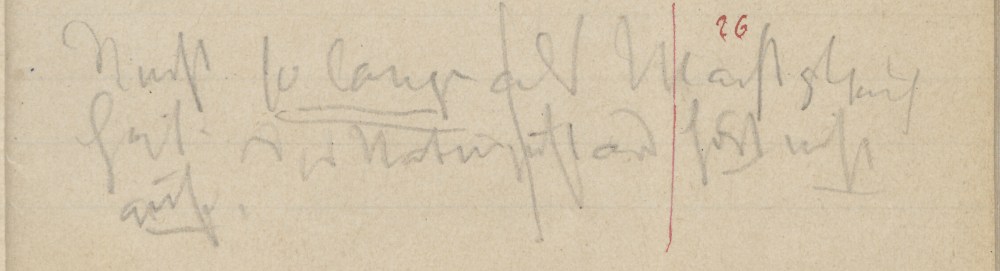
Nietzsche wrote the book in 1879 during his summer stay in St. Moritz The Wanderer and His Shadow (henceforth briefly: wanderers).2 There, he is of the opinion that justice can only be achieved among equals. In the aphorism with the title”Principle of balance” it states succinctly: “Balance is the basis of justice. ”3 And a few pages later: “Right to contracts between Gleichen is based, exists as long as the power of those who have come together is equal or similar.”4. Nietzsche does not normatively justify contract law. He makes it clear that there is no metaphysical reason for law. This in turn implies that the state of nature persists even in peace, but is suppressed through the active exercise of power. In the notebook N IV 1 from 1879, this is concisely noted: “Law as long as equality of power. The state of nature doesn't stop.” (Figure 1)5 It also belongs to the”cleverness“that similarly powerful people do not get involved in senseless feuds as, that the more powerful only subdue the weaker to the extent necessary in order to save strength in turn.6 In the book of aphorisms published a year earlier Human, All Too Human Is it said in 1878 with reference to Thucydides' famous Melier Dialogue about the”The origin of justice“: “[W] o there is no clearly discernible overpower and a struggle for unsuccessful, mutual damage would arise, the idea of coming to an agreement and negotiating mutual claims. ”7 Nietzsche is not interested in the moral and legal legitimation of law, but in its concrete practical implementation. In addition, law does not reflect the physical balance of power, but only its assessment: “The right Goes originally so far, as one valuable to another, essential, invincible, invincible and the like appears. ”8 It is therefore not about objectively measurable quantities, but about a process of mutual negotiation of power. Nietzsche therefore comes to the conclusion: “Unusquisque tantum juris habet, quantum potentia valet” (in English: Everyone has as much right as they are granted in power).9 Nietzsche thus manages to avoid the normative concept of justice through the principle of balance. The lack of norms therefore does not lead to crude power politics, but to a complex and interactive process of weighing up. Volker Gerhardt sums this up aptly for Nietzsche's so-called middle creative period: “It is the insightful Power, not pure force, which creates law here. Law is the product of reciprocal estimates of power projected onto future actions. ”10
Intuitively, when you think of balance, you think of a simple scale with two weights that are compared using a uniform measure. However, Nietzsche also draws on contemporary physics — in particular thermodynamics and the balance of forces — as well as on economic models.11 Equilibrium or balance describes a relationship of forces that stabilizes as long as neither side gains the upper hand. So it is dynamic, not static. As a result, the law only applies as long as the balance of powers persists. Gerhardt writes about this: “The balances are not only those authorized in each case sides, but also the one formed by them Ganze received. Individual and whole, element and Systems can also survive under equilibrium conditions. ”12 A balance of power therefore means neither suspension of power nor powerlessness, but an intelligent, dynamic and active interplay of forces.
2. The Reassessment of War and Peace
Before 1879, the persistence of a culture in Nietzsche's writings was always linked to war. Peace only served as a transitional phase for new wars — as is often the case in his early and late works.13 Still 1878 in Human, all-too-human The idea emerged that wars could either exhaust or revive a society. The “solution” was to wage even more terrible wars. That is what the aphorism says”War is essential“:
You will find many more such surrogates of war, but perhaps through them you will see more and more that such a highly cultivized and therefore necessarily dull humanity, like that of current Europeans, requires not only wars, but also the biggest and most terrible wars — i.e. temporary relapses into barbarism — in order not to lose its culture and existence itself through the means of culture.14
The ups and downs of peace and war should lead to the continuous renewal and regeneration of culture. Only in this way could Nietzsche imagine the emergence of a higher form of culture in 1878. And yet here, with the “surrogates of war,” Nietzsche is planting the seeds for his upcoming change of opinion. In fact, violent confrontation is just one of many forms of war. Societies that have become peaceful create “surrogates,” i.e. substitute forms of war: For example, the English embark on dangerous sea voyages and adventurous expeditions.15 It is precisely this possibility of substituting military functions that allows Nietzsche to distance himself from war a good year later.
Because 1879, in wanderers, Nietzsche has fundamentally changed his position. He distances himself from the abstract idea that war is a fair competition or a cleansing conflict between two isolated opponents. The new means of Europeanization is now a peaceful democracy. The war appears superfluous, destructive and backward: “The democratic institutions are quarantine facilities against the old plague of tyrannical cravings. ”16 Nietzsche accepts democratic change and its consequences — including security, peacetime, health, human rights, mental and physical freedom, and the possibility of long-term planning. The new temporal model provides for a long-term transition through democracy to higher forms of culture. Since war only brings short-term success as a remedy, but leaves behind great destruction, Nietzsche focuses on alternative forms of war — in particular diplomacy. The “indispensable war” became an “unnecessary war” within a year.17 The transition from Human, all-too-human for wanderers It therefore does not mean a devaluation of the meaning of war, but rather a transformation of its manifestations. In wanderers War is understood as a diverse and substitutable practice.
3. Peace as a Negotiated State of Equilibrium
This change in thinking can be seen in the aphorism”The praise of the unselfish and its origin“from wanderers Understand: In a detailed example, Nietzsche describes how two enemy tribes were forced to achieve peace through the strategic intervention of a third party: “There had been strife between two neighboring chiefs for years: they devastated each other's seeds, led away armies, burned down houses, with undecided success overall because their power was pretty much equal. ”18 Violent war among equals is not worthwhile, as it causes great damage to all opponents and the benefits remain uncertain. A third tribal group was in a protected position with their possessions and was not vulnerable to both parties to the conflict. However, she threatened to side with the victim in the event of a new attack. This threat led to peace being established. In their new state of peace, all three tribes benefited from growing prosperity. Even if the third tribal group could theoretically — due to their remote geographical location — stay out of the conflict, this would reduce the prosperity and welfare of all actors. Nietzsche describes this as follows:
Everyone saw with astonishment how suddenly their prosperity and comfort grew, how they now had a dealer ready to buy and sell at the neighbor instead of a treacherous or openly mocking offender, like themselves, in unforeseen emergencies, they could pull each other out of distress instead of exploiting this neighbor's distress and increasing it to the highest level, as has happened so far, As if the human attack in both areas had improved since then: because the eyes had brightened, the foreheads were frowning, Allen was Trust in the future has become one's own — and nothing is more beneficial to people's souls and bodies than this trust.19
The prosperity and flourishing of the human community in a relationship of trust with the environment not shaken by war became “a” desirable state of affairs for Nietzsche in 1879. In addition, the embellished stroke of people, the frowned foreheads and the comforting culture of trust evokes an aesthetic of peaceful coexistence — but also an ironic exaggeration of the contemporary democratic discourse.20
Nietzsche uses the example of the three tribes to describe peace as an actively and cleverly established balance of forces. This balance is not based on normative concepts of justice and peace. Instead, peace as a state of equilibrium is based on negotiated claims to power, specifically situated actors and rational usefulness. The diplomatic negotiation of the third tribe represents a substitute form of war. The diplomats represent positions of power with regard to the desired goals and must communicate these to the other negotiating partners as convincingly as possible. In this sense, diplomacy is a higher form of war than violent conflict. However, the third tribal group also brought about this peace through threat. In the form of the threat, the war formed a diplomatic negotiation as an option. Diplomacy takes place in wanderers As a result, an important role. That is what the aphorism says”The victory of democracy“We need diplomats of the future, “who must be cultural researchers, farmers, transport experts at the same time and not have armies behind them, but reasons and benefits. ”21 Compared to his earlier writings, Nietzsche designs a more complex model of power balance, which makes different power potentials visible, taking into account the respective situation of the participating tribes. Between early writings and wanderers Democracy has changed from a tyranny of the weak to a process of negotiation charged with power.
4. Armed and Real Peace
In a striking aphorism titled”The means to real peace“Nietzsche addresses the military armies of the individual states. Although the armies would be legitimized as a means of self-defense, they implicitly reflected distrust of the other actors: “This is how all states are now opposed to each other: they presuppose the bad will of the neighbour and the good will of themselves. However, this requirement is a inhumanity, as bad and worse than war. ”22 This statement is doubly irritating: On the one hand, because it criticizes the stated dynamic balance of power as “armed peace,” and on the other hand because, depending on the point of view, it appears idealistic or naive when Nietzsche argues that the belligerent attitude can only be broken if “the” most powerful man makes himself defenseless and smashes his army:”Make yourself defenseless while being the most defensive, from a height out of the sensation — that is the means of real Peace, which must always rest on a peace of mind. ”23 First of all, this aphorism addresses an unknown future and does not describe a current possibility for Nietzsche (“And there may be a big day coming”). I interpret the aphorism as a simple continuation of the idea of peace based on strength: The most defensive, i.e. the strongest, makes himself defenseless from the position of strength.24 For Nietzsche, this is the only conceivable option for maintaining real peace: because, as explained, Nietzsche (unlike Kant) does not believe in contractual peace guarantees that exist independently of dynamic balances of power. At the same time, for Nietzsche, eternal peace cannot be established by military means, because this is the “bad attitude of the neighbor.”25 Presuppose and provoke further wars. For this reason, there could be no gradual, gradual dismantling of weapons of war to establish lasting peace. Nietzsche's reference to an almost utopian future of a peace-making advanced empire (“highest training of military order and intelligence”) testifies in particular to how implausible this fiction is.26 Seen in this light, Nietzsche's thesis is not a pacifist plea, but even an admonition: For anyone who makes himself defenseless without Having supreme power and strength weakens the dynamic balance of power.
The future peace scenario with a single main actor appears sub-complex compared to the aphorism discussed above.”The praise of the unselfish and its origin”. Instead of the dynamic complex balance of three players, each in a different location, there is a simplified view of an agonal competition with a single, peace-loving winner. In the then and today imperial order of power with several major powers, it is difficult to imagine that there would once be a single “most defensive” or in the singular “a people” who could destroy their military means. In addition, this prospect of peace without alternative omits the manifold benefits of peaceful coexistence, as exemplified by the three tribes. The latter led to “trust in the future”27, which has great potential for peacemaking.
5. Conclusion: Peace through Strength Obliges All Actors
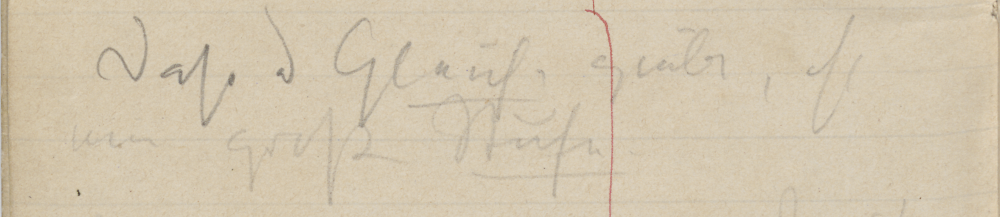
Although the 19th century in Europe was marked by wars, it was comparatively a “period of low violence. ”28 This left room for new ideas of peace. Nietzsche, who worked briefly as a medic during the Franco-Prussian War of 1871, seemed mentally distant enough in 1879 to attest to the violent wars had mostly destructive consequences. At the same time, his experiences of war made him firstly immune from falling into naive pacifism and secondly too familiar with realpolitik to believe in a universalist contract theory. Historiography thus left little hope for the enforceability of a philosophical legitimation of law. Nietzsche invites you to look at current challenges from a sober perspective of power politics and not to prematurely dismiss them as mere acts of violence. Because Nietzsche's reassessment of peace and democracy in wanderers is a plea for an intelligent, power-conscious peace order. Peace is not a sign of exhaustion, weakness or retreat, as in earlier works, but the conscious negotiation and balancing of a dynamic balance. Peace is an active state that binds and rearranges forces — not the absence of power. Peace is therefore also not a passive result of determined power relations. Peace as a dynamic balance of power is a cultural development effort: The notes from 1879 state: “The fact that there is an equilibrium is a big step” (Figure 2).29 As Henning Ottmann put it, this is a “philosophy of peace,” whose “condition [...] is strength.”30 In this view, there are no normative guarantees that stand the test of time far away from situateness, usefulness and claims to power.
There is (unfortunately) a lot to learn from this today. Because especially in a time of strengthened (or made visible) power politics, eroding multilateral institutions and threatening nuclear scenes, Nietzsche's perspective is remarkable: In the spirit of Nietzsche, the question today is which diplomatic negotiations can lead to new, stabilizing balances of power by individual actors beyond normative values? What could a useful peace look like for all actors? When it comes to peace, how can all actors actively manage their power (as opposed to relinquishing power)? This is because weaker actors cannot evade responsibility by pointing out their weakness or pacifism, because stabilizing effects must be negotiated even in the modalities of subjugation. This awareness of power and vulnerability is important when negotiating with actors who threaten to resort to military means (and with those who do not follow the rules negotiated with substitute means). A balance in relation to all stabilizing forces obliges all actors to their own strength. In times of armed peace and increasing armament, this cannot only be achieved through diplomatic skill, but must also be supported by economic and military strength. In this systemic view, chaos breaks out not only because of the misconduct of individual actors, but because the state of equilibrium sustained by all became unstable from several sides. This is how we are dealing today with the opposite starting point of Nietzsche's fiction: The most defensive are making themselves even more defensive, which is why armed peace continues to represent the only balance that can be achieved. And this obliges all actors to active power politics and strength. This is in line with Europe's current situation at a time when rules only apply “as long as an authority is prepared to enforce them. ”31
Tobias Brücker has a doctorate in cultural studies and is head of HR personnel development at the Zurich University of the Arts. He has researched Nietzsche's working methods and published the monograph in 2019 On the road to philosophy. Friedrich Nietzsche writes “The Wanderer and His Shadow” published. He is interested in all facets of diets, authorship, and creativity techniques in philosophy and the arts.
Article Image
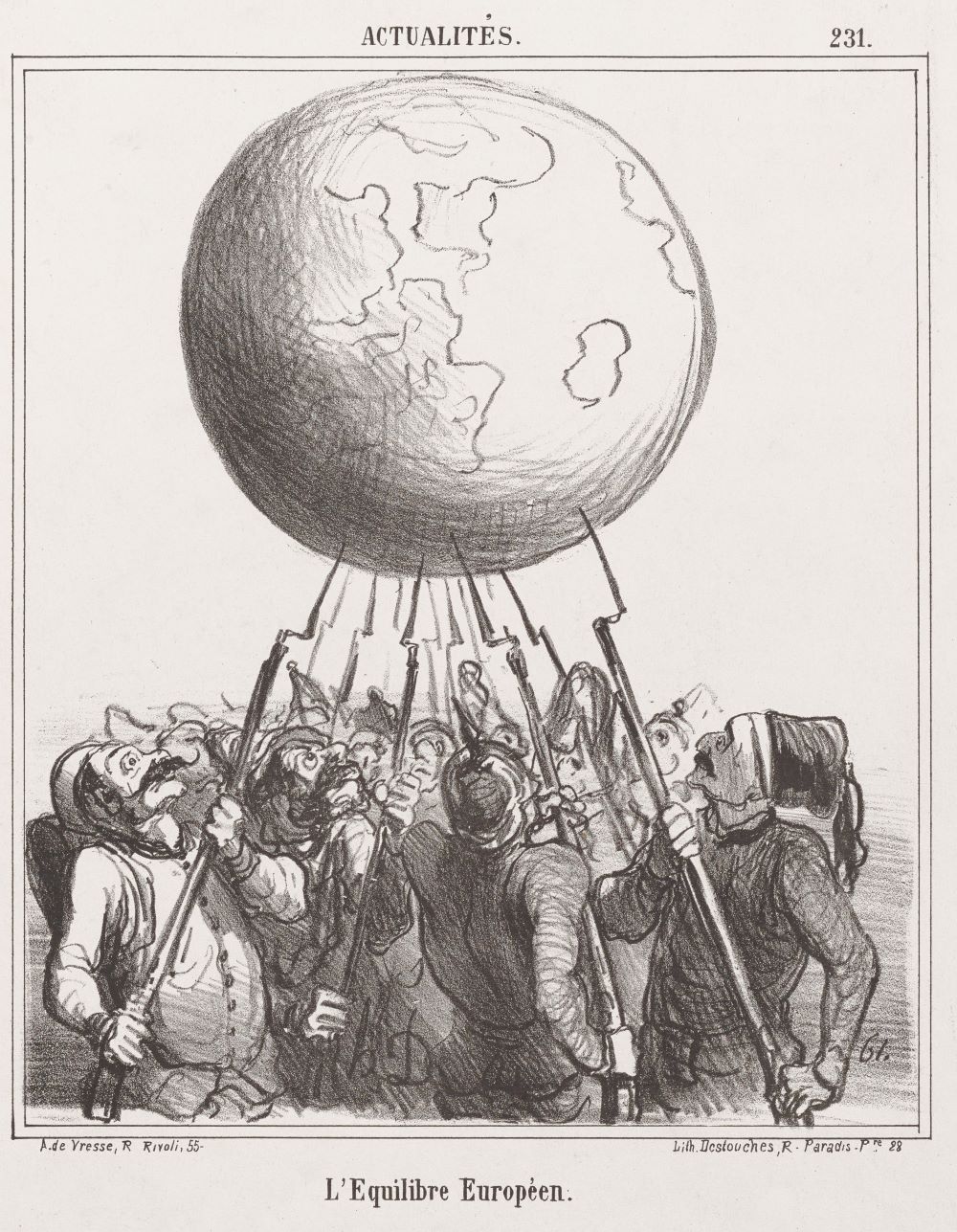
L'Equilibre Européen (“The European Balance”) is a famous lithograph by French cartoonist Honoré Daumier (1808—1879). It was published in 1866 in the satirical magazine Le Charivari published — during a period of great European tensions, just before and around the Prussian-Austrian War (spring).
Literature
Brücker, Tobias: On the road to philosophy. Friedrich Nietzsche writes “The Wanderer and His Shadow”. Paderborn 2019 (link).
Gerhardt, Volker: The “principle of balance.” On the relationship between law and power in Nietzsche. In: Nietzsche studies 12 (1983), PP. 111-133.
Kaufmann, Sebastian: Commentary on Nietzsche's “The Wanderer and His Shadow”. Berlin & Boston 2024.
Münkler, Herfried: The old world order is broken. In: NZZ, 2.7.2025, p. 32.
Osterhammel, Jürgen: The transformation of the world. A story of the 19th century. Munich 2009.
Ottmann, Henning: Philosophy and politics in Nietzsche. Berlin & New York 1999.
Footnotes
1: This article is based on a talk titled “La paix: un état de la puissance dans Le Voyageur et son ombre“, which I held at the following meeting: “Les figures de la puissance chez Nietzsche”, Journée d'études Nietzschéennes à l'Ens, École normale supérieure de Paris, 29.03.2018.
2: As an attachment to Human, all-too-human Considered, this work has so far received little importance. A detailed study of the history of editions and the topic of democracy can be found in: Tobias Brücker, On the road to philosophy, P. 197-239.
3: The Wanderer and His Shadow (in the following: WS), 22.
4: WS 26.
6: Cf. WS 26.
7: Human, all-too-human Vol. 1, 92.
8: Human, all-too-human Vol. 1, 93.
9: Ibid.
10: Cf. Volker Gerhardt, The “principle of balance”, P. 127.
11: Cf. Gerhardt, The “principle of balance”.
12: Ibid., p. 129.
13: See e.g. CV3, MAI I, 477, MA I, 444, JGB 210, JGB 238, NF 1888, 14 [192]. See also Brücker, On the way, P. 201-207.
14: Human, all-too-human Vol. 1, 477.
15: See ibid. 1
16: WS 289.
17: See in detail: Brücker, On the way, P. 197-239.
18: WS 190.
19: Ibid.
20: Cf. Brücker, On the way, p. 209 ff.
21: WS 292.
22: WS 284.
23: Ibid.
24: The commentary on WS includes various interpretations, see Sebastian Kaufmann, remark, P. 485-489.
25: WS 284.
26: See also here the remarks on the function of rhetoric and the undetermined future in Nietzsche's aphorisms of democracy in Brücker, On the way, p. 209 f.
27: WS 190.
28: Jürgen Osterhammel: The transformation of the world, P. 705.
29: Notebook N IV 1, p. 3. On pages 2 and 3, there are notes which serve as precursors to the quoted aphorism WS 22”Principle of balance“were processed.
30: Henning Ottmann, Philosophy and politics in Nietzsche, p. 127.m
31: Herfried Münkler, The old world order is broken.
Peace through Strength
Nietzsche's Perspective on Negotiated Power and Armed Peace
War in Europe was considered unthinkable for a long time — until it became a reality. But how can peace be thought of when normative guarantees fail? What if there are a few powerful and many weak players? Friedrich Nietzsche devised a surprisingly timely answer in 1879: Peace is not a sign of weakness, but an actively negotiated balance of power. He showed how a stable peace obliges all actors to build up their own strength. Nietzsche's transformation from an advocate of war to a thinker of peace based on strength is an admonition — also and especially to the weaker.
Discussion with Barbara Straka
Interview with Barbara Straka about Her Book Nietzsche Forever?
“It is no longer about monumentalization! Artists today want to make Nietzsche human so that one can deal with him in a new way.”
Interview with Barbara Straka about Her Book Nietzsche Forever?
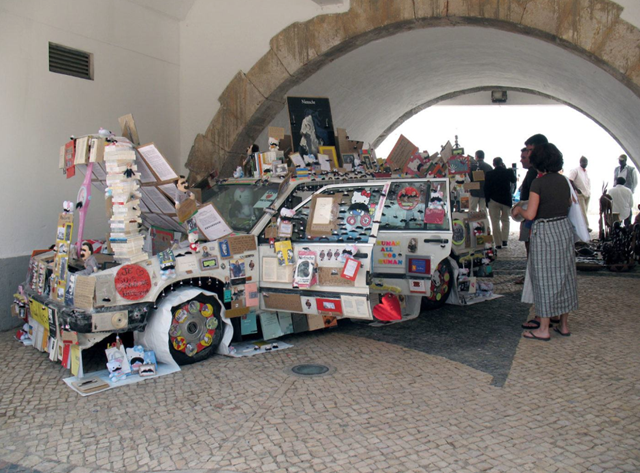
Last year, curator and art historian Barbara Straka published a two-volume monograph entitled Nietzsche forever? Friedrich Nietzsches Transfigurationen in der zeitgenössischen Kunst (Nietzsche Forever? Friedrich Nietzsche's Transfigurations in Contemporary Art), in which she explains Nietzsche's significance for the visual arts of the present day. After Michael Meyer-Albert dedicated a two-part review to her work in recent weeks (part 1, part 2), here follows an interview conducted by our author Jonas Pohler with the author in Potsdam. He discussed her book with her, but also about the not always easy relationship between philosophy and contemporary art.
1. “In this exuberant wealth of consumer culture, it is virtually impossible to develop something like an interest in art.”
Jonas Pohler: For the cover of your books, you have1 chose a gift shop.
Barbara Straka: No, it's not a gift shop.
JP: What is that?
BS: It's not a gift shop. Please turn around. Here you can see the entire work Nietzsche Car [see the article picture] and it is an excerpt of it.
JP: Why did you choose this painting anyway?
BS: Yes, that's a teaser, a lead, an appetizer, you could say. It is found in various places. For example, in the title of the book, Nietzsche Forever? The question mark is mine, but “Nietzsche Forever” is by Thomas Hirschhorn, because it stands as a handwritten cardboard sign with three or four Nietzsche portraits on the Car. There is a red sign and asks just this question: Does this have a long-term validity? Does Nietzsche have a temporal validity and what is the future of Nietzsche's art? I would like to leave that to the observer or later art scientists.
JP: This is a car that is full of all sorts of (Nietzsche) devotional items, for example Hello Kitty2. Did you choose it because it illustrates the present tense of Nietzsche's reception so well? Very cluttered, partly commercialized, there is a lot... They also write that this Car Standstill symbolizes because the car can no longer drive.
BS: Well, you could also ask now: Why did it come to a standstill? It is overwhelmed! It is overwhelmed with kitsch and devotional items, but they are not only Nietzsche-based, but they are also — represented here by Americanized Japanese culture, namely this Hello Kitty — icon. Hello Kitty As a manga face that works with the child scheme and captivates people, has become a symbol of international pop art and pop culture, a very trivial art that depicts the infantilization of societies, popularized. I wouldn't deny that it is also art. Of course, it is also art. There are enough artists who work like this, such as Takashi Murakami, who have achieved world fame. But in this exuberant wealth of consumer culture of our time, it is virtually impossible to develop something like an interest in art. And that is also the central question that Thomas Hirschhorn asks as I understood him. In this late capitalist period, how do we manage to get back to the essential questions, sort of rummage through and then maybe get stuck with Nietzsche and actually read him again? Hirschhorn doesn't say yes that's the way it is, it's all very terrible, that is the end point and the nihilistic farewell, but he plays in the spirit...
JP: ... there is therefore positive potential!
BS: That's right, he plays the role of the observer: Get to grips with it! Read! Read it! And I think that's great. There is not only a didactic moment in it, but not in the sense of the instructive “display board aesthetics,” as artists were accused of earlier in the 1970s, but an emancipatory moment. That speaks for Hirschhorn anyway: The materials he uses are usually very simple, which anyone can buy. He has a very, how should you say, social understanding of art. He really makes art for people. And he also wants to show, in the spirit of Joseph Beuys, that basically anyone can be an artist. The materials aren't expensive, you can even buy them at a hardware store: adhesive film, wood, aluminum foil, anything — and that's his message. Nietzsche's reception is endangered today because the popularized reception, which includes all these fakes, threatens to spill it. The core icon, namely Hello Kitty, that little cat, gets Nietzsche's beard glued on. This means that amalgamation has already taken place. It's already a mutation.
JP: ... but the beard, for example, is also a memory!
2. “Texts, texts!”
BS: Nietzsche himself is very often maligned. It was a motivation on my part that I did not want to let this populist reduction stand still like this. My impression was that since the 1994 Weimar exhibition [For F. N. — Nietzsche in the visual arts of the last 30 years], in which there were many cartoons showing that Nietzsche researchers often preferred to see this funny, somewhat cute and funny Nietzsche than the serious one.3 It was my impression that this populist reception has been developing as a main strand since that time.
JP: Do you have the impression that this popularization is welcomed?
BS: Yes, it is light food.
JP: But also among researchers? Nietzsche is often portrayed as a strict philosopher, in part already a classical philosopher, and this is also how I had imagined his “admirers”, who then feel rather repulsed by this popular art.
BS: Yes, you have to make a distinction. I was talking about the classic Nietzsche researchers who spend all their time studying Nietzsche's texts. Texts, texts, texts! As late as 2000, one of the exhibition organizers in Weimar said that Nietzsche was a text. When such people see pictures of Nietzsche, they naturally want something that is a bit lighter, to relax, so to speak. In any case, this humorous confrontation with Nietzsche is a welcome opportunity to popularize. They then pick out exactly what they enjoy doing themselves. They have no questions at all for the artists, but they are looking for in art what they already know themselves. On the other hand, art historians — in such circles there is once again a distinct concept of art, which reinforces my thesis that art and philosophy simply need new levels of encounter and a new dialogue: They know too little about each other. There are worlds between the art business, the development of contemporary art, its formation of theory and classical philosophy.
JP: Why is it that interdisciplinary work between contemporary art and academic philosophy, for example, is so difficult? You write in one place:
While art historical reception up to 2000 has at least some already established artistic positions in mind, philosophical Nietzsche research remains ignorant or skeptical [...]. It is astonishing that even on the 100th anniversary of Nietzsche's death, there can be no talk of a scientific impact analysis, let alone a wider knowledge of contemporary art about Nietzsche [.] (P. 39)
At the same time, you write, there is an accusation of modern art that it is partly “indiscriminate, [and] ambivalent” (p. 40).
BS: It's not for nothing that people talk about the “art operating system.” It is a self-contained system that revolves around itself, and so is the philosophy. And once in a while, they clash with each other. There are then points of contact, so to speak, which I have now also tried to incite here, literally. But you look at yourself from a distance and, of course, only perceive excerpts. Philosophers also have a great need to catch up or catch up to do, which they may not necessarily recognize at all or of which they are not necessarily aware of. They stopped somewhere on a certain level of dealing with art. That is just not their field. In other words, the understanding of art of a classical philosopher or Nietzsche researcher cannot be expected to be on the same level as contemporary art development. That doesn't work at all. I can't blame anyone for that; they don't even have that much time. They are researchers and the artists don't have that much time either; they read this and that and then integrate it. And then there are just these occasional sparks... Of course, there are also artists who have worked with philosophers, such as Hirschhorn — and that's where it naturally becomes fruitful. That's when things get really complex. I would like to see something like that more often! That is also a suggestion, the book should be an inspiration to get into conversation with each other. But so far, it has been the case that the encounters were mostly random. One can accuse not only philosophers and Nietzsche researchers of ostracism, but also of art historians. They were traveling just as excerpts... but the so-called “gallery art” was always mostly ignored. That is just the point. And that was my catch-up project: with works by over 220 artists, I have now compiled everything that was created after 1945.
3. “Anything that now sticks to a thesis, a discipline, a conviction is out of date!”
JP: What could philosophy learn from modern art, or what do you think could result from a collaboration? You had called for exhibitions in your book, if I understood you correctly. They think that these as a format would be a good means of creating the connections mentioned above. On the other hand, I have the impression that there is still something very exclusive and limiting about them and that what is called a “cultural sector” plays a major role.
BS: First of all, it's all about opening up. It is about opening up these narrow academic limits. I don't want to get caught up in general sentences, but academic disciplines are very careful to keep their subject limits and are reluctant to go into other realms. But it is about dialogue, about an attitude that also reflects current phenomena that shape our time, society, politics and history across horizons. It is about not just looking at topics from one side, but, in Nietzsche's sense, seeing the concept of truth as something prismatic, for example. That I learn to recognize different aspects, areas, topics, simply the diversity of a phenomenon. So everything that now sticks to a thesis, to a discipline, At a conviction that is out of date! Today it is about opening up, it is about movement, it is about multidisciplinarity, it is about collaboration, it is ultimately also about the knowledge that innovation can only be created if as many different disciplines as possible work together.
JP: In the spirit of Nietzsche, actually. He has pleaded for it himself. I had the impression that you wanted to present exactly that in your book, this multifaceted diversity, which can take on very different forms.
BS: Yes, that's right. There is no one valid Nietzsche image, there is no such thing.
JP: A scientist would probably disagree with that.
BS: Yes, he would still search.
4. “It is not about monumentalizing Nietzsche — it is about very complex perspectives.”
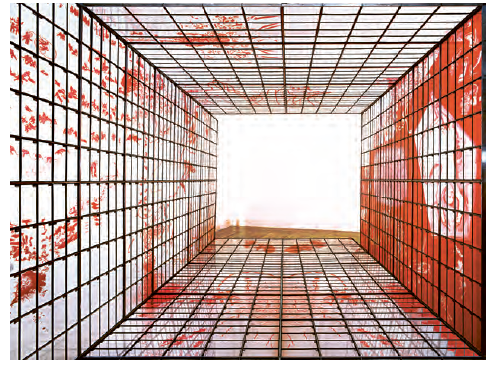
JP: Another work from your book is by Katharina Karrenberg [see fig. 1]. I don't think this is about destruction.
BS: No, it's about development and process.
JP: I had difficulty imagining the work.
BS: Yes, I'd like to believe that.
JP: How can you imagine that? Is that a room? With her? Is it in the studio, what is that?
BS: Katharina Karrenberg was invited to my exhibition for the first time Artists' metaphysics — Friedrich Nietzsche in post-modern art Participating was in Berlin in 2000. Because I knew her before, I knew that she deals extensively and explicitly with philosophy and is constantly reading, from the latest literature to non-fiction books. I invited her back then and had no idea what she was doing. She then designed an entire wall, with maybe 60 works. They're such small tablets.
JP: That was done? Or did she design them live?
BS: No, she did it at home in her studio. And then it was displayed in the exhibition room in the house on Waldsee [Berlin] on the upper floor. She was given an entire room to herself and it was about ZARA & TUSTRA. She took the character Zarathustra apart and turned it into two comic-like characters that draw on great couples in cultural history, such as Dante and Virgil or Faust and Mephisto. Two characters embarking on a journey and the artist, of course, did not even know where the journey was heading at the beginning. She first worked through the Zarathustra motif in the exhibition. Then we didn't hear from each other at all for a while and at some point I read that they had had further exhibitions and by now the whole thing had grown to over 800 pieces. Today, there are over 2000! It has become a journey through history. Follow the characters until they are resolved. At some point, the artist herself also appears. It is an immersion, a dive, an appearance, a transformation. It is very Nietzschean in the sense of this eternal movement, eternal return — the idea also comes to light, of course. In this work, she has reflected on all developments of modernism and postmodernism, including political topics, I'll give you an example: Gaza. Things are still in a state of flux. I visited them two years ago on Tempelhofer Ufer in Berlin, Kreuzberg. She lives in this work. It has become a work of art of life. But you can really imagine it that way, it's everywhere. It has developed like a stream through the entire apartment and is totally fascinating, totally fascinating! You can't even sum it up in a few words. If you go through it yourself, it's as if you're in a state of intoxication. Viewing is an exhilarating experience. The other person must then, of course, start reflecting again in order to even locate and find themselves in it. In principle, it's not finished, but she wants it now. It is basically an open work of art, in the words of Umberto Eco. An open work of art that is constantly changing, as Nietzsche said: a work of art that creates itself. In short: one of the most complex conceptual, intellectually top-class works, which stands in complete contrast to one or the other small drawing of Nietzsche, which also exists, but which can have no less intense effect. The works are all justified. This is an important aspect that I have tried to emphasize again and again: A major work can also be a small drawing. It is not about monumentality. I am bothered by the term, because it is not about monumentalizing Nietzsche — it is about very complex perspectives.
JP: You write at the beginning of your book:
[F] A cluster model was chosen to structure the subject areas, which focus on the most important works that show an iconographic development of the motif with complex references to other positions [.] (P. 5)
And at the end:
This leaves the margins of the subject groups with a grey area, or rather: a necessary blurring that is due to the complexity of art or rather owes itself to it [.] (SEE 722)
When you say there is a cluster, does that mean there is also a midpoint? This is reminiscent of Wittgenstein's family similarities or prototype semantics. There are prototypes and defining features.
BS: That is something else. So there is not one defining characteristic for me, but complexity is the criterion for the center of a cluster! It's not a guy! No, no, for God's sake! That would be a requirement again! It's about complexity and it's about incorporating so many things into a work like this one by Karrenberg! She has extensive knowledge and reflects this, so to speak, through the focus on Nietzsche in her art. But it is not a prototype! That is unique, there is no such thing again!
JP: Is that a center, can you say that, or is that also not true?
BS: Yes, but some of the chapters have two or three centers. That happens. Why — Because they also mix together. I had written that it was possible that an artist could also have been assigned to another chapter. But then I decided on one. And by that I also meant this blurring of the edges. I had to look at what the artist did on the whole, and then it emerged that I assigned him to a main theme. But with references to one or the other other topic and then I referred to that. I think that is what makes the book quite interesting from my point of view. You can leaf through, you can continue reading somewhere else and, if you are interested in this or that, you can see that there is still a connection to another chapter.
5. “... the tremendous empathy that is in there!”
JP: Instead of using the term “center,” I'll use the image of the crystal. It can be illuminated, refracted and reflected to different degrees from many sides. If we don't want to talk about the most important works now, but about these crystals... Where can we find them? You spoke of subjective and objective characteristics earlier.
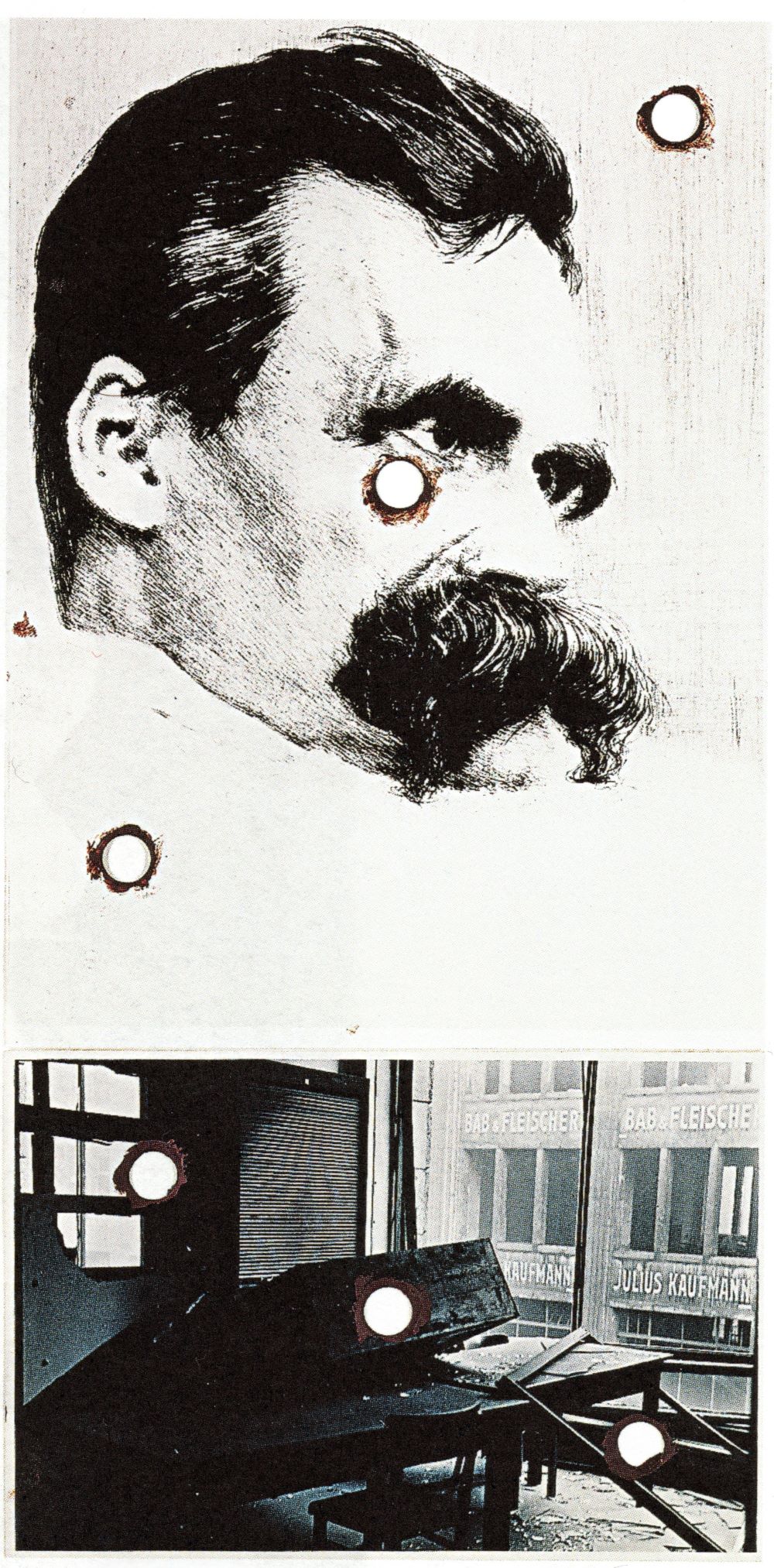
BS: Some have already been mentioned. Thomas Hirschhorn of course, Katharina Karrenberg, of course Wolf Vostell too, of course. Then Joseph Beuys, of course, Solar eclipse and corona [Figure 2]. This was a starting point for artists of his generation and the next generation to revisit Nietzsche. With Beuys, however, he still has one foot in the past. By taking up the portrait of Hans Olde — Nietzsche, who was already close to or close to death in 1899 — but turning the etching around (Olde depicted the etching backwards, there is no other way through the printing medium), Beuys Nietzsche turns back again. This means that he can be seen again at Beuys as Olde had seen and photographed him... Just a small thing, but it is important for the remark that artists were still looking for authentic Nietzsche at the beginning of the 60s and 70s. They really wanted the right Nietzsche image. They wanted to make it a topic again and were looking for the right picture. In a certain way, Beuys is already doing this small reversal. He confronts this portrait with a destroyed printing house, a devastated office that broke down in the newspaper district on Reichskristallnacht in Berlin, and opposite is a Jewish company name. You know immediately what's going on there. It is a pogrom. Wieland Schmied wrote that Beuys kept the wound painfully open. That means that at that time, the big question was whether you could even deal with Nietzsche again or whether he burned down once and for all because Nietzsche had not yet been rehabilitated back then. Beuys has nevertheless paved the way for him to be able to deal with him again and Colli and Montinari are also coming up with the critical study edition.
JP: Historically, this is certainly interesting, but I would be interested in the current period, i.e. since the 90s.
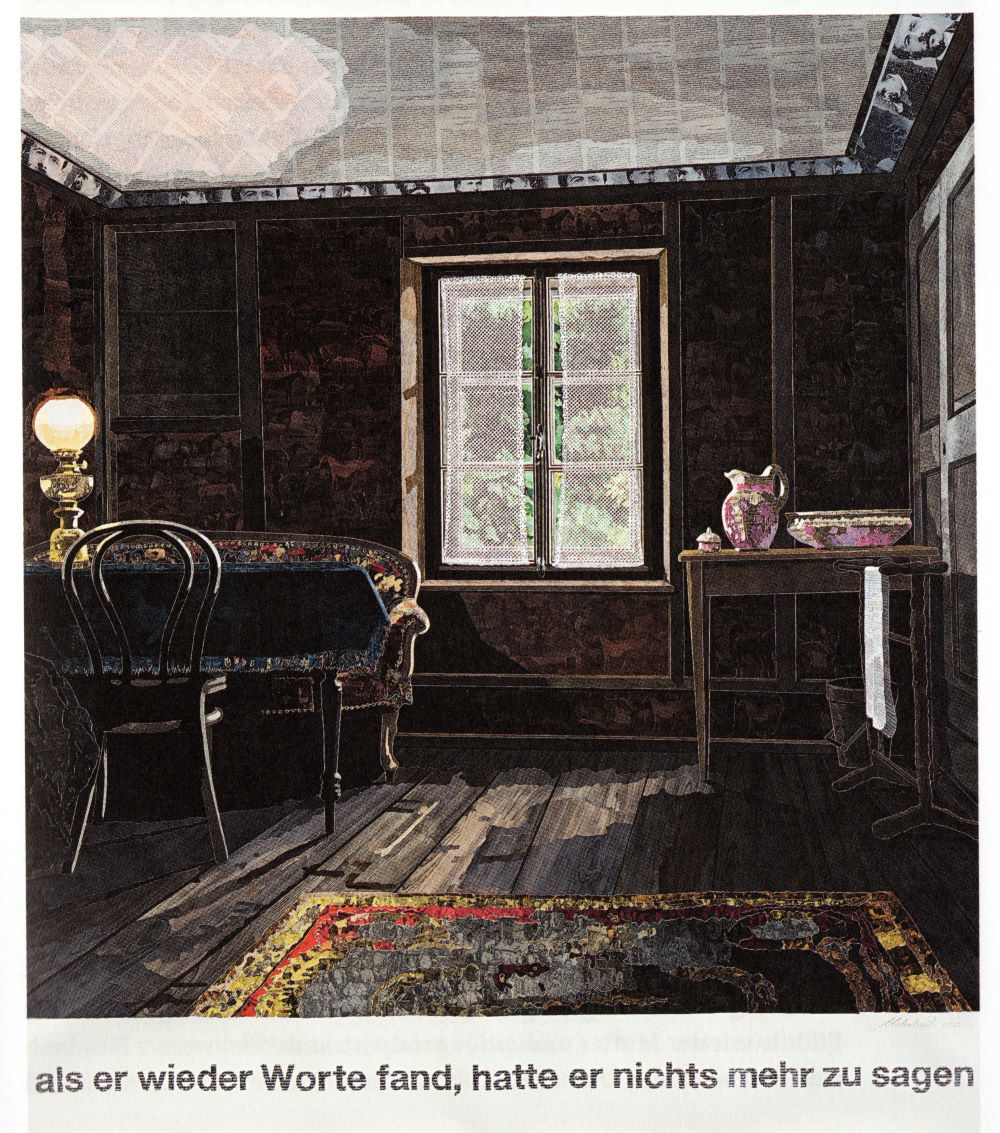
BS: I would definitely name another artist, that is Marcel Odenbach. He lived in Sils Maria during the corona period and worked in the Nietzsche room. The work is called View without God [Fig. 3] — a huge photo work that was created digitally. There you can see the Nietzsche Room as you know it... and every detail on this seemingly genuine but digital photograph is in itself a collage of other motifs. For example, Nietzsche's family, Nietzsche's letters, Nietzsche's compositions. You only see that when you stand in front of the picture. It's very big, it's full of walls. This means that, so to speak, the entire philosopher can be inferred from a single picture, and this includes this line of text: “When he found words again, he had nothing more to say.” — Of course, Nietzsche could not speak after his attack when he was in Turin, but when he found words again, he had nothing more to say. This alludes to the episode of the Turin Horse Hug.4 And now you have to imagine that the whole thing is a huge collage. It looks like a normal photo, but details are also hidden in the carpet and everywhere. There is a frieze at the top and this frieze is one portrait next to the other. Interestingly enough, there is also a fake. It's like a mosaic of Nietzsche texts, photos, trips, friends, relatives, acquaintances, Wagner... It all appears there, including the horse over and over again. I think they're all pictures of horses here on the left. So the famous episode when he supposedly hugged a horse in Turin, collapsed and then went insane.
JP: Who else should you know?
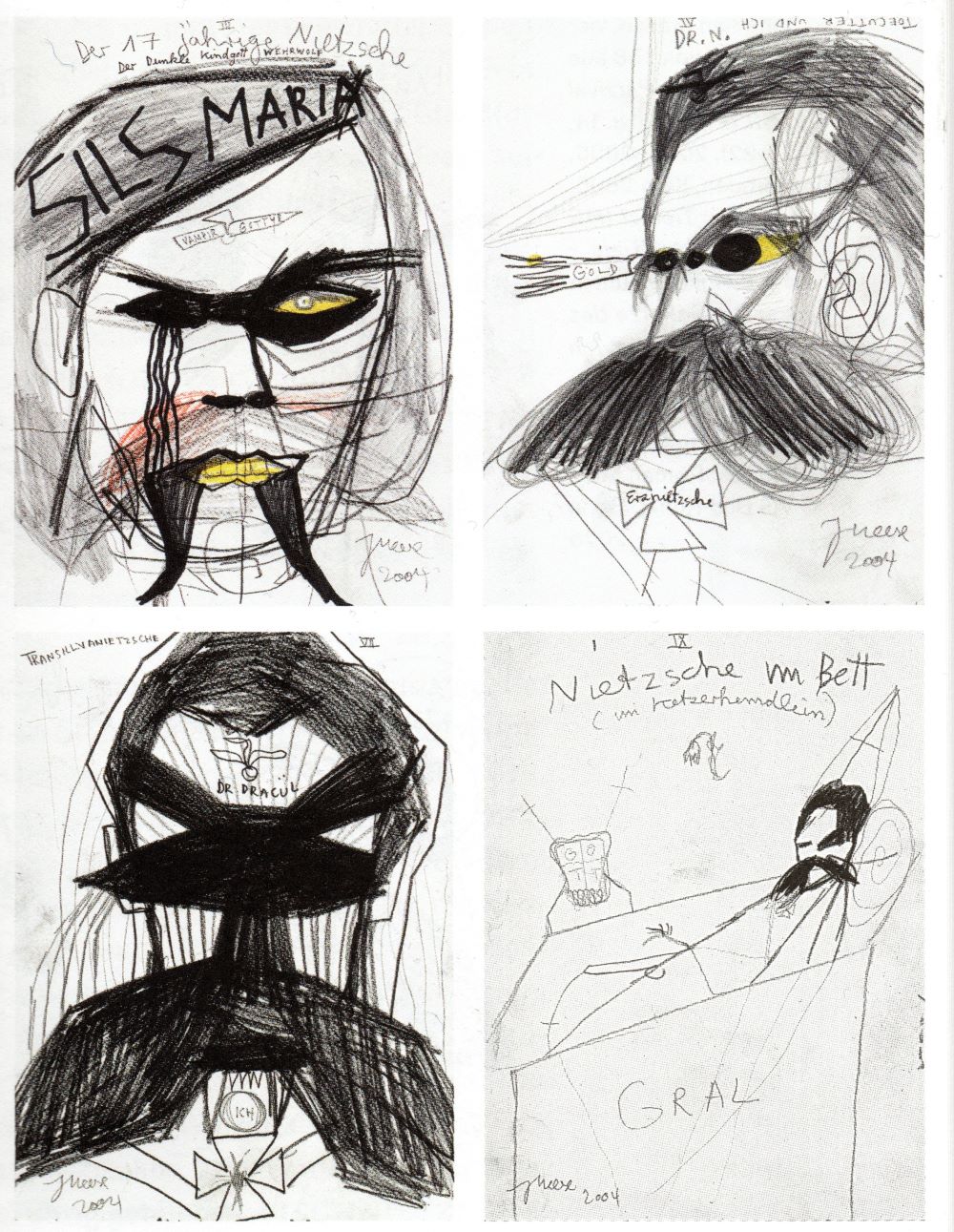
BS: It is absolutely impossible to imagine reception without Jonathan Meese [see fig. 4]. Then you should definitely know the series by Egyptian-Canadian artist Anna Boghiguian. She did a wonderful series called An Incident in the Life of a Philosopher [Figure 5]. It is only about his last days in Turin, this fateful episode, which for him ranges up to, how shall you say, metaphorical resolution of the apparitions he experienced there and which led him to write himself later in his insane letters as dionysus and The Crucified seen in a schizoid double role.
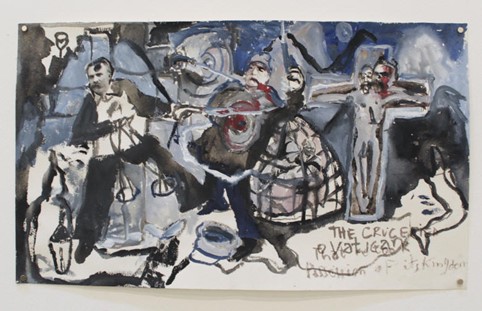
JP: What makes this work so special?
BS: ... The tremendous empathy that goes into it: on the one hand, understanding this episode, on the other hand, artistic free interpretation and how it works. She works with collage elements, some of which suggest authenticity. Then again, completely free interpretation. She virtually continues this legend. The question: How could this have happened? But then there are also flashbacks, just like in the movies. Suddenly Lou von Salomé appears and this famous Trio InfernalI always like to say, with Paul Reé. They wanted to start a residential community in Paris, but it was all very, very difficult at the time. Nietzsche had these plans, but there was a lot of jealousy and a great many misunderstandings, so that this friendship soon fell apart. But on the way to his madness, he virtually encounters this flashback again. And it represents it all. At the same time, she has written a poem in which she describes the incident as she feels about it. A great artist who has also been to the Venice Biennale. She is now an elderly woman, Anna Boghiguian, a very great artist. Then, of course, Felix Dröse, a Beuys student who made these blind drawings back in the 80s. That is in the chapter Being Nietzsche [Figure 6]. So that means how far do artists go...
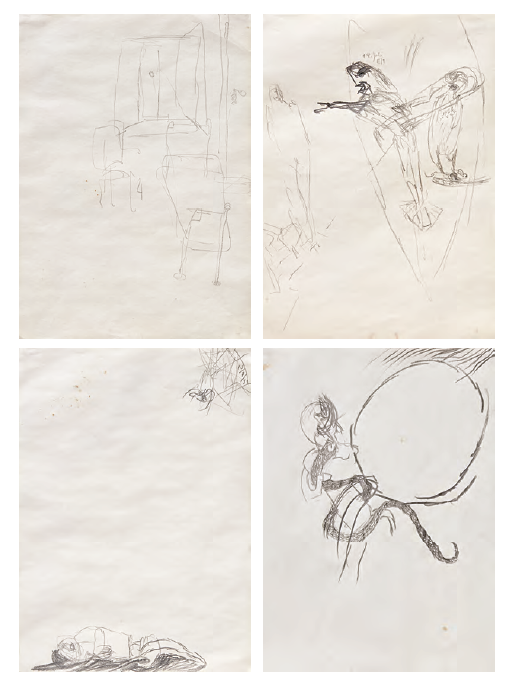
JP: ... I remember an artist who put himself in Nietzsche's shoes.
BS: Right, so how far do they push this moment of identification? Of course, the question behind this is: How can I really understand Nietzsche? So not just his lyrics, but how can I understand this person in all his tragedy? How can I also understand the insane Nietzsche, who has also said interesting things from time to time, how can I understand him? And Dröse answered that for himself back in the 80s by blindfolding himself. Then the inner images that he had in his head after he had read the then newly published Nietzsche biography by Curt Paul Janz, called these three volumes before his mind's eye, so to speak, and put them on paper with blind drawings. Such intensive things were created there, totally intense pictures, which are very delicate because they are very bright pencil drawings. They are not as expressive as Meese draws them, but rather searching drawings, you could say. A searching line and yet it condenses into incredible images or even visions, where you take a keyhole perspective and look into this hospital room. Or once a figure, i.e. Nietzsche, is lying down on the ground in the hospital camp, and a black spider comes from above and approaches dangerously. This is, of course, the symbol of the mother, the spider as the mother animal, which did not let go of him until death even though she had already died in 1897. That is also a very, very big achievement, a very large series of 151 drawings.
6. “Art and philosophy are ways of ultimately reaching a life-affirming position.”
JP: At the beginning of the book and on the title, write “Nietzsche forever? “and answer the question at the end of the book with “Nietzsche forever! “, i.e. with an exclamation mark. In the book, you have already formulated the question yourself as to the future viability of this subject in contemporary art. What factors do you currently see there? What is missing now?
BS: I believe that the topic will continue to be worked on, because after the book was completed, I had found around ten new works that could be sorted into the 14 subject groups I found. One of them was about sexuality, another about what relics there are. But that would have been nothing new in that sense. So I don't think there's a whole new topic coming up now. Perhaps “Nietzsche and the natural sciences” or something like that. There is now a researcher who is investigating Nietzsche's statements about the climate, others are asking about Nietzsche's attitude towards food — this eternal search for the right diet: What is digestible for him, just as he was always looking for the right place where he could write in peace, where he could get a better grip on his headaches and eternal illness, his nausea and everything he had. It is possible that artists will pick up on this at some point. But they're not there yet... The art development or reception that artists have towards Nietzsche and biographical Nietzsche research are not on the same level. This means that if a young scientist suddenly investigates Nietzsche's statements about climate, it will take a while before they are received by artists, if they may find out by chance.
JP: Do artists work in such a way that they read for now?
BS: It can happen in multiple ways. It may be that they read Nietzsche himself, where he talks about the climate in the Upper Engadine, for example, during his travels. And if someone is now interested in science, then it may well be that he comes to it via Nietzsche himself or through scientific discussion. One example is Berlin artist Tyyne Claudia Pollmann — with these two large, very early digital works.

JP: Is that an animation?
BS: It's all computer generated. “Photobased art,” they say today — based on photographs, but everything built on a computer. Back then, in 2000, she worked with the latest American programs and is also an example of how a scientist, namely a medical doctor, deals with Nietzsche and also with the way of making digital art. So that means someone who advances into these realms and also looks at this saying by Nietzsche about art from the perspective of science and science from the perspective of art5 Take it seriously. It is a shining example of this.
JP: Can you further explain Nietzsche's future viability as a subject?
BS: This is also a central question posed by this artist, who is a professor at the Berlin-Weissensee Academy of Art. Nietzsche Bynite [Fig. 7] and Transfigure Nietzsche: It contains the term transfiguration, which of course has several anchor points in the work. (As a side note, because my book is about transfigurations). Transfigurations are changes in Nietzsche's figure through the eyes of artists. But transfiguration is also a term that Nietzsche himself uses. In the introduction, you probably mentioned his discussion with Raphael [Transfigurazione di Gesù] saw where he regarded this motif as an icon for himself.6 Transfiguration has become synonymous with Nietzsche's entire philosophy, so to speak. He sees philosophy and ultimately also art as an opportunity to affirm life on earth, human life in all its problems, ugliness, warlike, terrible forms, by, so to speak, transfiguring it. Art and philosophy are ways of ultimately reaching a life-affirming position. That is the core of Nietzschean philosophy, his philosophy of life: his affirmation of life, despite all difficulties and circumstances.
JP: Are you worried about how Nietzsche will be portrayed in art in 20 years?
BS: No, not me personally. That brings us back to the topic of the fake. I'm seeing this flood of fakes right now. There are also some artists who work with fakes, such as Michael Müller, who hosted this birthday party for Nietzsche [First and second small rehearsal for Nietzsche's birthday party 2313, 2015] has organized. A Berlin artist, also a very, very important internationally working artist. Michael Müller asks himself these questions and he actually includes fakes. I spoke to him about it: “Mr. Müller, that is fake, that is not Nietzsche-authentic.” — “Yes,” he said, “but I am interested in exactly this change, projected into the future.” He really projects this into the future and basically says: Even in 2313, Nietzsche will still keep us busy and he has organized these performances, these events, where rehearsals are taking place for these events in the distant future — the rehearsal as an artistic event. He is interested in the future of the Nietzsche painting. He is one of the few so far who virtually equates the fake with the traditional images and says: “We recognize that and you can be curious about that...” But I suspect that at some point the authentic pictures will be outnumbered, that you will have to search for them with a magnifying glass and that perhaps in 20 years the Nietzsche portrait will have completely said goodbye to the authentic philosopher. There are already plenty of examples today where he is portrayed as a bodybuilding star or something like that — he never looked like that. This is due to Pop Art; it is not interested in authentic Nietzsche. It's just not about monumentalization anymore! Today, it is about making Nietzsche human so that we can deal with him again. Away from idealization, away from monumentalization! So to speak, bring him down to the level of dialogue, meet him. There are many examples where artists literally show him as a person of today, as an athlete, as a dialogue partner, as a partygoer and tucking him into a modern outfit with sneakers on his feet or in a biker dress. You can find it good, you can laugh about it, but this level is now on! And idealization and monumentalization is the new danger of pop art, popularizing art, because that's when he becomes a superstar again. Nietzsche Superstar, Nietzsche as Superman and so on. That's all there is to be found and you have to take it with care. It goes against the direction I would like people to get away from this popular way of thinking a bit and give this issue more seriousness.
JP: Yes, I personally believe that such a middle ground is needed. On the one hand, Nietzsche must not be too exclusive, on the other hand, it must not be trivial.
BS: Contemporary works in particular are looking for new ways to prepare him for other target groups... precisely this rejuvenation that he is undergoing, this modernization and rejuvenation, which of course appeals to a new target group. I'll be completely open when he gets his old-fashioned frock coat off now.
Barbara Straka, born 1954 in Berlin, studied art education/German literature and art history/philosophy in West Berlin. As a curator and art mediator, she has initiated exhibitions and major projects of contemporary art in Germany and abroad since 1980. She was director of the 'Haus am Waldsee Berlin — Place of International Contemporary Art, 'President of the Lower Saxony Art University HBK Braunschweig and consultant for cultural and creative industries and international affairs at the Berlin Senate. She is the author and editor of numerous publications on art after 1945 (www.creartext.de).
Jonas Pohler was born in Hanover in 1995. He studied German literature in Leipzig and completed his studies with a master's degree on “Theory of Expressionism and with Franz Werfel.” He now works in Leipzig as a language teacher and is involved in integration work.
This article was written with the collaboration of Erwin Krenz.
Literature
Straka, Barbara: Nietzsche Forever? Friedrich Nietzsche's Transfigurations in contemporary art. Basel: Schwabe Verlag 2025.
List of illustrations
Article image:
Thomas Hirschhorn: Nietzsche Car, 2008, mixed media, Allgarve Contemporary Art Program, Antiga Lota no Passeio Ribeirinho, Protimão, Portugal. Courtesy Jan Michalski Foundation for Writing and Literature, Montrichter (CH), photo: Romain Lopez © VG Bild-Kunst, Bonn. In: Straka: Nietzsche Forever?, P. 661.
Figure 1:
Katharina Karrenberg: R_A_U_S_CH_PASSAGE, interior view, 2000-2004, pigment ink, transparent paper, acrylic, bookbinding linen, aluminum, iron, L: 560 x W: 400 cm (inside: 300 cm) x H: 330 cm (inside: 300 cm) © VG Bild-Kunst, Bonn. In: Straka: Nietzsche Forever?, P. 490.
Figure 2:
Joseph Beuys: Solar eclipse and corona, 1978, 2-part photo collage with oil paint drawing, 37 x 18 cm, Jörg Schellmann Collection, Munich, photo: Schellmann Art © VG Bild-Kunst, Bonn. In: Straka: Nietzsche Forever?, P. 117.
Figure 3:
Marcel Odenbach: View without God, 2019/2021, collage, photocopies, pencil, ink on paper, 179.5 x 147.5 cm, private collection, photo: Vesko Gösel, courtesy Galerie Gisela Capitain, Cologne © Bild-Kunst, Bonn. In: Straka: Nietzsche Forever?, P. 343.
Figure 4:
Jonathan Meese: Four drawings of 20 from the Nietzsche series (No. III, IV, VII, IX), 2004, felt pen, colored pencil, pencil on paper, 27.8 x 20.9 cm each, photos: Jochen Littkemann © VG Bild-Kunst, Bonn. In: Straka: Nietzsche Forever?, P. 149.
Figure 5:
Anna Boghiguian: A work from the series An Incident in the Life of a Philosopher, 2017, mixed media and collage © Anna Boghiguian. In: Straka: Nietzsche Forever?, P. 560.
Figure 6:
Felix Dröse: from the cycle Untitled (“I'm dead because I'm stupid, I am Stupid because I'm dead.”), 1981, four blind drawings of 151 (No. 21, 26, 19, 144), pencil on paper, 29.5 x 21 cm each, photos: Manos Meisen © VG Bild-Kunst, Bonn. In: Straka: Nietzsche Forever?, P. 617.
Figure 7:
Tyyne Claudia Pollmann: Nietzsche Bynite, 2020, computer simulation, Cibachrome, 81 x 153 cm. © VG Bild-Kunst, Bonn. In: Straka, Nietzsche Forever?, p. 396 f.
Footnotes
1: See the second part of the review by Michael Meyer-Albert (link).
2: See the corresponding illustration in the first part of the review by Michael Meyer-Albert (link).
3: Editor's note: See also the drawings by Farzane Vaziritabar on the occasion of the conference Nietzsche's Futures 2024 in Weimar (link).
4: See detailed the second part of the review by Michael Meyer-Albert.
5: Cf. The birth of tragedy, An attempt at self-criticism, 2.
6: Cf. Human, all-too-human II, The Wanderer and His Shadow, 73.
“It is no longer about monumentalization! Artists today want to make Nietzsche human so that one can deal with him in a new way.”
Interview with Barbara Straka about Her Book Nietzsche Forever?
Last year, curator and art historian Barbara Straka published a two-volume monograph entitled Nietzsche forever? Friedrich Nietzsches Transfigurationen in der zeitgenössischen Kunst (Nietzsche Forever? Friedrich Nietzsche's Transfigurations in Contemporary Art), in which she explains Nietzsche's significance for the visual arts of the present day. After Michael Meyer-Albert dedicated a two-part review to her work in recent weeks (part 1, part 2), here follows an interview conducted by our author Jonas Pohler with the author in Potsdam. He discussed her book with her, but also about the not always easy relationship between philosophy and contemporary art.
Dionysos als rolling stone
An Attempt to Understand Nietzsche with Rock Music
Dionysus as Rolling Stone
An Attempt to Understand Nietzsche with Rock Music
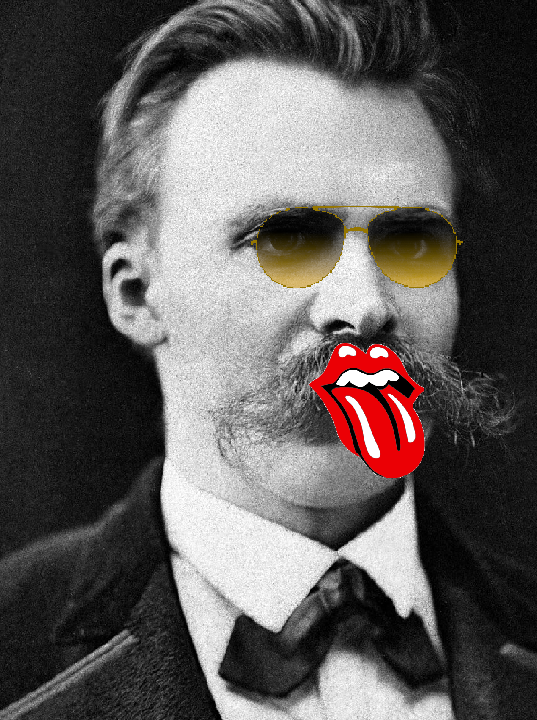
On the one hand, Nietzsche's distinction between the Apollonian and the Dionysian helps to understand the development of the rock music of the Rolling Stones both internally and externally. On the other hand, Nietzsche's philosophy is reflected in many places in their songs. But above all, it is also illuminated by the Stones, and their songs show what Nietzsche is thinking — an Apollonian act. If Nietzsche is aesthetically oriented towards intoxication, then you can also learn from the Stones how to receive Nietzsche's poetry in a Dionysian way. It is therefore not just about understanding the Stones with Nietzsche, but vice versa: with the Nietzsche Stones.
An audiovisual version of this article with clips of the quoted songs can be found on the YouTube channel of the Halcyonic Association for Radical Philosophy and on Soundcloud.
If you meet me, have some courtesy/Have some sympathy, and some taste. If you are unable to do so, the devil threatens to destroy your existence: Or I'll lay your soul to waste. — Sympathy for the Devil Compares Jochen Hörisch with the “best Schubert-Schumann-Mahler tradition of German art song”1.


1. The Devil and the Last Men
Who is this devil supposed to be? So Jagger sings: I Rode a Tank, Held a General's Rank/When the Blitzkrieg Raged. — According to Friedrich Kittler, the success of the Blitzkriege was based on VHF radio. Ergo: “All car radios that carried us to the sound of the Stones to their beloved Cote d'Azur have only adopted this Blitzkrieg trade secret. ”2 Did the devil pave the way for the Stones?
Who is this devil? Kurt Flasch explains his origins: It was not Judaism, not Islam, “it was the Christians who made him God's most powerful adversary. [...] [A] ber he also looked a hell of a lot like him. ”3
Nietzsche accuses Christians of this, while Buddhists do not need the devil: “[M] an had an overwhelming and terrible enemy — there was no need to be ashamed of suffering from such an enemy. ”4
Who is the devil? God's Helper for Flasch! An excuse for Nietzsche! In the middle of the song is the explanation: Who killed the Kennedys? When after all/It was you and me.
Who is the devil? The people who use the devil as an excuse in the sense of Nietzsche! According to Zarathustra, this would be “the last person to make everything small. ”5 Are we all devilsJust as every cop is a criminal?
The Stones implement Nietzsche's remark: “But the worst is the small thoughts. Truly better yet bad than thought! ”6
This is how the song on the LP reflects Beggars Banquet The restless spirit of 1968. The devil appears as a gentleman with manners: Please allow me to introduce myself/I'm a man of wealth and taste. Are the rich capitalists the devils?
Are the Stones on the side of the protesting youth? In the monarchy, such people were called “rabble.” Played, Nietzsche is appalled: “[I] ch once asked and almost choked on my question: How? Does life also need the rabble? ”7
Does the rabble also include dropouts or relegations? Bob Dylan narrates 1965 in the song Like a Rolling Stone from a socially smoked lady:
You used to laugh about
Everybody that was hanging out.
Now you don't talk so loud,
Now you don't seem so proud
About having to be scrounging your next meal.
This is how Dylan asks in the refrain:
How does it feel, how does it feel?
To be on your own, with no direction home
A complete unknown, like a Rolling Stone.
Men play a significant part in the descent of women:
You used to be so amused
At Napoleon in Rags and the Language That He Used
Go to him he calls you, you can't refuse
When You Ain't Got Nothing, You Got Nothing to Lose
You're invisible now, you've got no secrets to conceal.
The phrases of the lyrics require reflection like many of Dylan's songs, which inspire critical thought, less to sing along devotedly.
2. Bob Dylan's Apollonian Ballads or Dionysian “get louder” (Grace Slick)
Was this song too Apollinan for the Stones? In fact, Nietzsche distinguishes between two aesthetic forms, the Dionysian and the Apollonian. Apollo, as the god of the visual arts, uses art to comfort people in the face of their isolated existence. Nietzsche writes: “Apollo [.] shows us, with sublime gestures, how the whole world of torment is necessary so that it urges the individual to produce the redemptive vision.”8.
This is how Max Horkheimer and Theodor Adorno comment about Odysseus while driving past the Isle of Sirens: “The bound person attends a concert, listening motionlessly like the concert-goers later, and his enthusiastic call for liberation fades away as applause. ”9
The Stones played Like a Rolling Stone himself at various concerts and even together with Dylan, including at a concert in Buenos Aires in 1998, at which the audience sings along exuberantly, does not behave in an Apollinan way at all to reflect what is being sung to him, but in Dionysian.10 Dionysus, the god of intoxication, makes people forget their isolated existence. Nietzsche writes: “Under the magic of Dionysian, it is not only the bond between man and person that reunites. ”11
Herbert Marcuse, on the other hand: “The 'group' [...] is' totalitarian '[...]. It is true that the audience actively takes part in such a spectacle: the music moves their bodies make them 'natural'. But their (literally) electrical excitation often takes on hysterical features. ”12
Marcuse mocks at the comment made by Grace Slick from Jefferson Airplane: “Our constant goal in life, says Grace with a completely expressionless face, is to get louder. ”13
Of course, Marcuse could have learned from Arthur Danto that the Dionysian element of art is by no means irrational. So Danto 1965:
It would be too superficial to equate Nietzsche's pair of categories [Apollinian/Dionysian] with rationality and irrationality. In the end, dreaming is nothing more rational than dancing, and music [...] is also no less rational than poetry.14
The Stones included Dylan's song in 1972 Tumbling Dice towards a programmatic song: The rolling stone becomes a tumbling cube, also a social outsider:
Women think I'm tasty, but they're always tryin' to waste me
And make me burn the candle right down,
But baby, baby, I don't need no jewels in my crown.
Women want to retain the attractive man who was still able to talk his way out of financial and drug problems at that time:
Honey, got no money
I'm all sixes and sevens and nines.
Say now, baby, I'm the rank outsider
You can be my partner in crime.
Then she gets at least what Nietzsche writes:
She's got spirit now — how did she find him?
A man lost his mind as a result of her recently
His head was rich before this pastime:
His head went to hell — no! No to the woman!15
Jagger was a Homme des femmes, who embodied the male sexiness of that time like hardly anyone else and was accordingly idolized. Because he can only ever partially accept the far too many offers, he doesn't lose his mind: Baby, I can't stay, you got to roll me/And call me the tumblin' dice.
The infinitely repetitive Got to roll me, keep on rolling Reminds all the more of Like a Rolling Stone, thus to the name of the band, and various forms of outsider existence that the Stones themselves were in their beginnings and which they still continued in 2023 in Whole Wide World thematize:
When the whole wide world's against you
And you're standing in the rain,
When all your friends have let you down
And treat you with disdain.


3. Dionysian Farewell to Apollonian Reflection
In May 1965, the Stones released Satisfaction, which states:
When I'm watchin' my T.V.
And a man comes on to tell me
How white my shirts can be
But he can't be a man 'cause he doesn't smoke
The same cigarettes as me
I can't get no...
Even then, the Stones concealed their song lyrics in places in such a way that they appear confusing. The song critiques consumption in Apollonian terms.
When I'm Ridin' Round the World [..]
I'm tryin' to make some girl
Who tells me: “Baby better come back maybe next week,
“Cause you see, I'm on a losing streak.”
The sexual revolution of that time also included the refusal if the courted lady doesn't feel like it despite contraceptive pills, which, according to Hans Blumenberg, “are the only really significant change in human behavior in our century.”16 evokes.
On the other hand, rock concerts can be seen as a return to old traditions of Dionysian festivals. This is how Nietzsche writes:
From all ends of the ancient world [...] we can prove the existence of Dionysian festivals [...]. Almost everywhere, the center of these festivals was an exuberant sexual lack of discipline, the waves of which flooded every family home [.]17
In ancient times, people had a positive understanding of sexual pleasure, which is not devalued as a sin as in Christianity. According to Michel Foucault, negative is rather when “you remain passive in the face of your desires. ”18
The original song Satisfaction It sounds like Dylan's songs from 1965 as an Apollonian protest song. The Stones later transform the song to give it a Dionysian character that sweeps the audience away and lets them sing along, e.g. in concert Havana Moon 2016.19
Of course, there have been strong Dionysian tendencies since the early days of the Stones. This is how Jagger sings in 1967: Let's spend the night together now. And he says what it's about:
This doesn't happen to me every day, oh my,
No excuses offered anyway, oh my,
I'll satisfy your every need
And now I know you will satisfy me.
Oh come on now
Oh baby, my, my...
Yet prudery was widespread in the sixties. So you might think that Zarathustra's claim is still relevant as it was in 1967, when the US government thought it was winning the Vietnam War. So Zarathustra spoke:
That is how I want man and woman: warlike one, childbearing the other, but both ready to dance with head and legs. And let us lose the day when people never danced once!20
Rock music was also the music of the Vietnam War. Dancing and intoxication with hashish and LSD belong to war. Jagger had to admit in 1969: Now you can't (always get what you want), yeah,/And if you try sometimes, you just might find:/You get what you need.
You are not completely unsuccessful, as Camus notes: “Feel your rebellion [...] as strongly as possible — that means living as intensely as possible. ”21 The Stones everyday the famous nonetheless that Camus hurled at the Nazis. Resistance takes place on a small scale.
In a conflict of the sexes, you don't get what you want, but you get hurt. This is how Nietzsche makes Ariadne complain: “[M] an executioner god! ../No! /Come back! / With to all your torments! /[...] My pain! /My last luck! ”22 The Stones sing:
And I saw her today at the reception.
In her glass was a bleeding man.
She was practiced at the art of deception.
Well, I could tell by her blood-stained hands.
Nietzsche laments about George Sand: “The worst, of course, remains female coquetry with masculinities, with the manners of naughty boys. — How cold she must have been in all this, this obnoxious artist! ”23
Rock music, whether in front of the gramophone or in the arena, is comfort and distraction. This is how Nietzsche writes about Dionysian art: “[W] r are forced to look into the horrors of individual existence — and yet should not freeze. ”24 Or a bit simpler and yet highly Dionysian: You can't always get what you want.
Problems of having to express sexual innuendo discreetly disappeared largely in 1981 — but certainly only in the Western world. However, the Stones are popular almost all over the world and give concerts everywhere. This is how a double sense goes through Start Me Up. The beginning of the song sounds harmless: If you start me up,/I'll never stop. But suggestive words immediately follow: I've been running hot,/You got me ticking, now don't blow my top. The following line is unequivocal: You make a grown man cry.
The song culminates in the unequivocal sentence, which you could of course read innocently if the Stones didn't sometimes do half-naked gymnastics on stage: You, you make a dead man come.
Does this make Nietzsche's poem understandable:
”The world is deep
“And deeper than the day thought.
“Her pain is deep —
“Pleasure — even deeper than heartbreak:
“Woe says: Go away!
“But all pleasure wants eternity —
“— wants deep, deep eternity! ”25
However, pleasure comes from playing with displeasure. That is why, according to Vladimir Jankélévitch, ironic love follows the principle”A little of everything and not: Everything of one. ”26
Then receive comments in Start me up a non-technical sense: My eyes dilate, my lips go green,/My hands are greasy, she's a mean, mean machine.
Is that discriminatory? If you understand it innocently, not if you read it suggestively. This is how Nietzsche can be interpreted:
For there to be art, [...] a physiological precondition is unavoidable: intoxication. The intoxication must first have increased the excitability of the entire machine: sooner there will be no art. All [..] Types of intoxication have the power to do so: in particular the intoxication of sexual stimulation [.]27
4. Sweet Sound of Heaven “beyond good and evil”
Have the Stones turned away from Dionysian in recent years? This is how the gospel-like begins Sweet Sound of Heaven from 2023 with: Bless the Father, Bless the Son.
But it's hard to blame the Stones for what Nietzsche complains about:
[T] he artists of all time [.] are the glorifies of the religious and philosophical errors of humanity, and they could not have been so without believing in the absolute truth of them [.]28
In fact, you will hardly find any absolute truths in the Stones' songs. Dionysian is relativism. The Apollinan in art tends towards immutable truths. But Jagger sings:
No, I'm not, not goin' to Hell
In Some Dusty Motel [.]
I'm gonna laugh, [..], I'm gonna cry.
Eat the bread, drink the wine
'Cause I'm finally, finally Quenchin'
My thirst, yeah.
And what do the Stones want? I want to be drenched in the rain of your heavenly love.
It sounds hyper-erotic, almost pornographic. And not humble at all, but sinful:
And we all feel the heat
Of the sun,
Let us sing, let us shout
Let us all stand up proud
Let the old still believe
That they're young.
For pride or pride is the highest Christian mortal sin.
Even Nietzsche's poem Sils-Maria doubts self-evident things:
I sat here, waiting, waiting, but for nothing
Beyond good and evil, soon of light
Enjoying, soon the shadow, just playing,
All lake, all noon, all time without a destination.
There, suddenly, girlfriend! became one to two —
— And Zarathustra passed me by.29
Rock music had Dionysian features right from the start, but it also still had an Apollonian character, which was increasingly lost with the Stones over the decades. It is more and more about intoxication, not about reflection. Where this still persists in the texts, it is more due to the ambiguity, which is becoming increasingly superfluous to reflect on Dionysically, as in Nietzsche Sils-Mariawhen you refrain from reflecting it and enjoy it as a kind of rock 'n' roll.
Article image
The Stones on a Leipzig house wall on Wurzener Straße, painted by an unknown artist, photographed by Paul Stephan, who passes by here almost every day.
Literature
Adorno, Theodor W. & Max Horkheimer: Dialectic of Enlightenment (1944), Frankfurt am Main 1971.
Blumenberg, Hans: Description of the person. From the estate. Frankfurt am Main 2006.
Camus, Albert: The myth of Sisyphus (1942). Hamburg 1959.
Danto, Arthur C.: Nietzsche as a philosopher (1965). Munich 1998.
Flasch, Kurt: The devil and his angels. The new biography. Munich 2015.
Foucault, Michel: The use of delights. Sexuality and Truth 2 (1984), Frankfurt a.M. 1989.
That's right, Jochen: A Man Of Wealth And Taste. Jaggers Lucifer meets Goethe's Mephisto. In: Albert Kümmel-Schnur (ed.): Sympathy for the Devil. Munich 2009.
Jankélévitch, Vladimir: The irony (1964). Berlin 2012.
Kittler, Friedrich: When The Blitzkrieg Raged. In: Albert Kümmel-Schnur (ed.): Sympathy for the Devil. Munich 2009.
Marcuse, Herbert: Counterrevolution and revolt (1972). Frankfurt am Main 1973.
Footnotes
1: A Man of Wealth and Taste, P. 29.
2: When The Blitzkrieg Raged, P. 139.
3: The devil and his angels, P. 77.
5: So Zarathustra spoke, Preface, paragraph 4.
6: So Zarathustra spoke, From the compassionate.
7: So Zarathustra spoke, From the rabble.
8:The birth of tragedy, paragraph 4.
9: Dialectic of Enlightenment, P. 34.
10: Cf. this recording of the concert on YouTube. The Stones appeared five times in a row in Buenos Aires in short succession and reached a total of 272,000 spectators. They made a concert film from the recording of the last of these concerts.
11: The birth of tragedy, paragraph 1.
12: Counterrevolution and revolt, P. 135.
13: Ibid., p. 135, footnote.
14: Nietzsche as a philosopher, P. 66.
15: The happy science, prelude, No. 50.
16:Description of the person, P. 479.
17: The birth of tragedy, Paragraph 2.
18: The use of delights, P. 35.
19: Cf. this recording of the concert on YouTube. The concert in the capital of Cuba, which was celebrated on Good Friday despite the Vatican's intervention, was attended by 500,000 enthusiastic fans and was recorded as a movie.
20: So Zarathustra spoke, From old and new boards, paragraph 23.
21: The myth of Sisyphus, P. 56.
22:Dionysus Dithyrambi, Ariadne's Lament.
23: Götzen-Dämmerung, rambles, paragraph 6.
24: The birth of tragedy, paragraph 17.
25: So Zarathustra spoke, The Nightwalker Song, paragraph 12.
26: The irony, P. 35.
27: Götzen-Dämmerung, rambles, Aph 8.
Dionysus as Rolling Stone
An Attempt to Understand Nietzsche with Rock Music
On the one hand, Nietzsche's distinction between the Apollonian and the Dionysian helps to understand the development of the rock music of the Rolling Stones both internally and externally. On the other hand, Nietzsche's philosophy is reflected in many places in their songs. But above all, it is also illuminated by the Stones, and their songs show what Nietzsche is thinking — an Apollonian act. If Nietzsche is aesthetically oriented towards intoxication, then you can also learn from the Stones how to receive Nietzsche's poetry in a Dionysian way. It is therefore not just about understanding the Stones with Nietzsche, but vice versa: with the Nietzsche Stones.
An audiovisual version of this article with clips of the quoted songs can be found on the YouTube channel of the Halcyonic Association for Radical Philosophy and on Soundcloud.
Monumentality Issues. Nietzsche in Art After 1945
Thoughts on the Book Nietzsche Forever? by Barbara Straka II
Monumentality Issues. Nietzsche in Art After 1945
Thoughts on the Book Nietzsche Forever? by Barbara Straka II

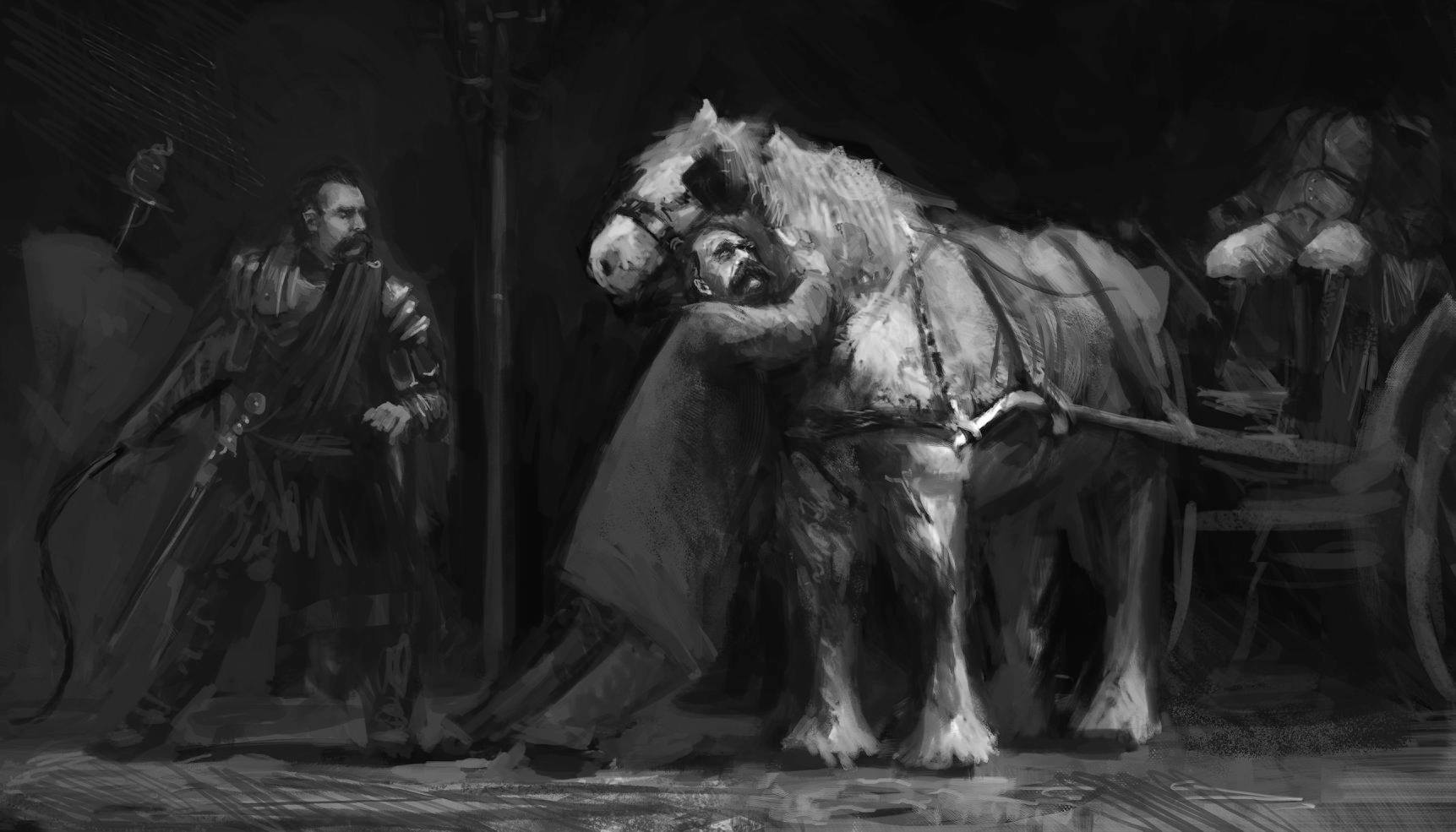
Barbara Straka's newly published book Nietzsche Forever? explores the question of how Nietzsche is received in 20th century art, in particular that after 1945. But the reception of Nietzsche's reception raises the question of whether the philosopher's monumentality is lost sight of. Does this reveal a fundamental problem of our age with monumentality? In any case, starting from Nietzsche, Michael Meyer-Albert argues against Straka for a “post-monumental monumentality” as an alternative to aesthetic postmodernism. In the first part of the two-part series, he dedicated himself to her book, and now he is accentuating his opposite position.
III. Horse Hug
Straka's observation that it was primarily certain details from Nietzsche's work and life that became decisive for art after 1945 gains particular significance for the philosophically interested reader. The gesture of hugging a horse is central to this. In January 1889, according to an anecdote, which probably happened one way or another, Nietzsche saw a coachman mistreating a horse in Turin. He ran to the horse, hugged it and thus protected it from the blows. From this scene, which caused quite a stir, Nietzsche was perceived as having a mental disorder and spent his life in nursing care.
Straka captures this moment in Nietzsche's life succinctly: “After the Turin Incident, the philosopher Nietzsche no longer existed.” (p. 517) The significance for Nietzsche's reception lies in the fact that his philosophy of affirmation of life, which sometimes turned into a metaphysics of will with social Darwinian features even before, but especially in his later thinking, often turned into a metaphysics of will with social Darwinian features. The truth of life prevailed over a philosophy of absolute victory. Straka sums up:
The “Turin Horse Hug” is a legend, but it is not suitable for making Nietzsche a myth again in contemporary art or stylizing it into a cult figure; it actually makes him a human in the first place because it depicts the fall of a delusional self-proclaimed god. She thus plays a key role within the themes and motifs of recent Nietzsche art. [...] [F] for posterity, Nietzsche is not a failure; his mental collapse in Turin did not set an end point, but a starting point for a new, empathetic view of person, life and work.1
Nietzsche now appears no longer as a monster of creativity who embodied a precarious triumphalistic philosophy of life, but as a vulnerable thinker who suffered from massive health problems (such as cluster headaches) and was forced to travel constantly in search of tolerable and affordable places to stay socially placeless. Photographs taken by Hans Olde in 1899, which document Nietzsche's nursing case and which “have contributed significantly to a convincing characterization of the philosopher to this day” (p. 568), were decisive for the reception.
The gesture of hugging a horse implicitly refutes the extremist statements of late Nietzsche, who falsely substantiated the transfiguration of the truthful animal into an ontology of chaos, which then legitimizes lethal naturalism as a will to power. The sick Nietzsche is not the true Nietzsche, but the truer Nietzsche. The weakness of Nietzsche's painting, which emphasizes his failure in life, is, however, the concealment of the strong vitality that this life was ultimately about. Sensitive iconoclasm immediately deconstructs encouragement with the cult. For Straka, it borders on cynicism that the contemporary depictions of a vitalist Nietzsche no longer relate to Olde's paintings (see p. 664).
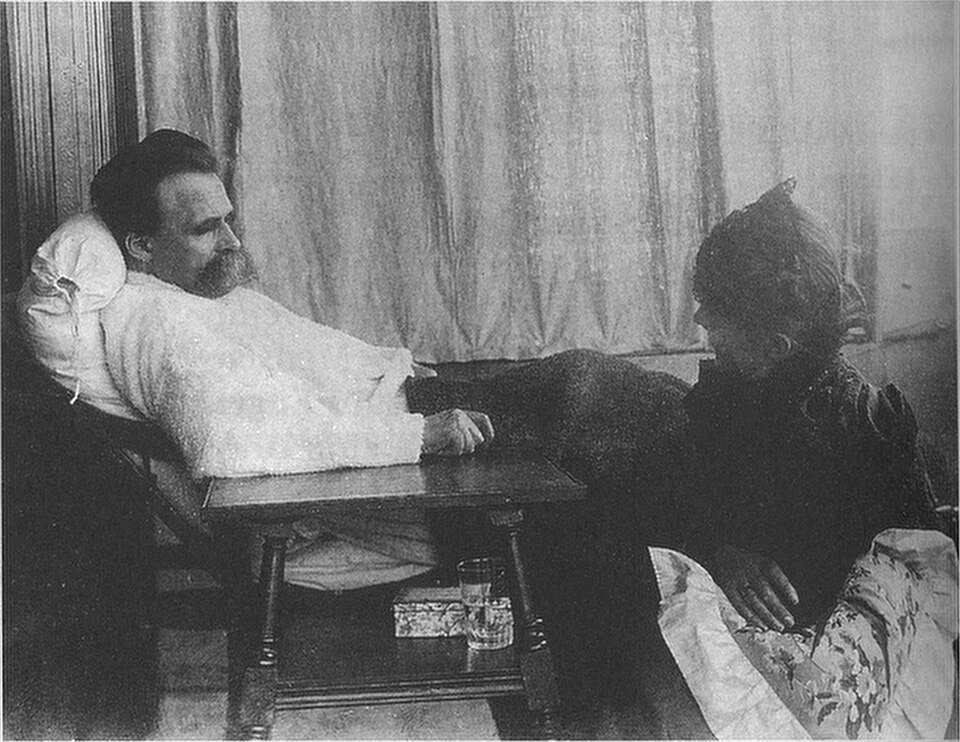
IV. A New Nietzsche Cult?
Where there was a cult, people should become: This is how the path Nietzsche left behind in art could be described. When receiving the reception of art, it is obvious that Nietzsche may have fallen victim to a cult for the second time. He was first over- and then under-monumentalized in the arts. Nietzsche becomes human as a sufferer, a sick person, a fragile person, and Nietzsche becomes a person in the manifold humanizations that appear most expressive in pop culture, but also dominates access to Nietzsche in more ambitious contemporary art. Straka affirms this trend:
The heroism, pathos and monumentalization that characterized the Nietzsche cult after 1900 have given way to differentiated representations of a contradictory, offensive, but also human, personal, even private Nietzsche who no longer fits on a memorial base.2
However, this anti-monumental tendency can not only be understood as a beneficial neutralization of excessive interpretations, as the “final phase of the deconstruction of the former cult image of Nietzsche” (p. 663), but it also bears the features of a new cult. It can be seen as a derivative of an iconoclastic cultural movement spanning the entire modern era. Everything old is brought before the court of reason. This gives the value of the new one the highest value. Culture as an imitation of excellence gives way to compulsive freedom, which can only believe in itself as an innovation and is self-referentially dynamic as a distance from competing innovation as innovative innovations. You imitate yourself in your worldless and world-poor innovation in order to stabilize yourself as a cult in the market of attention. You become a culture that imitates yourself because the imitation of past cultural greatness, which worked through reality resonance, is taboo. Committed to nonsense.
Four characteristics characterize modern traditional phobia in the field of art: It sacralizes firstly the spectacular excesses of subjective creativity — including Damien Hirsts For the Love of God (2007; link) or Wim Delvoyes Cloaca (2000; link) — who vie for attention, to the classical cultural dynamics of reverent imitation and careful variation, which wrestle within a decoration for inspiring emotionality, gives it secondly Meaning through billboard concepts, it creates thirdly Attention through the new power of exhibition as an attribution of quality and embodies it fourthly an informal morality that gains the “goodness” of works by simply revaluing the value of “degenerate art”:
A) Fuck it! Just express yourself!
The new cult of anti-monumentalism is evident as a sacralization of creativity in works that do not present a world, but only themselves as hypercreativity. Nietzsche's thinking can be heard here insofar as a legitimizing idea for self-referential spectacle creativity can be found in it. Nietzsche's “revaluation of values” is understood as a license to reject the “conventional” patterns of canonical works and to pursue a frivolous perspectivism in which maximum originality appears as a phenotype of creative vitality. The motto is: generating attention through excitement and no longer the traditional development of astonishing emotionality. One example of this is the leaves The Dark Child God, Transsilvannietzsche and DR. N. by Jonathan Meese (see p. 151), by whom Straka is delighted: Jonathan Meese succeeded in distorting Nietzsche to the point of recognition (see p. 153).
B) Readymade content
The reference to Nietzsche as the philosopher of the mask is once again becoming a mask in the context of contemporary art itself. The pop Nietzsche is explicit what the new art Nietzsche is usually implicit: aura markers for one's own products. Nietzsche serves as readymade content for content-free art. They outsource to him a depth of the works that the works themselves no longer own. The canonical authority of the works of which Mörike wrote is now over: “But what is beautiful, it seems blissful in himself.” Content is delegated to Nietzsche in order to evade the responsibility of the forms for the “sensual appearance of the idea” (Hegel). The works can only be “understood” as a “concept.” They become pure signs for which there is no language. Your concept says what they should mean. Her hypercreative hermeticism is deciphered by the hermeneutics of expressiveness without clarity.
Examples: Felix Dröse's drawings from the cycle Untitled (“I'm dead because I'm stupid, I'm stupid because I'm dead.”) from 1981 (see p. 614 ff.) show clumsy sketches made by the artist in the dark, thinking intensely of Nietzsche, according to his concept. Stephan Hubers Zitronstadel (originally: “Zarathustra im Zitronstadel”), from 2005 shows a wooden box quoting from “Also spoke Zarathustra” in the Allgäu dialect (see 464 f.; link).
C) “Exhibition Power” (Heiner Mühlmann)
Works that no longer display a world become works of art through the location where they are exhibited. The presentation in museums, in public spaces or even in a book about contemporary art gives the dignity of the highly cultural.3 The implicit competence of the aesthetic work gives way to the emotional state of the “exhibition trance” (Mühlmann), which refines pseudo-cultural water into highly cultural wine. The pedestal from which all monumentalist works are to be retrieved lives on hidden in the gesture of presentation. After the decorative ornament has been ennobled into “abstract art,” the museum is used as an installation by Casimir Malevich's4 Work concept for the white 3D square as a work of art naming work. Art is the power of the spatial effect. “The museum is no longer exhibiting anything. It turns itself off. ”5 In this exhibition, the mere aura of the exhibition results in meaningless, uninformative cultural imitation, which is called”Selfish cultural variant”6 (Mühlmann) occupies the valuable capacities of imitation, from which something could be learned. Sloterdijk adds to Mühlmann's observations:
The path of art follows the law of alienation, which proves the power of imitation precisely where imitation is most strongly denied: It leads from artists who imitate artists, to exhibitors who imitate exhibitors, to buyers who imitate buyers. From the motto L'art pour l'art Is the concept before our eyes The art system for the art system became.7
D) Entenatary art
The new cult of anti-monumentalism manifests a charge of meaning and value through morality. It is not the good that dominates, but the good. The aesthetic structure is charged with quality because it is in the tradition of what used to be “degenerate art.”8 A “framed ornament” (Mühlmann) can thus appear as anti-fascist “abstract art.” The truth of antinacian art is therefore the good that it stands for. There is no question of an in-depth response to realities. The absence of references to the work is reinforced externally through the rituals of reception. A moral view of art as a degenerate stabilizes it tribalistically. It sends harmony inwards, aggression outwards. Criticism of the lack of content is responded to in a maximally moral way by not responding to the objection, but by launching an automatic insinuation that, for example, brings criticism of contemporary works as mere “framed patterns” (Mühlmann) into the highly problematic tradition of fascist propaganda.
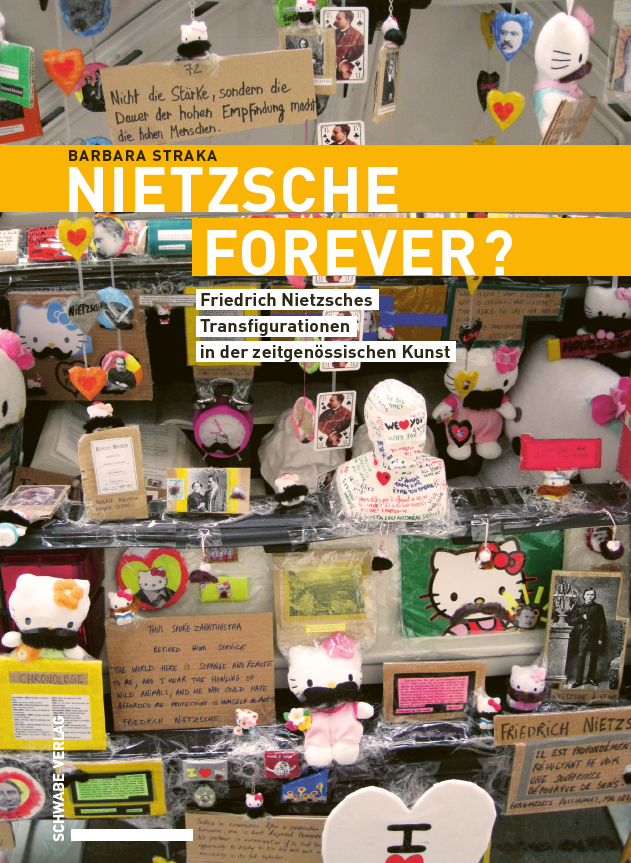
V. The Struggle for Monumentality
It is precisely this moralizing of aesthetics that motivates Straka's book to the extent that it contradicts Christian Saehrendt's views positioned; expressly at the end of her book in the acknowledgments (see p. 739). Sährendt, a regular author of this blog, speaks loudly in Trump's sometimes hard-to-bear tones for a remonumentalization of Nietzsche — “Make Nietzsche great again! “(see p. 585) —, gladly as a large monument above the Saale. Straka, on the other hand, defends himself against them with a more differentiated but also very affirmative view of the art world — probably as a deliberate provocation Cum grano salis — sounds and smells in Sährendt's statements, reflecting his polemical escalation in a way that is difficult to bear, even an update of the contempt of modern art as “degenerate” (see p. 598).
Perhaps this constellation could be used to gain an extended term for the understanding of reception? Is the opposition between Straka and Sährendt, insofar as he represents the point of view assumed by Straka to him in the first place, not about more than aesthetics? Does this particular confrontation over Nietzsche's legacy not also reflect the general rift that runs through the Western world and is embodied in a cultural struggle that is no longer just a cold one? Is there not the question in the background whether the modern struggle for recognition should emphasize justice in the sense of anti-monumentalist equal treatment or rather the monumentalist uniqueness in the sense of brilliance? Could Nietzsche possibly gain a comprehensive concept of monumentality that is ignored in this cultural struggle?
The question of how Nietzsche appears in art is a question of the form of relationship that is assumed with tradition. By deconstructing the monumentalist Nietzsche in the arts after 1945, the monumentalist is actually deconstructed as a form of reference to tradition.
Appropriately enough, Nietzsche himself wrote an essay that explores the question of the relationship to tradition. He distinguishes in his second Unexpected viewing with the title The benefits and disadvantages of history for life From 1874, three ways of dealing with history: One antiquarian Dealing that respectfully overlooks and wants to preserve the past; a monumentalist Dealing that strives for even greater things and instrumentalizes the past as motivation and role model; and a critical People who suffer from the past and want to emancipate themselves from it. Nietzsche primarily criticizes the dominance of antiquarian treatment of history in his time. Through this philosophically staged attitude by Hegel, contemporaries are brought into the position of viewers in a drama in which they themselves play a part. The belief that you are only a spectator of your own story demoralizes and creates cynicism.9
Nietzsches Untimely viewing Translated into the contemporary, shows a current overemphasis on the critical approach to tradition, but without suffering from it. It stabilizes itself in a cult of absolute innovation. The idea of canonical classicity as an admirable imitation model fails. Everything should be pushed off the base. There must be no superhumans and superpowers, because the shock of mastery and his works is too deep. There is no such positive connection to monumentality. As compensation, this shortcoming then creates a neo-monumentalism that bears the traits of areflexive, defiant self-affirmation and strives for a modernized size without being able to do it. The truth of anti-monumentalism in aesthetics is empathy for time and a sensitivity for its way of presentation. The truth of neomonumentalism is a critique of ignoring historical grandeur and a sense of the sublime. What is missing is well-tempered monumentality.
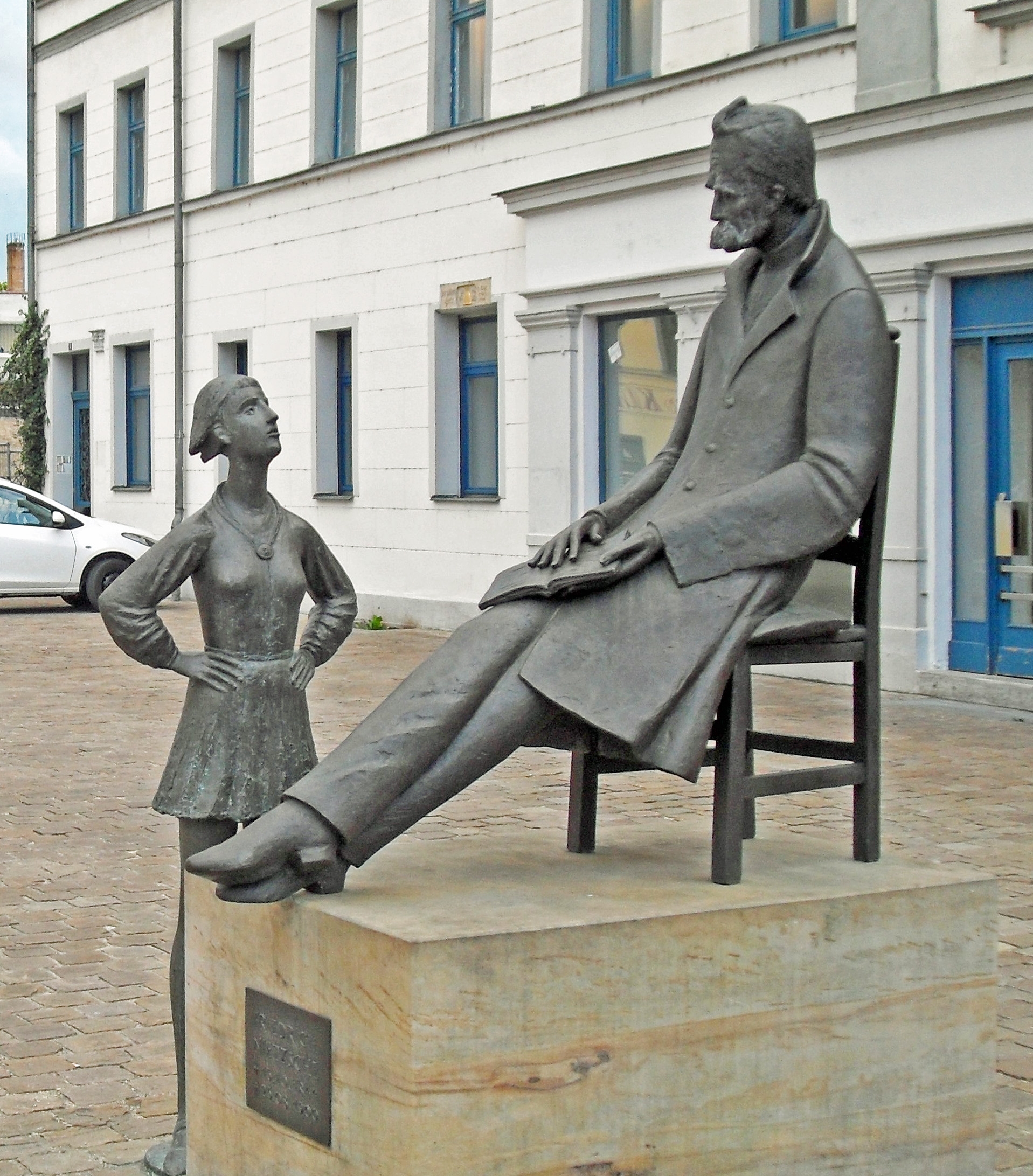
VI. Post-Monumental Monumentality
Perhaps, following a clue in Sloterdijk notebooks,10 Put forward the thesis that the sublime, which Nietzsche first located in art and then criticized in religion, was converted to the grandeur of the state and the military in the phase of its monumentalist reception. In the phase of anti-monumentalist reception, these forms of grandeur were criticized, but the sublime was thus ignored in the first place. What both phases so omit is the grandeur of evidence, which comes to the center of post-Wagnerian Nietzsche and allows post-metaphysical high notes in philosophy. What deserves the utmost seriousness, what is the most effective and can claim higher rank — even in the egalitarian states of the super-correct, hypersensitive, consensual zeitgeist — is the power of truth. God is dead, art is opiate, the state is bureaucracy and the military is a place of pre-modern heroic. But the truth is that the heart of modern grandeur beats. Paradoxically, this “sense of truth” (Sloterdijk) appears in Nietzsche as a discovery of the semblance necessary for life. Truth as a truth of illusion, which is intended to stimulate and protect, does not come with the old European pathos. It does not appear in the preaching or commanding apostle form, but as a therapeutic experiment with possible facilitations. The most serious can thus be understood as clarification, as relief and as an invigorating and motivating lie.
This decisive point of Nietzsche's concept of grandeur is also found in his second Unexpected viewing. Nietzsche puts forward the thesis that appearance as a constitutive aspect of life means a kind of minimal monumentality. Life requires the primacy of one's own over the foreign as a protective cocoon, a sealing atmosphere, an “enveloping delusion.”11, which limits and ignores the horizons of the incoming newcomer to such an extent that a positive self-image is stabilized as:
And this is a general law: every living person can only become healthy, strong and fertile within one horizon; if it is unable to draw a horizon around itself and in turn too selfish to include one's own gaze within a stranger, it taint or hastily seeps away at present doom.12
This cultural immune system of therapeutic hubris protects “the irreverent illusion in which everything that wants to live can live alone.”13. The truth of life is not neutral. It is the exact opposite of a perspective that wants to think of the truth as lack, alienation, robbery, exploitation. The pessimist Adorno is wrong: Wanting to think of the whole thing as untrue is untrue. There is a wrong life in the right one. History understood monumentally becomes a “remedy against resignation”14 and motivates people to become more lively.
In the following years, after turning away from Wagnerism, Nietzsche himself succeeded in uncovering perspectives that show an advanced idea of monumentality. According to this, the monumentality of modernity is to be seen as an “age of comparisons.”15 has to do cultural-psychological preparatory work for a cosmopolitan location within a global post-metaphysical ecumenism. This involves an evaluation of all cultures with regard to a new idea of noble vitality that distances itself from resentful retaliatory logics and from nihilistic lethargies, which can be imitated by future generations in an exemplary manner. Monumental about our time is the practising ritualization of civil, globally compatible monumentalism as an archive search and an attempt at construction. Nietzsche himself speaks of a cultural experiment that could satisfy any heroism.16 And he also mentions the attitude of a resentful relationship with tradition: “There are, of course, strange human bees who only ever know how to suck the bitterest and the most annoying out of the cup of all things; [...]” and at a “bee basket of malaise.”17 build.
In the “age of comparisons,” art has the task of co-constructing an exemplary minimal monumentalism — a bee basket of comfort — which, even in view of the task and the abysses of the course of the world, makes an affirmation of the situation appear plausible in a locally concentrated symbolism. It is important to find an expression for a hope that can be believed in. Transfiguration of all countries, unite! Art is thus in productive competition with religion and philosophy when working on global civil transfigurations of a life of not only economic prosperity. The categorical imperative of post-monumental monumentalism is: Act in such a way that the choice of cultural role models that you imitate and who educate you embodies the permanence of sustainable, creative and generous liberalism so much that your life can also become a possible inspiration for others.
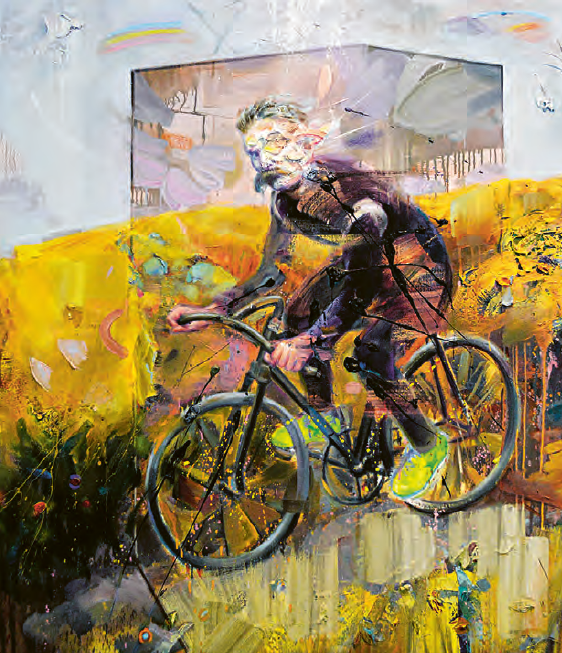
VII. “Nietzsche on a Bike”
Straka's book contains several works that reveal a post-monumentalist monumentality. This shows that we have the successful works of art to make the existence of the art business even more bearable.
Mathieu Laca's painting is particularly noteworthy Nietzsche on a Bike from 2016 (see p. 665). It shows the philosopher wearing glowing sports shoes on a racing bike. He looks up at the viewer like someone who is absorbed by his performance — the indicated cube around the figure reinforces this impression — and his gaze oscillates between being watched by surprise and an appeal. If you want to project thoughts into this view, they could read: “Oh. What do you want? Get on your bike yourself. Make something out of yourself! “Nietzsche is thus exposed as a trainee who affirms life as an overcoming in a physiological way, 6,000 feet beyond Übernietzsche and TINY-Nietzsche.
The impression of Nietzsche in Laca's painting can also be transferred to other areas of life. After the mobilized masses of red-brown and brown-red professional revolutionaries of the 20th century, for whom the struggle continues, come the athletized masses who, infected by sport, achieve brilliant achievements.18 The charism of the millennial empires and world revolutions is losing its luster. The betterment of the world begins in private life as a search for lost magnificence. Make yourself great again and again. In the spirit of Nietzsche: Seek disciplines and cultivate rituals that weaken the grumpy desire for retaliation because they do not interpret the empty hours as “abandonment of being” (Heidegger) and alienation. The time allows studies that are dedicated to the admirable, that invites imitation and that sparks their own success story of brilliant monumentality. As an example, Nietzsche's broken monumentality motivates people to set life up monumentally. His life rises into the modern age as a monument to a “resolution to serve life” (Thomas Mann). Because the power of the great that once was is still ongoing, we have the space to become more than we are. This enables pride that radiates jovial generosity and becomes immune from projecting feelings of grandeur into excessive imperial desire. Some victories and defeats are no longer necessary. The story is over. The fight is no longer going on. The training starts.
Article Image
Mitchell Nolte: The Turin Horse (2019; source) (Used with permission by the artist.)
Sources
Mühlmann, Heiner: countdown. Vienna & New York 2008.
Sloterdijk, Peter: You must change your life. Frankfurt am Main 2009.
Ders. : Lines and days III. Notes 2013-2016. Berlin 2023.
Straka, Barbara: Nietzsche Forever? Friedrich Nietzsche's Transfigurations in contemporary art. Basel 2025.
Footnotes
1: p. 548 f.
2: P. 610.
3: In this regard, see Mühlmann, countdown, p. 91 ff.
4: Editor's note: The Eastern European artist Kasimir Severinovich Malevich (1879—1935) is regarded with his painting The black square (1915) as the progenitor of aesthetic modernism.
5: Ibid., p. 74.
6: “Self-related cultural variant.”
7: Sloterdijk, You must change your life, P. 689.
8: Cf. Mühlmann, Countdown, p. 63 ff.
9: Cf. On the benefits and disadvantages of history for life Paragraph 8
10: Cf. Sloterdijk, Lines and days III, p. 239 f.
11:The benefits and disadvantages of history for life, paragraph 7.
12: The benefits and disadvantages of history for life, Paragraph 1.
13: On the benefits and disadvantages of history for life Paragraph 7.
14: The benefits and disadvantages of history for life, paragraph 2.
15: Human, all-too-human I, Aph 23.
16: Cf. The happy science Aph 7.
17: Human, All Too Human, II, Mixed Opinions and Sayings, Aph 179.
18: Sloterdijk instructively pointed this out — cf. You must change your life, p. 133 ff. — that with the appearance of the “athlete” type since the reinstatement of the Olympic Games in 1896, a rebirth of antiquity in the passion for sport succeeded en masse. From sport, the impulse of the Renaissance as a broad-based force forms wide sections of the population.
Monumentality Issues. Nietzsche in Art After 1945
Thoughts on the Book Nietzsche Forever? by Barbara Straka II
Barbara Straka's newly published book Nietzsche Forever? explores the question of how Nietzsche is received in 20th century art, in particular that after 1945. But the reception of Nietzsche's reception raises the question of whether the philosopher's monumentality is lost sight of. Does this reveal a fundamental problem of our age with monumentality? In any case, starting from Nietzsche, Michael Meyer-Albert argues against Straka for a “post-monumental monumentality” as an alternative to aesthetic postmodernism. In the first part of the two-part series, he dedicated himself to her book, and now he is accentuating his opposite position.
Amor fati — A Guide and Its Failure
Reflections between Adorno, Nietzsche, and Deleuze
Amor fati — A Guide and Its Failure
Reflections between Adorno, Nietzsche, and Deleuze

This article attempts to approach two of Nietzsche's most puzzling ideas: the Eternal Return and Amor fati, the “love of fate.” How exactly are these ideas to be understood — and above all: What do they have to tell us? How can we not only affirm fate, which is interpreted as an eternal return, but really love learn?
Among the philosophers, it was in particular the “main philosopher” of the Institute for Social Research, Theodor W. Adorno (1903-1969), who was skeptical or negative of these ideas of Nietzsche. Where remains, from the point of view of Amor fati, of critique and utopia whose banner Adorno and his intellectual companions held up?
As a result of the general failure of Marxisms to deal with fascism theoretically, the Frankfurt Institute tried to reorient itself from the 1930s onwards. The success of this movement seemed understandable to many unorthodox Marxists not only on the basis of economic laws; in their opinion, greater consideration was needed of the “subjective factor,” i.e. the psychological structure of the bourgeois individual. As part of this paradigm shift, Adorno turned to Sigmund Freud as well as Nietzsche. For the rest of his work, the German philosopher was a recurring point of reference for him.
Adorno, however, remained stubborn towards Nietzsche in an aspect that is typical of Marxist Nietzsche interpreters time and again: the insistence on the orientation towards a state of redemption for humanity in some way — the anticipation of which is manifested above all in the devaluation of the present. From this point of view, he also criticizes in his main aphoristic work Minima Moralia (1951) — according to him, a “sad science [...] of the right life”1 — Nietzsche's concept of Amor fati. Nietzsche's will to “just be a yes-sayer at some point”2, he thinks is a kind of Stockholm syndrome in the philosophy of life. However, such a task — not only of affirmation, but even of the will to affirm — would amount to abandoning the basis for every living appropriation of Nietzsche's philosophy. Taking up Adorno's critique, with reference to the interpretation of the important French Nietzsche interpreter Gilles Deleuze (1925-1995), it is intended to explore what Nietzsche provides for the universal and yet always very personal question of why existence — here and now — wants to be affirmed.
I. Do We Want the Eternal Return?
Nietzsche's practical philosophy is often somewhat baffled. Amor Fati, Eternal Recurrence — What is that? What should you not only endure from (quasi-) imperatives such as “the necessary, [...] but love! ”3, “I just want to be a yes-man someday! ”4 and the question “Do you want to do this again and countless times? ”5 start? How are you supposed to make yourself want something if you don't want it? Reasons could at best establish that something is “necessary” and would be “accepted” as such — but love? In Zarathustra The “cripples” ask the protagonist of the book how they too could be convinced of his teaching. Nietzsche's “prophet” “answers” them by stringing together questions: “And who learned him [the will] reconciliation over time, and is higher than all reconciliation? [...] Who also taught him to want to go back? ”6 In other writings, Nietzsche does not become more direct in this regard: “[W] e would you have to be good for yourself and life to ask for nothing more than this last eternal confirmation and sealing? ”7 This lack of answers can be frustrating and gradually feels like a dead end.
And yet the Eternal Return in particular continues to develop a very natural appeal and an intuitive understanding of what is at stake here. Isn't it amazing that it's somehow understandable what the cryptic metaphor of the Eternal Return is about, even though it seems insoluble as a problem? Why don't you reject them as ludicrous or don't even understand what that's supposed to do? What is actually surprising is not the insolubility of the problem of eternal return, but that we still understand it, do not let go of it. It is precisely because we understand the problem (and possibly the answer as well) that anything can be done with the problems and frustrations that arise when trying to conceptually describe what this is about.
So why? I mean that the Eternal Return doesn't really teach us anything. It gains this natural appeal from its response to what we already have and understand within ourselves. Anyone who cannot accept the past, present or future cannot want their life to repeat itself forever. But this is precisely the germ of a Amor Fati who wants to affirm the Eternal Return. All negations are filled with the desire to answer in the affirmative. We know that the negation doesn't want itself. Although we can postpone it as a state of affairs, we only endure it. We feel that we should really fully develop the will to affirm. Otherwise, we would not be baffled by the problem of how to want the Eternal Return — we would reject the request as pointless and would not even be faced with a problem at all. As a matter of course, you would come to terms with a situation.
But for now, we find ourselves in a funny space between affirmation (of another state yet to be achieved) and acceptance (of the current state in its facticity) when we deny a state of affairs. For this reason and as a result, the Eternal Return motivates us. It shows that a state of negation or even just of yielding does not want itself (recurring). There is therefore a will for a state of affirmation which makes the affirmation of the Eternal Return perceived as a promise and as a problem — because it is simply not yet capable of reaching such a state. But how do you get there?
It is clear that you should not accept some things, but other times you should still refrain from unrealistic expectations. But it is so difficult to judge here; fundamentally, this question makes you rummage within yourself: What hopes do you release yourself from... and which hopes should you also fight through despair? Often enough, you should persist with the latter against “common sense,” which can only ever be limited to what can be said, imagined, felt here and now. “The fact that you despair is much to honor. For you did not learn how to surrender.”8, says Zarathustra to the “higher people.” Because “[a] ll that suffers wants to live, that it becomes mature and funny and longing — longing for something more distant, higher, brighter. ”9 Only when you keep up the bar of hope against the now can the pressure of “Woe speaks: Go away! Go away you woe! “(ibid.) turn against the world and yourself and create something in which the once uncertain “yes” of former hope completely unfolds.
If at some point you just want to be a yes-man and want the eternal return but can't, it can't be a question of finding a general answer and solution. What prevents you from saying yes? You have to ask the question of who you are. You won't find a ready answer — you can only give the answer by becoming it. In this way, the question of how you can want the eternal return of your existence falls apart.
But the insight that you shouldn't look for the answer doesn't solve the question yet. How can you assess which claim should be maintained and which should be abandoned or modified? And how should one know whether such doubts should not also be attacked against Amor Fati? Are there not conditions that should be denied, even if you cannot work towards changing them?
II. Adorno's Criticism of Nietzsche's Amor Fati
That is exactly what Adorno asks: “And it would probably be the question to ask whether there is any more reason to love what happens to you, to affirm what is there because it is than to believe what you hope for to be true. ”10 Especially in conditions of incarceration, when you can no longer defend yourself against the circumstances, the will to assert yourself would turn against your own indignation and claims so that you could at least somehow assert yourself: “[S] o you could find the origin of Amor Fati in prison. People who no longer see and have nothing else to love fall in love with stone walls and barred windows.” (ibid.) If you can't rely on the fact that you should live up to the need to become a yes-man — then what can you rely on? “In the end, hope is how it escapes reality by negating it, the only form in which truth appears. Without hope, the idea of truth would be hard to think about” (ibid.). Although it sounds similar for now, Adorno gives a radically different answer than Nietzsche. It is not the here and now that would be answered in the affirmative, but in favour of the affirmation of something that may be unreachable, a hope.
It was stated above that with Nietzsche, practical philosophy is based on the task: Existence requires to be answered in the affirmative. Is there anything truer? Something more important? That is now threatening to slip away again. How could an argument be made against Adorno here? On what basis can you still judge here?
For now, a step back again. Adorno writes that it is hope that reveals the view of truth. It would therefore not be the case, as is usually thought, that the cool and realistic look would make it clear what was right — for example, the subsequent, negating hope or Nietzsche's affirmation. It is exactly the other way around: hope first, then truth. You would then probably recognize that you are deluding yourself with Amor Fati and not with negating hope.
This appears as and is a self-fulfilling line of argument. But let us not dismiss them by wishing back the deceptive certainty of a supposedly objective look, which would clear the truth just by thinking really seriously. Let's just let ourselves fall. What can then be countered with Nietzsche Adorno? Are we finding a new reason on which it can be proven that the task of existence is to affirm oneself and the Eternal Return must be affirmed?
III. The Impossibility of an Objective Evaluation of Life
Nietzsche also knows that there is no objective reason for judging life: “[E] in drive without a kind of discerning assessment of the value of the goal does not exist in humans. ”11 And in the event that life makes judgement about life, you must therefore bear in mind that here an assessment can only ever show how it appears to itself. It is important to “grasp this amazing finesse that the value of life cannot be estimated. Not from a living person, because such a party is an object of dispute and not a judge.”12. As a result, such judgments “only have value as symptoms” (ibid.).
Now you can avoid the intrusiveness of Adorno's argument that hope — the perspective of a better world — would somehow be more true. But there is also nothing left. All settings open up perspectives in which they then appear to be the right one for each case. We can't trust anyone that she's really the real one now. The question of whether life and eternal return must be answered in the affirmative now seems pointless. A swarm of different urges. And they either say yes to life — or they just don't. The question of how the Eternal Return can be answered in the affirmative now seems almost embarrassing. What should any guidance be based on? We all fall back on ourselves—to who we are, where there is nothing to praise, reprimand, or argue about.
In Human, all-too-human Nietzsche also doesn't know how to navigate any further when he hits on this determinism: “I believe the decision about the aftermath of knowledge is made by the temperament given by a person”13. In Nietzsche's confrontation with this complex, people's existence thus appears questionable. The bottom line is that life creates more suffering than pleasure and the fact that people stuck to life is due to their instincts. But something must have changed in Nietzsche's thinking that, in this initial situation, he found something that made him portray the Eternal Return as something to be wanted. What did Nietzsche understand and why doesn't he simply share it with you? And how can you ask for it?
IV. Why the Will is Affirmative...
At this point, I want to turn the problem around: What did you actually hope to get from getting an answer? A theoretical answer, which could make you understand the necessity, would therefore compel you. Or should it be a secret whose hearing transforms us, as it were, in order to become what we actually want to be? It has the taste of self-abandonment to hope that the necessity would be able to impose on you what you were unable to do yourself. The reasonably perceived need may give rise to “its essence for any purpose Roll off”14 If you could, you would be tired of this responsibility yourself. Honestly speaking, however, there is still a whole separate space of consideration where self-respect does not allow us to simply surrender to what is necessary, even if there is nothing to counter it. It also looks quite funny when Hannah Arendt (1906-1975), for example, sees Nietzsche's Amor Fati as a simple identification with what is necessary: “Obviously, it is not about changing the world or people, but about 'evaluating' them.” A transformation that would consist in the “psychologically highly effective trick,”to want, which is happening anyway. ”15 In this way, the wish to be a yes-sayer would lead the will to silence in order to look away from everything to the negative.16 Such self-reliance is a simple matter and is not worth much simply because it costs a lot. But we really don't just want to endure “[d] what is necessary, [...] but love...”17. And would such a manifestation of the world's love for itself turn away from its denials? Or does real self-love not also include one's own growing pains?
The affirmation of the Eternal Return must therefore be something that comes out from within us for no reason. Why say yes? Why say yes to anything at all? Because all will has always been an affirmation! That “the will to power is not a being, not a becoming, but a pathos [is] the most elementary fact that results in becoming, having an effect...”18. Pathos: This means a force, a movement, an interpretation of the world and its change. Yet there is not one thing that wants to change anything. Change is what exists as a will. Or as Deleuze says: “Power is That, what willingly. ”19 The will “does not seek, it does not desire, and above all it does not desire power. He giveth”20. But he doesn't pass it on to anyone: The will to power is a diverse, ever-renewing gift of affirmation to oneself. For Nietzsche, this circumstance is expressed in a person in such a way that in him what is commanding and obedient at the same time: “Freedom of will — that is the word for that multiple state of pleasure of the willing person who commands and at the same time sets himself as one with the performer.”21. There is nothing upstream in humans that could decide; a balance is only a symptom, for example, of an unfinished battle of different wills. Asking the question why the will is affirmative is therefore ignoring the will. Affirmation is not an optional state of will; it is its necessary mode of existence. Affirmation certainly not as an accounting judgment, but as a way of being. Every will, as long as it exists, stands firm against influences, resistance and time. His affirmation does not have to be an emphatic thanksgiving. His affirmation is his own, always unfounded maintenance and improvement, which creates the basis for judgment and evaluation in the first place. Nor is such an affirmation about happiness or absence of suffering. Nietzsche writes of pessimism that it “absolutely does not have to be a theory of happiness: by triggering strength that was squeezed and accumulated to the point of torment, Does she bring luck. ”22 That latter happiness is the affirmation of being and doing what you have to be and do.
V.... and Why People Say No
Whether you follow me at this point or not, such a point of view gets ridiculous at second glance. Human conditions are known, observable or imaginable which do not seem alien to themselves, but which grieve the world that this has happened. Situations in which you wish things had happened differently. This makes it look like there is a general standpoint of judgment from which we deplore our specific ego and, as it were, do not affirm it. That should not be denied. But it is that “second look” at existence that can make existence questionable for us. For a “first glance,” however, the question of affirmation cannot arise at all, because the concrete will has always been an immanent affirmation. As we imagine it with animals, only the first look — which makes everything impossible beyond affirmation — comes into consideration.
The affirmation of the Eternal Return at the level of second glance is the affirmation of the whole, of the great coincidence that existence exists in general and in its present form. Again: It is of no use to interpret one's own concrete being, the world, or the whole as necessary in this form. Not only can this not produce love, you also deceive yourself that nothing is completely necessary in the last resort, because the existence of the whole thing can only be understood as a coincidence. Deleuze writes:
For the eternal return is the return differentiated from progress, is the contemplation different from progress, but also the return of progress itself and the return of action [...].23
He imagines a child immersed in his game who also delights when he takes a step back and then feels like playing again. Such a second affirmation is therefore needed. Even on this second level, it cannot be about theoretical insights, no imperative. Just as naturally as every individual will wants himself on the first level, the person of Amor Fati will want the whole thing and also in that respect “the eternal pleasure of becoming self [...] being”24. So how to answer in the affirmative? No explanation does the work. Nietzsche's cocky descriptions of bravely saying yes in the midst of all suffering have their charm, but then they also exhaust themselves. Once again, it helps to ask why it doesn't actually work. That brings us to the problem of resentment25.
VI. What Does Resentment Want?
It has often been described how low the resentment is that it harms everyone involved. But you can also try to understand the resentment. The word “resentment” is a substantiation of “to feel again.” You can understand it as the fact of not being able to let go of a feeling — or better yet: that a feeling cannot let go of itself. This happens during experiences of loss, insults, and disappointment. Why does this happen to us so often? With regard to the “fight [it] for life,” Nietzsche accuses Darwin of having forgotten the mind; the weak repeatedly reaches for the spirit in order to master the strong.26 Instead, the human imagination gives all our pain the means not to have to go into catharsis, the spiritual purification, but to survive or even to dominate. It is therefore too easy for us not to have to admit that something is over or never existed and to live through the full severity of the loss. Instead, we can ask again and again: “Why me? ”, “Why hasn't this person decided otherwise? ”, “Why are people and the world like this? ”. But in their will to power, such feelings become even more creative; unfortunately, the imagination has no limits. Didn't Adorno, with his standpoint of hope, give an interpretation of the world within which it is good to suffer from the world as it is, because in it there is another world accessible through hope, which is the true one? But we all practice the little moralisms in our everyday lives through which we do not let the world, others and ourselves be as they are. Or we accuse them of being bad because they're not what we wanted them to be. What's all this for? It is usually not a question of recovering a beloved object that would redeem. There is only the pain that is constantly reinterpreted, that should also be done to others, acknowledged or felt again. By creating a world in which it is right to suffer for yourself and the world, resentment blocks every exit. In this way, it can survive as a will that in a certain way does not want itself because the catharsis has only been postponed — and yet cannot let go. Like a broken record, the same track plays out over and over again.
All of this puts people in a questionable aspect. A will that keeps itself alive — and would actually rather not be? This is what is manifested in resentment and articulated in the inability to affirm the Eternal Return. Wanting, you could want your own return, but still remain something that does not want to repeat yourself and the world — what is that actually supposed to be? In the main, we can't do anything about it. At the “Try [...] Man”27 Is “[d] he consciousness [...] the last and latest development of the organic and therefore also the most incomplete and ineffective about it. Countless mistakes originate from consciousness, which cause an animal, a human, to perish.”28. Far too many opportunities give us the awareness and imagination to postpone the pain of fatality a bit without knowing what impasse we are entering. When we first ask, both large and small, “Why this way... and not something else? “If we go somewhere else, we certainly don't stick to fate; this is how an Amor Fati becomes more and more alien to us. “Why is the world so and so? ”, “That person could have made a different decision! “— Such thoughts do not remain thoughts. They create a new, imaginary world, we then feel in it, we feel it. But it is a steep path away from the world which must be answered in the affirmative.
VII. Who Overcomes Resentment and How?
What next? “Will — that is the name of the liberator and the bringer of joy”29. But we still have the “half-will”30 and are not “[s] olks who can want to”31. The “human attempt” is not responsible for ending up in an awkward impasse — in fact, she is himself. However, this should not give rise to a blunt desire to return to a time before consciousness. The traces have already been blurred and everything that could possibly be desired — that is simply not who we are anymore. But the fact that we are not responsible for our situation does not mean that we cannot take responsibility for ourselves here and now. In fact, another direction is emerging: no return, no leisurely furnishing, but a merciless and welcoming consideration of what has actually happened to us in our existence — and a whole will to do so again. Because we cannot lean back on nature, but must regard and perceive ourselves as a piece of new nature, Nietzsche speaks of his naturalism as “coming up” into nature instead of returning.32 In the case discussed here, coming up in nature means: Affirming existence without deception and with full awareness on the said second level, i.e. affirming the big picture and wanting to repeat our role in it. But we're not there yet. First, we need compassion for the part of us that doesn't want to return. In Zarathustra It says: “But all immaturity wants to live: woe! ”33 The resentment persists in the space between wanting to continue and not wanting more. There is nothing concrete that it can want more from the world; it simply persists in any hope of redemption. Once again, it says: “What was perfect, all maturity — wants to die! ”34 This applies not only to all affirmative wishes, which like to be inherited by new affirmations. However, there can also be perfection for suffering:
Everything that suffers wants to live, mature and funny and longing — longing for something more distant, higher, brighter. “I want heirs, so says everything who suffers, I want children, I don't want myself”.35
All the suffering in resentment is not in any way degenerate and must be recklessly rejected. Instead, there can be an understanding and agreement. Resentment itself is still part of the nature that wants to rise up and be inherited. Was it not what was waiting for when the suffering of farewell was still too blunt? And wasn't it precisely the resentment that insisted that the Eternal Return was something to be affirmative? An oh-so-masculine conduct of will is not enough here; Zarathustra also knows that: “Woe says: 'Break, bleed, heart! Walk, leg! Wings, fly! Inan! Get up! pain! 'Well! Well done! Oh my old heart: Woe says: Go away!”36 The resentment that, looking at itself, understands that it should and wants to pass away and only had to gather the strength to do so — that is also ourselves! There is no subject behind this who could calculate anything. The “Vergeh! “, which a pain speaks to oneself, can only be an intrinsically motivated journey into nothingness, behind which there is nothing more waiting: no justification, no rebirth, no redemption. How can that be wanted? How can an eternal return still be wanted here? This cannot be about a necessity, but only a matter of course: “Pain is also a pleasure”37. And those affected in this way would speak to pain: “[V] go, but come back! ”38 Such pleasure does not want the offense as something that could be quickly put behind. By wanting the becoming and the whole, she also wants such offense with unconditional “yes” and recurring forever. “[S] he is thirstier, heartier, hungrier, more terrible, more secret than anything hurt, she wants yourself, she bites into yourself, the will of the ring wrestles with her —”39. Something like that happens or not. In any case, there are no reasons and any further justification would be misplaced.
If we followed Adorno in saying that only hope would open up the perspective of truth, we would limit ourselves. Would that be the whole truth? A truth limited by what we can and must hope for in the here and now? Nietzsche, on the other hand, tries to open his mind to the possibility of love that goes beyond us. In such love, the fatal, actual world is not longed for, asked away or hoped away. But it is not a selfless sacrifice to fate. Precisely by not accusing the world, it gives us the space to express our suffering and despair directly. Like any mature love, however, such self-love does not retain its object but liberates, shows us that we do not have to be limited to what we want, that we are not and do not want to be an end. Such love, in that it is the pleasure of creating, becoming and passing away that we are, makes us become something that will one day continue to arrive in the world and be at home. If we set ourselves up to the eternal desire to be ourselves and push it ever higher and farther, the question of Amor Fati also dissolves into a matter of course.
Moritz Pliska (born 1999) studies sociology and philosophy in Kiel. There he tries to be a good epistemological experiment for himself.
Sources
Adorno, Theodore: Minima Moralia. Reflections from damaged life. Frankfurt am Main 1951.
Arendt, Hannah: Of the life of the mind. Thinking, Wanting. Berlin & Munich 1979.
Deleuze, Gilles: Nietzsche and philosophy. Hamburg 1991.
Footnotes
1: Adorno, Minima Moralia, P. 13 (Assignment).
2: The happy science, Aph 276.
3: Ecce homo, WArum I am so clever, paragraph 10.
4: The happy science, Aph 276.
5: The happy science, Aph 341.
6: So Zarathustra spoke, Of redemption.
7: The happy science, Aph 341.
8: So Zarathustra spoke, From the higher person, 3.
9: So Zarathustra spoke, The Nightwalker Song, 9.
10: Adorno, Minima Moralia, p. 110 (Aph. 61).
11: Human, all-too-human Vol. I, Aph 32.
12: Götzen-Dämmerung, The problem of Socrates, paragraph 2
13: Human, all-too-human Vol. I, Aph 34.
14: Götzen-Dämmerung, The Four Great Mistakes, paragraph 8.
15: Arendt, On the life of the mind, P. 398.
16: See ibid., p. 400.
17: Ecce homo, Why I'm so smart, paragraph 10.
18: Subsequent fragments No. 1888, 14 [79].
19: Deleuze, Nietzsche and philosophy, P. 93.
20: Ibid., 94.
21: Beyond good and evil, Aph 19.
22: Subsequent fragments No. 1887, 11 [38].
23: Deleuze, Nietzsche and philosophy, P. 30.
24: Ecce Homo, The birth of tragedy, paragraph 3.
25: Editor's note: This year's Kingfisher Prize for Radical Essay Writing is also dedicated to the problem of resentment and its topicality (link).
26: Cf. Götzen-Dämmerung, Journeys of an Out-of-Date, Aph 14.
27: So Zarathustra spoke, Of the gifting virtue, 2.
28: The happy science, Aph 11.
29: So Zarathustra spoke, Of redemption.
30: So Zarathustra spoke, On the diminishing virtue, 3.
31: Ibid.
32: Cf. Götzen-Dämmerung, Journeys of an Out-of-Date, Aph 48.
33: So Zarathustra spoke, The Nightwalker Song, paragraph 9.
34: Ibid.
35: Ibid.
36: Ibid.
37: So Zarathustra spoke, The Nightwalker Song, paragraph 10.
38: Ibid.
39: Ibid.
Amor fati — A Guide and Its Failure
Reflections between Adorno, Nietzsche, and Deleuze
This article attempts to approach two of Nietzsche's most puzzling ideas: the Eternal Return and Amor fati, the “love of fate.” How exactly are these ideas to be understood — and above all: What do they have to tell us? How can we not only affirm fate, which is interpreted as an eternal return, but really love learn?
Among the philosophers, it was in particular the “main philosopher” of the Institute for Social Research, Theodor W. Adorno (1903-1969), who was skeptical or negative of these ideas of Nietzsche. Where remains, from the point of view of Amor fati, of critique and utopia whose banner Adorno and his intellectual companions held up?
As a result of the general failure of Marxisms to deal with fascism theoretically, the Frankfurt Institute tried to reorient itself from the 1930s onwards. The success of this movement seemed understandable to many unorthodox Marxists not only on the basis of economic laws; in their opinion, greater consideration was needed of the “subjective factor,” i.e. the psychological structure of the bourgeois individual. As part of this paradigm shift, Adorno turned to Sigmund Freud as well as Nietzsche. For the rest of his work, the German philosopher was a recurring point of reference for him.
Adorno, however, remained stubborn towards Nietzsche in an aspect that is typical of Marxist Nietzsche interpreters time and again: the insistence on the orientation towards a state of redemption for humanity in some way — the anticipation of which is manifested above all in the devaluation of the present. From this point of view, he also criticizes in his main aphoristic work Minima Moralia (1951) — according to him, a “sad science [...] of the right life”1 — Nietzsche's concept of Amor fati. Nietzsche's will to “just be a yes-sayer at some point”2, he thinks is a kind of Stockholm syndrome in the philosophy of life. However, such a task — not only of affirmation, but even of the will to affirm — would amount to abandoning the basis for every living appropriation of Nietzsche's philosophy. Taking up Adorno's critique, with reference to the interpretation of the important French Nietzsche interpreter Gilles Deleuze (1925-1995), it is intended to explore what Nietzsche provides for the universal and yet always very personal question of why existence — here and now — wants to be affirmed.
Monumentality Issues. Nietzsche in Art After 1945
Thoughts on the Book Nietzsche Forever? by Barbara Straka I
Monumentality Issues. Nietzsche in Art After 1945
Thoughts on the Book Nietzsche Forever? by Barbara Straka I
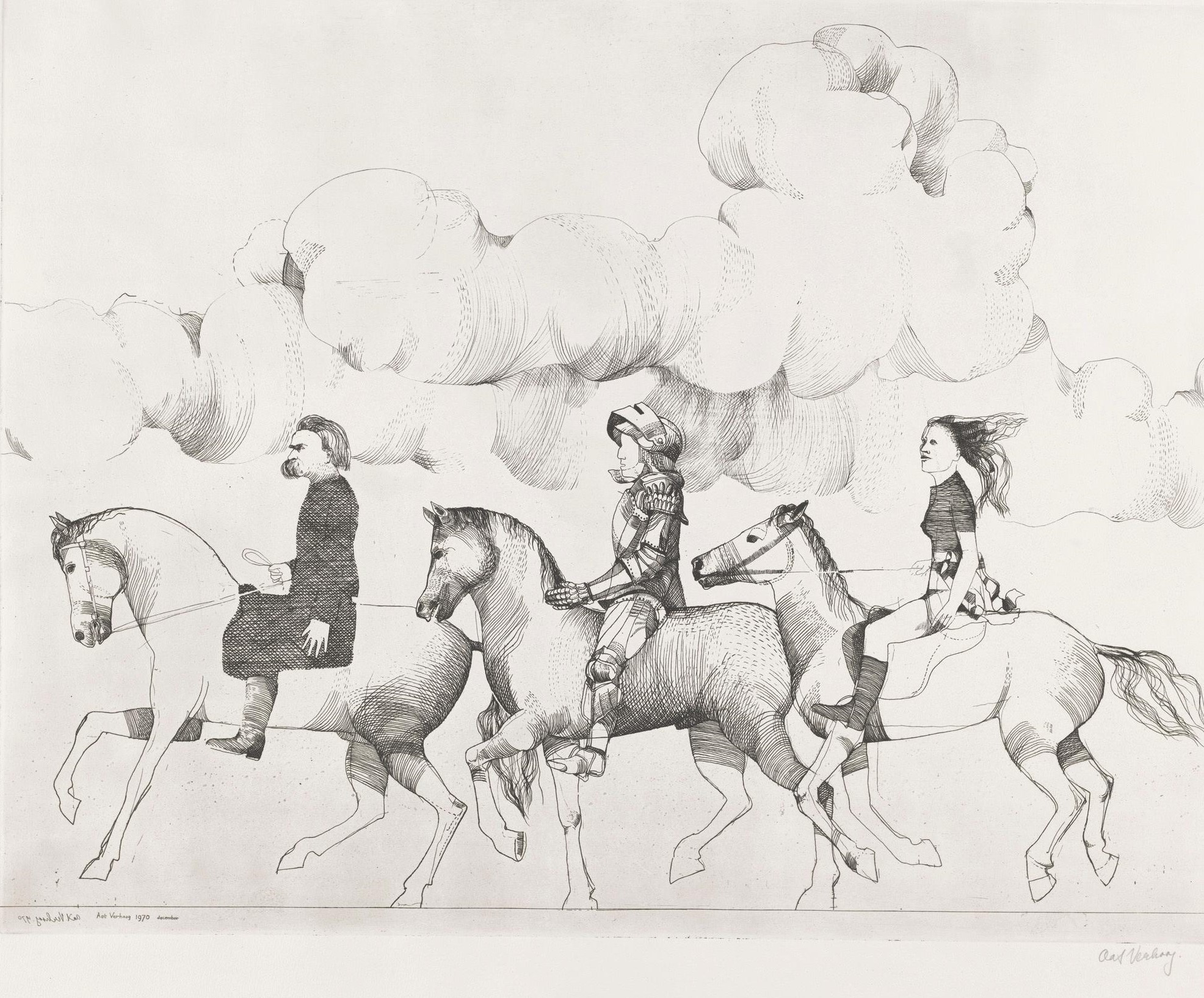
The fact that Nietzsche is a philosopher who speaks particularly to artists, even an “artist-philosopher,” is almost commonplace. In Barbara Straka's newly published book Nietzsche Forever?, the question is explored how exactly Nietzsche has been received in 20th century art, in particular that after 1945. The author has created a standard work that clearly and competently conveys the topic in plausible overviews. In this first part of this two-part article, Michael Meyer-Albert dedicates himself to her book and will then accentuate his own position in the upcoming second part.
“So how does the monumental contemplation of the past, the study of the classic and rare of earlier times, benefit the present day? He deduces from this that the great thing that was there once was in any case possible once and will therefore probably be possible again [.]
On the Benefits and Disadvantages of History for Life, § 2
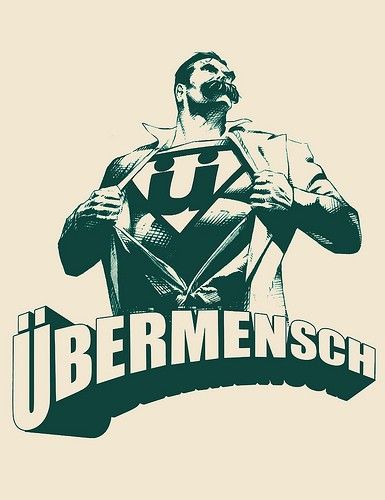
I. Übernietzsche
In his first publication The birth of tragedy (1872) Nietzsche still represented a pathetic understanding of art, as a result “only as aesthetic phenomenon [...] existence and the world forever warranted”1 be. The operas of his idol Richard Wagner were intended to bring about a rebirth of the tragic myth of antiquity, a comprehensive cultural revolution under the banner of the double-faced power of Dionysian and Apollonian. Nietzsche's philosophical art now consisted in liberating a new concept of art from this late Romantic aestheticism. In an emancipatory “art of living”2 Should we, the “free spirits” become “poets of our lives”3 and learn to philosophically glorify our own being — and “in the smallest and most mundane first” (ibid.) — through the appearance of life-affirming perspectives.
Nietzsche thus invented an understanding of truth as art, which was intended to vitalize Europe as an intensified enlightenment. Precisely because the truth is too hard to be lived, it is true to keep it at a distance. For Europe, this means that even though the gods may be dead, we have the cunning cockiness of ideas to make life friendly with life. In this respect, successful art can be measured by whether it enriches life by transfiguring it in such a way that it remains motivated to value life. It is interesting to ask how the philosopher of appearances appears in the main medium of appearances.
It is the claim of Barbara Straka's book Nietzsche Forever?, which was published by Schwabe-Verlag in 2025, to depict Nietzsche's reception of art after the Second World War.4 As an art historian and former curator, she sets herself apart from the history of reception before 1945, which was determined by the will to monumentalize that Nietzsche's sister embodied in her manipulative marketing as estate administrator. Analogous to the cult of Wagner, which Nietzsche renounced philosophically productively from 1876, he himself became a mythical heroic cult object and, spiritually reneged since 1889, from 1897 until his death in 1900 as a “living exhibit” (p. 21) in the Weimar Nietzsche Archive. He was mystified as a Christ-like Antichrist, as a philosophical prophet of nihilism, as a Germanic thinker of superman in the sense of fascism. Nietzsche became Übernietzsche.
Straka states that these reductive revaluations of Nietzsche's philosophy of revaluations have an effect. Nietzsche appeared as the thinker for Hitler's actions. Only the complete text-critical edition by the two Italian philologists Giorgio Colli and Mazzino Montinari in the 1960s allowed an unobstructed look at Nietzsche's works and a gradual removal of the taboo of this supposedly proto-fascist thinker. After all, it took a generation for the effects of the history of manipulative reception to recede so far into the background that, starting in 1980, Nietzsche was gradually and always ambivalently rediscovered as a “free spirit” for art.

II. Transfigurations of the Nietzsche Image
Straka's book provides an overview of art's diverse engagement with Nietzsche beyond cult and Hitler, with reference to her subject, alleging a “failure of art history in dealing with the subject” (p. 46). Straka methodically analyses the work of 220 artists — primarily from the years 1980 to 2000 — sorted into 14 thematic clusters (for example: Nietzsche's physiognomy, his travels, his loneliness), each of which she illustrates with exemplary works. However, it is also pointed out that the immense increase in production of the art market since the 1970s, the expansion of the art zone through globalization and the lack of digital archiving of works before 1990 have fundamentally affected the exemplary documentation of art history after 1945.
Nevertheless, with regard to Nietzsche in contemporary art, it is clear for Straka that it is above all the change of inspirational source that influenced Nietzsche's image. Away from the concrete image of Nietzsche in the genre of portrait towards the images that evoke Nietzsche's work and life. It is these “transfigurations” that Straka wants to highlight.
The impact of Nietzsche's thinking on art — particularly of So Spoke Zarathustra, The Happy Science, Ecce Homo and the literary Dionysus Dithyrambi — is eminent for Straka: “Without Nietzsche's writings, yet fundamental statements on art and aesthetics, which played an inspiring role for modern and contemporary art, recent art history would probably have taken a different course.” (p. 10) She adds at the end of her book: “For the arts, their theory formation and development in the 20th and 21st century, the legacy of the most controversial of philosophers is likely to have taken a different course.” (p. 10) She adds at the end of her book: “For the arts, their theory formation and development in the 20th and 21st century, the legacy of the most controversial of philosophers is likely to have taken a different course.” (p. 10) She adds at the end of her book: “For the arts, their theory formation and development in the 20th and 21st century, the legacy of the most controversial of philosophers yet be undisputed.” (p. 726)
Straka differentiates roughly between three phases of Nietzsche's reception: “As an object of the visual arts, Friedrich Nietzsche's portrait has experienced an unprecedented process of construction (around and after 1900), of deconstruction (after 1945) and reconstruction (since the 1980s).” (p. 628)
The last phase of the new construction had an increased impact with the Internet. Nietzsche “not only became popular, but also became a pop idol and superstar.” (p. 628) Straka's differentiation of the various forms of the Nietzsche pop phenomenon is instructive:
1. Nietzsche funny — the joke figure (professor, bookworm, owl, clumsy, anti-hero, misogynist); 2. Over-Nietzsche — the superman (saint, action hero, savior, fighter, athlete); 3. Nietzsche now — the human-all-too-human contemporary (teacher, helper, friend, advisor); 4. Nietzsche cool — the idol (pop star, superstar); 5. Nietzsche cute — the cute (doll, dwarf, toy, devotional items); 6. Tiny Nietzsche — the tiny (baby, toddler).5
As diversely trivialized, Nietzsche becomes a human being. In it, Übernietzsche is inoculated with normality so much that he shrinks and comes on equal footing with the “last people.” Straka points out this culturally critical “phenomenon of (too) humanising” (p. 663), but also notes that “the final phase of deconstructing the former cult image of Nietzsche” (ibid.) could be realized in this delta of typologies. The story of Nietzsche's reception in the arts ends with a plural neutralization of the former cultic monumentality and thus opens the horizon for a wide variety of creative approaches.
In her analyses, Straka pays particular attention to the possibility of whether, as a result of Nietzsche's now liberated reception, art could play a mediating role between philosophy and the general public. Art as a more cosmopolitan sister of Nietzsche who popularized the true heroism of Nietzsche's cheerful heroism beyond myth and banality? After the Völkisches, not the popular but still more popular Nietzsche? Straka mentions that the Nietzsche House in Sils Maria was the most likely to achieve this utopian task (see p. 727).
Straka's book succeeded in turning the sheer incomprehensible extent of Nietzsche's reception in contemporary art into plausible thematic overviews. It thus presents a standard work against which any future examination of this topic will have to be measured. The richly illustrated book impresses with comprehensive knowledge of the art market and Nietzsche's world of ideas, which gains depth of focus through extensive quotations and vivid details.
Link to the second part of the essay.
Article Image
Aat Verhoog: Three Riders (including Nietzsche) (1970; source)
Sources
Straka, Barbara: Nietzsche Forever? Friedrich Nietzsche's Transfigurations in contemporary art. Basel 2025.
Footnotes
1: The birth of tragedy, paragraph 5.
2: Human, all-too-human II, The Wanderer and His Shadow, Aph 266.
4: The body text of this book is quoted below.
5: P. 662.
Monumentality Issues. Nietzsche in Art After 1945
Thoughts on the Book Nietzsche Forever? by Barbara Straka I
The fact that Nietzsche is a philosopher who speaks particularly to artists, even an “artist-philosopher,” is almost commonplace. In Barbara Straka's newly published book Nietzsche Forever?, the question is explored how exactly Nietzsche has been received in 20th century art, in particular that after 1945. The author has created a standard work that clearly and competently conveys the topic in plausible overviews. In this first part of this two-part article, Michael Meyer-Albert dedicates himself to her book and will then accentuate his own position in the upcoming second part.
From Denier to Conspiracy Theory to Ghosting
Nietzsche and the Social Upheavals Caused by Today's Widespread resentment
From Denier to Conspiracy Theory to Ghosting
Nietzsche and the Social Upheavals Caused by Today's Widespread Resentment

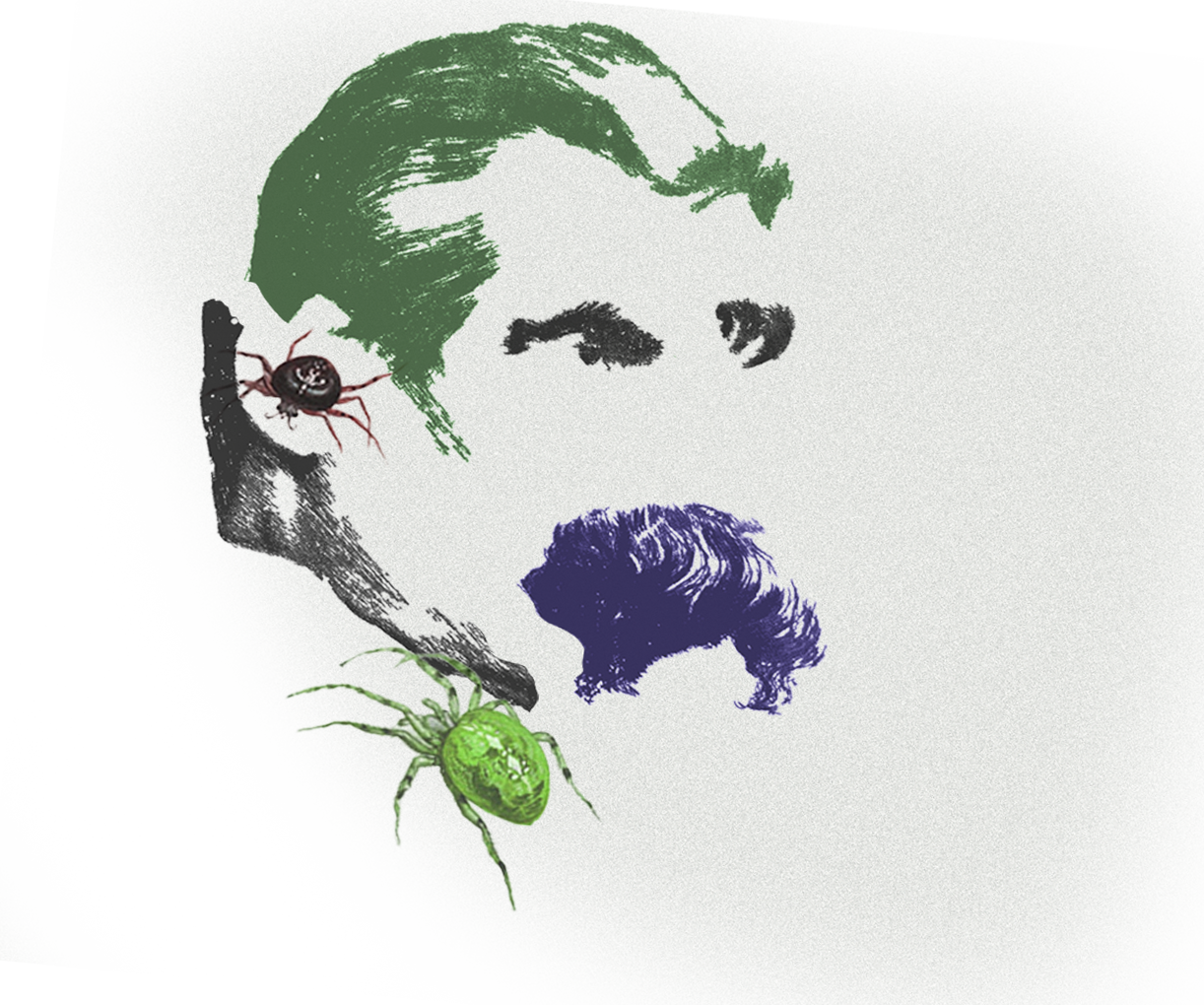
After Hans-Martin Schönherr-Mann has already dealt with Nietzsche's concept of resentment in two articles on this blog (here and there), he now addresses the question of how it can be applied to the current social situation.
His thesis: The current political landscape is characterized by many divisions based on resentment. They are due to the weaknesses of their own arguments. This is how critics are defamed as “corona” or “climate deniers.” The objections are often branded as conspiracy theories. You can't ask 'Cui bono?' anymore. Or you break off contact without comment to protect yourself. This is not only in line with Nietzsche's understanding of resentment in many places, precisely because he himself is not free from it, but is looking for ways out of it.
“What is the topicality of Nietzsche's analysis and critique of 'resentment'?“ is also the question of this year's Kingfisher Award for Radical Essay Writing, in which you can once again win up to 750 Swiss francs. The closing date for entries is August 25. The complete tender text can be found here.
If you'd rather listen to the article, you can find an audiovisual version on the Halcyonic Association YouTube channel, read by the author himself (link) and a listening-online version on Soundcloud (link).
Since the corona period at the latest, a word has had a career that has had a relevant meaning for a long time, but has had a rather limited meaning for decades, namely the “denier.”
Historically, it began with the denier of God when atheism spread during the Enlightenment, which was hated by many believing Christians.
The aggressiveness towards atheists, however, is based on the argumentative weakness that the existence of God simply cannot be proven. According to Kant, reason tries to do so, it engages itself in “eternal contradictions and disputes,” because it “could never go beyond the field of possible experience.”1. The end of all proofs of God! Like the famous one by Thomas Aquinas that everything in the world has a cause, so the world must also have one. So “you have to come to a first change person who is not changed by anyone else. And that is what everyone understands by “God” . ”2
This increases religious people's aversions to religious doubters. This process is similar to resentment, as Nietzsche said the word in On the genealogy of morality used, a constant need for revenge against the alleged 'injurer' resulting from a perceived inferiority.
Such hatred was also directed at Nietzsche; for what is it called in Zarathustra about the priests: “They are evil enemies: nothing is more vengeful than their humility. And the one who attacks them easily sullies himself. ”3
The critic as Denier
The word “denier” in corona policy has made a career. Of course, there were people among their critics who denied the disease as such. But the word “corona denier” also disqualified anyone who questioned the corona measures. Out of panic, opposition and criticism could motivate many not to take the measures adopted seriously, as well as from the knowledge that these measures are by no means self-evident, their political, media and medical advocates reacted with aggressive rituals.
The term “climate denier”, which appeared almost at the same time, is similar. Here, too, there are critics who reject the scientific debate. But others primarily doubt the apocalyptic vision of the end of the world derived from this, which evokes an urgency that is by no means self-evident. Scientific findings are based on methods, theories, experiments that are not ultimate truths. Only approximate forecasts can be made about future developments.
In this way, these findings can and must always be called into question. Disqualifying critics as “deniers” testifies to the weakness of one's own argument and the resulting resentment, which is reflected in turn through corresponding critiques.
In any case, Nietzsche is one of the critics of modern technologies when he writes: “Hubris is today our entire attitude to nature, our rape of nature with the help of machines and the so harmless technical and engineering ingenuity.”4.
How resentful the word “corona” such as that of “climate denier” is is shown by the fact that, in order to reinforce the urgency, it implicitly follows on from the “Auschwitz denier”, who is probably still the most famous denier today. On April 25, 1985, the German Bundestag passed a law prohibiting the Auschwitz lie, i.e. the claim that there was no murder of European Jews by the millions.
It was less about denying the more than well-established historical fact and more about insulting the victims and their families associated with it. This restriction on freedom of expression is therefore justified. Insults are not covered by this fundamental right.
Representatives of corona and climate policy similarly assume that their measures are intended to protect people. The decisive difference remains that no one is insulted by the 'corona' and 'climate denial. ' If the word “denier” is also used in this way, it puts the Holocaust denial into perspective.
However, because the advocates of climate and corona policies are propagating that they must save humanity, their critics even appear to them as enemies of humanity. All the more they must dramatize their concerns and all the more they can despise their enemies: pure resentment that provokes a corresponding reaction, so that opposing resentments stir up each other.
Who Is Not a Conspiracy Theorist?
As a result, the various “deniers” are regularly discriminated against as “conspiracy theorists.” It goes without saying that there are the craziest ideas about the world. But religious stories in particular are full of conspiracy theories. An outstanding example is the doctrine of the Trinity developed by church fathers that the Holy Spirit profoundly governs the world, i.e. the Invisible Hand: truly a conspiracy theory, still secularized in Adam Smith: “In fact, he <der einzelne>does not consciously promote the common good, nor does he know how much his own contribution is. [...] he is guided [...] by an invisible hand to promote a purpose that he fulfills did not intend in any way. ”5
Nietzsche aptly describes this Christian-liberal founding myth — and of course not just that — with the following words: “[A] lle life is based on illusion, art, deception, appearance, the necessity of perspective and error. ”6
History does not consist of simple facts, but is written by historians, who are mostly in the service of the powers that let history be written in their own sense. The facts must also be explained and acknowledged. Nietzsche aptly commented on this:
Against positivism, which stands still with the phenomenon that “there are only facts,” I would say: No, there are no facts in particular, only interpretations. We cannot determine any fact “in itself” [.]7
For Paul Ricœur, Nietzsche, Marx and Freud are the “three masters of doubt [...] three great 'destroyers'”8who are not satisfied with the appearance of reality, but want to lift the veil in which ideologies or the unconscious make the world appear: conspiracy theories! , about which the defenders of democracy, corona and climate policy do not want to know anything — a grandiose obsession with Marx in the service of saving humanity.
Therefore, the question “cui bono? 'no longer be asked at all. Or you're a conspiracy theorist. Of course, the question is who the conspiracy theorists are here: probably all of them, but especially those who wear such cloaks to others. And everyone reacts with resentment to each others' angry criticism, because they in turn know that their own arguments are weak.
Democracy, nature and health draw on contemporary science — as do their critics. Everyone hopes that this will give good reasons for their ideas and suppress the fact that the sciences must constantly review and change their insights. And behind this are economic, political interests or the simple will to power. This applies to Nietzsche as well as to all science critics when he writes:
[W] ir myself, we free spirits, are already an “transformation of all values,” a physical Declaration of war and victory to all old terms of “true” and “false.” The most valuable insights are found the latest; but the most valuable insights are the methods.9
But Paul Feyerabend demonstrates that the results of the sciences always remain methodological relative and that the methods used by Nietzsche in antichrist still understood as the actual progress. As Feyerabend writes,
that the idea of a fixed method or a fixed theory of reasonableness is based on an overly naive view of man and his social conditions.10
Methodological orientation therefore does not protect against the accusation of being dependent on interests, which certainly affects modern sciences much more than Nietzsche. In turn, this can only be offset by more aggressive defense, which thus reproduces the resentment with which scientism defends itself not only in corona and climate policy.
On the other hand, Nietzsche in Zarathustra was already a huge step ahead when he wrote: “Oh my brothers, is now Not everything in Rivers? Didn't all railings and walkways fall into the water? who held Still thinking of “good” and “bad”? ”11 And who still believes in scientific truth? Quite a lot and anyone who does not do so is a “conspiracy theorist” for scientism and established politics who approaches the sciences with resentment, i.e. with unfounded rejection and aggression. Of course, rejection, like resentment, is mutual.
Ghosting as The End of the Social Band
Since the sixties, left-wing critics have been questioning democracy as it developed in the Western world after the Second World War. In the seventies, this was followed by ecological criticism.
But only the environmental issue has been tackled quickly and diligently in all political camps since the eighties. In a certain sense, this therefore became a new social band that brought large sections of society into communication with one another. This culminates in the climate crisis as an even global issue.
These similarities, this type of social bond, were shaken by the corona policy, which divided society. There were hostile camps that met each other with massive resentment, not least because the previous similarities in the corona friendly camp fuelled the expectation that everyone would support the corona policy, it was ultimately about the high level of human and ecological value of health and life protection.
When, on the other hand, many in the liberal camp appeared patronized and commanded, there was great disappointment on the side of the corona policy and the opponents were met with harsh rejection. Conversely, the individualistic opponents of the corona policy lost confidence in democracy, which suddenly appeared as a dictatorship because it regulated life down to the most intimate spheres.
The rift is deep and runs across the political camps, which leads to friendships suddenly breaking up without communication, because people assume unfair attitudes to each other: individual freedom or fundamental rights vs. protection of life. This speechless break of friendships was called “ghosting” as a mutual resentment of each other.
In mid-October 2025, German President Frank-Walter Steinmeier once again called on people to end this speechlessness and thus the 'ghosting' in order to overcome this private and social division.
Steinmeier could have relied on Nietzsche if he in Zarathustra writes: “For that man is redeemed from revenge: that is the bridge to the highest hope and a rainbow after long storms. ”12 Revenge is due to resentment and speechlessness among former friends.
Even Nietzsche, with his contempt for his fellow human beings, is not free from such resentment. How does he still write in On the genealogy of morality: “We don't see anything today that wants to get bigger, we suspect that things are still going downwards, downwards, into [...], more good-natured, smarter, more comfortable, mediocre, [...], more Christian — the human being, it is no doubt, is becoming more and more 'better' . ”13
This can be related to both corona and climate discourse, which are conducted with high moral standards and thus want to make people “better” and “better.” Nietzsche, on the other hand, does not want to moralize people, make people 'good', as climate activists or defenders of the corona policy are striving for, for which people should submit to their moral requirements and not develop their own values. Rather, it is intended to serve political powers that are concerned with health and climate and thus with the moral “good.”
“Get on the ships, philosophers! ”
In any case, Nietzsche's philosophy of resentment allows contemporary conflicts to be analysed, especially when Nietzsche's own resentment is included. But Nietzsche has also developed a conciliatory perspective that does not threaten the future like the scientific climate and corona advocates. He writes:
[E] a new righteousness Don't do it! A new solution! And new philosophers! The moral earth is round too! The moral earth also has its antipodes! Even the antipodes have their right to exist! There is another world to discover — and more than one! Get on the ships, philosophers!14
But the future is open. Karl Löwith Nietzsche attests “that, as the philosopher of our age, he as contemporary as it is untimely Is” 15. Timely, because you can use your term of resentment to shed light on current events! Outdated, because he creates a far-reaching perspective that hardly anyone who is actively involved in the resentful conflicts at the beginning of the 21st century will appreciate.
Sources
Feyerabend, Paul: Against the use of methods. Outline of an anarchist theory of knowledge (1975). Frankfurt am Main 1976.
Kant, Immanuel: Critique of Pure Reason (2nd ed. 1787). Academy edition Vol. 3. Berlin 1968.
Loewith, Karl: From Hegel to Nietzsche. The revolutionary break in nineteenth-century thinking (1941). Complete writings 4. Stuttgart 1988.
Ricoeur, Paul: Hermeneutics and Psychoanalysis. The conflict of interpretations II (1969). Munich 1974.
Smith, Adam: The prosperity of nations. An investigation of its nature and causes (1776). Munich 1974.
Thomas Aquinas: Summa theologica I 2.1, (1265-73). Opera Omnia, Vol. 4 Rome 1886.
Footnotes
1: Critique of Pure Reason (2nd ed. 1787), p. 460 f.
2: Summa theologica I 2.1 (1265-74), P. 31.
3: So Zarathustra spoke, From the priests.
4: On the genealogy of morality, paragraph III, 9.
5: The prosperity of nations (1776), P. 371.
6: The birth of tragedy, an attempt at self-criticism, paragraph 5.
7: Subsequent fragments 1886 7 [60].
8: Hermeneutics and Psychoanalysis (1969), P. 68.
9: The Antichrist, paragraph 13.
10: Against the method requirement (1975), P. 45.
11: So Zarathustra spoke, From old and new boards, paragraph 8.
12: So Zarathustra spoke, Of the tarantulas.
13: Zur genealogy of morality, Paragraph I, 12.
14: The happy science Aph 289.
15: From Hegel to Nietzsche (1941), P. 240.
From Denier to Conspiracy Theory to Ghosting
Nietzsche and the Social Upheavals Caused by Today's Widespread Resentment
After Hans-Martin Schönherr-Mann has already dealt with Nietzsche's concept of resentment in two articles on this blog (here and there), he now addresses the question of how it can be applied to the current social situation.
His thesis: The current political landscape is characterized by many divisions based on resentment. They are due to the weaknesses of their own arguments. This is how critics are defamed as “corona” or “climate deniers.” The objections are often branded as conspiracy theories. You can't ask 'Cui bono?' anymore. Or you break off contact without comment to protect yourself. This is not only in line with Nietzsche's understanding of resentment in many places, precisely because he himself is not free from it, but is looking for ways out of it.
“What is the topicality of Nietzsche's analysis and critique of 'resentment'?“ is also the question of this year's Kingfisher Award for Radical Essay Writing, in which you can once again win up to 750 Swiss francs. The closing date for entries is August 25. The complete tender text can be found here.
If you'd rather listen to the article, you can find an audiovisual version on the Halcyonic Association YouTube channel, read by the author himself (link) and a listening-online version on Soundcloud (link).