
Nietzsche POParts
Aren’t words and notes
like rainbows and bridges
of semblance,
between that which is
eternally separated?
Nietzsche
POP
arts
Nietzsche

Sind

nicht

Worte


und

Töne
Regenbogen
POP

und

Scheinbrücken

zwischen

Ewig-

Geschiedenem
arts

Timely Blog on Nietzsche’s Insights
Articles
_________
Chameleon Nietzsche
The Failure of Nietzschean Materialism
Chameleon Nietzsche
The Failure of Nietzschean Materialism
The connection between Marx(ism) and Nietzsche(anism) has repeatedly been a topic on our blog. To what extent can the ideas of arguably the most important theorist on the left and the philosophical chameleon, who was an avowed anti-socialist and anti-feminist and inspired Goebbels and Mussolini, among others, be meaningfully combined. While there have been repeated attempts at left-wing Nietzscheanism, Estella Walter's conclusion in this controversial thesis article is skeptical: The contrast between “historical-dialectical materialism” and Nietzsche's idea of will to power is too irreconcilable. Beyond his time diagnosis, his thinking only provides little emancipatory content.
I. The Transformer Philosopher
In his proclaimed outsidership, as the history of reception suggests, Nietzsche seems to have something suitable for everyone. From his popularity in the philosophy of Nazi fascism to humanist philosophy of life to left-wing Nietzschean interpretations, which at their core often make attempts to materialize and historicize, in particular his moral criticism and the will to power. One should pay attention when such a chameleon-like philosopher allows himself to be equally appropriated for contradictory and even antagonistic agendas, since these should be fundamentally incompatible with each other. The question of how Nietzsche's theoretical work, which once served to legitimize racial ideology and is currently like the Bible from hand to hand Alpha Bros Being able to be productive for a historical-materialistic analysis in the service of the proletarian class struggle and whether such an attempt makes sense is obvious. It is important to take a look at the attempts to synthesize Marxist and Nietzschean theory, which form just such a materialistic understanding of the will to power and its resulting moral criticism.
II. The will to power as a reactionary metaphysics
The will to power may well be Nietzsche's most fundamental as well as the most controversial concept. Some are satisfied with seeing him as a creative, creative life force, but in his later work, the will to power is more than an ontological principle with a causal character of all possible phenomena of life. In the 36th aphorism in Beyond good and evil Nietzsche formulates a critique of idealism that aims to postulate desires and passions as the only given reality and to consolidate them in a single uniform principle, the will to power:
Assuming that it would be possible to explain our entire instinct as the formation and branching of a basic form of will — namely the will to power [...] [,] this would have given oneself the right all The effective force can be clearly determined as: The will to power. Seen from within, defined and described the world in terms of its “intelligible character” — it would simply be “will to power” and nothing else.1
Previously, in the 9th aphorism, Nietzsche characterized this will as “wanting to be different.”2, which results in the striving for becoming and, as a result, the multiplicity of obvious realities, but Nietzsche always speaks of the will to power itself as a singular principle. In the same way, he rejects all original thinking. Is the will to power explained, even if not as a historical origin, as a supra-historical universal, or in other words: the metaphysical principle? In view of his genealogical critique of ideals and morals, which aims precisely at deconstructing seemingly universal moral laws of Christianity as contingent phenomena, the will to power as an ontological principle is a very contradictory assumption. And yet, as such, he consistently runs through his, especially later, writings. Everything is the will to power and nothing else. In his quest for difference, he naturally produces hierarchies — after all, the masters are strong, the slaves simply weak. Who would seriously denounce the raptor for tearing poor lambs? And so the story can be understood as processes of blind struggles between will and will, arbitrary and exclusively for the purpose of self-promotion. Nietzsche's fantasies of self-overcoming and of superman, however hopeful and vitalistic, remain committed to an essentially conservative and reactionary image of man, which, last but not least, appears quite openly in his vehement anti-socialism.
III. Dialectics instead of ontology
Despite this, how could his writings be so well received, particularly in French post-Marxism? As is well known, Marx and Engels represented a strict scientific historical-dialectical materialism, according to which history develops in accordance with the progress of material productive forces, which include human labor power in particular:
In the social production of their lives, people enter into certain, necessary relationships independent of their will, production relations which correspond to a specific stage of development of their material productive forces. The totality of these production relations forms the economic structure of society, the real basis on which a legal and political superstructure is built, and to which certain forms of social consciousness correspond. The mode of production of material life determines the social, political and spiritual process of life in general.3
In order to understand this dialectical materialistic logic, it is necessary, of course, to abstract from concrete reality, but abstraction always remains subordinate to material reality. It is an important principle to say that material production relations determine the structure of society, but in no way replaces the analysis of the specific form of a society, which only makes this principle determinable. The assumption of a fundamental, self-serving force as a condition and motor for the development of history has little place where the analysis of bourgeois private ownership of social means of production and the accumulation of capital necessary for capitalism through the appropriation of the surplus value of labor power is concerned. Just as there are no unhistorical hierarchies between natural strong and weak, so the story is not an arbitrary struggle of forces, but is the legal development of productive forces as the material basis of entire societies. For Marx and Engels, of course, this development is also a struggle — otherwise Marxism would be a mechanical economy, not a political economy — but one of the classes: the one that owns and the one who has to sell their only property, labor power. “The consistent basic idea of the [communist] 'manifesto',” says Engels, is that “the whole of history has been a history of class struggles, struggles between exploited and exploiting, dominated and ruling classes at various stages of social development. ”4
There were and still are numerous post-Marxist attempts to understand the will to power as a life-affirming, material desire in the sense of revolutionary and emancipatory forces. The emphasis is on difference and processuality, which drive the story forward. Desire as a differentiating engine, such as Deleuze, is by definition revolutionary,5 because it goes against every petrified totality, every woody dogma. And as is well known, according to Foucault, there can be no such totality at all, because “where there is power, there is resistance.”6. In both cases, the evolution of the will to power remains which ontological category and as such, even though they dress in materialistic skirt, they do not differ from the metaphysical core of Nietzschean will to power. Here it is desire as an immanent will that, in the worst case, is directed against itself, there the productive power that suppresses as well as rebels. From a consistently materialistic perspective, it must be asked: Where does the desire for metaphysics come from, since Marx, Engels and their successors have already brought us so close to material reality in their theoretical writings? Why the will, the will to power, which — if you stick strictly to Nietzsche — naturalizes hierarchies, exploitation and cruelty instead of historicizing, with bend and break, to the Marxist theory and politics that oppose him? The attempts to reinterpret them seem to attract many, but remain cumbersome upon closer inspection because, instead of successfully materializing the will to power, they try to idealize the material productive forces, i.e. to release them from their reality themselves.
IV. Critique of Morality as Ideology
This may be due to the fact that, as a result of the failure of Western European revolutions in the first half of the 20th century, many thinkers turned away from the primacy of the material basis in their attempts to explain and rely increasingly on the abovementioned ideological superstructure. Instead of adhering to that primacy and understanding the concrete interactions between base and superstructure at that time, we still see an overemphasis on idealistic concepts and ideological criticism which, contrary to their intent, obscure rather than reveal the actually relevant production relations. In order to anticipate well-known criticism, Marx and Engels were by no means involved and at no time was crude economism: “Political, legal, philosophical, religious, literary, artistic, etc. development is based on economic development. But they all also react to each other and to the economic basis. ”7 — Anyone who forgets this dialectical interaction between base and superstructure will quickly lose themselves in abstractions.
Nietzsche's genealogical moral critique — pointedly summed up in On the genealogy of morality, who probably received his work most frequently among left-Nietzscheans — questions and deconstructs the “value of morality” in a radical way8 themselves, in particular the Christian and their secularized excesses. According to Nietzsche, Western moral values are by no means absolute truths, but primarily instruments of subjugation for the purpose of certain consolidations of power. Where the pious sheep donate their last cents to the church, the priest laughs up his sleeve. In fact, Nietzsche identified an important moment between moral values and power relations, and this certainly echoes a materialistic critique of ideology. Certain parallels can be found in German ideology:
In every epoch, the thoughts of the ruling class are the dominant ideas, i.e. the class that is the ruling class material The power of society is at the same time its dominant spiritual power. [...] The prevailing thoughts are nothing more than the ideal expression of the prevailing material conditions [.]9
Asceticism, law and order, civil freedom and equality — they are all identified and criticized as instruments of power by Nietzsche as well as by Marx and Engels. But — and this is the decisive point — Christian moral values, according to Nietzsche, are the result of the resentment and powerlessness of the weak and, as such, sick will, will to nothing. After revealing the relative character of morality, it is necessary to abolish slave morality in favor of creating a new master morality of the strong. For Nietzsche, “life-affirming” simply means the affirmation of the strong lord and for this reason he needs his metaphysical will to power. For him, there is no question that this cannot be addressed equally to everyone and everyone:
Every increase in the “human” type has hitherto been the work of an aristocratic society — and so it will be again and again: as a society which believes in a long ladder of ranking and difference in the values of man and person and needs slavery in some sense.10
Nietzsche's pathos of new creation involves moral relativism and he necessarily must, because, unlike historical materialism, Nietzsche places the metaphysical, speculative principle of will to power and his otherwise indefinite struggles first, with which he ultimately legitimizes his aristocratic ideology of natural social hierarchies. This is in insurmountable contradiction to Marx and Engels's understanding of morality. They repeatedly emphasize the historical character of ideas and the materially given power relationship, which is reflected in them. Moral values are not just as arbitrary as they are universal, but the product of those conditions. The fact that the bourgeoisie loudly cries out for individual freedom (for private property) and universal equality (on paper) is not a form of weak or strong morality, but an expression of bourgeois interests in maintaining private ownership of social means of production. The fact that proletarian values are those of solidarity, incorruptibility, collectivity, internationalism, etc., has nothing to do with altruism, but with economic and political necessity and the recognition of this need. They are therefore by no means arbitrary, but decisive for the proletarian class struggle. This is the difference between idealistic arbitrariness and historical specificity. Who benefits should read Nietzsche as a critic of bourgeois morality. Beyond your time diagnosis, you have to be aware that you quickly sink into the swamp of idealistic speculation and reactionary fantasies of great power.
Sources
Deleuze, Gilles & Felix Guattari: Anti-Oedipus. Capitalism and Schizophrenia. Frankfurt am Main 2019.
Engels, Frederick: Letter to W. Borgius v. 25/1/1894. Marx-Engels-Werke Vol. 39. Berlin 1968.
Ders. : Preface to the German edition of ”Manifests” from 1883. Marx-Engels-Werke Vol. 4 Berlin 1977.
Ders. & Karl Marx: The German Ideology. Marx-Engels-Werke Vol 3. Berlin 1978.
Foucault, Michel: The will to know. Sexuality and Truth I. Frankfurt am Main 1983.
Marx, Karl: On the critique of political economy. Marx-Engels-Werke Vol. 13. Berlin 1961.
Footnotes
1: Beyond good and evil, Aph 36.
2: Beyond good and evil, Aph 9.
3: Karl Marx, On the critique of political economy, p. 8 f.
4: Frederick Engels, Preface to the German edition of ”Manifests” from 1883, P. 577.
5: Cf. Gilles Deleuze & Felix Guattari, Anti-Oedipus, P. 149.
6: Michel Foucault, The will to know, P. 116.
7: Frederick Engels, Letter to W. Borgius v. 25/1/1894, P. 206.
8: On the genealogy of morality, Preface, paragraph 5.
9: Frederick Engels & Karl Marx, The German Ideology, P. 46.
Chameleon Nietzsche
The Failure of Nietzschean Materialism
The connection between Marx(ism) and Nietzsche(anism) has repeatedly been a topic on our blog. To what extent can the ideas of arguably the most important theorist on the left and the philosophical chameleon, who was an avowed anti-socialist and anti-feminist and inspired Goebbels and Mussolini, among others, be meaningfully combined. While there have been repeated attempts at left-wing Nietzscheanism, Estella Walter's conclusion in this controversial thesis article is skeptical: The contrast between “historical-dialectical materialism” and Nietzsche's idea of will to power is too irreconcilable. Beyond his time diagnosis, his thinking only provides little emancipatory content.
Mythomaniacs in Lean Years
Über Klaus Kinski und Werner Herzog
Mythomaniacs in Lean Years
About Klaus Kinski and Werner Herzog

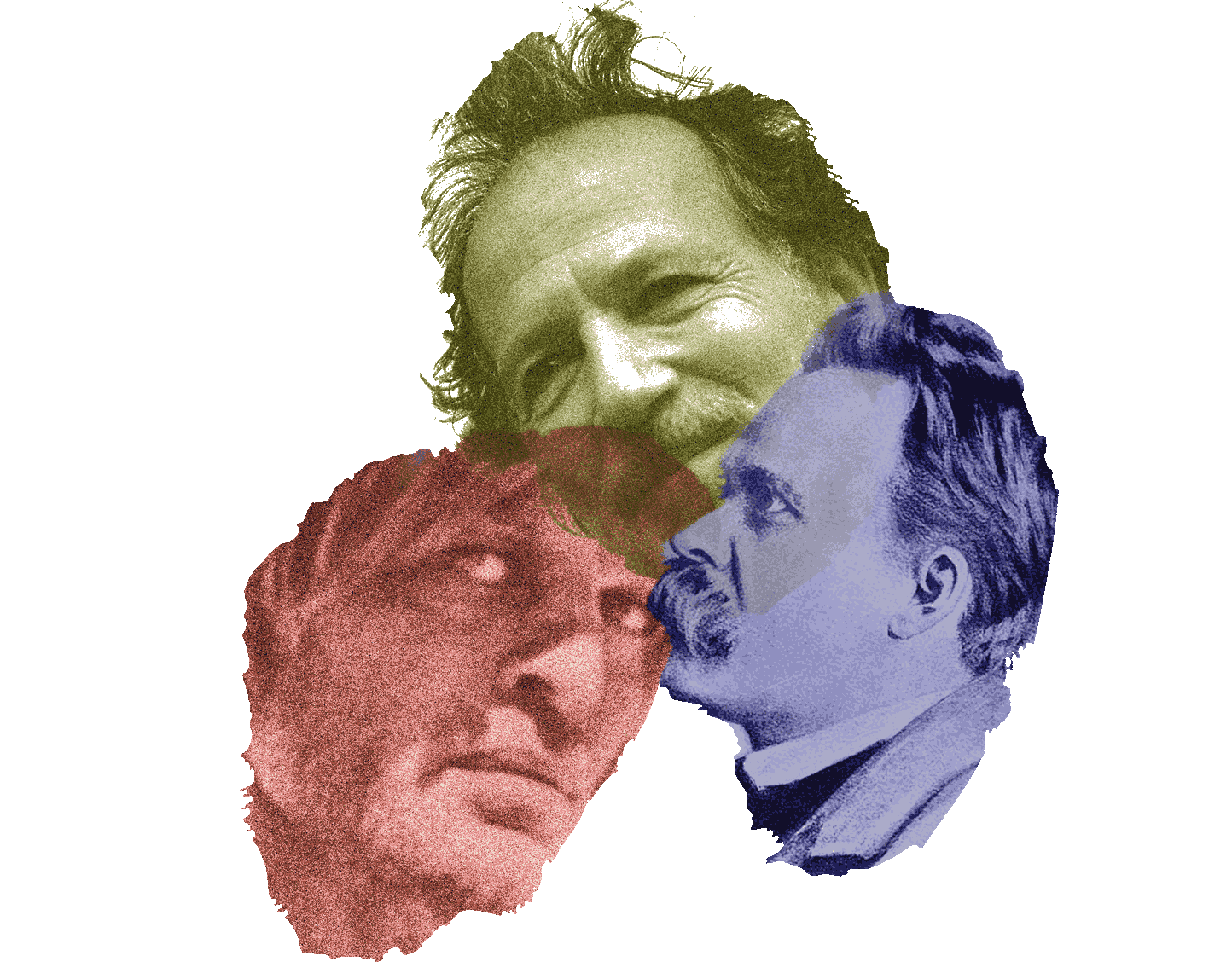
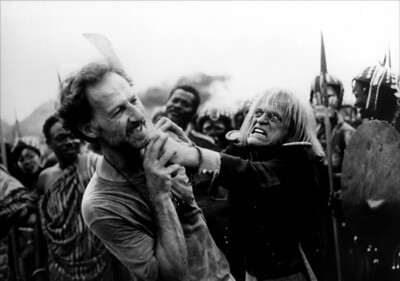
Werner Herzog (born 1942), described as a “mythomaniac” by Linus Wörffel, and Klaus Kinski (1926—1991) are among the leading figures of post-war German cinema. In the 70s and 80s, the filmmaker and the actor shot five feature films that are among the classics of the medium's history. They are hymns to tragic heroism, in which the spirit of Nietzsche can easily be recognized. From “Build Your Cities on Vesuvius! “will “Build opera houses in the rainforest! ”.
Truth has no future, but truth also has no past.
We want to, we will, we may, but we cannot give up the search for it.
(Werner Herzog, The future of truth, P. 110)
I wasn't great, I wasn't adorable. I WAS MOMENTARY, I WAS EPOCHAL.
(Klaus Kinski according to Werner Herzog, Everyone for himself and God against all, P. 92)
Nietzsche spent a lifetime on the subject of a “new myth” — the practice was provided by the congenial duo Werner Herzog and Klaus Kinski, among others, several decades later. After a brief introduction to Nietzsche's vision of a new myth, it will be shown that cinema can be understood as a precise implementation of Nietzsche's vision of a tragic work of art that once again confronts people with a view of real grandeur. Herzog and Kinski's joint work marks, as will be shown in the second part of the article, a culmination of this development.
I. Zarathustra between cynicism and magic
For early Nietzsche the Birth of Tragedy It is clear: The biggest problem facing the West since the rise of the rational spirit in the form of Socrates is its loss of myths. The optimistic spirit first of Platonism, then of Christianity and finally of modern science and enthusiasm for democracy has the “myth-building spirit of music.”1 Silenced. This new spirit no longer knows tragedy, no more heroism. Only in Richard Wagner's Gesamtkunstwerke does the young philosopher see the hope of a revival of tragic heroism, a Dionysian worldview, which he harshly opposes the omnipresent modern rationality. He dreams of “overcoming knowledge by Myth-building powers”2 with Wagner as a revered “Mythologue and Mythopoet”3.
In the course of his general departure from Wagner and Wagnerianism, Nietzsche saw things much more complex just a little later. Under the influence of philosopher and psychologist Paul Rées, Nietzsche mutates into a “free spirit,” which “arbitrariness and confusion.”4 Sharply criticizes mythological thinking and shows time and again how much seemingly rational thinking is still entrenched in him. The critic of the Enlightenment becomes a relentless radical enlightener who takes the last blow: “The 'unfree will' is mythology: in real life, it is only about strong and weak Will. ”5
Of course, Nietzsche will always return to the big theme of his early writings, never completely shake off the dream of 're-enchanting the world. ' His Zarathustra mocks the mythless and ideless “last person”6 and appeals to a young man who has become cynical: “But with my love and hope, I implore you: Don't throw away the hero in your soul! Keep your highest hope holy! ”7
But Nietzsche is not himself “a cheeky, a mocking, an annihilator.”8When, looking back, he is proud of Human, all-too-human writes:
One mistake after another is calmly put on hold, the ideal is not refuted — It freezes... Here, for example, “the genius” freezes to death; a nook “the saint” continues to freeze to death; “the hero” freezes to death under a thick icicle; in the end, “faith,” the so-called “conviction,” also “compassion” cools down significantly [.]9
But Nietzsche doesn't want to stop there. The reckless negation is not intended to prevent a new affirmation, but to prepare it — to make it possible in the first place. In the dead of midnight, a new light should awaken: The flame of a new myth, whose exact shape Nietzsche is silent about, is supposed to be a myth of the future: “Premonitions of the future! Celebrate the future, not the past! Write the myth of the future! Live in hope! ”10
This hope is linked to the emergence of a new type of person, whom Nietzsche completely uncritically described as”barbarians of the 20th century”11 referred to. The modern person — “the most intelligent slave animal, very hard-working, basically very humble, curious to the point of excess, maniacal, weak-willed — a cosmopolitan chaos of affect and intelligence”12 — should be replaced by “a stronger Type”13 be replaced by their “will [s] to simplify, to strengthen, to the visibility of happiness, to dread, to psychologically nudity”14. The “blonde beast” is to be resurrected, about whom it is in the The genealogy of morality means:
At the bottom of all these noble races is the predatory animal, the magnificent wandering for prey and victory blonde beast Unmistakable; this hidden reason requires unloading from time to time, the animal must come out again, must return to the wild [.]15
Nietzsche sees the dialectic of nihilism and Renaissance at work here too: The general weakening and decadence will produce, on the one hand, an army of passive slaves who only thirst for new masters; hardened in the fight against modern slave morality, a new master caste will emerge victorious, which is also ready to take on this mission. In this respect, the following applies to him: “The adjustment For European people, this is the big process that cannot be hampered: it should be accelerated even more. ”16 The extreme, most thorough, radical nihilism should also turn into its opposite in this respect: “Midnight is also noon”17.
Nietzsche has therefore never given up the dream of a new myth; it has only become more complex, more complex. The remythologization, yes: rebarbarization, of the world can only succeed if it no longer harshly opposes modern irony and skepticism, but uses it as a means. The skeptical insight that there are no more truths, no more pillars of world orientation — as in the case of Zarathustra's “Shadow.”18 — a reason for despair but for the greatest joy, as it enables the creation of new values, new wisdom, new myths precisely on the basis of that skepticism: “[E] ndly the horizon appears clear to us again, set itself that it is not bright, finally our ships may sail again, sail at any risk, every risk of the discerning person is allowed again, the sea, our The sea is open again, perhaps there has never been such an 'open sea' . ”19 And Nietzsche confidently calls for departure: “Get on the ships, philosophers! ”20
II. Cinema as a place of worship
Numerous performers have followed Nietzsche's appeal — but, unsurprisingly, interpreted it in very different ways. Even more than philosophers, Nietzsche has inspired artists not to be swayed by moral and rationalistic prejudices in their work, but to follow their instincts and imagination. Since the youth movement around 1890 at the latest, we have been dealing with ever new waves of remythologization, which repeatedly find an advocate in Nietzsche. While Hegel around 1800, arguing against Romanticism, which was similar to Nietzsche, called for people to accept that tragedy, heroism and individualism had just come to an end, and to submit to the state and its bureaucracy,21 Nietzsche and his colleagues repeatedly hurl a defiant “no” at him. The story isn't over yet: “There are so many dawns that haven't lit up yet. ”22
Of all the arts, cinema is the most suitable way to give this' Reconquista 'an aesthetic form. Wagner's operas can be interpreted as direct anticipations of film and it is no coincidence that his compositional methods — such as the use of leitmotifs and the primacy of mood over harmonic logic — are almost ubiquitous in film music. The powers of all arts are combined and bundled here to literally captivate the audience with all their senses and take them away to another world. Adorno and Horkheimer observed this historically new fascinating power of film as early as the Second World War and saw Wagner's operatic art as a direct precursor to the manipulative “cultural industry.”23
If you still wanted to argue like this today, you would put yourself in the unpleasant situation of a monk who, around 1650, would have warned of the dangers of printing and would have praised the faded beauty of the handwriting. Today would be more the magic of the classic cinema hall versus the isolated binge watching To defend against a home tablet. The great era of film and its myth-making power is probably over. Real tragic stories have been replaced by stage-produced film series, which draw their 'shine', if at all, from overwhelming technical effects and barely allow a big moment that is not immediately returned by the obligatory Comic Relief would be leveled. Each of these strips is obviously calculated to include as many as possible sequels and spin-offs allow and maximum merch-to be fit. Serious artistic engagement with interesting topics was systematically based on a crude mixture of commercial calculation and the effort to signal, depending on the target group, Wokeness or 'realness'replaced. In its weak moments, as it was called in the work of the exiles committed to the principle of despair, cinema may have been “mass fraud” — today it is a means of blatant mass delusion.
III. Lonely giants
It was only a few decades ago that it was different. The cinema was a magical place, a last bastion of heroism in a completely “managed world,” as the Adorno and Horkheimers critically described post-war society in the spirit of Nietzsche. Not only the auteur films of avant-garde cinema, but also the popular productions, there was an authentic magic, the effect of which was not only obfuscating and numbing, but also inspiring and in some cases perhaps even enlightening. Cinema not only compensated for the loss of the stolen individuality, but also encouraged people not to simply put up with it. The cinema answered Nietzsche's prophetic question “[W] o are the barbarians of the 20th century? ”24 Both defiant and trivial: Here, on the screen.25
The joint work of Klaus Kinski and Werner Herzog is located at the interface between author and popular film, in the midst of this classic period of cinema. The actor and the universally responsible “filmmaker” acting in Wagner's tradition, who had already met in Munich in the 1950s26 produced in that golden age of feature films with Aguirre, the wrath of God (1972), Nosferatu: Phantom of the Night (1979), Woyzeck (1979) — probably the best film adaptation of Büchner's material that exists —, Fitzcarraldo (1982) and Cobra Verde (1987) five highlights of post-war German film, which, apart from Cobra Verde, are undoubtedly masterpieces.27 There the calm, sober head, there his quick-tempered, wild organ, both possessed by the same delusions of grandeur: creating the perfect film, giving shape to the tragic myth on the screen. We're actually not dealing with an “actor” or a mere “filmmaker.” “I'm not playing, that's me”28, Kinski announced and Herzog continued: “He wasn't an actor. [...] He was the only genius I met. ”29 He himself, however, announced: “My films are what I am”30. They are artists who claim to be identical with their work. There is no irony, no skepticism, no calculation here — there is only the absolute will to be authentic, to sacrifice for the complete work of art.
Even visually, Kinski is predestined to play the “blonde beast” over and over again, actually playing the same role, himself, playing the insane psychopath in different facets in the fight against the modern world: “With Herzog, Kinski is the person who goes to the extreme, at the edge of the world, perception, language and life. ”31
The saga begins with Aguirre. This is where the archetype makes its first appearance. The film tells of a Spanish conquistador's desperate search for the golden land of El Dorado. With growing despair, the title hero, who has acted as a choleric dictator from the start, becomes more and more insane. He whips his followers across the Amazon. They die or are killed. In the end, he is left alone. A squirrel monkey is his last companion. The only one is driven along the stream with his remaining property, little more than a capsizing raft. The fury of Aguirre is unforgettable, the pictures shot with great effort of crossing the Andes at the beginning of the film and the rainforest, unforgettable is the final monologue in which Aguirre promises himself a bright future. The Dionysian myth is beamed onto the screen in the spirit of early Nietzsche and therefore ends with the demise of the hybrid hero. Everything in the film consistently goes down the drain, better: down the river, but he firmly adheres to his dream of fabulous wealth and endless fame until the very end.
However, it may mark the peak among the highlights Fitzcarraldo.32 Kinski doesn't play one, he is The opera enthusiast Brian Sweeney Fitzgerald, known as Fitzcarraldo, who is obsessed with the crazy dream of building an opera house in the middle of Peru's rainforest, in the city of Iquitos, struck by rubber fever. He sets off on a boat trip in the middle of the jungle to buy rubber to finance this plan — but to do so he has to cross a mountain with his steamer. Through his charisma, he is able to convince the indigenous people living there to help him. He achieves the unbelievable. After a few accidents, however, Fitzcarraldo has to be content with having a single opera performed himself on the deck of the damaged ship.
Who watched the documentary My favorite enemy (1999), produced by Herzog himself, gets the impression that the film tells its own story. Herzog himself notes in his diary during filming that “my task and that of the character have become identical.”33. During the two-year adventurous ordeal, for the most part in the middle of the rainforest, several of Herzog's employees almost died, there were repeated conflicts with the indigenous people involved, and Kinski's choleric tantrums further complicated the situation. Apart from the financing difficulties for this mammoth project.
The battle of the white man with the wilds of the rainforest — that is also the defining theme of Aguirre and Cobra Verde. In the latter, however, it is repeated, in accordance with the famous formula of Marx,34 Tragedy as a farce. Brazilian bandit Francisco Manoel da Silva is sent to Africa by a sugar baron to acquire new slaves there. There, da Silva takes on a local king and overthrows him with the help of an army of half-naked black Amazon warriors drilled by him. Kinski as a sadistic leader of an army of bare-breasted African women who captivate them solely by his exuberant masculinity: A man's imagination is turned into the absurd in such a way that the film, in the absence of any ironic break, simply seems involuntarily funny. After all, Herzog succeeded in creating what is perhaps the most grotesque, not intended as such, image in film history. It is only logical that the cooperation between the two ended afterwards: The material had exhausted itself, the inadequate had already become an event.35
Separated from each other, neither Kinski nor Herzog ever succeeded in rebuilding this zenith of their work. Kinski died a few years later and left behind the film Paganini (1989), for which he himself took on the role not only of the title hero, but also of the screenwriter and director. A barely visible work in which he plays himself one last time, the eccentric “original genius” who captivates women into sexual ecstasy through his demonic violin playing.36
Herzog continued to create major films such as the documentary Grizzly Man (2005) and Queen of the desert (2015), which, however, only vary the theme already set — rebellion against the wilderness and failure. The latter film is remarkable because it is now a white woman who is moving to the Middle Eastern desert. It is based on the real life story of the protagonist Gertrude Bell, a young British woman who flees the narrow world of Victorianism to live a lonely life as a desert researcher. Unlike her male counterparts, however, she does not act brutally and exploitatively, but learns the languages of the natives and criticizes British imperialism. A successful memorial to an emancipated woman of fin de siècle? Or not a sexist orientalist male fantasy that repeatedly descends into kitsch? In any case, the film is no longer as convincing as it is still Fitzcarraldo and Aguirre actions. The obvious question “Where are the barbariansinside? “— Wouldn't a 'rescue of the Occident' be the responsibility of emancipated women rather than men, who, like Nietzsche, are far too entangled in patriarchal structures to become truly free spirits?37 — in any case, remains open.
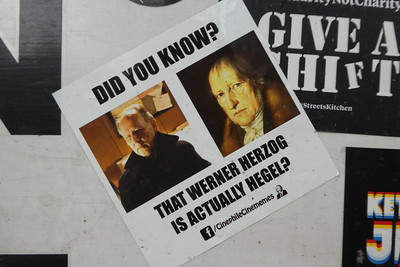
IV. Genius and Kitsch
But anyone who wants to create a new myth in the modern age must be constantly on the line between kitsch and grandeur. Nietzsche's texts also often move on her — and even exceed them. He saves himself through the permanent use of ironic breaks and withdrawals. Herzog and Kinski are probably turning from size to kitsch again and again because they completely dispense with these stylistic devices. Queen of the desert The orientalism of the end of the 19th century does not simply quote, the film celebrates it, it revels in these long-stale dream worlds in a completely unironic way and it depends on the viewer whether he likes to get involved with it or not — a successful production would not require such a decision at all. In Cobra Verde Approving identification with what is shown would even require the complete abandonment of aesthetic judgment and self-deception; greatness is shown in great failure.
The distance to Nietzsche, who is actually much closer to historical German Romanticism in this aspect of all things, is reflected not least in the fact that he does not play a major role in either Kinski's or Herzog's frame of reference. Kinski, who celebrated his breakthrough around 1960 as a reciter of major literary works,38 Read only a few poems by Nietzsche over and over again with the same powerful, creaky trained actor voice. There is no irony here, no withdrawal, just pure pathos. Sometimes Kinski's voice turns into screaming, screeching, screeching.39 Here, too, involuntary comedy, which shows that he may have read little about Nietzsche apart from those poems.
Neither in the relevant Kinski biography by Peter Geyer nor in that of Christian David is Nietzsche mentioned even once. In Kinski's own autobiography I need love Almost any reference to any philosophers is missing, but there is even more talk of sparkling women's stories. However, this also applies to Herzog, who in his memoir Everyone for himself and God against all It doesn't seem as though reading any philosopher has decisively shaped his life path.
In the case of Herzog, this is certainly surprising, as he propagates a thoroughly Nietzschean view of the world in his films, which he has repeatedly set forth explicitly in numerous writings, in particular in his book of essays worth reading The future of truth — but without mentioning Nietzsche in a decisive place. Rather, it is noticeable that, in contrast to many other philosophers, he just not mentioned.40
As Kristina Jaspers and Rüdiger Zill also points out in the preface to their anthology Werner Herzog. At the borders note and convincingly substantiate them on the basis of a few Nietzsche quotes,41 Herzog's view of cinematic truth has strong references to Nietzsche. It circles, as it is contained in that volume, for example Minnesota Declaration from 199942 explains, therefore, that the usual 'realistic', factual documentary is missing the actual reality right now. This applies with the aim of “enlightenment”43 of the viewer, using completely different methods: “In film, the truth lies deeper and there is something like poetic, ecstatic truth. It is mysterious and difficult to grasp; it can only be learned through poetry, invention, stylization.” (ibid.) Herzog is concerned with the authenticity of the self-experienced, directly experienced as opposed to the simply prechewed and known. In a few words in the style of a Nietzsche sentence: “Tourism is sin, traveling on foot is virtue.” (ibid.)
Just like in the Birth of Tragedy For Herzog, reality is therefore not reflected in ordinary everyday experience, but in crossing borders and excess — and to represent them requires mythical images, a tragic hero of the likes of Kinski, in whose failure the audience learns a deeper existential truth.
Like Schopenhauer and Nietzsche, this truth is gloomy, normally, i.e. without an aesthetic veil, hard to bear. For him, it is particularly evident in the confrontation with untamed nature, whose epitome is the rainforest. This is particularly in Aguirre and Fitzcarraldo Almost the true protagonist of the films. Herzog's artistic greatness is particularly evident in the way he stages the landscape in these films. Even more than the music, it is here the Ur—Wald The sounding board on which the Dionysian myth can unfold. He gives birth to the hero and devours him again, even if he gives him in Fitzcarraldo — perhaps for this reason a more successful film than Aguirre — in the end, cunning cheats, triumphant in failure, laughing in doom.
This understanding can be found in particular in the mentioned documentary My favorite enemy remove. For Herzog, the rainforest is an anti-idyll that shows the brutality and absurdity of being. In manifesto It says accordingly: “The moon is dull and stupid. Nature doesn't call or talk to anyone, but occasionally a glacier farts. Just don't listen to the 'Song of Life. '” (p. 164) And:
Life in the deep sea must be hellish. A limitless, merciless hell of constant danger. So hellish that some species — including humans — have crawled out of it in the course of evolution and have escaped to the dry land of a few small continents, where the lessons continue in darkness.44
And the same goes for Kinski. This is how Peter Geyer leaves the band Kinski with a quote from I need love start:
Wind force twelve. No one is outside. I sit on the rock by the sea, from which I always look at the departing ships. The surf rages over fifteen meters high. The storm whips the salty spray all the way to my face. The thunder causes the sky to collapse and the lightning to shake me. I've never been happier than I've ever been in my life.45
Both attitudes — warning against Dionysian primal truth and ecstatic dedication to it — are also found in Nietzsche.
But even though it is the landscape photo rather than the music that acts as a Dionysian sounding board in Herzog's films, it still plays a key role in his self-image: “In my films, music is never an event in the background, but transforms the images into elementary visions. ”46
This also puts us right in the middle of the program of Birth of Tragedy And it is hardly surprising that Herzog shares his love for the 'great opera' of the 19th century with his fictional character Fitzcarraldo and the philosopher. Herzog is also an opera enthusiast and has staged several operas, including some by Wagner. For him, the opera is almost even more “realistic” (in his sense) than the film:
The feelings of opera are absolutely condensed, but they are true for the audience because the power of music makes them come true. The feelings of grand opera are always like axioms of feelings, like an accepted truth in mathematics that you can no longer reduce, concentrate, explain.47
Nietzsche's absence is all the more surprising since Herzog and Kinski are trying to resurrect the 19th century.48 Whether in her films or in her other work: Time and again, the 19th century is a central point of contact. This is no accident, as it was the heyday of modern individualism. The bureaucracy of the modern state was not yet complete, the market still allowed real competition before monopoly capitalism, the world was not yet managed. There was still unmapped territory, both literally and figuratively, where isolated heroism could ignite.
But it is precisely in this “big gesture” that the limitations lie — that of the more reflective duke less than that of Kinski. Anyone who just enters their name on YouTube quickly realizes that in his permanent desire to market himself as a rebellious 'original genius' of the 19th century, he crossed the line not only into kitsch, but also into ridiculous and embarrassing. Because you realize all too quickly that he is an actor after all and this is a production based on specific effects, never pure authenticity. As Herzog notes in his memoirs, the voice, the entire style of Kinski, is the product of days of excruciating exercises49: He wasn't born as Klaus Kinski — in the very literal sense of the word, because his birth name is less sonorous Klaus Günter Karl Nakszynski — he set out to do so.
Nietzsche and Herzog reflect that the relationship between masquerade and authenticity is not so simple, that authenticity necessarily always goes hand in hand with masking — in his anachronistic reenactment The cult of genius of the 19th century escapes Kinski. Perhaps this is the real tragedy of his life. He didn't always just play so much yourself — he played Always just yourself. He merged so much with his own role that he was left with no self at all. It is precisely this obvious lack of reflection that awakens foreign shame when you look at some of his interviews: Unable to save himself in irony like Nietzsche, he tries cynicism and insists, in all seriousness, that he is not interested in the artistic value of a film, it is only about the amount of the fee for him.50
In fact, Kinski's gigantic filmography of over 130 films comprises a good portion of trash films to erotic films of dubious level. Since he couldn't handle money, he was plagued by monetary concerns throughout his life and was therefore willing to shoot junk films when the pay was right. But he also rejected film offers that did not appeal to him artistically. The production as a cynic affects But undoubtedly more “authentic” than truly honest self-disclosure — and it gets Kinski in particular more attention.
But tragically, all of this does not seem to have been calculated for him. He seems “crazy” insofar as he has lost himself in the role of a madman, inasmuch as he really believes that he is — a cynical psychopath — without actually being one. His excentricity on display should prove this to himself and to the world time and again: I am not like you, I am a person of the 19th century. He would not be an authentic person, but an inauthentic person par excellence, one in which self-image and reality of life, as with everyone, not only diverge but diverge to such an extent that the delusional self-image becomes second nature — a 'nature' whose status, of course, remains precarious and which therefore has to be re-staged, reconfirmed and proven anew at any moment.
However, this does not involve Kinski's tremendous driving energy. His compulsive self-alienation suggests an early childhood trauma that haunted him for a lifetime and not only made him a unique actor and feared choleric, but also culminated in drug excesses, several psychiatric visits and addictive sexuality. I need love It is not by chance the title of his autobiography: He sought love, but since the experience of real love would have meant leaving the role, which was impossible for him, he was only able to seek a substitute for love — recognition, power, sexual enjoyment without fulfillment, drug intoxication in order to somehow avoid the inner emptiness. What he lacked was the experience of real resonance, of real love: “If only the sea would be a bit quieter! I'm not afraid, it's too huge, too overwhelming. Almost as protective as a mother. Like love. ”51
A fate that is not only pitiful, but of course also led to Kinski behaving just as recklessly and violently as his film roles, even in his 'real life, 'when you are allowed to speak like that. In recent years, the revelations surrounding the sexual and emotional abuse of his two daughters — which is even hinted at in his autobiography — have been particularly striking.52 This dark side of his actions cannot be excused even by Kinski's own traumatization, which he passed on directly through his despicable behavior towards them.
But Kinski's failure also has to do with the fact that he lacked a real social sounding board. Georg Seeßlen attributes Kinski's — tragic — ridicule primarily to the fact that he never met with a right response in the bourgeois, small-minded West German post-war society, as “the sad ghost of the German superman.”53 had to remain nothing more than an admired but at the same time despised nerd, an individual archist in the spirit of Stirner,54 In which, however, there is also a collective fate; Kinski as “[e] in the German archetype, an archetype of the German, and always above all their parody.”55. In probably no figure of the German post-war period intersect such 'genius' and madness, kitsch and ridicule56, “size” and triviality — and that probably actually makes Kinski a kind of “super-German,” just like Herzog with his accent in the USA as Edgy German is celebrated. — All this causes great discomfort, but in the sense of Nietzschean self-expression, it would probably be important not to avoid this gruesome reflection, but to recognize it as part of one's own self; especially in order to be able to embark on a different path.

V. The anti-robot
In spite of everything, I don't want to lose my enthusiasm for the work of Kinski and Herzog. Without ambitious people like them, the world would be worse than it already is. We may think they are crazy and morally condemn their personal behavior — in the end, we must admire the greatness of their work and should use it as an incentive to produce something great ourselves, even though we may not want to be so reckless in doing so. Or is at least a certain recklessness towards oneself and others not necessarily part of the work?
In any case, shortly before his death, Kinski received a last anonymous letter from a fan, published on the back of the first edition of his autobiography I need love, which summarizes well what remains of Kinski. It is hardly necessary to mention that almost every sentence can be interpreted as an allusion to Nietzsche:
... They are the opposite of the robot, the programmed computer, the metal structure and the reinforced concrete... Yes, you live and breathe like a free animal... you are the human-animal, the animal that you have denied in order to submit to the machine... You are the vibrant life that we have forgotten... You have the lion's mane, the eagle's gaze, the wolf's smile, the harsh beauty of the raging sea and the wild ugliness of melting lava, blood-red, like a bleeding heart, on the slopes of a gloomy volcano... You are the man from whom You'll talk again and again, but that no one can remember anymore... the legend... of being human...57
“Build your cities on Mount Vesuvius! ”58, Nietzsche famously recommends. Whether Herzog and Kinski read this or not — they certainly lived it59 and in doing so made the world richer by some inspiring big myths. “Look for Eldorado! ”, one would like to add: “Build opera houses in the rainforest! ”
sources
Adorno, Theodor W. & Max Horkheimer: Dialectic of Enlightenment. Philosophical fragments. Frankfurt am Main 2006.
David, Christian: Kinsky. The biography. Berlin 2008.
Geyer, Peter: Klaus Kinski. Frankfurt am Main 2006.
Ders. & Oliver A. Krimmel: Kinsky. Legacy, autobiographical, stories, letters, photographs, drawings, lists, private matters. Hamburg 2011.
Hegel, George William Frederick: Principles of the Philosophy of Law. works, Vol. 7. Frankfurt a. M. 1986.
Ders. : Lectures on aesthetics, Vol. II works, Vol. 14 Frankfurt a. M. 1986.
Herzog, Werner: The future of truth. Munich 2024.
Ders. : Conquering the useless. Munich 2013.
Ders. : Everyone for himself and God against all. Frankfurt am Main 2024.
Jaspers, Kristina & Rüdiger Zill (eds.): Werner Herzog. At the borders. Berlin 2015.
Kinski, Klaus: I need love. Munich 1995.
Ders. : Paganini. Munich 1994.
Kinski, Poland: Children's mouth. Berlin 2013.
Presser, Beat: Kinski. Berlin 2000.
Worffel, Linus: Mythomaniac Werner Herzog. Work — effect — interplay. Bielefeld 2024.
footnotes
1: The birth of tragedy, paragraph 17.
2: Subsequent fragments 1872 19 [62]. See also another programmatic fragment from the same period (link).
3: Richard Wagner in Bayreuth, paragraph 3.
4: Human, all-too-human I, Aph 12.
5: Beyond good and evil, Aph 21.
6: So Zarathustra spoke, Preface, 5.
7: So Zarathustra spoke, From a tree on a mountain.
8: Ibid.
9: Ecce homo, Human, all-too-human, paragraph 1.
10: Subsequent fragments 1883, 21 [6].
11: Subsequent fragments 1887 11 [31].
12: Ibid.
13: Ibid.
14: Ibid. Our essay prize this year is dedicated to the precise interpretation of this fragment and its current relevance (link).
15: On the genealogy of morality, paragraph I, 11.
16: Subsequent fragments 1887 9 [153]. For this motif, see also Beyond good and evil, Aph 242.
17: So Zarathustra spoke, The Nightwalker Song, paragraph 10.
18: See my corresponding remarks in the second part of the essay Between Monsters and Abysses(Link).
19: The happy science, Aph 343.
20: The happy science, Aph 289.
21: See in particular Hegel's exclamations of the “end of art” in comedy (cf. Lectures on aesthetics Vol. II, p. 219 f.). Hegel's anti-individualism is most blatantly expressed in Principles of the Philosophy of Law, where he unbridled the slaughter of individuals for the civil service state: “The courage of the animal, the robber, the bravery for honor, the chivalric bravery are not yet the true forms. The true bravery of educated peoples is the willingness to sacrifice in the service of the state, so that the individual is only one among many. The important thing here is not personal courage, but classification into the general.” (addition to § 327; p. 495)
22: That is the motto of Morgenröthe (link).
23: Cf. Dialectic of Enlightenment, PP. 128—176.
24: Subsequent fragments 1887 11 [31].
25: Waiting for the Barbarians Accordingly, the title is one of the chapters of Herzog's autobiography (cf. Everyone for himself and God against all, pp. 260—264) and also the title of a novel by J. M. Coetzee, which Herzog wanted to film temporarily (see ibid., p. 260).
26: Even then, young Kinski stood out for his eccentric behavior and in particular his outbursts of anger. Cf. the vivid description of this period in Herzog's autobiography Everyone for himself and God against all (PP. 92—95).
27: Herzog, who had a proud filmography of 79 films in 2024, is one of the few internationally successful German filmmakers (see Linus Wörffel: Mythomaniac Werner Herzog, P. 9).
28: Quoted by Wörffel, Mythomaniac, P. 179.
29: Beat Presser: Kinski, P. 17.
30: Quoted by Wörffel, Mythomaniac, P. 179.
31: Georg Seeßlen in Presser, Kinski, P. 35.
32: According to Wörffel, the film also represents the zenith of both Kinski's fame and Herzog's recognition in Germany (cf. Mythomaniac, P. 9).
33: conquering the useless, p. 158 (entry dated 18 February 1981).
34: “Hegel noticed somewhere that all major world historical facts and people happen twice, so to speak. He forgot to add: one time as a tragedy, the other time as a farce.” (The eighteenth Brumaire of Louis Bonaparte; link.)
35: “According to Klaus Kinski, after Woyzeck, 'everything was said. ' There is something to it,” notes Seeßlen accordingly (in Presser, Kinski, p. 35), even though afterwards Fitzcarraldo came. On the corresponding negative contemporary reception of the film, see Peter Geyer: Klaus Kinski, p. 107. In Herzog's more recent texts, there is a general tendency, very often about Aguirre and Fitzcarraldo to talk about him, but hardly ever about him.
36: “This Satan who dominates the horny dreams of the female sex” quotes the cover of the film book in a lurid but authentic way (see Klaus Kinski, Paganini). Appropriately, at the end of the book, the publisher promotes various “erotic novels and stories” with titles such as rainforest. Chaos of Desire.
37: Interestingly enough, one of Kinski's first major successes as a stage actor was a “rock role”, as was still common back then, in fact, he played the female protagonist of Jean Cocteau's one-person play La voix humaine (see Peter Geyer & Oliver A. Krimmel: Kinski, PP. 32—39).
38: After a cult around him in the 1950s as Enfant Terrible of German theatre, he reached one million viewers with his readings in 1961 (see Geyer & Krimmel, Kinski, p. 7), he was “Germany's most successful [r] reciter with an audience of millions and 32 speaking plates between 1959 and 1962” (ibid., p. 73).
39: This is particularly clear in his reading of An den Mistral And also from After new seas. These poems are included on the CD's Kinski talks, “Hauptmann & Nietzsche” and Klaus Kinski: Dostoyevsky, Nietzsche, Baudelaire, etc.
40: I actually didn't come across a single mention of it. In the presentation About the Absolute, the Sublime and Ecstatic Truth (in: Kristina Jaspers & Rüdiger Zill: Werner Herzog. At the borders, pp. 165—174), for example, he instead also talks about Blaise Pascal and Homer, who were also appreciated by Nietzsche. In The future of truth A list of great thinkers on the subject of the book Nietzsche of all things is missing (see p. 23).
41: Cf. p. 9 — this is, of course, the only mention of the philosopher in the entire volume!
42: Cf. p. 163 f.
43: Ibid., p. 163.
44: Ibid.
45: P. 4.
46:Everyone for themselves, P. 308.
47: Ibid., p. 310. See also his remarks in Jaspers and Zill, Werner Herzog, p. 170 f. Herzog's love for opera was apparently only awakened by this film and not vice versa. According to his own admission, he had never seen an opera from the inside before filming Fitzcarraldo (see Geyer, Klaus Kinski, P. 105).
48: “I consider the 20th century as a whole to be a mistake,” Herzog writes accordingly in Everyone for himself and God against all (P. 124).
49: Cf. Everyone for themselves, P. 94.
50: Cf. Seeßlen in Presser, Kinski, P. 32.
51: I need love; cited by Geyer & Krimmel, Kinski, p. 382 ff.
52: And also in Paganini Rape and affection for underage women and girls are addressed quite openly. — According to her autobiography, he abused his older daughter Pola Kinski Children's mouth Sexually and raped her several times; his younger daughter was more likely to be the victim of emotional abuse by him, even though he also approached her in an unacceptable way.
53: In: Presser, Kinski, P. 31.
54: See ibid., p. 31 et seq.
55: Ibid., p. 32.
56: A ridicule that comedian Max Giermann in particular has shown in his Kinski parodies in recent years.
57: Geyer & Krimmel, Kinski, p. 71 (original omissions).
58: The happy science, Aph 283. See also the detailed interpretation of this passage by Natalie Schulte on this blog (link).
59: Several of Herzog's films are even dedicated to the topic of “Encountering the Volcano”, most recently The inner glow (2022).
Mythomaniacs in Lean Years
About Klaus Kinski and Werner Herzog
Werner Herzog (born 1942), described as a “mythomaniac” by Linus Wörffel, and Klaus Kinski (1926—1991) are among the leading figures of post-war German cinema. In the 70s and 80s, the filmmaker and the actor shot five feature films that are among the classics of the medium's history. They are hymns to tragic heroism, in which the spirit of Nietzsche can easily be recognized. From “Build Your Cities on Vesuvius! “will “Build opera houses in the rainforest! ”.
Turning Moral Weakness Into Power
Nietzsche and the Accusation of Resentment
Turning Moral Weakness Into Power
Nietzsche and the Accusation of Resentment


Strangers seem creepy to many. They immediately fear that these strangers will harm them. Many decent earners think that recipients of citizen benefits are lazy and therefore do not allow them to receive government support. To many educated people, illiterate people appear rude and simple-minded, with whom they therefore want as little as possible nothing to do with, whom they do not trust. Religious people are often afraid of atheists, who in turn are afraid of contact with religion. What you don't know often appears to be dangerous and you prematurely discount that. Such prejudices lead to rejection, which often solidifies to such an extent that counterarguments are no longer even heard. This is resentment that has existed for a long time, but which today makes consensus almost impossible in many political and social debates. This can degenerate into hate and contempt and then into violence whether between rich and poor, right and left, machos and feminists, abortion opponents and abortion advocates, vegetarians and meat-eaters. When one side prevails, it imposes its values on the other, and the resentment even becomes creative. In any case, it prevents you from making an effort to understand the other person. For Nietzsche, resentment has been driving the dispute over what is morally necessary for a long time.
“Resentment” is one of the key terms of Nietzsche's late work. The philosopher is referring to an internalized and solidified affect of revenge, which leads to the development of an overall negative approach to the world. Especially in On the genealogy of morality Nietzsche is trying to show that the entire European culture since the rise of Christianity has been based on this affect. Judaism and Christianity, in their hatred of aristocrats, propagated an ethics of the weak — in this act, resentment became creative. With a new creative ethic, Nietzsche now wants to contribute to a renewed revaluation of values in order to return to a life-affirming aristocratic ethic of the “strong.” In this article, Hans-Martin Schönherr-Mann introduces Nietzsche's reflections on resentment and works out what makes the accusation of mutual resentment so popular to this day.
Since the beginning of modernism in the 18th century, which entailed the dissolution of a uniform Christian approach to the world, the affected European societies have been in a permanent conflict of ideologies and worldviews. The French philosopher Paul Ricœur speaks of a war of interpretations, more precisely a “conflict of rival hermeneutics.”1. In such a situation, resentment makes a career. Because you cannot refute other concepts of the world because they are based on different premises, you often reject them with an emotional intensity that precludes a mutual effort to understand the other person from the outset. This is how resentment quickly builds up on each other.

I. Resentment in today's war of ideologies
The accusation of resentment really took off because the Enlightenment in the 18th century, with its demand for human rights, propagated the idea of seeing people as legally equal. Social equality was added a century later. Both ideas of equality remain unfulfilled to this day. Jürgen Grosse remarks: “A sense of resentment and the concept of resentment are increasingly connoted with questions of social justice, in particular with a frustrated desire for equality. ”2
As a result, people see themselves socially and politically disappointed. Capitalist and conservative views of the world prevent equality, which leads to aversions and political conflicts from a left-wing perspective, so that many feel socially disadvantaged. Max Hartung writes: “There is always a dialectic within the story: the guilty conscience of the hearers and the external determination through the law, the subtle spirals of power and the subjects included in them, driven by resentment without their knowledge.”3.
While in the first half of the 20th century, right-wing and fascist ideologies dominated in many countries and aggressively pursued liberal and left-wing thinking with terror, today's representatives of such worldviews see themselves marginalized, although they have received strong impetus in recent decades. Oliver Nachtwey notes: “Material and cultural status fears are drivers of resentment, negative affects, identitary closure and conspiracy theories — aspects that were identified early on as signs of authoritarian personality structures. ”4

II. Nietzsche's fabulous true world
Nietzsche developed his concept of resentment in a more focused and differentiated way. He was one of the first to recognize that as a result of the war of ideologies, there is no longer a single reality; rather, these are just different interpretations that cannot refute each other. He writes: “We have abolished the real world: what world was left? The apparent one maybe? .. But no! With the real world, we have also abolished the apparent world! ”5
For Nietzsche, the real world has thus become a fable. For this reason, the various views of the world can only be met with rejection, which cannot be justified, except through an enemy image or mutual resentment.
Scientism is now trying to overcome this dilemma with a scientific view of the world. But the sciences do not escape the problem of the difference between language and the world, nor their dependence on methods and the subjectivity of all perception, which cannot be undermined by intersubjectivity. Nietzsche's verdict of the fabulous true world therefore persists.

III. Resentment of the weak towards the strong
For Nietzsche, resentment is not due to a war of ideologies. Rather, it has a more far-reaching origin. Basically, it originates from the conflict between rich and poor back in ancient times. For Nietzsche, however, this is first conveyed by the Jewish priests. He writes: “The very big haters in world history have always been priests, even the most witty haters: — against the spirit of priestly revenge, all the rest of the spirit is barely considered at all. ”6
According to Nietzsche, the priests hated the aristocracy, i.e. the strong and rich, because they were inferior to them. Out of their feeling of inferiority and powerlessness, they developed a reluctance towards them, the resentment from which they took revenge on the aristocracy.
But how did they take revenge? By devaluing their ethical values and replacing them with the values of the poor. Are the latter not always the natural ethical orientations? Not at all, as Nietzsche points out: “They took the Werth, this “value” as a given, as in fact, as beyond all questioning”7.
But only Christianity gave this impression. Originally — i.e. before Judaism and Christianity — ethical goodness was not linked to the poor and weak; it did not originate from their need for help. For Nietzsche, it had a completely different origin when he wrote:
The pathos of nobility and detachment, [...] the lasting and dominating overall and basic feeling of a higher dominant species in relation to a lower species, to a “bottom” — That is the origin of the contrast between “good” and “bad.” [...] It is because of this origin that the word “good” is quite clear from the outset not necessarily linked to “unselfish” actions [.]8
This can be proven by Plato, for whom justice means “that everyone does his own thing. ”9 Good, even ethically good, is to fulfill its nature. If this has made you a craftsman, he should not try to interfere in the business of the powerful and rich. Of course, wealth means nobility and represents ethical goodness. Poverty, on the other hand, is ethically bad and tends towards malice.

IV. The revaluation of all values
According to Nietzsche, it was precisely this relationship that the Jewish priests reversed
who dared to turn back against the aristocratic equation of values (good = noble = powerful = beautiful = happy = loved God) with a terrifying consistency and held on with the teeth of the most profound hate (the hate of powerlessness), namely “the wretched are only the good, the poor, the powerless, the lowly are only the good, the suffering, the sacrificing, the deprived, Sick, ugly people are also the only pious, the only godly ones, there is bliss for them alone — but you, you who are powerful and powerful, are in all Eternally the wicked, the cruel, the lustful, the insatiable, the wicked, you will also be the unfortunate, cursed and damned forever! ”10
It is doubtful whether Nietzsche adequately describes the religious world of Judaism before the beginning of Christianity. The ancient religions, i.e. their priestly representatives, who generally served the rulers, thus participated in power and thus also in wealth. But Nietzsche goes on to refer to Christianity, which was originally a Jewish sect. How does Agnes Heller write: “Jesus was not a Christian, nor was he, of course, a European. ”11
It therefore seems more obvious to associate this revaluation of values, the devaluation of aristocratic morality and the appreciation of the ethics of the weak primarily with Christians, at least in view of their beginnings. As a result, resentment is primarily due to Christians, who also welcomed the poor into their ranks and who were unable to collaborate with political powers during their beginnings, as they were persecuted in parts of the Roman Empire because they carried out missions, which was forbidden to all cults. Nietzsche also continues: “You know who inherited this Jewish transformation. I recall [...] the sentence [...] — that is to say with the Jews The slave revolt in morality starts”12, but which Christians fought successfully to the end in order to interpret and change the world in a sustainable way with a new structure of ethics.

V. Resentment as a creative force
But didn't they leave everything as it was? Because Max Weber will then ask himself how a religion oriented towards poverty could achieve such a development of power and splendor as was felt particularly in Rome at the time. His answer was “due to unplanned side effects.”13, according to his biographer Jürgen Kaube: The monks' poverty rule in monasteries led to the accumulation of immense wealth.
With the moral turn of elevating poverty and weakness to high virtues, while wealth and power are viewed skeptically, and humility takes the place of pride, Christians not only completed the revaluation of all values. Instead, they devalued life itself for Nietzsche, but this resulted in new values. Nietzsche writes:
The morale of slave revolt begins with the fact that resentment becomes creative himself and gives birth to Werthe: [...]. While all noble morality grows out of a triumphant yes to themselves, slave morality says no from the outset to an “outside,” to an “other,” to a “not-self”: and this no is their creative fact.14
With this creativity of resentment, with this change from good to evil and from evil to good, Nietzsche no longer explains morality from himself, in a sense causally — the good from the good or as a story of good — but from its opposite, i.e. genealogically: Today's ethical good springs from evil, as the ancient aristocratic ethic of strength must appear to today's ethics. That is the meaning of Nietzsche's concept of genealogy.
Altruism thus represents ethical good, while egoism does not simply represent evil. Rather, he appears today as if he had nothing to do with ethics at all. Nietzsche, on the other hand, reveals this suppression of the origin of good precisely from this evil. He writes:
Rather, it only happens with a Decline aristocratic claims that this whole contrast “selfish” “unselfish” “unselfish” imposes itself more and more on the human conscience — it is to use my language that Army Instinct, who finally spoke with him (also to Worten) comes. [...] ([...] today there is a prejudice which takes “moral”, “unselfish”, “désintéressé” as equivalent terms, already with the violence of a “fixed idea” and head illness).15


VI. Egoism instead of altruism
Nietzsche, on the other hand, does not want to be an altruist. For him, Socrates's concept of suffering wrong rather than doing wrong is hostile to life and paves the way for the Nazarene commandment, according to which one should love one's enemies. Instead, Nietzsche invokes Buddhism and in its sense propagates egoism, which represents almost the highest immorality for Christian morality and rational ethics following Kant. Buddhism on the other hand
resists nothing more than the feeling of revenge, aversion, resentment [...]. <er>The mental fatigue that he finds, and which is expressed in too great “objectivity” (i.e. weakening of individual interest, loss of heavyweight, of “egoism”), combats with a strict return of even the most spiritual interests to persona. In Buddha's teaching, egoism becomes a duty [.]16
So Zarathustra spoke in the same sense, “that his word the selfishness Blessed, the healthy, healthy selfishness that springs from a powerful soul. ”17
Only egoism does not develop resentment that Nietzsche does not need, because it is initially transformed as self-loathing into the overwhelming Christian love of one's neighbour, the pure will to power the weak. Because anyone who refuses to do so is an evil sinner, on whom resentment is directed, as at the beginnings of Judaism at the aristocrats. As a result of this revaluation of values, resentment has become creative.
The question is, of course, whether egoism is similarly animated by resentment. Nietzsche himself hates Christianity and the “last people”18who turn away from Christianity materialistically: socialists and liberals. Out of egoism and in differentiation from all traditional morality, Zarathustra create new values that push people beyond themselves. Does this not make resentment even more creative? Nietzsche wants to be creative, but medieval Christianity doesn't. In any case, it is a further revaluation of the values that Nietzsche propagates, whether driven by resentment or not.

VII. Accusing each other of resentment
Max Scheler also accuses Nietzsche of resentment towards Christianity. For Nietzsche devalues the highest value, namely the sacred. Nietzsche is not alone for Scheler when he writes: “We believe [...] that the core of bourgeois morality, which began to replace Christians more and more from the 13th century until they achieved their highest achievement in the French Revolution, It is rooted in resentment. ” 19
In a sense, however, he is not so distant from Nietzsche if he accuses his contemporaries not only of materialism. Instead, for Scheler, this devaluation of Christianity is driven by people who lack morality. He writes:
In a sense, however, he is not so distant from Nietzsche if he accuses his contemporaries not only of materialism. Instead, for Scheler, this devaluation of Christianity is driven by people who lack morality. He writes:
There is perhaps no point on which the insightful and well-intentioned of our time are more united than that: that in the development of modern civilization, things [...] Man's Lord and Master have become; [...]. But far too little is it realized that this universally recognized fact is a consequence of a fundamental An overthrow of appreciation is who has its root in the victory of the value judgments of the most vital lowest, [...] and the Resentment is its root is!20
Nietzsche could also formulate the last two half sentences in a similar way. Of course, Scheler Nietzsche would just be one of these “deepest” ones. But just as Nietzsche sees Christians as weak and driven by resentment, Scheler, conversely, regards the enemies of Christianity as such weak. With Nietzsche, they would then have to creatively assert themselves as Christians once did against the aristocrats, not for Scheler, of course.
Sartre, however, would agree with Nietzsche if he did not understand the anti-colonialist struggle, as promoted by Frantz Fanon, as a resentful reaction of the colonized people against their colonizers. Rather, he writes: “As <Fanon>proven, this irrepressible violence is not an absurd storm, not even the resurgence of wild instincts, not even the effect of resentment: it is nothing more than the new person who creates himself. ”21
Here you could hear a reference to Nietzsche's superman in the background; there are interpretations not only in existentialism but also in post-structuralism that draw the proletarian or anti-colonial revolutionary in this direction.
Gabriel Marcel, on the other hand, criticizes the existentialist self-image from an emphatically Christian perspective, as Sartre did, for example, in his novel Maturity period designs. Marcel writes:
And how did you want to prevent this from simulating or parody autarkiaWhich (the human being) gives himself up, degenerates into repressed resentment against himself and results in the techniques of humiliation? There is an obvious path that leads from abortions, where Sartre's customers come and go, to death camps, where torturers pounce on people who are unable to defend themselves.22
Historically, this is probably the first comparison of abortions with the Holocaust, a heavy gun that thus speaks of tremendous resentment.
Hannah Arendt, in any case, protected Nietzsche from every accusation of anti-Semitism and from any resentment towards Judaism when she wrote in 1951, when Nietzsche was still the ancestor of the Nazis for many:
[U] and finally Friedrich Nietzsche, whose so frequently misunderstood remarks on the Jewish question are consistently based on concern for “good Europeanism” and whose assessment of Jews in the intellectual life of his time is therefore so surprisingly fair, free from resentment, enthusiasm and cheap philo-Semitism.23
Item image source
Francisco de Goya: The seesaw (1791/92) (spring)
sources
Arendt, Hannah: Elements and origins of total domination (1951), 9th edition Munich 2003.
Große, Jürgen: The cold rage. Resentment theory and practice. Marburg 2024.
Hartung, Max: Revolution? Revolt? Resistance! Change and how it can be thought of in the work of Gilles Deleuze and Michel Foucault. Munich 2015 (link).
Brighter, Agnes, The resurrection of the Jewish Jesus (2000). Berlin & Vienna 2002.
Kaube, Jürgen: Max Weber. A life between the ages. Berlin 2014.
Marcel, Gabriel: The Humiliation of Man (1951). Frankfurt am Main 1957.
Nachtwey, Oliver: De-civilization. About regressive tendencies in western societies. In: Heinrich Geiselberger (ed.): The big regression. An international debate on the spiritual situation of the time. Berlin 2017, pp. 215—232.
Plato, Politeia (c. 374 BC), transl. by Friedrich Schleiermacher, works Vol. 3. Hamburg 1958.
Ricoeur, Paul: Hermeneutics and structuralism. The conflict of interpretations I (1969), Munich 1973.
Sartre, Jean-Paul: The period of maturity (1945), Collected works novels and stories Vol. 2 Reinbek b. Hamburg 1987.
Sartre, Jean-Paul: preface to: Frantz Fanon, The Damned of this Earth (1961). Reinbek near Hamburg 1969.
Scheler, Max: Resentment in building morals (1912). In: Ders. : On the overthrow of values. Treatises and essays (1915/1919), Collected works Vol. 3, 4th ed. Bern 1955.
footnotes
1: Hermeneutics and structuralism I, P. 30.
2: The Cold Rage, P. 327.
3: Revolution? Revolt? Resistance!, P. 242.
4: De-Civilization, P. 228.
5: Götzen-Dämmerung, Like the “real world” ...
6: On the genealogy of morality, paragraph I, 7.
7: On the genealogy of morality, Preface 6.
8: On the genealogy of morality, paragraph I, 2.
9: Politeia, 433 a.
10: On the genealogy of morality, paragraph I, 7.
11: The resurrection of the Jewish Jesus, P. 88.
12: On the genealogy of morality, paragraph I, 7.
13: Max Weber — Ein Leben zwischen den Era, P. 143.
14: On the genealogy of morality, paragraph I, 10.
15: On the genealogy of morality, paragraph I, 2.
16: The Antichrist, 20.
17: So Zarathustra spoke, Of the three bad guys, paragraph 2.
18: So Zarathustra spoke, Preface, paragraph 5.
19: Resentment in building morals, P. 70.
20: Ibid., P. 145.
21: preface to: Frantz Fanon, The Damned of this Earth P. 18.
22: The humiliation of man, P. 157.
23: elements and origins of total domination, P. 72.
Turning Moral Weakness Into Power
Nietzsche and the Accusation of Resentment
Strangers seem creepy to many. They immediately fear that these strangers will harm them. Many decent earners think that recipients of citizen benefits are lazy and therefore do not allow them to receive government support. To many educated people, illiterate people appear rude and simple-minded, with whom they therefore want as little as possible nothing to do with, whom they do not trust. Religious people are often afraid of atheists, who in turn are afraid of contact with religion. What you don't know often appears to be dangerous and you prematurely discount that. Such prejudices lead to rejection, which often solidifies to such an extent that counterarguments are no longer even heard. This is resentment that has existed for a long time, but which today makes consensus almost impossible in many political and social debates. This can degenerate into hate and contempt and then into violence whether between rich and poor, right and left, machos and feminists, abortion opponents and abortion advocates, vegetarians and meat-eaters. When one side prevails, it imposes its values on the other, and the resentment even becomes creative. In any case, it prevents you from making an effort to understand the other person. For Nietzsche, resentment has been driving the dispute over what is morally necessary for a long time.
“Resentment” is one of the key terms of Nietzsche's late work. The philosopher is referring to an internalized and solidified affect of revenge, which leads to the development of an overall negative approach to the world. Especially in On the genealogy of morality Nietzsche is trying to show that the entire European culture since the rise of Christianity has been based on this affect. Judaism and Christianity, in their hatred of aristocrats, propagated an ethics of the weak — in this act, resentment became creative. With a new creative ethic, Nietzsche now wants to contribute to a renewed revaluation of values in order to return to a life-affirming aristocratic ethic of the “strong.” In this article, Hans-Martin Schönherr-Mann introduces Nietzsche's reflections on resentment and works out what makes the accusation of mutual resentment so popular to this day.
Taylor Swift — Superwoman or Last Man?
A Nietzschean Critique of the Most Successful Pop Star of Our Time
Taylor Swift — Superwoman or Last Man?
A Nietzschean Critique of the Most Successful Pop Star of Our Time


Taylor Swift is one of the most important “idols” of our time. Reason enough for our regular authors Henry Holland, Paul Stephan and Estella Walter to pick up on the Nietzschean “hammer” and get to grips with the hype a bit: Does Swift deserve the cult around her that goes down to philosophy? Is it grossly overrated? And what explains the discrepancy between appearance and reality, spectacle and life?
You can watch the entire unabridged conversation on the Halcyonic Association for Radical Philosophy YouTube channel (link).
“What doesn't kill me makes me stronger. ”
(Götzen-Dämmerung)


I. Inequities
Paul Stephan: I would like to start our exchange with Nietzsche and Taylor Swift with a kind of small, self-written aphorism that reads: “You are old when you only notice mass pop cultural phenomena after several years of delay.” I myself, as I must admit, only heard anything about her after a delay of maybe a good ten years in the course of the massive hustle and bustle surrounding her Eras tour. How are you doing?
ES: When she started to become famous, I was still relatively young and I knew her, but it has already passed me by. I never really listened to their songs and saw them more as a marginal figure. She was at the time
Not as big as it is now. I think she had a revival then, that was maybe in 2019 or 2020, when I heard about her, but I was already too old for that. This means that at no point was she really a particularly relevant figure for me and it is therefore all the more exciting to see that she has now become such a big phenomenon.
HH: My connection to her is also more from outside, but there is a certain family background: At some point I talked to my sister about what my two nieces do and like. That was maybe 2019 or 2020 when my sister said that they were very big Taylor Swift fans and I actually asked: “Who is that? “My sister was really mad at me that I didn't know that. She explained Swift's great importance to me, and also praised her feminism. This fantasy may have reached its peak during the Eras tour. That's when my sister and her daughters somehow managed to get tickets to see Swift in Edinburgh, where my family and I happened to be at that time. We didn't see Swift, but the city was jam-packed with the Swifties. Because you have to know that Swift not only plays a concert in a city, as usual, but always three or even more in a row, and there were really a lot of Swifties out and about, often with their cowboy hats, that is one of their trademarks. And in line with popular belief, around 80 to 90% of them were women, mostly under 30 — there are simply a few men who go for Taylor Swift and that is perhaps part of this phenomenon.

II. Who is Taylor Swift?
PS: Maybe we should explain the background a bit in case some of our readers aren't that popular culture buff either. You've already introduced the term “Swiftie,” which Swift fans use to describe themselves. She herself is an American pop singer who originally comes from the country music sector, but has largely broken away from these origins and now simply makes pop.
HH: Your very first album, Taylor Swift, published in 2006. Her breakthrough into a megastar took place around 2018.
PS: She is now in her mid-30s and has just started her career very early. Even as a child, she was trained for this through dance lessons or participation in appropriate competitions. And that has led to success: She is now competing with greats like Madonna for the rank of most successful pop singer of all time and is also very successful in business. She is a billionaire and gives concerts all over the world, has an incredibly huge fan base — the Swifties — has also made various films and much more.
ES: Which films has she acted in?
PS: We've already talked about this Eras tour, which caused a lot of sensation. For me, it felt like nothing else was being talked about on the radio during this time. That was in the summer of 2024, it was there in Central Europe, where it was discussed very broadly. Overall, the tour was the most economically successful tour of all time — and she even made a movie of her concert, which was also very successful. But there is also, for example, a documentary biopic about her life — Miss Americana (2020) — and she has also worked on several other films.
HH: Yes, there are several films and documentaries that she has often directed herself. She really cares about control. Like Elon Musk, for example, she is often accused of being obsessed with steering and defining the narrative about her down to minute detail. And what stands out is also the sheer level of productivity. There is a huge production machine around them that wants to produce more and more cultural goods and that has tremendous self-dynamism. The Eras tour, for example, lasted two years and achieved a turnover of around 2 billion dollars. By way of comparison, the much older Paul McCartney has only recently reached a total net worth of one billion dollars. It is simply a gigantic device that, once set in motion, continues to run.
ES: It simply has something universal, such an omnipresence, which has also resulted very strongly from this marketing — if that term isn't almost an understatement. She is a brand, she has managed to turn herself as a figure and everything she stands for into a brand, which is reflected in different cultural sectors. Her music, her films — that's something of a self-referential system.
PS: Yes, a kind of parallel world. There is just this Swiftie culture, where she is referred to as “the Queen” and is sometimes worshipped as a kind of goddess. This certainly takes on religious features. There are young people who go into debt to go to all their concerts — and the tickets for them aren't exactly cheap, you have to start with at least €300.1 There are people who actually go to all three concerts when they play in a city. Well, there is already a hype that really describes a whole new quality in pop culture. There have always been crazy fans, but the fact that it is so massive and goes so deep that they really adore and idolize people so much is something new. And it also affects all spheres: There are politicians who either strongly distinguish themselves from it or praise it to the skies — and that doesn't even stop at philosophy. So I actually only did very brief and superficial research before this conversation and have already come across a whole flood of philosophical publications of varying quality.2 What struck me: There, too, the train clearly goes into the apologetic table. So it is really very difficult to find critical philosophical analyses of her; the basic tenor is that her texts are so profound, she is even referred to as a philosopher herself.3 As you can see, the hype is really all-encompassing — maybe we could deviate a bit from our colleagues and set a different tone.

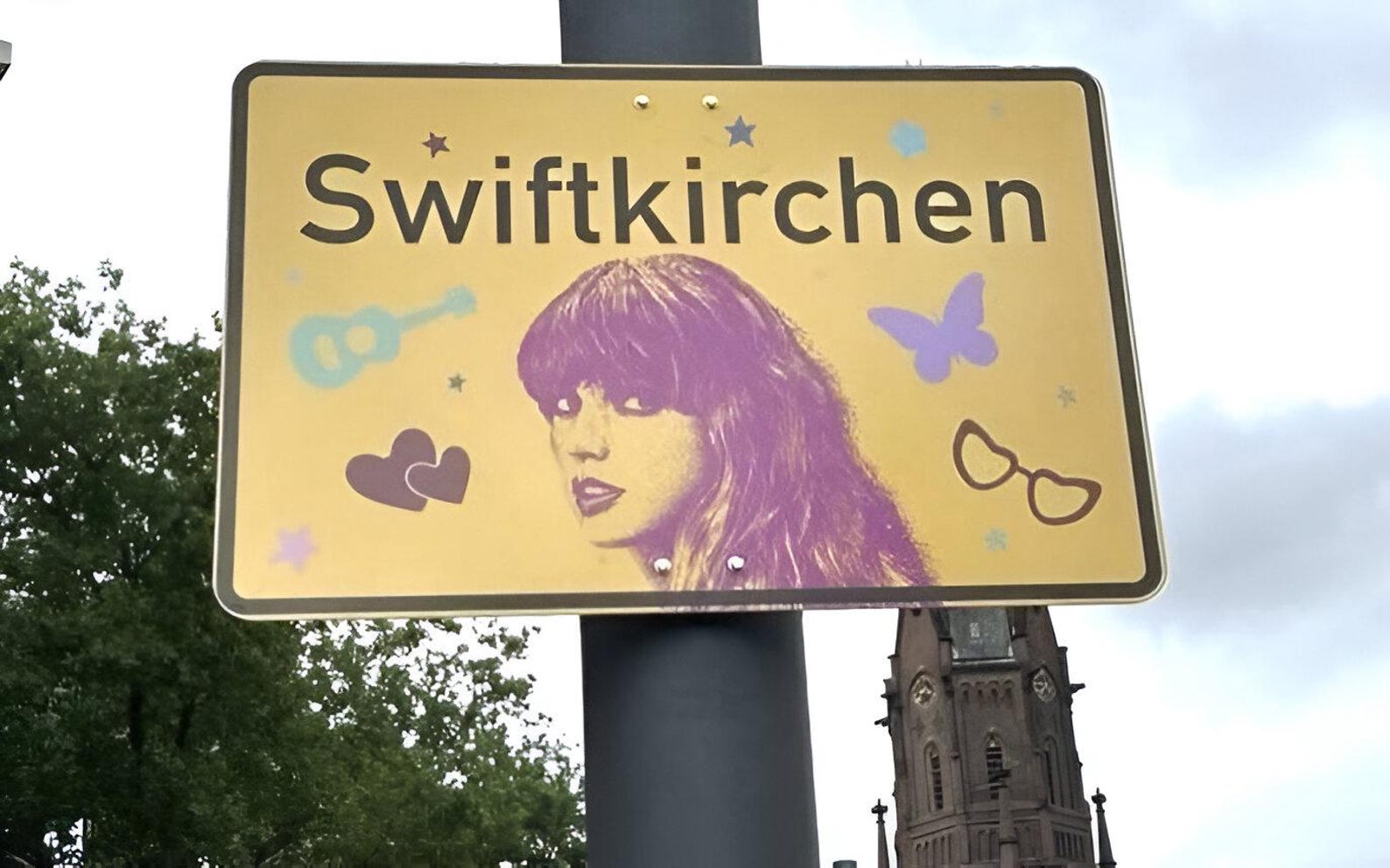
III. Understanding the hype
ES: What I find exciting is the way this hype was created and on which logic it is based. Because she is very uplifted, declared a kind of “goddess” — and at the same time, admiration for her is based on her “authenticity.” She is a real person, understandable to everyone and she fights human battles. Just think of the very exciting conflict over the copyrights to her albums, which began around 2019 — although one cannot ignore the fact that she was already very wealthy at this point in time and has very little to do with the everyday struggles of the masses. So I find it interesting to see how this image of the accessible, “authentic” figure has brought her back to a new level at which she can actually no longer be accessible, because not everyone on such a religious level can be deified, for that you need a unique selling point — which in turn is authenticity. It's a paradox — it doesn't even surprise me, but above all fascinates me.
PS: I would even go so far as to say that anyone who understands our time, that is, wants to think about it, wants to say how Hegel formulated the mission of philosophy4 He must actually understand Taylor Swift.
ES: With such a specific example as Swift, you can really see the presence of the historical process in society. In all their contradictions, if you want to stay with Hegel.
HH: What do you mean by that exactly?
ES: For example, that one of the reasons why she is adored is precisely her “down-to-earth attitude.” Historically speaking, gods and goddesses were just not down to earth; perhaps fallible, but still exalted, they were heroic, not earthly, not human. With Taylor Swift, it's exactly the other way around: The reason why she almost has this status of a “superman” is because you say “Oh, but she is real,” you're dealing with a “real person,” she's kind of “real,” “authentic,” “comprehensible,” “grounded.” That is certainly a contradiction. Quite apart from that, as a billionaire, she is not confronted with the same reality as billions of people in the world; she is not a “normal person” — that would be a second contradiction. And you could go on and on. We can also address the musical quality, I think there is another contradiction.
PS: For me, the basic contradiction, or even the puzzle, that she gives me is the stark contradiction between what she is — the objectively assessable quality of her works and her performance — and what she seems — i.e. how blatantly she is hyped by her fans and the general public. So I'm not saying that she can't do anything, she can definitely sing much better than most of us and much more. But it is still the case when you look at the musical structure of her songs, for example, and she really tries to understand music theory, quickly realizes that even by pop standards, it is a very monotonous and very simple harmony that underlies these songs. For a good three quarters of her songs, she uses exactly the same worn out and trivial chord schemes and you can really layer her songs on top of each other and play them synchronously without being too noticeable.5 And even when it comes to the lyrics, whose “special depth” is praised by many, I would say that they are actually not very deep and creative even by pop standards. She actually only uses very few metaphors or any form of mystery — on the contrary, her principle is simply to say what she wants to say, i.e. not to express her message in a big rhetorical way. And the few metaphors she uses are also very worn out. Or am I missing something?
HH: So I pay particular attention to the lyrics, because musically speaking, their songs are really pretty boring. You often don't know whether there is a drum machine running in the background or a drummer playing. Drum machines can also create brilliant music, of course, but that doesn't happen with them. With the lyrics, especially in her more recent albums, she certainly tries to incorporate elements of “poetry” and “originality,” but the only thing that comes to mind is the philosophical term “floating signifiers,” the free-floating meaning carriers without meaning.6 I'm thinking about the song The Tortured Poets Department from their latest album, which has the same name. There is a section where she says:
I laughed in your face and said: “You're not Dylan Thomas, I'm not Patti Smith, This ain't the Chelsea Hotel, we're modern idiots. ”7
Why do the celebrated yet hermetic Welsh author Dylan Thomas (1914—1953) and the American punk musician and author Patti Smith (born 1946) even appear in the song? I can't imagine Taylor Swift really being interested in these things; these empty signifiers simply serve to represent something “intellectual,” “bohemian.”
PS: I think that's why it's simply very post-modern. As early as the mid-80s, cultural theorist Frederic Jameson, for example, described this permanent quotation without a deeper meaning as a basic characteristic of postmodernism; he speaks of “pastiche.”8 Especially when you watch her music videos — which, you have to admit, are very elaborately made — they are full of allusions, such as when she imitates Lady Gaga. These are all forms of pastiche, not satire, for example. You don't know exactly what she actually means by that — but it is precisely these allusions that are often cited as proof of her “profundity.” Well, I would really like to say it so polemically: This entire philosophical and also general humanities discourse about Taylor Swift is really the complete surrender of the critical spirit to what exists — as if the quality of works of art has something to do with any allusions; as if the poems by Shakespeare, for example, were simply great for the reason that they were a collage of references of some kind.
ES: I'd like to come back to the musicality aspect again. What I would look at critically would not be for an artist to write a musically simple song. There are many songs that only use the three to four skin chords that are very successful, that you can enjoy. I don't think anyone would dispute that. The problem with Swift — and others too — is that it's just That is, it doesn't go beyond that. You have a product that consists of four chords and builds your entire musical career on it. After all, music is a unique form of art, a form of aesthetic processing of social conditions that tries to express something that is connected with the environment. Behind this is a technique, skills, that you experiment, that you bring in a certain complexity. Music is much more than just a song that is then recycled over and over again. When you build an entire work on it, it crumbles in your hands and makes it unbelievable that so much success can be achieved as a result. The fact that it is, of course, a commercial success is easy to analyze again, i.e. the question of why, if it is relatively primitive and repetitive in terms of musical complexity, why is it still such a huge success: What is the aspect of it that can generate such gigantic masses, some of which get into debt in order to go to a concert? I'd rather look at that, wouldn't per se On the simplicity of a song, because that's not the point. And the same goes for the lyrics. What remains is a form of commodity that is characterized primarily by quantity and not by its qualitative substance.


IV. A “mouthpiece”9 of the cultural struggle
HH: Perhaps it is the case that at least one contradiction among the several that you have identified, Estella, can be resolved: For the fans, it is primarily about the success or the skill of the production. She is regarded as down-to-earth, but you can't even speak of a real down-to-earth attitude. I don't know her biography very well, but she is said to have grown up in a relatively wealthy family in the countryside. For example, there is an early video from 2006 (link), when she was 16, where she performs at the well-known “Whisky a Go Go” club in Hollywood, and there she plays a few country songs on the guitar, with a fiddle and so on in the backing band: Nothing amazing, and yet it all sounds much more real, even more authentic than what came after that. It all still looks a bit “real.” Estella, you mentioned earlier that it is a product of the cultural industry — but perhaps it is more accurate to say that it is a product that produces itself. It has its own means of production — which very few of us do, you could envy it for it.
PS: I think you have already added a very important aspect with the “down-to-earth” or perceived “authenticity”, which is also often mentioned when you look at the discourse around them and what their fans also say. Because there is also a myth — which is certainly not a complete myth — that she writes her songs herself and so on. But it's also the case again that people who know their way around10 Say that if she would simply release her songs based on her chord and melody ideas, no one would like it; they are already well done by professional producers who then somehow “save” the song with some original rhythmic ideas or through the instrumentation. But I think that the more important aspect is actually the political orientation that she stands for or at least seems to stand for, i.e. that she is so clearly in favour of a particular form of wokeness in this cultural struggle, which is currently simmering in the USA in particular. Excitingly enough, this is not all that present in their song, apart from a few exceptions, but all the more so in their production on social media and the like. She is currently considered one of the most important champions by many young women, perhaps even: which The most important champion of today's feminism is perceived as a kind of anti-Trump or anti-Musk. It also seems very important to me for their fans that, with their fantasy, they express their affiliation to a certain political ideology and, as a result, to a certain lifestyle, i.e. to a woken lifestyle, which in turn almost includes being a swiftie.
ES: When I look at Taylor Swift in the more general cultural struggle, she strongly embodies this one side that you have just mentioned, i.e. this liberal, woke — which I mean not as a polemical catchword but as an analytical term. On the other hand, you have what you call the “reactionary conservative right,” i.e. Andrew Tate, Ben Shapiro, Jordan Peterson, Elon Musk, etc. There is a clear cultural divide and I think it strongly represents what I would call “liberal feminism.” In principle, I criticize it as a bourgeois product. He represents an understanding of equality, which is about the fact that women, to put it casually, should now also become CEOs and can then oppress them in the same way as men — that is the narrative. That is the appropriation of feminism for class struggle from above. It is relatively self-evident that this does not create actual emancipation from or an overcoming of the patriarchal system. That's why I don't understand how you can regard her as such an icon of feminism — not even so much from Taylor Swift's perspective, we can't really know her, except perhaps from the few interviews that remain on a relatively superficial level. I don't want to negate the fact that she experiences sexism, but it doesn't go to the basis of the structural inequality system. In any case, I can rarely understand how her fans or not even her fans, but anyone who deals with it in any way, can claim in all seriousness that she is the pioneer of emancipatory feminism. And that brings us back to the level of material conditions. She is simply a billionaire and is not one of the billions of women workers. Both feminist struggles cannot be equated. In doing so, you take away its substance from the whole movement and reduce it to questions of recognition, but you can't stop there. Perhaps she is also experiencing or has experienced violence; you shouldn't push that aside. But when she is then elevated to a feminist icon, but not so many other figures whose victims are much greater, whose struggles are based so much more on the material basis, I cannot understand that, I find that undeserved. Instead, we should focus on the social struggles that take place in the middle of everyday life, on the streets.
PS: In the preliminary discussion, you used a very appropriate term for this, namely you spoke of Girlboss feminism spoken. A term that I did not know before, but which sums up very well in one word what form of feminism it actually stands for.
ES: As we've already talked about this, she has created a very successful business model, i.e. in a capitalist logic, you could of course say that she has achieved a certain form of equality — but beyond that, the question of course is: Do you want to stop with such an understanding of feminism? And beyond that: What kind of feminist work does she do in terms of content? Her lyrics are often about her ex-boyfriends or the fact that she herself is the problem. That is a romanticization of failed relationships. Where is the feminist message there? If you produce songs that indicate how independent you are from men, but these songs actually only talk about men, then that is inherently inconclusive. Nothing against breakup albums, but the way Swift does it doesn't actually amount to the fact that it leads to emancipation from exactly these relationship structures that are patriarchal.

V. Suffering and Love
HH: I would like to take this opportunity to mention that among the many good links Paul has sent us in advance, there is one that, in a sense, reflects your words and who is not so apologetic. I mean the article by Mary Harrington from UnHerd (link). The headline, translated into German, reads: “The dark truth about Taylor Swift. Too many young women are longing for extinction.” That is an interesting thesis. And it is Swift's tragic right now Love songs, mostly about the ex-boyfriends who run best. Harrington speaks of a “kamikaze mysticism”; psychologically speaking, it is almost in the direction of self-harm. It's pretty weird and I wasn't so aware before that it could actually revolve around it. What does that say when so many young women are in the mood for songs that, to put it less romantically, are about bad relationships, about relationships that end badly? What is it about — also with regard to this feminism, which may not be one?
ES: Yes, it is a feminism that doesn't really demand anything and is therefore devoid of substance. In the 2010s, there was also the phenomenon of Tumblr girls.11 Back then, this was related to Lana Del Rey, who has certain similarities to Swift in this regard. In any case, this image of the tragic, sad “girl” was romanticized and glorified. It served as an alternative to the popular American girl, according to the motto: “I'm not like that, I'm struggling with life and suffering from world pain.” This was then really often accompanied by self-harm and it was then played down very heavily and almost became a trend, it became coolthat you hurt yourself — and that's all based on a narrative of tragedy: “No one really understands me.” Swift builds on this to a certain extent. There is something slightly nihilistic about her becoming a drama queen and says “It's me, hi, I'm the problem.”12 or “You look like my next mistake”13. She already knows that this person is not good for her and yet she gets involved. There is little feminist integrity in it for me, then you can't actually claim feminism for them if you recognize these mechanisms and at the same time say: “Yes, I still want that. ”
PS: Yes, according to my subjective impression, this theme or the prevailing mood that we were talking about is really at least actually in three quarters of their songs The main aspect. So failed relationships with “boyfriends.” So there is also a certain monotony on the content level.
ES: Based on a spectacle of emotion, I'd say. So the excitement of falling in love and then the failure of the relationship that this becomes such a big spectacle is perhaps the reason why it is so dragging on for many.
HH: You call this a “spectacle of emotions” because the fans enjoy watching it, empathizing without really having to experience it themselves, right? It remains an interesting circle of contradictions. We actually experience them as absolutely inauthentic, but it is still possible that so many fans are living these relationships after all, because otherwise where does this great comprehensibility come from?
ES: Yes, maybe the basis for this is simply human emotion and interpersonal relationships. But perhaps the opposite is also true. After all, when it comes to a spectacle, it's often the case that you just find it exciting because you're not experiencing it yourself. In soap operas, for example, even the wildest things happen that are very unlikely or even impossible in reality. The pleasure or desire for it comes precisely from the fact that this extremely hyperstimulant exists, i.e. a superlative. These songs, which process this aspect of the relationship drama over and over again — or it is actually not even a processing, it is simply brought to the table very openly over and over again — give me the feeling that they always have something saturated and highly frequented. You can really get yourself into an emotion there. Although the interesting thing is that, statistically speaking, the younger generation has much fewer romantic relationships, there is a clear trend towards a decline in social and sexual relationships. Perhaps there is a trend — but that is now very speculative — that people do not experience such drama in their actual lives, but in Swift's music instead. You have the desire for it and this is a fantastic experience.
PS: Isn't Swift's conventionality also reflected in the fact that she actually only revisits the topics of stereotypical “women's literature” or “women's films” — I'm thinking of Rosamunde Pilcher or Hedwig Courths-Mahler, for example — who often follows exactly this plot, that a woman falls in love with a man who is actually not good to her and then goes through a very exciting and heartwarming development with him?
ES: Yes, although Swift shows a quality, because for her, it is always linked to feminist empowerment. It is not like classic love stories that follow a specific plot, a conservative plot that has been known for decades, but it is about being labelled as “feminist” in one way or another. And I personally find that dangerous because feminism, which was and is historically a revolutionary practice, is being appropriated for a market, i.e. it simply becomes a commodity. A political term is depoliticized, it gets its breath out; it is made compatible with what you were talking about.

VI. Well-portioned eroticism
PS: Another very important aspect seems to me to be eroticism. We've already talked about the fact that we're dealing with music whose target group is primarily young women and perhaps homosexual men — that's the stereotype anyway, but we've already seen that it doesn't completely contradict reality, even though there are, of course, heterosexual male Swifties on the sidelines. And that brings me exactly to the aspect of eroticism. To get a bit personal: What irritated me when I saw her picture for the first time was that she is such a blatant pop star but doesn't seem very erotic to me personally. Well, she is definitely a beautiful woman, but it is important to understand that beauty and eroticism are not the same thing, sometimes even mutually exclusive. So there are — and I think Swift is one of them — that are almost “too beautiful.” So they definitely look attractive, but not erotic — which is definitely very unusual for a pop star. I then asked myself whether this was only due to my subjective taste, but I quickly realized that this was not the case. That is definitely a topic that is discussed very often.14 In fact, there are also objective criteria for eroticism. There are simply women who are considered erotic by almost all men, and other women are not, that is quite obvious. And Swift is simply not considered erotic by many men.
But at this point I've made another discovery and I have to admit that various of her songs actually made me think, because she also addresses this in various songs herself. She certainly shows herself in erotic poses there — but at the same time makes it a topic that she is just playing a role to please a man. I found it interesting how simple these methods actually are, with which a woman can present herself as erotic. Of course, this has a lot to do with clothing — such as clothing that highlights the breasts — or certain ways of looking at you. I actually found these videos a bit instructive. And that's when I would see a new quality in her, that it's just a pop star who really doesn't rely on eroticism anymore. And that has nothing to do with her appearance, but with her nature, i.e. that she makes it clear that eroticism is essentially the product of a particular performance and that she is perhaps really the first successful female pop star to refrain from this type of performance. I find that remarkable.
HH: I can understand your statements — although that's just eine Perspective is. But yes, if you asked 1,000 straight men: “Who is more sexually attractive, Madonna in the 80s or Taylor Swift? “, then this would simply not be a competition, then 950 of them would vote for Madonna. And that is simply because it was part of Madonna's self-production right from the start: She knew that she was sexually attractive to many men and effectively exploited this as part of her production and art production. I find that absolutely legitimate. And Swift didn't want to go that route. From every perspective, from any sexual orientation, it looks good. She is, in Paul's words, “beautiful.” But she doesn't want to market herself sexually — which is also absolutely legitimate, but is perhaps only noticeable because up to now this has been more of an exception in the pop industry for women who have sold a lot. But it's actually true: In certain videos, she presents herself in this stereotypical cliché way — but in doing so, she conveys a very different message than most women in the pop industry have so far.
ES: I think the criterion of eroticism or sex appeal was the decisive factor when it came to female celebrities until the early 2000s. And that was also a marketing criterion. But I think that there has been a change in the narrative and that this is no longer the only decisive factor for women's careers, to be the object of desire for heterosexual men. I would say that now we are dealing with a completely different discourse, now it is primarily about the liberal feminism that it represents. But what I find exciting is that it comes down to something similar in practice. It's not like she only appears fully clothed now and you can't see a piece of skin. Billie Eilish, for example, saw such an explicit refusal much more in comparison at the beginning of her career. But when Swift does that, when she shows herself that way, she does it based on a completely different narrative, then she does it as self-empowerment: “Nobody tells me how to dress.” This moment is woven into the discourse anew. But I can't imagine that Swift is not aware that this, of course, still includes the aspect of male desire. Because what is perceived as erotic as sexy is, in our given reality, strongly determined by a masculine definition of desire, you can't just release yourself just as much as the rest of the world knows that this is of course appealing to heterosexual men.
PS: There is one song in particular where what I mean is very clear Look what you made do.15 This is also another form of pastiche. All sorts of male fantasies are portrayed in a video. I think that was really successful. There is, of course, a certain ambiguity; I think it succeeded for two reasons, so to speak. Once I found it successful as a man because I find it really erotic. But I also find it successful as a philosopher, as it were, because it was very instructive, because it made me understand a great deal about the nature of erotic staging. It's not just about lightweight or absent clothing — that's how Swift is almost permanent. But that is not the point, it is indirectly very, very clear in the video. She could also undress completely naked, but it wouldn't necessarily be erotic without the appropriate gestures. For example, it also has a lot to do with the camera, where it focuses, how the woman looks at the camera. In this video, for example, I noticed that looking directly at the camera, combined with appropriate clothing, looks very erotic. Or even other camera settings. And it is, of course, not least about fantasies and scenarios that are hinted at; eroticism is something mental, not just a physical phenomenon. You could now analyse that for hours. I think that this is definitely a step forward that a new type of woman is emerging, I definitely think that is not bad, even though she picks me up much less as a private person than any Madonna songs that actually appeal to me a lot.
ES: When the lyrics read “Look what you made me do,” then I ask myself: What is the feminist message there? Of course, a woman is not responsible for the patriarchal structures into which she was born. But this line of text does imply that you deny any responsibility. This once again glorifies passivity. After all, it also has a certain form of agency power. Instead, however, she says “Look what you've brought me to” — without, despite realizing it, changing anything about it. Or how is the message of the song to be understood?
PS: Yes, that's the message. You almost forced me, i.e. you as “The Man” — there is also this video where she portrays herself as a “typical man” as a counterpart (link) — that I have to play all these roles just to please you. Well, I don't think the message is that profound at all, you can certainly do that these days in the bravo Read if they still exist. Of course: This video has an ambiguity, it definitely picks up heterosexual men for now with the various scenes that are shown there. But at the same time, it has certainly succeeded in questioning me and other men in the sense that it can also have an effect on me and other men: What do I actually find erotic? Am I not actually very manipulable? At the same time, she's already doing things differently in her other videos because she doesn't use exactly these gestures and codes. I would highlight that.
HH: I think that 70 to 80% of Swift's fan base actually consists of women. Most of these women must desire her in some way. I think that's part of this kind of fanship, whether you define it as sexual desire or as another kind, they want a piece of it, so to speak. I wonder whether this massive female desire directed at Taylor Swift could even contribute to a redefinition of eroticism in the medium or long term; that it is no longer defined so one-sidedly by male desire.
On the subject of desire, I Look What You Made Me Do looked at it and compared it with Nobody No CrimeWhat I know better. These two songs have similar motives. A love triangle is told, including cheating and so on. And it ends, unsaid, with the murder of a woman of a man. It's a kind of living revenge fantasy. That is actually the same as what is actually in Look What You Made Me Do goes: That she finally takes revenge on her ex-boyfriends and can live out who she actually is. And that is not a feminist motive, because everything continues to revolve around these men. From Swift's perspective, another type of feminism is hardly possible either, because it has no connection to the everyday struggles of 95 to 99% of women on this planet and simply cannot have because of the billions it has accumulated.
ES: Perhaps we should differentiate between desire and eroticism. I think straight women's feminine desire regarding Swift has a lot to do with identification. Freud differentiates between these basic types of desire: sexual and identifical. In this sense, it is already an authorization. I can also recognize feminism when you recognize your own autonomy or patriarchal repression. Perhaps this is the first basal step on the path of liberation. This is where identification takes place in order to find a vocabulary for it in the first place and to make it intelligible.
Another aspect is that she also has a very large queer fan base. And there is definitely a desire, even among gay men, but I don't know how erotic it is or whether it's more about identification or representation. In particular, you have a motif of “angry but nice” or even the term “wholesome”, which can barely be translated into German — healthy, sincere, lovable. This “wholesome” character is just popular, but it's not necessarily about eroticism. Nevertheless, it will certainly become an erotic object for many, not just for heterosexual men.

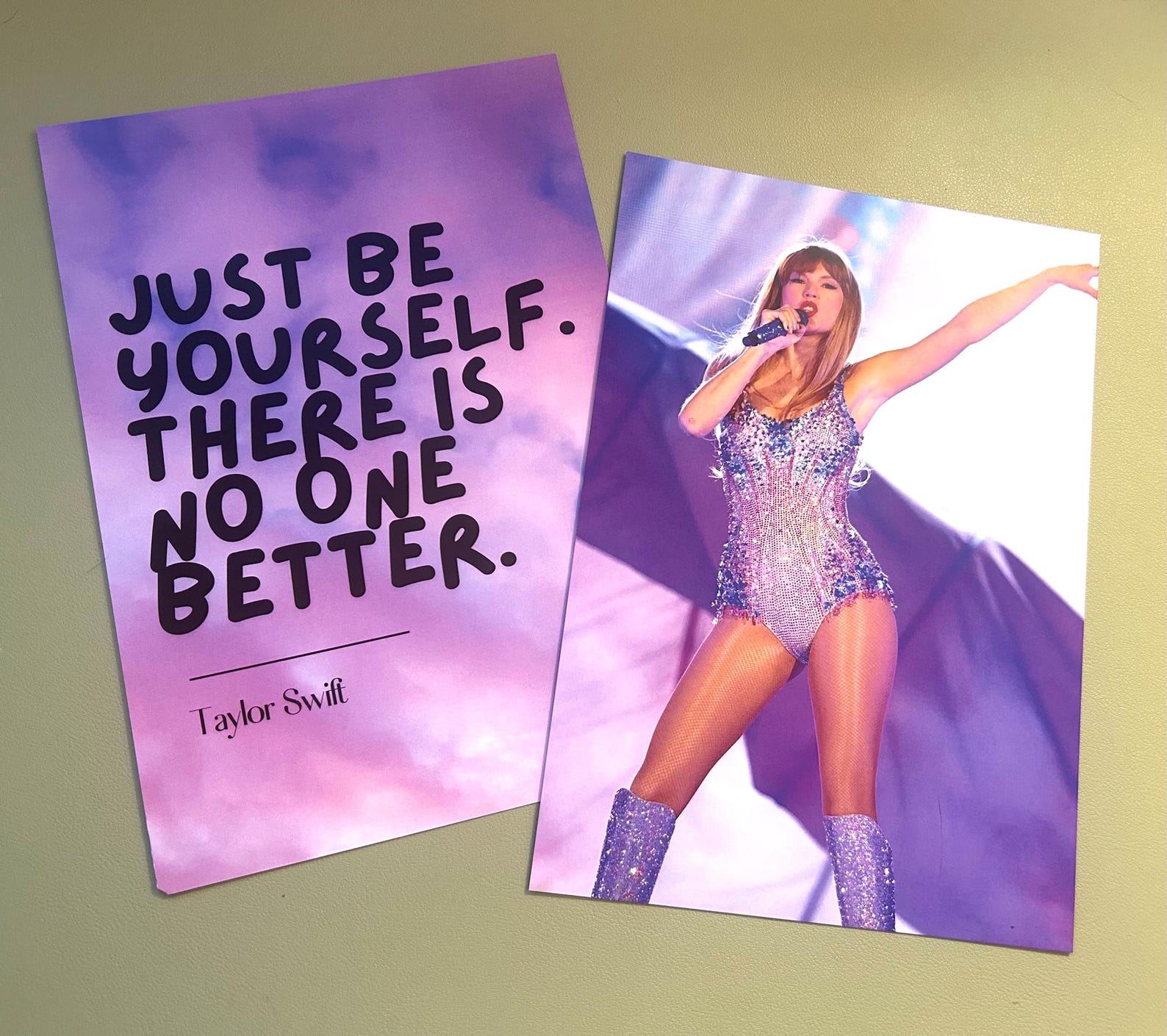
VII. Nietzscheanism for the People
PS: But the paradox lies precisely in the fact that it is still heard and well found by all these “normal women” (nurses, nurses, cashiers, etc.). I think that in order to understand this, such a Marxist understanding has its limits. But that is precisely the peculiarity of the ideology of our time, that people are really completely steeped in and firmly convinced of an ideology that does not suit their material living situation at all. In order to understand the paradox, or even stronger: absurdity, you certainly have to draw on other theorists, such as Freud, whom you have already mentioned, in order to understand this specific attractiveness of the “leader figure,” as he described in Crowd psychology and ego analysis describes. Or even Nietzsche. What does Taylor Swift have to do with Nietzsche?
HH: What strikes me time and again in my very unsystematic way of reading Nietzsche is his deep hatred of what will later be referred to as “mass culture.” I don't share this hate, but I'm impressed by how tough it is and how much Nietzsche expresses himself in it. Nietzsche's hatred of newspaper readers and especially newspaper readers is very well known: “Of course, there are enough stupid women's friends [...] [,] who want to bring the woman down to 'general education, 'probably even to read newspapers and politicize. ”16 So if people read newspapers at all, especially women, then the mail goes off for Nietzsche, that doesn't work at all. What he can't bear is the idea that if 10,000 people have read the same newspaper articles, they will think and feel roughly the same way about a particular topic at that moment.17 And it's not just about 10,000 people, but maybe 50,000 or 100,000 people or more. And to get to the present tense, it's now about millions of people who listen to a Swift song and then have roughly the same emotional experience. Because these songs do not allow for a wide range of feelings, the affective reaction they are supposed to evoke is relatively simple. And this hatred of mass culture is not on the margins of Nietzsche's work, but right at the center.
ES: Well, I would defend Marx because I think that the Marxist concept of ideology can cover this aspect that you mentioned quite well. With Nietzsche, I find that a bit difficult. But I believe that one could criticize her position in the cultural struggle with Nietzsche — not only among her but also her opponents — with the help of concepts of resentment and slave morality. But at the same time I ask myself to what extent Nietzsche is a good choice as an anti-feminist. If I disregard this aspect and simply look at what remains for Taylor Swift's analysis, you can build on Nietzsche's analysis of mass culture that modernity is creating new gods for itself. You think that you have left Christianity behind, but as a supposedly atheistic society, you no longer understand that you create new deifications of your own, towards which you also place yourself in a new relationship of dependence. Perhaps this perspective helps to understand how there is a form of control again, that people want their own submission; that is, the problem of voluntary submission.
PS: Yes, Taylor Swift is an expression of our time in the sense that, speaking from a Nietzschean perspective, there is obviously a stark absence of meaning and orientation figures, but at the same time also a strong desire to be fascinated or carried along by some leading figures. You can really see that on both sides of this cultural struggle, including Trump or Musk, for example, that there is a very comparable cult of personality there. I find this exciting and, in turn, fascinating, but also unsettling and frightening at the same time. So I'm not so afraid of this specific fan culture for now, it is also quite likeable compared to other fan cultures — but this fundamental willingness to submit to authoritarian leaders and structures... Sure, Taylor Swift embodies a very gentle and indirect authority, she is also, fortunately perhaps, not a political leader, that looks completely different with the two men I've mentioned and that's when it gets really dangerous, frightening and threatening. But there is a fundamental willingness on both sides to make this, to speak with Kierkegaard, “leap into faith,” to practice this dedication and fascination and to find in it a form of freedom — which is, of course, complete pseudo-freedom, the opposite of freedom — that seems to me to be a disturbing expression of the blatant irrationality of our era, which arouses serious fears. In this respect, I would say that Taylor Swift is often portrayed as a great source of hope. But if it is really our biggest hope, perhaps our only hope, then we are really living in a very hopeless time.
ES: Nihilism is also a good bullet point. The tendency towards musical, stylistic and thematic repetition, that little new substance is being created there, as an expression of a nihilism that can actually no longer imagine anything for the future.
PS: I also came across a very short but interesting YouTube video, where it is almost understood as the embodiment of the “last person” (link). In truth, she is perhaps only an appearance of an “overwoman,” but rather an expression of profound nihilism. But what makes this nihilism even more difficult to understand or even more difficult: To whom Swift, which some colleagues like to refer to in order to substantiate her “profundity,”18 Nietzsche also alludes to or at least seems to allude to again and again. It's about that famous phrase “What doesn't kill me makes me stronger.” I'm even on two songs — Cruel Summer and Cassandra — in which she quotes him, varying slightly in each case; which is of course also remarkable that she apparently came across this sentence and then immediately muddled it into two song lyrics. And she was awarded a prize and also quoted this sentence in her acceptance speech, but without mentioning the name Nietzsche (link). I think that this sentence as a motto of their own self-image and that of their fan base is actually very central in the sense of: “We are all women and queer people who have had a very difficult time, but who come out stronger and look forward to these various traumas and so on that we have been exposed to. ”19 This kind of “Nietzscheanism for the people”20 Nietzsche certainly wouldn't have liked it, but for now I think it's good or at least better than other ways of dealing with such experiences. But of course, this attitude remains abbreviated because it remains completely stuck in this neoliberal thinking of individual self-empowerment, but yet in certain situations of “oppression” — or in any case: discrimination — it seems to me to open up a certain leeway to be able to deal with it, even though this does not now reveal a larger social perspective and thus ultimately fails. Although I have the assumption that Swift is not actually referring to Nietzsche with this quote, but to a song by a colleague called Kelly Clarkson, which was released back in 2011. His first chorus line is exactly “What doesn't kill you makes you stronger” (link). In any case, I believe that it is Clarkson's and not Swift's credit to have brought this saying so heavily into today's pop culture. I also listened to this song by Clarkson and that once again made me vividly aware of the paradox we were talking about. Well, I found him really strong, especially because of her strong voice. Music experts often say that Swift's voice is actually quite average, at least not particularly powerful.21 So this is really a song that has power, carried by a powerful female voice with a great deep response; really an objectively better pop song in every respect, especially since in the following line of the chorus, Nietzsche is quoted again on a very profound level, namely with “Just me, myself and I” the beginning of Ecce homo (link). Well, he is really also very Nietzschean, both in terms of lyrics and music. I find it remarkable and sad that Clarkson, even though she is also very successful, is in the second row compared to Swift.
HH: Where in Cassandra There are also two modified Nietzsche quotes in a row from 2024, which indicates that she deliberately quoted Nietzsche there. It initially says, “What doesn't kill you makes you aware”22 — an interesting shift compared to the original — and it's called directly, interestingly enough again on Ecce homo alluding to the subtitle of the book: “What happens if it becomes who you are? ”23 Although this is also a free-floating carrier of meaning, I would say. But otherwise I agree with you, Paul: If Swift was the only hope, then it would actually look really bad — but I don't think she is. But we will probably have to find out at another opportunity who could be hopefuls instead.
ES: However, it is also due to Nietzsche's own aphoristic writing style to a certain extent that individual sentences can be used phrasewise in this way. And sometimes you can see a lot in an aphorism and sometimes very little — that depends not least on what you make of it.
Last but not least, who I wanted to bring into the game as an alternative to Swift is Mexican singer Natalia Lafourcade. In my opinion, it shares a lot with Nietzsche's philosophy of life, even though it doesn't quote him. In her music, she gets more out of it than Swift, especially when it comes to the topic of separation that Lafourcade often deals with. For example, she has a song that starts with the line: “I thank death for teaching me life” (link). It is not about natural death as a factual phenomenon, but the many small dying processes that pervade life; that something dies at every stage and that you learn something from it for life. I see a lot more Nietzsche in there. That would be my final word: You also make it much more substantial than Taylor Swift.
Source of the article image template: https://commons.wikimedia.org/wiki/File:Taylor_Swift_%286966830273%29.jpg

footnotes
1: Note: When buying directly, the cards are sometimes cheaper, but you usually have to buy them on the secondary market, where they cost significantly more (see e.g. this report).
2: See, for example this series of articles, this item about their “authenticity,” this anthology, which is only about their practice of re-recording old songs, this anthology and those. For a German-language article, cf. this.
3: Cf. this Article by Susan Andrews, this by Jessica Flanigan and this by Catherine M. Robb (unabridged version).
4: See the introduction to Principles of the Philosophy of Law (works Vol. 7. Frankfurt a. M. 1986, p. 26.
5: See these two very good, albeit apologetic, music-theoretical analyses of their work (here and there).
6: French anthropologist Claude Lévi-Strauss introduced this concept to language theory (cf. Introduction to the work of Marcel Mauss. Transated by Henning Ritter. In: Marcel Mauss: Sociology and anthropology, Vol. 1. Wiesbaden 2010, pp. 7—41; 39) .7
7: “I laughed in your face and said, 'You're not Dylan Thomas, I'm not Patti Smith. It's not the Chelsea Hotel, we're idiots of the moment. ”
8: Cf. Postmodernism — on the logic of culture in late capitalism. Translated by Hildegard Föcking & Sylvia Klötzer. In: Andreas Reckwitz and others (eds.): Aesthetics and Society. Basic texts from sociology and cultural studies. Berlin 2015, pp. 335—350; 342—344.
9: Cf. On the genealogy of morality, paragraph I, 5.
10: See analyses cited in footnote 5.
11: The page Tumblr was a predecessor of today's popular social media-Platforms.
12: “Hi, it's me, I'm the problem” (Anti-Hero).
13: “You look like my next mistake” (Blank Space).
14: See, for example, the article Successful, beautiful — and unsexy by Michalis Pantelouris (link).
15: Other examples include Lavender Haze and Bejeweled.
16: Beyond good and evil, Aph 239.
17: See this study Nietzsche, the aristocratic rebel by Marxist historian Domenico Losurdo (translated by Erdmute Brielmayer. Hamburg 2009, pp. 449—456).
18: See e.g. this Article in the zeit.
19: For this position, see also the song I Can Do It With A Broken Heart.
20: In the preface, Nietzsche speaks of Beyond good and evil of Christianity as “Platonism for the 'people'” (link).
21: See e.g. those and those assessment.
22: “They say: What doesn't kill you makes you more aware.”
23: “What happens when that becomes who you are? “; Cf. Ecce Homo, title page.
Taylor Swift — Superwoman or Last Man?
A Nietzschean Critique of the Most Successful Pop Star of Our Time
Taylor Swift is one of the most important “idols” of our time. Reason enough for our regular authors Henry Holland, Paul Stephan and Estella Walter to pick up on the Nietzschean “hammer” and get to grips with the hype a bit: Does Swift deserve the cult around her that goes down to philosophy? Is it grossly overrated? And what explains the discrepancy between appearance and reality, spectacle and life?
You can watch the entire unabridged conversation on the Halcyonic Association for Radical Philosophy YouTube channel (link).
Nietzsche and Techno
Nietzsche and Techno
“Smooth ice.
A paradise.
For the
who knows how to dance well!”1
Nietzsche and Techno


“Techno” — the show of the same name at the Swiss National Museum in Zurich, with traveling exhibitions by the Goethe-Institut and publications in German-speaking countries is currently honoring a once-subcultural movement that became a mass phenomenon in the 1990s with the Berlin Love Parade and continues to live on in Zurich's Street Parade today. Did techno offer (or offer) the Dionysian cultural experience that Nietzsche celebrated in his writings? Would Nietzsche have been a raver?
Behind him, above him, around him:
The sound forces had now risen up very big, these huge devices that thundered into each other in him,
superhuman size.
He looked up, nodded and felt thought of the bum-bum-bum of the beat.
And the big bumbum said:
One one one
And one and one and —
One one one
and —
Horny horny horny horny awesome!2
Nietzsche had programmatically in the Birth of Tragedy The intoxicating vital Dionysian and the aesthetically contemplative Apollinian presented as the two basic antagonistic principles of human culture. In the preface, he answers the question: “What is Dionysian? “: It was “that madness from which tragic and comic art grew,” it was the “endemic delights, visions and hallucinations that had been transmitted to entire communities, entire cult gatherings” of the ancient Greeks.3 And elsewhere it says: “In order for there to be art, so that there is some aesthetic doing and looking, there is a physiological precondition for this: The intoxication [...] above all the intoxication of sexual stimulation [...], the intoxication of the festival, the competition [...] the intoxication of the will. ”4 According to Nietzsche, intoxication allowed (over) civilized people to return to an archaic form of existence: “With alcohol and hashish, you return to the stages of culture that you have overcome. ”5 At another point in the abandoned fragments, he literally demands “a booze next to every shop. ”6 In any case, Nietzsche sees the Dionysian state as the origin of all culture. For the Greeks, however, it was only synthesis and constant interplay with Apollonian culture that led to the flourishing of civilization. Apollonian art describes Nietzsche as the achievement of individuals who, through analysis and imitation, create works that were inspired by lucid dream images. Clarity of thought, formation of work, separation from nature and isolation of the artistic personality represent a visually influenced Apollinan culture, while in Dionysian culture, union with fellow human beings and with nature dominates, with the help of intoxication, music and dance.
It was the same night after the parade, and while dancing I realized that I could no longer tell which effect of which drug was working and was completely okay with this state of affairs. The music took me
on...7

Dionysian and Apolonian: No Nietzsche inventions
Archaeological experts and Romantic spokesmen were enthusiastic about Dionysus in the early 19th century. Friedrich Schlegel is considered the discoverer of this “cult”; he glorified Dionysus as the god of joy, abundance and liberation. Schelling contrasts Dionysian and Apollinian early on, in a similar form with Nietzsche's mentor Friedrich Ritschl in 1831. In addition, the Basel antiquarian Johann Jakob Bachofen in 1861 uses the contrasting terms telluric and Uranian or can be determined in Apollinan and Dionysian terms.8 Nietzsche has therefore taken up an existing figure of thought and developed it further with a view to Richard Wagner's work. With Wagner, too, the contrasts appeared in Apollinan and Dionysian before the publication of the Birth of Tragedy , and later there was a dispute between the Nietzsche Archive and House of Wahnfried over the question of which of the two antagonists had brought these terms into the debate first. Cosima later wrote to Chamberlain in this context that Nietzsche “doesn't have a drop of his own blood, just a strange gift of appropriation. ”9 In fact, the main idea is Birth of Tragedy in Wagner's script The art and the revolution from 1849: In order to create the drama, the highest work of art, the poet, who was as enthusiastic about Apollo as he was about Dionysus, would have to unite all genres of art.

Orgies only in theory, the cult of Dionysus as compensation — Nietzsche's lifestyle
Nietzsche is not only (or possibly only marginally) interested in Dionysus's orgiastic activities, but above all in his ability to endure suffering.: “Saying yes to life even in its strangest and hardest problems; the will to live, becoming happy in the sacrifice of his highest types of his own inexhaustibility — That I called it Dionysian. ”10 Living yes also meant saying yes to a painful life. After all, Nietzsche had a number of reasons for this: in addition to illness, loneliness and lack of social recognition.
During his time in Bonn, he neither enthusiastically attended the beer evenings of the Franconia brotherhood, nor did he enjoy the Cologne Carnival; alcohol and tobacco were not his thing. He may have experimented with drugs, i.e. with “medicines” recognized at the time, but more likely to alleviate his symptoms and less to specifically induce a festive state of intoxication. Outwardly, he valued bourgeois dignified clothing, which was considered old-fashioned even in Basel; he groped his way through the rocky high mountains with a delicate walking stick and elegant urban footwear. For him, the celebrating Dionysus remained a theoretical force, an ideal on paper whose excesses he did not even attempt to relive. Nietzsche was the absolute opposite of an exhilarating and sensually enjoying person: “In the image of Dionysus, Nietzsche redeems his unlived life, his encapsulated vitality. That will be his motto Live dangerously especially sublimated as Think dangerously enforced. ”11
The music picked me up... Suddenly, some faces around me felt pretty broken and fucked up, and I immediately thought: Hard soup, you look so broken now. I rummaged into my pockets, took something right away, in exchange for overly accurate observations or even any ridiculous thoughts.12

Techno as a historical phenomenon
Originally developed in the 1970s and 80s by German electronic bands such as Kraftwerk and African-American DJs in Detroit, the genre of music can be characterized by the synthesis and development of various styles of electronic dance music (house, synth pop, EBM, Detroit techno) and flourished over the 1990s. On the one hand, this gave rise to numerous sub-cultural subspecies, on the other hand, a mainstream techno was produced that delighted the masses at open-plan discos and at folk festivals, and was sometimes referred to as “fairground techno.” What was new about this movement was gathering and dancing in public or in improvised, sometimes quite remote places on urban wastelands or in nature. Parades (“parades”) with mobile music systems took on gigantic proportions in some cases, festivals (“raves”) could last several nights and days. The English verb “to rave” means “to romp” and has historically been used in the religious context of “shakers.” They had been a religious group in North America that had split off from the Pietist Quakers and practiced emphatic dance and song in church services. Some Methodist communities also celebrated such services, sometimes with heavy alcohol consumption. Church critics of these ecstatic gatherings in the 19th century invented the derogatory word “rave” for them.13 As a result, the term was given a new positive meaning in the 1980s.
Synthetic drugs such as ecstasy or LSD spread in the 1980s and 90s and enabled ravers to now dance for nights and days and to experience a “party crowd” thrown together by chance and constantly fluctuating as a deeply connected community. What was characteristic and new at the time was that techno was open to all dancers, and that there was neither dress code nor compulsion to dance as a couple, which is why rave culture was regarded as an agreement between free, pleasure-oriented individuals who unite to form temporary festive communities. Through drugs, lighting effects and the hypnotic effect of monotonous music, they can enter a trance-like state in which the limits of their self-consciousness are exceeded. At the Love Parade or at Club Tresor in Berlin, exactly the scenes that Nietzsche in the Birth of Tragedy enthusiastically described as conditions in which the “breaking of the Principii Individuationis experienced” with “blissful rapture”, through the use of “narcotic drinks” or the “pleasurable approach of spring that permeates all nature. ”14 Even in publications on techno from the 1990s, Nietzsche and the term Dionysian were associated with the new music and lifestyle. “The Dionysian escapism of techno is difficult to reconcile with conservative values,” Claus Bachor, for example, wrote in his book in 1995 techno.15 Techno was also seen from the point of view of healing and necessary self-love in a disoriented and rapidly technologically developing society. In a publication about the “Generation XTC,” Nietzsche was cited for this: “The techno-narcissist works with a skill that Nietzsche once called healthy and healthy love in Zarathustra. ”16 The novel hedonistic, individualistic dance culture and the opening up of the former socialist countries of Eastern and Central Europe led to the perception of techno as a “soundtrack of freedom” and an exhilarating “posthistoire,” i.e. an era “after history.”17 Clubs like the Berliner Tresor (no longer at its eponymous historic location since 2007) appeared back then as places where the limits of time and space were abolished in an ecstatic eternity of uninterrupted beats and bass and where visions from the subconscious mind expanded the view.18 In the meantime, we have arrived at the post-history and know that the story has continued “after the story.” The illusion of timelessness, however, still lives on today at many techno parties and raves.
The accompanying texts for the Zurich “Techno” exhibition explain that because techno does not require a fixed sequence of steps and no binding dance style, “the range of expressive options among dancers is particularly wide.” However, when you look at the dance scenes in the exhibition videos soberly, you get the impression of stereotypical movement patterns and unimaginative redundancy. It is by no means imaginatively “performed”, but often, also due to tightness on the dance floor, the body weight is simply shifted from one foot to the other. This is the image of mass swaying or trotting around, holding beer bottles and mobile phones in the hands, or being rhythmically stabbed in the air with the index finger from time to time. The latter is also the highest form of gestural interaction with the DJ, who in most cases helms himself with headphones and baseball cap, bends over his mixer and makes little eye contact with the audience. Viewed from the outside, and with a museum time gap of over thirty years, many 1990s techno parties and parades appear uninspired, strangely lifeless and uninviting, so that the Dionysian character of these events appears somewhat far-fetched to the sober observer. But it may be that the celebrators felt differently, i.e. more intensely and ecstatically.

When something receives museum ordinations, it is usually very valuable, very unusual — or very old, if not dead already; extinct, petrified and archaeologically relevant. Regardless of the fact that a lively techno culture still exists selectively and locally, the historical approach to techno does not bode well for a future Dionysian culture. Current news about club deaths in former European party cities and about changing nightlife habits of younger generations doesn't fit the picture nicely.
But even more absurd and broken than any drug abuse was, of course, general abstinence... not taking any drugs, on principle, is absolutely the most effective thing, definitely.19
During the Covid years, the impression could be created that intoxication as a social and therefore collective cultural event had no future, because digital-virtual cultural experience would become the new norm for reasons of infection prophylaxis. In this scenario, we would have been dealing primarily with an image-based, at best immersive, digital cultural life. In Nietzsche's diction, the Apollonian element would completely dominate: “The Apollonian intoxication keeps the eye excited in particular, in the Dionysian state, on the other hand, the entire affect system is excited and amplified.” But this is “the actual Dionysian normal state: that the human being immediately imitates and represents everything he feels in his body. ”20

Even though there was a revival of live culture, concerts, club nights and festivals in the post-Covid phase, a long-term trend towards disembodying cultural experiences is obvious. In the future, a good number of cultural events will take place online and in virtual worlds. From today's perspective, it still seems questionable whether experiences similar to those in a lively party crowd or in a mosh pit, the wild dance area at metal or punk concerts, usually right in front of the stage, are possible (or simulated). But perhaps one day the desire for Dionysian unification is just a distant memory, a historical phenomenon presented to inquisitive nerds and white-haired nostalgics in dusty museums and cultural-historical publications. Although Nietzsche personally shied away from the convivial, sensual intoxication and probably never experienced it, he saw it as the basis of all art and all cultural highlights. In the Birth of Tragedy He suggests how essential the interplay between rational isolation and intoxicating unification is for the human psyche:
Under the magic of Dionysian, not only is the bond between man and man reunited, but also the alienated, hostile or subjugated nature is once again celebrating its festival of reconciliation with its prodigal son, the human being.21
With that in mind: Let's get intoxicated!
Exhibition notice:
techno. Zurich State Museum, until August 17, 2025
https://www.landesmuseum.ch/techno
Article image: Nietzsche techno playlist on YouTube (link) (screenshot)
sources
Bachor, Claus: techno. Zurich 1995.
Balzer, Jens: No Limit The nineties — the decade of freedom. Berlin 2023.
Böpple, Friedhelm: Generation XTC. Techno and ecstasy, Berlin 1996.
Carlson, Anni: The myth as a mask of Friedrich Nietzsche. In: Germanic-Romanesque monthly 39 (1958), PP. 388—401.
Götz, Rainald: Rave. Frankfurt a. M. 2001, p. 18 f.
Kirakosian, Racha: Intoxicates deprived of senses. A story of ecstasy, Berlin 2025.
Stephen, Paul: Boredom in perpetual excess. Nietzsche, Intoxication and Contemporary Culture. In: Dominik Becher (ed.): Controversial thinking — Friedrich Nietzsche in philosophy and pop culture. Leipzig 2019, pp. 217—250.
Vogel, Martin: Apollinan and Dionysian. Story of a brilliant mistake. Regensburg 1966.
Wagner, Cosima & Houston Stewart Chamberlain: Exchange of letters 1888-1908. Leipzig 1934.
footnotes
1: The happy science, Joke, cunning and revenge, 13.
2: Rainald Götz, Rave, p. 18 f.
3: The birth of tragedy, an attempt at self-criticism, 4.
4: Götzen-Dämmerung, Journeys of an Out-of-Date, 8.
5: Subsequent fragments No. 1887 11 [85].
6: Subsequent fragments No. 1888 20 [12].
7: Götz, Rave, P. 180.
8: Cf. Martin Vogel, Apollinan and Dionysian, p. 95 ff.
9: Houston Stewart Chamberlain & Cosima Wagner, Exchange of letters 1888-1908, p. 350 (letter dated 15/9/1893).
10: Ecce Homo, Birth of Tragedy 3.
11: Anni Carlson, The myth as a mask of Friedrich Nietzsche, p. 393. (Editor's note: On this aspect, see also Natalie Schulte's corresponding interpretation of Nietzsche's request on this blog [link]).
12: Götz, Rave, P. 180.
13: Cf. Racha Kirakosian, Intoxicated deprived of senses, P. 232.
14: The birth of tragedy, paragraph 1.
15: Claus Bachor, techno, P. 46.
16: Friedhelm Böpple, Generation XTC, p. 193. What is meant is a passage from the third book of the Zarathustra (From the spirit of gravity, 2).
17: Cf. Jens Balzer, No Limit, p. 55 f.
18: For a Nietzschean analysis of techno using the Dionysian concept, see also Paul Stephan, Boredom in perpetual excess.1
19: Götz, Rave, P. 189.
“Smooth ice.
A paradise.
For the
who knows how to dance well!”1
Nietzsche and Techno
“Techno” — the show of the same name at the Swiss National Museum in Zurich, with traveling exhibitions by the Goethe-Institut and publications in German-speaking countries is currently honoring a once-subcultural movement that became a mass phenomenon in the 1990s with the Berlin Love Parade and continues to live on in Zurich's Street Parade today. Did techno offer (or offer) the Dionysian cultural experience that Nietzsche celebrated in his writings? Would Nietzsche have been a raver?
Traveling with Nietzsche through Southeast Asia IV
Malaysia
Traveling with Nietzsche through Southeast Asia IV
Malaysia


The last country that our author, Natalie Schulte, traveled by bike was Malaysia. After a good 5,000 km, she got the creeping feeling that the trip could still end poorly. With considerations as to whether cycling in Southeast Asia is a response to Nietzsche's appeal “live dangerously! “, she concludes her series of essays.
Live dangerously!
Because believe me! — The secret to reaping the greatest fertility and enjoyment from existence is: perilous live! Build your cities on Mount Vesuvius! Send your ships to uncharted seas! Live in war with your kind and with yourself!1
Nietzsche has these sentences for the Happy science authored. And somehow — admittedly — they always spoke to me. A tempting saying that vaguely promises more of life: adventure, intensity, contempt for death! This interest, which can hardly be concealed, has led others to often ask me whether I think I am living a dangerous life. And as much as you might want to answer this question with a cocky “yes,” it is difficult to live in a picturesque holiday town like Freiburg and to sincerely say “yes” to it. Who knows, it is certainly possible that Nietzsche's words worked their magic in the background of the idea of traveling through Southeast Asia by bicycle. Once to this question with a hearty “Yes! “That would be something to answer!
I have probably missed the fact that the eruption of Vesuvius is a very rare event and that it is therefore not so dangerous for individuals to make themselves comfortable at the foot of the volcano. At least a good half a million people have either decided that Nietzsche is absolutely right in his words or that this area simply lends itself to cities with sonorous names. In Ercolano and Torre del Greco, via Torre Annunziata and San Sebastiano al Vesuvio to Somma Vesuviana and Ottaviano, residents have decided to defy the risk of fire, even though the villages are within the “red zone” of the active volcano.
I do not know for sure whether the residents — as I have read — are as aware of the risk of an outbreak, which is difficult to calculate, as I am aware of the risk of being run over by a car in Malaysia. And to stick with what I'm sure of: Malaysia is a dangerous country for bike travelers! I am therefore happy that Malaysia was the last country of our trip. Not because I would have seen at least three other countries before if I were run over, but in general. If I had started here, I would probably have turned around.

Driving dangerously in Vietnam and Cambodia
Vietnam was startling due to its loud traffic. Every truck driver who wanted to prevent the cyclist dreaming in front of him from missing out on — possibly due to an existing hearing loss — what large vehicle was feeding him from behind, said with a roaring horn: “Attention, I'm coming! Don't turn around now because I'll overtake you right away.” These truck horns, like the trucks themselves, were frighteningly loud and may have cost me a good deal of my hearing.
Cambodia offered the choice between wide, busy highways or winding, unpaved, bumpy side roads. When you had enough of screeching traffic, you could turn onto small forest and miracle trails, which often ended in front of a fence. If you had enough of these labyrinthine paths, you could switch to heavy roads again.

Deathfahrthailand
But it wasn't until “Deadly Thailand” that I felt the icy grip of existential anxiety for the first time. Why In contrast to Vietnam and Cambodia, the roads are well developed, but that is exactly the problem. It's so nice to race on Thailand's roads. And in addition, there are far more four-wheelers than two-wheelers — but all of them are more heavily motorized and have it: in a hurry.
Speeding offences are considered a minor offense; no driver's license, drunk, safety deficiencies? You just have to pay 30 euros — and you can continue driving. Thailand is one of the leaders with its number of road deaths and is regularly in second or third place in the global ranking. Only Liberia and the Dominican Republic can surpass Thailand. While Thailand has 38.1 per hundred thousand inhabitants per year, the average number in Germany is between 3 to 4 deaths.

Murderous Malaysia
So how can Malaysia be worse than Thailand? Malaysia is unable to get into the top ten. By contrast, even Vietnam has far more road deaths per hundred thousand. Nevertheless, there is some evidence that Malaysia is far more dangerous for cyclists. Because it is the first country whose expressways regularly have no shoulder for smaller and slower vehicles such as scooters or bicycles. If fewer cyclists die in Malaysia, it is probably because there are very few cyclists there who travel outside the city at all. Malaysia's expressways are almost exclusively driven by cars and motorbikes and, when they see a speeding, swaying large vehicle in the rear-view mirror, they can press on the tube and escape the danger with some probability.
The situation is different for us cyclists. All motorized vehicles overtake us, meaning that every approaching car, truck or bus driver has to make a small turn to get past us. On a busy road, there are several hundred truck and car drivers making a small curve around us at over 100 km/h. A very tiny one. Anyway, they should. With every carefree accelerating motor sound behind us, I sincerely pray that these wheels may also roll past me.
What does that feel like? Like adventure, intensity, contempt for death?
No More like the cold breath of a rather ordinary and impersonal death. Being able to stick to Malaysia's street as a flat frog doesn't seem like the worthy end result of a dangerous life to me. I almost suspect that Nietzsche did not have any bicycle tourists in mind when he wrote his sentence. So maybe I've taken Nietzsche's appeal too literally?

Preparatory heroism and experimental findings
And it's worth taking a look at the surrounding lines. Because this quatrain is not the entire aphorism 283. With Nietzsche, there is sometimes a risk of misunderstandings and the most famous accusation, which is directed against overly hasty interpreters, is: Wasn't something taken out of context?
The aphorism begins with the keyword printed in blocked form in the original:”Preparing people“, which is not so easy to reconcile with the call to live dangerously. Because for adventurers, preparation shouldn't be the main part of their story.
So let's take a look at the first few lines until the call:
I welcome all signs that a more masculine, warlike age is beginning, which will above all honor bravery! For it should pave the way for an even higher age and gather the strength that that will one day need — that age that brings heroism into knowledge and Wages wars for the sake of thoughts and their consequences. This requires many preparatory brave people who cannot spring out of nowhere — and just as little out of the sand and slime of current civilization and big city education: people who understand how to be silent, lonely, determined, satisfied and consistent in invisible activity: people who, with an inner attachment to everything, search for what is about them to overcome is: People who share the joy, patience, simplicity and contempt of the great vanities, as magnanimity in victory and tolerance against the small vanities of all the defeated: people with a sharp and free judgment about all victors and about the part of chance in every victory and fame: people with their own festivals, their own workdays, their own mourning periods, living and safe in command and ready, It is important to obey, equally proud in one way or the other, serving their own cause: more vulnerable people, More fertile people, happier people!
I have to say that I imagined an adventurous life in a different way, quite apart from the fact that I sympathize far less with Nietzsche's heroic ideals of courage and perseverance. So I'm not surprised that “live dangerously! “became a memorable part of the aphorism, while the first lines are quoted less frequently. Sounds more like the work of founding a company, which, although it also has its holidays, has far more “working days,” on which the “preparatory people” “silently, alone, resolutely” simply pursue their “invisible activity [s].”
And speaking of “invisible”: When Nietzsche writes of the “heroism of knowledge” and of “wars [...] for the sake of thoughts and their consequences” or even just about “wars [...] with yourself,” I ask myself whether I am actually called upon to move into the world — be it with a sword or by bicycle — or whether my world of thought itself is the playground of all dangers and all dangerous life Should. Do we prefer not to pursue the former option in aphorism 283 of Happy science, which finally offers the prospect of a dubious rule of philosophers:
Be robber and conqueror as long as you can't be ruler and owner, you discerning! The time will soon pass when it was enough for you to live hidden in forests like shy deer! The knowledge will finally reach out to what it deserves: — it will rule and possess want, and you with her!
Let's take a look at another branch of labyrinthine thinking:
And the insight itself: may it be something else for others, for example a resting bed or the way to a resting bed, or a conversation, or idleness — for me it is a world of dangers and victories, in which heroic feelings also have their places to dance and play. ”Life as a means of knowledge“— with this principle in your heart, you can not only be brave, but even Live happily and laugh happily! And who would actually be good at laughing and living who wouldn't be good at war and victory for now?2
Here too, war, heroism and danger. And yet: Life in this aphorism is a life in thought, i.e. in the service of knowledge — which, however, is not one or the last insight itself, but offers a field of experimentation. So don't you even have to travel the world to live a dangerous life? Can life be risked just thinking? That is what the aphorism seems to suggest. Intensity and enjoyment come from adventurous thinking (!) promised.
Have I taken this aphorism out of context? Well, you'll have to check that out for yourself. In any case, I'm turning my back on Malaysia and home to my cozy room with the books, notes, pens and I feel ready:
For a dangerous life — in thought!

The pictures for this article are photographs by the author.
footnotes
Traveling with Nietzsche through Southeast Asia IV
Malaysia
The last country that our author, Natalie Schulte, traveled by bike was Malaysia. After a good 5,000 km, she got the creeping feeling that the trip could still end poorly. With considerations as to whether cycling in Southeast Asia is a response to Nietzsche's appeal “live dangerously! “, she concludes her series of essays.
Considering Artificial Intelligence with Nietzsche
On the Critique of Current AI Debates
Considering Artificial Intelligence with Nietzsche
On the Critique of Current AI Debates

.jpg)
Transhumanists believe that artificial intelligence is used to capture the real world. It wasn't just Nietzsche who presented this as nonsense. Moral programs are entered into the AI. With Nietzsche, this prolongs hostile morality. And Nietzsche would have already questioned the fact that AI helps people. Instead, people must submit to AI. With Nietzsche, they can evade their power.
Assuming that the truth is a woman — how? Is it not reasonable to suspect that all philosophers, provided they were dogmatists, got along poorly with women? [..] It is certain that she did not allow herself to be captured.1
Can artificial intelligence do that today? Since AI also accesses Internet data beyond the materials that are entered into it, for Christian Uhle, AI is superior to human intelligence in many ways: “In both medicine and law, AI will have read and evaluated all studies, articles and comments ever published — no one is able to do so. ”2 So has AI already seduced the truth? Does it thus grasp the world itself as it is, the true reality?
Yuval Noah Harari obviously agrees: “The system will know you better than you know yourself and will therefore make most important decisions for you — and you will be completely satisfied with them. ”3 What would then remain of truth and reality other than those captured by AI!
The pioneer of transhumanism Ray Kurzweil describes today's AI as weak and predicts a strong 'Artificial Super Intelligence' (ASI), about which Günter Cisek writes: “If the ASI can develop beyond human intelligence, then the bet is that it can also reach a level of knowledge where it becomes a 'supersensory' consciousness. ”4

I. The questionable relationship between language and world
However, the central problem remains the relationship between language and world, which Nietzsche is already questioning: “The importance of language for the development of culture lies in the fact that in it man placed one world of his own next to the other, [...] he really meant to have knowledge of the world in language. ”5 The language philosophy of the 20th century will see the relationship in a similar way and thus shake the objectivity of the sciences and scientific truth.
Jonathan Geiger, on the other hand, sees digitization as an opportunity to finally get a grip on such linguistic philosophical uncertainties. Even though digitization is incorporated into philosophy, there is nothing else left, says Geiger: “Search, analysis, transformation and visualization access to digital collections is only possible through controlled vocabularies. ”6 Then, of course, digitization will intensify a standardization of language, which is also happening scientistically. With the help of AI, the sciences should then recognize the real world.
Nietzsche would accuse digitization of illusionism. Because it only calculates, it doesn't write poetry, is just getting closer to the world's poetry.7 Modern sciences, on the other hand, quantify everything, but they don't explain; because “we operate with lots of things that don't exist, with lines, surfaces, bodies, atoms, divisible times, divisible spaces — how can explanation even be possible if we first get everything to Bilde Make it our image! ”8 The mathematical terms are inventions and are not derived from any hallucinated nature. Causality is an interpretation, nothing more.
AI hasn't changed that, quite the opposite. Hans-Peter Stricker explains this: “What you — and this includes the experts — does not really understand is what the activities of the vast majority of neurons mean in the course of processing an input and generating an output. ”9 AI is based on so-called artificial neurons, namely mini programs that simulate functions with inputs and outputs, which connect with an infinite number of other so-called neurons in order to exchange data.
It won't be possible to decipher what billions of artificial neurons are doing in data centers right now. Martin Ford also confirms this: “We know that the network somehow understands the picture, but describing exactly what is happening in its neurons is very difficult, if not impossible. ”10 Sybille Krämer also remarks: This incomprehensibility of artificial neurons, “blackboxing, forms a genuine dimension and a necessary side effect of AI, which is becoming a cultural technology in mass use. ”11
Then even the AI will not be able to refute Nietzsche when he writes: “The habits of our senses have spun us into lies and deceit of emotion: these in turn are the basis of all our judgments and 'findings, '— there is absolutely no escape, no slip and creeping paths into the real world! ”12 AI does not escape this either, unless it realizes itself as a will to power, which everyone believes and then understands it as a true world like transhumanists.
In addition, AI is hermeneutically incompetent. Because she doesn't understand anything at all, she uses grammar that dispenses with any semantics. AI is based on the grammar model of distributionalism, which does not ask about the meaning, but determines it based on the environment in which a word occurs. AI can calculate this en masse and hastily and also form sentences that a person understands. For Krämer, this means “that the machine does not understand and cannot understand what it is producing.”13. AI can describe exactly how to boil an egg, but it has never boiled an egg before. The AI certainly doesn't understand what it feels like to live.
His aphorism How the “real world” finally became a fable. Story of a mistake” Nietzsche begins with the words: “1. The true world accessible to the wise, the pious, the virtuous — he lives in it, He is she./(Oldest form of idea, relatively clever, simple, convincing. Paraphrasing the sentence “I, Plato, am The truth' . )”14
Plato's criticism that people think what they are currently experiencing is true can be transferred to the digital world. As Uhle writes: “We are staring at screens more and more, whether at work or at home, our body barely plays a role anymore — but it is our body with which we can sense the world and therefore also ourselves. ”15 For Plato, on the other hand, the real world consists of the right ideas that you make of things. Bodies are ephemeral. Does the AI have the right ideas now? Perhaps!
Saša Josifović is concerned with the interplay of virtual and analog worlds, which he describes as a “hybrid.” The separation of the two worlds is becoming questionable in view of the increasing spread of digitization in the living environment. The digital world, which is merging into the living world, is now also known as the “metaverse” — Meta, the name of the Facebook group. Josifović writes: “The metaverse is by no means just a digital world. It is a hybrid world in which participation in digital events can serve as a prerequisite for access to analog and digital living resources to satisfy natural, social and cultural needs. ”16 Josifović emphasizes that the two worlds can hardly be differentiated anymore, that the 'world' has actually become a hybrid in which both worlds interact. What someone does in the virtual world has an impact on their living environment and vice versa.
Is there a true world after all, namely the hybrid world, in which virtual and living environments interact? Or are there three worlds? Or does this mean that the concept of “world” as a single true one that pervades all ideological debates loses its meaning?
With his conclusion, Nietzsche then confirmed this aphorism about the world that has become fabulous: “6. We have abolished the true world: which world was left? The apparent one maybe? .. But no! With the real world, we have also abolished the apparent world! ”17

II. AI and the morale of the weak
Beyond all questions about the real world, ethics also play an important role in AI. Nietzsche criticizes Western ethics as a morality of the weak, which has hostile effects on life. Nietzsche writes: “While all noble morality grows out of a triumphant yes to oneself, slave morality says no to an 'outside', to an 'other', to a 'not self': and this No is their creative act. ”18 Christian morality rejects vitality, lust, sexuality as sins.
But you could see AI as a return to such an ethics of the weak, which most still think is good today. Transhumanist Cisek complains: “If almost half of the marriages concluded in Germany end in divorce, the 'human machine' is likely to have significant social deficiencies. AI could design training sequences”19to strengthen hostile morale.
So answer the question “What criteria guide the selection of texts for training a large language model? “The current ChatGPT-4 language model, including the following note: “Ethics and Fairness: When selecting training data, care is taken to minimize distortions and to maintain ethical standards. Texts that contain hate speech, discrimination, or misleading information are avoided so as not to demand biased or harmful answers. ”20
This reverberates strongly in the AI. Because when asked “What is happening in this picture? “Namely, “The Virgin chastizes the baby Jesus in front of three witnesses: André Breton, Paul Éluard and the painter,” Max Ernst answers ChatGPT-4: “This picture shows a woman in a red top and a blue skirt holding a sleeping child in her arms. [.] The child is wearing a white outfit and sleeps peacefully in the woman's arms. ”21 That is simply a lie. No, ChatGPT-4 can't lie at all. His moral programs, which in turn are controlled by an AI elite, let him lie. ChatGPT-4 could even have found a correct description of the image on the Internet. But the fact that Mary chastises Jesus and others are also watching, which is almost a blasphemy, the painting also caused a scandal at its first exhibition in Paris in 1926. Not only have the bosses of major Internet companies recently positioned themselves very far to the right. Their audience in the USA is to a large extent deeply religious and influential. For the sake of business alone, you must not morally disturb them, even if the AI is lying: You can hurt the feelings of atheists, but not those of believers. Whatever assistants or AI programs, they use information to steer people in the sense of a small elite, but thus in the sense of a still prevailing religious ethic of weakness.
This has far-reaching consequences for AI, in which the owners of Internet companies (e.g. Elon Musk) and the technicians determine what can and cannot be presented. Uhle writes: “With ChatGPT alone, the value system of a small group of decision makers has been rolled out to several hundred million people. ”22
For Markus Bohlmann, on the other hand, you only have to enter ethical objectives into digitization when he writes: “One option would be to integrate inclusion goal and conflict into the concept at the same time, plurality and agonality: Criticism of digitization is a conflictive practice with regard to digitization with the goal of social inclusion. ”23 Digitalization should then be used in such a way that it contributes to social unity, not to division, as has usually been the case so far.
Lea Watzinger also draws technical ethical consequences from the dangers of AI. AI must be contained. For them, “individuals must be free from observation, i.e. free from permanent publicity — both in analog and digital space. ” 24
For Jörg Raewel, the digital recording of individuals is interpreted as avatars — digitally constructed figures that are assigned to a user — The next company on. He writes: “The fact that digital forms of communication were able to establish themselves within a few decades can be explained by the fact that they are based on present social ideas and self-descriptions. The 'next society' realizes its conventional self-descriptions through user profiles as 'action theory avatars' . ”25
It's also a bit easier to ask: Are you wasting your life with a computer game? Maria Schwartz denies this: “Gambling therefore does not lead to the 'destruction' or 'waste of life time — it is fulfilled time when and because a meaningful experience has been made. ”26 Of course, you shouldn't be too hogged up by it, but many games encourage you to do so. You shouldn't obsessively want to win. And in doing so, you must not violate moral principles — says Schwartz. Against which?

III. Does AI help humans or does humans help AI?
The Uhle doesn't see interpersonal communication as simple when he remarks: “Sensory complexity cannot be implemented through digital communication; neither through images, texts and emojis, nor in the metaverse or in video calls. ”27
Conversely, this also applies to robots, which will not be able to compete with humans in the foreseeable future to replace the butler inexpensively. As Ford notes: “The minimum requirements for a truly usable machine assistant — such as the necessary visual perception, mobility and dexterity to function in an unpredictable environment such as a household — represent some of the biggest challenges in robotics. ”28 To get the beer hidden somewhere in the fridge, open it and pour it, you still need the husband.
For Nietzsche, the difficulty of interacting humans and digital machines would have a completely different background if he writes: “The actions are never What they appear to us as! We've had so much trouble learning that external things aren't what they seem to us, well! It's the same with the inner world! ”29 As a result, Nietzsche's thinking is of no help to AI.
Because violinists need controlled vocabularies because — including Nietzsche's interpretation — “the hermeneutical process is Black Box is because the courses and processes elude precise analysis and reflection. ”30 The inner world must therefore be explained in such a way that the AI can deal with it, not as Nietzsche understands it.
Then not only Andrew McAfee's vision could come true “that capitalism and technological progress enable us today to treat the earth more carefully rather than plunder it.” 31. That still sounds humble.
Because even more far-reaching prospects open up for Uhle when the translation programs finally remove language barriers. He writes:
It is a gift to our species that the Pentecost story becomes reality. [...] [V] Maybe this is a small building block on the way to connecting people on this planet. Until one day we all talk to each other again, united as one humanity, and yet complete this damned tower.32
Nietzsche's philosophy cannot be used for this, of course, as he states flatly, “that a thought comes when 'he' wants and not when 'I' wants [...]. It thinks: but that this' it 'is just that old famous' I 'is, to put it mildly, just an assumption, an assertion, above all not an 'immediate certainty.' . ”33 Of course, AI can't wait for that. She will quickly tell the thinker what he has to say.
If he stubbornly refuses such help, Cisek predicts:
But should the local questioners actually succeed in technically disentangling us from AI research, the Europeans will be the Aborigines of the modern era, from whom the “Transis” will now and then buy “analog” tomatoes and potatoes with antique coins for their occasional retro parties at the “European Cultural Heritage Center.”34
Vaclav Smil, on the other hand, comments on similar visions of the future with the categorical words: “The prophets of disaster were and are wrong, over and over again. ”35 Nietzsche would probably agree with that.
Or he would with the poem Lost your head Answer: “She has spirit now — how did she find him? /A man recently lost his mind because of her,/His head was rich before this pastime:/His head went to hell — no! No to the woman! ”36 Is the woman the truth now? That could be really dangerous for men like AI!
The article image was created with Canva immediately: “The Virgin chastizes the baby Jesus in front of three witnesses: André Breton, Paul Éluard and the painter.” (cf. footnote 21.)
sources
Bohlmann, Markus: What is digitization criticism. In: Sybille Krämer & Jörg Noller (eds.): What is digital philosophy? Phenomena, forms and methods. Paderborn 2024, pp. 48—67.
Cisek, Günter: Change of power of intelligences. How artificial intelligence is changing how we work together. Wiesbaden 2021.
Ford, Martin: Reign of robots. How artificial intelligence will transform everything—and how we can deal with it (2021). Kulmbach 2024.
Geiger, Jonathan D.: The philosophy and its data. In: Sybille Krämer & Jörg Noller (eds.): What is digital philosophy? Phenomena, forms and methods. Paderborn 2024, pp. 207—228.
Harari, Yuval Noah: Homo Deus. A story of tomorrow. Munich 2017.
Josifović, Saša: The reality of digital objects and events in the metaverse. In: Sybille Krämer & Jörg Noller (eds.): What is digital philosophy? Phenomena, forms and methods. Paderborn 2024, pp. 180—194.
Krämer, Sybille: Digital media philosophy. In: Dies. & Jörg Noller (eds.): What is digital philosophy? Paderborn 2024, pp. 3—30.
McAfee, Andrew: More from less. Munich 2020.
Raewel, Jörg: The next company. Social evolution through digitization. Weilerswist 2022.
Schwartz, Maria: Wasting time in virtual worlds? In: Sybille Krämer & Jörg Noller (eds.): What is digital philosophy? Phenomena, forms and methods. Paderborn 2024, pp. 135—155.
Smil, Vaclav: How the world really works. The fossil foundations of our civilization and the future of humanity. Munich 2023.
Stricker, Hans-Peter: Understanding language models. Chatbots and generative AI in context. Berlin 2024.
Uhle, Christian: Artificial intelligence and real life. Philosophical orientation for a good future. Frankfurt am Main 2024.
Watzinger, Lea: On the problem of digital privacy. In: Sybille Krämer & Jörg Noller (eds.): What is digital philosophy? Phenomena, forms and methods. Paderborn 2024, pp. 119—134.
footnotes
1: Beyond good and evil, Preface.
2: Artificial intelligence and real life, P. 230.
3: Homo Deus, P. 467.
4: change of power of intelligences, P. 157.
5: Human, all-too-human Vol. I, Aph 11.
6: The philosophy and its data, P. 214.
7: For example, in his poem Sils-Maria: “Here I sat, waiting, — yet for nothing,/Beyond good and evil, soon of light/Enjoying, soon of shadow, completely just playing,/All sea, all noon, all time without a destination./There, suddenly, girlfriend! became one to two —/— And Zarathustra passed me by...”
8: The happy science, Aph 112.
9: Understanding language models, P. 203.
10: Reign of Robots, P. 125.
11: Digital media philosophy, P. 20.
12: Morgenröthe, Aph 117.
13: Digital media philosophy, P. 22.
14: Götzen-Dämmerung, Like the “real world” ...
15: Artificial intelligence and real life, P. 80.
16: Saša Josifovic: The reality of digital objects and events in the metaverse, P. 182.
17: Götzen-Dämmerung, Like the “real world” ...
18: On the genealogy of morality, paragraph I, 10.
19: Change of power of intelligences, P. 152.
20: Quoted by Stricker, Understanding language models, P. 190.
21: Cited. ibid., p. 73. Editor's note: A similar problem occurs when you ask ChatGPT to create an image with the work title as a prompt. Instead of a graphic, you get the answer: “I can't create this image directly, but I can suggest an alternative interpretation. Perhaps you'd like a surreal scene with a divine mother figure and an unruly child in an environment reminiscent of Surrealist art? Let me know how you'd like to design it! 😊 “Leonardo AI also answered: “Our content filter has detected violent or abusive content in your prompt. Remove any references to violent or abusive content and try again. “With Grok, we tried the same thing and were given two pictures, but one was not shown to us but was immediately censored. We used the other of the two images as the article image for this article and three more that created us with the same prompt Deep AI, Canva, and the Microsoft AI Image Generator. It can be seen that the results do not entirely match our request.
22: Artificial intelligence and real life, P. 172.
23: What is digitization criticism, P. 61.
24: On the problem of digital privacy, P. 123.
25: The next company, P. 107.
26: Wasting time in virtual worlds?, P. 146.
27: Artificial intelligence and real life, P. 73.
28: Reign of Robots, P. 455.
29: Morgenröthe, Aph 116.
30: The philosophy and its data, P. 212.
31: More from less, P. 15.
32: Artificial intelligence and real life, P. 87.
33: Beyond good and evil, Aph 17.
34: Change of power of intelligences, P. 158.
35: How the world really works, P. 292.
Considering Artificial Intelligence with Nietzsche
On the Critique of Current AI Debates
Transhumanists believe that artificial intelligence is used to capture the real world. It wasn't just Nietzsche who presented this as nonsense. Moral programs are entered into the AI. With Nietzsche, this prolongs hostile morality. And Nietzsche would have already questioned the fact that AI helps people. Instead, people must submit to AI. With Nietzsche, they can evade their power.
Stuck Between the Monsters and the Depths
Wanderings Through Modern Nihilism in the Footsteps of Nietzsche and Kierkegaard — Part 2
Stuck Between the Monsters and the Depths
Wanderings Through Modern Nihilism in the Footsteps of Nietzsche and Kierkegaard — Part 2


In this two-part essay, Paul Stephan examines how Nietzsche uses the wanderer as a personification of modern nihilism. After he is in the first part (link) focused on the general cultural significance of movement metaphors and the metaphor of wandering in Nietzsche's important brother in spirit, the Danish philosopher Søren Kierkegaard, it will now primarily be about Nietzsche himself.
III. From Jutland to Engadin
It is not surprising that similar descriptions can also be found in Nietzsche as a “seismograph” (Ernst Jünger) of the trials and tribulations of the modern soul, and in doing so he repeatedly refers to the metaphor of wandering. Even though he never read it, the stateless pastor's son described modern nihilism in a similarly drastic way as the failed Danish parish candidate. It is only with the way out that things are less easy for the self-proclaimed “Antichrist.”
“Wandering”, which previously appeared only sporadically as a metaphor for Nietzsche, has its first prominent appearance in the second encore to Human, all-too-human, The Wanderer and His Shadow, published in 1880. Nietzsche later describes this work as the expression of a fundamental crisis — “This was my minimum: “The Wanderer and His Shadow” was created during it. Undoubtedly, I knew how to use shadows back then...”1 —, which, however, at the same time his “recovery”, his “return to me”2 I ushered in. For him, “wandering” becomes a metaphor of an initially purely negative liberation from the familiar:
“Better to die than here Live” — this is what the commanding voice and seduction sound like: and this “here”, this “home” is everything she had loved up to that point! A sudden terror and suspicion of what she loved, a flash of contempt for what was called her “duty,” a seditious, arbitrary, volcanically upsetting desire for wandering, strangers, alienation, cold, disillusionment, icing, a hatred of love, perhaps a temple-abusing grip and gaze reverse, to where she worshipped and loved until then, perhaps an ardor of shame about what she just did, and a rejoicing at the same time, that She did it, a drunken inner exulting shiver in which a victory is revealed — a victory? About what? about whom? A puzzling questionable victory, but the first victory anyway: — such bad and painful things are part of the story of the great detachment. It is at the same time a disease that can destroy people, this first burst of strength and will for self-determination, self-appreciation, this will to free Will [.]3
It is therefore not an easy triumph over the traditional, but with wandering, you are simultaneously entering the zone of danger and uncertainty. There is a risk of self-loss, which is perhaps even more terrible than the old captivity; a fundamental disorientation that would later give Nietzsche the name “nihilism.” Nietzsche will repeatedly describe this danger — his “shadow” — as his own danger, the abyss with which he constantly confronts and which threatens to swallow him up again and again. The hike is sometimes more positive than an adventure trip,4 but at the same time repeatedly described as a risk, as a “highly dangerous [] glacier and polar ocean migration”5, which threatens to lead the wanderer to nowhere; also a kind of way of the cross, but without redemption in the end.
Nietzsche shares with Rousseau a preference for the Swiss Alps, but this is about a completely different type of hiking, also a completely different kind of experience of nature. Even though you can't exactly imagine Nietzsche as a mountaineer — he was more of a walker who marveled at the peaks from the valley — the thinker comes forward to them at the risk of freezing to death. It is not contemplative rest from the misfortunes of civilization, but precisely the intensification of its restlessness and alienation that Nietzsche undertakes:
Or perhaps the entire modern historiography showed a more life-certain, more ideally certain attitude? Your primary claim is now mirrors to be; she rejects all teleology; she doesn't want to “prove” anything anymore; she disdains playing the judge and has her good taste in it — she says as little as she says no, she states that she “describes”... All of this is ascetic to a high degree; but at the same time it is to an even higher degree nihilistic, don't be mistaken about that! You see a sad, hard but determined look — an eye that Look outHow a lonely North Pole rider looks out (perhaps not to look in? so as not to look back? ...) There is snow here, life has stopped here; the last crows that make noise here are called “What for? ”, “For free! ”, “Nada! “— nothing thrives and grows here anymore, at most Petersburg metapolitics and Tolstoian “compassion.” But as far as that other type of historian is concerned, a perhaps even more “modern” kind, a pleasurable, voluptuous kind who is just as fond of life as with the ascetic ideal, who uses the word “artist” as a glove and has today leased the praise of contemplation completely and completely for itself: Oh what thirst do these sweet witches themselves still arouse for ascetics and winter landscapes! No! The devil may get these “contemplative” people! How much more would I like to wander through the darkest gray cold fog with those historical nihilists!6
Nietzsche is well aware of the high price of this heroism. That is what is perhaps one of his most famous poems, The free spirit:
The crows scream
And they fly to the city:
It will snow soon —
Probably the one who still has — a home now!
Now you're staring.”
Look backwards oh! How long ago!
What are you fool
Into the world before winter — escaped?
The world — a Thor
To a thousand deserts dumb and cold!
Who lost that
What you lose doesn't stop anywhere.
Now you're pale. '
Cursed to winter wandering,
Equal to smoke.”
Who is always looking for Kärtern Skies.
Fly, bird, snore
Your song in desert bird sound! —
Hideaway, you fool
Your bleeding heart in ice and derision!
The crows scream
And they fly to the city:
It's going to snow soon.”
Woe to him who has no home!7
At least that's the first section of the poem. But Nietzsche adds almost defiantly immediately afterwards:
That God is merciful!
The Meant I longed to go back
In's German Warm‚
Into dull German house luck!
My friend, what's here
Hinders and holds me back is your Reason'
Compassion with thee!
Compassion with German queer sense! (Ibid.)
It must So keep moving forward. Nietzsche also envisions his personal superman Zarathustra as such an eternal wanderer. The first speech of the third book is with The Wanderer and there the Prophet speaks “to his heart” i.e.: “I am a hiker and a mountaineer [...], I don't love the plains and it seems I can't sit still for long”8. Migration as a process of permanently overcoming ever new peaks, which must ultimately result in complete self-overcoming:
But you, O Zarathustra, wanted to look at the reason and background of all things: so you must rise above yourself — up, up, until you also still have your stars under You have!
Yes! Looking down at myself and still looking at my stars: that would first be called mine summitsThat was left to me as my last Summit! (Ibid.)
But doesn't that mean questioning the ideal of hiking yourself? Does the migration to its highest “peak” then cancel itself out and reach a dead end? The myth of the “eternal return” should probably fix it at the end of the third book, insofar as the eternal wandering person affirms himself as an eternally wandering person.
But even after that, doubts remain as to whether this self-affirmation is really seamless; in other words, modern humans can truly identify with their fate. In the fourth book, Zarathustra again meets his shadow. And he laments his fate in very similar words to Nietzsche in his unpublished poem:
I am a hiker who has already gone after your heels a lot: always on the go, but without a destination, even without a home: that is, I really lack little about the eternal Jew, unless I am not a Jew forever, nor am I a Jew.
How? Do I always have to be on the go? Whirled, restless, driven away by every wind? Oh earth, you were too round for me!
I was already sitting on every surface, tired dust and falling asleep on mirrors and window panes: Everything takes from me, nothing gives, I get thin — I almost resemble a shadow.
But I flew after you, O Zarathustra, for the longest time, and, if I hid myself from you, I was your best shadow: wherever you sat, I sat too.
I've dealt with you in the farthest, coldest worlds, like a ghost that voluntarily walks over winter roofs and snow.
With you I strove to every forbidden, worst, farthest: and if there is anything virtue about me, it is that I was not afraid of any prohibition.
With you I broke what my heart ever adored, I threw over all landmarks and images, I pursued the most dangerous wishes — truly, I once overcame every crime.
With you, I lost faith in words and values and big names. When the devil molts his skin, doesn't his name also fall off? Because he is also skin. The devil himself may be — skin.
“Nothing is true, everything is permitted”: I said to myself. I plunged into the coldest water with my head and heart. Oh, how often did I stand there naked as a red crab!
Ah, where did all the good and all shame and all faith in the good guys come to me! Ah, where is that false innocence that I once had, the innocence of the good guys and their noble lies!
Too often, indeed, I followed the truth close to my foot: that's when it kicked me in front of my head. Sometimes I thought I was lying, and look! That's when I met — the truth.
Too much clarified for me: now it's none of my business anymore. There is nothing alive that I love anymore — how should I still love myself?
“Live as I please, or not live at all”: that is how I want it, that is also what the Most Holy One wants. But woe! How do I still — feel like it?
Habe me — another destination? A port after my Sail is running?
A good wind? Oh, but who knows where He drives, he also knows which wind is good and his wind.
What was left behind for me? A heart tired and cheeky; an unstable will; fluttering wings; a broken backbone.
This search for my Home: Oh Zarathustra, do you know that this search was my Visitation, it eats me up.
“Where is — my Home? “After that I asked and searched and I did not find that. Oh eternal everywhere, oh eternal nowhere, oh eternal — for free!9
What does Zarathustra have to answer this lawsuit? Does the permanent migration of itself become a permanent standstill simply because every movement in it becomes meaningless, equal—valid? His answer is surprisingly defensive:
You're my shadow! He said at last, with sadness.
Your danger is no small, you free spirit and wanderer! You've had a bad day: make sure you don't have another worse evening ahead of you!
In the end, even a prison seems blissful to such wrongs like you. Have you ever seen captured criminals sleep? They sleep peacefully, they enjoy their new security.
Beware that you don't end up with a close faith, a harsh, strict delusion! In fact, you are now seducing and trying everything that is tight and firm.
You've lost the goal: Woe betide, how are you going to make up and get over this loss? So — you've lost your way too!
You poor sweetheart, you tired butterfly! Do you want a rest and home this evening? So go up to my cave!
That's where the road leads to my cave. And now I want to quickly run away from you again. It's already like a shadow on me.
I want to run alone so that it gets light around me again. I have to be funny on my feet for a long time to do that. In the evening, however, I do — dance! (Ibid.)
Can Zarathustra respond to the “shadow” at all?

IV. Walking as Dancing
From Nietzsche's point of view, Kierkegaard would probably be one of those apostate free spirits who set off courageously in order not to endure the heights of liberation in the end and allow themselves to be captured by a “harsh, strict delusion.” He describes aimlessness as just as much as the choice of any goal because you can no longer bear it.
Kierkegaard's answer would probably be: “It is not correctly understood that I chose the goal — faith — but faith chose me and brought me out of the desert into which you have fallen. Go within yourself and you will also hear the call within yourself.” The metaphor of “life.”10 suggests that Nietzsche imagines the way out of nihilism in a similar way: opening himself up to “something” that lies outside of one's own subjectivity and gives you a new orientation; for him, this simply has nothing to do with dedication to “God,” but is about opening up to the diversity of life itself, which inspires ever new goals. In order to stay in the picture, you probably have to imagine that it would be a matter of letting the environment dictate the route again and again. It's just a question of perspective: You haven't lost your way, on the contrary, you've always arrived.
But Nietzsche himself does not end up with a kind of faith himself, perhaps even with the western god, whom he describes, now strangely enough in a derogatory way, as an eternal wanderer: “In the meantime, just like his people themselves, he went abroad, he never sat still anywhere since then: until he finally became at home everywhere, the great cosmopolitan.”11. Isn't that Nietzsche's own dream, is being Isn't God actually the “god of all dark corners and places, of all unhealthy quarters in the whole world” (ibid.)?
The ambiguity of emphasis on migration and doubt is as much a part of the hiker's existence as his staff and footwear. We can infer both dimensions from Nietzsche's writings and feel invariably drawn to one, sometimes to the other — because it is the ambiguity of our own existence. We should avoid trying to separate one of the two — because what would we be without our shadows?
The dance, which Zarathustra also invites his shadow to do, describes an existence that exactly that ambivalence “[z] wipe saints and harlots, [z] wipe God and the world.”12 Able to take on yourself. Interestingly enough, Kierkegaard also uses this metaphor now and then to create such a successful existence in limbo, on “smooth [m] ice.”13 to describe. But it is, and here too both thinkers agree, a tightropeDance, one that also implies the risk of falling: “Man is a rope, tied between animal and superman, — a rope over an abyss”14. — In different ways, both thinkers lose balance on their own journey.
To sum up, metaphors of movement have always been used to describe basic modes of existence. In the sense of Hans Blumenberg's concept of “absolute metaphor,” they condense the lifestyle of an entire culture and from them it is possible to see what their approach to the world is.
sources
Kierkegaard, Soren: The term fear. In: The term anxiety/Prefaces. Collected works and diaries. 11th & 12th abbot. Translated by Emanuel Hirsch. Simmerath 2003, pp. 1—169.
Ders. : Fear and trembling. Collected works and diaries. 4th abbot. Transacted by Emanuel Hirsch. Simmerath 2004.
Item photo: Caspar David Friedrich: The Arctic Ocean (1823/24)
Source for all images used: Wikipedia
footnotes
1: Ecce homo, Why I'm so wise, 1.
2: Ecce homo, Human, all-too-human, 4.
3: Human, all-too-human I, Preface, 3.
4: See e.g. Morgenröthe, Aph 314.
5: Human, all-too-human II, Mixed opinions and sayings, Aph 21.
6: On the genealogy of morality, III, 26.
7: Subsequent fragments 1884, No. 28 [64].
8: So Zarathustra spoke, The Wanderer.
9: So Zarathustra spoke, The shadow.
10: See e.g. So Zarathustra spoke, The dance song and The other dance song.
11: The Antichrist, 17.
12: The happy science, An den Mistral.
13: The happy science, For dancers.
14: So Zarathustra spoke, Preface, 4. On the (rope) dance metaphor in Kierkegaard, see for example The term fear, p. 54 and Fear and trembling, P. 35.
Stuck Between the Monsters and the Depths
Wanderings Through Modern Nihilism in the Footsteps of Nietzsche and Kierkegaard — Part 2
In this two-part essay, Paul Stephan examines how Nietzsche uses the wanderer as a personification of modern nihilism. After he is in the first part (link) focused on the general cultural significance of movement metaphors and the metaphor of wandering in Nietzsche's important brother in spirit, the Danish philosopher Søren Kierkegaard, it will now primarily be about Nietzsche himself.