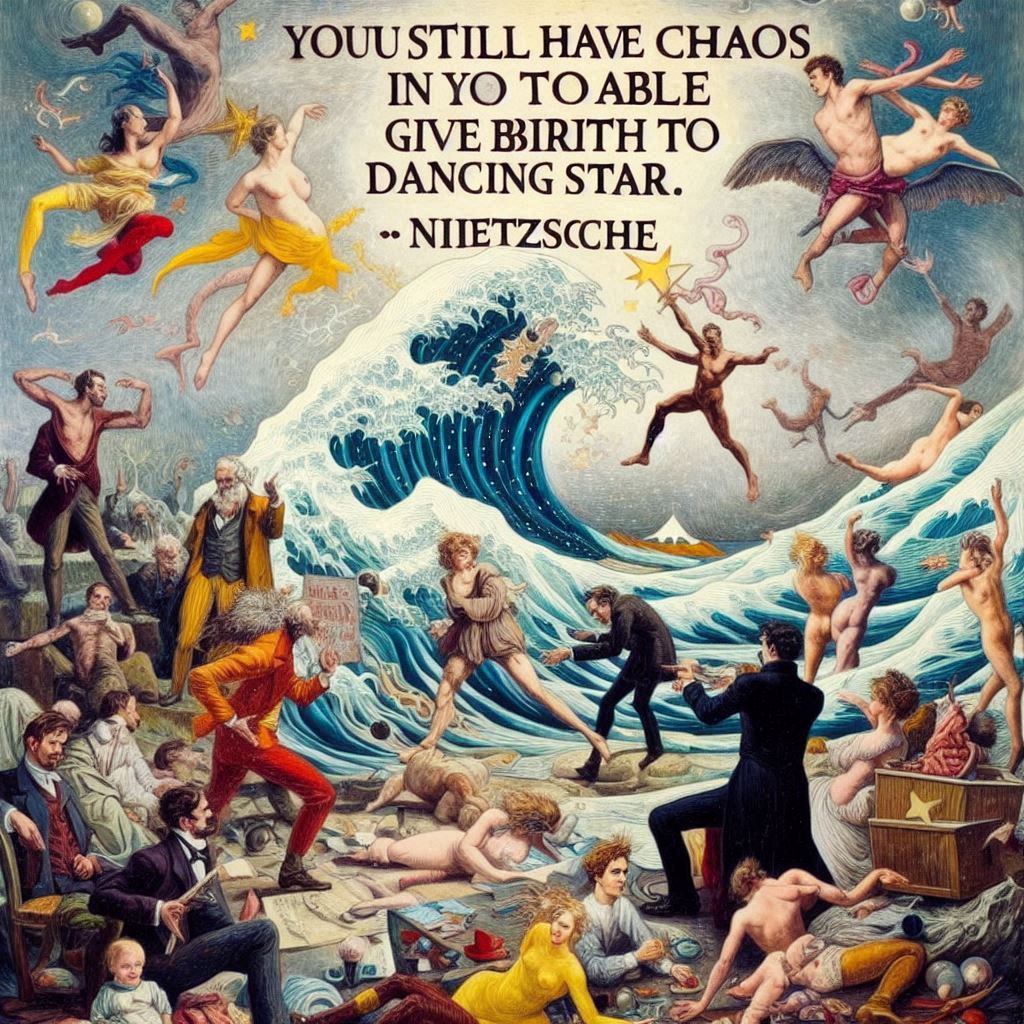
Nietzsche and Nationalism?
A Disputation between Michael Drescher and Paul Stephan
Nietzsche and Nationalism?
A Disputation between Michael Drescher and Paul Stephan

Throughout his life, Nietzsche was a great critic of nationalism. The burgeoning German national sentiment, in particular, was anathema to him, and he wrote scathing remarks about his home country, such as "definition of the Germanic: obedience and long legs..."1. At the same time, nationalists and patriots of all stripes count among his fans. How can one be a Nietzschean and a (German) nationalist? What exactly is "nationalism," and is it possible to give this term a positive meaning?
Paul Stephan discussed these delicate topics, which are gaining increasing relevance given the successes of nationalist parties worldwide, in written form with YouTuber, Nietzsche expert, and nationalism researcher Michael Drescher, also known as PhrasenDrescher.
Additionally, they continued this dialogue verbally on YouTube – feel free to check out the result here (or as an audio-only version on SoundCloud).
I. Utopia, Nationalism, and Germanness
Paul Stephan: Dear Michael, thank you very much for agreeing to our conversation on "Nietzsche and Nationalism." Some of our readers probably know you less by your real name and more as "PhrasenDrescher." Under this name, you run a very popular channel on YouTube, where you have recorded some of Nietzsche's most important works as audiobooks – highly recommended! – as well as works by other significant philosophers and writers, but also frequently speak out on philosophical topics yourself. One of your main themes is nationalism, and you are currently pursuing your doctorate on this topic. So, this is the dual role in which I have invited you: as a Nietzsche expert and as a nationalism researcher.
Perhaps it should be emphasized right away that you do not approach either topic with complete neutrality. You clearly have great sympathy for Nietzsche, but also for the idea of the nation. In 2024, you also published a non-fiction book on this, Germanness for the Advanced, in which you advocate for a kind of "rehabilitation" of German nationalism.
Perhaps we should start our conversation with a clarification of terms, because your use of the term "nationalism" is probably already causing some irritation among some readers – and it also struck me when reading the book. But that's precisely what our conversation is about: to put aside one's immediate "knee-jerk reactions" and engage in a factual discourse on important fundamental questions of our time, even if we probably won't reach an agreement in the end. Listening to what the other person really has to say, instead of immediately pigeonholing them. Perhaps this can be seen as an exercise in the art of "perspektivische[n] Sehen[s]"2, which Nietzsche speaks of.
Normally, a distinction is made between patriotism and nationalism. Patriotism is said to be an unproblematic identification with one's own nation, while nationalism is its unhealthy exaggeration. In your book, you clearly distance yourself from the term "Völkisch," from racism, imperialism, chauvinism, antisemitism, and also very unequivocally from National Socialism, but you want to hold on to the term "nationalism," and, if I understand you correctly, you also describe yourself as a "nationalist." Why is this term still important to you, despite the negative connotations it has in current usage? What does it mean for you to be a "nationalist"?
Michael Drescher: Dear Paul, thank you very much for your kind words and your introduction. I am truly touched by how honestly you ask me about these matters! Such openness is something I've only been accustomed to from my university days, and even there, after some back and forth, sparks would fly. Both are practically notorious and seem all too dangerous, as the thinking associated with both is directly, at least partially, blamed for the atrocities of National Socialism and the World Wars. As a Nietzschean, you know that Nietzsche undeservedly holds this reputation, which is why he has largely been rehabilitated today. With nationalism, the whole matter is a bit more complicated.
There is the nation, there is nationalism, there is patriotism, and there is Germanness. I have tried to playfully explore the latter in my book, although all these terms, as you have already indicated, are not entirely separable from one another. I must confess that they evoke a feeling in me that is difficult to describe, yet positive. Does that jeopardize my objectivity? I don't think so, as long as I reflect on this feeling, which I share with many people. In nationalism research, it is often the other way around (whether reflected upon or not); most researchers openly reject nationalism or secretly wish that the age of nations were finally over.
German nationalism, in particular, plays a special role in nationalism research due to the intellectually explanatory writings on nationalism by Johann Gottfried Herder, Leopold von Ranke, or Johann Gottlieb Fichte. However, they are largely ignored today by mostly English-speaking research; instead, with the standardization of research operations, there is not only linguistic uniformity, because language shapes our understanding of the world. Nevertheless, I would like to leave aside the philosophers of German Romanticism, among whom Nietzsche is occasionally counted, for now, and jump directly to the end of the 20th century.
While I sharply distinguish National Socialism from nationalism, both definitionally and substantively, in my book, there is nevertheless little to object to in the idea that early National Socialism at least used nationalism as a vehicle, but ultimately abandoned it for its ideological chauvinism. The world we live in today is shaped by two epochal breaks: 1945 and 1990. After 1945, National Socialism, which was now equated with nationalism, was ideologically exposed as bankrupt and militarily defeated. Liberalism and communism (even if these terms are poorly applicable to realpolitik) had prevailed and shaped the entire world for the next few years. Konrad Adenauer simply called nationalism the "cancer of Europe." While nationalism was openly combated in the West and partly replaced by a cosmopolitan Americanism, the self-conception of nations remained stronger in the Soviet Union, which is still evident today. However, as soon as the Soviet Union disintegrated, nationalism returned in one of its worst forms in the Yugoslav Wars. After his election, German Federal President Johannes Rau summarized how most people now thought about nationalism: "[A] patriot is someone who loves his homeland, a nationalist is someone who despises the homelands of others."3 This definition solidified, even though patriotism continued to draw upon the achievements, colors, songs, and figures of nationalism (such as black, red, and gold or the national anthem). According to the Duden, "nationalism" is today "mostly used pejoratively" and means, in a thoroughly chauvinistic manner, an "exaggerated national consciousness."
But: "Rarely," the term also refers to the "awakening self-awareness of a nation with the aspiration to form its own state"4. This is where the crux of the matter finally lies. The view that collectives or peoples should be allowed to govern themselves in their own state. The pursuit of such a state and the desire to maintain it can only be described as nationalistic. This has nothing to do with chauvinism, as the first definition in the Duden dictionary suggests. Nor is the concept of nation static or biologically determined in any way. While "nation" originally comes from the Latin "nasci," meaning "to be born," nationalism research has long agreed that a felt kinship is more important in nationalism than an actual one.
After 1990, it quickly became clear that after the "end of history,"5 only the supposedly defunct nation-state would be able to guarantee democratic and liberal institutions. To this day, only nation-states are capable of safeguarding the diversity of cultural and political systems in a world oriented towards functionalism, where everything pushes towards uniformity (such as the language of science; even the contributions on Nietzsche POParts are now, as I've read, intended to target an English-speaking audience or at least be translated6). Thus, only the nation-state, or its demand by peoples suppressed by nationalistic aspirations, can guarantee the enforcement of their right to self-determination (consider Kurdistan or Ukraine). While a nation is not the same as a nation-state (often confused in English), I think it's fair to say that a nation can realize itself through nationalism within a nation-state. By this alone, nationalism is immensely emancipatory and anti-imperialistic. I would even go so far as to say that nationalism offers the greatest opportunity to counteract a global homogenization of culture, language, and other aspects of communal life. In my humble opinion, in the future world, only languages, cultures, and customs with strong institutional representation will be able to survive in the long run. This, too, is only possible through the nation-state, whereby even regionalisms or separatist movements are nationalistic (consider Catalonia). Unlike other political systems, nationalism primarily depends on how a particular group sees itself. Because, quite apart from intellectual justifications: most people want the nation, they want to be equals among equals, and they want to base their solidarity precisely on that. As the last few years have shown, the nation and national sentiment cannot be abolished by simply not addressing or ignoring them. At the latest, when the right to exist of nations, as in the case of Ukraine, Israel, or Palestine, is threatened, even the staunchest critic of nationalism can become a flag-waving nationalist.
I've taken a long detour and presented you with some historical explanations and a Duden definition. I'll also give you my most valued definition of nationalism by the religious scholar Steven Grosby, who treats nationalism as "territorial kinship." Yet, definitions, to paraphrase Nietzsche, are nothing but a "mobile army of metaphors,"7 and to this day, no researcher, let alone a politician or anyone else, has succeeded in providing a uniform and accepted definition of nation and nationalism. The terms simply refer to too many heterogeneous phenomena. But the world is indeed profound, and from a Nietzschean perspective, truths only exist through agreement. This—despite the value relativism that accompanies nationalism—is both possible and desirable in a world of nations and nation-states. It enables cooperation and only leads to conflict under adverse conditions: it is not difficult to imagine nation-states instead of states in Kant's treatise on perpetual peace, and in my opinion, the principle of subsidiarity in Catholic social teaching (tasks should be solved by institutions as small as possible and as large as necessary) is also a guarantor of peaceful coexistence, with which supranational, global problems such as climate change can also be addressed.
The alternatives to a world divided into nation-states are not convincing to me. If utopia is literally the "non-place," then the nation-state is the non-utopia and the spatially bound. Nationalism, accordingly, stands for the culturally multipolar. It is a particular spirit: it conceives of the world, as Heinrich Heine wrote about Herder, as a harp played by God, with the peoples as its strings.
If that's how a nationalist thinks, then I am one! However, for the positive aspects of nationalism to be realized and the negative ones prevented, nationalism undoubtedly needs to be better understood. This is also why I engage in research on nationalism, specifically its relationship to the nation and which came first.
Whether a peaceful and future-oriented life is possible in a Europe and a world divided into nations is, of course, uncertain. But isn't that also the case with other political systems?
II. Nietzsche, Homeland, and Modernity
PS: Thank you for your detailed response. Yes, nationalism is indeed a remarkable historical phenomenon. It emerged in the 18th century alongside progressive ideas such as popular sovereignty, human rights, and social justice – today, there's an attempt to uphold these ideas while simultaneously detaching from nationalism. The question is whether this is easily possible, whether there isn't even a close connection – and whether nationalism, even if no longer called such, persists so stubbornly for this very reason.
Thinkers important to you, like Schopenhauer and especially Nietzsche, struggled with all these "modern ideas."8. You open your book on German identity with a Schopenhauer quote – but this one probably wouldn't have fit as well:
The cheapest kind of pride [...] is national pride. For it reveals in those who possess it a lack of individual qualities he could be proud of, as otherwise he would not resort to something he shares with so many millions. Whoever possesses significant personal merits will, rather, most clearly recognize the flaws of their own nation, as they constantly have them before their eyes. But every pathetic fellow who has nothing in the world to be proud of seizes upon the last resort: to be proud of the nation to which he happens to belong. In this he finds solace and is now gratefully ready to defend, tooth and nail, all the faults and follies that are peculiar to it.9
Goethe, whom you also count among the greatest Germans, expressed similar disdain for nationalism – and it was also a thorn in Nietzsche's side, especially in its German variant. This also seems to me to be something that truly runs through all of Nietzsche's writings, from the Birth of Tragedy up to Ecce homo : his rejection of nationalism, and especially of the German nation, in the name of his ideal of the "good European." In Ecce homo he takes his hatred of Germany so far as to define himself as a "Polish nobleman pur sang"10 – he was never a German citizen anyway, but had been stateless since 1869, when he moved to Switzerland.
He considers nationalism in times of globalization to be an artificial ideology that can only be enforced by force.11 When he himself becomes political, he distances himself from the demand for "closed, original folk cultures"12 His views clearly diverge and he distinctly pursues a 'globalist' goal, occasionally even sounding almost a little Marxist when he writes, for example:
Humans can consciously decide to evolve towards a new culture, whereas previously they developed unconsciously and by chance: they can now create better conditions for the emergence of humans, their nourishment, upbringing, instruction, manage the Earth as a whole economically, weigh and deploy the forces of humanity against each other. This new conscious culture kills the old one, which, viewed as a whole, led an unconscious animal and plant life; it also kills the distrust of progress.13
He criticizes the backwardness of German culture and even advocates for a united Europe:
Thanks to the pathological alienation that the madness of nationality has placed and continues to place between the peoples of Europe, thanks also to the short-sighted and quick-handed politicians who are currently on top with its help and have no idea how much the divisive politics they pursue can necessarily only be an interim policy – thanks to all this and much that is quite unspeakable today, the most unambiguous signs are now overlooked or arbitrarily and falsely reinterpreted, in which it is expressed that Europe wants to become one.14
Nietzsche dreams in Zarathustra of "One Goal" under which humanity must be united15 and values in Germans precisely "their old, proven quality, interpreters and mediators of peoples to be"16 and that they actually had no fixed nature, but were "the deceptive people"17 were.
When you write about the nation as a "non-utopia," that seems to me to be precisely the crucial problem with nationalism and the real reason Nietzsche rejects it. There may be 'realistic' arguments in its favor, but its fundamental impulse is: Why strive for something higher? We are already home. And this 'homeland' must then, of course, be defended against all possible dangers – which, naturally, always come 'from outside,' not from within – if necessary, with violence. It seems to me that the Marxist Ernst Bloch, of all people, is much more Nietzschean when, at the very end of The Principle of Hope writes:
Man still lives everywhere in prehistory; indeed, everything and everyone is still before the creation of the world as it should be. The real genesis is not at the beginning, but at the end, and it only begins to begin when society and existence become radical, meaning they grasp themselves at their root. The root of history, however, is the working, creating human being, transforming and surpassing given conditions. If he has grasped himself and established his own without alienation and estrangement in a real democracy, then something arises in the world that shines into everyone's childhood and in which no one has yet been: homeland.18
"Homeland" here is not at the beginning, but actually only at the end of history. Homeland is not; it becomes. – And Bloch does not even connect this radical stance with any particular anti-conservatism; instead, he repeatedly acknowledges the hope-bearing, forward-looking aspects of inherited traditions.
Philosophically speaking, this seems to me to be the only adequate concept of homeland. It sends humanity on an infinite journey to nowhere: "Odysseus did not die in Ithaca"19. From this perspective, common nationalism precisely blocks the further development of humanity by merely simulating homeland and the possibility of true homeland conceals; it is a temptation like the Sirens, Circe, or perhaps, at best, Calypso.
How would you respond to this critique of nationalism? And how do you reconcile being a Nietzschean and To be a nationalist?
MD: You are, of course, right: as a political movement capable of mobilizing the masses, nationalism was also a strange phenomenon for people who often paid for their existence as a genius with loneliness. However, I consider it a problematic undertaking to consult long-deceased philosophers, who lived under the specific conditions of their time, on current political issues; especially because political and social conditions have changed so drastically throughout the 20th century. The keyword here is Zeitgeist: some context is also important for the Schopenhauer quote. Politically, Schopenhauer sided with the Prussian monarchy. By "wretched wretch," he meant those liberal democrats who took to the barricades in 1848 and 1849 for a united, democratic Germany. Your quote, for example, continues:
The Germans are free from national pride and thereby furnish proof of the honesty attributed to them; the opposite, however, applies to those among them who feign such pride and ridiculously affect it; as is mostly done by the "German brothers" and democrats who flatter the people to seduce them.20
Regarding Schopenhauer's rather famous statements, it must also be mentioned that while Schopenhauer thought highly of Germans, his critique of nationalism simultaneously argued against democracy and the republic. He even donated money to soldiers who died in battles with democrats, not to mention his misogyny. Now, I don't believe this disqualifies Schopenhauer from discussing nationalism, nor does it mean that Schopenhauer wasn't right about some things: blunt and superficial forms of national pride also deter me. However, it highlights the importance of historical context; few who quote Schopenhauer for his anti-nationalism are aware of the historical circumstances of that time or wish to side with the reactionaries and the German Confederation, which was re-established by the time the work was published (1851).
Goethe and Nietzsche also held views that modern people might find objectionable. For instance, they were very dismissive of democracy. Their classical education led them to dream of a Europe like ancient Greece, and as the geniuses they were, their thinking was partly clearly linked to their great role models of a perhaps supranational Western culture. Unlike Heinrich von Kleist, for example, they did not see the Germanic tribes as the forefathers of German culture, but rather, if at all, as late descendants of Greece and Rome. Therefore, Goethe and Nietzsche can undoubtedly be called good Europeans.
Especially the solitary free spirit Nietzsche, who politically would have preferred to live in pre-Socratic Greece, was, you are right, entirely hostile to Germany. At the latest after his break with Richard Wagner, Nietzsche wanted to expose the Germans as responsible for numerous phenomena of decadence and energetically turned his back on them. He was particularly hostile towards Luther, but also towards the Prussian and Swabian philosophers whom Nietzsche perceived as consequential phenomena of the Reformation. However, Nietzsche rejected not only Germany and its thinkers, but, as you correctly wrote, also nationalism. In Nietzsche's time, nationalism was still accompanied by the demand for equality among citizens. Such demands, especially when they came from the masses, were for Nietzsche lived nihilism.
Today, we live in a different world: two world wars have completely transformed nationalism, like almost every other political and intellectual current. In a globalized and increasingly digitized world, complete with artificial intelligence and global interconnectedness, Europe is not becoming an ancient Greece in Nietzsche's sense (which is not at all averse to self-confident nations without a nation-state), but rather an Eastern America. If nationalism was once accompanied by the demand for more equality, today it is the demand for more diversity. Even on a smaller scale: demanding the preservation of German dialects through state measures would probably be interpreted as a nationalist demand. As this example illustrates, nationalism today is considered rather reactionary and conservative, whereas it was formerly perceived as more revolutionary and liberal. What would Schopenhauer and Nietzsche think of nationalism today? A difficult question!
To this day, nationalism also has many faces. Besides those who would simply prefer – figuratively speaking – to live the life of hobbits in the Shire, there are others who cast an eye towards a German colony on Mars. Even if the latter sounds utopian, a certain German self-confidence, also regarding its leading role in Europe, would certainly not be a bad thing.
I found your explanations on "Heimat" (homeland/home) very interesting, even if I would rather disagree: in my eyes, "Heimat" is what is familiar. At the same time, in my opinion, it can never be identical with the nation, as the latter is too large to be fully known. Especially since modernity, the world is changing at an enormous pace. This means both the loss of national characteristics and often the loss of "Heimat." Modernity cannot be reversed; but it can be guided in ways that respect both the existence of "Heimat" and that of the nation in favor of a vibrant diversity in the world.
In my opinion, one can therefore be a Nietzschean and a nationalist if one does not cling to rigid concepts and formally adapts to the ever-changing conditions in a world of becoming. Like nationalism today, Nietzsche's thinking is particular. For both, a modern world state that could formulate and implement universal truths would probably be the greatest possible dystopia. Although such a state is unrealistic, various processes are working towards the unification of all culture, even without a corresponding political will. Only the particular spirit can defend itself against this great simplicity or, in Nietzsche's words, nihilism.
III. World State, Patriotism, and Conservative Revolution
PS: Although what Nietzsche there in Human, All Too Human describes, indeed remarkably moves towards a world state... But I agree with you that Nietzsche usually expresses himself differently; one only has to think of his famous critique of the state in Zarathustra, where he, on the one hand, describes the state as "the coldest of all cold monsters"21 calls it, yet at the same time distinguishes between the state and "peoples," contrasting the natural evolution of "peoples" with their particular values against the abstract universality of the state. However, his positive counter-proposal here is not a return to the particularism of peoples, but a vision of individual liberation and the "Übermensch" (Overman/Superman) as perhaps a new universal that could replace the state.
I would object regarding the concept of "genius." Early Nietzsche adopted it quite uncritically from Schopenhauer, and even in Schopenhauer's work, it already had a clear anti-democratic meaning in the sense of the "great man" who is not understood and is suppressed by the 'stupid masses.' Interestingly, from Human, All Too Human there are repeatedly aphorisms in which Nietzsche very clearly criticizes this concept and the mystifications associated with it22 – yet at the same time, he could never quite detach himself from it.
The question here, too, is what can still be done with all these 19th-century concepts today. History has tainted them, yet at the same time, they continue to exert a great fascination and are almost indispensable to our cultural self-understanding. Who would seriously want to understand art without any reference to the concept of genius, as a mere craft like any other?
In my view, a similar problem arises with the concepts of "Heimat" (homeland) and "Nation" (nation). I also believe that they were once very progressive, with a clear edge against the cosmopolitan aristocracies of the 18th century. Even into the 20th century, it wasn't necessarily a contradiction to be left-wing and a patriot – which, of course, also led to the fateful decision of the major workers' parties not to prevent the First World War. Here, the elites of the time – that is, the "mud on the throne"23 – nationalism was used as the 'cocaine of the people,' if you will,24 to burn through people on an unprecedented scale on the battlefields of Verdun etc. Hasn't nationalism rightly fallen into disrepute simply because of this experience, and shouldn't one, especially as a Nietzschean, say: "Get out of the way of the bad smell! Get away from the steam of these human sacrifices!"25 And indeed, there were some ardent Nietzschean pacifists at that time, such as the "Red Count" Harry Kessler, Emma Goldman, who agitated against the US entry into the war, or Hermann Hesse, to name just a few.26
I mean, during this period, the Nietzschean movement definitively split into a cosmopolitan, pacifist, left-wing faction and a right-wing one, led by his sister – who beat the drums for war, using outrageous lies about her brother's views.27 –, with representatives such as the young Thomas Mann, Ernst Jünger, or Oswald Spengler. This is often referred to as the "Conservative Revolution."
In your book, you seem to refer to this concept positively and emphasize that even the conspirators of July 20th or the White Rose were close to this intellectual current and were nationalists. On your YouTube channel, you've also read aloud several of Spengler's writings – which I don't necessarily interpret as agreement, but certainly as a certain expression of sympathy.
But isn't the actual "Conservative Revolution," as the name suggests, a very avant-garde movement that explicitly turns away from 19th-century nationalism and strives for the more radical vision of re-establishing hierarchical order in the 20th century – with Italian Fascism often serving as a model and relations with National Socialism being quite ambiguous; Spengler, for example, already spoke in 1920 in his essay Prussianism and Socialism, which you also read aloud, of a 'Caesarian Socialism,' even if he later distanced himself from Nazism.28 Or consider Ernst Jünger's The Worker from 1932, where he expresses only contempt for the 'junk room' of the 19th century, and seems to directly anticipate Nazism – his clear and honorable distancing from the Nazi atrocities seems to me, not least, also a distancing from the pre-war Jünger.
What I'm getting at is this: If, for me, after the infernal period from 1914 to 1945 – and it must be emphasized here that European imperialism had previously spread similar horror on other continents – there can still be a meaningful reference to nationalism as a 19th-century idea, then one would have to strongly refer precisely to this liberal and democratic legacy of nationalism, such as the Revolution of 1848. The anthem of such a 'nationalism,' if one wishes to call it that, was perhaps penned by Bertolt Brecht, whom you count among the "great Germans" in your book, in 1950 with the Children's Anthem written, which in my view should actually be declared the national anthem. – But such a 'nationalism' would, to me, strongly contradict the anti-democratic and anti-liberal ideas of the Conservative Revolution.
Starting from such a patriotism, as I would prefer to call it, one could combine the preservation of cultural diversity with collective work towards universal "superhuman" ideals. Bloch also speaks in this sense of a "multiverse" of cultural heritages, all pointing to similar contents of hope.
I am, however, not sure if such patriotism is still conceivable in Germany today. Black, Red, and Gold is associated by very few with the flag of the democratic revolution of 1848 – one of the few truly heroic moments in the history of the German people, I would argue (and it doesn't say much good about German culture that arguably the greatest German philosopher of that era positioned himself so ' brilliantly' here) – but rather with the World Wars and Nazi barbarism, even though all of this occurred under different flags; at best, with a shallow 'hurrah-patriotism' or a rather unpromising German copy of Trumpism. Perhaps German patriotism – despite all the appealing aspects one might find in German tradition, such as pub culture, German food, the rich treasury of folk songs, fairy tales, and legends (you write about this in great detail) – was irretrievably lost in the trenches and then later in the concentration camps, and our hopes must rather lie, as Nietzsche already hinted, in the European – and in the local? Whereby Europe would then have to be conceived more as a 'world Switzerland' or 'world Sweden,' as a purified continent without any imperial ambition, as a haven of democracy, liberalism, and social market economy, under whose wing the different national cultures could express their diversity in a non-repressive way. By the latter, I mean: 'diversity' would also have to imply the recognition of non-traditional lifestyles and the lifestyles of migrants from non-European cultures, otherwise it almost sounds as if, in the name of 'diversity,' one would want to force homosexuals to enter heterosexual marriages and Muslims to eat Weißwurst and drink beer; Orwell would have had a field day with that.
MD: In my opinion, a modern world state cannot be justified by Nietzsche. A world citizen, or cosmopolitan, is, according to section 16 of The Antichrist anyway, merely the god of a declining people. At the end of Aphorism 475 from Human, All Too Human that you quoted, Nietzsche writes that Judaism, in contrast to Christianity, did not want to orientalize the Occident, but rather helped "to make Europe's task and history a continuation of the Greek."29 This underscores my argument that Nietzsche wanted a European ancient Greece. However, as you know, it's always tricky with Nietzsche quotes, because "[i]n the mine of this thinker, every metal can be found"30. Thus, in the same aphorism from Human, All Too Human he writes about progress in the sense of the victory of conscious over unconscious culture, while in Twilight of the Idols he defines progress in his sense as follows:
I too speak of "return to nature," although it is not really a going back, but an ascending – ascending into the high, free, even terrible nature and naturalness, one that plays with great tasks, is allowed to play . …31
In the same paragraph, Nietzsche emphasizes – as so often – his contempt for the idea of equality.
I find it necessary to clarify something here. I consider myself a Nietzschean based on five points of agreement in my worldview. I consider:
- the will to power as a general driving force of the world,
- the pursuit of excellence, along with a critique of the idea of equality, as important,
- so-called universal truths critically and emphasize the importance of art,
- a certain pessimism regarding future visions as appropriate, especially concerning the Last Man,
- morality as a materialistic concept in its development, often linked to weakness.
This does not mean that I approve of all of Nietzsche's statements.32 Nonetheless, I take note of them: In my view, therefore, despite some pacifist comments, Nietzsche cannot be construed as a pacifist. Zarathustra loves his "brothers in war".33 However, I also believe, and this will likely be part of our discussion, that Nietzsche cannot be made into a left-wing cosmopolitan ("No shepherd and one herd!").34). The five aspects of Nietzsche's thought I mentioned alone contradict this desire too strongly.
I, too, find the enthusiasm for war, both today and before and after the First World War, alien. At the same time, I do not condemn it morally, but rather view it historically. Accordingly, I perceive Ernst Jünger's life and work as thoroughly Nietzschean. Spengler, too, is an enthusiastic Nietzschean who frequently refers to him – and who resigned from the Nietzsche Archive when it became too National Socialist for him there. I studied him extensively in my younger years because I could not share the optimism of progress held by many fellow students, especially regarding historical materialism. I primarily recorded the audiobooks because I consider him criminally underrepresented in German intellectual history. For some time now, however, I have moved away from his philosophy of history in favor of a Nietzschean vitalism.
I believe you'll agree with me when I insist that a Nietzschean worldview cannot align with National Socialist ideology. This is proven not only by Spengler or the later Jünger, but also by the Hitler assassin Stauffenberg, who had his comrades swear:
We want a New Order, which makes all Germans upholders of the state and guarantees them law and justice, but despise the lie of equality and demand recognition of natural ranks.35
In my view, this passage is both Nietzschean and nationalistic.
So, to get to the heart of the matter: there is a continuity of non-National Socialist, German-nationalist ways of thinking from the Wars of Liberation to the present day, although history has profoundly influenced them and makes us think differently today than 50, 100, or 150 years ago. This strong moralizing mostly concerns only national thought, not to the same extent anti-democratic or anti-liberal ideas, which are advocated by Schopenhauer and Nietzsche, as well as by adherents of the Conservative Revolution. Well, I acknowledge that, but I insist that National Socialism must not be reduced to a mix of these or to one alone, with the intention of dragging everything connected to it into the abyss. In my book, I therefore point out in detail the ideological foundation of National Socialism in antisemitism and racial chauvinism. Instead of relying on emancipatory and non-chauvinistic nationalisms (to which the German state refers with its national symbols), all nationalism has been condemned and equated with National Socialism since 1945. As a leftist, you surely know all too well when leftist thought is associated with the atrocities of the Soviet Union or the GDR. Superficially, I consider both to be disingenuous. Likewise, I do not believe that German patriotism (socialism could be accused of similar things) has been "irretrievably lost" due to the atrocities of the 20th century. Rather, I believe anti-national ways of thinking would like to assume this, but they are disproven by recent election forecasts, in which non-patriotic parties and individuals tend to be penalized.
I am firmly convinced that national sentiment (for example, as territorial kinship) is natural and is what enables solidarity and coexistence in the first place. At the same time, the division of Europe into nation-states is the status quo, and any demands for a reordering require strong arguments. Nietzscheans, meanwhile, know that moral arguments for this often stem from a drive of one's own weakness, such as the desire not to be a nation. Nevertheless, we will remain a nation. Almost in contrast to every other people, this grates on many Germans, which, ironically, seems to have long since developed into a typically German peculiarity for a part of the nation.
In my view, the local and the European do not inherently contradict the national. But regardless of whether it's a Europe of fatherlands or a "world Switzerland": the conservative element of these systems must aim at preserving culture, which, given the demographic situation in Western Europe, the abandonment of traditional cultural assets, and especially anti-nationalist currents from the circles of the so-called "Paypal Mafia" – which are often anti-democratic or can even be described as neo-fascist – is by no means a given.
PS: I would immediately object to some points here again, but I think we at least agree on rejecting the "Paypal Mafia," which makes me optimistic. We will certainly discuss further details in the verbal follow-up to this written exchange, which I am very much looking forward to. Thank you for your willingness to have this conversation, Michael.
MD: Thank you very much too, dear Paul! I am also looking forward to our joint conversation, hoping to identify further parallels and common ground, as well as to discuss differences.
Michael Drescher (born 1995 in Southern Germany), also known as PhrasenDrescher, is a YouTuber, author, and is currently pursuing a doctorate on the question of the age of nations. He lives in Vienna and, during and after his philosophy studies, focuses primarily on Friedrich Nietzsche. On his YouTube channel "PhrasenDrescher" he has recorded numerous works by the philosopher and explained individual concepts, but also conducts interviews, reviews films and books, or publishes other philosophical content.
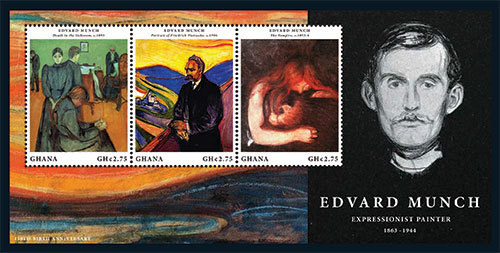
The Article image shows the only stamp dedicated to Nietzsche in a German state so far. It was issued in 2000 on the occasion of the centenary of his death (Source). It is based on a drawing by Edvard Munch.
Bibliography
Bloch, Ernst: The Principle of Hope. Frankfurt a. M. 1976.
Colli, Giorgio: After Nietzsche. Frankfurt a. M. 1980.
Förster-Nietzsche: Elisabeth: Nietzsche and the War. In: Hamburg Correspondent of Sep. 15, 1914 (No. 468, Vol. 184), p. 2.
PhrasenDrescher: Being German for Advanced Learners. Krefeld 2024.
Schopenhauer, Arthur: Parerga und Paralipomena. Minor Philosophical Writings I. Complete Works Vol. IV. Leipzig 1979.
Stephan, Paul: Left-Nietzscheanism. An Introduction. 2 Vols. Stuttgart 2020.
Zeller, Eberhard: Spirit of Freedom. The 20th of July. Berlin 2004.
Footnotes
1: The Case of Wagner, Turin Letter, Para. 11.
2: On the Genealogy of Morality, Para. III, 2.
3: https://www.bundespraesident.de/SharedDocs/Reden/DE/Johannes-Rau/Reden/1999/05/19990523_Rede.html (last accessed: 23.04.2026).
4: duden.de/rechtschreibung/Nationalismus (last accessed: 23.04.2026).
5: Editor's note: This was notably proclaimed by the American philosopher Francis Fukuyama. See, for example, this article by Michael Meyer-Albert on our blog.
6: Here's a little anecdote: Not too long ago, I met a young woman who, as a native German speaker, speaks and reads a lot of English because of her job. When the conversation turned to Nietzsche, she told me – and I can still barely believe it – that she had read the Zarathustra in English.
7: On Truth and Lies in a Nonmoral Sense, Sec. 1.
9: Arthur Schopenhauer, Parerga and Paralipomena, Aphorisms on the Wisdom of Life, Chap. 4; p. 430 f.
10: Ecce Homo, Why I Am So Wise, 3. For more on Nietzsche's "Polishness", see my article "Poland Has Not Yet Perished" on this blog.
11: Cf. Human, All Too Human I, Aph. 475 and similarly the 23rd aphorism of the book.
12: Human, All Too Human I, Aph. 24.
13: Ibid.
14: Beyond Good and Evil, Aph. 256.
15: Cf. Of the Thousand and One Goals.
16: Human, All Too Human I, Aph. 475.
17: Beyond Good and Evil, Aph. 244.
18: The Principle of Hope, p. 1628.
19: Ibid., p. 1201.
20: Schopenhauer, Parerga and Paralipomena I, p. 430.
21: Thus Spoke Zarathustra, On the New Idol.
22: In the 126th Aphorism of the first volume of MA it states, for example: "Among the greatest effects of those whom we call geniuses and saints is that they compel interpreters who, for the salvation of humanity, misunderstand." – Perhaps this observation could also be applied to Nietzsche himself.
23: Thus Spoke Zarathustra, Of the New Idol.
24: Cf. Nietzsche's very apt remarks on this in On the Genealogy of Morality, 3rd Essay, Sec. 26.
25: Thus Spoke Zarathustra, Of the New Idol.
26: As you know, I discuss all of this in great detail in my book on Left-Nietzscheanism see.
27: One can read this in her article published directly in 1914 Nietzsche and the War.
28: For a critique of Spengler's Nietzscheanism, see also Christian Saehrendt's corresponding article on our blog.
29: Human, All Too Human I, Aph. 475.
30: Giorgio Colli, After Nietzsche, p. 209.
31: Twilight of the Idols, Expeditions, Aph. 48.
32: "[O]nly when you have all denied me, will I return to you" (Thus Spoke Zarathustra, Of the Bestowing Virtue, 3). Nietzsche intended to convey that his readers should not cling to a supposedly "true" doctrine, but rather should continually reinvent both it and themselves.
33: Cf. Thus Spoke Zarathustra, Of War and Warriors.
34: Thus Spoke Zarathustra, Prologue, 5.
35: Quoted from Eberhard Zeller, Spirit of Freedom, p. 324.